Adapted by:
Paula Davenport
Miranda Leickly
Beth Sigurdson
“The paradoxical goal of raising children is that
we hold them close so that they have the
confidence to move away from us.”
- Dr. Jef van Kuyk
About Pyramid
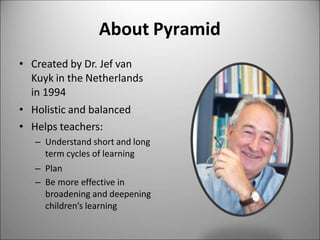
• Created by Dr. Jef van
Kuyk in the Netherlands
in 1994
• Holistic and balanced
• Helps teachers:
– Understand short and long
term cycles of learning
– Plan
– Be more effective in
broadening and deepening
children’s learning
Pyramid in
Action
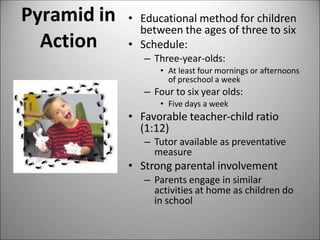
• Educational method for children
between the ages of three to six
• Schedule:
– Three-year-olds:
• At least four mornings or afternoons
of preschool a week
– Four to six year olds:
• Five days a week
• Favorable teacher-child ratio
(1:12)
– Tutor available as preventative
measure
• Strong parental involvement
– Parents engage in similar
activities at home as children do
in school
Interactive Storytelling
Step One – Orientation
Interactive Storytelling
Step Two – Demonstration
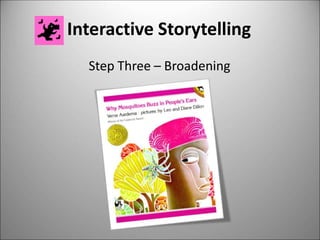
Interactive Storytelling
Step Three – Broadening
Interactive Storytelling
Step Four – Deepening
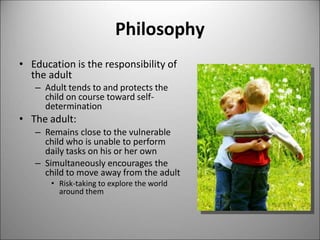
Philosophy
• Education is the responsibility of
the adult
– Adult tends to and protects the
child on course toward self-
determination
• The adult:
– Remains close to the vulnerable
child who is unable to perform
daily tasks on his or her own
– Simultaneously encourages the
child to move away from the adult
• Risk-taking to explore the world
around them
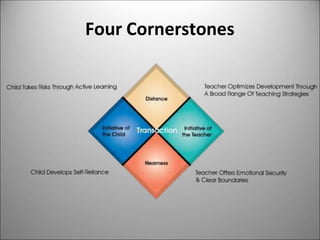
Four Cornerstones
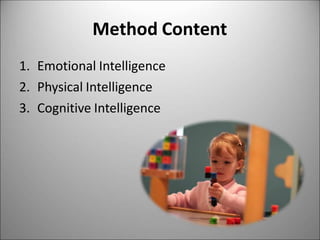
Method Content
1. Emotional Intelligence
2. Physical Intelligence
3. Cognitive Intelligence
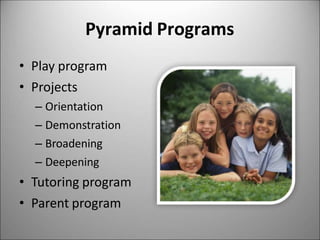
Pyramid Programs
• Play program
• Projects
– Orientation
– Demonstration
– Broadening
– Deepening
• Tutoring program
• Parent program
Projects
Pyramid projects offer children a
structured environment
– Each project book contains 12
projects
– Projects last about 3-4 weeks
– Books follow a sequential
developmental line
– Projects contain the following
sections:
• Learning framework
• Optimizing children’s development
through their own initiative and the
teacher’s initiative
• Promoting parent partnerships
through authentic involvement
• Planning
• Resources
• Proactive tutoring
References
•
• Pyramid Post. (2006). In D. Neubauer-van Dijk (Ed.), Cito USA. Retrieved
March 20, 2009, from http://www.cito.com
• Roopnarine, J. L., & Johnson, J. E. (2005). Approached to early childhood
education (4th ed.). Upper Saddle River, NJ: Merrill Prentice Hall.
Smith, C. G. (2008). Inspired cognition: A revolutionary four-step process.
Interactive storytelling. Symposium conducted at the NESA Winter
Training Institute. Retrieved from
www.nesacenter.org/storage/content-pages/conferences/wti-2008/Inter
• van Kuyk, J. (2001, June 1). Pyramid Educational Method for 3 to 6-Year-
Old Children: Theory and Research. (ERIC Document Reproduction
Service No. ED455005) Retrieved March 25, 2009, from ERIC database.
• van Kuyk, J., & Centraal Inst. voor Toetsonwikkeling, A. (1997, September
1). The Pyramid Project. (ERIC Document Reproduction Service No.
ED420369) Retrieved March 24, 2009, from ERIC database.

pyramidmethodpresentationppt-090331223944-phpapp02.pptx

  • 1.
  • 2.
    “The paradoxical goalof raising children is that we hold them close so that they have the confidence to move away from us.” - Dr. Jef van Kuyk
  • 3.
    About Pyramid • Createdby Dr. Jef van Kuyk in the Netherlands in 1994 • Holistic and balanced • Helps teachers: – Understand short and long term cycles of learning – Plan – Be more effective in broadening and deepening children’s learning
  • 4.
    Pyramid in Action • Educationalmethod for children between the ages of three to six • Schedule: – Three-year-olds: • At least four mornings or afternoons of preschool a week – Four to six year olds: • Five days a week • Favorable teacher-child ratio (1:12) – Tutor available as preventative measure • Strong parental involvement – Parents engage in similar activities at home as children do in school
  • 5.
  • 6.
  • 7.
  • 8.
  • 9.
    Philosophy • Education isthe responsibility of the adult – Adult tends to and protects the child on course toward self- determination • The adult: – Remains close to the vulnerable child who is unable to perform daily tasks on his or her own – Simultaneously encourages the child to move away from the adult • Risk-taking to explore the world around them
  • 10.
  • 11.
    Method Content 1. EmotionalIntelligence 2. Physical Intelligence 3. Cognitive Intelligence
  • 12.
    Pyramid Programs • Playprogram • Projects – Orientation – Demonstration – Broadening – Deepening • Tutoring program • Parent program
  • 13.
    Projects Pyramid projects offerchildren a structured environment – Each project book contains 12 projects – Projects last about 3-4 weeks – Books follow a sequential developmental line – Projects contain the following sections: • Learning framework • Optimizing children’s development through their own initiative and the teacher’s initiative • Promoting parent partnerships through authentic involvement • Planning • Resources • Proactive tutoring
  • 14.
    References • • Pyramid Post.(2006). In D. Neubauer-van Dijk (Ed.), Cito USA. Retrieved March 20, 2009, from http://www.cito.com • Roopnarine, J. L., & Johnson, J. E. (2005). Approached to early childhood education (4th ed.). Upper Saddle River, NJ: Merrill Prentice Hall. Smith, C. G. (2008). Inspired cognition: A revolutionary four-step process. Interactive storytelling. Symposium conducted at the NESA Winter Training Institute. Retrieved from www.nesacenter.org/storage/content-pages/conferences/wti-2008/Inter • van Kuyk, J. (2001, June 1). Pyramid Educational Method for 3 to 6-Year- Old Children: Theory and Research. (ERIC Document Reproduction Service No. ED455005) Retrieved March 25, 2009, from ERIC database. • van Kuyk, J., & Centraal Inst. voor Toetsonwikkeling, A. (1997, September 1). The Pyramid Project. (ERIC Document Reproduction Service No. ED420369) Retrieved March 24, 2009, from ERIC database.