Learning from the Past:
     with Scikit-Learn
         ANOOP THOMAS MATHEW
               Profoundis Labs Pvt. Ltd.
Agenda
●   Basics of Machine Learning

●   Introduction some common techniques

●   Let you know scikit-learn exists

●   Some inspiration on using machine
    learning in daily life scenarios and live
    projects.
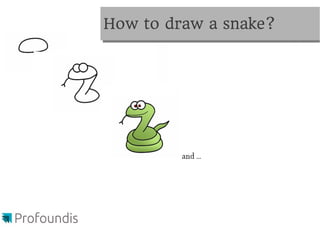
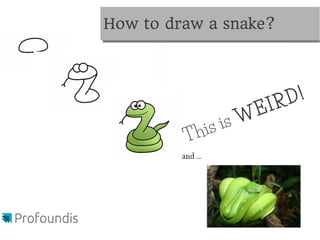
How to draw a snake?


                             IR D!
                       W E
             hi s is
         T
Introduction


A lot of Data!

What to do???
Introduction

What is

             Machine Learning
                    (Data Mining)?
                         (in plain english)
Machine Learning

 "A computer program is said to learn from
experience E with respect to some class of tasks
T and performance measure P, if its performance
at tasks in T, as measured by P, improves with
experience E"
                                  Tom M. Mitchell
Machine Learning


● Supervised Learning - model.fit(X, y)
● Unsupervised Learning - model.fit(X)
Supervised Learning
For example ...
from sklearn.linear_model import Ridge as RidgeRegression
from sklearn import datasets
from matplotlib import pyplot as plt

boston = datasets.load_boston()
X = boston.data
y = boston.target
clf = RidgeRegression()
clf.fit(X, y)
clf.predict(X)
Unsupervised Learning
For example ...


from sklearn.cluster import KMeans
from numpy.random import RandomState
rng = RandomState(42)
k_means = KMeans(3, random_state=rng)
k_means.fit(X)
What can Scikit-learn do?


Clustering
Classification
Regression
Terminology

•   Model the collection of parameters you are trying to fit
•   Data what you are using to fit the model
•   Target the value you are trying to predict with your model
•   Features attributes of your data that will be used in prediction
•   Methods algorithms that will use your data to fit a model
Steps for Analysis
●   Understand the task. See how to measure the
    performance.

●   Choose the source of training experience.

●   Decide what will be input and output.

●   Choose a set of models to the output function.

●   Choose a learning algorithm.
Steps for Analysis
●   Understand the task. See how to measure the
    performance. Find the right question to ask.

●   Choose the source of training experience.
      ●   Keep training and testing dataset separate. Beware of overfitting !

●   Decide what will be input and expected output.

●   Choose a set of models to approximate the output
    function. (use dimensinality reduction)

●   Choose a learning algorithm. Try different ones ;)
Some Common Algorithms
     Some Common Algorithms

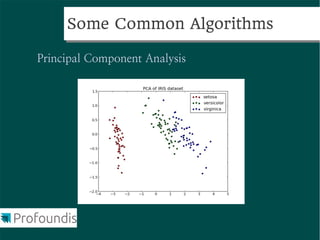
Principal Component Analysis
Some Common Algorithms
         Some Common Algorithms
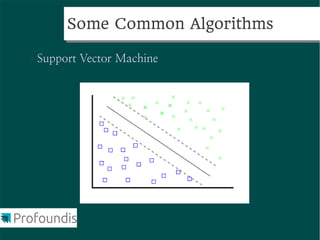
●   Support Vector Machine
Some Common Algorithms
         Some Common Algorithms
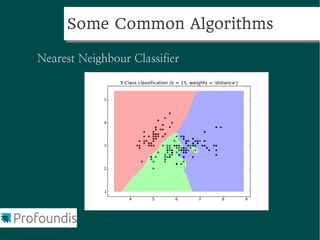
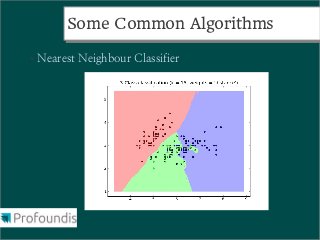
●   Nearest Neighbour Classifier
Some Common Algorithms
         Some Common Algorithms
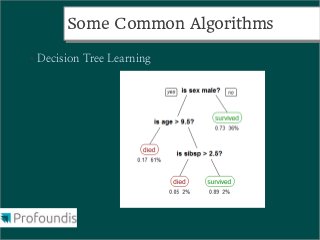
●   Decision Tree Learning
Some Common Algorithms
     Some Common Algorithms

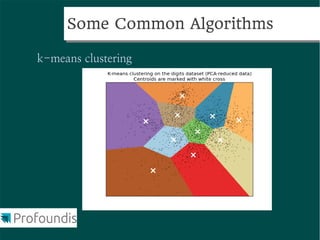
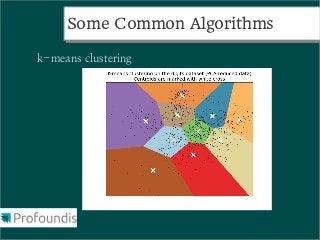
k-means clustering
Some Common Algorithms
     Some Common Algorithms

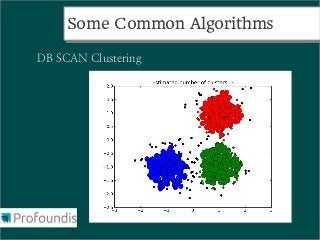
DB SCAN Clustering
Some Example Usecases
       Some Example Usecases


● Log file analysis
● Outlier dectection

● Fraud Dectection

● Forcasting

● User patterns
A few comments
                            A few comments

●
    nltk is a good(better) for text processing
●
    scikit-learn is for medium size problems
●
    for humongous projects, think of mahout
●
    matplotlib can be     used for visualization
●
    visualize it in browser using d3.js
●
    have a look at pandas for numerical analysis
Conclusion
                                   Conclusion


● This is just the tip of an iceberg.
● Scikit-learn is really cool to hack with.

● A lot of examples

(http://scikit-learn.org/stable/auto_examples/index.html)
Final words
              Final words


pip install scikit-learn

Its all in the internet.

 Happy Hacking!

Pycon 2012 Scikit-Learn

  • 1.
    Learning from thePast: with Scikit-Learn ANOOP THOMAS MATHEW Profoundis Labs Pvt. Ltd.
  • 3.
    Agenda ● Basics of Machine Learning ● Introduction some common techniques ● Let you know scikit-learn exists ● Some inspiration on using machine learning in daily life scenarios and live projects.
  • 4.
    How to drawa snake? How to draw a snake?
  • 5.
    How to drawa snake? How to draw a snake? IR D! W E hi s is T
  • 6.
    Introduction A lot ofData! What to do???
  • 7.
    Introduction What is Machine Learning (Data Mining)? (in plain english)
  • 8.
    Machine Learning "Acomputer program is said to learn from experience E with respect to some class of tasks T and performance measure P, if its performance at tasks in T, as measured by P, improves with experience E" Tom M. Mitchell
  • 9.
    Machine Learning ● SupervisedLearning - model.fit(X, y) ● Unsupervised Learning - model.fit(X)
  • 10.
  • 11.
    For example ... fromsklearn.linear_model import Ridge as RidgeRegression from sklearn import datasets from matplotlib import pyplot as plt boston = datasets.load_boston() X = boston.data y = boston.target clf = RidgeRegression() clf.fit(X, y) clf.predict(X)
  • 12.
  • 13.
    For example ... fromsklearn.cluster import KMeans from numpy.random import RandomState rng = RandomState(42) k_means = KMeans(3, random_state=rng) k_means.fit(X)
  • 14.
    What can Scikit-learndo? Clustering Classification Regression
  • 15.
    Terminology • Model the collection of parameters you are trying to fit • Data what you are using to fit the model • Target the value you are trying to predict with your model • Features attributes of your data that will be used in prediction • Methods algorithms that will use your data to fit a model
  • 16.
    Steps for Analysis ● Understand the task. See how to measure the performance. ● Choose the source of training experience. ● Decide what will be input and output. ● Choose a set of models to the output function. ● Choose a learning algorithm.
  • 17.
    Steps for Analysis ● Understand the task. See how to measure the performance. Find the right question to ask. ● Choose the source of training experience. ● Keep training and testing dataset separate. Beware of overfitting ! ● Decide what will be input and expected output. ● Choose a set of models to approximate the output function. (use dimensinality reduction) ● Choose a learning algorithm. Try different ones ;)
  • 18.
    Some Common Algorithms Some Common Algorithms Principal Component Analysis
  • 19.
    Some Common Algorithms Some Common Algorithms ● Support Vector Machine
  • 20.
    Some Common Algorithms Some Common Algorithms ● Nearest Neighbour Classifier
  • 21.
    Some Common Algorithms Some Common Algorithms ● Decision Tree Learning
  • 22.
    Some Common Algorithms Some Common Algorithms k-means clustering
  • 23.
    Some Common Algorithms Some Common Algorithms DB SCAN Clustering
  • 24.
    Some Example Usecases Some Example Usecases ● Log file analysis ● Outlier dectection ● Fraud Dectection ● Forcasting ● User patterns
  • 25.
    A few comments A few comments ● nltk is a good(better) for text processing ● scikit-learn is for medium size problems ● for humongous projects, think of mahout ● matplotlib can be used for visualization ● visualize it in browser using d3.js ● have a look at pandas for numerical analysis
  • 26.
    Conclusion Conclusion ● This is just the tip of an iceberg. ● Scikit-learn is really cool to hack with. ● A lot of examples (http://scikit-learn.org/stable/auto_examples/index.html)
  • 27.
    Final words Final words pip install scikit-learn Its all in the internet. Happy Hacking!