EPFL, spring 2012 – week 8!
mobile i/o
overview

➝    types of mobile device
➝    design challenges 
➝    in: text entry
➝    in: overcoming finger occlusion
➝    in: movement
➝    out: overviews
➝    out: off-screen visualizations
➝    out: audio & haptic output


     ✱this lecture is based on Will Seager s (UCL) lecture of mobile systems
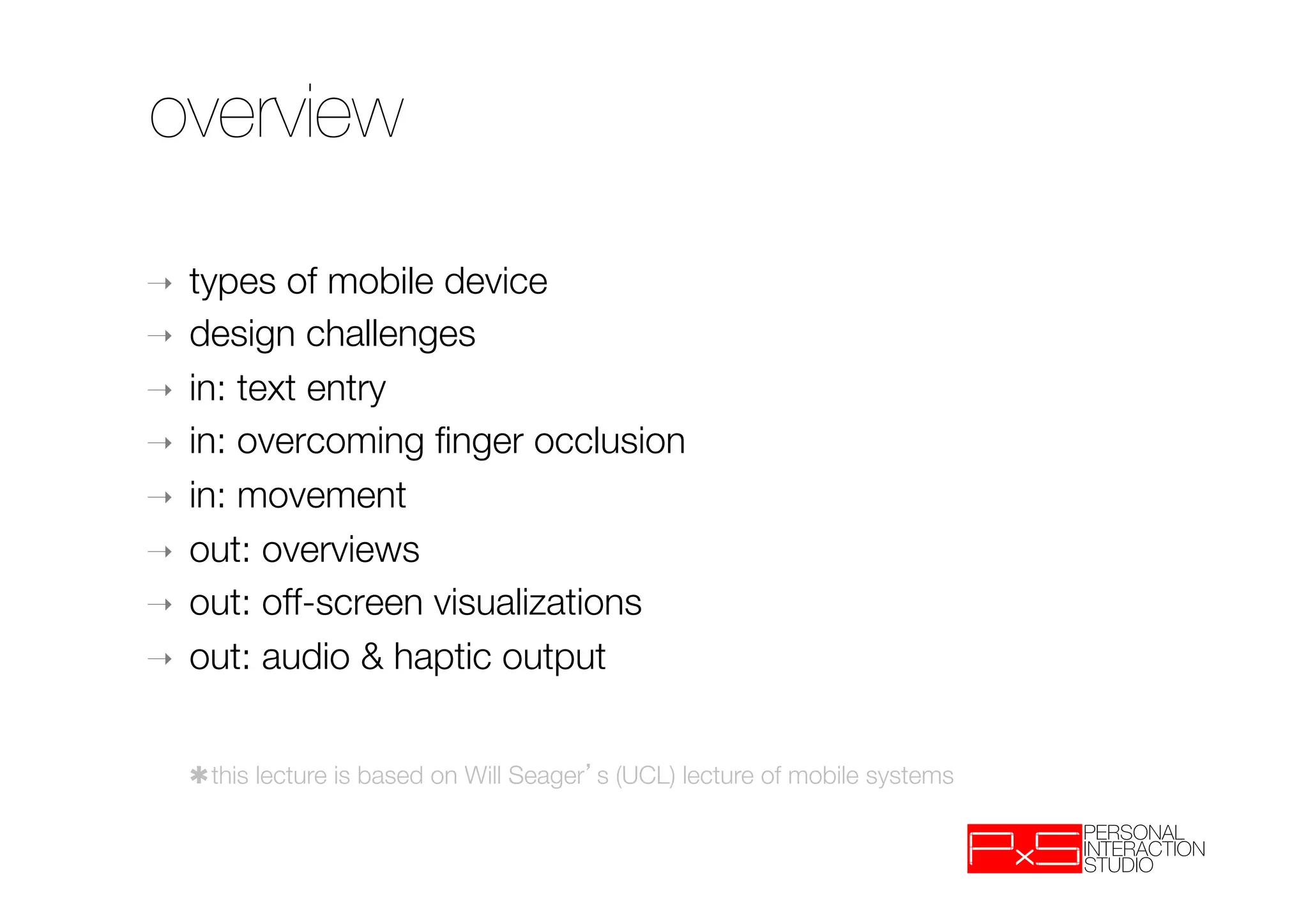
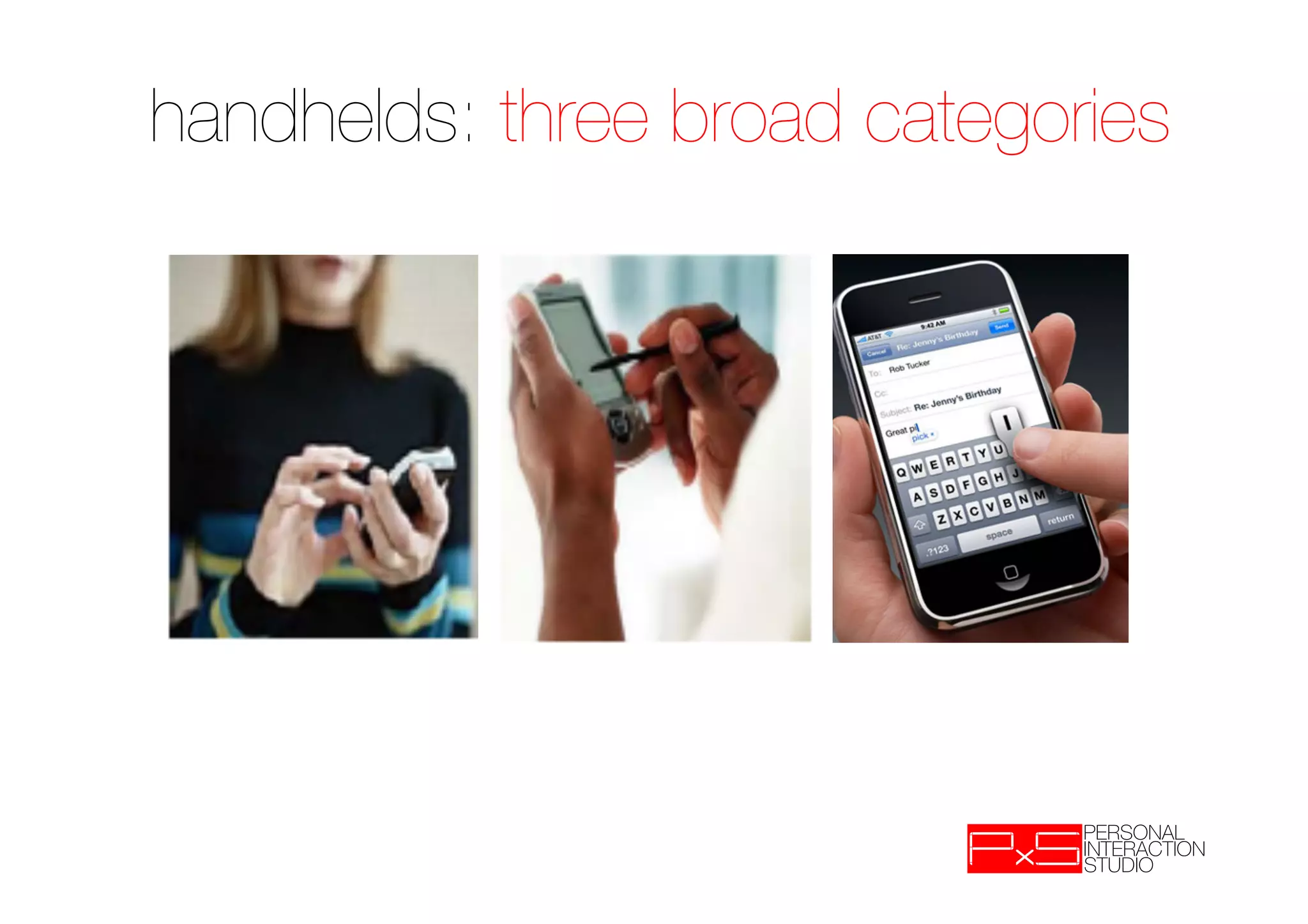
handhelds: three broad categories
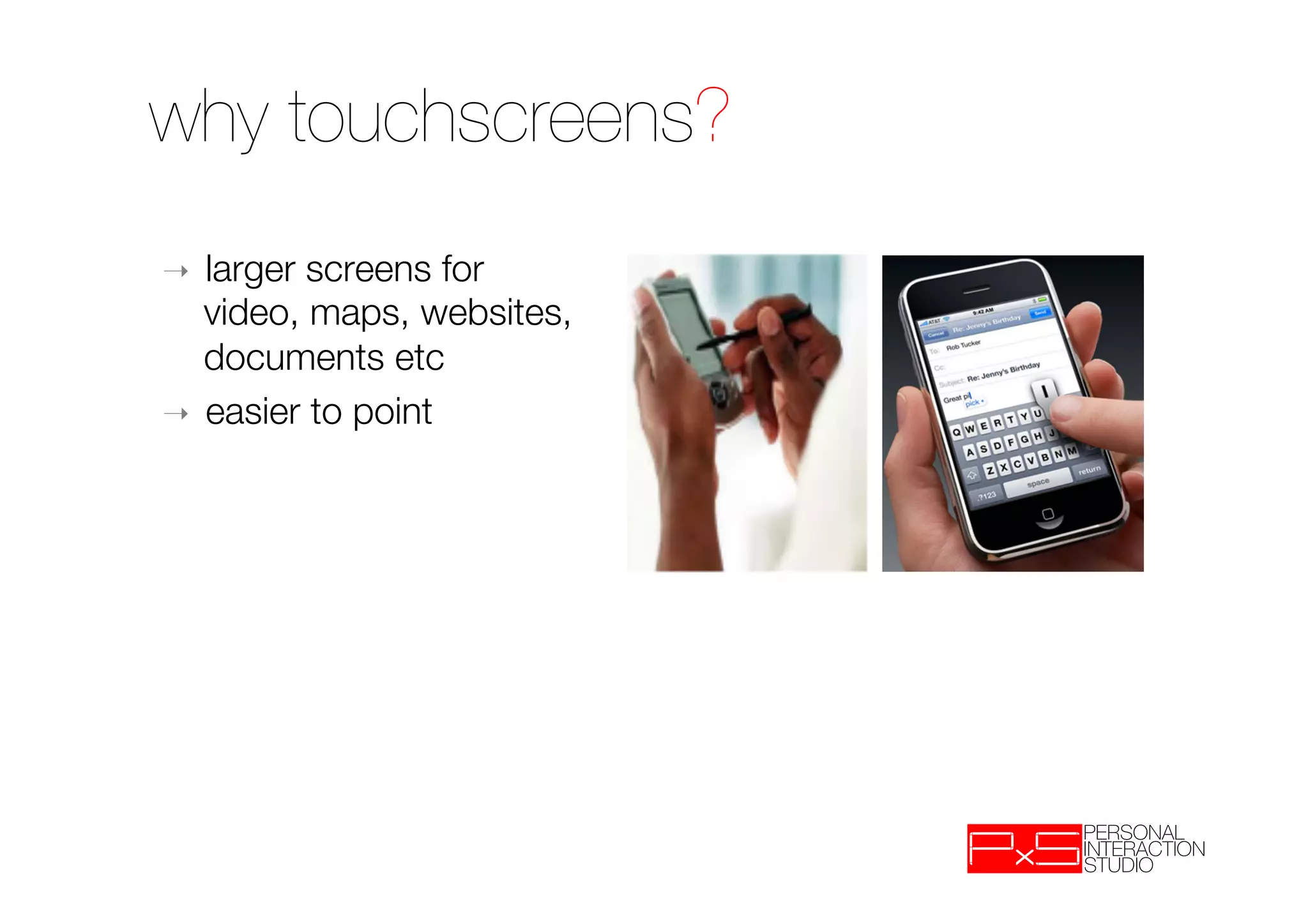
why touchscreens?
➝  larger screens for
   video, maps, websites,
   documents etc
➝  easier to point
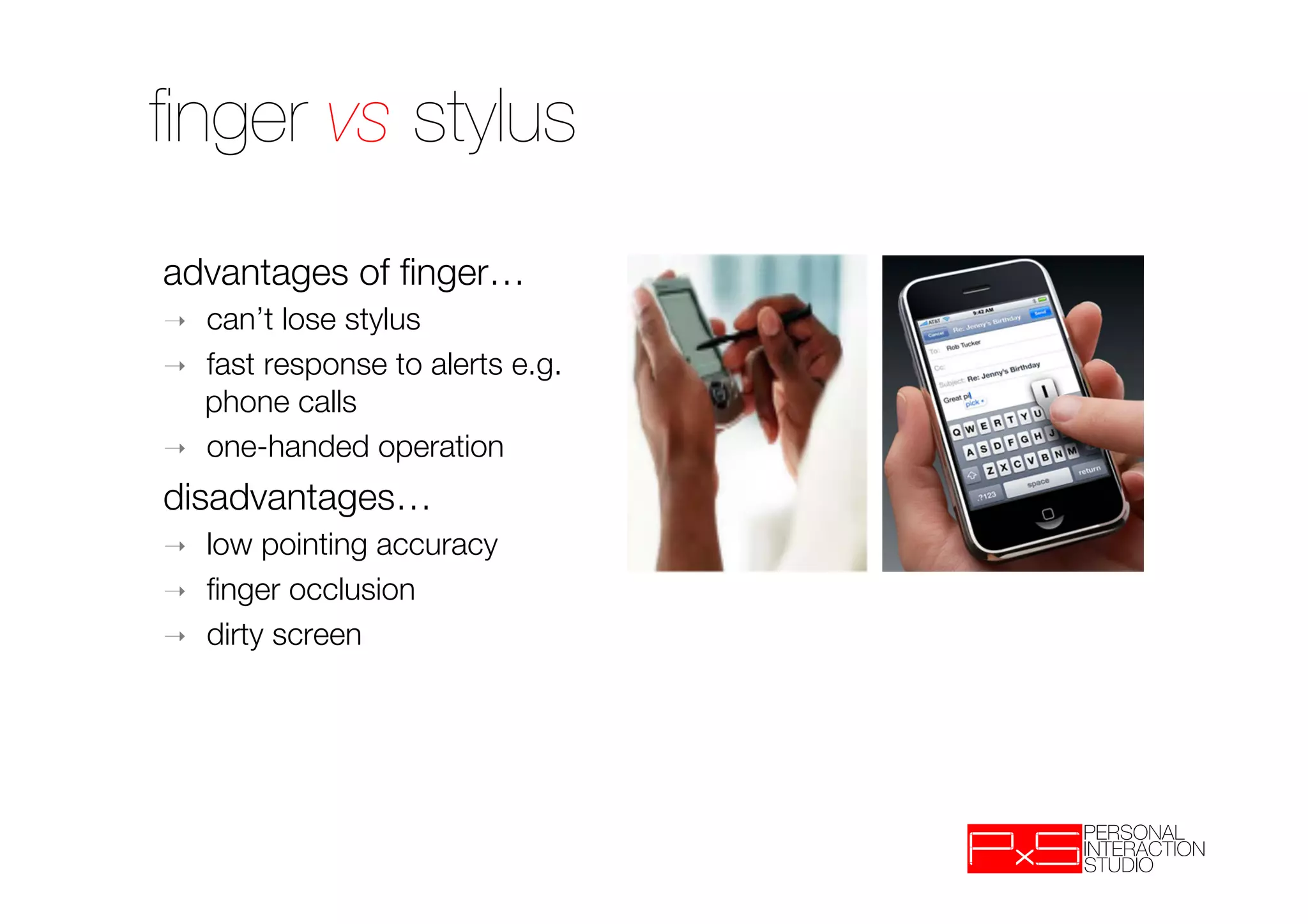
finger vs stylus
advantages of finger…
➝    can’t lose stylus
➝    fast response to alerts e.g.
     phone calls
➝    one-handed operation
disadvantages…
➝    low pointing accuracy
➝    finger occlusion
➝    dirty screen
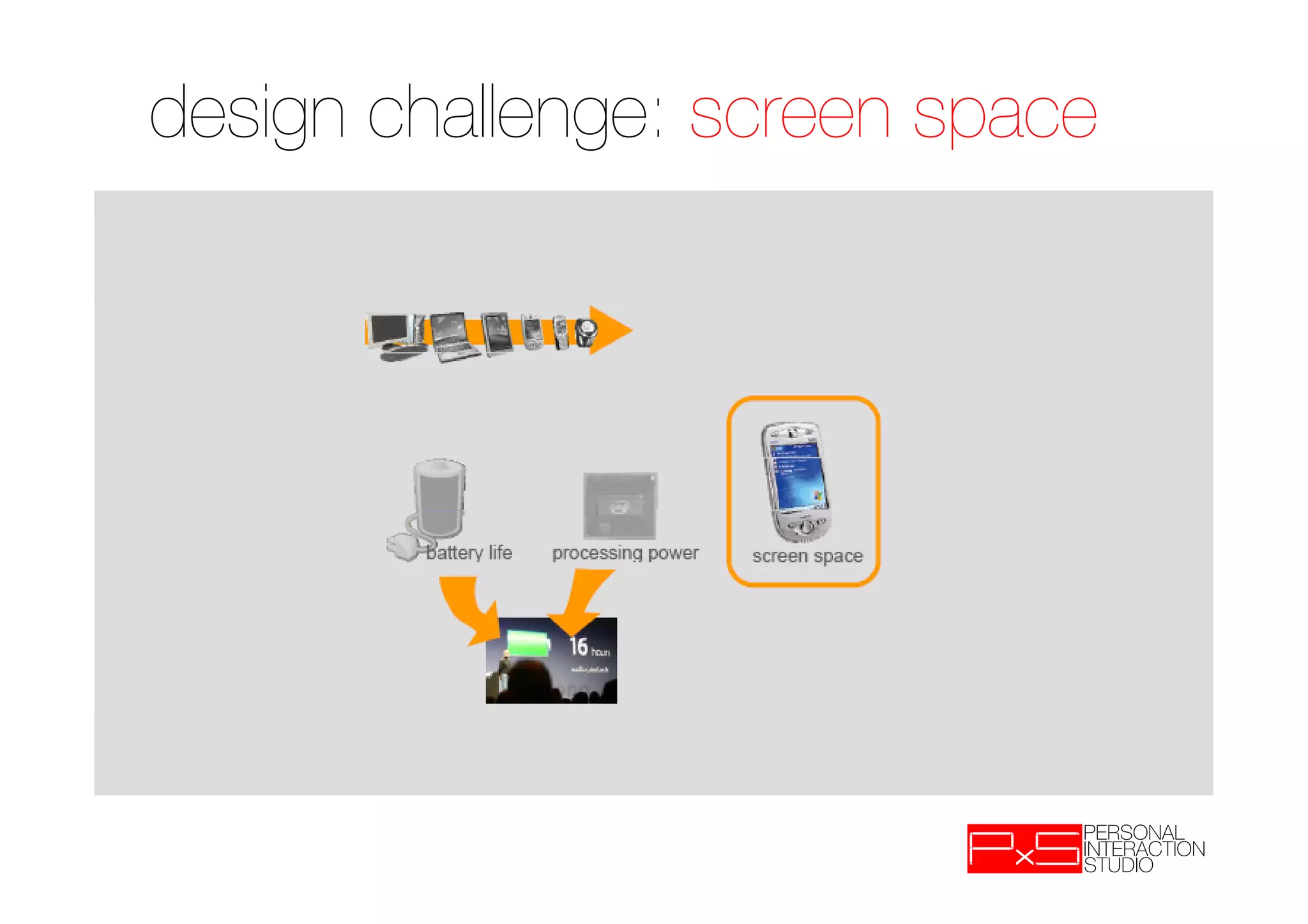
design challenge: screen space
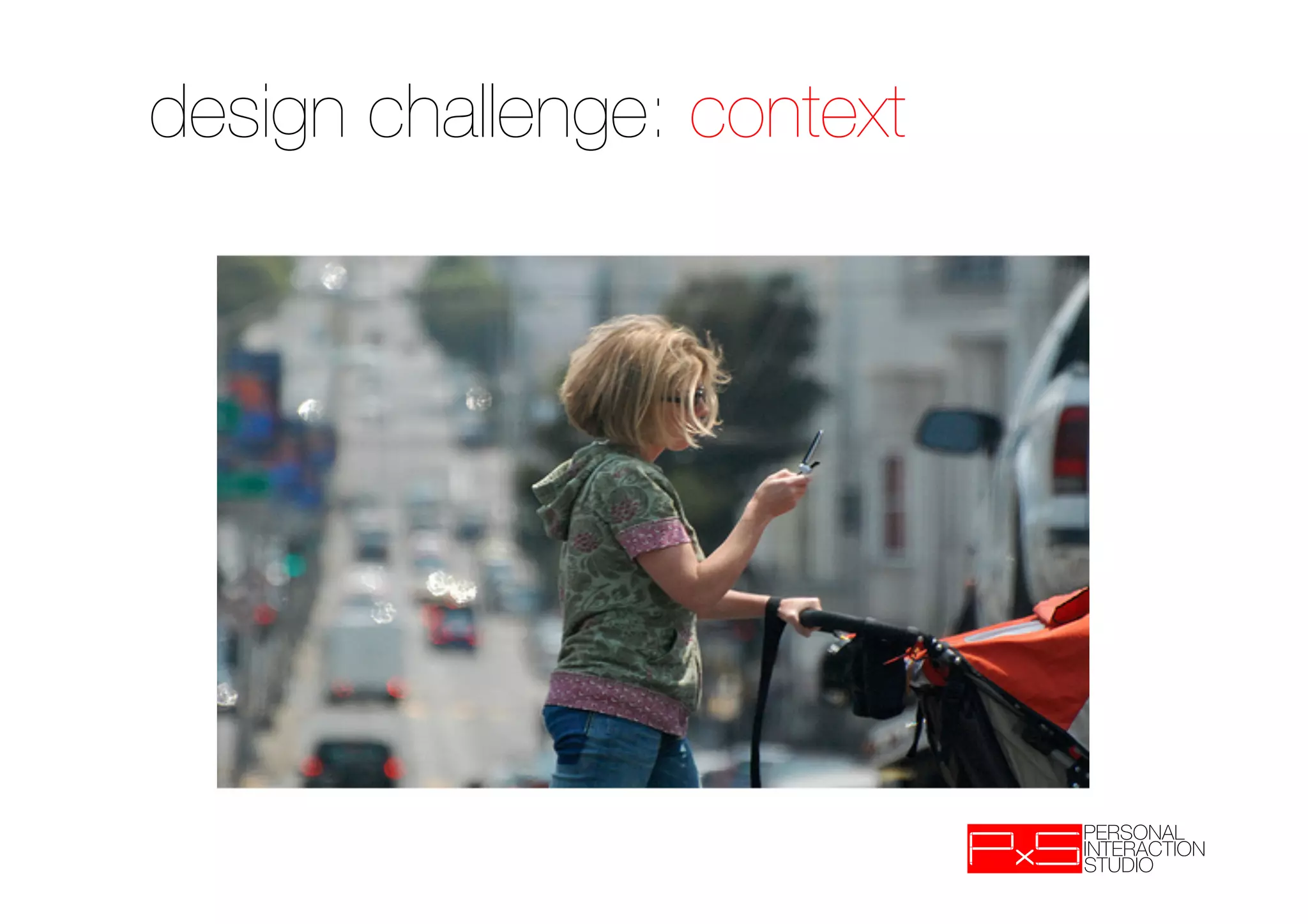
design challenge: context
in: text entry
 ➝  > 1 billion text messages sent per day
 ➝  most common type of mobile interaction 
 ➝  companies are looking for improvements to mobile text
    entry methods
 ➝  many methods currently exist
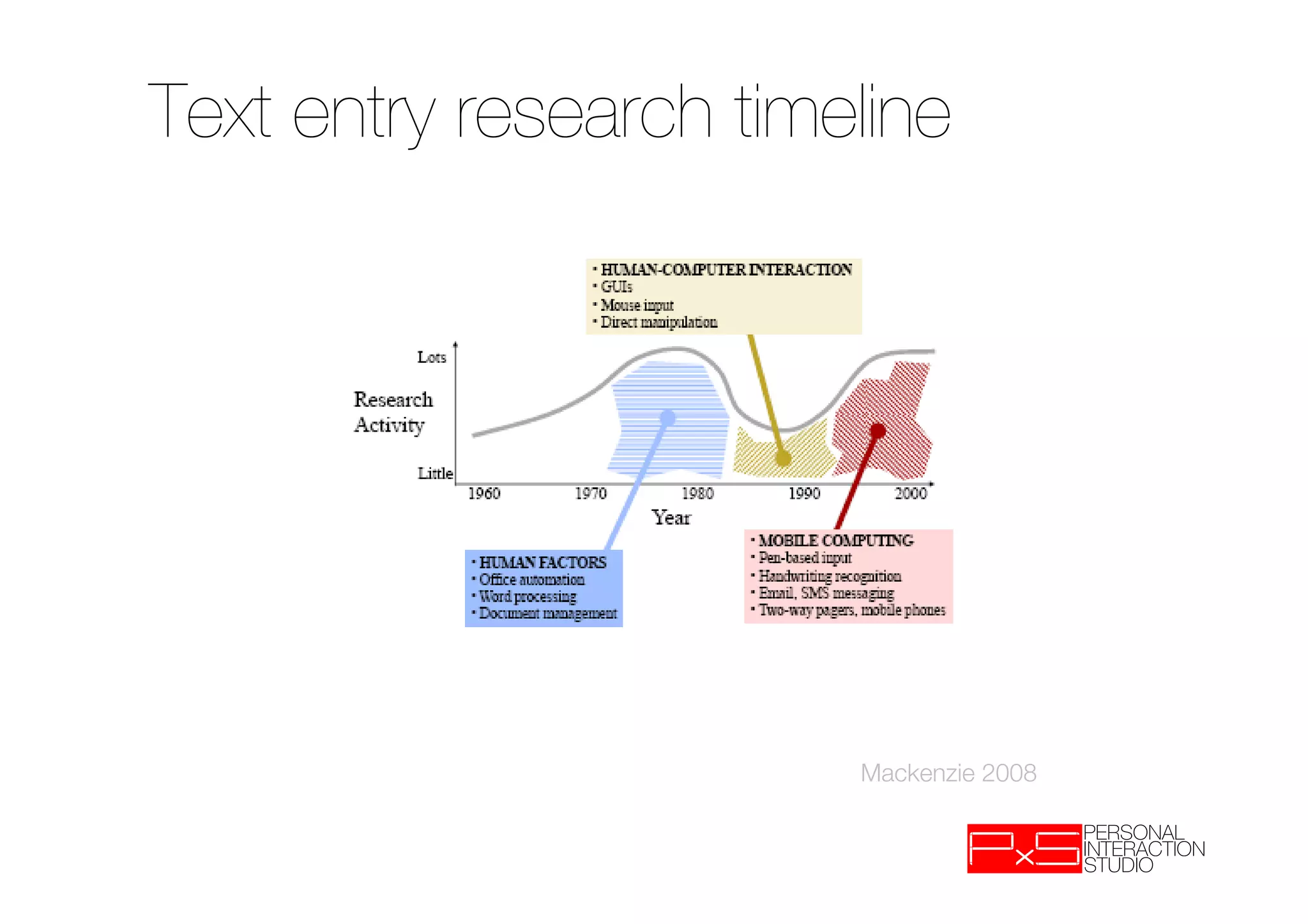
Text entry research timeline


                         Mackenzie 2008
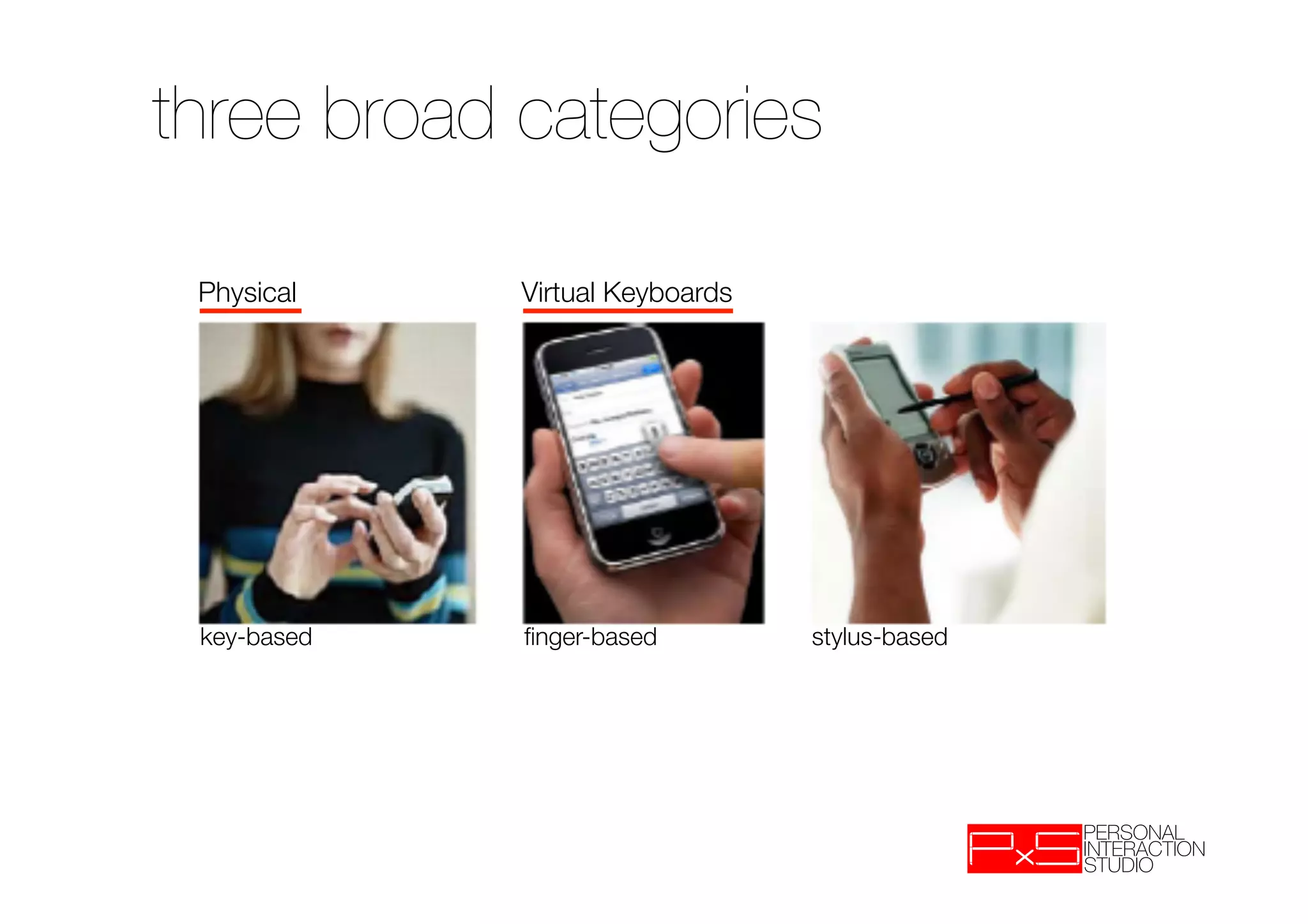
three broad categories

 Physical    Virtual Keyboards


 key-based   finger-based        stylus-based
physical vs virtual keyboards
➝    physical keyboards
     ➝    mobile phone keypad, mobile qwerty (e.g. Blackberry), 5 button
          pager, 3-key date stamp, 1 key input etc
➝    virtual keyboards
     ➝  aka “soft keyboards” or “on-screen keyboards”
     ➝  similar to clicking buttons in a GUI
     ➝  used with a stylus or a finger (but also with other input mechanisms
        e.g. eye tracking)
➝    design issues
     ➝    number of keys, key layout, key size, key shape, activation force,
          feedback, disambiguation, language modelling, word prediction etc
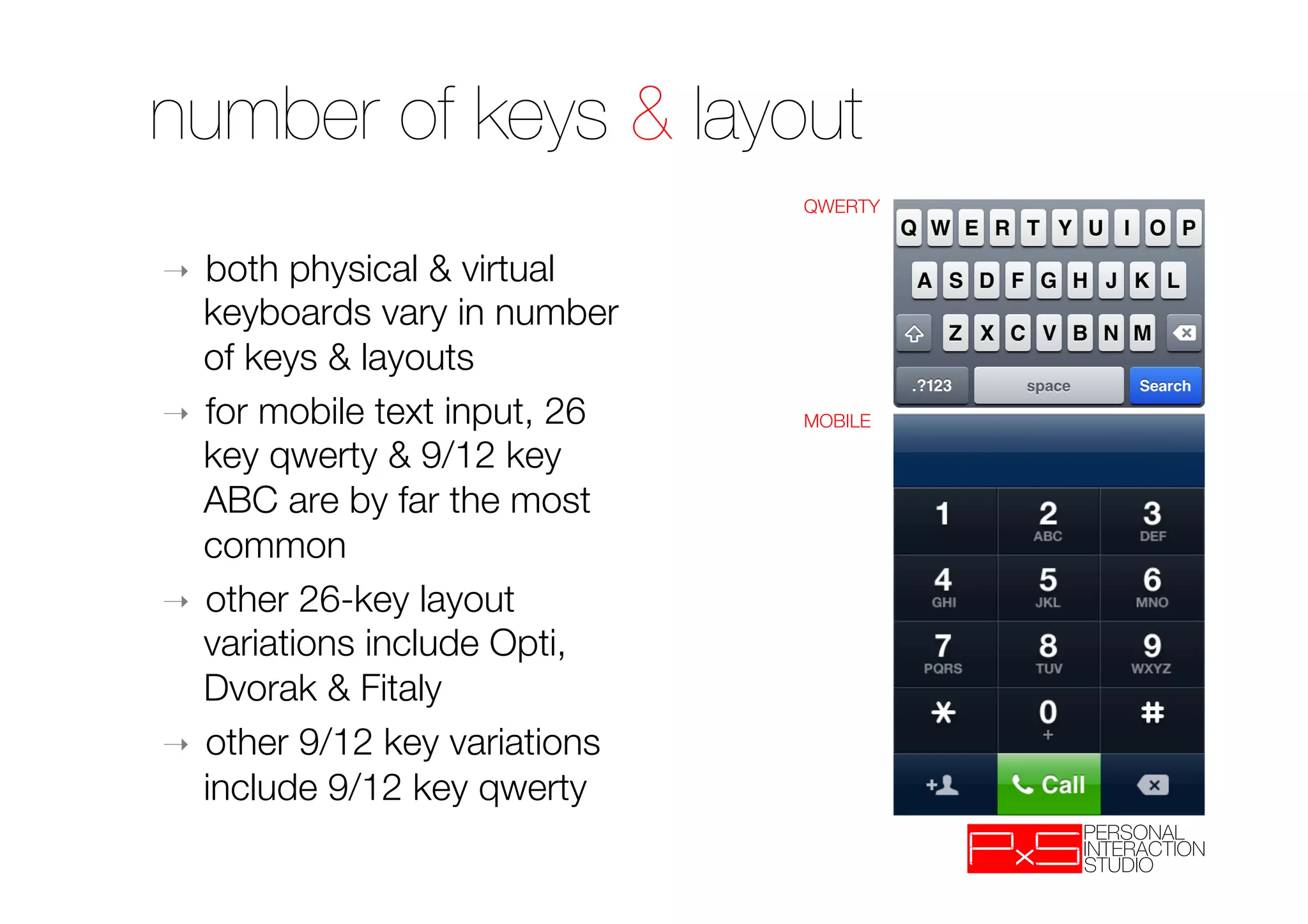
number of keys & layout
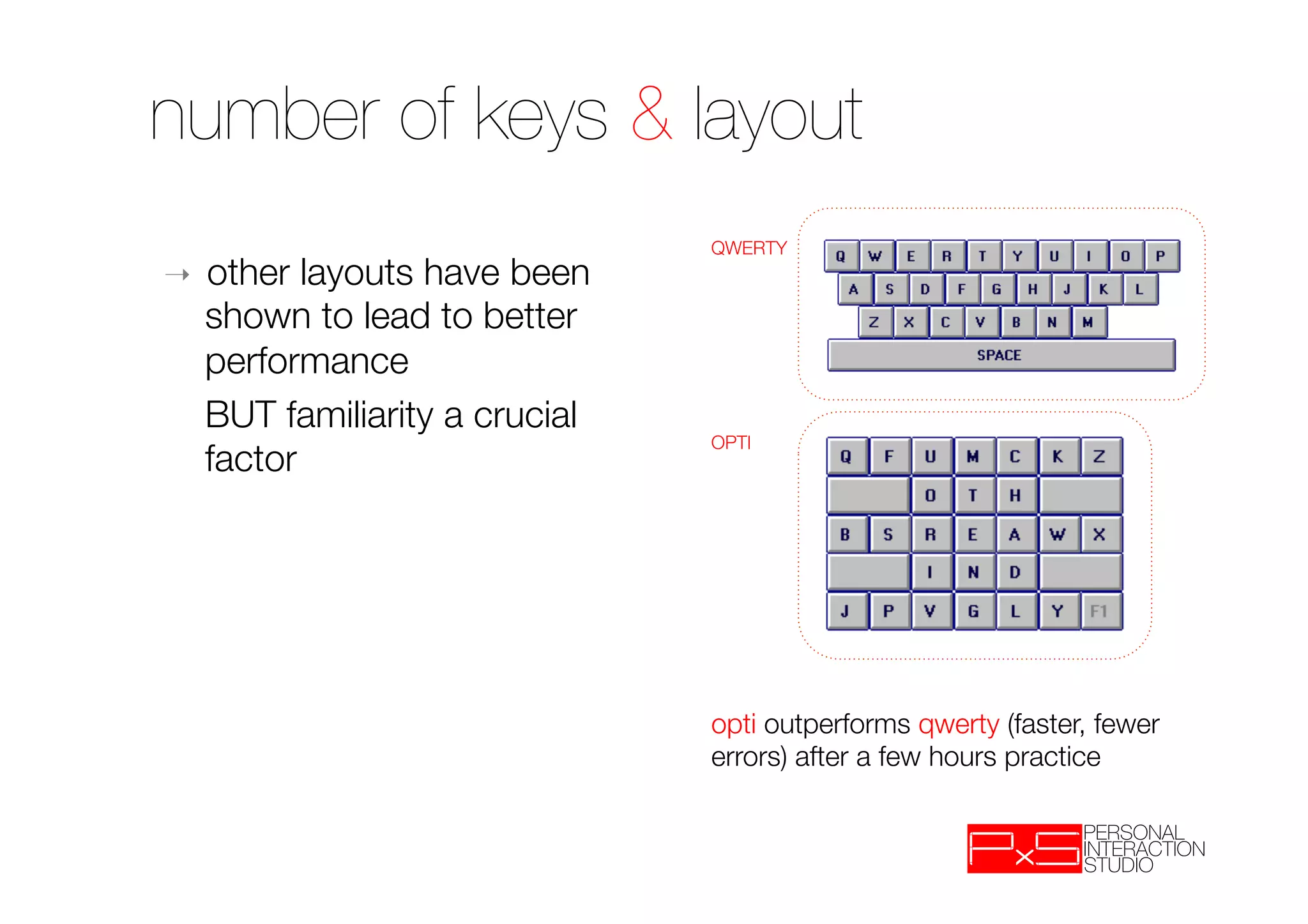
                               QWERTY


➝  both physical & virtual
   keyboards vary in number
   of keys & layouts
➝  for mobile text input, 26   MOBILE

   key qwerty & 9/12 key
   ABC are by far the most
   common
➝  other 26-key layout
   variations include Opti,
   Dvorak & Fitaly 
➝  other 9/12 key variations
   include 9/12 key qwerty
number of keys & layout
                              QWERTY
➝ other layouts have been
  shown to lead to better
  performance 
 
BUT familiarity a crucial
                              OPTI
  factor


                              opti outperforms qwerty (faster, fewer
                              errors) after a few hours practice
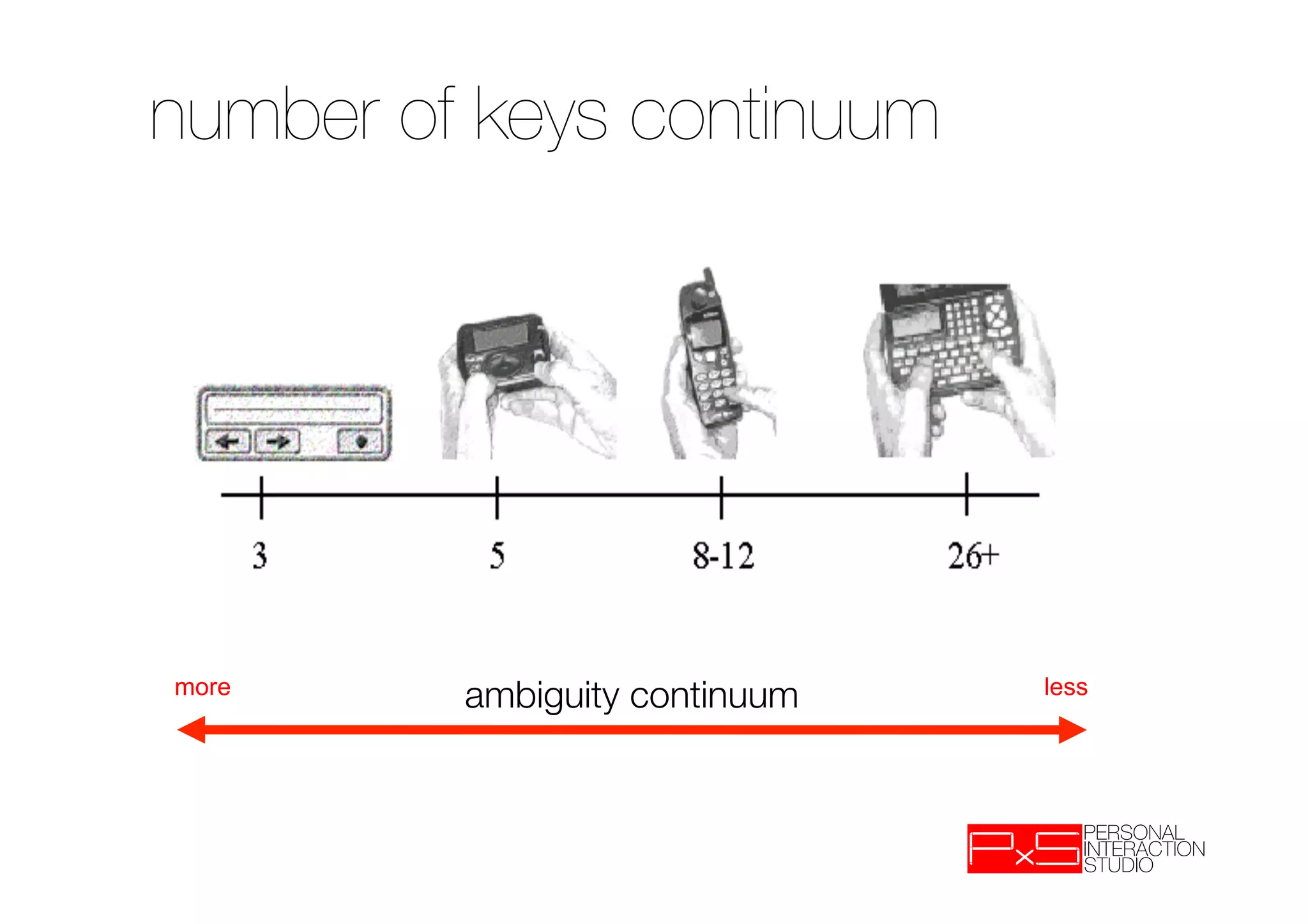
number of keys continuum


more     ambiguity continuum
   less
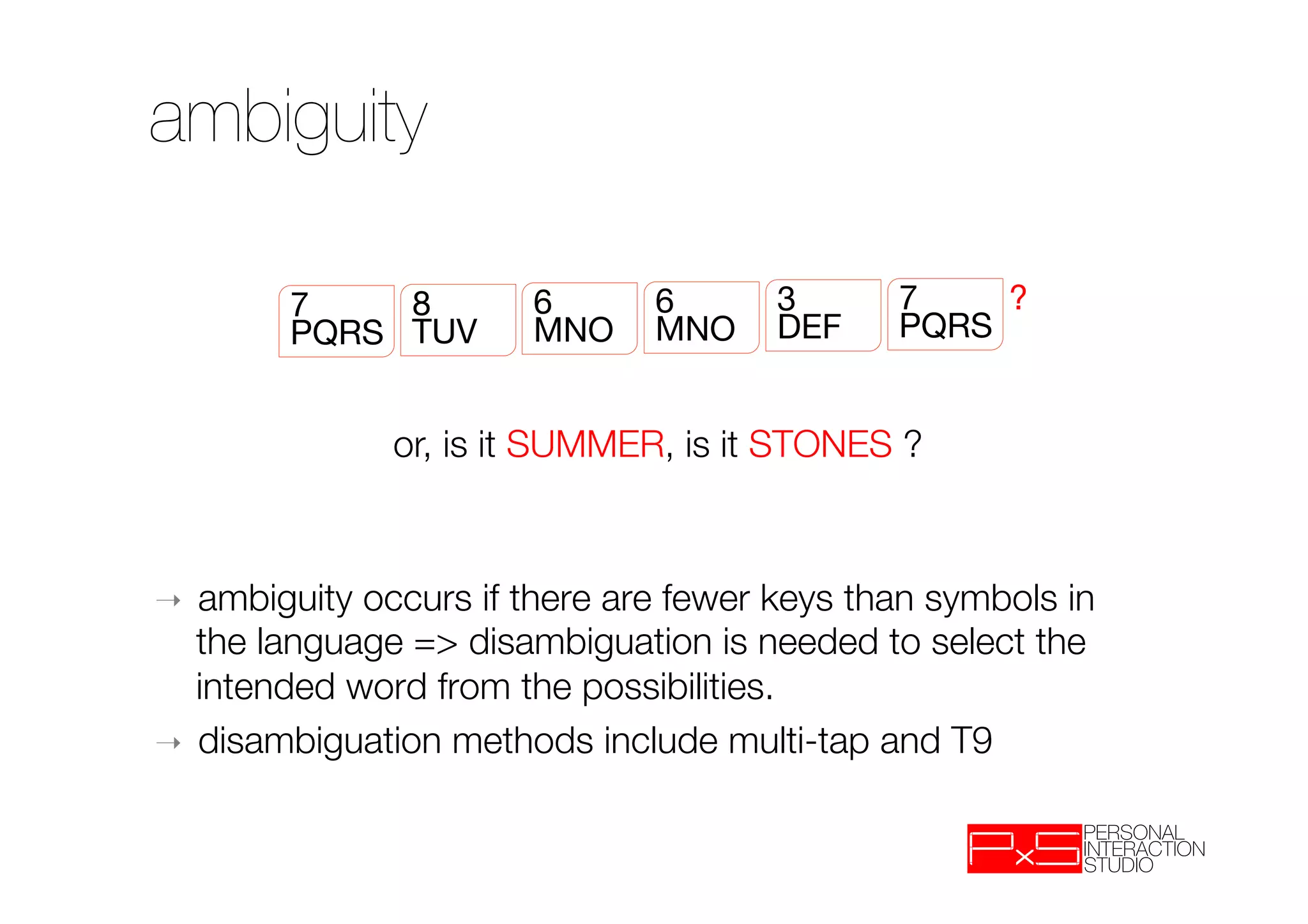
ambiguity

        7
    8
       6
   6
   3
           7
    ?
        PQRS
 TUV
     MNO
 MNO
 DEF
         PQRS


              or, is it SUMMER, is it STONES ?


➝  ambiguity occurs if there are fewer keys than symbols in
   the language => disambiguation is needed to select the
   intended word from the possibilities.
➝  disambiguation methods include multi-tap and T9
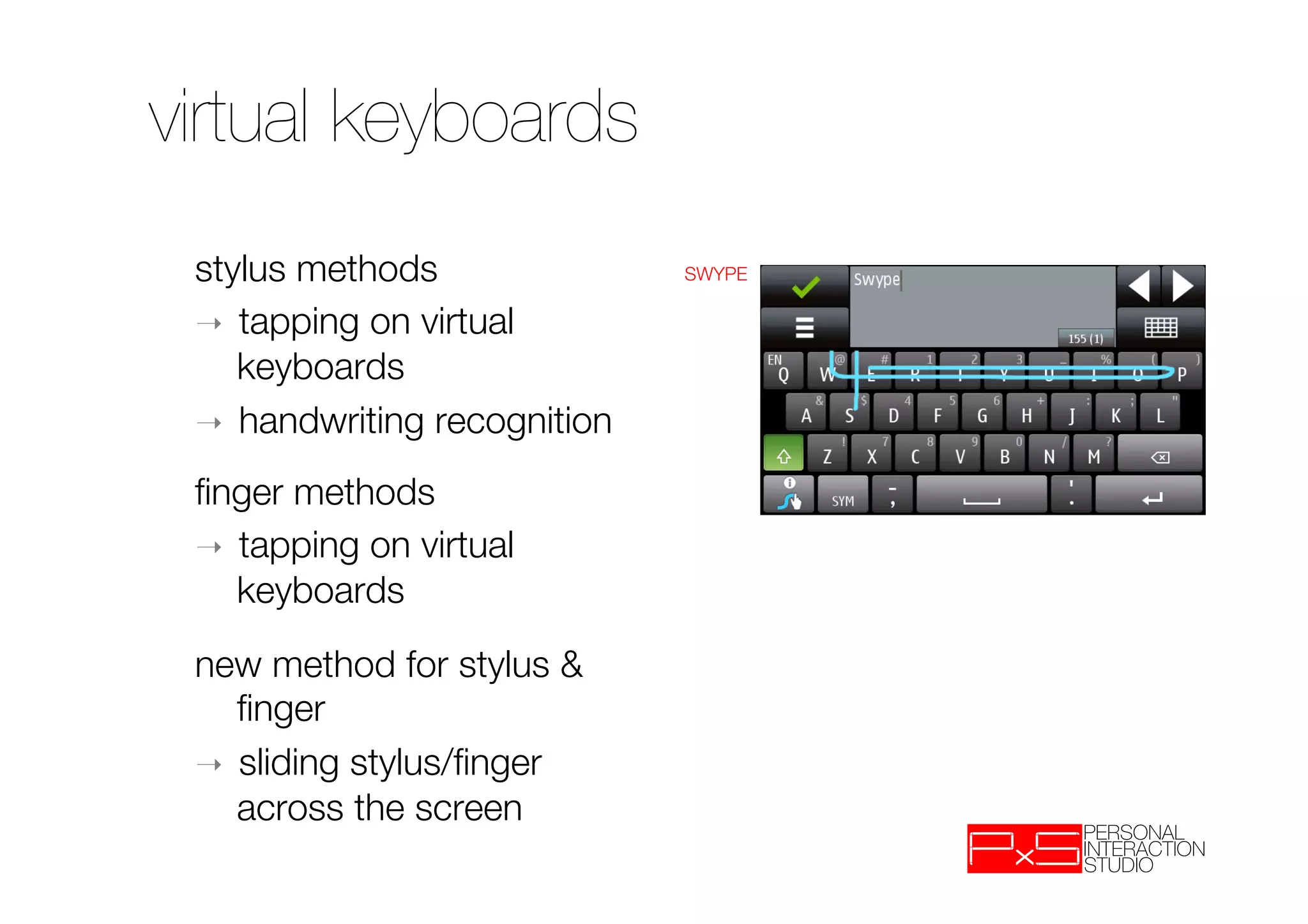
virtual keyboards
 stylus methods
                SWYPE

 ➝  tapping on virtual
    keyboards
 ➝  handwriting recognition 


 finger methods
 ➝  tapping on virtual
    keyboards


 new method for stylus &
    finger
 ➝  sliding stylus/finger
    across the screen
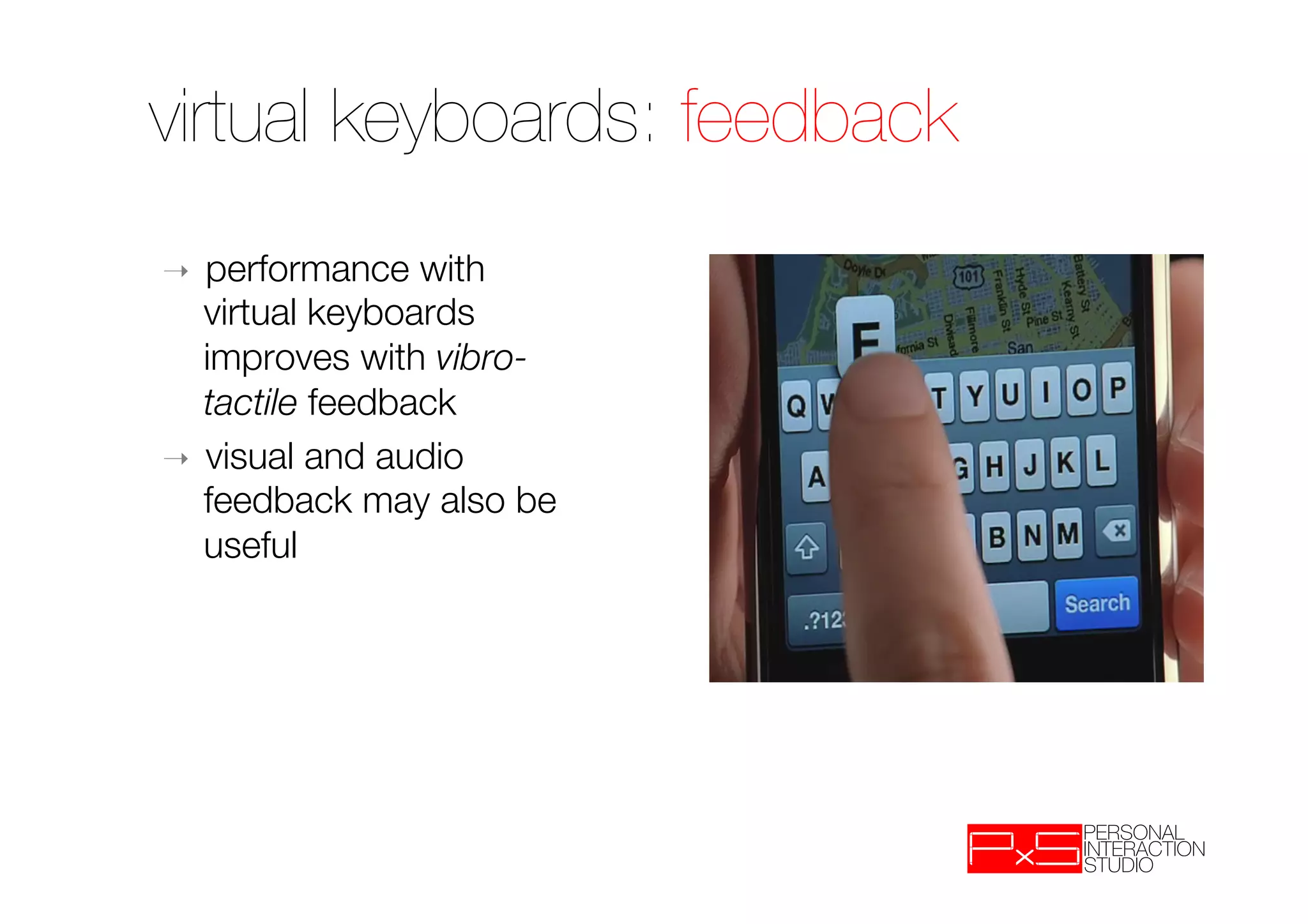
virtual keyboards: feedback
➝  performance with
   virtual keyboards
   improves with vibro-
   tactile feedback
➝  visual and audio
   feedback may also be
   useful
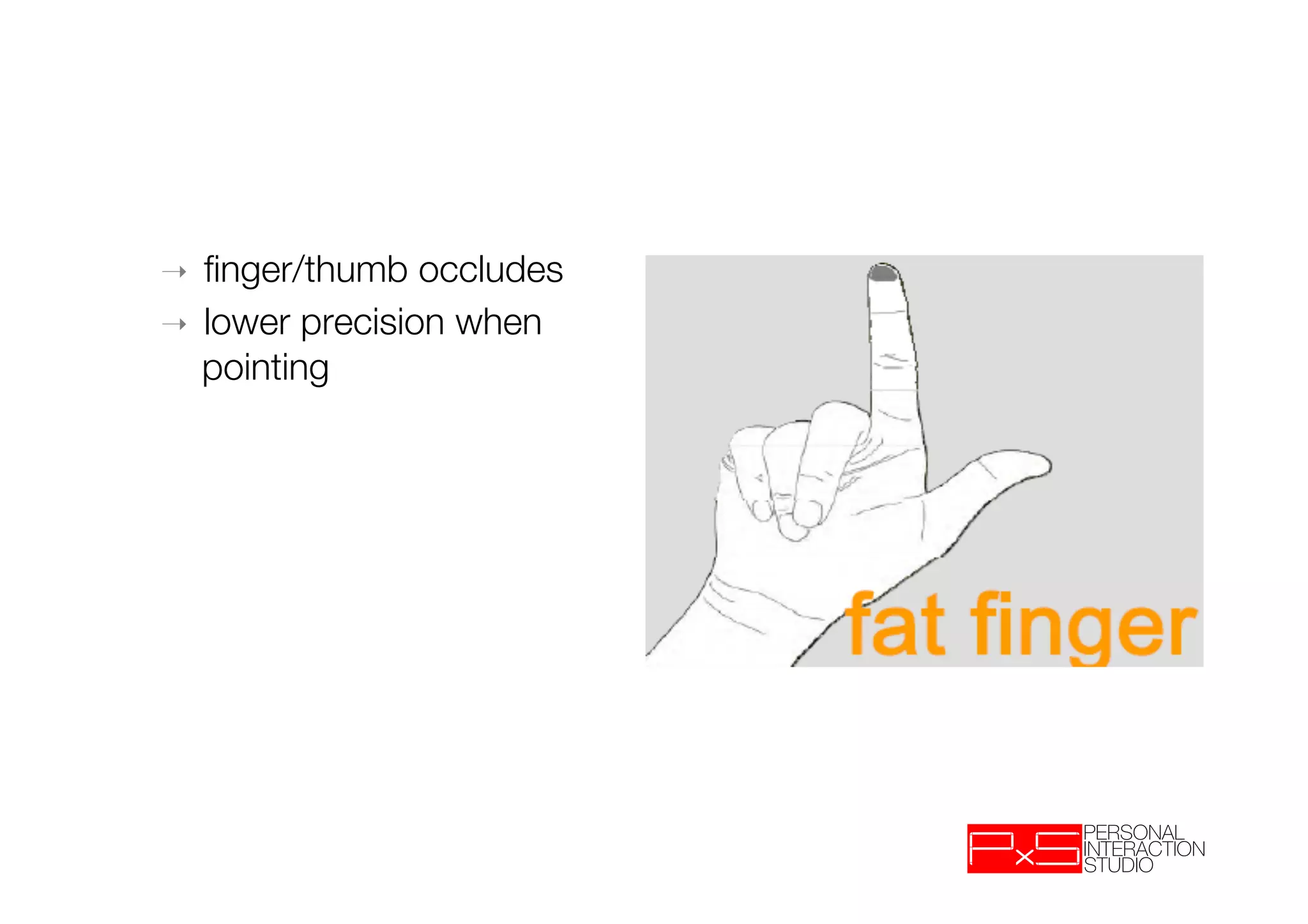
➝  finger/thumb occludes
➝  lower precision when
   pointing
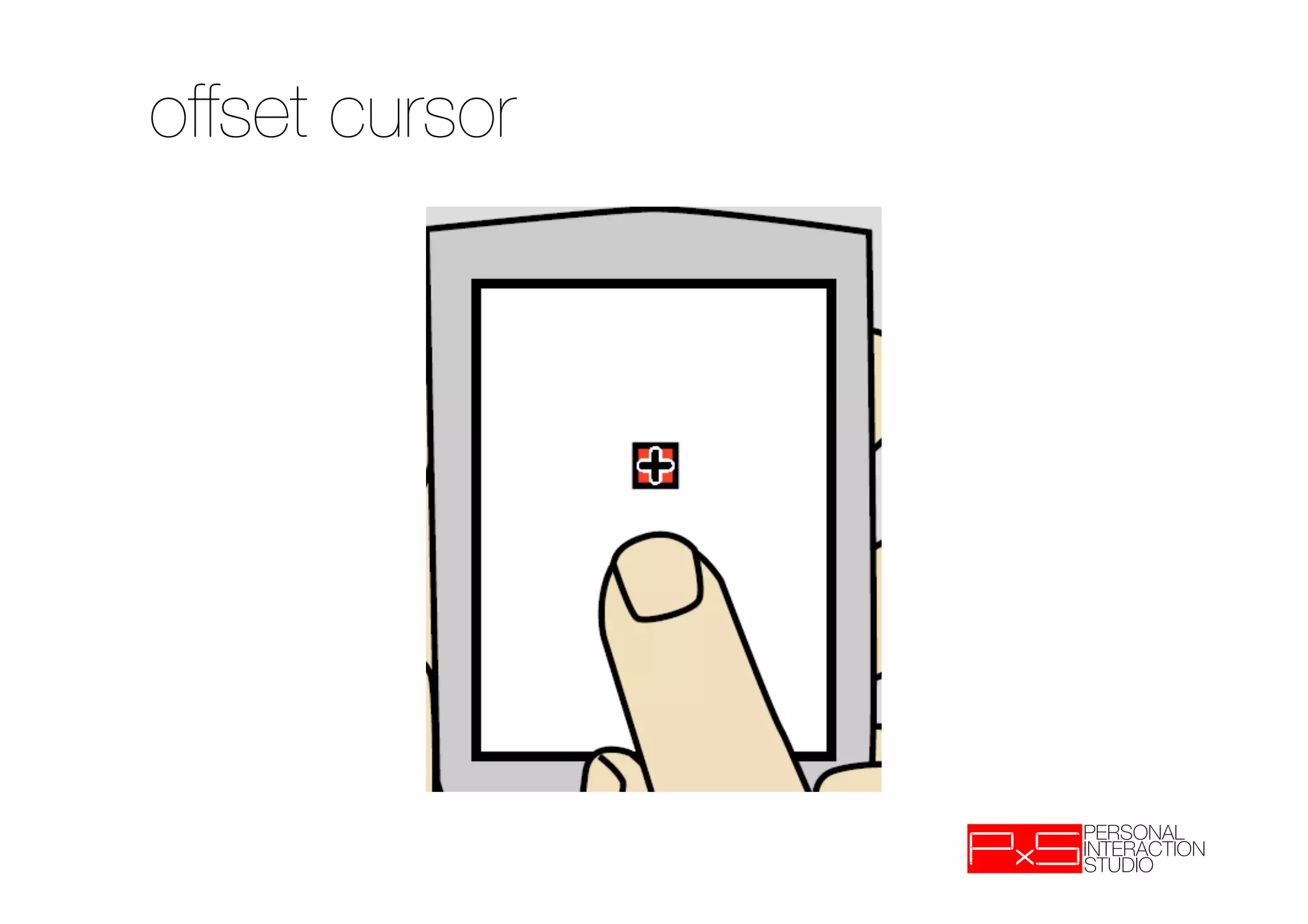
offset cursor
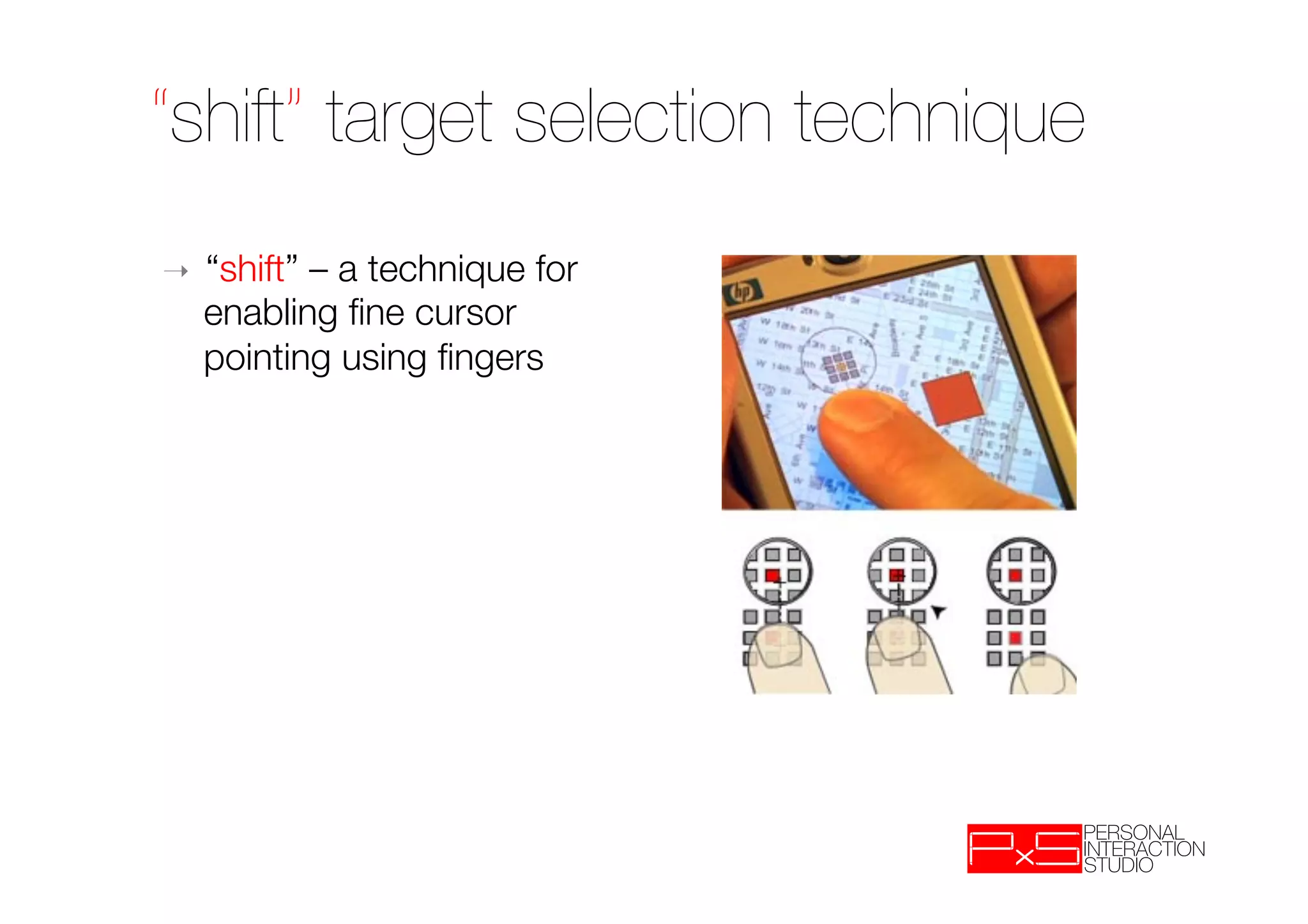
“shift” target selection technique
➝    “shift” – a technique for
     enabling fine cursor
     pointing using fingers
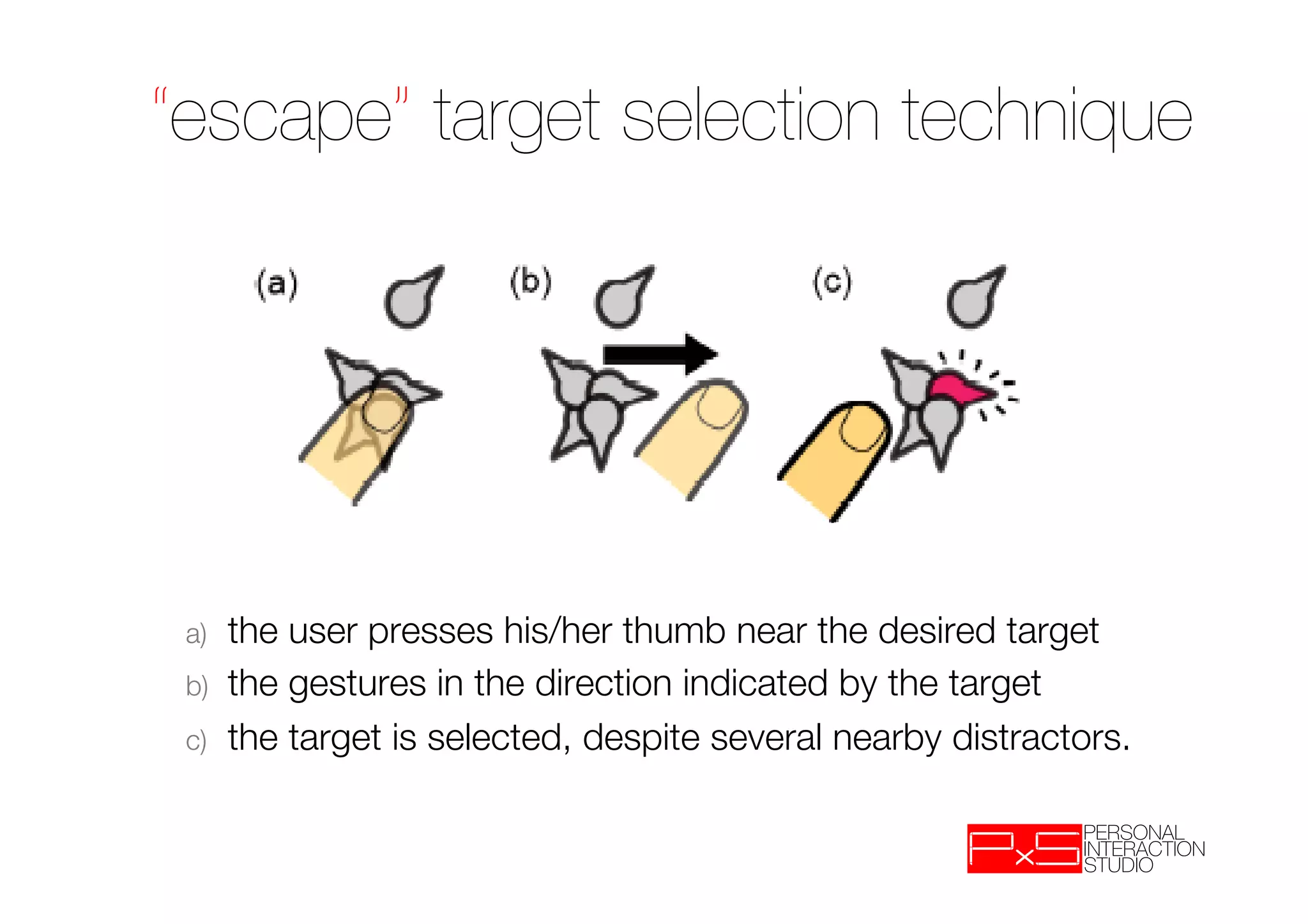
“escape” target selection technique


 a)    the user presses his/her thumb near the desired target
 b)    the gestures in the direction indicated by the target
 c)    the target is selected, despite several nearby distractors.
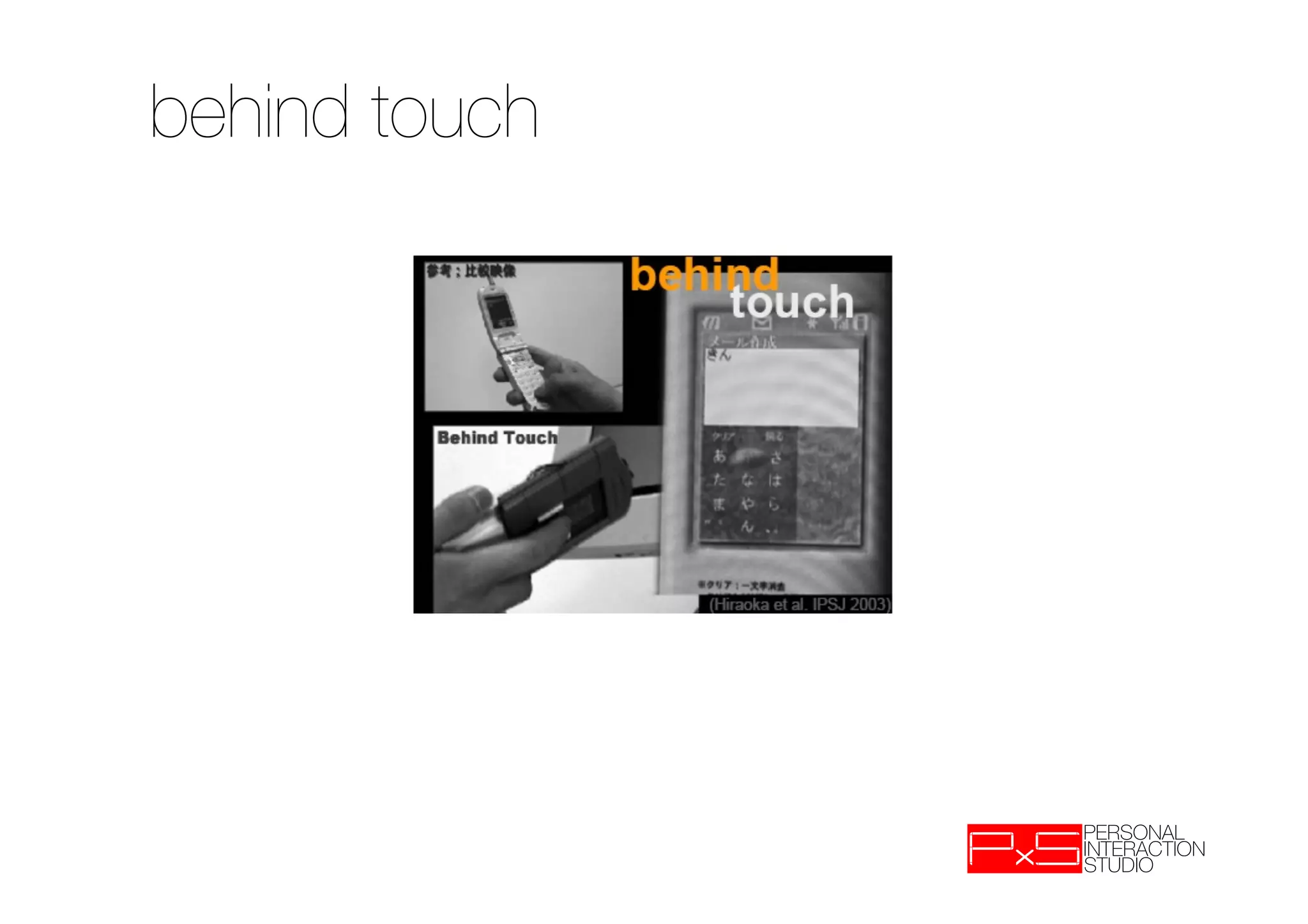
behind touch
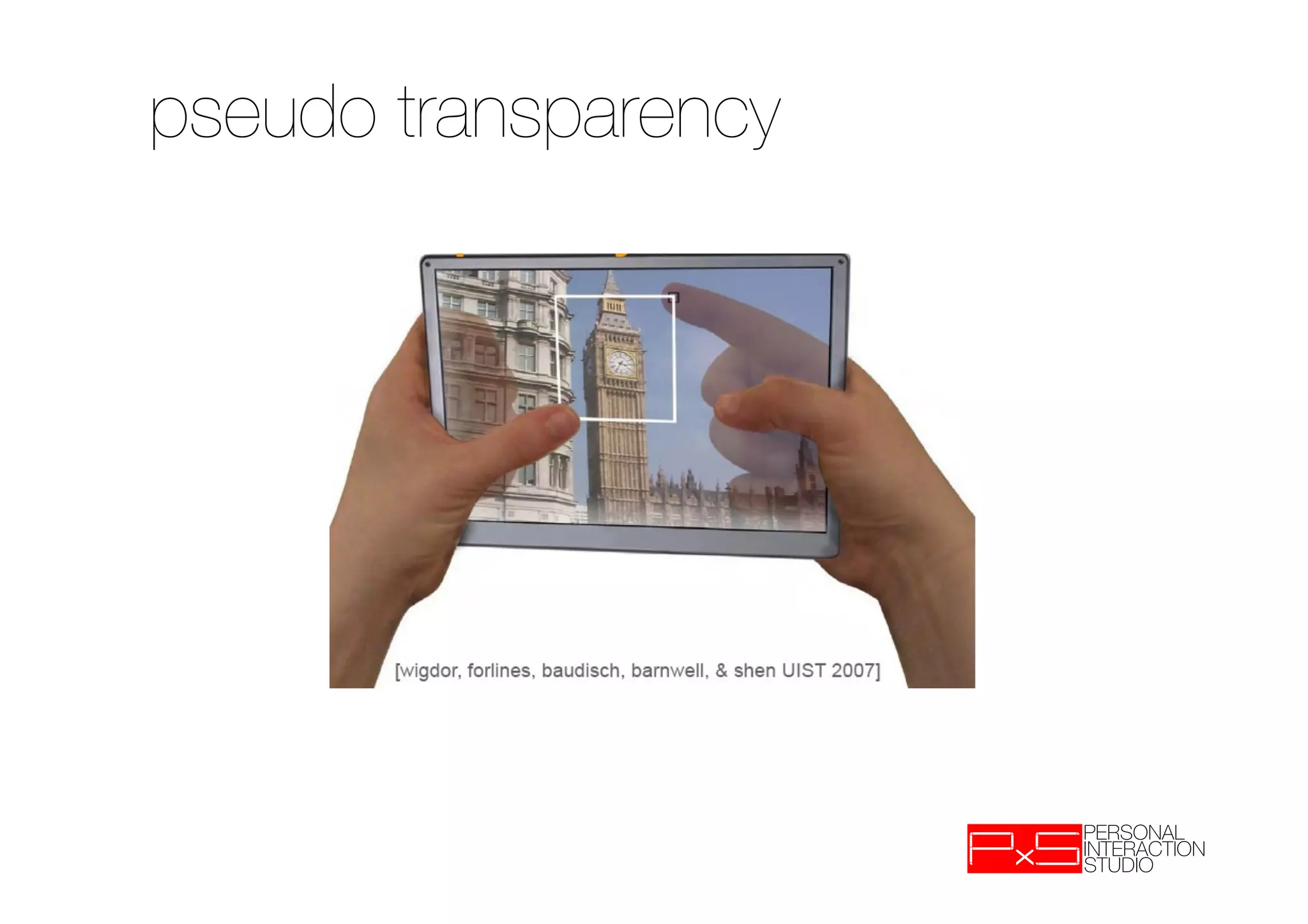
pseudo transparency
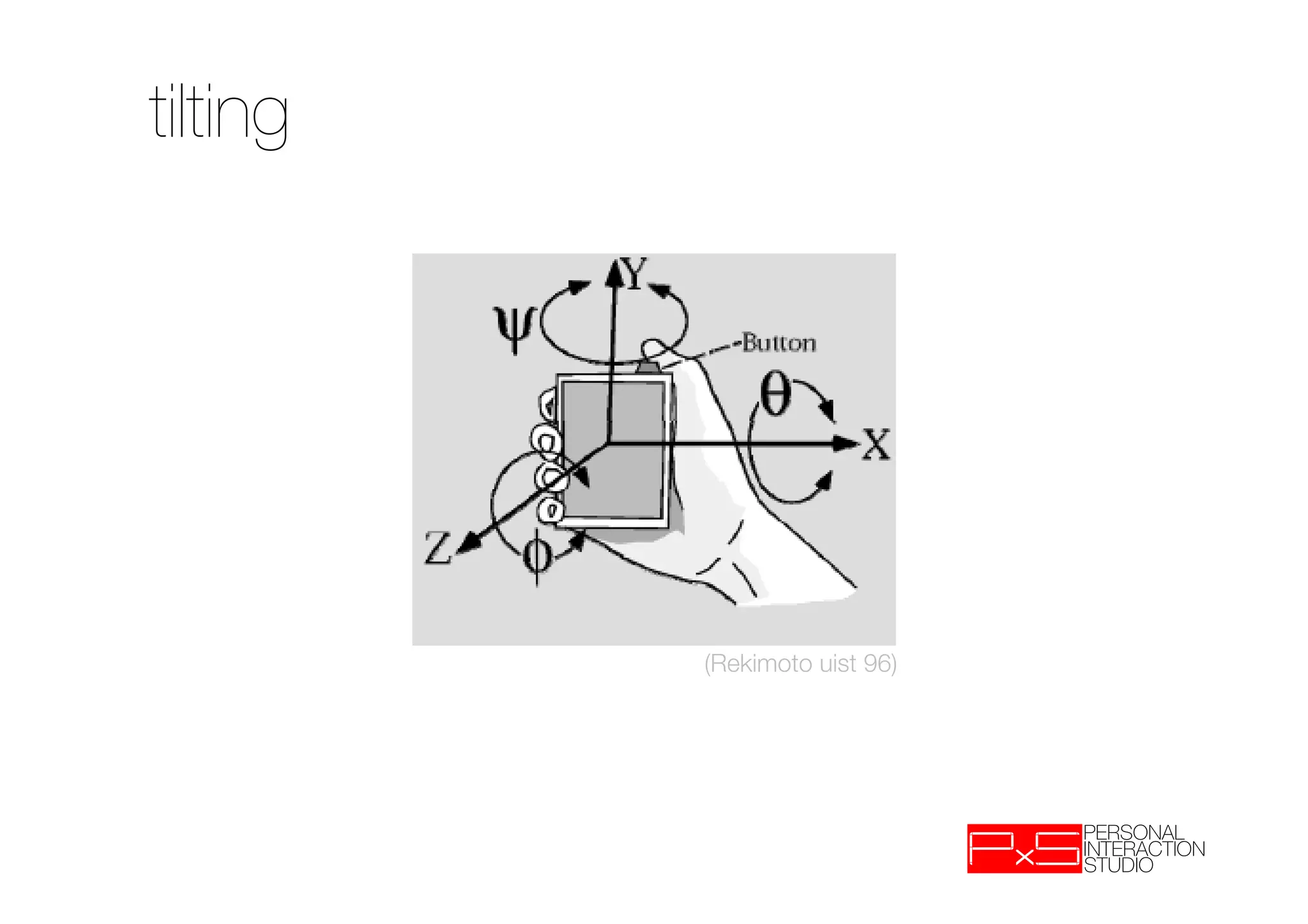
tilting


           (Rekimoto uist 96)
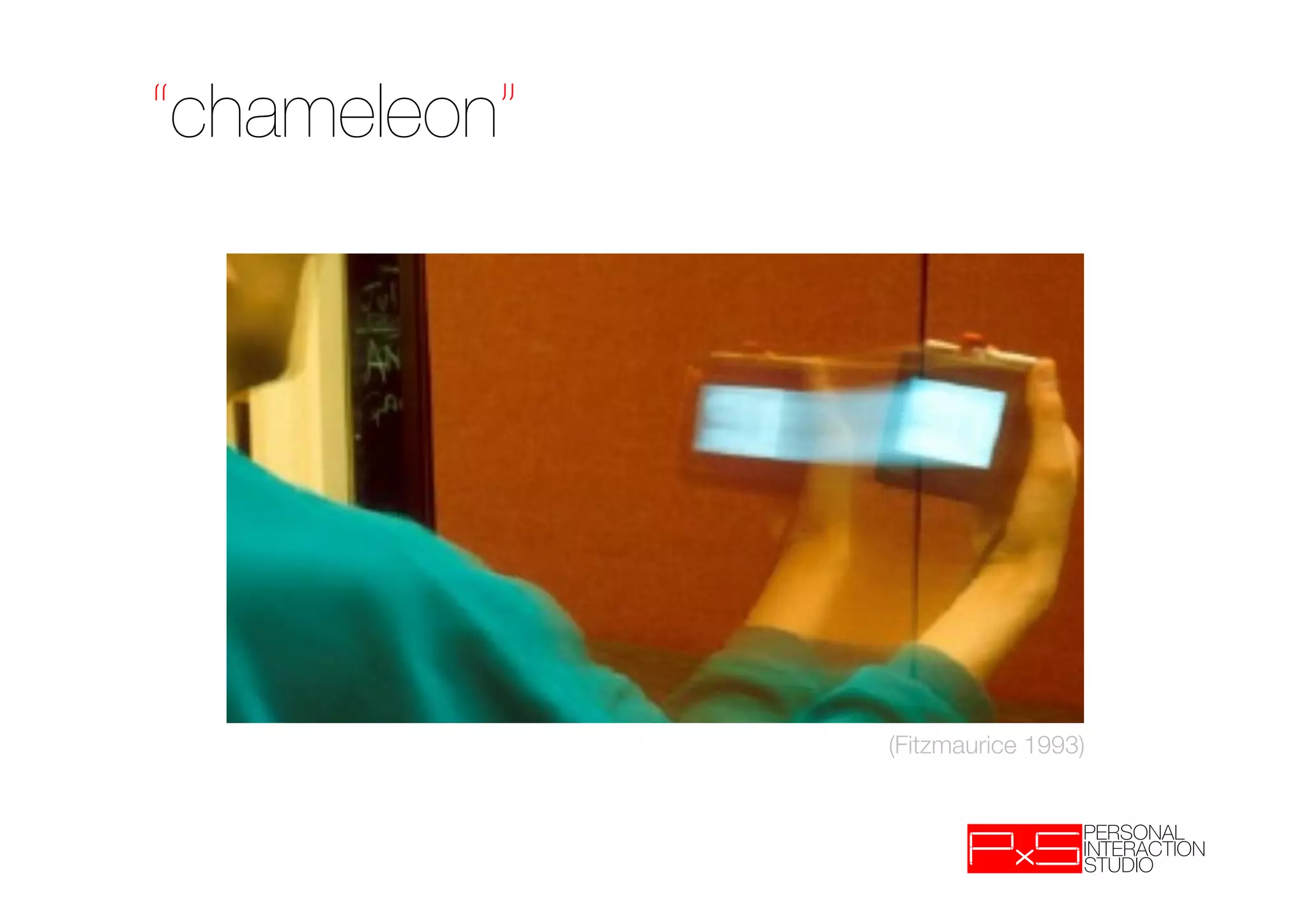
“chameleon”


               (Fitzmaurice 1993)
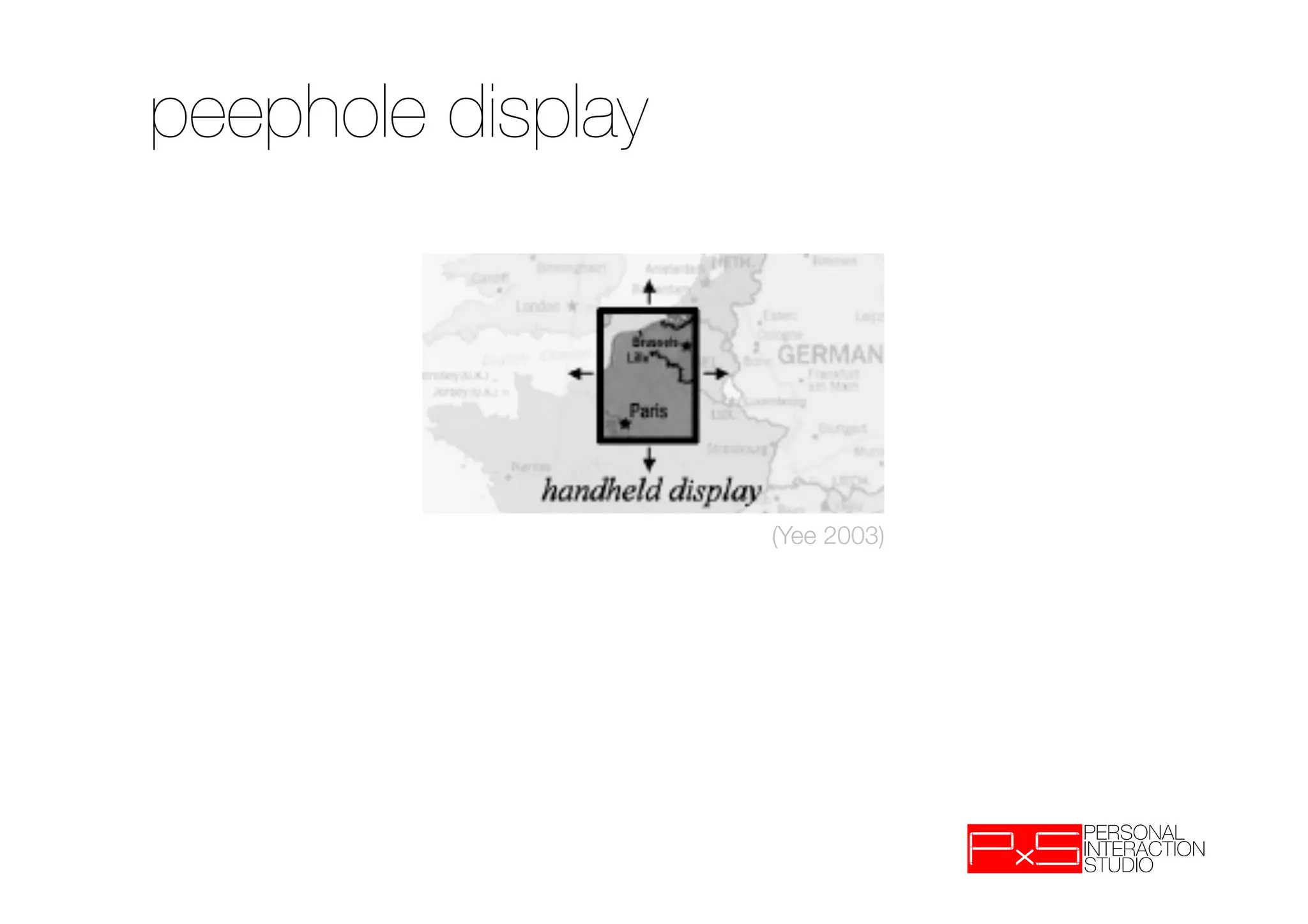
peephole display


                    (Yee 2003)
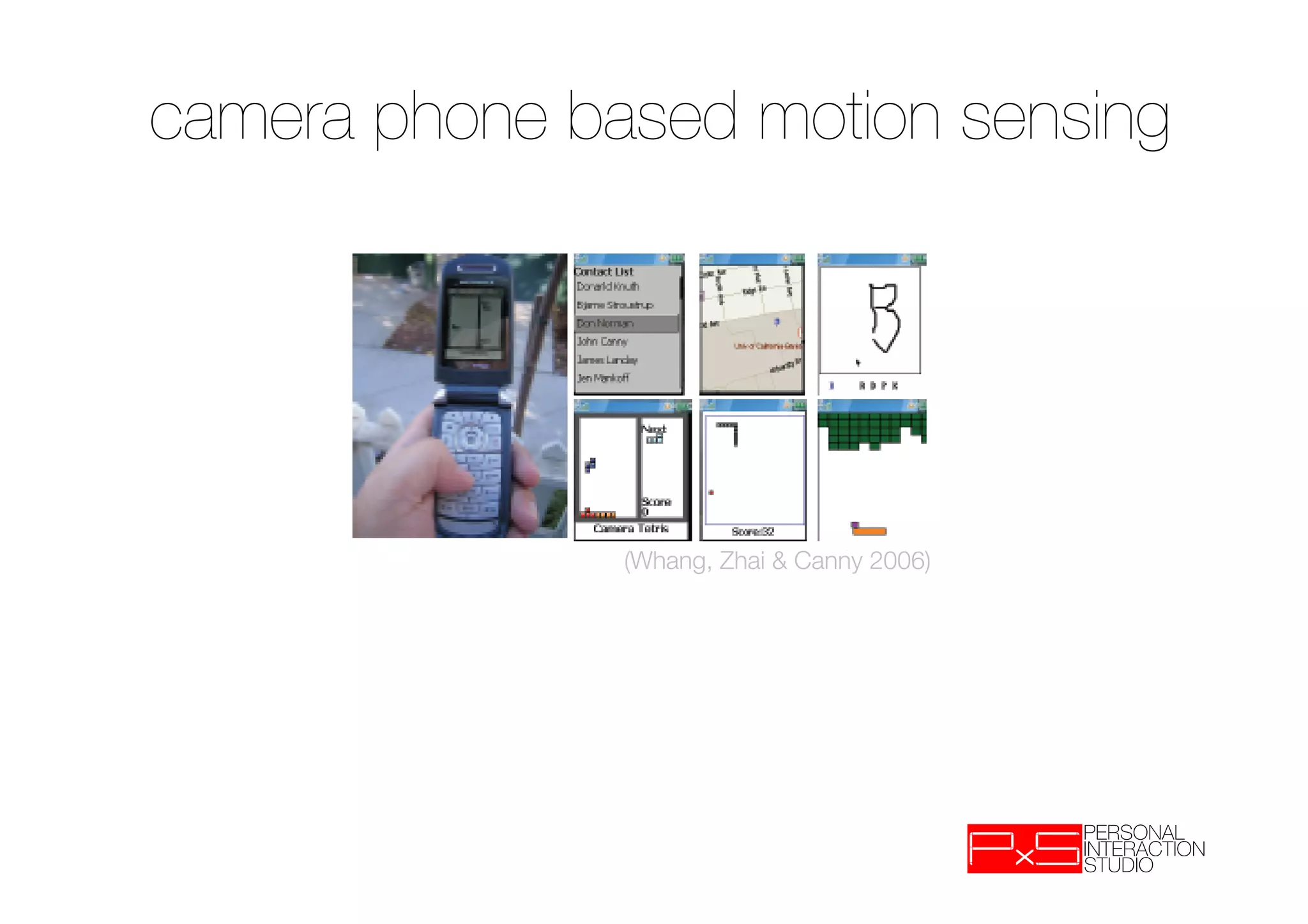
camera phone based motion sensing


               (Whang, Zhai & Canny 2006)
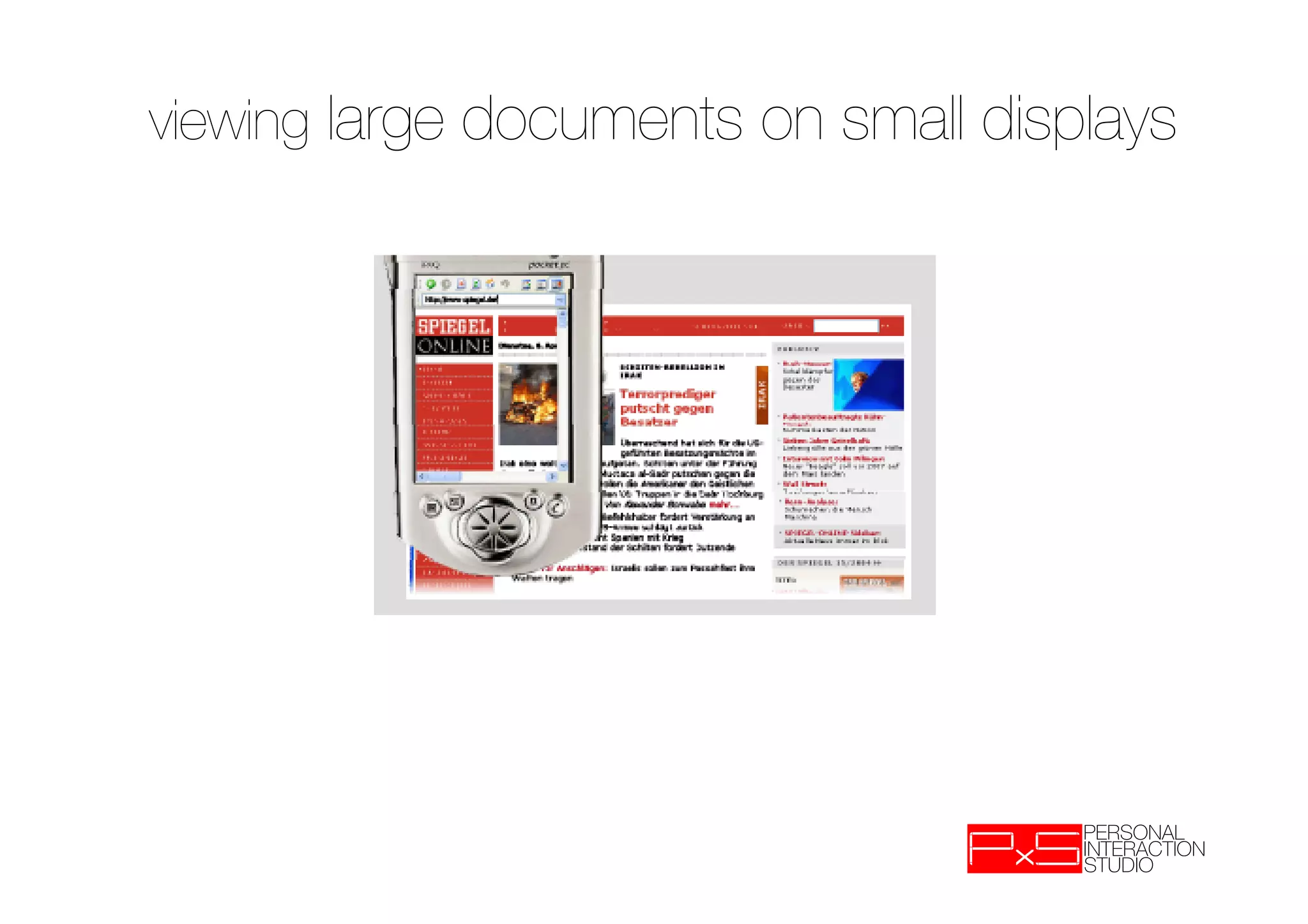
viewing large documents on small displays
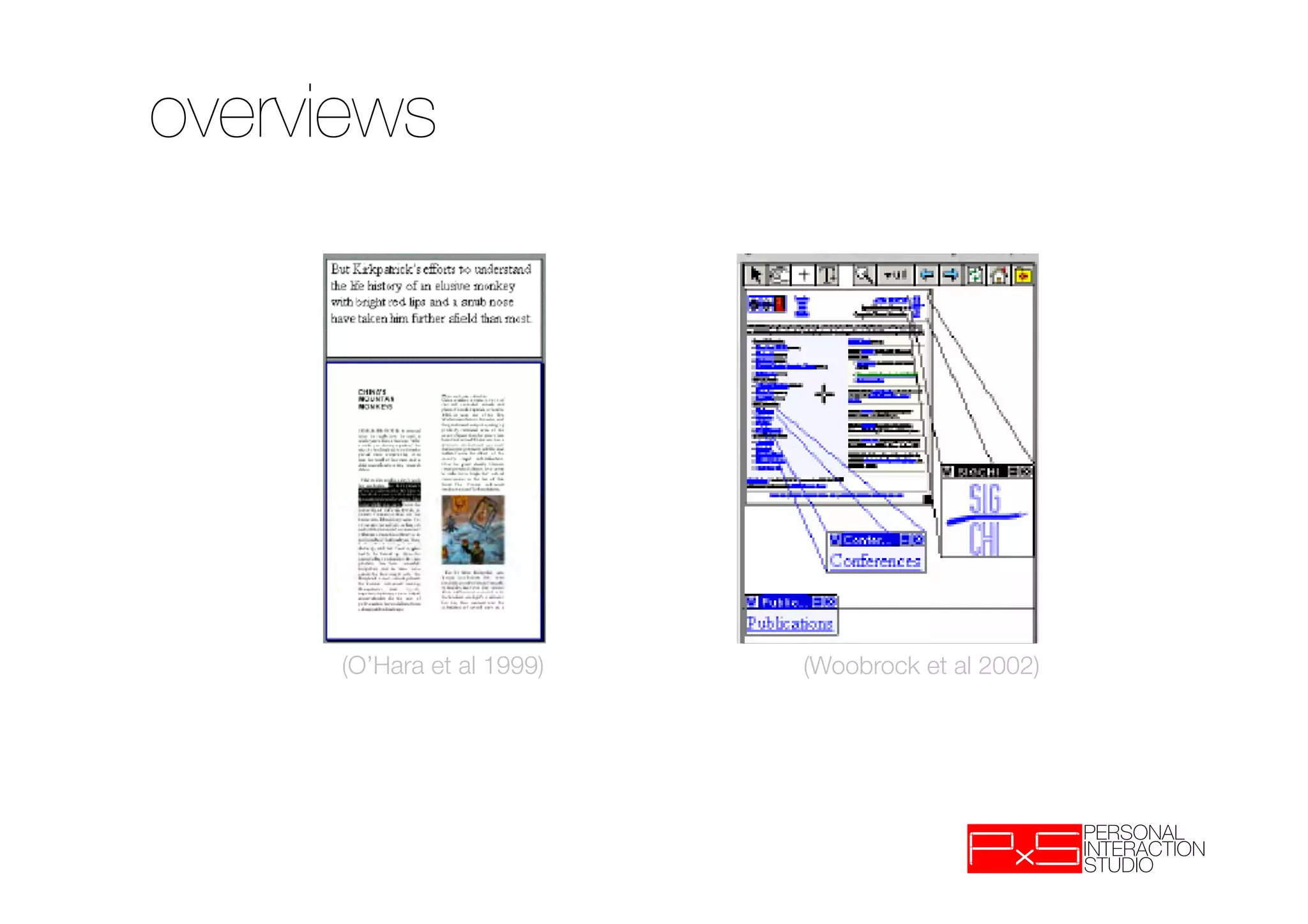
overviews


      (O’Hara et al 1999)
   (Woobrock et al 2002)
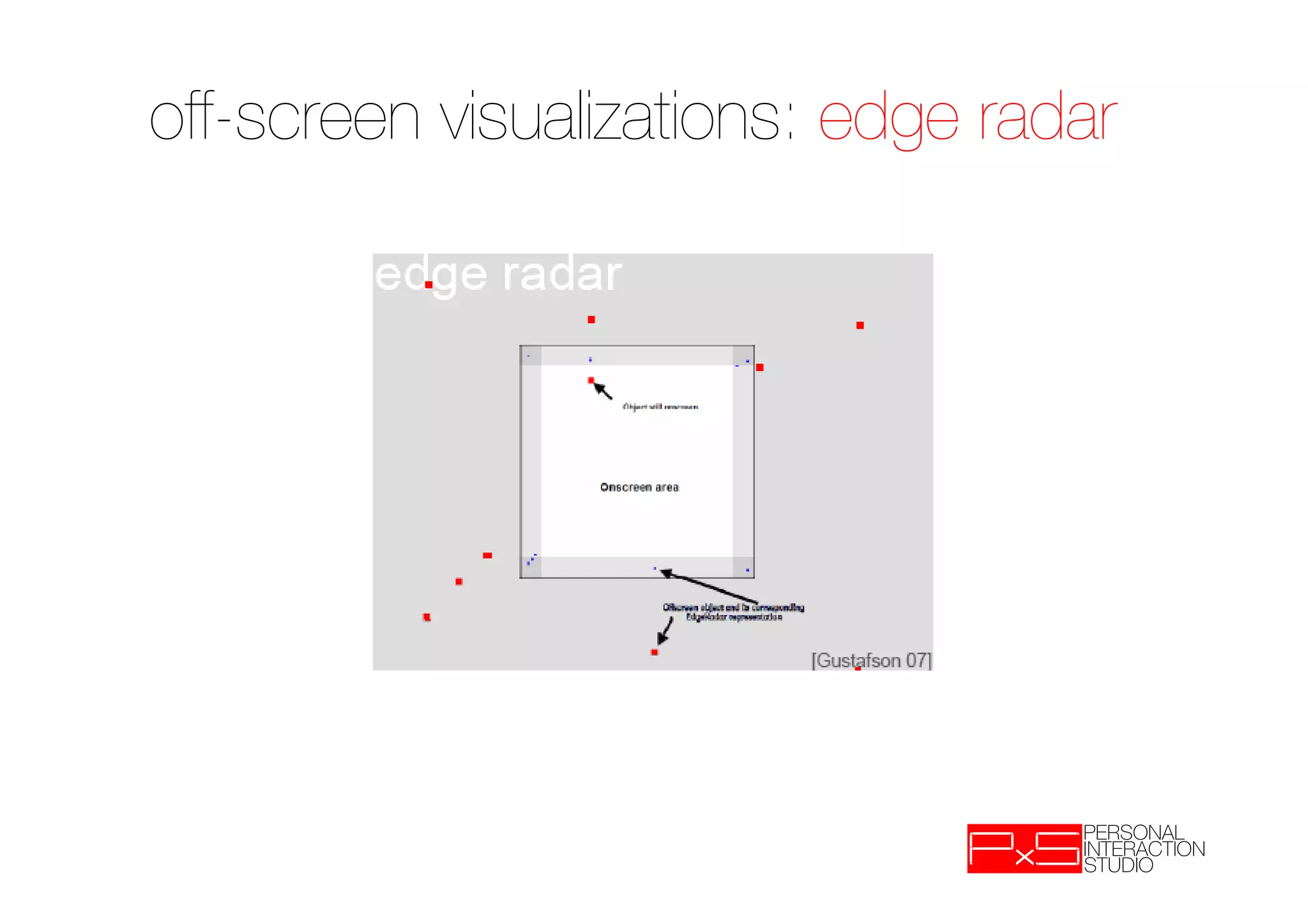
off-screen visualizations: edge radar
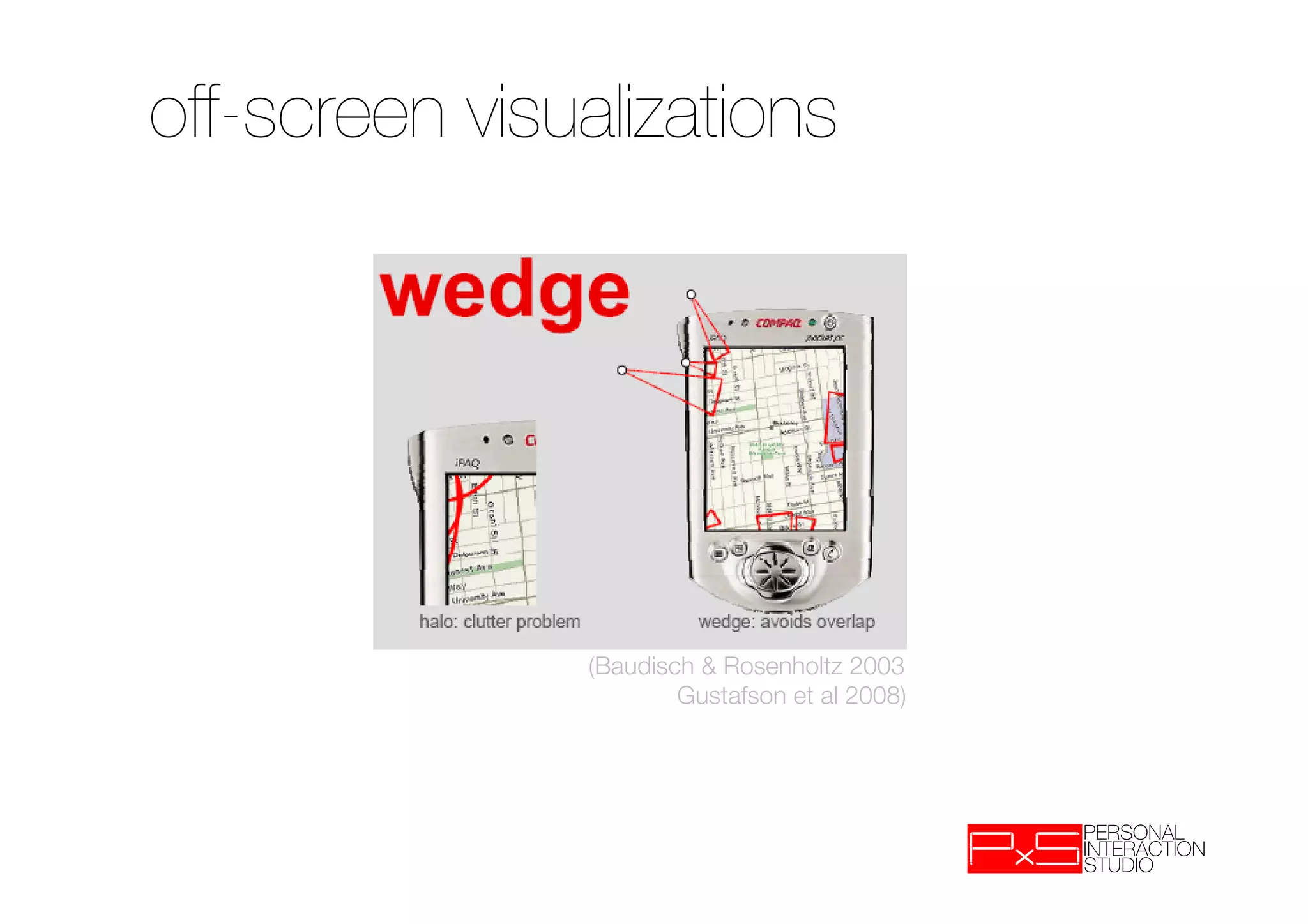
off-screen visualizations


                (Baudisch & Rosenholtz 2003
                        Gustafson et al 2008)
audio & haptic output
➝    non speech audio
     output
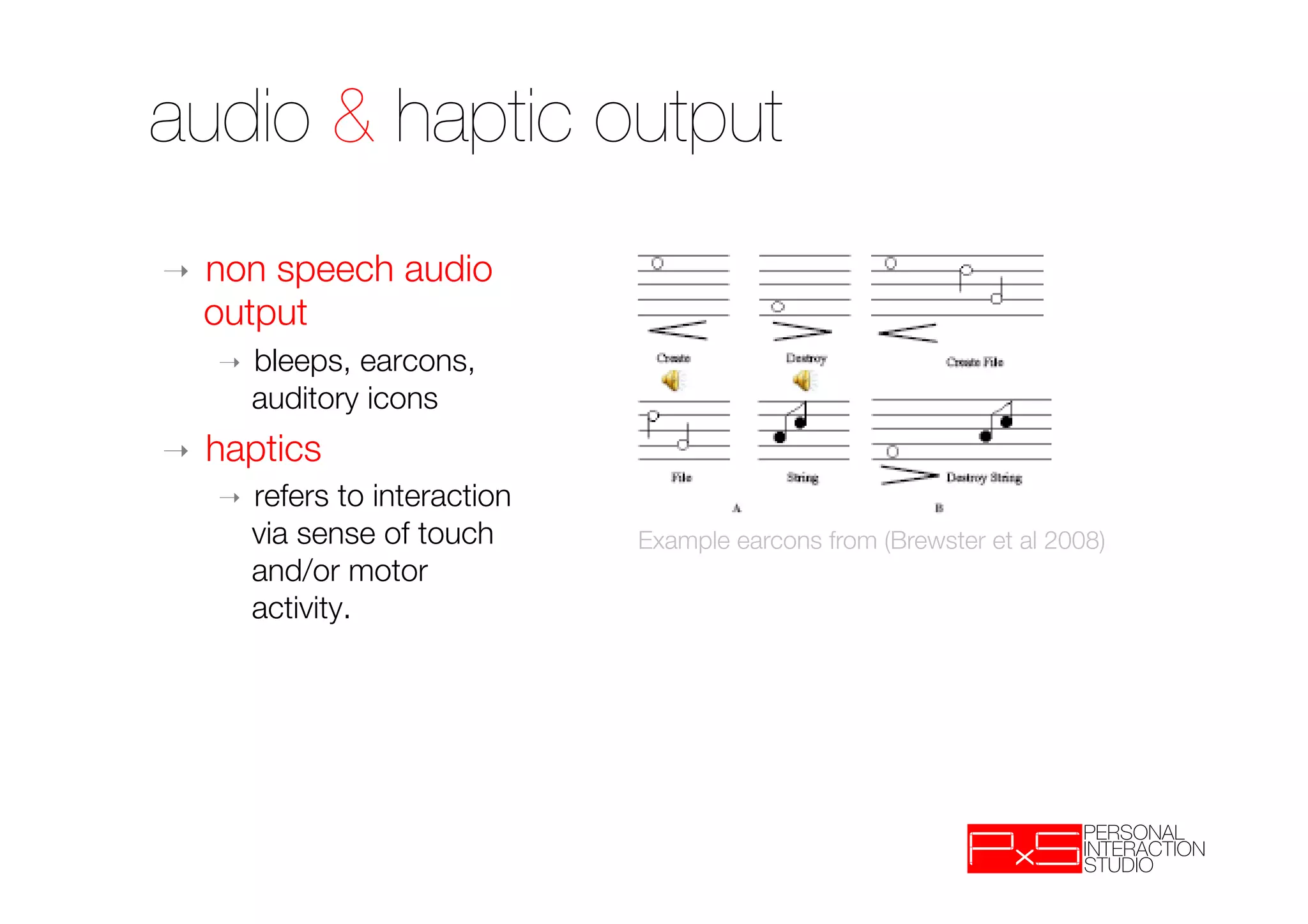
     ➝    bleeps, earcons,
          auditory icons
➝    haptics
     ➝    refers to interaction
          via sense of touch      Example earcons from (Brewster et al 2008)
          and/or motor
          activity.
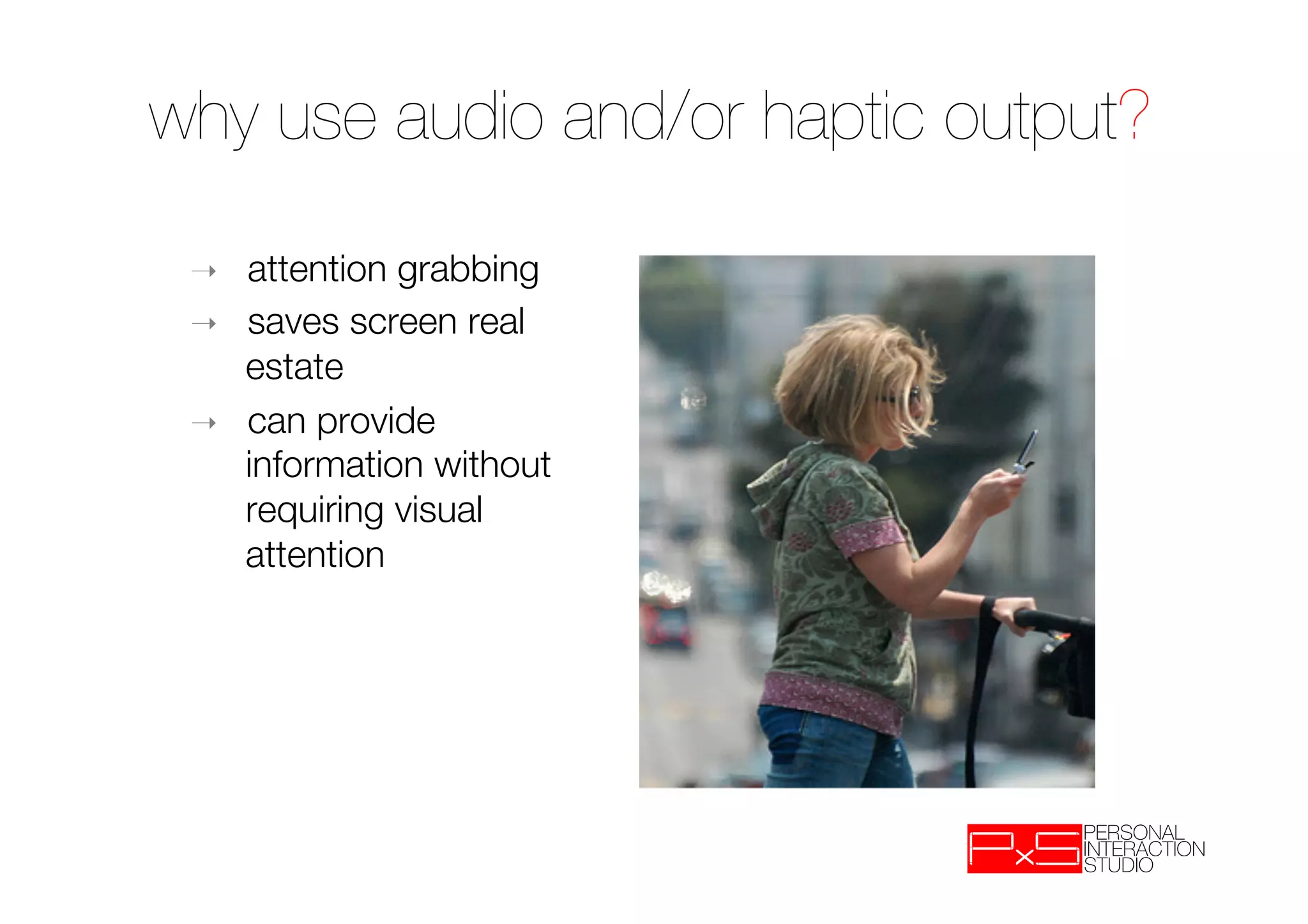
why use audio and/or haptic output?

 ➝    attention grabbing
 ➝    saves screen real
      estate
 ➝    can provide
      information without
      requiring visual
      attention
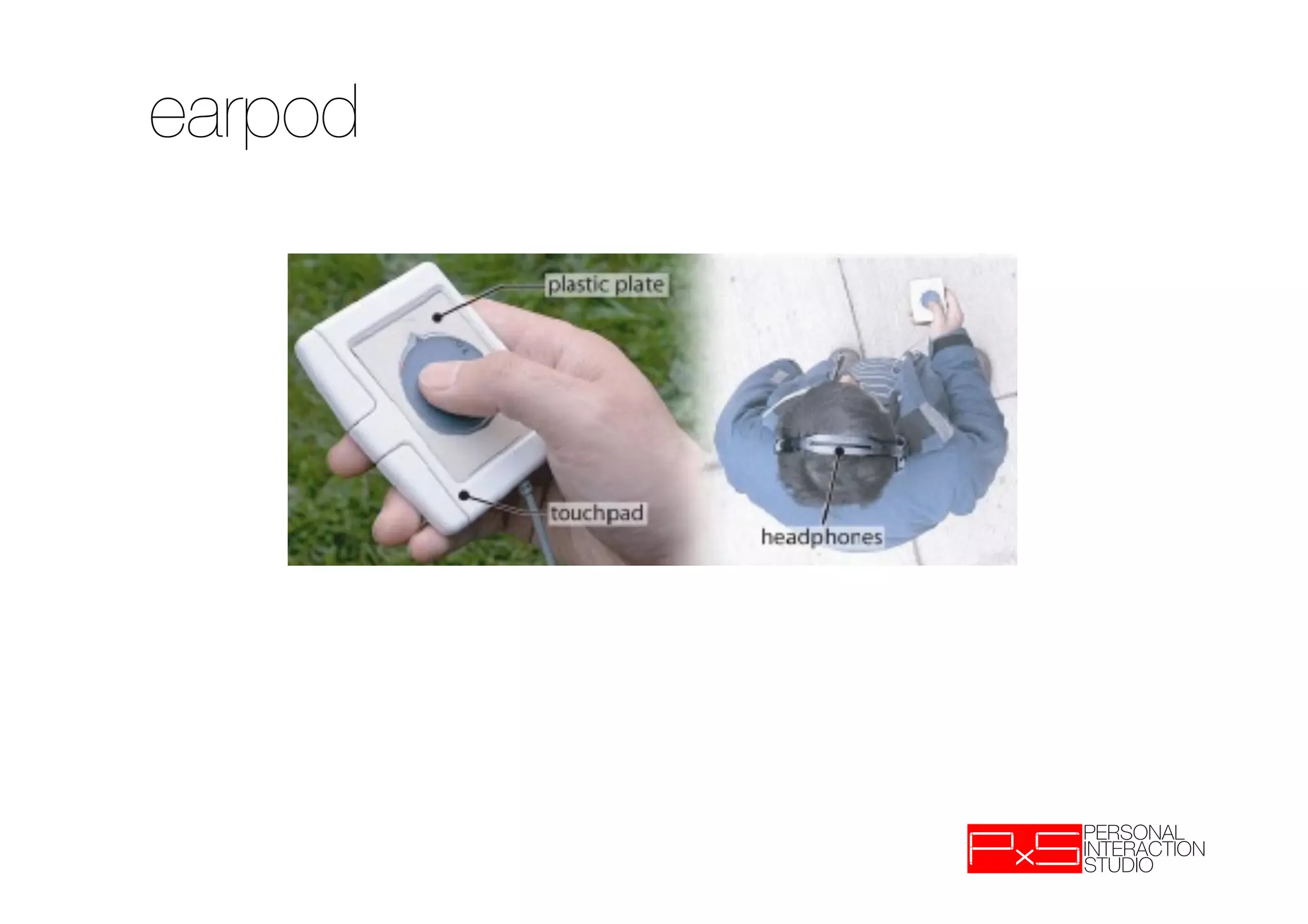
earpod
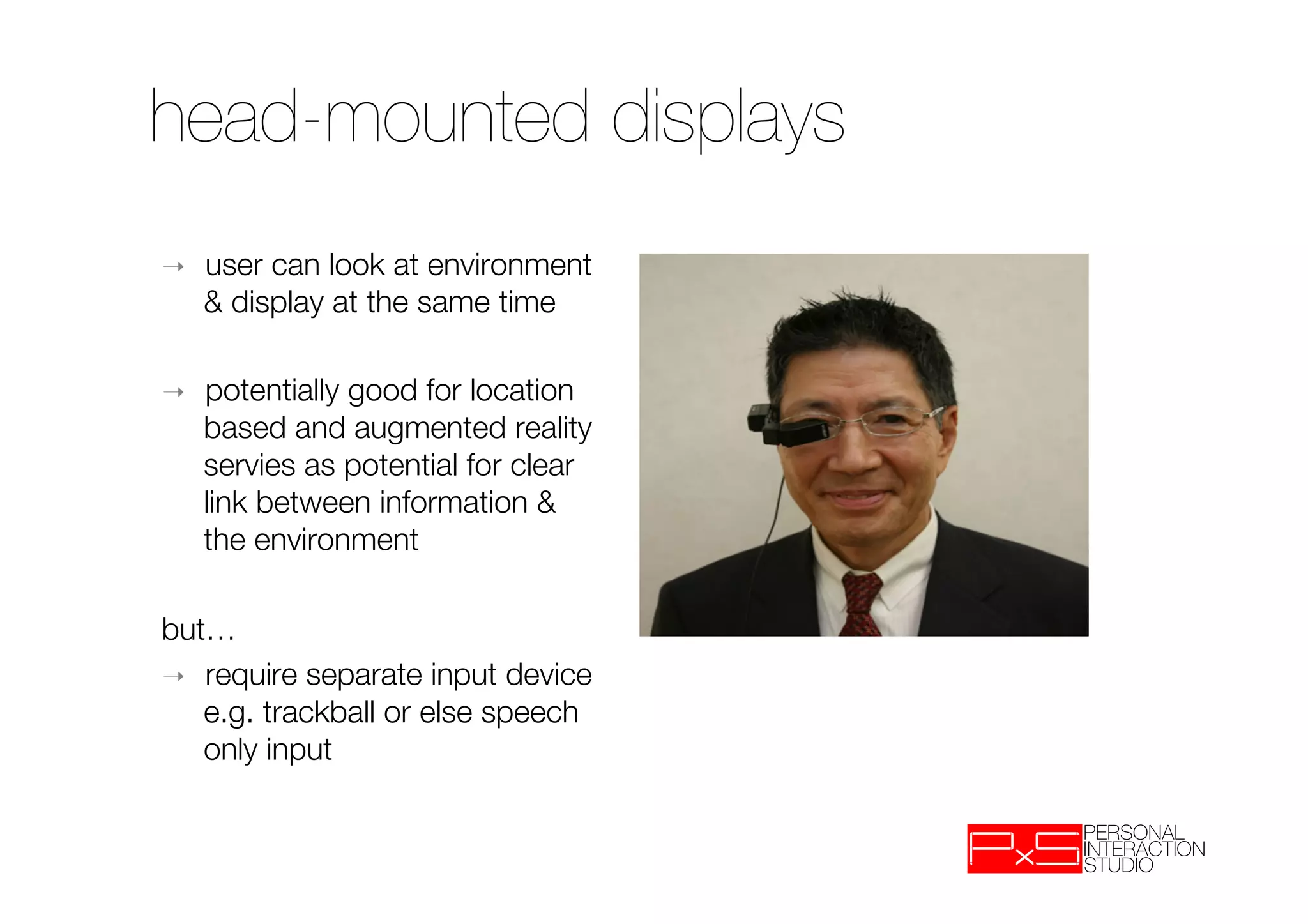
head-mounted displays
➝    user can look at environment
     & display at the same time

➝    potentially good for location
     based and augmented reality
     servies as potential for clear
     link between information &
     the environment

but…
➝  require separate input device
   e.g. trackball or else speech
   only input
summary: some key points
➝  Key design challenges: small screens & context
➝  mobile text entry research ongoing, in particular for
   finger-based input via touch screens
➝  movement as input
➝  importance of overviews when browsing documents on
   small screens
➝  off-screen visualizations
➝  audio & haptic output is a way to reduce demand on
   visual attention

PxS’12 - week 8 - mobile i/o

  • 1.
    EPFL, spring 2012– week 8! mobile i/o
  • 2.
    overview ➝  types of mobile device ➝  design challenges ➝  in: text entry ➝  in: overcoming finger occlusion ➝  in: movement ➝  out: overviews ➝  out: off-screen visualizations ➝  out: audio & haptic output ✱this lecture is based on Will Seager s (UCL) lecture of mobile systems
  • 3.
  • 4.
    why touchscreens? ➝  largerscreens for video, maps, websites, documents etc ➝  easier to point
  • 5.
    finger vs stylus advantagesof finger… ➝  can’t lose stylus ➝  fast response to alerts e.g. phone calls ➝  one-handed operation disadvantages… ➝  low pointing accuracy ➝  finger occlusion ➝  dirty screen
  • 6.
  • 7.
  • 8.
    in: text entry ➝  > 1 billion text messages sent per day ➝  most common type of mobile interaction ➝  companies are looking for improvements to mobile text entry methods ➝  many methods currently exist
  • 9.
    Text entry researchtimeline Mackenzie 2008
  • 10.
    three broad categories Physical Virtual Keyboards key-based finger-based stylus-based
  • 11.
    physical vs virtualkeyboards ➝  physical keyboards ➝  mobile phone keypad, mobile qwerty (e.g. Blackberry), 5 button pager, 3-key date stamp, 1 key input etc ➝  virtual keyboards ➝  aka “soft keyboards” or “on-screen keyboards” ➝  similar to clicking buttons in a GUI ➝  used with a stylus or a finger (but also with other input mechanisms e.g. eye tracking) ➝  design issues ➝  number of keys, key layout, key size, key shape, activation force, feedback, disambiguation, language modelling, word prediction etc
  • 12.
    number of keys& layout QWERTY ➝  both physical & virtual keyboards vary in number of keys & layouts ➝  for mobile text input, 26 MOBILE key qwerty & 9/12 key ABC are by far the most common ➝  other 26-key layout variations include Opti, Dvorak & Fitaly ➝  other 9/12 key variations include 9/12 key qwerty
  • 13.
    number of keys& layout QWERTY ➝ other layouts have been shown to lead to better performance BUT familiarity a crucial OPTI factor opti outperforms qwerty (faster, fewer errors) after a few hours practice
  • 14.
    number of keyscontinuum more ambiguity continuum less
  • 15.
    ambiguity 7 8 6 6 3 7 ? PQRS TUV MNO MNO DEF PQRS or, is it SUMMER, is it STONES ? ➝  ambiguity occurs if there are fewer keys than symbols in the language => disambiguation is needed to select the intended word from the possibilities. ➝  disambiguation methods include multi-tap and T9
  • 16.
    virtual keyboards stylusmethods SWYPE ➝  tapping on virtual keyboards ➝  handwriting recognition finger methods ➝  tapping on virtual keyboards new method for stylus & finger ➝  sliding stylus/finger across the screen
  • 17.
    virtual keyboards: feedback ➝ performance with virtual keyboards improves with vibro- tactile feedback ➝  visual and audio feedback may also be useful
  • 18.
    ➝  finger/thumb occludes ➝ lower precision when pointing
  • 19.
  • 20.
    “shift” target selectiontechnique ➝  “shift” – a technique for enabling fine cursor pointing using fingers
  • 21.
    “escape” target selectiontechnique a)  the user presses his/her thumb near the desired target b)  the gestures in the direction indicated by the target c)  the target is selected, despite several nearby distractors.
  • 22.
  • 23.
  • 24.
    tilting (Rekimoto uist 96)
  • 25.
    “chameleon” (Fitzmaurice 1993)
  • 26.
  • 27.
    camera phone basedmotion sensing (Whang, Zhai & Canny 2006)
  • 28.
    viewing large documentson small displays
  • 29.
    overviews (O’Hara et al 1999) (Woobrock et al 2002)
  • 30.
  • 31.
    off-screen visualizations (Baudisch & Rosenholtz 2003 Gustafson et al 2008)
  • 32.
    audio & hapticoutput ➝  non speech audio output ➝  bleeps, earcons, auditory icons ➝  haptics ➝  refers to interaction via sense of touch Example earcons from (Brewster et al 2008) and/or motor activity.
  • 33.
    why use audioand/or haptic output? ➝  attention grabbing ➝  saves screen real estate ➝  can provide information without requiring visual attention
  • 34.
  • 35.
    head-mounted displays ➝  user can look at environment & display at the same time ➝  potentially good for location based and augmented reality servies as potential for clear link between information & the environment but… ➝  require separate input device e.g. trackball or else speech only input
  • 36.
    summary: some keypoints ➝  Key design challenges: small screens & context ➝  mobile text entry research ongoing, in particular for finger-based input via touch screens ➝  movement as input ➝  importance of overviews when browsing documents on small screens ➝  off-screen visualizations ➝  audio & haptic output is a way to reduce demand on visual attention