Contents:
1
•Introduction
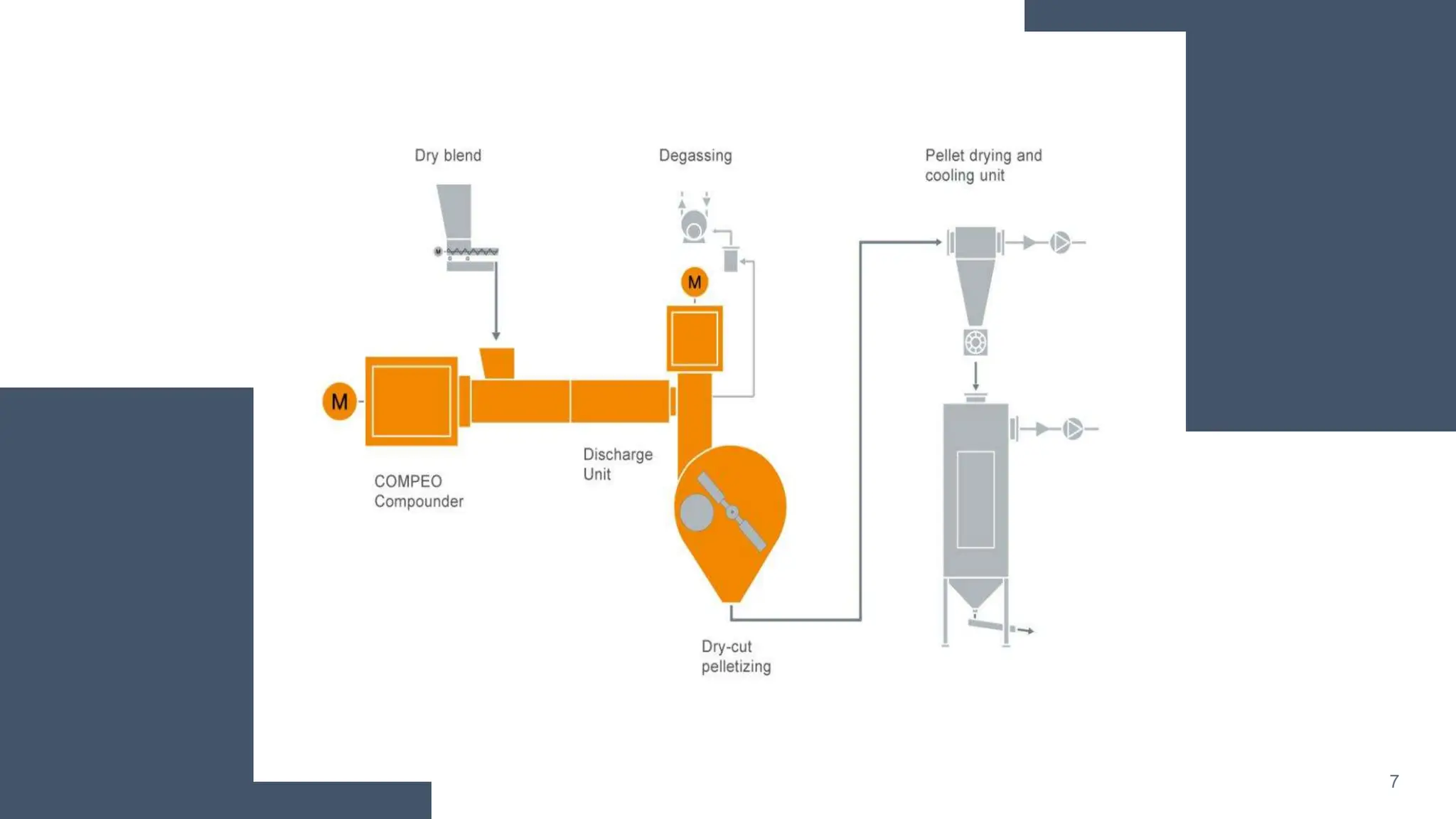
•Formulation Process of PVC Compounds
•Extrussion Process Diagram
•Properties and Applications
•Reference’s
Introduction
27/01/24 PRESENTATION TITLE 2
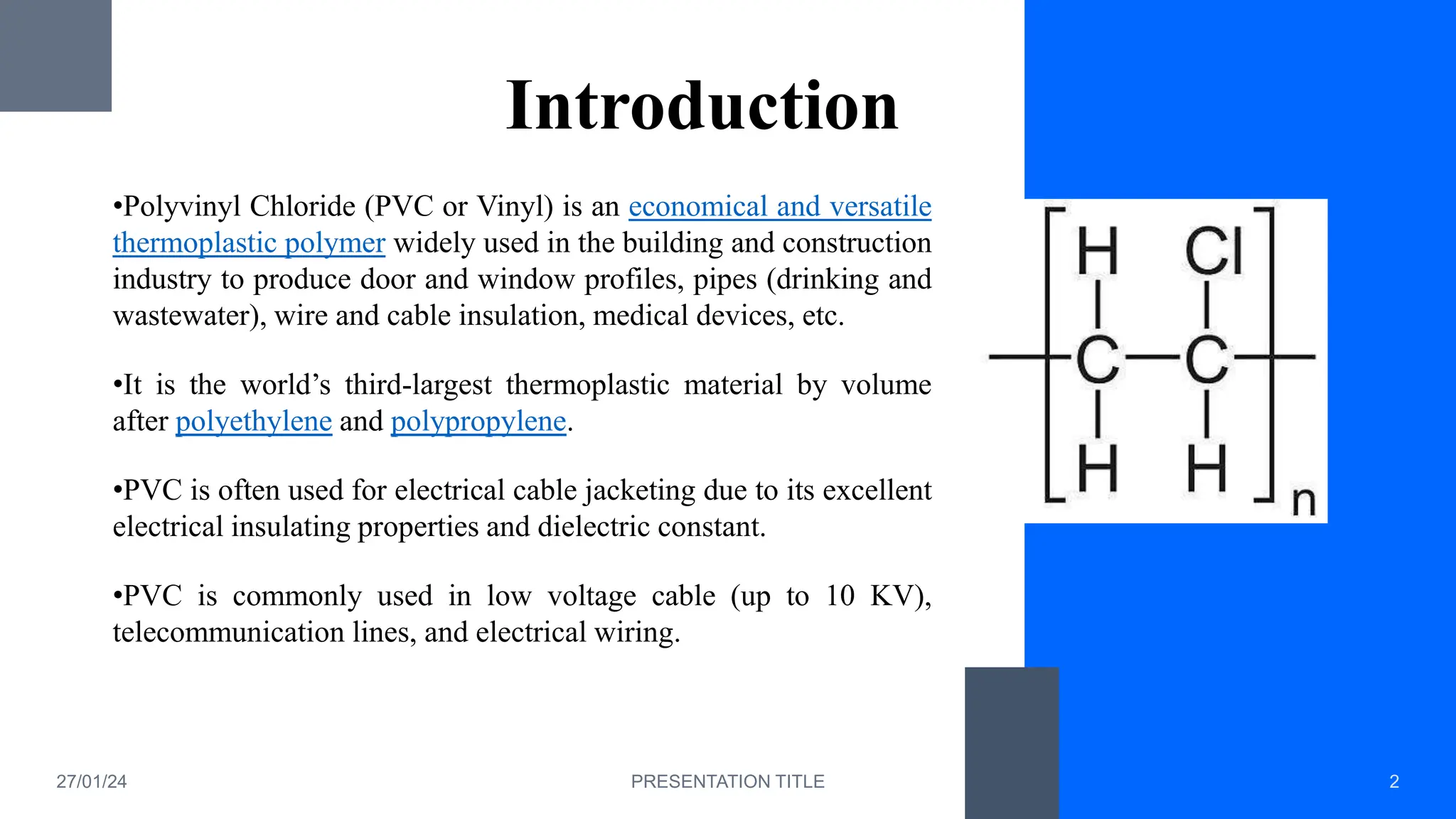
•Polyvinyl Chloride (PVC or Vinyl) is an economical and versatile
thermoplastic polymer widely used in the building and construction
industry to produce door and window profiles, pipes (drinking and
wastewater), wire and cable insulation, medical devices, etc.
•It is the world’s third-largest thermoplastic material by volume
after polyethylene and polypropylene.
•PVC is often used for electrical cable jacketing due to its excellent
electrical insulating properties and dielectric constant.
•PVC is commonly used in low voltage cable (up to 10 KV),
telecommunication lines, and electrical wiring.
Cables and wires:
Basic formulation for the production of PVC insulation and jacket
compounds for wire and cable is generally composed of the following:
1.PVC
2.Plasticizer
3.Filler
4.Pigment
5.Stabilizers and co-stabilizers
6.Lubricants
7.Additives (flame retardants, UV-absorbers, etc.)
Plasticizer Selection
•Plasticizers are always added to wire & cable insulation and jacket compounds to increase
flexibility and decrease brittleness. It is important that the plasticizer used have a high
compatibility with PVC, low volatility, good aging properties, and be electrolyte-free.
•General purpose phthalate esters such as DOP, DINP, and DIDP are often used as primary
plasticizers in wire and cable formulations due to their broad area of use, good mechanical
properties, and good electrical properties.
Commonly Used Fillers
•Fillers are used in wire & cable formulations to reduce the price of the compound while
improving electrical or physical properties. Fillers can positively affect heat transfer and
thermal conductivity. Calcium Carbonate is the most common filler for this purpose. Silicas
are also sometimes used.
4
Pigments in Wire and Cable
•Pigments are of course added to provide distinguishing color to compounds. Titanium
Dioxide is the most commonly used color carrier.
Lubricants
•Lubricants for wire and cable can be either external or internal, and are used to aid in the
reduction of the PVC sticking on the hot metal surfaces of the processing
equipment. Plasticizers themselves can act as an internal lubricant, as well as Calcium
Stearate. Fatty alcohols, waxes, paraffin and PEGs are can be used for additional lubrication.
Common Additives in Wire & Cable
•Additives are used to impart special properties required for the end use of the product, for
example, flame retardancy or resistance to weathering by the sun or by microbes. Flame
retardancy is a common requirement for wire and cable formulations. Additives such
as Antimony Trioxide (ATO) are effective flame retardants. Plasticizers used such as
phosphoric esters (i.e. TBP, TOF) can also impart flame retardant properties. UV-absorbers
may be added for exterior use applications to prevent weathering by the sun.
5
PRESENTATION TITLE 6
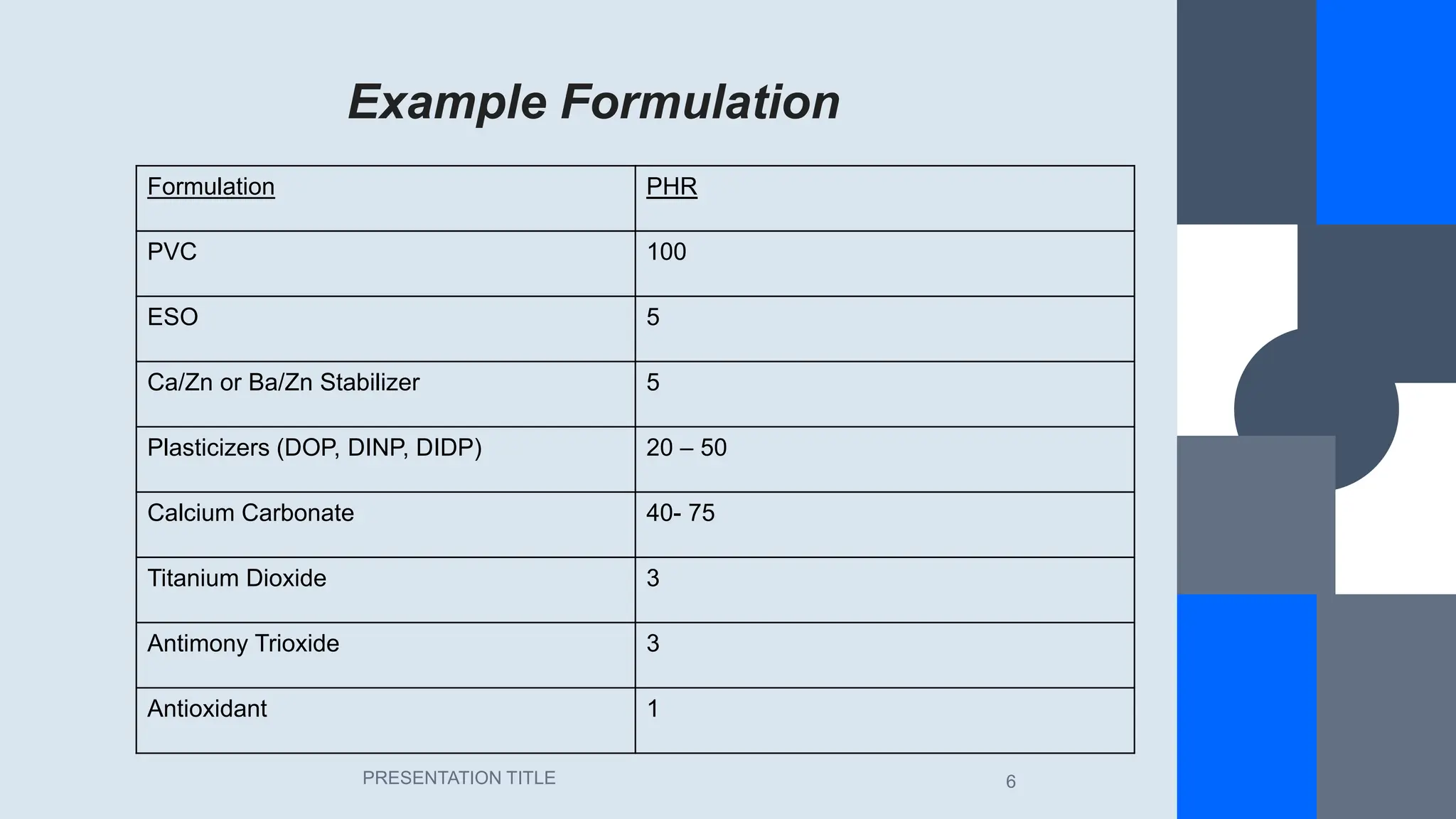
Example Formulation
Formulation PHR
PVC 100
ESO 5
Ca/Zn or Ba/Zn Stabilizer 5
Plasticizers (DOP, DINP, DIDP) 20 – 50
Calcium Carbonate 40- 75
Titanium Dioxide 3
Antimony Trioxide 3
Antioxidant 1
7
Properties and Application
27/01/24 PRESENTATION TITLE 8
•PVC based plasticizers have considerable mechanical
strength and water resistance, high thermal resistance to
low temperatures, good insulation properties, insoluble
in gasoline and kerosene, abrasion, acid and alkali
resistant.
•commonly used in low voltage wire & cable (up to 10
kV), telecommunication lines, automotive wires other
electrical wiring
Reference :
PVC compounds for Wires & Cables
https://www.vitahco.com/pvc-compounds-for-wires-and-
cables#:~:text=PVC%20compounds%20are%20commonly%
20used,Plasticizer
Formulation 101: Wire and Cable Insulation and Jacket PVC
Compound
https://chemceed.com/product-news/formulation-101-wire-
cable-insulation-jacket-pvc-compounds/
27/01/24 PRESENTATION TITLE 9
Thank you

PVC Compounds for wire and Cabels .pptx

  • 1.
    Contents: 1 •Introduction •Formulation Process ofPVC Compounds •Extrussion Process Diagram •Properties and Applications •Reference’s
  • 2.
    Introduction 27/01/24 PRESENTATION TITLE2 •Polyvinyl Chloride (PVC or Vinyl) is an economical and versatile thermoplastic polymer widely used in the building and construction industry to produce door and window profiles, pipes (drinking and wastewater), wire and cable insulation, medical devices, etc. •It is the world’s third-largest thermoplastic material by volume after polyethylene and polypropylene. •PVC is often used for electrical cable jacketing due to its excellent electrical insulating properties and dielectric constant. •PVC is commonly used in low voltage cable (up to 10 KV), telecommunication lines, and electrical wiring.
  • 3.
    Cables and wires: Basicformulation for the production of PVC insulation and jacket compounds for wire and cable is generally composed of the following: 1.PVC 2.Plasticizer 3.Filler 4.Pigment 5.Stabilizers and co-stabilizers 6.Lubricants 7.Additives (flame retardants, UV-absorbers, etc.)
  • 4.
    Plasticizer Selection •Plasticizers arealways added to wire & cable insulation and jacket compounds to increase flexibility and decrease brittleness. It is important that the plasticizer used have a high compatibility with PVC, low volatility, good aging properties, and be electrolyte-free. •General purpose phthalate esters such as DOP, DINP, and DIDP are often used as primary plasticizers in wire and cable formulations due to their broad area of use, good mechanical properties, and good electrical properties. Commonly Used Fillers •Fillers are used in wire & cable formulations to reduce the price of the compound while improving electrical or physical properties. Fillers can positively affect heat transfer and thermal conductivity. Calcium Carbonate is the most common filler for this purpose. Silicas are also sometimes used. 4
  • 5.
    Pigments in Wireand Cable •Pigments are of course added to provide distinguishing color to compounds. Titanium Dioxide is the most commonly used color carrier. Lubricants •Lubricants for wire and cable can be either external or internal, and are used to aid in the reduction of the PVC sticking on the hot metal surfaces of the processing equipment. Plasticizers themselves can act as an internal lubricant, as well as Calcium Stearate. Fatty alcohols, waxes, paraffin and PEGs are can be used for additional lubrication. Common Additives in Wire & Cable •Additives are used to impart special properties required for the end use of the product, for example, flame retardancy or resistance to weathering by the sun or by microbes. Flame retardancy is a common requirement for wire and cable formulations. Additives such as Antimony Trioxide (ATO) are effective flame retardants. Plasticizers used such as phosphoric esters (i.e. TBP, TOF) can also impart flame retardant properties. UV-absorbers may be added for exterior use applications to prevent weathering by the sun. 5
  • 6.
    PRESENTATION TITLE 6 ExampleFormulation Formulation PHR PVC 100 ESO 5 Ca/Zn or Ba/Zn Stabilizer 5 Plasticizers (DOP, DINP, DIDP) 20 – 50 Calcium Carbonate 40- 75 Titanium Dioxide 3 Antimony Trioxide 3 Antioxidant 1
  • 7.
  • 8.
    Properties and Application 27/01/24PRESENTATION TITLE 8 •PVC based plasticizers have considerable mechanical strength and water resistance, high thermal resistance to low temperatures, good insulation properties, insoluble in gasoline and kerosene, abrasion, acid and alkali resistant. •commonly used in low voltage wire & cable (up to 10 kV), telecommunication lines, automotive wires other electrical wiring
  • 9.
    Reference : PVC compoundsfor Wires & Cables https://www.vitahco.com/pvc-compounds-for-wires-and- cables#:~:text=PVC%20compounds%20are%20commonly% 20used,Plasticizer Formulation 101: Wire and Cable Insulation and Jacket PVC Compound https://chemceed.com/product-news/formulation-101-wire- cable-insulation-jacket-pvc-compounds/ 27/01/24 PRESENTATION TITLE 9
  • 10.