A Comprehensive Approach to Wire &
    Cable Material Enhancement


       Polymers in Cables
Overview

    • Curing Performance Rubber
       - Coagent Definition
       - Performance Measures
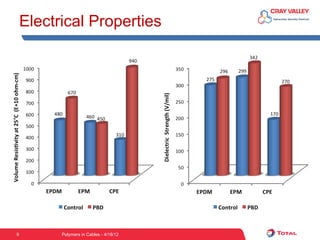
       - Applications
    • Inorganic Mineral Dispersion
       - Mineral Dispersion
       - NHFR Transition
       - Property Balancing
    • Flow & Processibility Optimization
       - Flow Modification
       - Nylon Chain Extension
       - TPE Flow Optimization

2            Cray Valley HSC
Coagent Function

    • Coagents increase the quantity of crosslinks formed by
      making more efficient use of radicals
       - Minimize beta scission reactions
       - Maximize crosslink-forming reactions


    • Through the proper choice of coagents, the quality of the
      crosslinks can be changed as well
       - Alter the bond strength of linkage
       - Alter network polarity


3             Polymers in Cables - 4/18/12
Coagent Types

• Type I Coagents: Increase both the rate and state of
  cure
     - Generate very reactive radicals

     - Polar molecules usually of low molecular weight

     - Capable of homopolymerization as well as grafting

     - Typical structures include acrylate and methacrylate esters,
     bismaleimides


4           Polymers in Cables - 4/18/12
Coagent Types

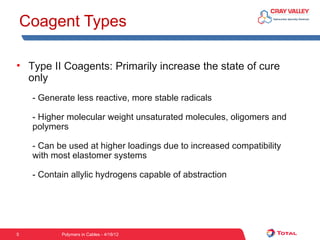
• Type II Coagents: Primarily increase the state of cure
  only
     - Generate less reactive, more stable radicals

     - Higher molecular weight unsaturated molecules, oligomers and
     polymers

     - Can be used at higher loadings due to increased compatibility
     with most elastomer systems

     - Contain allylic hydrogens capable of abstraction


5           Polymers in Cables - 4/18/12
Cure Profiles

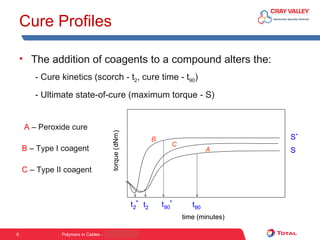
    • The addition of coagents to a compound alters the:
       - Cure kinetics (scorch - t2, cure time - t90)

       - Ultimate state-of-cure (maximum torque - S)


     A – Peroxide cure
                                       torque (dNm)


                                                                B                           S*
                                                                       C
    B – Type I coagent                                                              A       S

    C – Type II coagent


                                                      t 2* t2       t90*      t90
                                                                           time (minutes)

6              Polymers in Cables - 4/18/12
Rubber Study

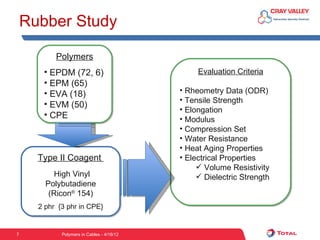
           Polymers
       • EPDM (72, 6)                            Evaluation Criteria
       • EPM (65)
       • EVA (18)                           • Rheometry Data (ODR)
                                            • Tensile Strength
       • EVM (50)
                                            • Elongation
       • CPE                                • Modulus
                                            • Compression Set
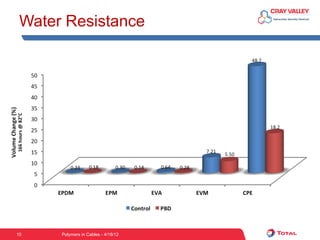
                                            • Water Resistance
                                            • Heat Aging Properties
      Type II Coagent                       • Electrical Properties
                                                  Volume Resistivity
           High Vinyl                             Dielectric Strength
        Polybutadiene
         (Ricon® 154)
      2 phr {3 phr in CPE}


7            Polymers in Cables - 4/18/12
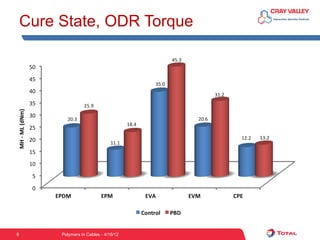
Cure State, ODR Torque


8        Polymers in Cables - 4/18/12
Electrical Properties


9         Polymers in Cables - 4/18/12
Water Resistance


10    Polymers in Cables - 4/18/12
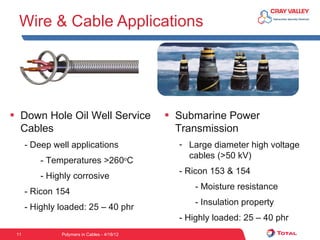
Wire & Cable Applications


 Down Hole Oil Well Service                  Submarine Power
 Cables                                      Transmission
     - Deep well applications                - Large diameter high voltage
                                               cables (>50 kV)
         - Temperatures >260oC
                                             - Ricon 153 & 154
         - Highly corrosive
                                                 - Moisture resistance
     - Ricon 154
                                                 - Insulation property
     - Highly loaded: 25 – 40 phr
                                             - Highly loaded: 25 – 40 phr
11            Polymers in Cables - 4/18/12
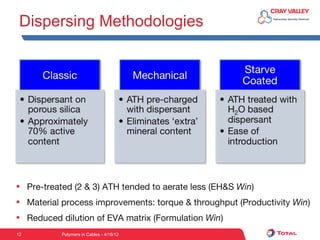
Dispersing Methodologies


     Pre-treated (2 & 3) ATH tended to aerate less (EH&S Win)
     Material process improvements: torque & throughput (Productivity Win)
     Reduced dilution of EVA matrix (Formulation Win)
12           Polymers in Cables - 4/18/12
Improved Dispersion

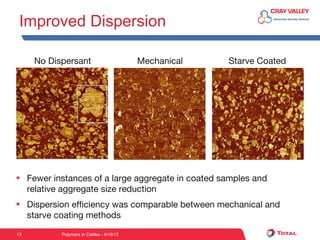
      No Dispersant                         Mechanical   Starve Coated


     Fewer instances of a large aggregate in coated samples and
     relative aggregate size reduction
     Dispersion efficiency was comparable between mechanical and
     starve coating methods

13           Polymers in Cables - 4/18/12
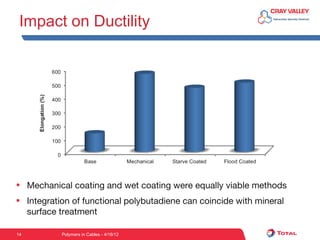
Impact on Ductility


     Mechanical coating and wet coating were equally viable methods
     Integration of functional polybutadiene can coincide with mineral
     surface treatment

14           Polymers in Cables - 4/18/12
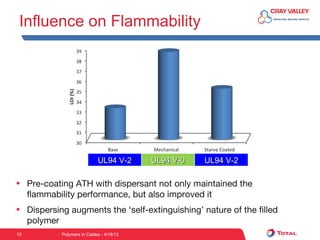
Influence on Flammability


                               UL94 V-2      UL94 V-0   UL94 V-2

     Pre-coating ATH with dispersant not only maintained the
     flammability performance, but also improved it
     Dispersing augments the ‘self-extinguishing’ nature of the filled
     polymer
15            Polymers in Cables - 4/18/12
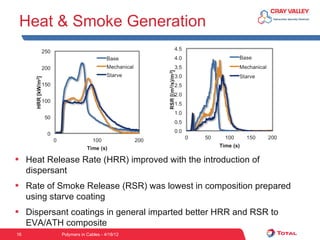
Heat & Smoke Generation


     Heat Release Rate (HRR) improved with the introduction of
     dispersant
     Rate of Smoke Release (RSR) was lowest in composition prepared
     using starve coating
     Dispersant coatings in general imparted better HRR and RSR to
     EVA/ATH composite
16           Polymers in Cables - 4/18/12
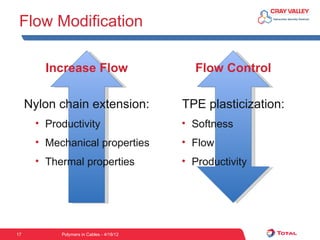
Flow Modification

        Increase Flow                       Flow Control

     Nylon chain extension:               TPE plasticization:
      • Productivity                      • Softness
      • Mechanical properties             • Flow
      • Thermal properties                • Productivity


17         Polymers in Cables - 4/18/12
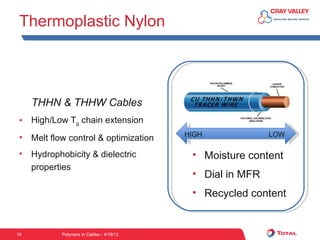
Thermoplastic Nylon


     THHN & THHW Cables
 •   High/Low Tg chain extension
                                           HIGH             LOW
 •   Melt flow control & optimization
 •   Hydrophobicity & dielectric            • Moisture content
     properties
                                            • Dial in MFR
                                            • Recycled content


18          Polymers in Cables - 4/18/12
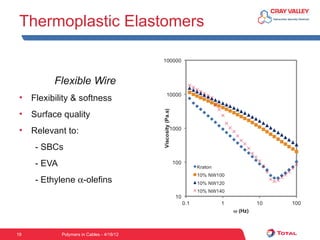
Thermoplastic Elastomers


           Flexible Wire
 •   Flexibility & softness
 •   Surface quality
 •   Relevant to:
      - SBCs
      - EVA
      - Ethylene α-olefins


19            Polymers in Cables - 4/18/12
Cray Valley HSC

 •   Leading global supplier of hydrocarbon resins, diene-based resins,
     and specialty monomers
      - Wingtack® and Norsolene® (C5 & C9 tackifiers)
      - Poly bd®, KrasolTM, and Ricon® (low molecular weight liquid
      polybutadiene resins)
      - SMA® (styrene-maleic anhydride copolymer resins)
      - DymalinkTM (metal centered monomers)
 •   Annual sales over $350 million and has more than 340 employees
     worldwide
 •   Company’s more than 250 products are manufactured at 9 sites in 4
     countries

20          Polymers in Cables - 4/18/12
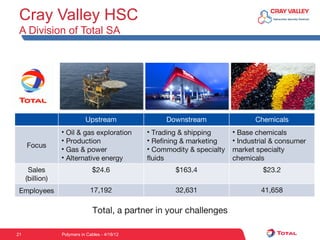
Cray Valley HSC
 A Division of Total SA


                            Upstream                 Downstream                  Chemicals
                 • Oil & gas exploration        • Trading & shipping      • Base chemicals
                 • Production                   • Refining & marketing    • Industrial & consumer
     Focus
                 • Gas & power                  • Commodity & specialty   market specialty
                 • Alternative energy           fluids                    chemicals
      Sales                    $24.6                    $163.4                     $23.2
     (billion)
 Employees                    17,192                    32,631                    41,658

                                Total, a partner in your challenges

21               Polymers in Cables - 4/18/12
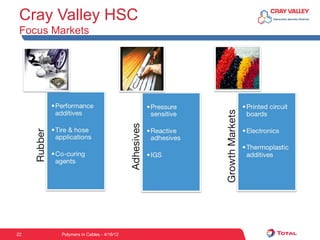
Cray Valley HSC
 Focus Markets


22      Polymers in Cables - 4/18/12
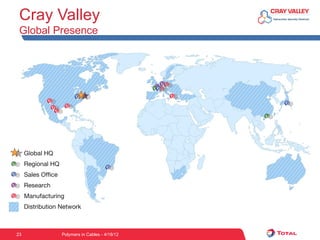
Cray Valley
     Global Presence


                                                        vv
                                                       vvv v
                              v v                              v
                 v                                                     v
                  vv v
                                                                   v


         Global HQ
v        Regional HQ
                                             v
v        Sales Office
v        Research
v        Manufacturing
         Distribution Network


    23                  Polymers in Cables - 4/18/12
Cray Valley HSC


     •For additional information about Cray Valley, its products
         or its work in Hydrocarbon Specialty Chemicals,
                   visit www.CVPolymerAdditives.com.


24           Polymers in Cables - 4/18/12

Polymers in Cables

  • 1.
    A Comprehensive Approachto Wire & Cable Material Enhancement Polymers in Cables
  • 2.
    Overview • Curing Performance Rubber - Coagent Definition - Performance Measures - Applications • Inorganic Mineral Dispersion - Mineral Dispersion - NHFR Transition - Property Balancing • Flow & Processibility Optimization - Flow Modification - Nylon Chain Extension - TPE Flow Optimization 2 Cray Valley HSC
  • 3.
    Coagent Function • Coagents increase the quantity of crosslinks formed by making more efficient use of radicals - Minimize beta scission reactions - Maximize crosslink-forming reactions • Through the proper choice of coagents, the quality of the crosslinks can be changed as well - Alter the bond strength of linkage - Alter network polarity 3 Polymers in Cables - 4/18/12
  • 4.
    Coagent Types • TypeI Coagents: Increase both the rate and state of cure - Generate very reactive radicals - Polar molecules usually of low molecular weight - Capable of homopolymerization as well as grafting - Typical structures include acrylate and methacrylate esters, bismaleimides 4 Polymers in Cables - 4/18/12
  • 5.
    Coagent Types • TypeII Coagents: Primarily increase the state of cure only - Generate less reactive, more stable radicals - Higher molecular weight unsaturated molecules, oligomers and polymers - Can be used at higher loadings due to increased compatibility with most elastomer systems - Contain allylic hydrogens capable of abstraction 5 Polymers in Cables - 4/18/12
  • 6.
    Cure Profiles • The addition of coagents to a compound alters the: - Cure kinetics (scorch - t2, cure time - t90) - Ultimate state-of-cure (maximum torque - S) A – Peroxide cure torque (dNm) B S* C B – Type I coagent A S C – Type II coagent t 2* t2 t90* t90 time (minutes) 6 Polymers in Cables - 4/18/12
  • 7.
    Rubber Study Polymers • EPDM (72, 6) Evaluation Criteria • EPM (65) • EVA (18) • Rheometry Data (ODR) • Tensile Strength • EVM (50) • Elongation • CPE • Modulus • Compression Set • Water Resistance • Heat Aging Properties Type II Coagent • Electrical Properties  Volume Resistivity High Vinyl  Dielectric Strength Polybutadiene (Ricon® 154) 2 phr {3 phr in CPE} 7 Polymers in Cables - 4/18/12
  • 8.
    Cure State, ODRTorque 8 Polymers in Cables - 4/18/12
  • 9.
    Electrical Properties 9 Polymers in Cables - 4/18/12
  • 10.
    Water Resistance 10 Polymers in Cables - 4/18/12
  • 11.
    Wire & CableApplications Down Hole Oil Well Service Submarine Power Cables Transmission - Deep well applications - Large diameter high voltage cables (>50 kV) - Temperatures >260oC - Ricon 153 & 154 - Highly corrosive - Moisture resistance - Ricon 154 - Insulation property - Highly loaded: 25 – 40 phr - Highly loaded: 25 – 40 phr 11 Polymers in Cables - 4/18/12
  • 12.
    Dispersing Methodologies Pre-treated (2 & 3) ATH tended to aerate less (EH&S Win) Material process improvements: torque & throughput (Productivity Win) Reduced dilution of EVA matrix (Formulation Win) 12 Polymers in Cables - 4/18/12
  • 13.
    Improved Dispersion No Dispersant Mechanical Starve Coated Fewer instances of a large aggregate in coated samples and relative aggregate size reduction Dispersion efficiency was comparable between mechanical and starve coating methods 13 Polymers in Cables - 4/18/12
  • 14.
    Impact on Ductility Mechanical coating and wet coating were equally viable methods Integration of functional polybutadiene can coincide with mineral surface treatment 14 Polymers in Cables - 4/18/12
  • 15.
    Influence on Flammability UL94 V-2 UL94 V-0 UL94 V-2 Pre-coating ATH with dispersant not only maintained the flammability performance, but also improved it Dispersing augments the ‘self-extinguishing’ nature of the filled polymer 15 Polymers in Cables - 4/18/12
  • 16.
    Heat & SmokeGeneration Heat Release Rate (HRR) improved with the introduction of dispersant Rate of Smoke Release (RSR) was lowest in composition prepared using starve coating Dispersant coatings in general imparted better HRR and RSR to EVA/ATH composite 16 Polymers in Cables - 4/18/12
  • 17.
    Flow Modification Increase Flow Flow Control Nylon chain extension: TPE plasticization: • Productivity • Softness • Mechanical properties • Flow • Thermal properties • Productivity 17 Polymers in Cables - 4/18/12
  • 18.
    Thermoplastic Nylon THHN & THHW Cables • High/Low Tg chain extension HIGH LOW • Melt flow control & optimization • Hydrophobicity & dielectric • Moisture content properties • Dial in MFR • Recycled content 18 Polymers in Cables - 4/18/12
  • 19.
    Thermoplastic Elastomers Flexible Wire • Flexibility & softness • Surface quality • Relevant to: - SBCs - EVA - Ethylene α-olefins 19 Polymers in Cables - 4/18/12
  • 20.
    Cray Valley HSC • Leading global supplier of hydrocarbon resins, diene-based resins, and specialty monomers - Wingtack® and Norsolene® (C5 & C9 tackifiers) - Poly bd®, KrasolTM, and Ricon® (low molecular weight liquid polybutadiene resins) - SMA® (styrene-maleic anhydride copolymer resins) - DymalinkTM (metal centered monomers) • Annual sales over $350 million and has more than 340 employees worldwide • Company’s more than 250 products are manufactured at 9 sites in 4 countries 20 Polymers in Cables - 4/18/12
  • 21.
    Cray Valley HSC A Division of Total SA Upstream Downstream Chemicals • Oil & gas exploration • Trading & shipping • Base chemicals • Production • Refining & marketing • Industrial & consumer Focus • Gas & power • Commodity & specialty market specialty • Alternative energy fluids chemicals Sales $24.6 $163.4 $23.2 (billion) Employees 17,192 32,631 41,658 Total, a partner in your challenges 21 Polymers in Cables - 4/18/12
  • 22.
    Cray Valley HSC Focus Markets 22 Polymers in Cables - 4/18/12
  • 23.
    Cray Valley Global Presence vv vvv v v v v v v vv v v Global HQ v Regional HQ v v Sales Office v Research v Manufacturing Distribution Network 23 Polymers in Cables - 4/18/12
  • 24.
    Cray Valley HSC •For additional information about Cray Valley, its products or its work in Hydrocarbon Specialty Chemicals, visit www.CVPolymerAdditives.com. 24 Polymers in Cables - 4/18/12