Pursuing a Better
Investment Experience
80 South Eighth Street
Suite 4900
Minneapolis, MN 55402
www.totalwealthadvisors.com
In US dollars. Global electronic order book (largest 50 exchanges). Source: World Federation of Exchanges.
1. Embrace Market Pricing
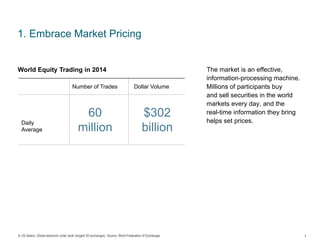
The market is an effective,
information-processing machine.
Millions of participants buy
and sell securities in the world
markets every day, and the
real-time information they bring
helps set prices.
1
World Equity Trading in 2014
Number of Trades Dollar Volume
Daily
Average
60
million
$302
billion
Beginning sample includes US equity mutual funds as of the beginning of the 15-year period ending December 31, 2014. Survivors are funds that were still in existence as of December 31, 2014. Non-survivors
include funds that were either liquidated or merged. Outperformers are funds that survived and beat their respective benchmarks over the period. Past performance is no guarantee of future results.
Data Source: The US Mutual Fund Landscape 2015, Dimensional Fund Advisors. US-domiciled mutual fund data is from the CRSP Survivor-Bias-Free US Mutual Fund Database, provided by the Center for
Research in Security Prices, University of Chicago. Benchmark data provided by MSCI, Russell, and S&P. MSCI data © MSCI 2015, all rights reserved. Russell data © Russell Investment Group 1995-2015, all
rights reserved. The S&P data are provided by Standard & Poor’s Index Services Group. Benchmark indices are not available for direct investment. Their performance does not reflect the expenses associated
with the management of an actual portfolio. Mutual fund investment values will fluctuate, and shares, when redeemed, may be worth more or less than their original cost. Diversification neither assures a profit nor
guarantees against a loss in a declining market.
2. Don’t Try to Outguess the Market
The market's pricing power
works against mutual fund
managers who try to outsmart
other participants through stock
picking or market timing.
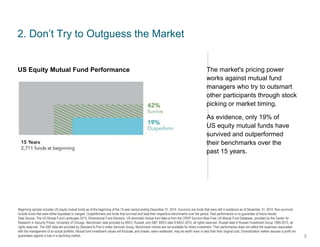
As evidence, only 19% of
US equity mutual funds have
survived and outperformed
their benchmarks over the
past 15 years.
2
US Equity Mutual Fund Performance
The graph shows the proportion of US equity mutual funds that outperformed and underperformed their respective benchmarks (i.e., winners and losers) during the initial 10-year period ending December 31,
2009. Winning funds were re-evaluated in the subsequent five-year period from 2010 through 2014, with the graph showing winners (outperformers) and losers (underperformers). Fund count and percentages
may not correspond due to rounding. Past performance is no guarantee of future results. Data Source: The US Mutual Fund Landscape 2015, Dimensional Fund Advisors. US-domiciled mutual fund data is from
the CRSP Survivor-Bias-Free US Mutual Fund Database, provided by the Center for Research in Security Prices, University of Chicago. Benchmark data provided by MSCI, Russell, and S&P. MSCI data © MSCI
2015, all rights reserved. Russell data © Russell Investment Group 1995-2015, all rights reserved. The S&P data are provided by Standard & Poor’s Index Services Group. Benchmark indices are not available for
direct investment. Their performance does not reflect the expenses associated with the management of an actual portfolio. Mutual fund investment values will fluctuate, and shares, when redeemed, may be worth
more or less than their original cost. Diversification neither assures a profit nor guarantees against a loss in a declining market.
3. Resist Chasing Past Performance
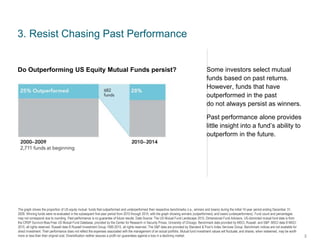
Some investors select mutual
funds based on past returns.
However, funds that have
outperformed in the past
do not always persist as winners.
Past performance alone provides
little insight into a fund’s ability to
outperform in the future.
3
Do Outperforming US Equity Mutual Funds persist?
In US dollars. Indices are not available for direct investment. Their performance does not reflect the expenses associated with the management of an actual portfolio. US Small Cap Index is the Fama/French US
Small Cap Index; US Large Cap Index is the Fama/French US Large Cap Index; Long-Term Government Bonds Index is 20-year US Government Bonds; Treasury Bills are One-Month US Treasury bills; Inflation
is the Consumer Price Index. Fama/French Data provided by Fama/French. Eugene Fama and Ken French are members of the Board of Directors for and provide consulting services to Dimensional
Fund Advisors LP. Bonds, T-bills, and inflation data © Stocks, Bonds, Bills, and Inflation Yearbook™, Ibbotson Associates, Chicago (annually updated work by Roger G. Ibbotson and Rex A. Sinquefield). Past
performance is no guarantee of future results.
4. Let Markets Work for You
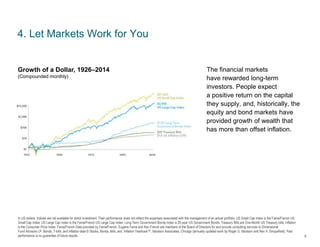
The financial markets
have rewarded long-term
investors. People expect
a positive return on the capital
they supply, and, historically, the
equity and bond markets have
provided growth of wealth that
has more than offset inflation.
4
Growth of a Dollar, 1926–2014
(Compounded monthly)
Diversification does not eliminate the risk of market loss. Relative price as measured by the price-to-book ratio; value stocks are those with lower price-to-book ratios.
Profitability is a measure of current profitability, based on information from individual companies’ income statements.
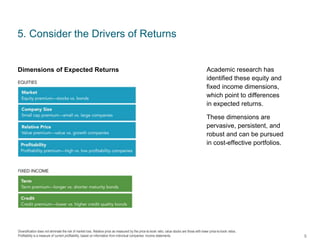
5. Consider the Drivers of Returns
Academic research has
identified these equity and
fixed income dimensions,
which point to differences
in expected returns.
These dimensions are
pervasive, persistent, and
robust and can be pursued
in cost-effective portfolios.
5
Dimensions of Expected Returns
Number of holdings for the S&P 500 and MSCI All Country World Index—Investable Market Index (MSCI ACWI IMI) as of December 31, 2014. Indices are not available for direct investment and their performance
does not reflect the expenses associated with the management of an actual portfolio. International investing involves special risks such as currency fluctuation and political instability. Investing in emerging
markets may accentuate these risks. Past performance is not a guarantee of future results. Diversification neither ensures a profit nor guarantees against loss in a declining market. The S&P data are provided by
Standard & Poor’s Index Services Group. MSCI data © MSCI 2015, all rights reserved.
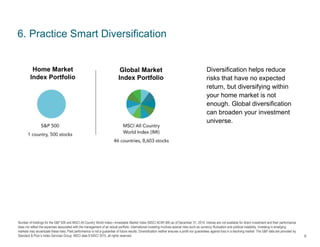
6. Practice Smart Diversification
Diversification helps reduce
risks that have no expected
return, but diversifying within
your home market is not
enough. Global diversification
can broaden your investment
universe.
6
Home Market
Index Portfolio
Global Market
Index Portfolio
In US dollars. Chart is for illustrative purposes only. Index descriptions for asset groups: US Large Cap is the S&P 500 Index, provided by Standard & Poor’s Index Services Group. US Large Cap Value is the
Russell 1000 Value Index. US Small Cap is the Russell 2000 Index. US Small Cap Value is the Russell 2000 Value Index. Russell data © Russell Investment Group 1995–2015, all rights reserved. US Real Estate
is the Dow Jones US Select REIT Index, provided by Dow Jones Indexes. International Large Cap Value data provided by Fama/French from Bloomberg and MSCI securities data. International Small Cap Value
data compiled by Dimensional from Bloomberg and Style Research securities data. Emerging Markets is the MSCI Emerging Markets Index (gross dividends), © MSCI 2015, all rights reserved. Five-Year US
Government Fixed is the Barclays Capital Treasury Bond Index 1−5 Years, formerly Lehman Brothers, provided by Barclays Bank PLC. Indices are not available for direct investment. Index performance does not
reflect the expenses associated with the management of an actual portfolio. Past performance is not a guarantee of future results.
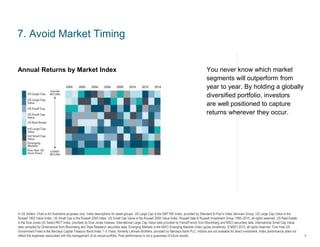
7. Avoid Market Timing
You never know which market
segments will outperform from
year to year. By holding a globally
diversified portfolio, investors
are well positioned to capture
returns wherever they occur.
7
Annual Returns by Market Index
For illustrative purposes only.
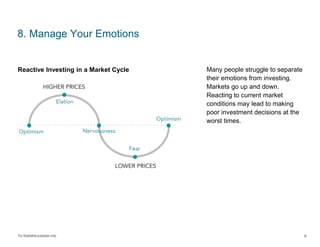
8. Manage Your Emotions
Many people struggle to separate
their emotions from investing.
Markets go up and down.
Reacting to current market
conditions may lead to making
poor investment decisions at the
worst times.
8
Reactive Investing in a Market Cycle
For illustrative purposes only.
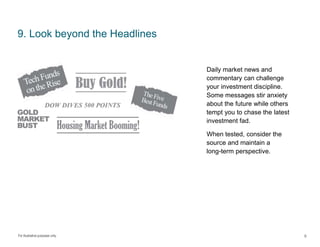
9. Look beyond the Headlines
Daily market news and
commentary can challenge
your investment discipline.
Some messages stir anxiety
about the future while others
tempt you to chase the latest
investment fad.
When tested, consider the
source and maintain a
long-term perspective.
9
Diversification does not eliminate the risk of market loss. There is no guarantee investment strategies will be successful. For illustrative purposes only.
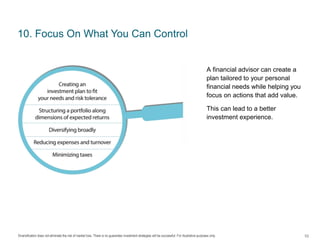
10. Focus On What You Can Control
A financial advisor can create a
plan tailored to your personal
financial needs while helping you
focus on actions that add value.
This can lead to a better
investment experience.
10

Stop Wasting Your Money & Start Having a Better Investment Experience

  • 1.
    Pursuing a Better InvestmentExperience 80 South Eighth Street Suite 4900 Minneapolis, MN 55402 www.totalwealthadvisors.com
  • 2.
    In US dollars.Global electronic order book (largest 50 exchanges). Source: World Federation of Exchanges. 1. Embrace Market Pricing The market is an effective, information-processing machine. Millions of participants buy and sell securities in the world markets every day, and the real-time information they bring helps set prices. 1 World Equity Trading in 2014 Number of Trades Dollar Volume Daily Average 60 million $302 billion
  • 3.
    Beginning sample includesUS equity mutual funds as of the beginning of the 15-year period ending December 31, 2014. Survivors are funds that were still in existence as of December 31, 2014. Non-survivors include funds that were either liquidated or merged. Outperformers are funds that survived and beat their respective benchmarks over the period. Past performance is no guarantee of future results. Data Source: The US Mutual Fund Landscape 2015, Dimensional Fund Advisors. US-domiciled mutual fund data is from the CRSP Survivor-Bias-Free US Mutual Fund Database, provided by the Center for Research in Security Prices, University of Chicago. Benchmark data provided by MSCI, Russell, and S&P. MSCI data © MSCI 2015, all rights reserved. Russell data © Russell Investment Group 1995-2015, all rights reserved. The S&P data are provided by Standard & Poor’s Index Services Group. Benchmark indices are not available for direct investment. Their performance does not reflect the expenses associated with the management of an actual portfolio. Mutual fund investment values will fluctuate, and shares, when redeemed, may be worth more or less than their original cost. Diversification neither assures a profit nor guarantees against a loss in a declining market. 2. Don’t Try to Outguess the Market The market's pricing power works against mutual fund managers who try to outsmart other participants through stock picking or market timing. As evidence, only 19% of US equity mutual funds have survived and outperformed their benchmarks over the past 15 years. 2 US Equity Mutual Fund Performance
  • 4.
    The graph showsthe proportion of US equity mutual funds that outperformed and underperformed their respective benchmarks (i.e., winners and losers) during the initial 10-year period ending December 31, 2009. Winning funds were re-evaluated in the subsequent five-year period from 2010 through 2014, with the graph showing winners (outperformers) and losers (underperformers). Fund count and percentages may not correspond due to rounding. Past performance is no guarantee of future results. Data Source: The US Mutual Fund Landscape 2015, Dimensional Fund Advisors. US-domiciled mutual fund data is from the CRSP Survivor-Bias-Free US Mutual Fund Database, provided by the Center for Research in Security Prices, University of Chicago. Benchmark data provided by MSCI, Russell, and S&P. MSCI data © MSCI 2015, all rights reserved. Russell data © Russell Investment Group 1995-2015, all rights reserved. The S&P data are provided by Standard & Poor’s Index Services Group. Benchmark indices are not available for direct investment. Their performance does not reflect the expenses associated with the management of an actual portfolio. Mutual fund investment values will fluctuate, and shares, when redeemed, may be worth more or less than their original cost. Diversification neither assures a profit nor guarantees against a loss in a declining market. 3. Resist Chasing Past Performance Some investors select mutual funds based on past returns. However, funds that have outperformed in the past do not always persist as winners. Past performance alone provides little insight into a fund’s ability to outperform in the future. 3 Do Outperforming US Equity Mutual Funds persist?
  • 5.
    In US dollars.Indices are not available for direct investment. Their performance does not reflect the expenses associated with the management of an actual portfolio. US Small Cap Index is the Fama/French US Small Cap Index; US Large Cap Index is the Fama/French US Large Cap Index; Long-Term Government Bonds Index is 20-year US Government Bonds; Treasury Bills are One-Month US Treasury bills; Inflation is the Consumer Price Index. Fama/French Data provided by Fama/French. Eugene Fama and Ken French are members of the Board of Directors for and provide consulting services to Dimensional Fund Advisors LP. Bonds, T-bills, and inflation data © Stocks, Bonds, Bills, and Inflation Yearbook™, Ibbotson Associates, Chicago (annually updated work by Roger G. Ibbotson and Rex A. Sinquefield). Past performance is no guarantee of future results. 4. Let Markets Work for You The financial markets have rewarded long-term investors. People expect a positive return on the capital they supply, and, historically, the equity and bond markets have provided growth of wealth that has more than offset inflation. 4 Growth of a Dollar, 1926–2014 (Compounded monthly)
  • 6.
    Diversification does noteliminate the risk of market loss. Relative price as measured by the price-to-book ratio; value stocks are those with lower price-to-book ratios. Profitability is a measure of current profitability, based on information from individual companies’ income statements. 5. Consider the Drivers of Returns Academic research has identified these equity and fixed income dimensions, which point to differences in expected returns. These dimensions are pervasive, persistent, and robust and can be pursued in cost-effective portfolios. 5 Dimensions of Expected Returns
  • 7.
    Number of holdingsfor the S&P 500 and MSCI All Country World Index—Investable Market Index (MSCI ACWI IMI) as of December 31, 2014. Indices are not available for direct investment and their performance does not reflect the expenses associated with the management of an actual portfolio. International investing involves special risks such as currency fluctuation and political instability. Investing in emerging markets may accentuate these risks. Past performance is not a guarantee of future results. Diversification neither ensures a profit nor guarantees against loss in a declining market. The S&P data are provided by Standard & Poor’s Index Services Group. MSCI data © MSCI 2015, all rights reserved. 6. Practice Smart Diversification Diversification helps reduce risks that have no expected return, but diversifying within your home market is not enough. Global diversification can broaden your investment universe. 6 Home Market Index Portfolio Global Market Index Portfolio
  • 8.
    In US dollars.Chart is for illustrative purposes only. Index descriptions for asset groups: US Large Cap is the S&P 500 Index, provided by Standard & Poor’s Index Services Group. US Large Cap Value is the Russell 1000 Value Index. US Small Cap is the Russell 2000 Index. US Small Cap Value is the Russell 2000 Value Index. Russell data © Russell Investment Group 1995–2015, all rights reserved. US Real Estate is the Dow Jones US Select REIT Index, provided by Dow Jones Indexes. International Large Cap Value data provided by Fama/French from Bloomberg and MSCI securities data. International Small Cap Value data compiled by Dimensional from Bloomberg and Style Research securities data. Emerging Markets is the MSCI Emerging Markets Index (gross dividends), © MSCI 2015, all rights reserved. Five-Year US Government Fixed is the Barclays Capital Treasury Bond Index 1−5 Years, formerly Lehman Brothers, provided by Barclays Bank PLC. Indices are not available for direct investment. Index performance does not reflect the expenses associated with the management of an actual portfolio. Past performance is not a guarantee of future results. 7. Avoid Market Timing You never know which market segments will outperform from year to year. By holding a globally diversified portfolio, investors are well positioned to capture returns wherever they occur. 7 Annual Returns by Market Index
  • 9.
    For illustrative purposesonly. 8. Manage Your Emotions Many people struggle to separate their emotions from investing. Markets go up and down. Reacting to current market conditions may lead to making poor investment decisions at the worst times. 8 Reactive Investing in a Market Cycle
  • 10.
    For illustrative purposesonly. 9. Look beyond the Headlines Daily market news and commentary can challenge your investment discipline. Some messages stir anxiety about the future while others tempt you to chase the latest investment fad. When tested, consider the source and maintain a long-term perspective. 9
  • 11.
    Diversification does noteliminate the risk of market loss. There is no guarantee investment strategies will be successful. For illustrative purposes only. 10. Focus On What You Can Control A financial advisor can create a plan tailored to your personal financial needs while helping you focus on actions that add value. This can lead to a better investment experience. 10

Editor's Notes

  • #3 With each trade, buyers and sellers bring new information to the market, which helps set prices. No one knows what the next bit of new information will be. The future is uncertain, but prices will adjust accordingly. This doesn’t mean that a price is always right—there’s no way to prove that. But investors can accept the market price as the best estimate of actual value. If you don’t believe that market prices are good estimates—if you believe that the market has it wrong—you are pitting your knowledge and hunches against the combined knowledge of thousands or millions of other market participants.
  • #4 Many fund managers believe they can identify “mispriced” securities and convert that knowledge into higher returns. But fair market pricing works against such efforts, as indicated by the large proportion of mutual funds that have underperformed their benchmarks. In this chart, the gray box represents the number of US-domiciled equity funds in operation during the past 15 years. These funds compose the beginning universe of that period. The striped area shows the proportion of funds that survived the 15-year period through the end of 2014. The survival rate was 42%. The blue-shaded area shows that only 19% of the equity funds survived and outperformed their respective benchmarks during the period. Over both short and long time horizons, the deck is stacked against mutual funds that attempt to outguess the market.
  • #5 Some investors use mutual fund track records as a guide to selecting funds, reasoning that a manager’s past outperformance is likely to continue in the future. Does this assumption pay off? The research offers strong evidence to the contrary. This chart illustrates the lack of persistence in outperformance among US equity mutual funds. The funds are evaluated based on their 10-year track records (20002009), and those that beat their respective benchmarks are re-evaluated in the subsequent five-year period (20102014). Among the 2,711 equity funds that began the initial 10-year period, only 25% outperformed—and among these 682 winning funds, only 28% continued to beat their benchmarks in the subsequent five-year period. Some US equity fund managers may be better than others, but they are hard to identify in advance using track records alone. Returns contain a lot of noise, and impressive track records often result from good luck. The assumption that past outperformance will continue often proves faulty and leaves many investors disappointed.
  • #6 Most people look to the financial markets as their main investment avenue—and the good news is that the capital markets have rewarded long-term investors. The markets represent capitalism at work in the economy—and historically, free markets have provided a long-term return that has offset inflation. This is documented in the growth of wealth graph, which shows monthly performance of various indices and inflation since 1926. These indices represent different areas of the US financial markets, such as stocks and bonds. The data illustrates the beneficial role of stocks in creating real wealth over time. T-bills have barely covered inflation, while longer-term bonds have provided higher returns over inflation. US stock returns have far exceeded inflation and significantly outperformed bonds. Another key point is that not all stocks or bonds are the same. For example, consider the performance of US small cap stocks vs. large cap stocks over this time period. A dollar invested in small cap stocks in 1926 would be worth more than $21,000 in 2014, compared to more than $3,900 for large cap stocks. Keep in mind that there’s risk and uncertainty in the markets. Historical results may not be repeated in the future. Nevertheless, the market is constantly pricing securities to reflect a positive expected return going forward. Otherwise, people would not invest their capital.
  • #7 Rather than viewing the market universe in terms of individual stocks and bonds, investors should define the market along the dimensions of expected returns to identify broader areas or groups that have similar relevant characteristics. This approach relies on academic research and internal testing to identify these dimensions, which point to differences in expected return. In the stock market, the dimensions are size (small cap vs. large cap), relative price (value vs. growth), and expected profitability (high vs. low). In the bond market, these dimensions are credit quality and term. The return differences between stocks and bonds can be considerably large, as can the return differences among a group of stocks or bonds. To be considered a dimension, it must be sensible, backed by data over time and across markets, and cost effective to capture in diversified portfolios. In a dimensions-based approach, capturing returns does not involve predicting which stocks, bonds, or market areas are going to outperform in the future. Rather, the goal is to hold well-diversified portfolios that emphasize dimensions of higher expected returns and have low turnover.
  • #8 Many people concentrate their investment in their home stock market. They choose only US stocks and mutual funds and consider their portfolio diversified. In some cases, they only hold a small group of securities. Yet, from a global perspective, limiting one’s investment universe to a handful of stocks, or even one stock market, is a concentrated strategy with possible risk and return implications. This slide offers a conceptual comparison of investing only in the US market, as represented by the S&P 500 Index, and structuring a globally diversified portfolio that holds assets in markets around the world, as represented by the MSCI All Country World Index (IMI). For the global portfolio, holding over 8,600 stocks in 46 countries broadens one’s investment universe. A diversified portfolio should be structured to hold multiple asset classes that represent different market areas across the world.
  • #9 Even with a globally diversified portfolio, market movements can tempt investors to switch asset classes based on predictions of future performance. But as shown in this table, there is little predictability in asset class performance from one year to the next. This slide features annual ranked performance of major asset classes in the US and international markets from 2000 through 2014. The asset classes are represented by corresponding market indices. The data shows no obvious pattern of performance across asset classes, suggesting that predicting future performance is a difficult task. The charts offer additional evidence of market efficiency and make a strong case for investors to rely on portfolio structure, rather than market timing, to pursue returns.
  • #10 The idea behind investing is to buy low and sell high. Yet, following an emotional investment cycle sparked by reactive decisions may bring the opposite effect: buying at higher prices and selling at lower prices. The 2008–09 global market downturn offers an example of how the cycle of fear and greed can drive an investor’s decisions. Some investors fled the market in early 2009, just before the rebound began. They locked in their losses and then experienced the stress of watching the markets climb. Staying disciplined through rising and falling markets can pose a challenge, but it is crucial for long-term success.
  • #11 News and financial commentary can influence people’s view of investing. Without a strong investment philosophy to guide them, they also may follow the advice of friends, neighbors, or family, especially if the “insight” promises a fast, easy return. But growing wealth has no shortcuts. Success requires a solid investment approach, a long-term perspective, and discipline to stay the course.
  • #12 To have a better investment experience, people should focus on the things they can control. It starts with an advisor creating an investment plan based on market principles, informed by financial science, and tailored to a client’s specific needs and goals. Along the way, an advisor can help clients focus on actions that add investment value, such as managing expenses and portfolio turnover while maintaining broad diversification. Equally important, an advisor can provide knowledge and encouragement to help investors stay disciplined through various market conditions.