Brendan Connelly   Vice President Index Funds Advisors, Inc.
888.643.3133 Local: 608.227.6000   [email_address] 19200 Von Karman Ave. Suite 150 Irvine, CA 92612
 
Abbreviated Disclosure for Backtested Performance Information on the Simulated Strategies of IFA Indexes and IFA Index Portfolios (Indexfolios) : 1. Index Funds Advisors, Inc. (IFA) was incorporated in March 1999 and placed its first independent client investments in early 2000. The performance information presented in the chart or table represents backtested performance based on combined simulated index data and live (or actual) mutual fund results from Jan 1, 1928 to period ending date shown using the strategy of buying, holding and annually rebalancing globally diversified portfolios of index funds. Backtested performance is hypothetical (it does not reflect trading in actual accounts) and is provided for informational purposes to indicate historical performance had the index portfolios been available over the relevant period. IFA did not offer the index portfolios until November 1999. Prior to 1999, IFA did not manage client assets. The IFA indexing investment strategy is based on the principles of Modern Portfolio Theory and the Fama and French Three Factor Model for Equities and Two Factor Model for Fixed Income. Index portfolios are designed to provide substantial global diversification (approximately 15,000 companies in 40 countries) in order to reduce investment concentration and the resulting increased risk caused by the volatility of individual companies, indexes, or asset classes. Client portfolios are monitored and rebalanced, taking into consideration risk exposure consistency, transaction costs, and tax ramifications to maintain target asset allocations as shown in the twenty index portfolios.  For complete and important disclosure information please visit : www.ifabt.com 13. Your use of these materials, including www.ifa.com Web site is your acknowledgement that you have read and understood the full disclaimer as stated above. Index portfolios, times series, standard deviations, and returns calculations are determined in the Dimensional Fund Advisors  FA Returns 2.0 program. ©Copyright 1999-2009, DFA, Inc..
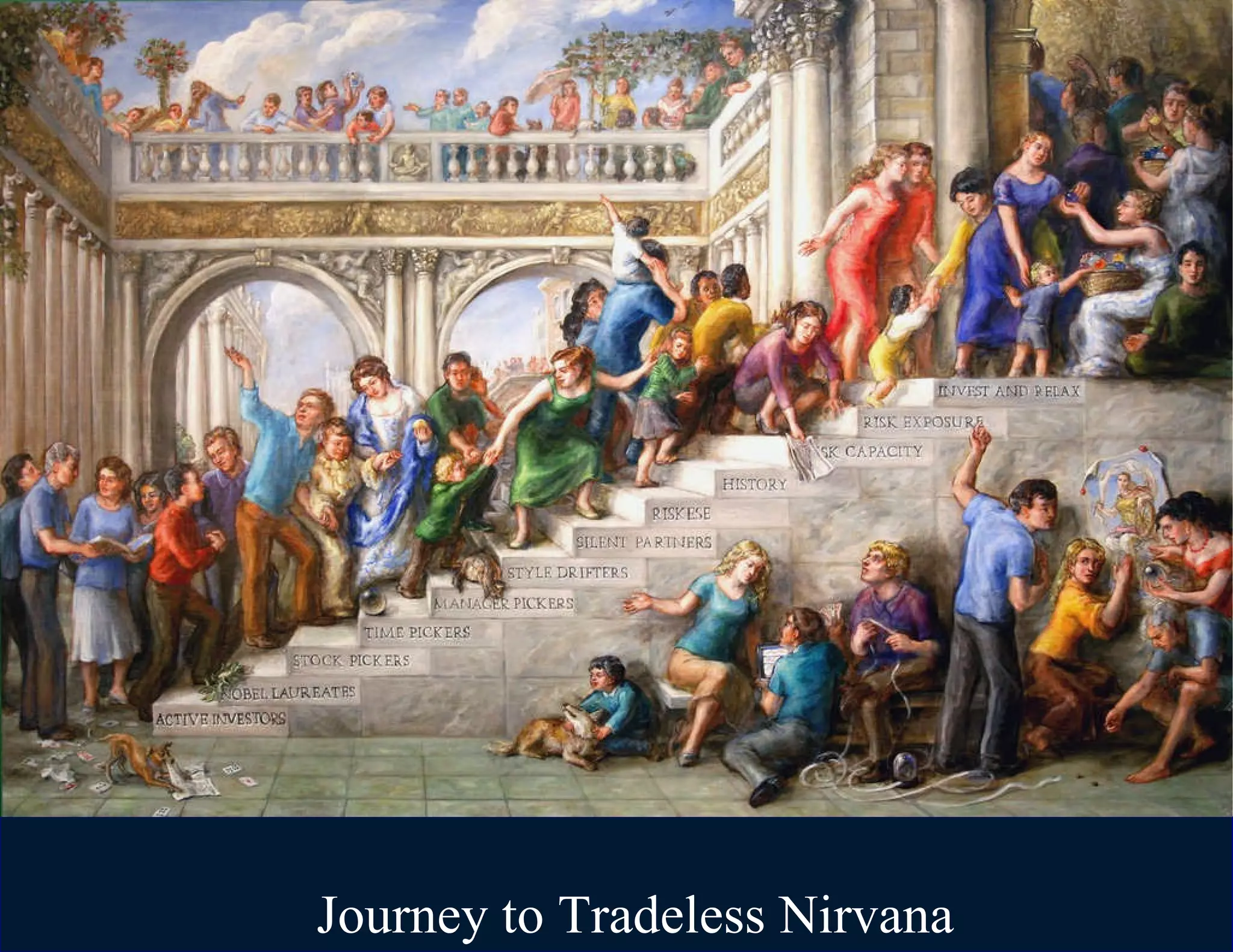
Journey to Tradeless Nirvana
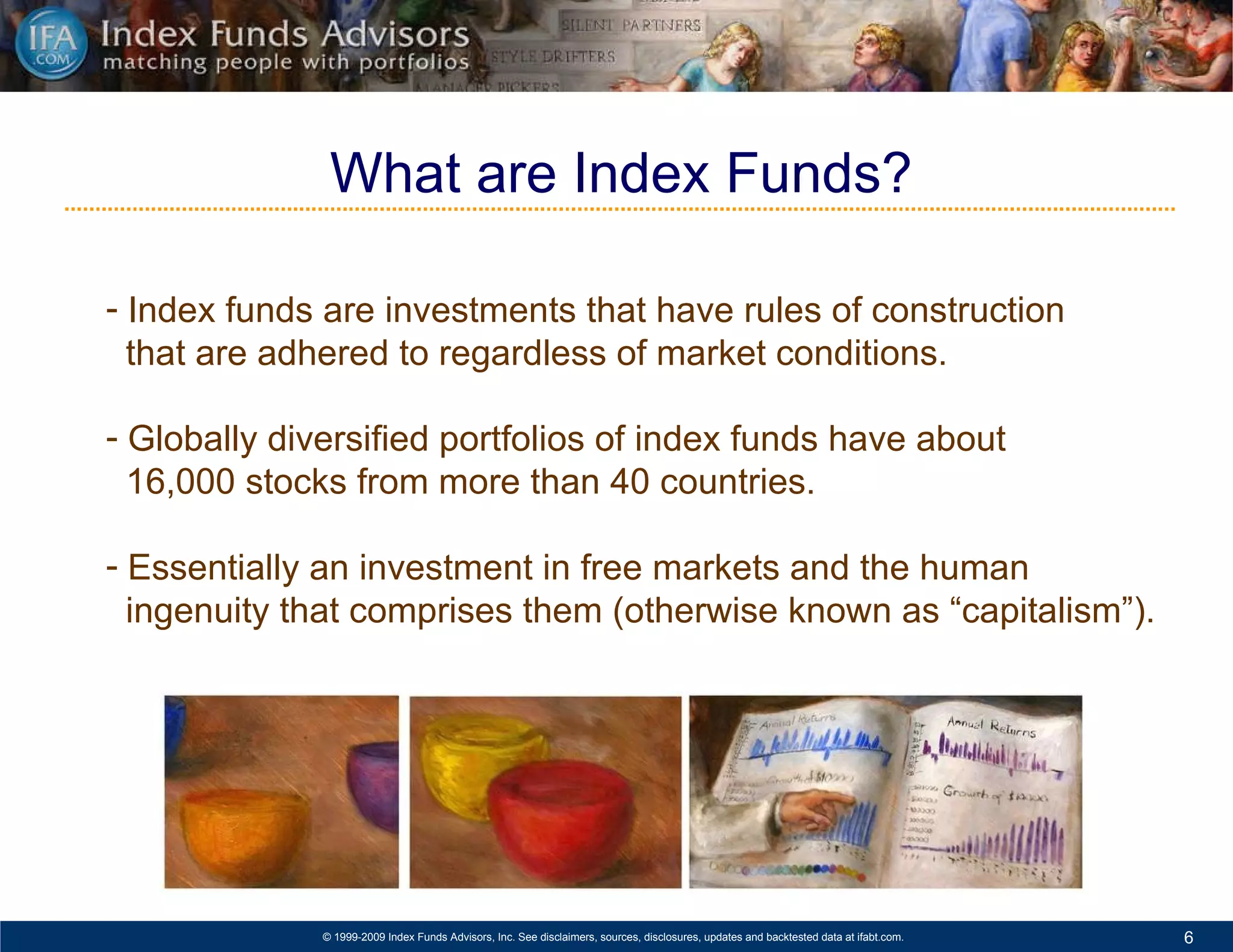
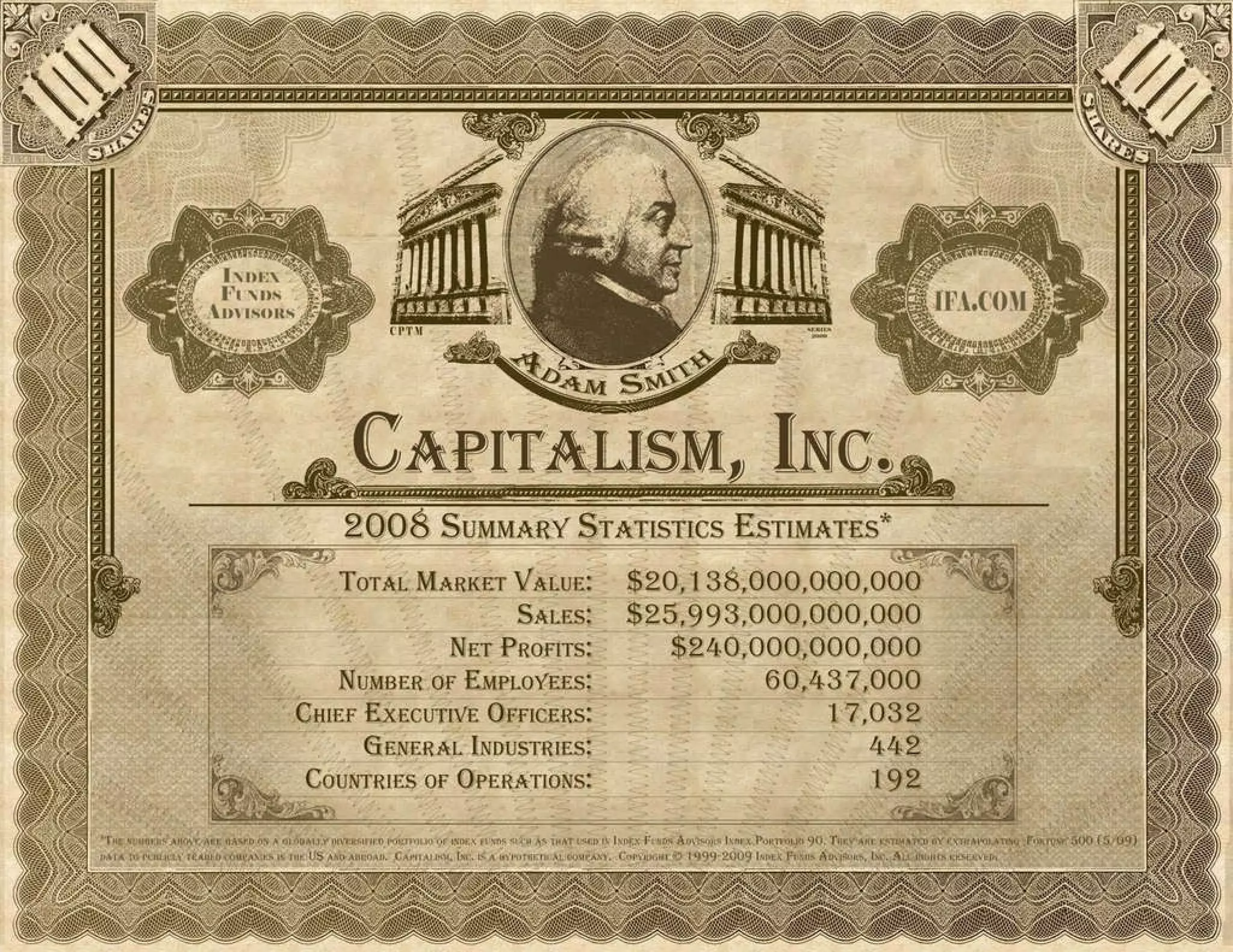
Index funds are investments that have rules of construction  that are adhered to regardless of market conditions.  Globally diversified portfolios of index funds have about  16,000 stocks from more than 40 countries. Essentially an investment in free markets and the human  ingenuity that comprises them (otherwise known as “capitalism”). What are Index Funds?
 
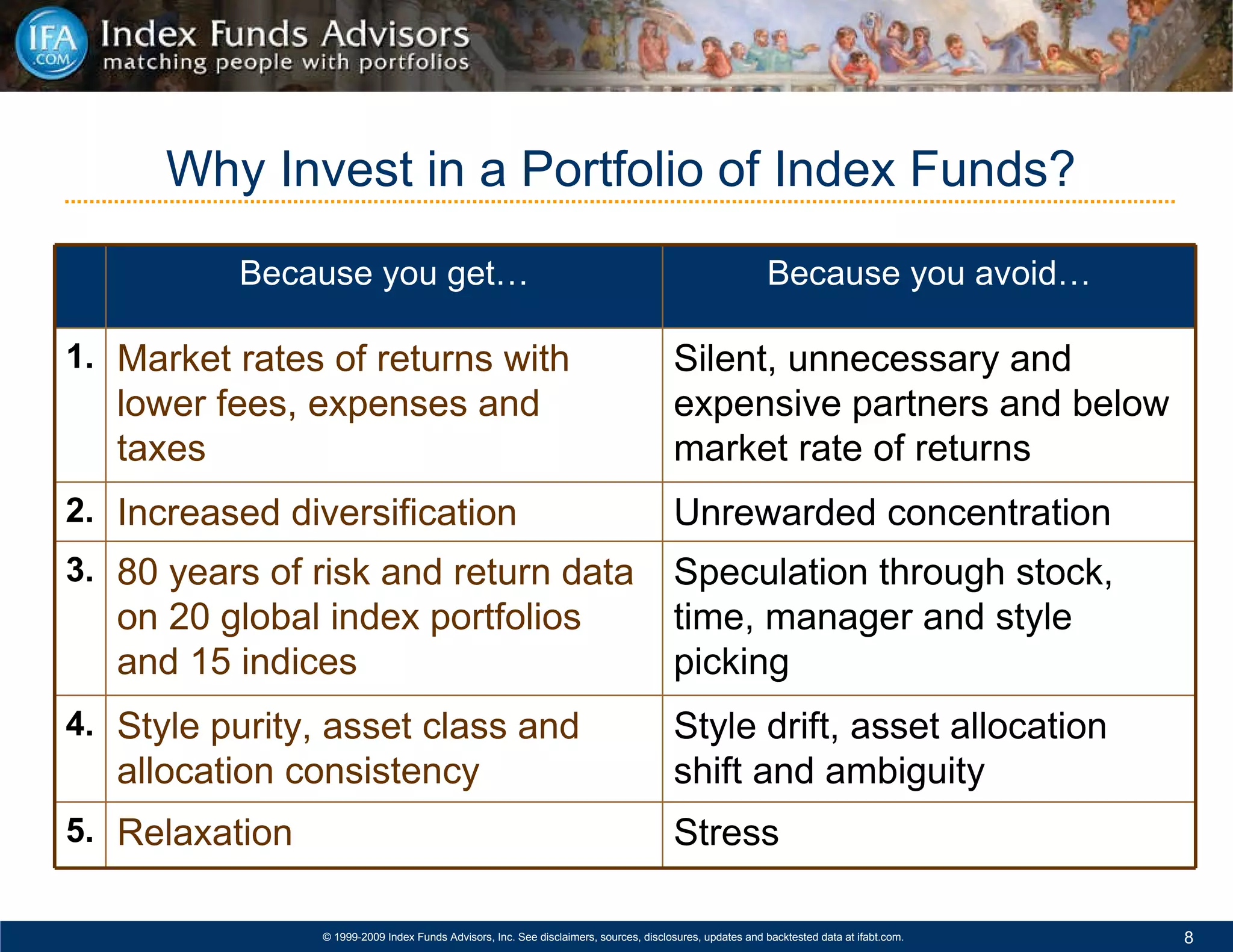
Why Invest in a Portfolio of Index Funds? Because you get… Because you avoid… 1. Market rates of returns with lower fees, expenses and  taxes Silent, unnecessary and expensive partners and below market rate of returns 2. Increased diversification Unrewarded concentration 3. 80 years of risk and return data on 20 global index portfolios and 15 indices Speculation through stock, time, manager and style picking 4. Style purity, asset class and allocation consistency Style drift, asset allocation shift and ambiguity 5. Relaxation Stress
 
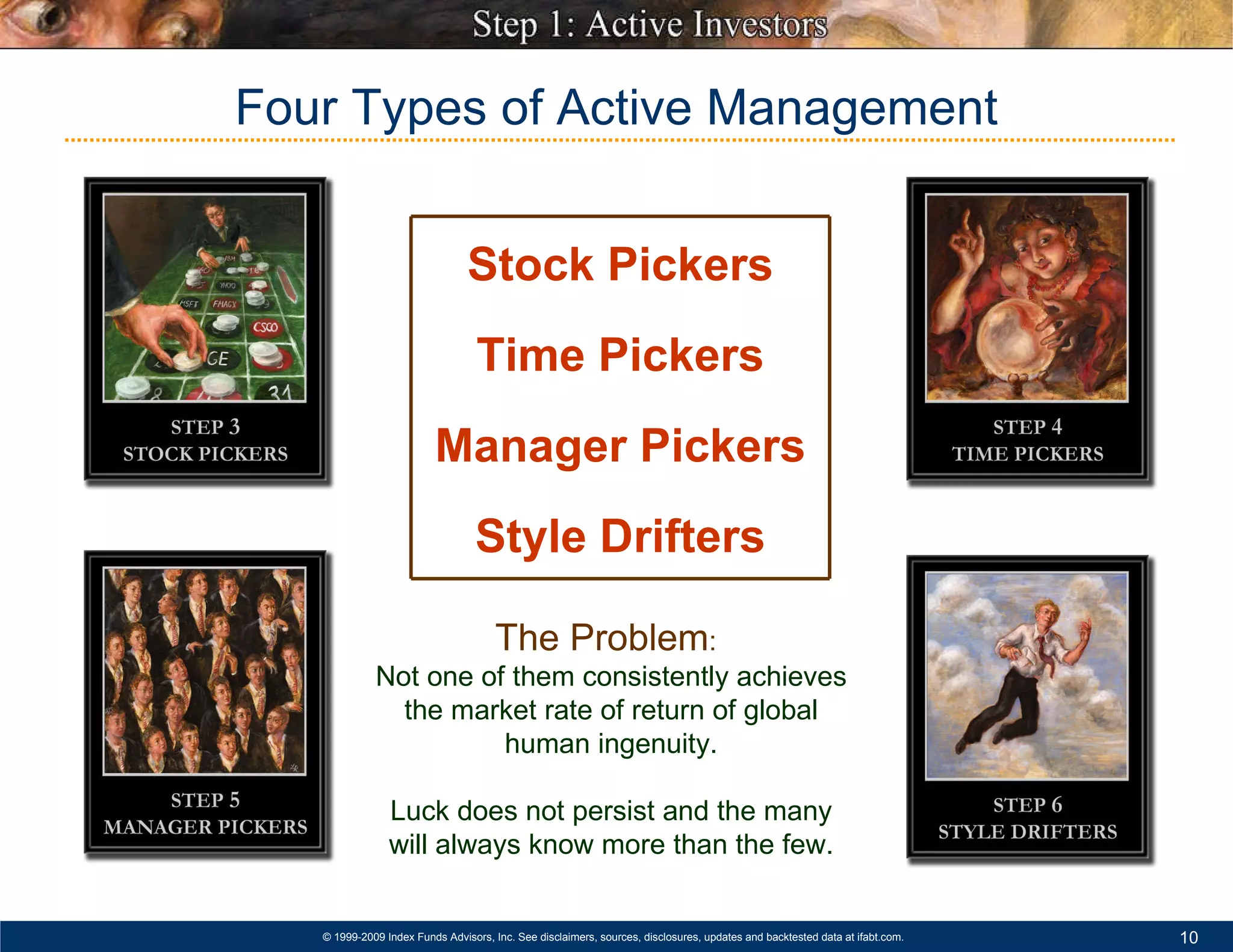
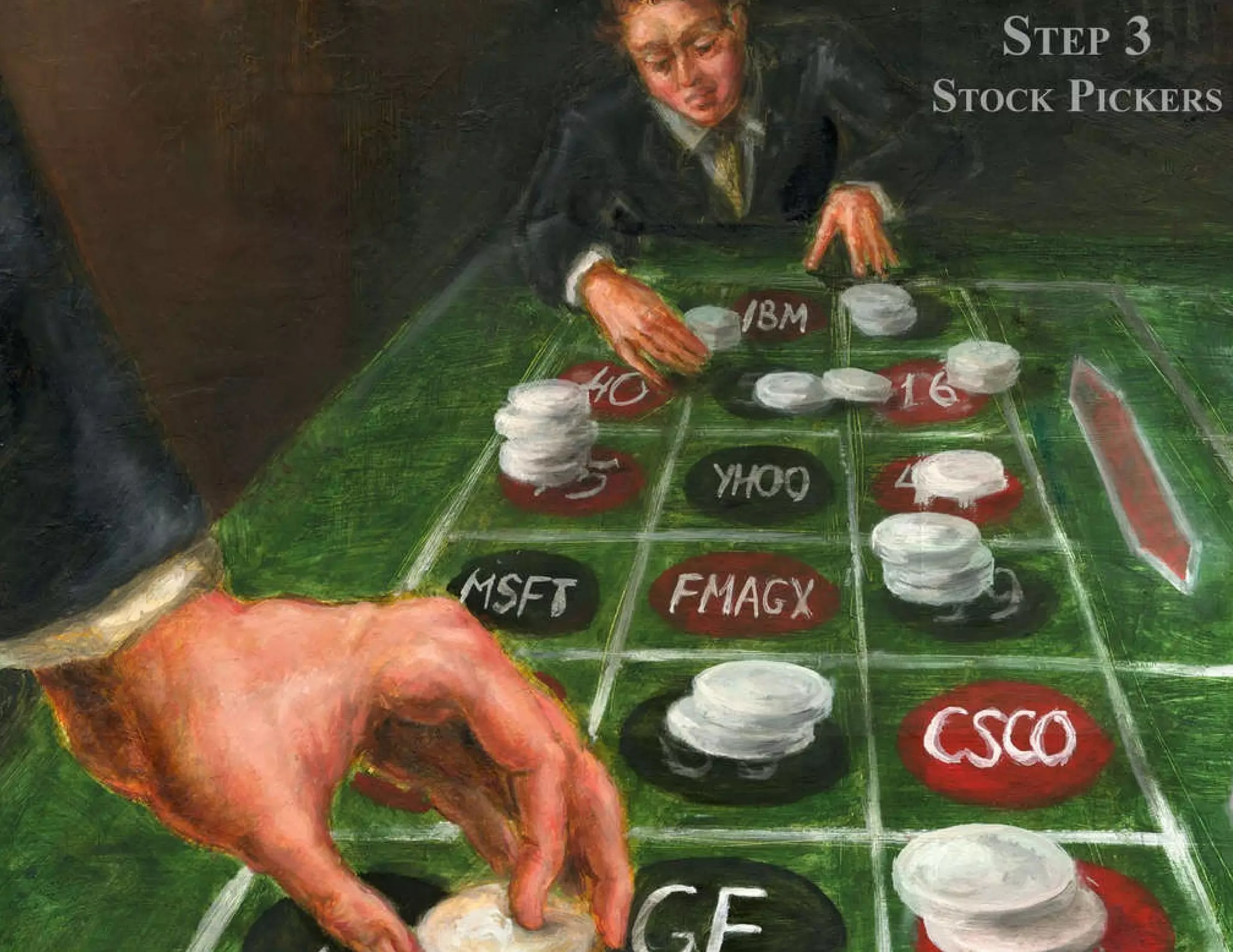
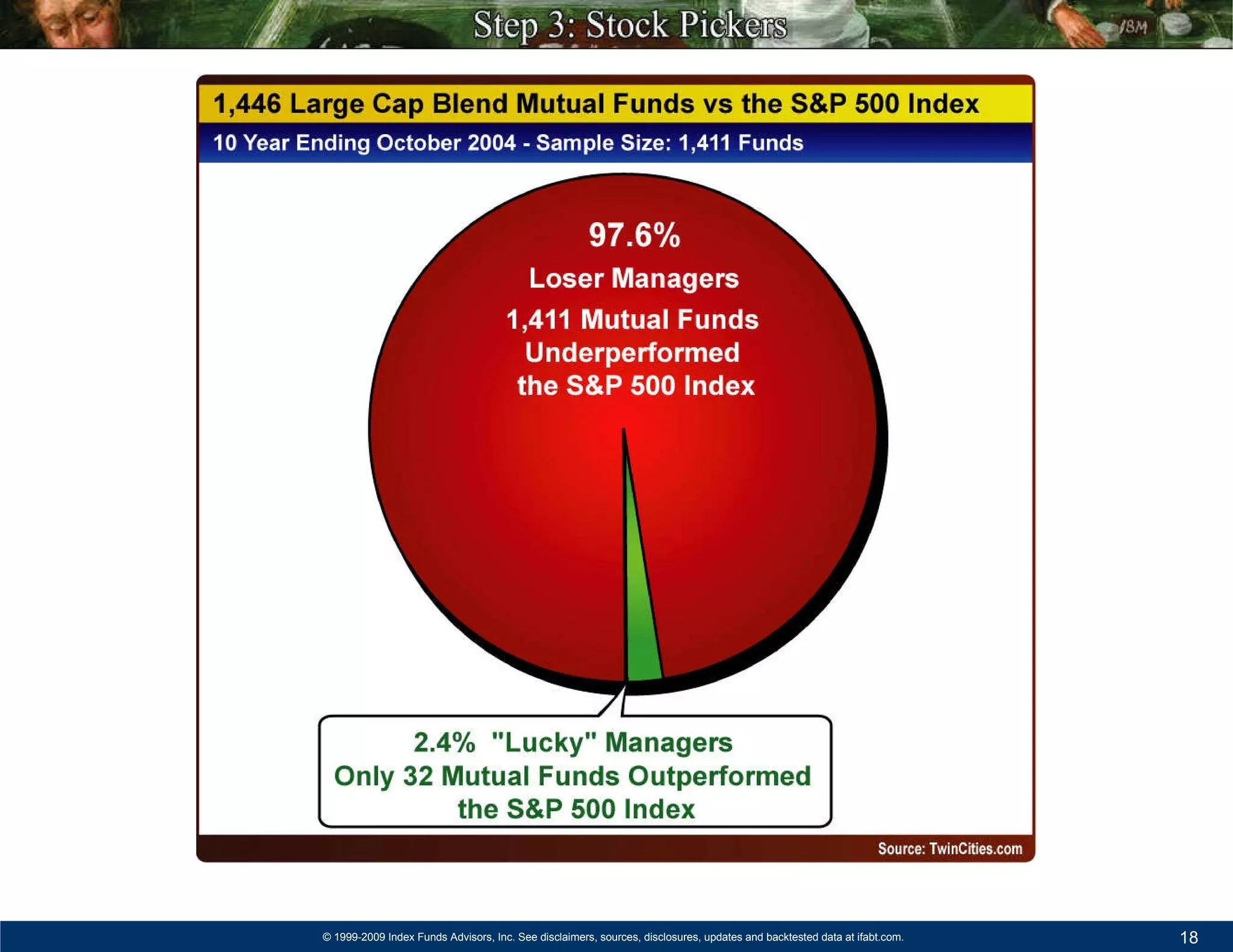
The Problem :   Not one of them consistently achieves the market rate of return of global human ingenuity. Luck does not persist and the many will always know more than the few. Four Types of Active Management Stock Pickers Time Pickers Manager Pickers Style Drifters
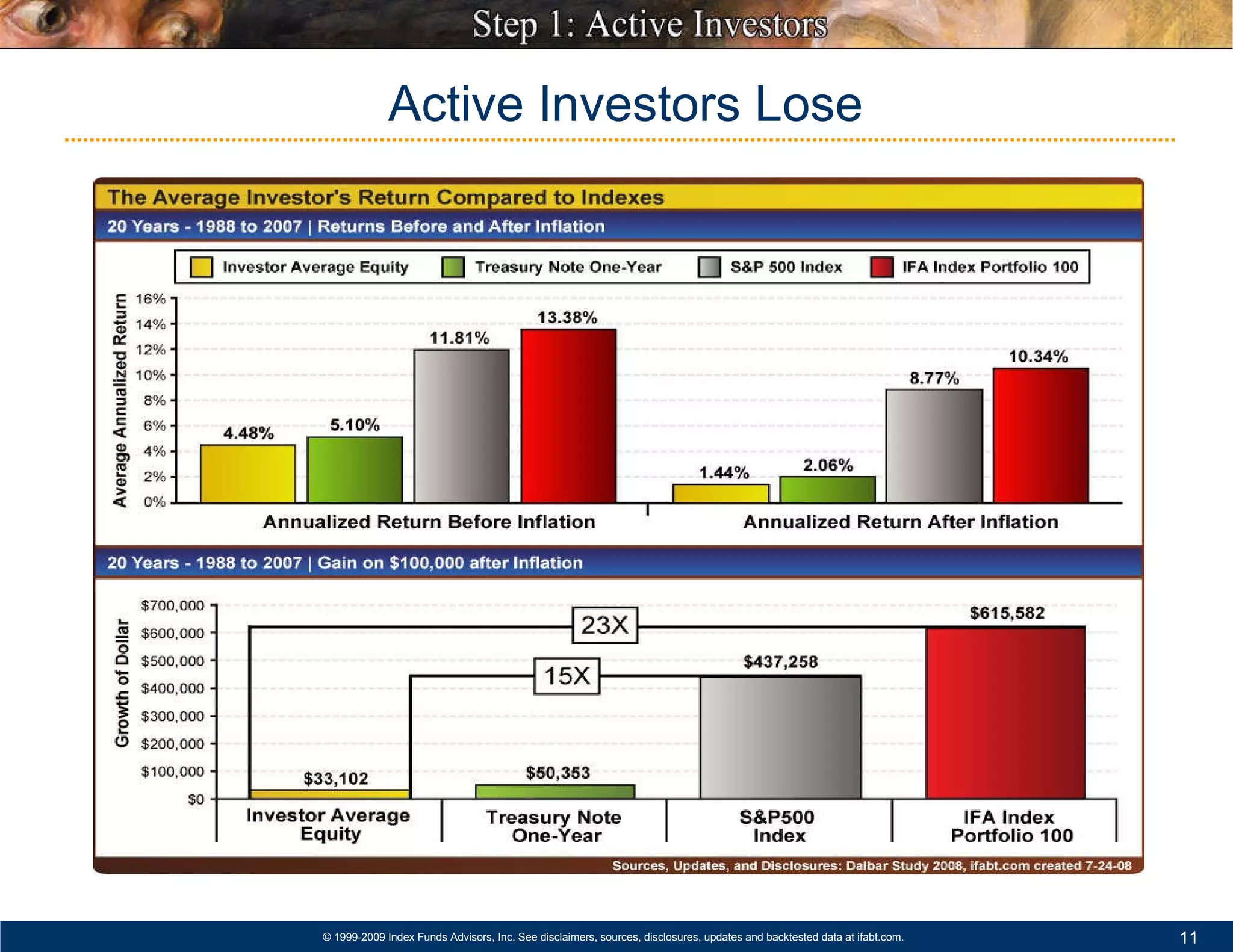
Active Investors Lose
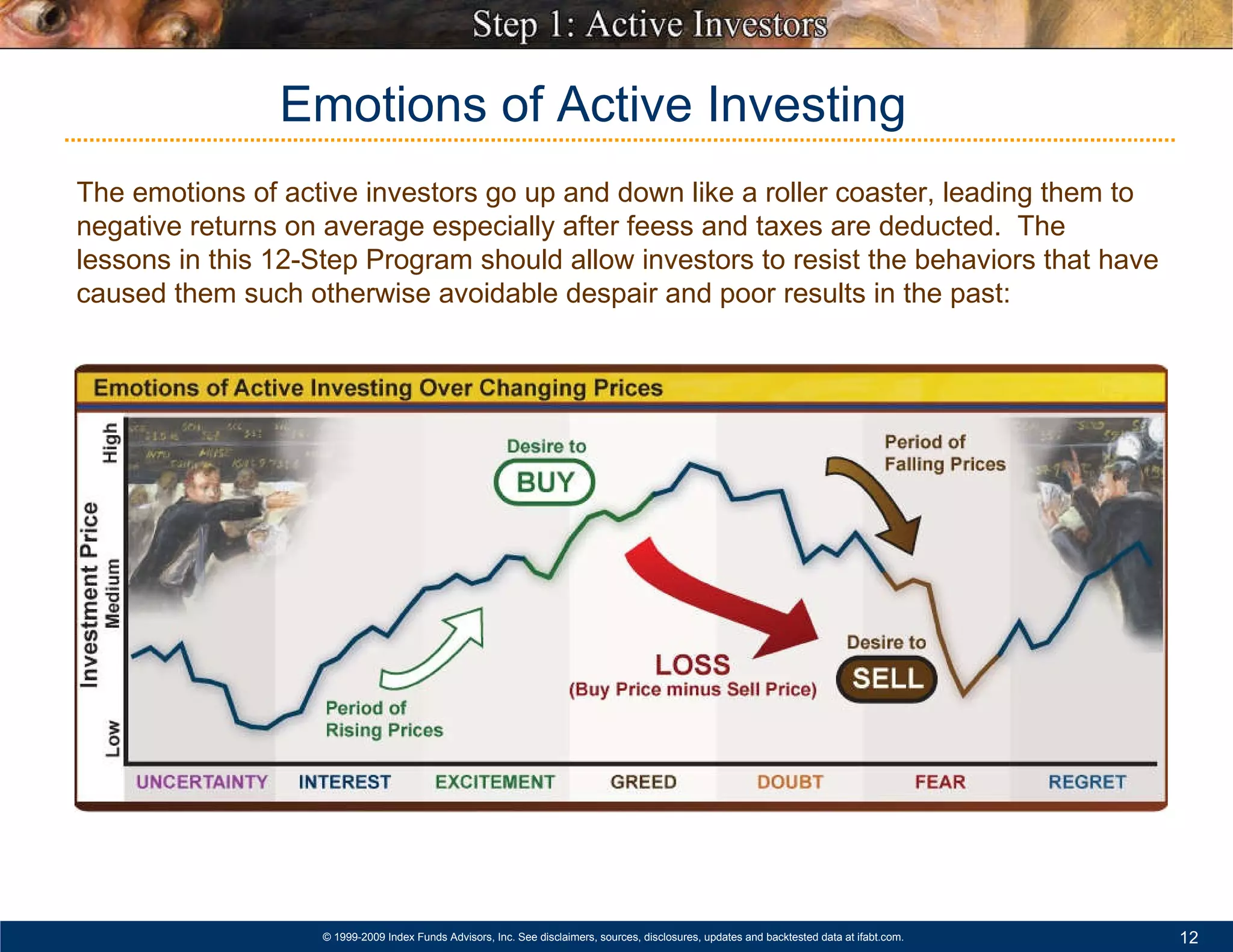
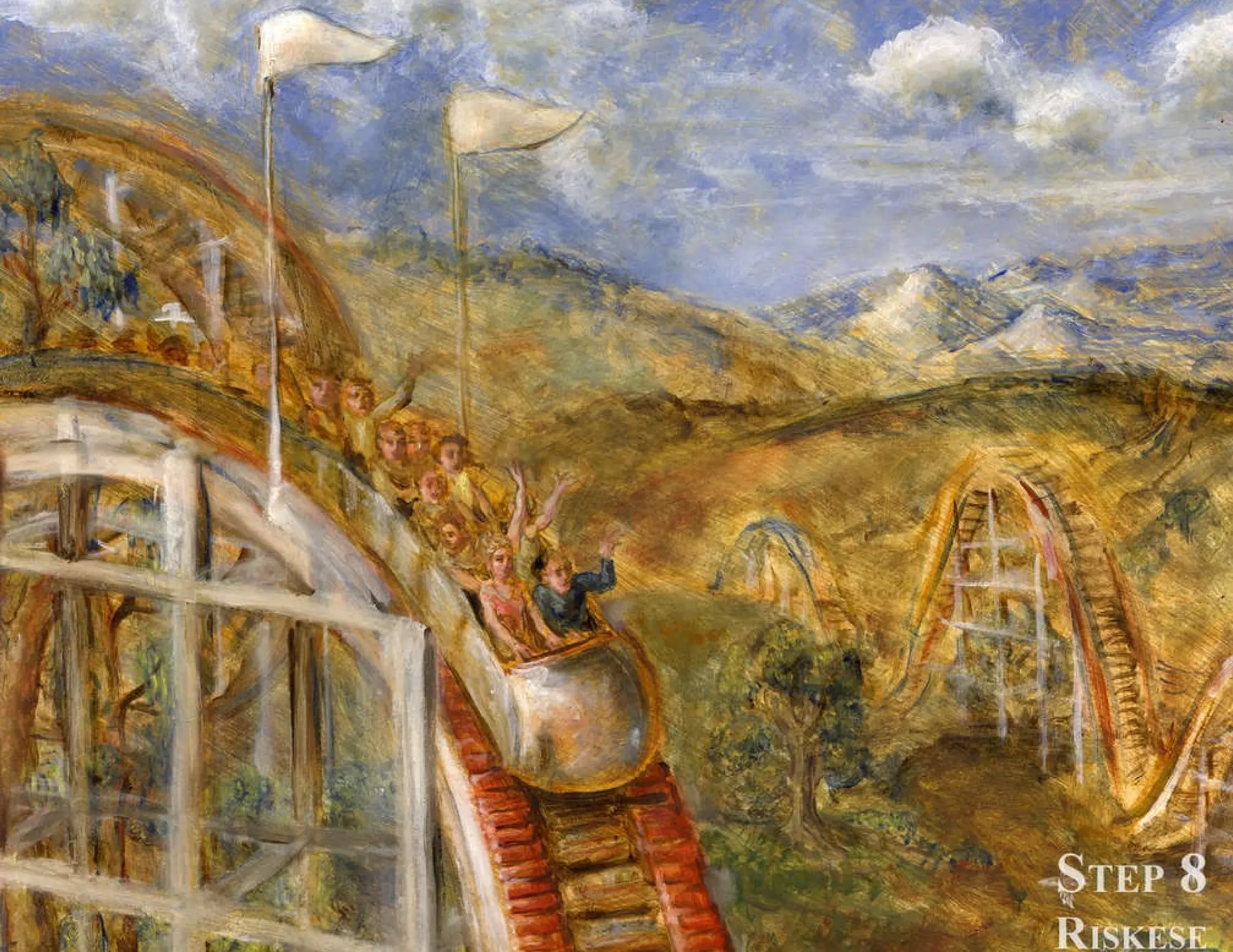
Emotions of Active Investing The emotions of active investors go up and down like a roller coaster, leading them to negative returns on average especially after feess and taxes are deducted.  The lessons in this 12-Step Program should allow investors to resist the behaviors that have caused them such otherwise avoidable despair and poor results in the past:
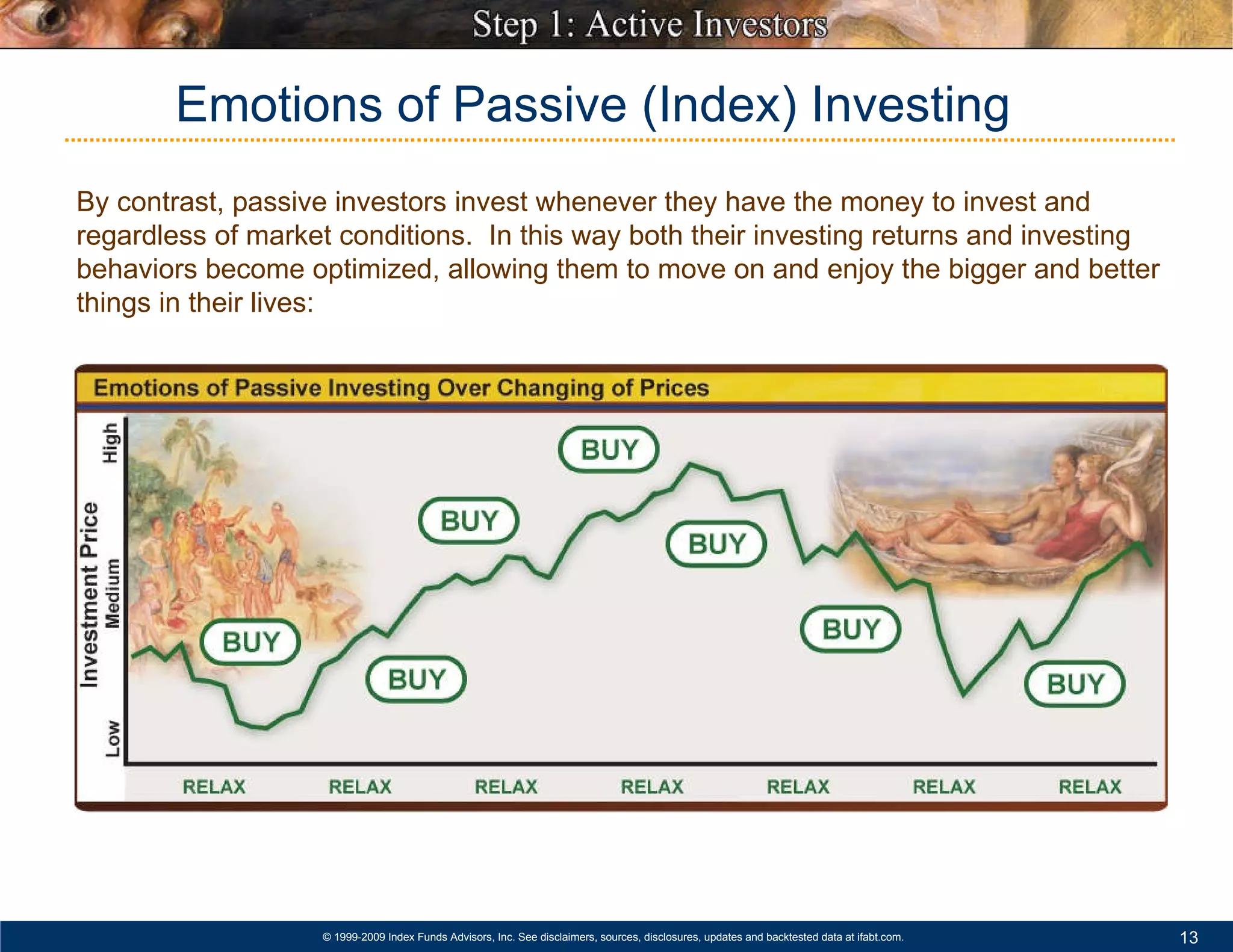
Emotions of Passive (Index) Investing By contrast, passive investors invest whenever they have the money to invest and regardless of market conditions.  In this way both their investing returns and investing behaviors become optimized, allowing them to move on and enjoy the bigger and better things in their lives:
 
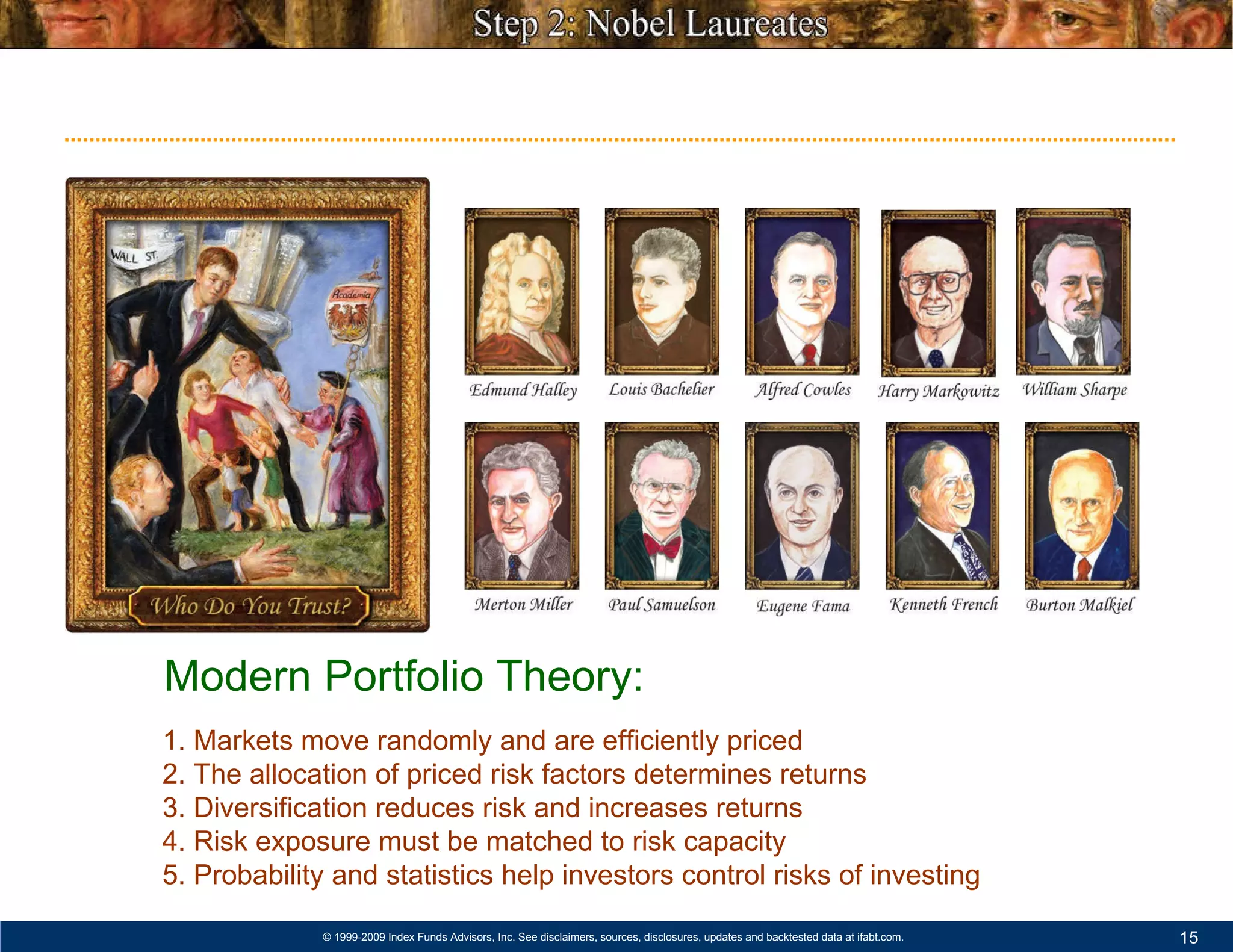
Modern Portfolio Theory:   1. Markets move randomly and are efficiently priced   2. The allocation of priced risk factors determines returns   3. Diversification reduces risk and increases returns   4. Risk exposure must be matched to risk capacity   5. Probability and statistics help investors control risks of investing
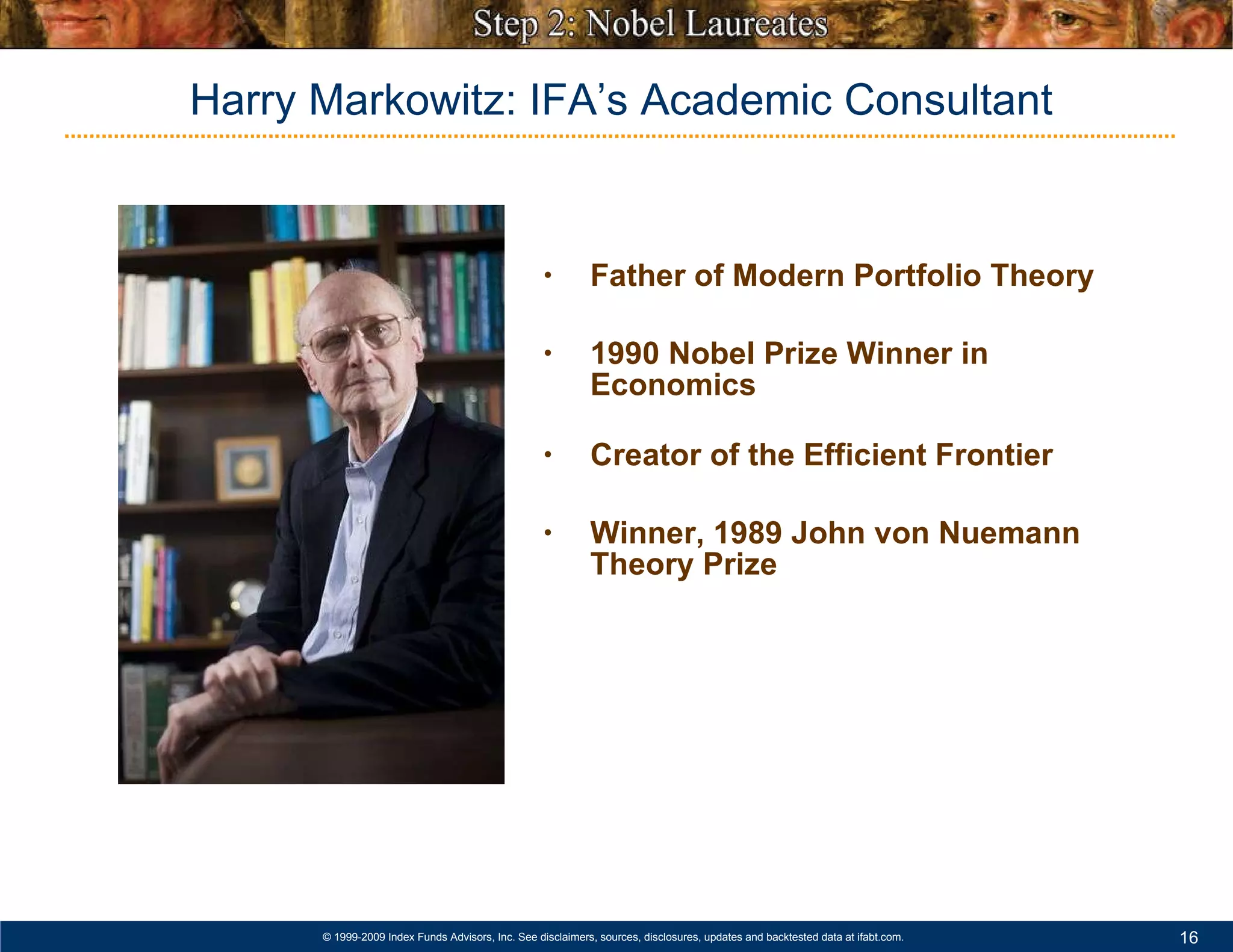
Father of Modern Portfolio Theory 1990 Nobel Prize Winner in Economics Creator of the Efficient Frontier Winner, 1989 John von Nuemann Theory Prize Harry Markowitz: IFA’s Academic Consultant


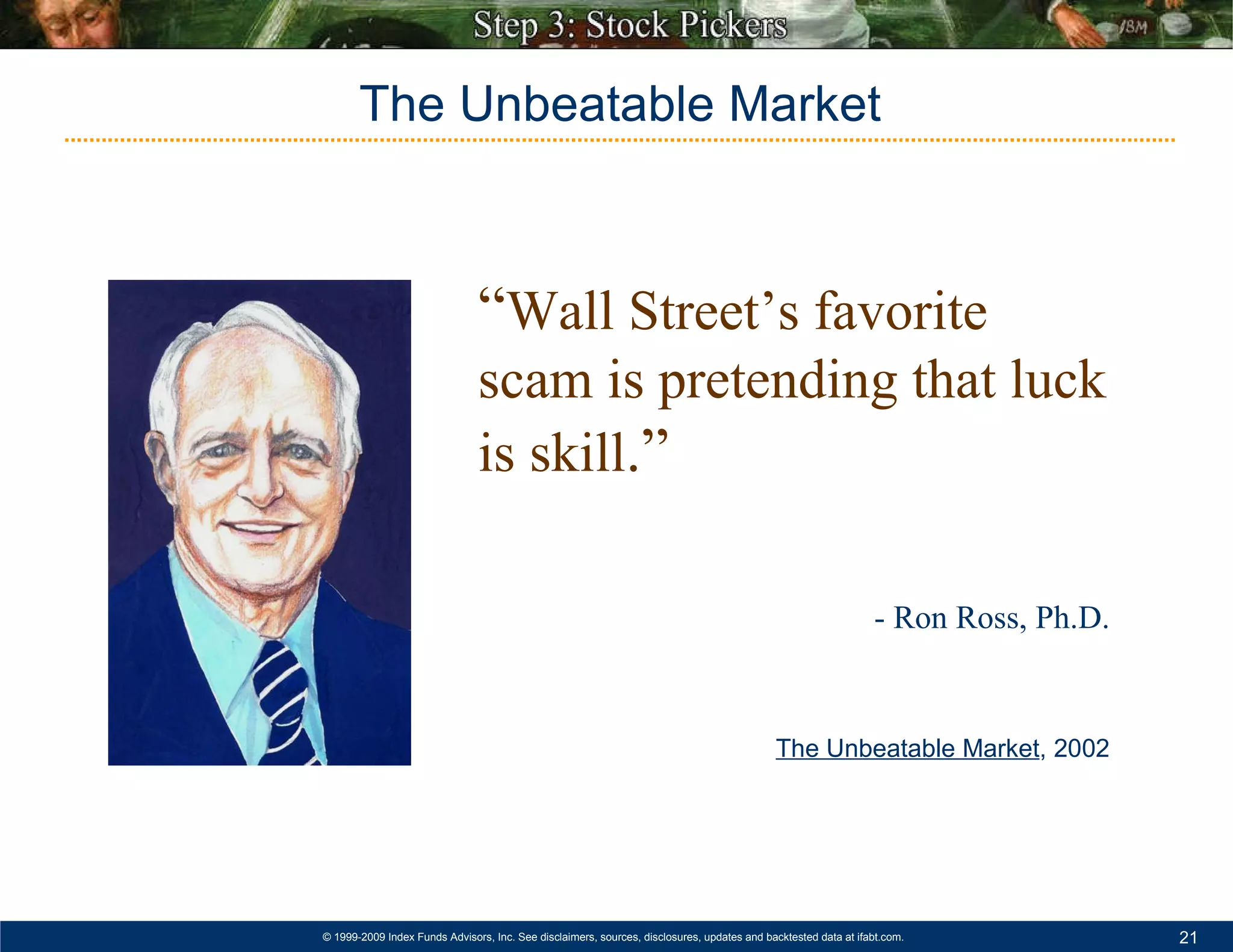
“ Wall Street’s favorite scam is pretending that luck is skill .” - Ron Ross, Ph.D. The Unbeatable Market , 2002 The Unbeatable Market
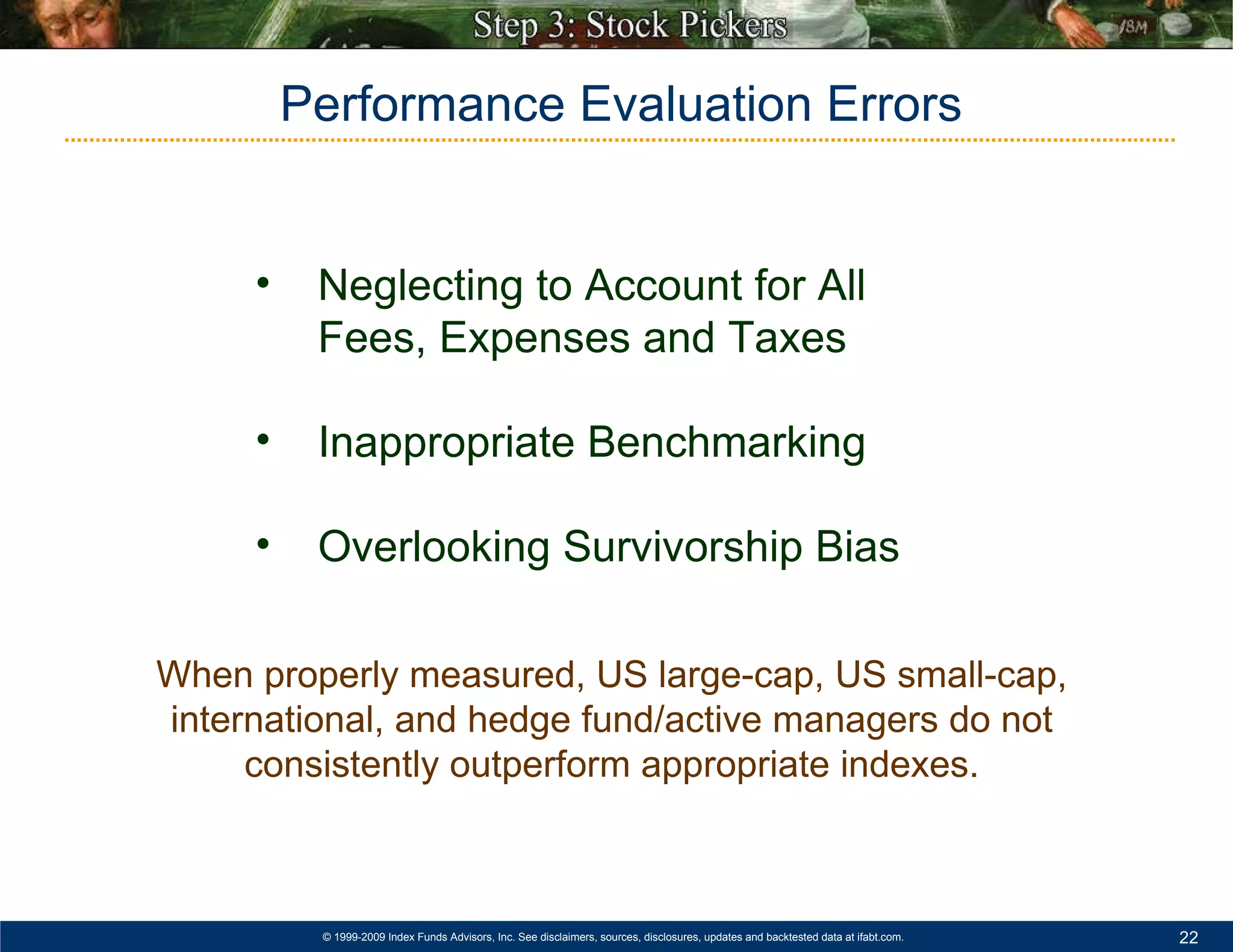
Neglecting to Account for All Fees, Expenses and Taxes Inappropriate Benchmarking  Overlooking Survivorship Bias Performance Evaluation Errors When properly measured, US large-cap, US small-cap, international, and hedge fund/active managers do not consistently outperform appropriate indexes.
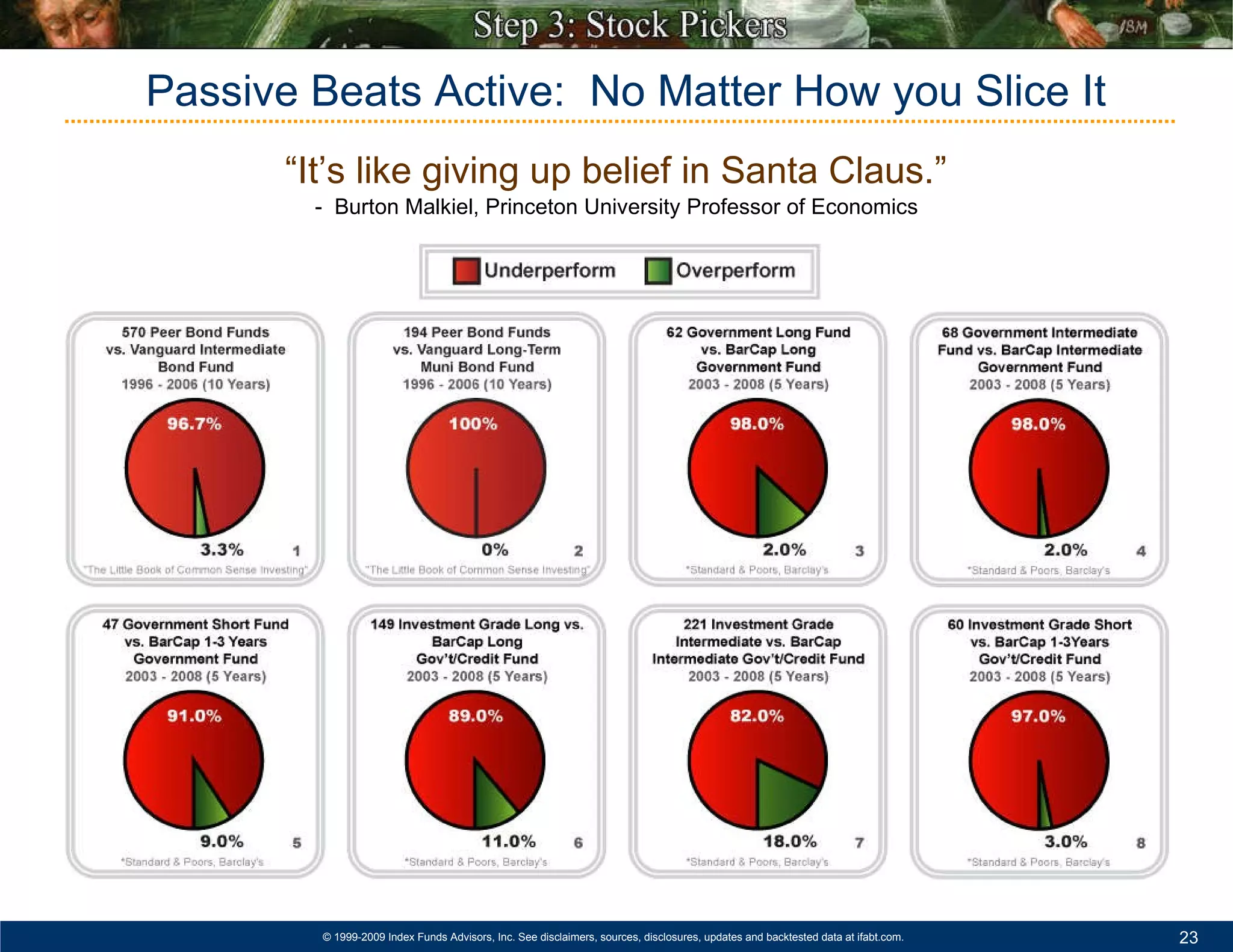
Passive Beats Active:  No Matter How you Slice It -  Burton Malkiel, Princeton University Professor of Economics “ It’s like giving up belief in Santa Claus.”
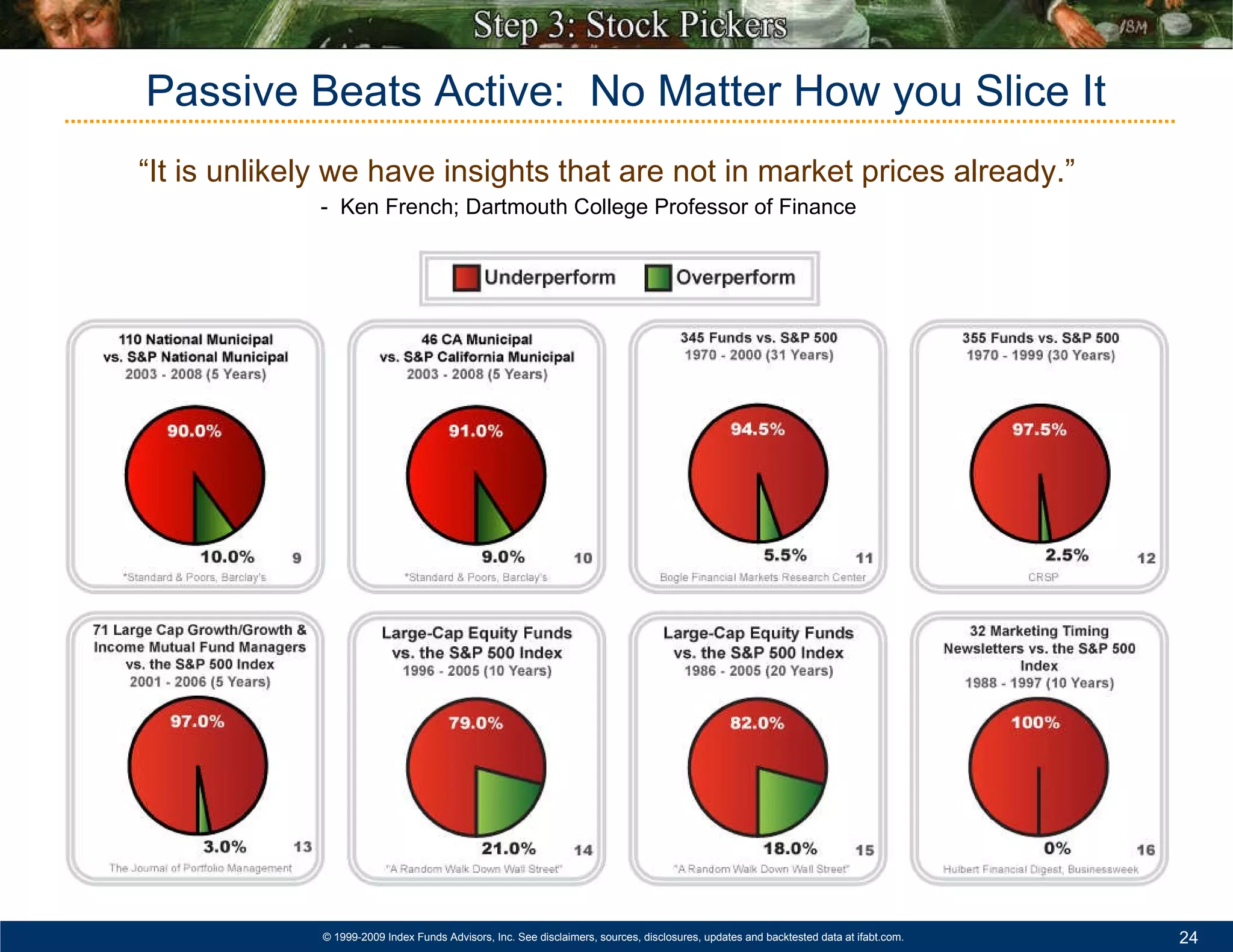
Passive Beats Active:  No Matter How you Slice It “ It is unlikely we have insights that are not in market prices already.”   -  Ken French; Dartmouth College Professor of Finance
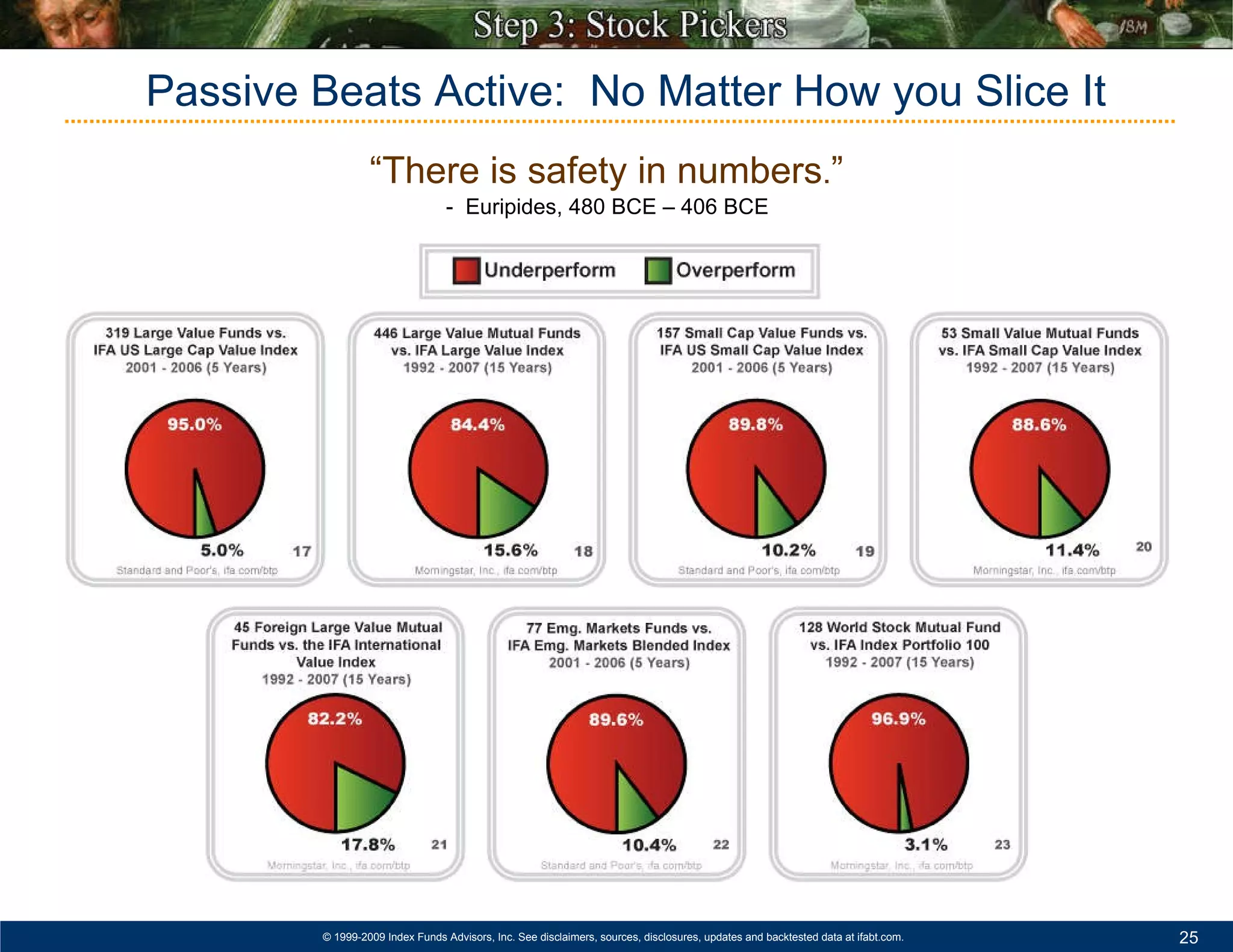
Passive Beats Active:  No Matter How you Slice It “ There is safety in numbers . ”   -  Euripides, 480 BCE – 406 BCE
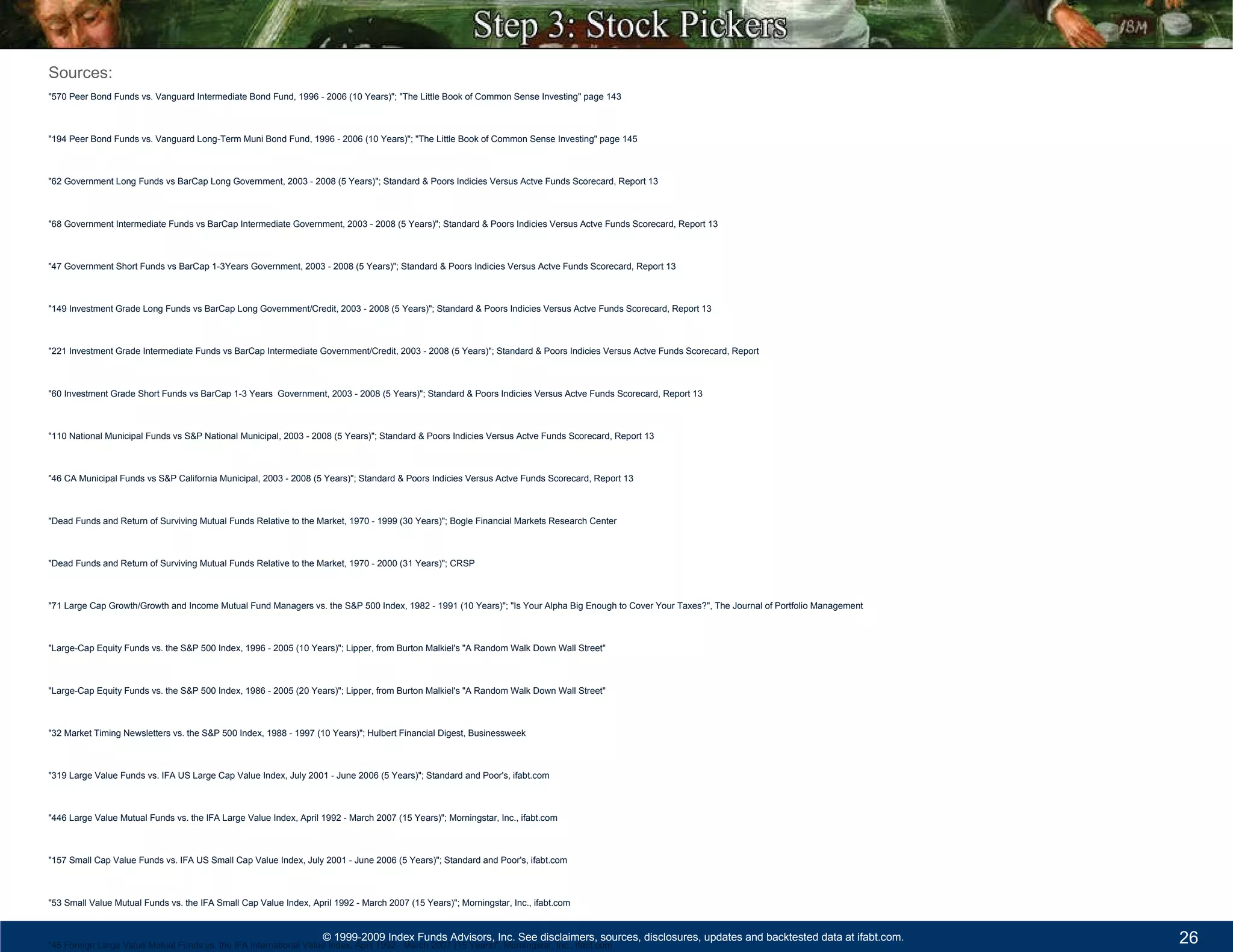
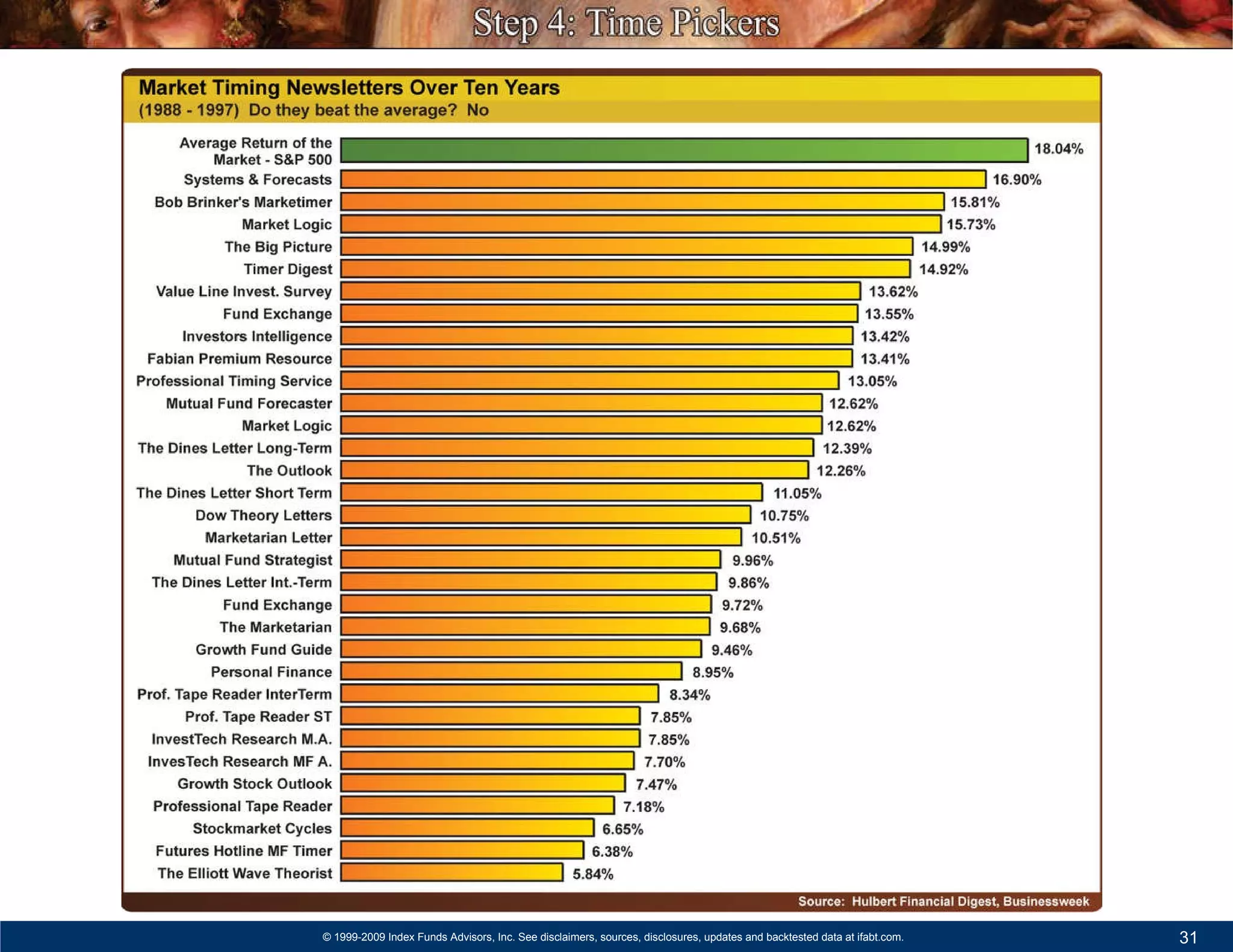
Sources: "570 Peer Bond Funds vs. Vanguard Intermediate Bond Fund, 1996 - 2006 (10 Years)"; "The Little Book of Common Sense Investing" page 143 "194 Peer Bond Funds vs. Vanguard Long-Term Muni Bond Fund, 1996 - 2006 (10 Years)"; "The Little Book of Common Sense Investing" page 145 "62 Government Long Funds vs BarCap Long Government, 2003 - 2008 (5 Years)"; Standard & Poors Indicies Versus Actve Funds Scorecard, Report 13 "68 Government Intermediate Funds vs BarCap Intermediate Government, 2003 - 2008 (5 Years)"; Standard & Poors Indicies Versus Actve Funds Scorecard, Report 13 "47 Government Short Funds vs BarCap 1-3Years Government, 2003 - 2008 (5 Years)"; Standard & Poors Indicies Versus Actve Funds Scorecard, Report 13 "149 Investment Grade Long Funds vs BarCap Long Government/Credit, 2003 - 2008 (5 Years)"; Standard & Poors Indicies Versus Actve Funds Scorecard, Report 13 "221 Investment Grade Intermediate Funds vs BarCap Intermediate Government/Credit, 2003 - 2008 (5 Years)"; Standard & Poors Indicies Versus Actve Funds Scorecard, Report  "60 Investment Grade Short Funds vs BarCap 1-3 Years  Government, 2003 - 2008 (5 Years)"; Standard & Poors Indicies Versus Actve Funds Scorecard, Report 13 "110 National Municipal Funds vs S&P National Municipal, 2003 - 2008 (5 Years)"; Standard & Poors Indicies Versus Actve Funds Scorecard, Report 13 "46 CA Municipal Funds vs S&P California Municipal, 2003 - 2008 (5 Years)"; Standard & Poors Indicies Versus Actve Funds Scorecard, Report 13 "Dead Funds and Return of Surviving Mutual Funds Relative to the Market, 1970 - 1999 (30 Years)"; Bogle Financial Markets Research Center "Dead Funds and Return of Surviving Mutual Funds Relative to the Market, 1970 - 2000 (31 Years)"; CRSP "71 Large Cap Growth/Growth and Income Mutual Fund Managers vs. the S&P 500 Index, 1982 - 1991 (10 Years)"; "Is Your Alpha Big Enough to Cover Your Taxes?", The Journal of Portfolio Management "Large-Cap Equity Funds vs. the S&P 500 Index, 1996 - 2005 (10 Years)"; Lipper, from Burton Malkiel's "A Random Walk Down Wall Street" "Large-Cap Equity Funds vs. the S&P 500 Index, 1986 - 2005 (20 Years)"; Lipper, from Burton Malkiel's "A Random Walk Down Wall Street" "32 Market Timing Newsletters vs. the S&P 500 Index, 1988 - 1997 (10 Years)"; Hulbert Financial Digest, Businessweek "319 Large Value Funds vs. IFA US Large Cap Value Index, July 2001 - June 2006 (5 Years)"; Standard and Poor's, ifabt.com "446 Large Value Mutual Funds vs. the IFA Large Value Index, April 1992 - March 2007 (15 Years)"; Morningstar, Inc., ifabt.com "157 Small Cap Value Funds vs. IFA US Small Cap Value Index, July 2001 - June 2006 (5 Years)"; Standard and Poor's, ifabt.com "53 Small Value Mutual Funds vs. the IFA Small Cap Value Index, April 1992 - March 2007 (15 Years)"; Morningstar, Inc., ifabt.com "45 Foreign Large Value Mutual Funds vs. the IFA International Value Index, April 1992 - March 2007 (15 Years)"; Morningstar, Inc., ifabt.com "77 Emerging Markets Funds vs. IFA Emerging Markets Blended Index, July 2001 - June 2006 (5 Years)"; Standard and Poor's, ifabt.com "128 World Stock Mutual Funds vs. IFA Portfolio 100, April 1992 - March 2007 (15 Years)"; Morningstar, Inc., ifabt.com
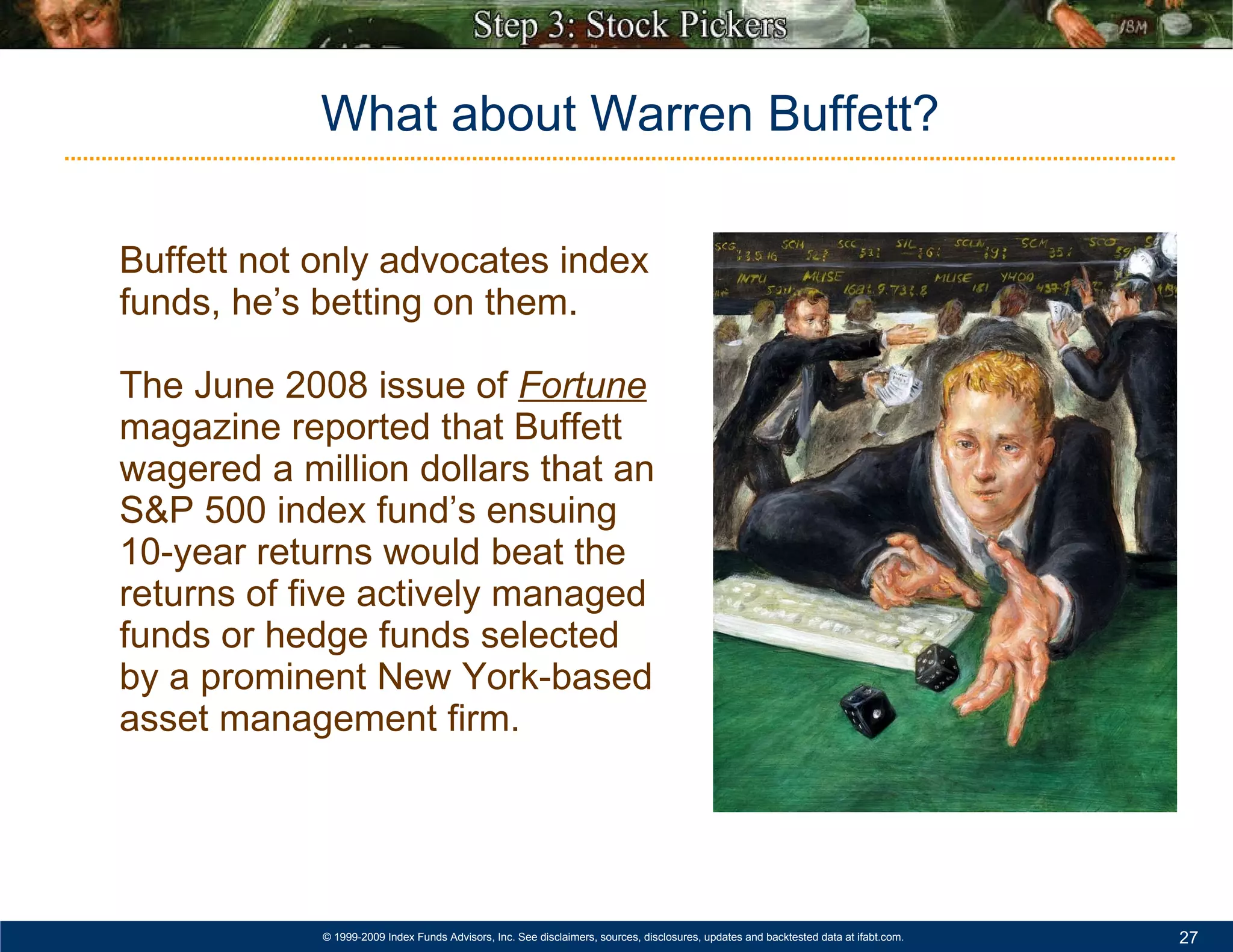
Buffett not only advocates index funds, he’s betting on them.  The June 2008 issue of  Fortune   magazine reported that Buffett wagered a million dollars that an S&P 500 index fund’s ensuing 10-year returns would beat the returns of five actively managed funds or hedge funds selected by a prominent New York-based asset management firm.  What about Warren Buffett?
1.  “..the best way to own common stocks is through index funds...  Those following this path are sure to beat the net results (after fees and expenses) delivered by the great majority of investment professionals. - Warren Buffett, Berkshire Hathaway Inc. 1996 Shareholder Letter   2.  “Additionally, those index funds that are very low-cost … are the best selection for most of those who wish to own equities.”  - Warren Buffett, Berkshire Hathaway Inc. 2002 Shareholder Letter 3.  “All [investors] had to do was piggyback Corporate America in a diversified, low-expense way. An index fund that they never touched would have done the job. Instead many investors have had experiences ranging from mediocre to disastrous.” - Warren Buffett, Berkshire Hathaway Inc. 2003 Shareholder Letter 4. "The active investors will have their returns diminished by a far greater percentage than will their inactive brethren. That means that the passive group – the “know-nothings” – must win." - Warren Buffett, Berkshire Hathaway Inc. 2007 Shareholder Letter Buffett’s Smart Bet


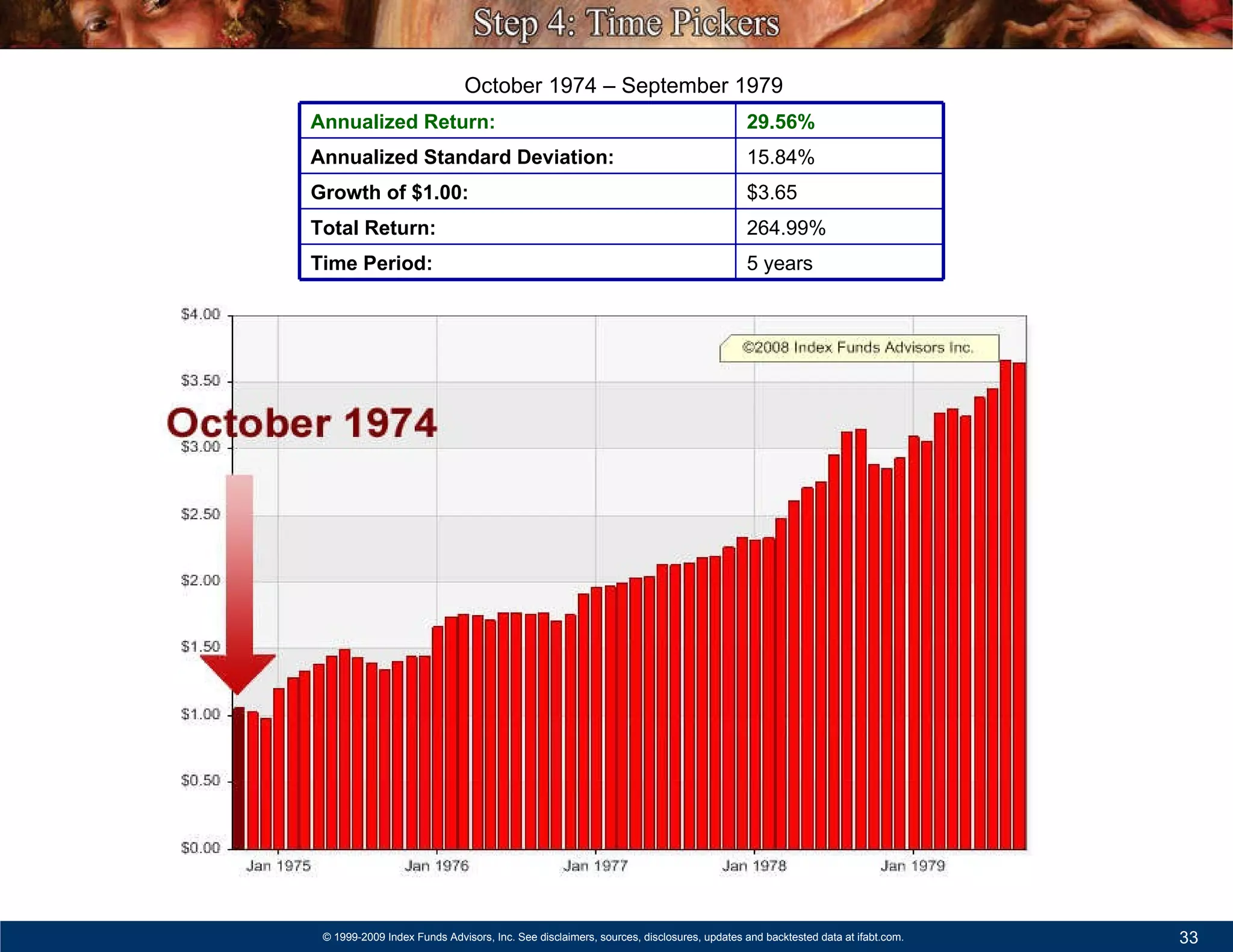
October 1974 – September 1979 Annualized Return: 29.56% Annualized Standard Deviation: 15.84% Growth of $1.00: $3.65 Total Return: 264.99% Time Period: 5 years
 
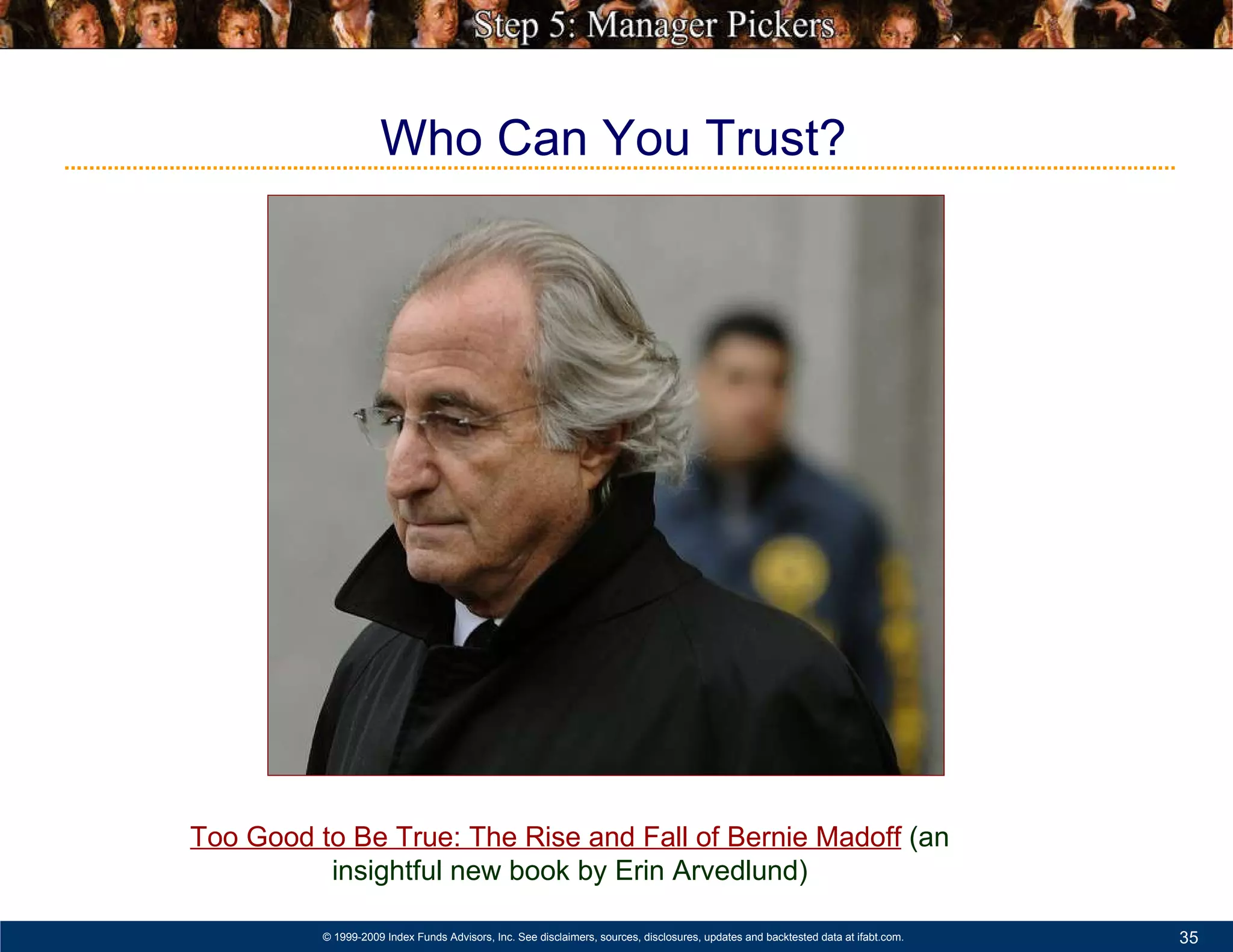
Who Can You Trust?   Too Good to Be True: The Rise and Fall of Bernie Madoff   (an insightful new book by Erin Arvedlund)
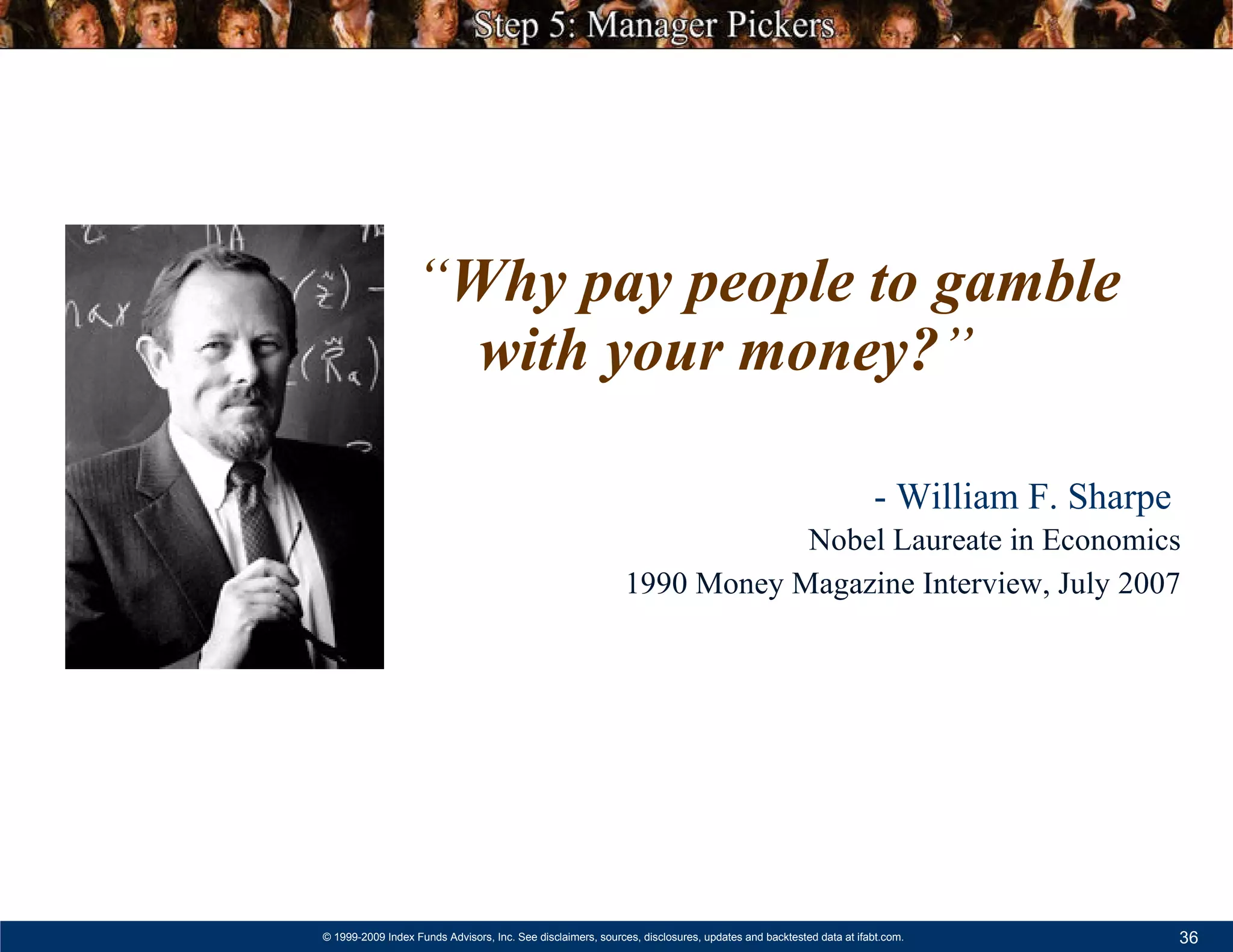
“ Why pay people to gamble with your money? ” - William F. Sharpe     Nobel Laureate in Economics 1990 Money Magazine Interview, July 2007
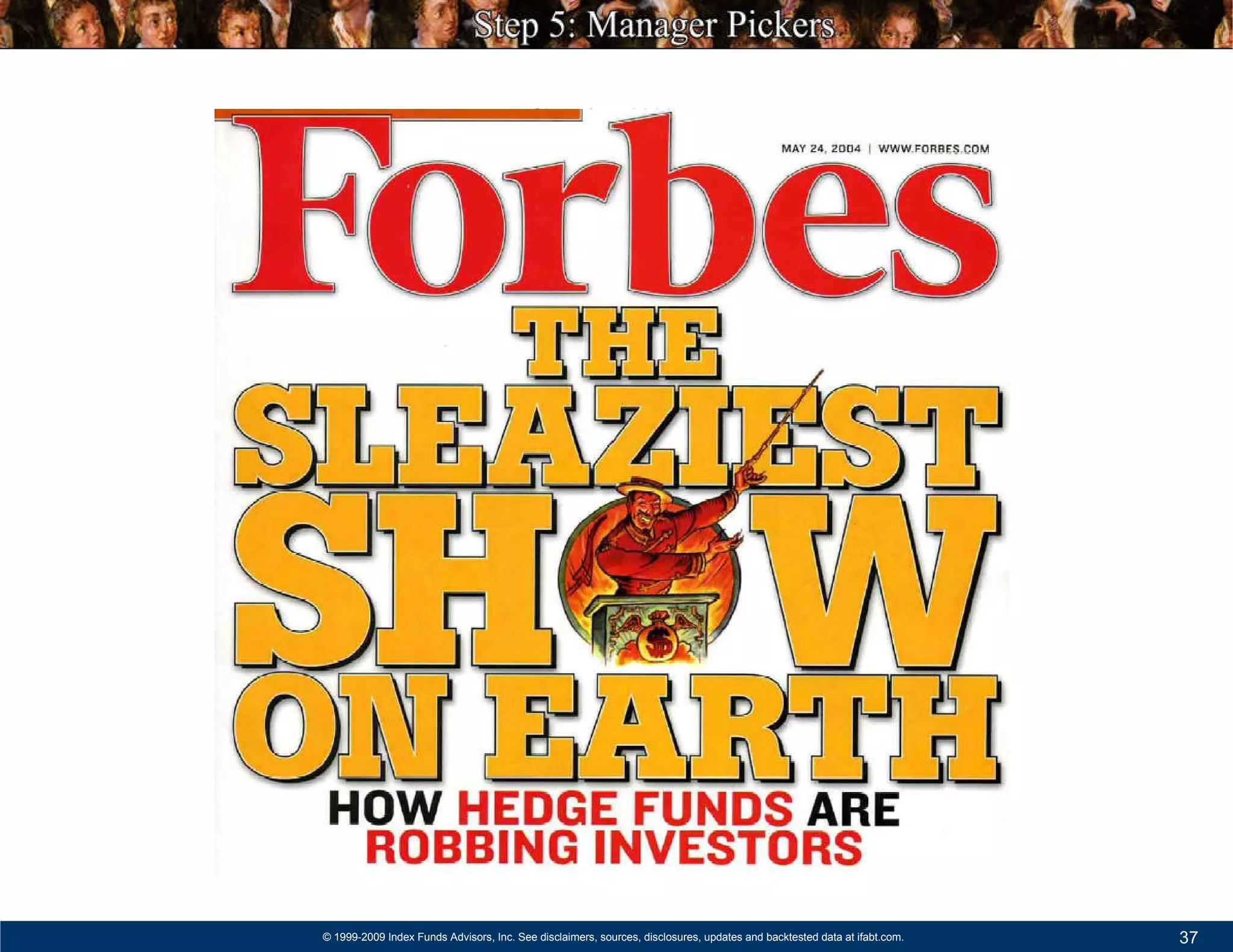
Since late 2006 at least 111 funds at 68 outfits have "imploded " don't tell me the proof is in the pudding, because there is no pudding when it comes to hedge funds.
“ Anyone who has delved into the literature on efficient markets should smell a rat when thousands of hedge funds are being launched each year, all flamboyantly claiming they can earn returns massive enough to cover their typically 2% management fee, 0.4% ‘administrative fee’ and 20% incentive fee, not to mention the enormous brokerage fees the funds rack up on their frenetic trading . ” - Glyn Holton, author  Who’ll Take the Toxic Waste ?   Who’ll Take the Toxic Waste?
“ Since late 2006 at least 111 funds at 68 outfits have ‘imploded’.” Dead Funds & Survivorship Bias www.hf-implode.com
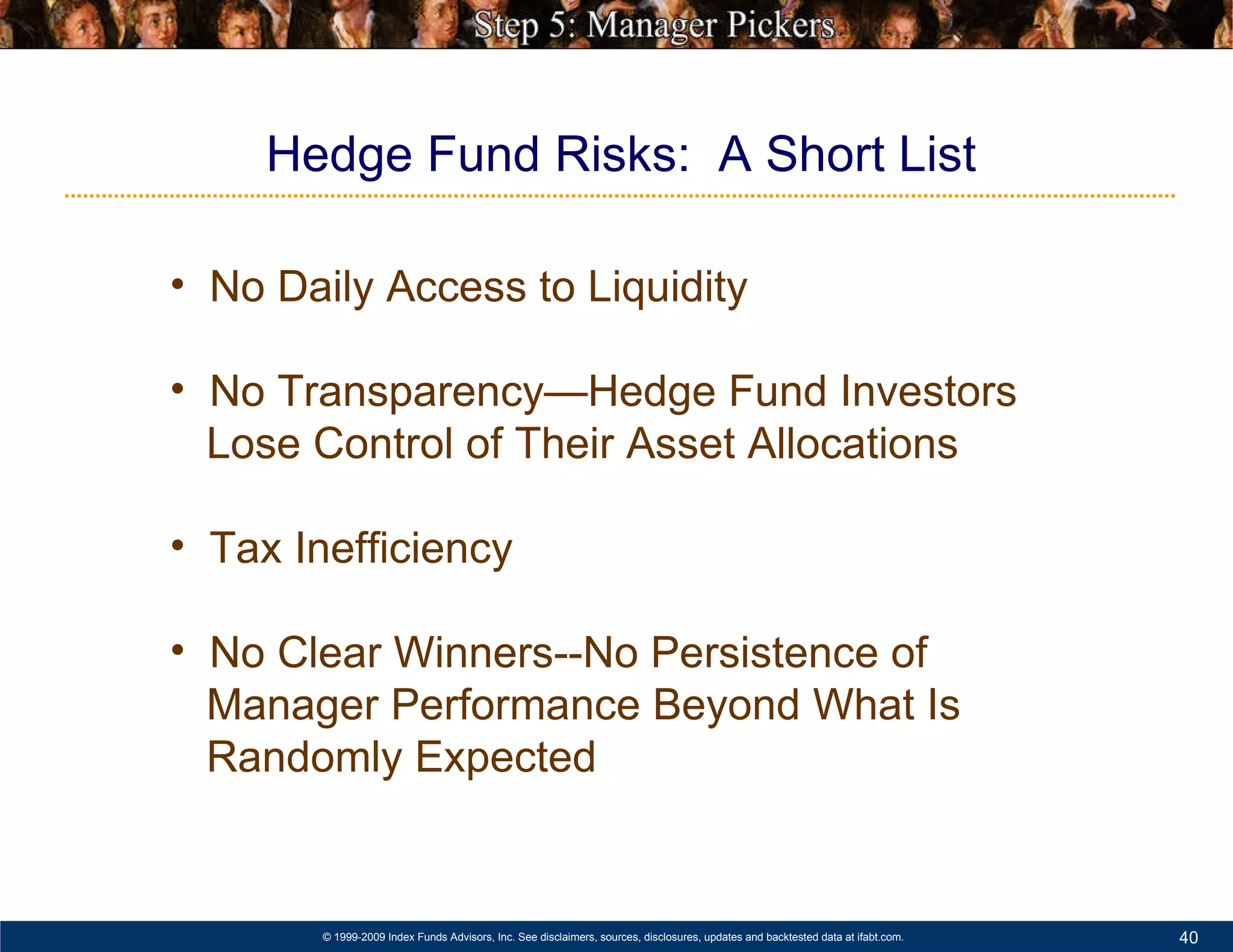
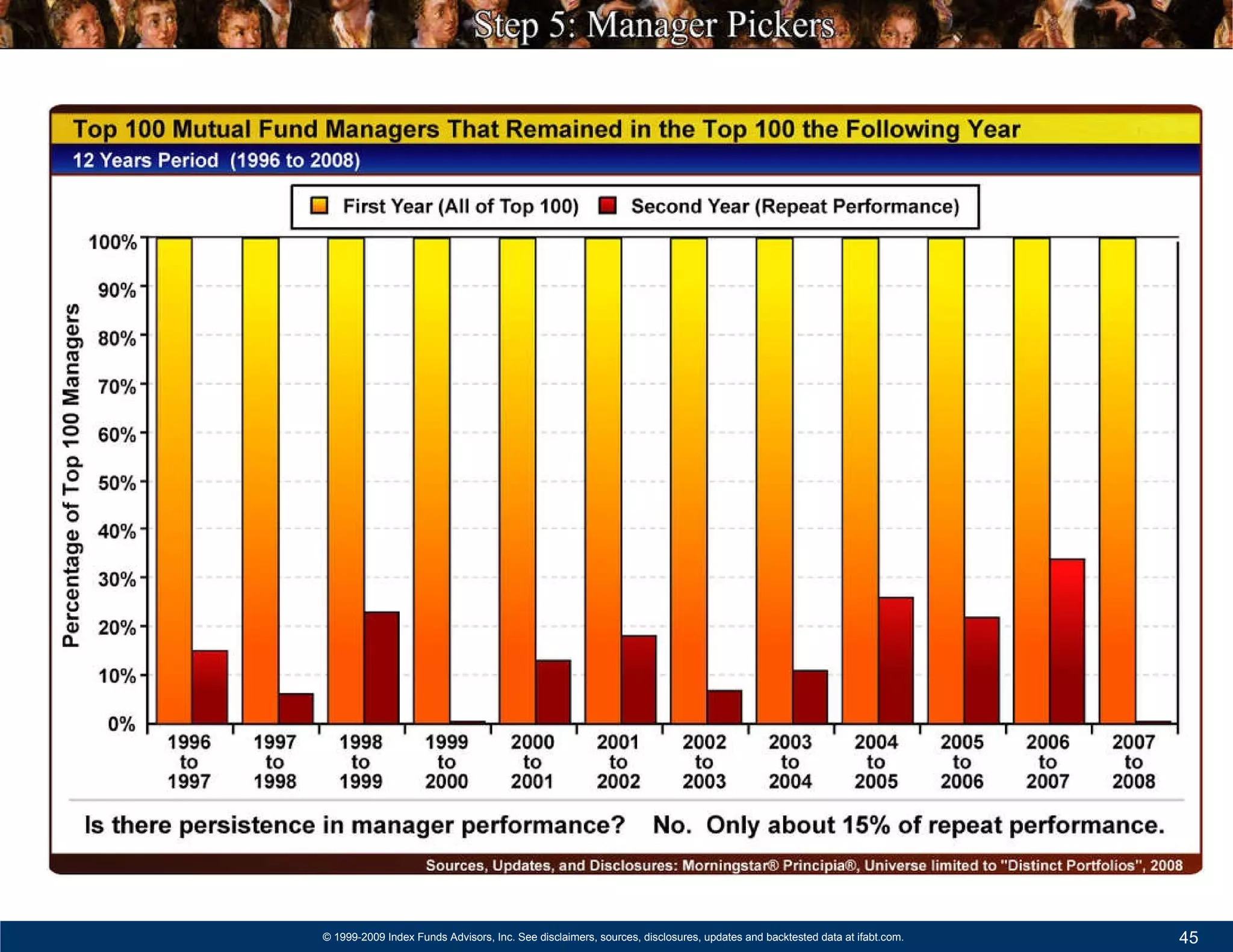
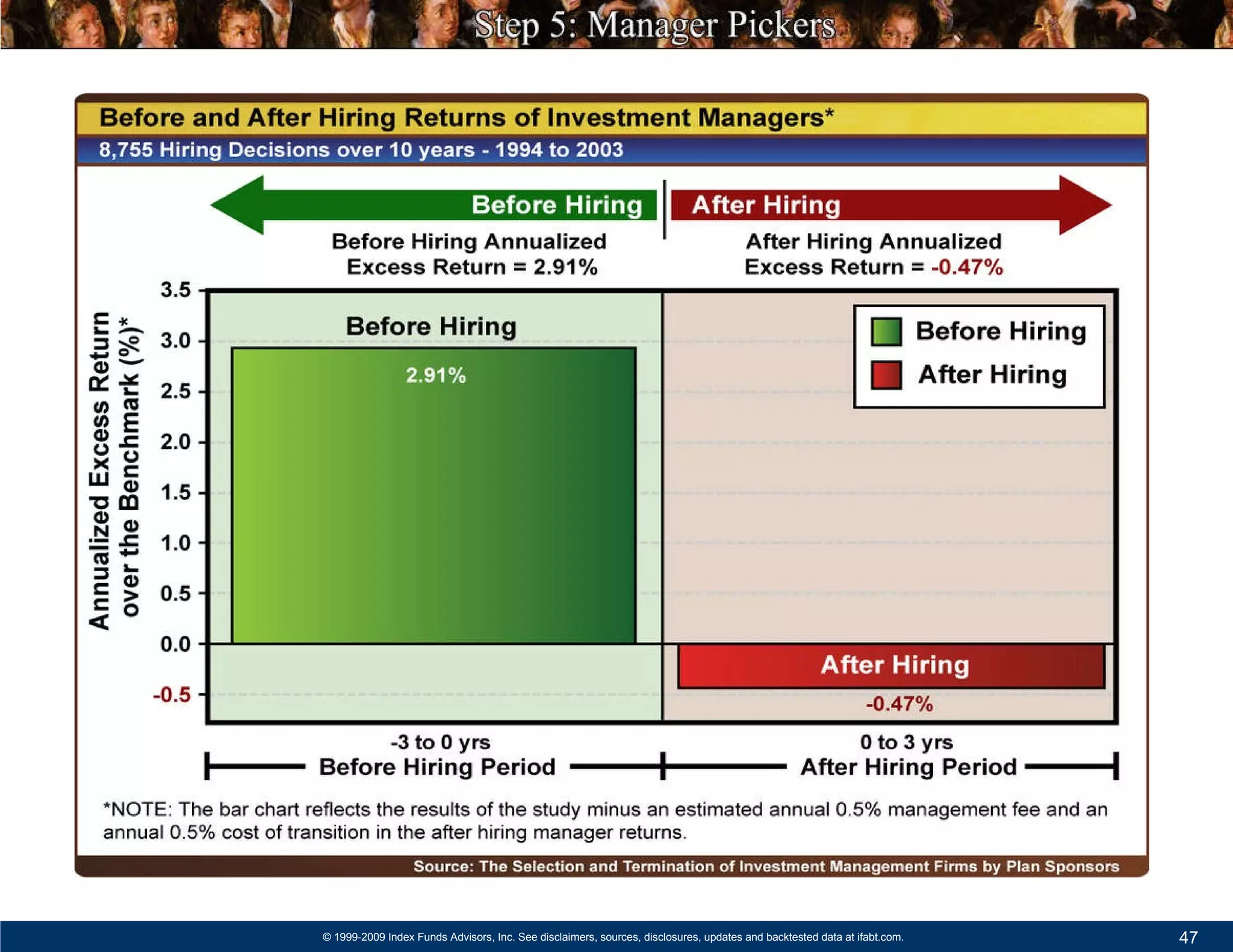
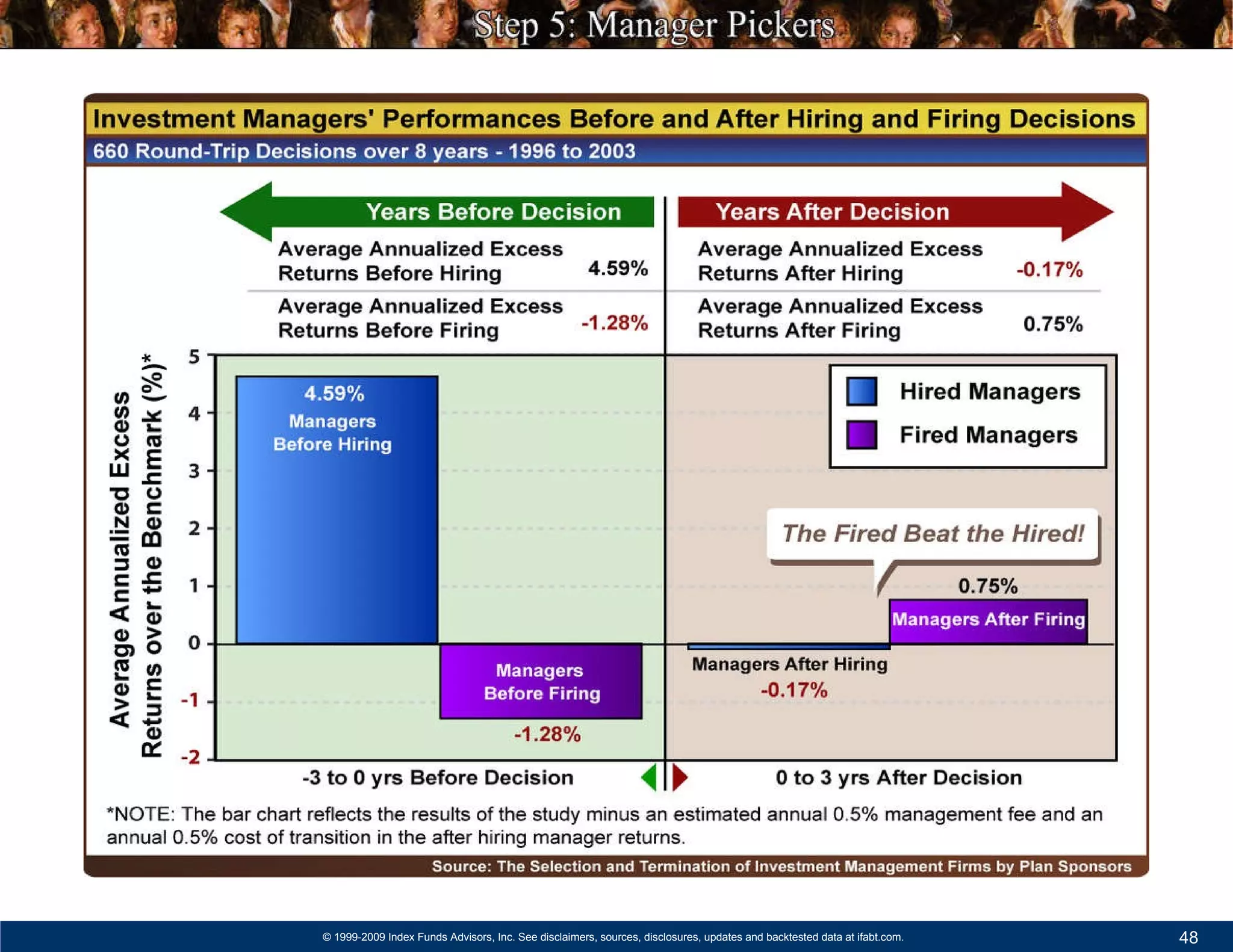
Hedge Fund Risks:  A Short List No Daily Access to Liquidity No Transparency—Hedge Fund Investors    Lose Control of Their Asset Allocations Tax Inefficiency No Clear Winners--No Persistence of    Manager Performance Beyond What Is    Randomly Expected
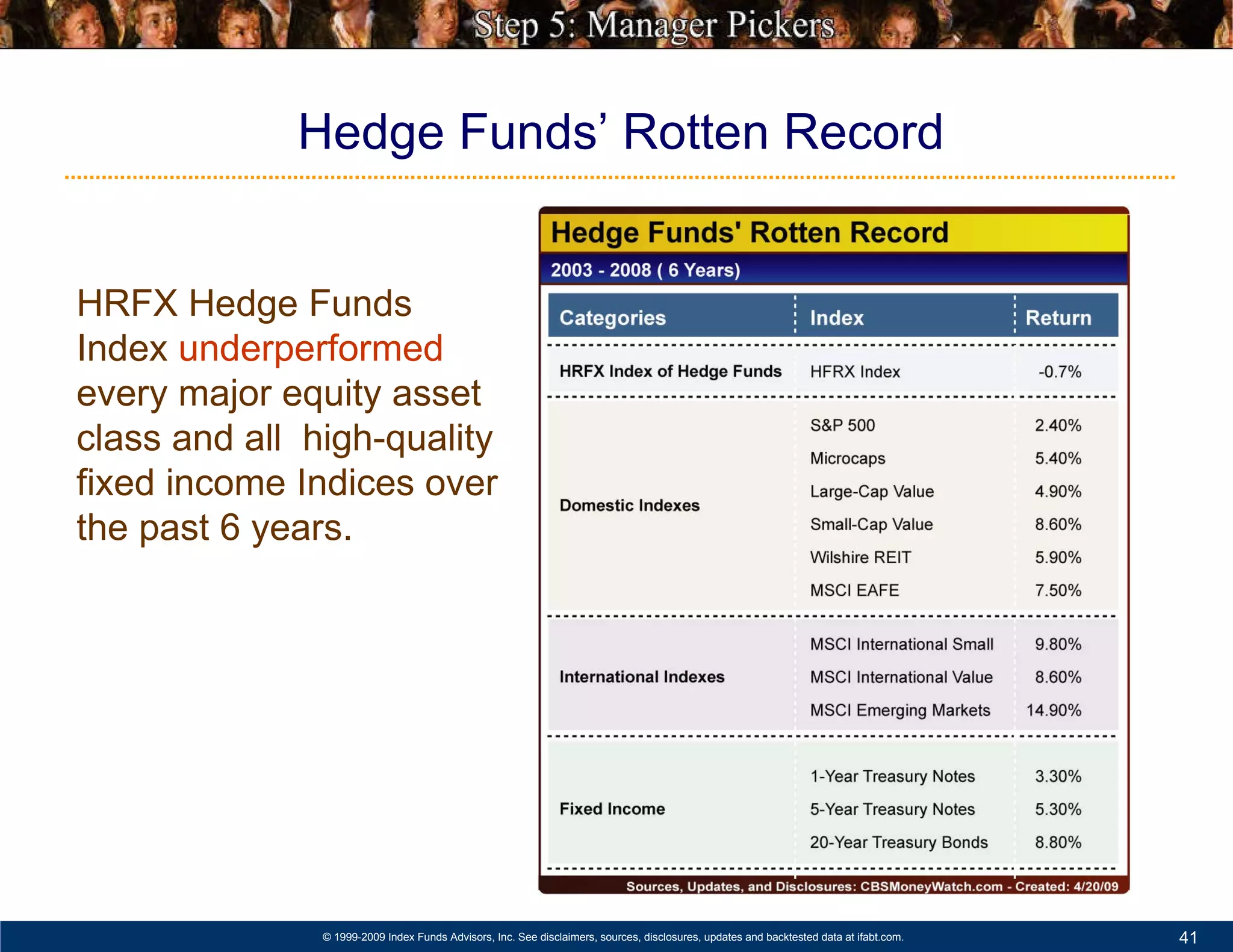
Hedge Funds’ Rotten Record HRFX Hedge Funds Index  underperformed  every major equity asset class and all  high-quality fixed income Indices over  the past 6 years.
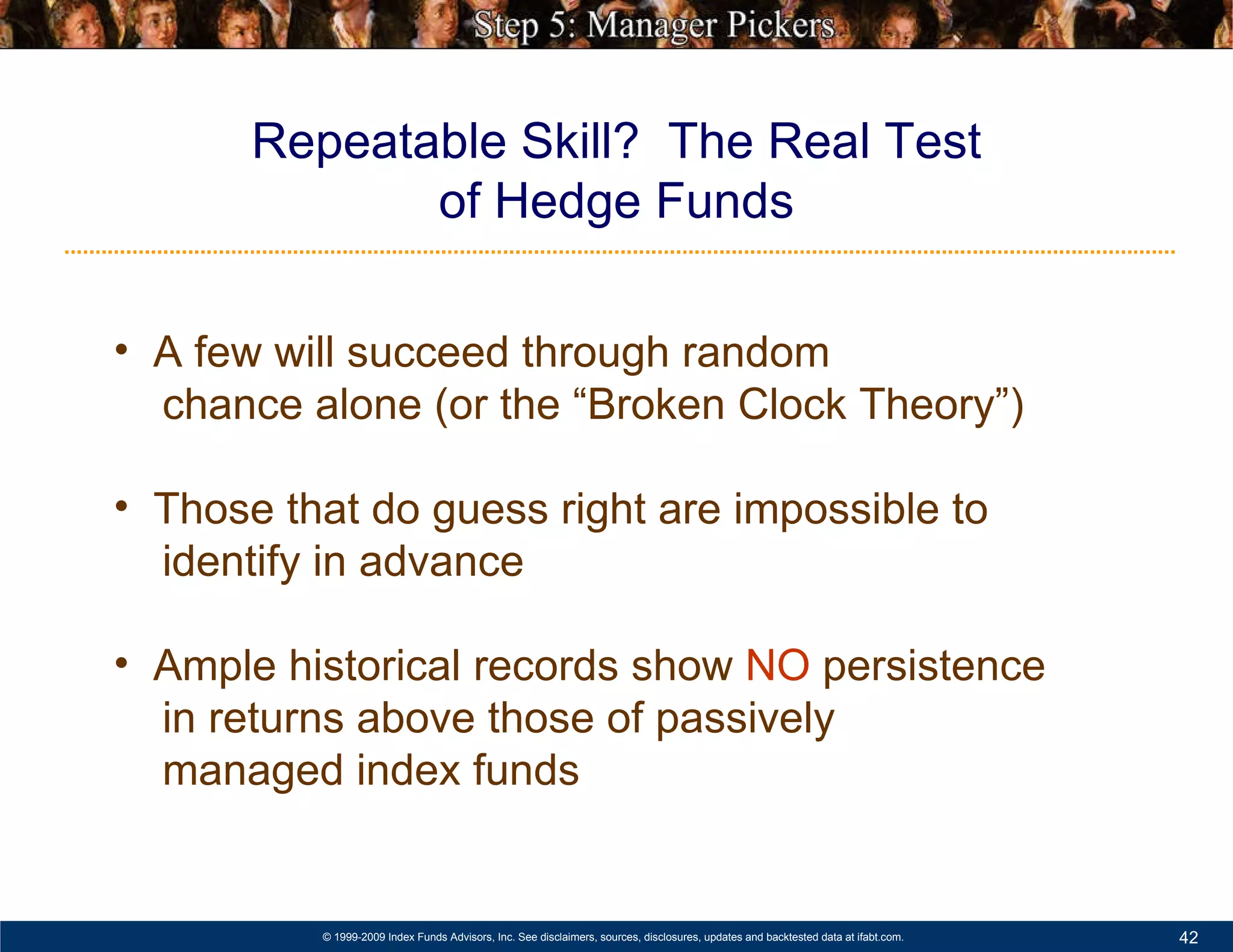
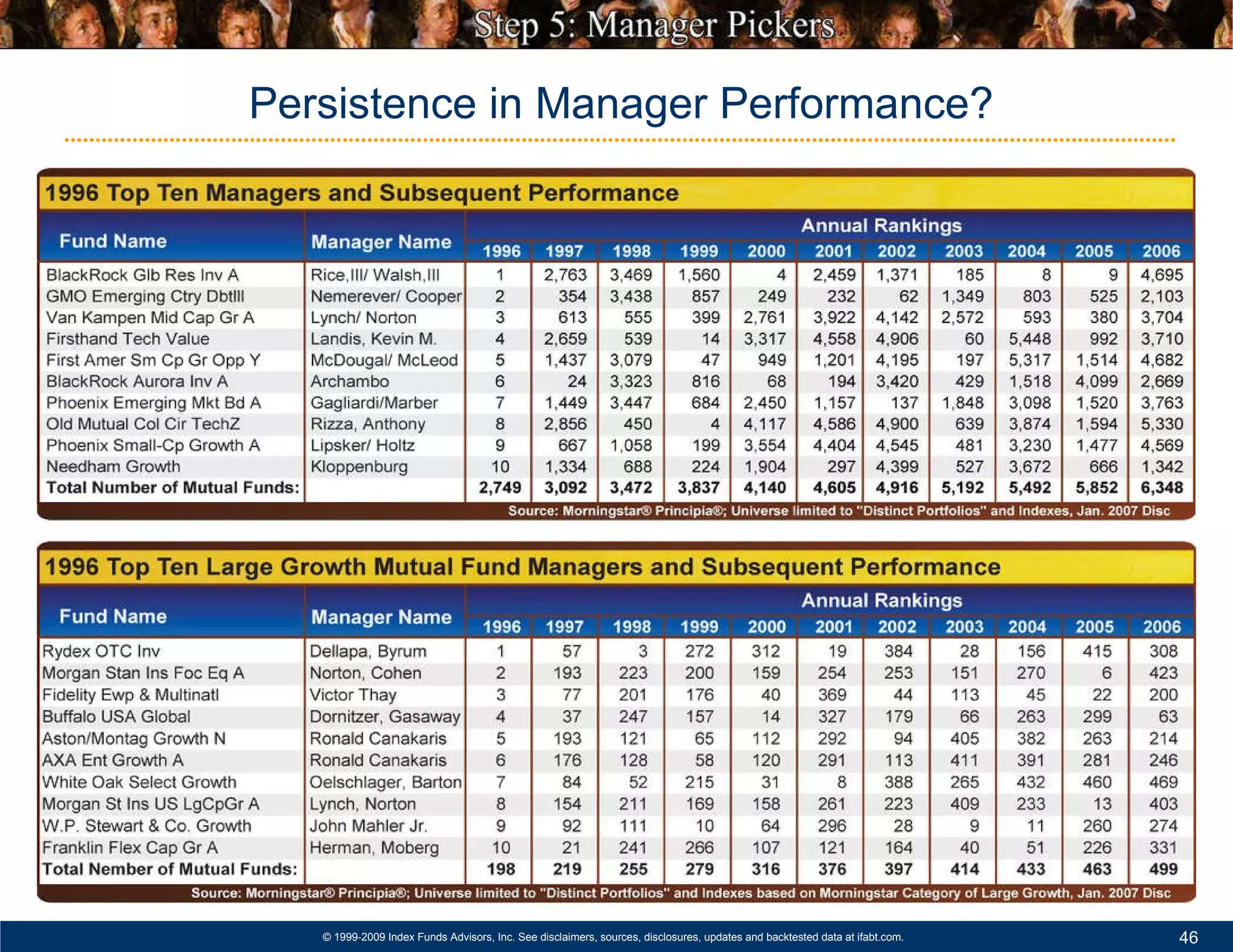
Repeatable Skill?  The Real Test of Hedge Funds A few will succeed through random    chance alone (or the “Broken Clock Theory”) Those that do guess right are impossible to  identify in advance  Ample historical records show  NO  persistence    in returns above those of passively    managed index funds
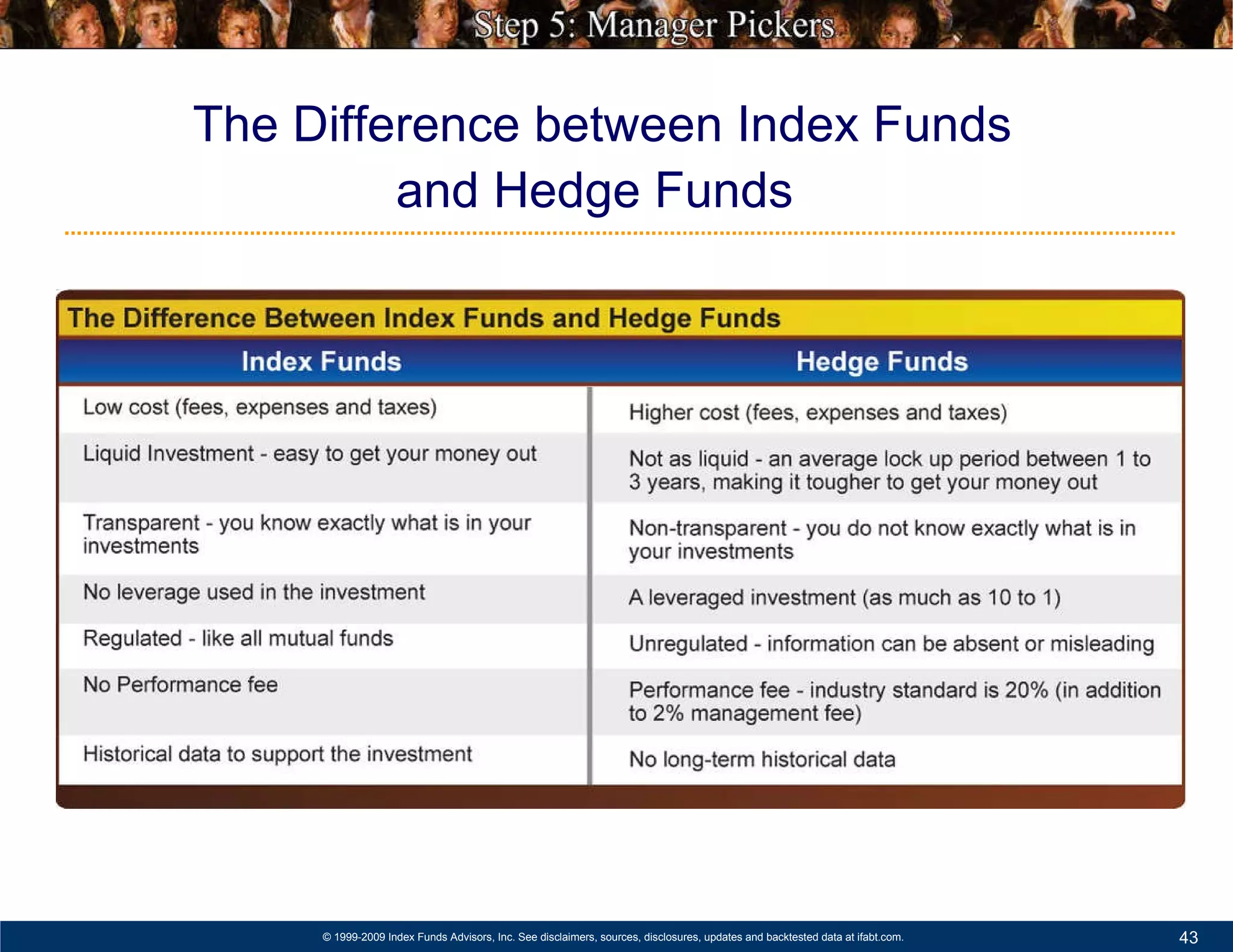
Hedge Funds: Leverage, Opacity, Illiquidity The Difference between Index Funds and Hedge Funds
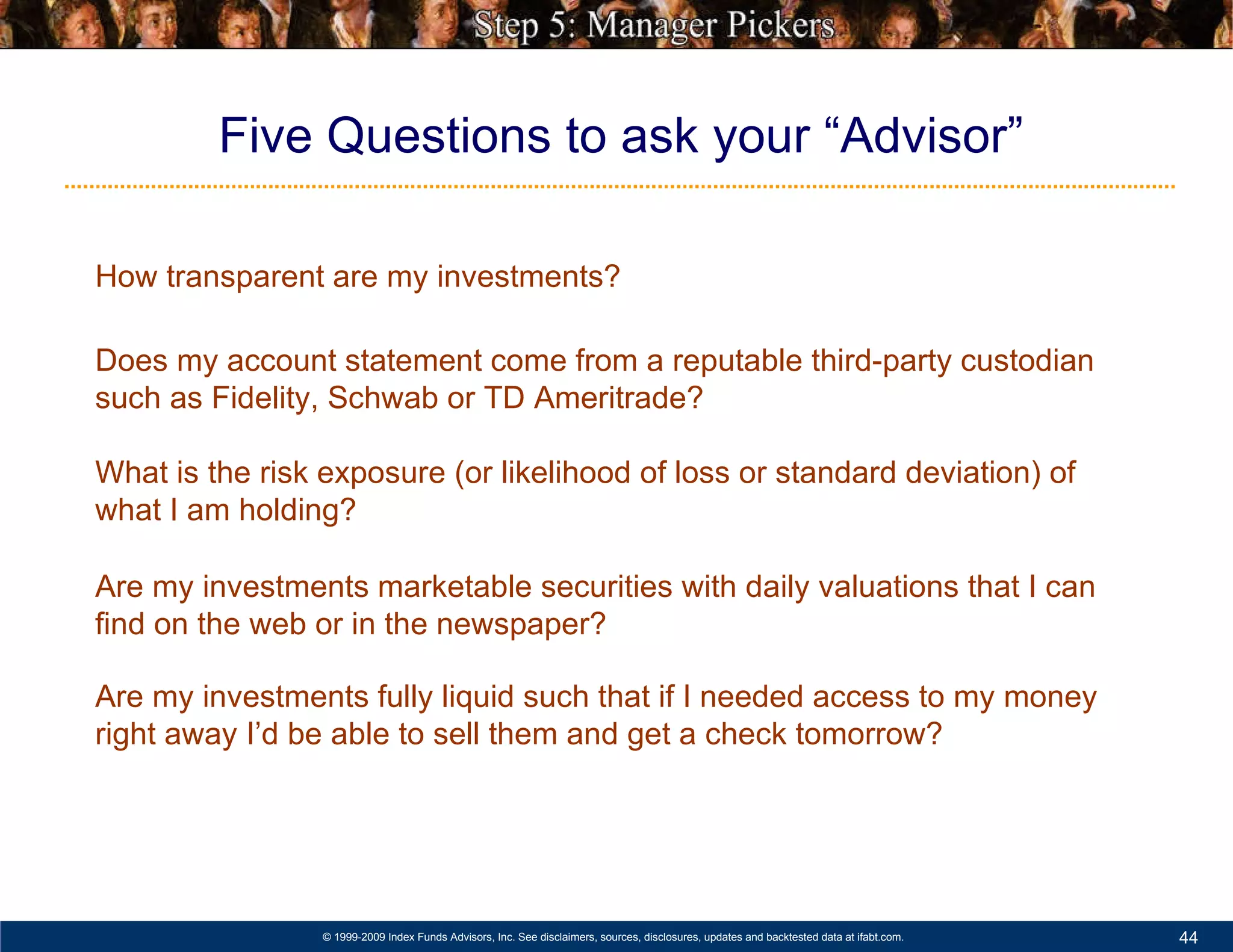
Hedge Funds: Leverage, Opacity, Illiquidity Five Questions to ask your “Advisor” How transparent are my investments? Does my account statement come from a reputable third-party custodian such as Fidelity, Schwab or TD Ameritrade? What is the risk exposure (or likelihood of loss or standard deviation) of what I am holding? Are my investments marketable securities with daily valuations that I can find on the web or in the newspaper? Are my investments fully liquid such that if I needed access to my money right away I’d be able to sell them and get a check tomorrow?
 
Persistence in Manager Performance?
 
 
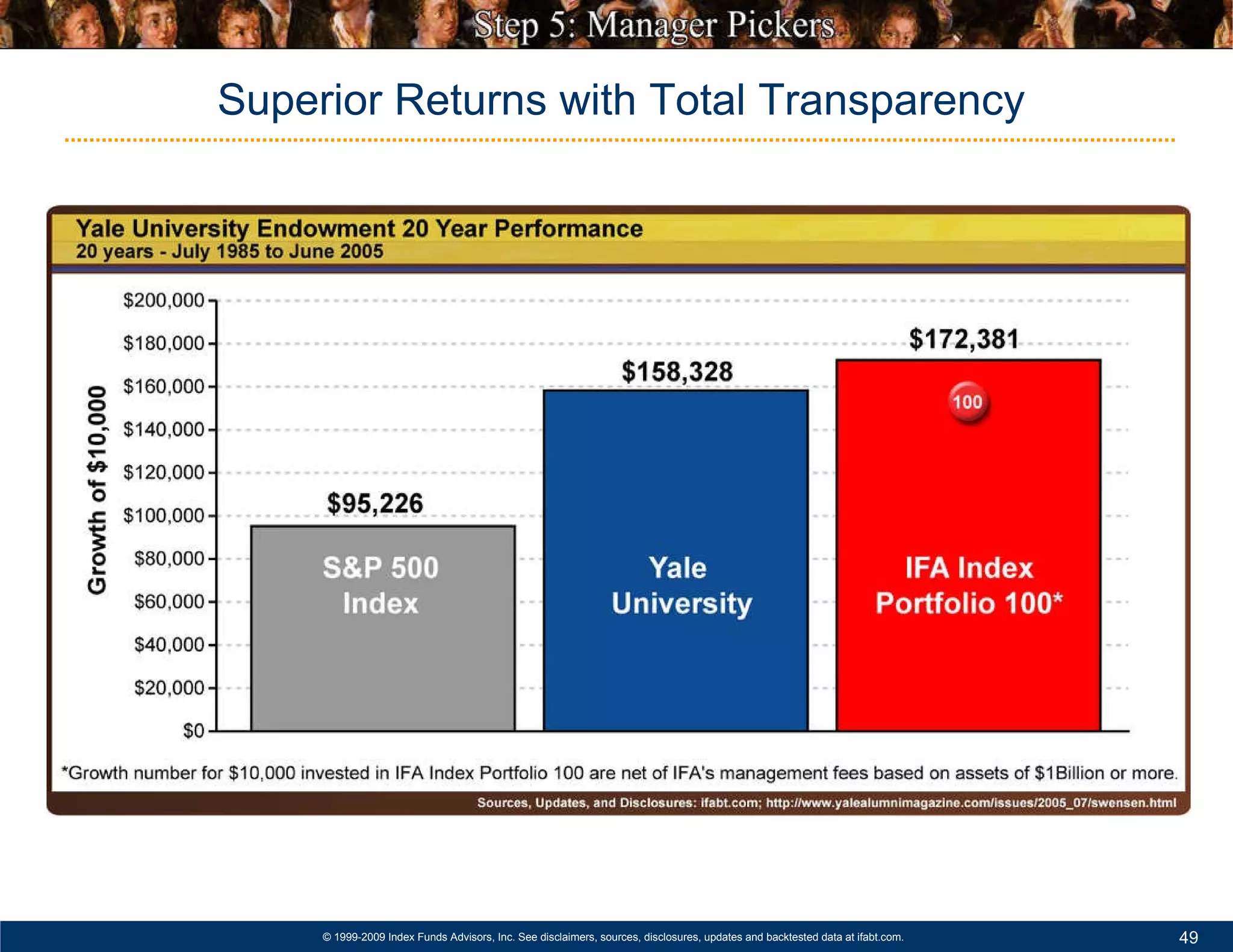
Superior Returns with Total Transparency


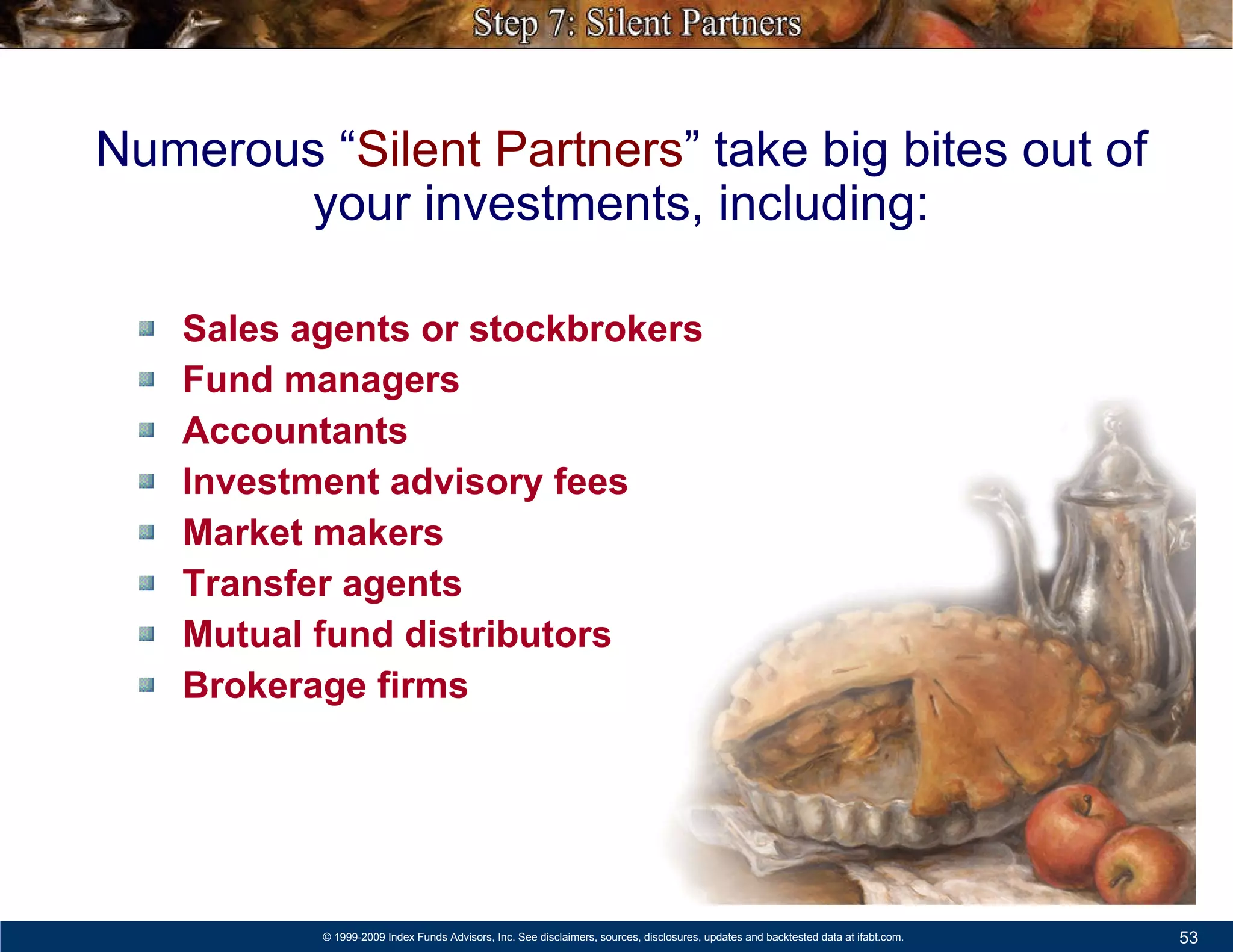
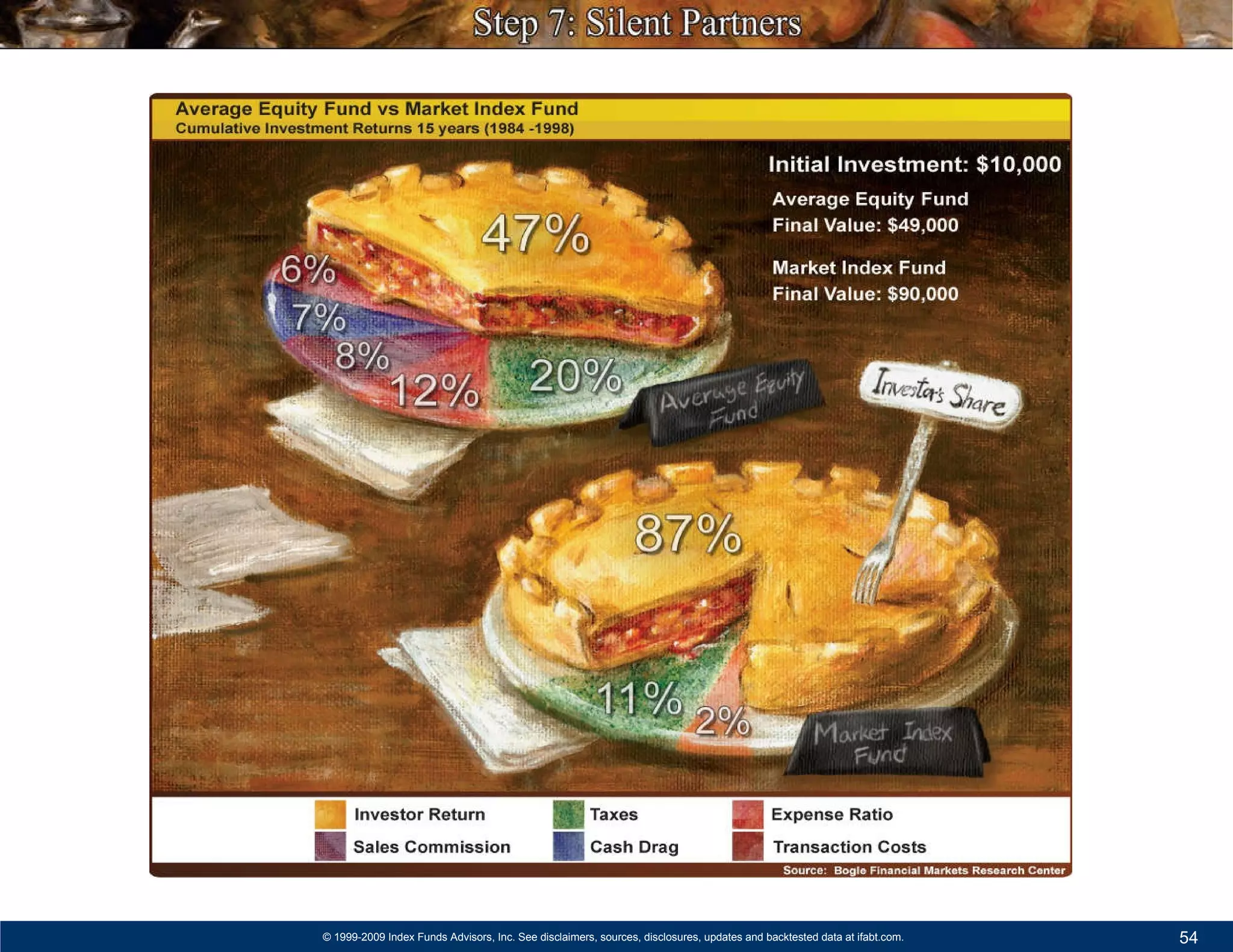
Sales agents or stockbrokers Fund managers Accountants Investment advisory fees Market makers Transfer agents Mutual fund distributors Brokerage firms Numerous “ Silent Partners ” take big bites out of your investments, including:
 
 
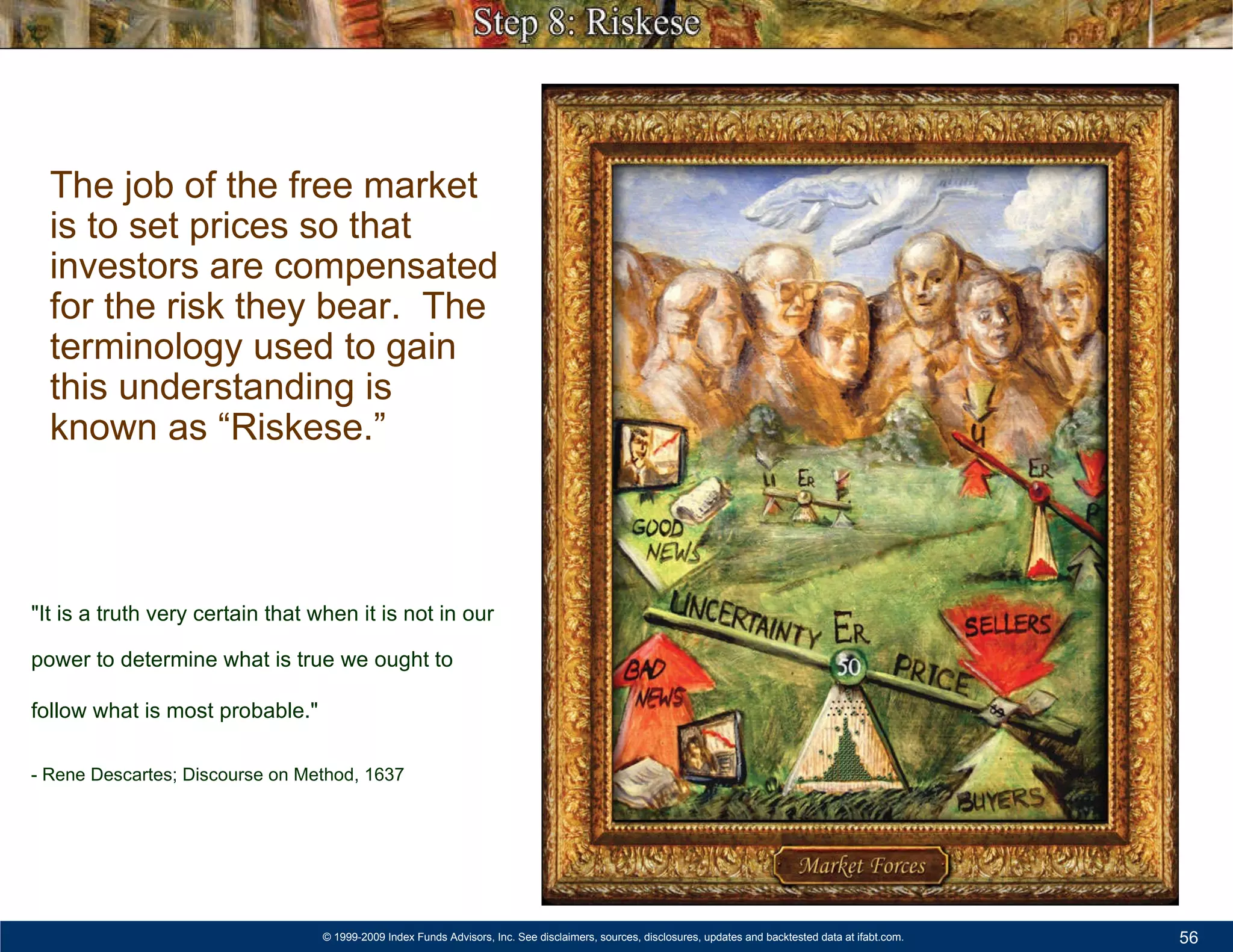
The job of the free market is to set prices so that investors are compensated for the risk they bear.  The terminology used to gain this understanding is known as “Riskese.” "It is a truth very certain that when it is not in our power to determine what is true we ought to follow what is most probable."   - Rene Descartes; Discourse on Method, 1637
 
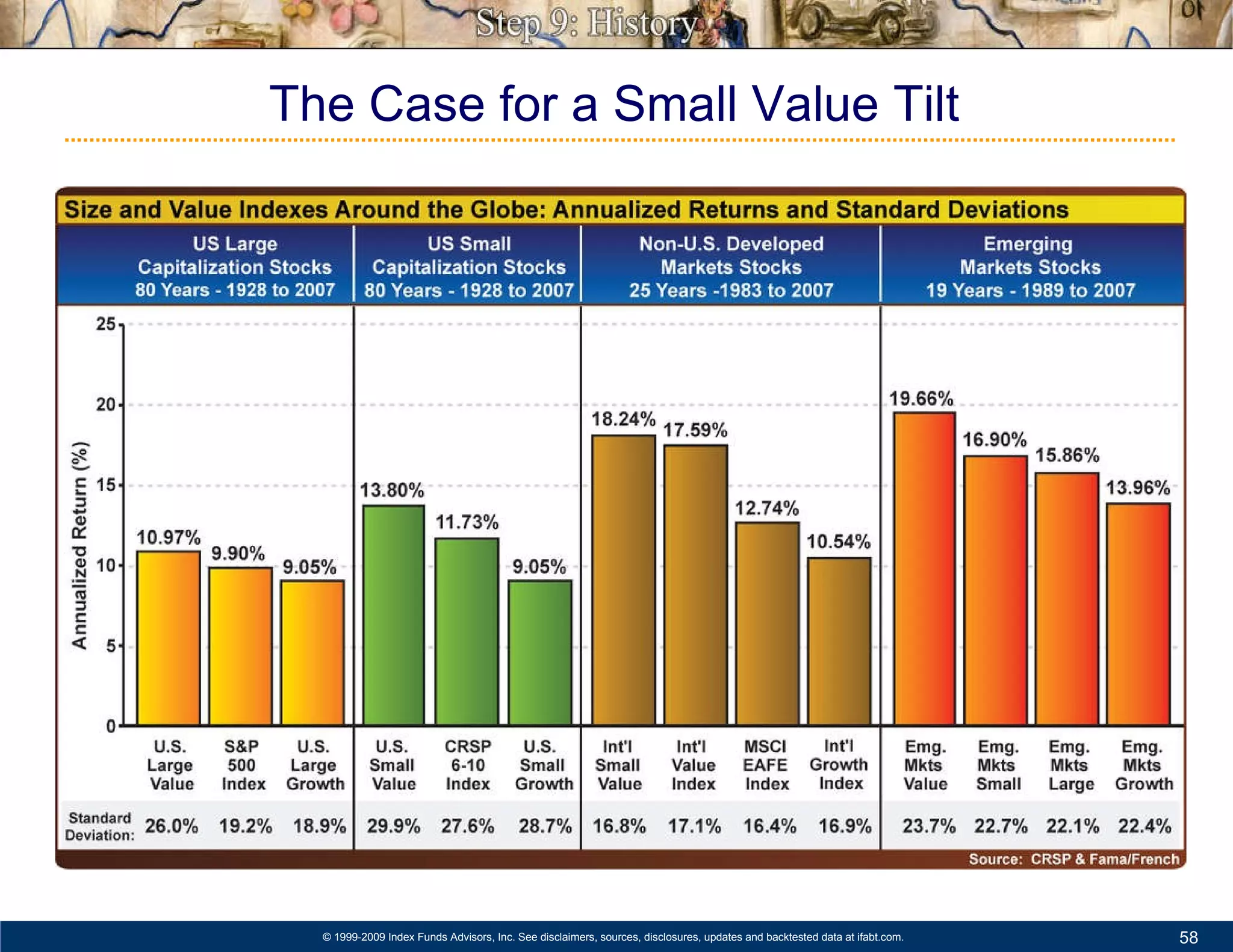
The Case for a Small Value Tilt


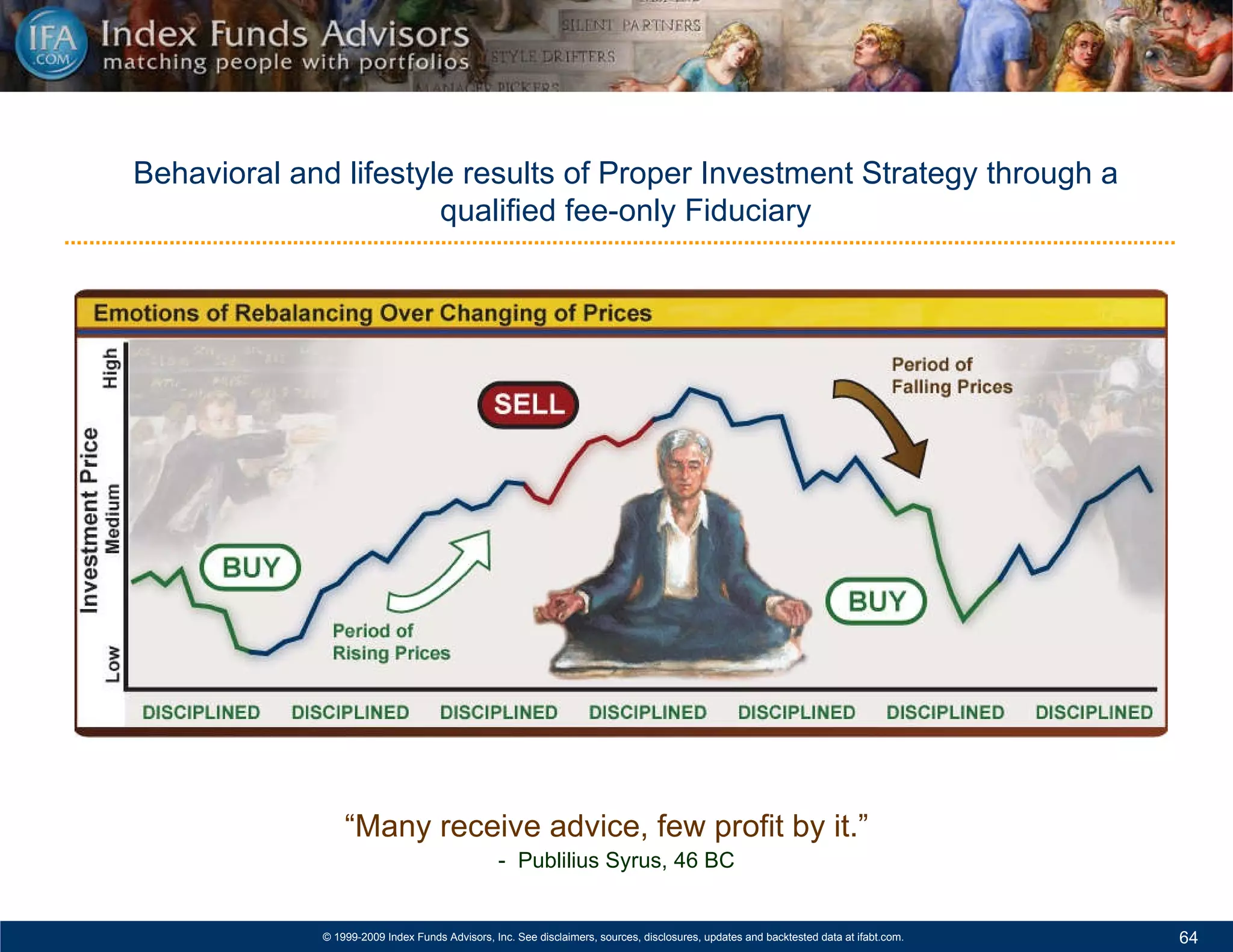
Behavioral and lifestyle results of Proper Investment Strategy through a qualified fee-only Fiduciary “ Many receive advice, few profit by it.”   -  Publilius Syrus, 46 BC
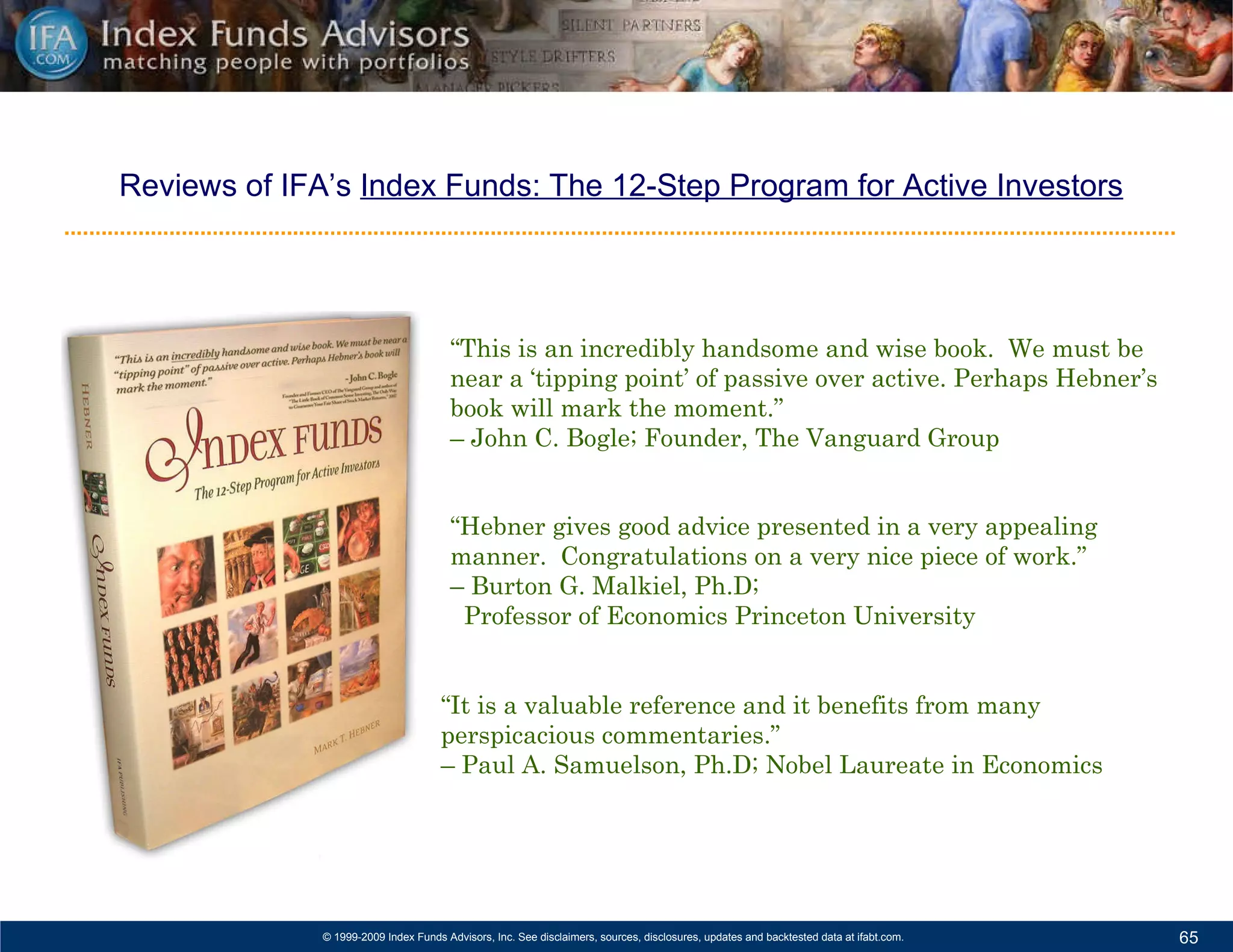
Reviews of IFA’s  Index Funds: The 12-Step Program for Active Investors “ This is an incredibly handsome and wise book.  We must be near a ‘tipping point’ of passive over active. Perhaps Hebner’s book will mark the moment.”  –  John C. Bogle; Founder, The Vanguard Group   “ Hebner gives good advice presented in a very appealing manner.  Congratulations on a very nice piece of work.”  –  Burton G. Malkiel, Ph.D;  Professor of Economics Princeton University “ It is a valuable reference and it benefits from many perspicacious commentaries.”  –  Paul A. Samuelson, Ph.D; Nobel Laureate in Economics
888.643.3133 Local: 608.227.6000 brendan@ifa.com  19200 Von Karman Ave. Suite 150 Irvine, CA 92612 Irvine, San Diego, Pasadena/Los Angeles and Westlake Village, CA;  Madison, WI; Naples, FL; New York, NY;  Windsor, Canada Brendan Connelly   Vice President

The 12-Step Program For Active Investors

  • 1.
    Brendan Connelly Vice President Index Funds Advisors, Inc.
  • 2.
    888.643.3133 Local: 608.227.6000 [email_address] 19200 Von Karman Ave. Suite 150 Irvine, CA 92612
  • 3.
  • 4.
    Abbreviated Disclosure forBacktested Performance Information on the Simulated Strategies of IFA Indexes and IFA Index Portfolios (Indexfolios) : 1. Index Funds Advisors, Inc. (IFA) was incorporated in March 1999 and placed its first independent client investments in early 2000. The performance information presented in the chart or table represents backtested performance based on combined simulated index data and live (or actual) mutual fund results from Jan 1, 1928 to period ending date shown using the strategy of buying, holding and annually rebalancing globally diversified portfolios of index funds. Backtested performance is hypothetical (it does not reflect trading in actual accounts) and is provided for informational purposes to indicate historical performance had the index portfolios been available over the relevant period. IFA did not offer the index portfolios until November 1999. Prior to 1999, IFA did not manage client assets. The IFA indexing investment strategy is based on the principles of Modern Portfolio Theory and the Fama and French Three Factor Model for Equities and Two Factor Model for Fixed Income. Index portfolios are designed to provide substantial global diversification (approximately 15,000 companies in 40 countries) in order to reduce investment concentration and the resulting increased risk caused by the volatility of individual companies, indexes, or asset classes. Client portfolios are monitored and rebalanced, taking into consideration risk exposure consistency, transaction costs, and tax ramifications to maintain target asset allocations as shown in the twenty index portfolios. For complete and important disclosure information please visit : www.ifabt.com 13. Your use of these materials, including www.ifa.com Web site is your acknowledgement that you have read and understood the full disclaimer as stated above. Index portfolios, times series, standard deviations, and returns calculations are determined in the Dimensional Fund Advisors FA Returns 2.0 program. ©Copyright 1999-2009, DFA, Inc..
  • 5.
  • 6.
    Index funds areinvestments that have rules of construction that are adhered to regardless of market conditions. Globally diversified portfolios of index funds have about 16,000 stocks from more than 40 countries. Essentially an investment in free markets and the human ingenuity that comprises them (otherwise known as “capitalism”). What are Index Funds?
  • 7.
  • 8.
    Why Invest ina Portfolio of Index Funds? Because you get… Because you avoid… 1. Market rates of returns with lower fees, expenses and taxes Silent, unnecessary and expensive partners and below market rate of returns 2. Increased diversification Unrewarded concentration 3. 80 years of risk and return data on 20 global index portfolios and 15 indices Speculation through stock, time, manager and style picking 4. Style purity, asset class and allocation consistency Style drift, asset allocation shift and ambiguity 5. Relaxation Stress
  • 9.
  • 10.
    The Problem : Not one of them consistently achieves the market rate of return of global human ingenuity. Luck does not persist and the many will always know more than the few. Four Types of Active Management Stock Pickers Time Pickers Manager Pickers Style Drifters
  • 11.
  • 12.
    Emotions of ActiveInvesting The emotions of active investors go up and down like a roller coaster, leading them to negative returns on average especially after feess and taxes are deducted. The lessons in this 12-Step Program should allow investors to resist the behaviors that have caused them such otherwise avoidable despair and poor results in the past:
  • 13.
    Emotions of Passive(Index) Investing By contrast, passive investors invest whenever they have the money to invest and regardless of market conditions. In this way both their investing returns and investing behaviors become optimized, allowing them to move on and enjoy the bigger and better things in their lives:
  • 14.
  • 15.
    Modern Portfolio Theory: 1. Markets move randomly and are efficiently priced 2. The allocation of priced risk factors determines returns 3. Diversification reduces risk and increases returns 4. Risk exposure must be matched to risk capacity 5. Probability and statistics help investors control risks of investing
  • 16.
    Father of ModernPortfolio Theory 1990 Nobel Prize Winner in Economics Creator of the Efficient Frontier Winner, 1989 John von Nuemann Theory Prize Harry Markowitz: IFA’s Academic Consultant
  • 17.
  • 18.
  • 19.
  • 20.
  • 21.
    “ Wall Street’sfavorite scam is pretending that luck is skill .” - Ron Ross, Ph.D. The Unbeatable Market , 2002 The Unbeatable Market
  • 22.
    Neglecting to Accountfor All Fees, Expenses and Taxes Inappropriate Benchmarking Overlooking Survivorship Bias Performance Evaluation Errors When properly measured, US large-cap, US small-cap, international, and hedge fund/active managers do not consistently outperform appropriate indexes.
  • 23.
    Passive Beats Active: No Matter How you Slice It - Burton Malkiel, Princeton University Professor of Economics “ It’s like giving up belief in Santa Claus.”
  • 24.
    Passive Beats Active: No Matter How you Slice It “ It is unlikely we have insights that are not in market prices already.” - Ken French; Dartmouth College Professor of Finance
  • 25.
    Passive Beats Active: No Matter How you Slice It “ There is safety in numbers . ” - Euripides, 480 BCE – 406 BCE
  • 26.
    Sources: "570 PeerBond Funds vs. Vanguard Intermediate Bond Fund, 1996 - 2006 (10 Years)"; "The Little Book of Common Sense Investing" page 143 "194 Peer Bond Funds vs. Vanguard Long-Term Muni Bond Fund, 1996 - 2006 (10 Years)"; "The Little Book of Common Sense Investing" page 145 "62 Government Long Funds vs BarCap Long Government, 2003 - 2008 (5 Years)"; Standard & Poors Indicies Versus Actve Funds Scorecard, Report 13 "68 Government Intermediate Funds vs BarCap Intermediate Government, 2003 - 2008 (5 Years)"; Standard & Poors Indicies Versus Actve Funds Scorecard, Report 13 "47 Government Short Funds vs BarCap 1-3Years Government, 2003 - 2008 (5 Years)"; Standard & Poors Indicies Versus Actve Funds Scorecard, Report 13 "149 Investment Grade Long Funds vs BarCap Long Government/Credit, 2003 - 2008 (5 Years)"; Standard & Poors Indicies Versus Actve Funds Scorecard, Report 13 "221 Investment Grade Intermediate Funds vs BarCap Intermediate Government/Credit, 2003 - 2008 (5 Years)"; Standard & Poors Indicies Versus Actve Funds Scorecard, Report "60 Investment Grade Short Funds vs BarCap 1-3 Years Government, 2003 - 2008 (5 Years)"; Standard & Poors Indicies Versus Actve Funds Scorecard, Report 13 "110 National Municipal Funds vs S&P National Municipal, 2003 - 2008 (5 Years)"; Standard & Poors Indicies Versus Actve Funds Scorecard, Report 13 "46 CA Municipal Funds vs S&P California Municipal, 2003 - 2008 (5 Years)"; Standard & Poors Indicies Versus Actve Funds Scorecard, Report 13 "Dead Funds and Return of Surviving Mutual Funds Relative to the Market, 1970 - 1999 (30 Years)"; Bogle Financial Markets Research Center "Dead Funds and Return of Surviving Mutual Funds Relative to the Market, 1970 - 2000 (31 Years)"; CRSP "71 Large Cap Growth/Growth and Income Mutual Fund Managers vs. the S&P 500 Index, 1982 - 1991 (10 Years)"; "Is Your Alpha Big Enough to Cover Your Taxes?", The Journal of Portfolio Management "Large-Cap Equity Funds vs. the S&P 500 Index, 1996 - 2005 (10 Years)"; Lipper, from Burton Malkiel's "A Random Walk Down Wall Street" "Large-Cap Equity Funds vs. the S&P 500 Index, 1986 - 2005 (20 Years)"; Lipper, from Burton Malkiel's "A Random Walk Down Wall Street" "32 Market Timing Newsletters vs. the S&P 500 Index, 1988 - 1997 (10 Years)"; Hulbert Financial Digest, Businessweek "319 Large Value Funds vs. IFA US Large Cap Value Index, July 2001 - June 2006 (5 Years)"; Standard and Poor's, ifabt.com "446 Large Value Mutual Funds vs. the IFA Large Value Index, April 1992 - March 2007 (15 Years)"; Morningstar, Inc., ifabt.com "157 Small Cap Value Funds vs. IFA US Small Cap Value Index, July 2001 - June 2006 (5 Years)"; Standard and Poor's, ifabt.com "53 Small Value Mutual Funds vs. the IFA Small Cap Value Index, April 1992 - March 2007 (15 Years)"; Morningstar, Inc., ifabt.com "45 Foreign Large Value Mutual Funds vs. the IFA International Value Index, April 1992 - March 2007 (15 Years)"; Morningstar, Inc., ifabt.com "77 Emerging Markets Funds vs. IFA Emerging Markets Blended Index, July 2001 - June 2006 (5 Years)"; Standard and Poor's, ifabt.com "128 World Stock Mutual Funds vs. IFA Portfolio 100, April 1992 - March 2007 (15 Years)"; Morningstar, Inc., ifabt.com
  • 27.
    Buffett not onlyadvocates index funds, he’s betting on them. The June 2008 issue of Fortune magazine reported that Buffett wagered a million dollars that an S&P 500 index fund’s ensuing 10-year returns would beat the returns of five actively managed funds or hedge funds selected by a prominent New York-based asset management firm. What about Warren Buffett?
  • 28.
    1. “..thebest way to own common stocks is through index funds... Those following this path are sure to beat the net results (after fees and expenses) delivered by the great majority of investment professionals. - Warren Buffett, Berkshire Hathaway Inc. 1996 Shareholder Letter 2. “Additionally, those index funds that are very low-cost … are the best selection for most of those who wish to own equities.” - Warren Buffett, Berkshire Hathaway Inc. 2002 Shareholder Letter 3. “All [investors] had to do was piggyback Corporate America in a diversified, low-expense way. An index fund that they never touched would have done the job. Instead many investors have had experiences ranging from mediocre to disastrous.” - Warren Buffett, Berkshire Hathaway Inc. 2003 Shareholder Letter 4. "The active investors will have their returns diminished by a far greater percentage than will their inactive brethren. That means that the passive group – the “know-nothings” – must win." - Warren Buffett, Berkshire Hathaway Inc. 2007 Shareholder Letter Buffett’s Smart Bet
  • 29.
  • 30.
  • 31.
  • 32.
  • 33.
    October 1974 –September 1979 Annualized Return: 29.56% Annualized Standard Deviation: 15.84% Growth of $1.00: $3.65 Total Return: 264.99% Time Period: 5 years
  • 34.
  • 35.
    Who Can YouTrust? Too Good to Be True: The Rise and Fall of Bernie Madoff (an insightful new book by Erin Arvedlund)
  • 36.
    “ Why paypeople to gamble with your money? ” - William F. Sharpe Nobel Laureate in Economics 1990 Money Magazine Interview, July 2007
  • 37.
    Since late 2006at least 111 funds at 68 outfits have "imploded " don't tell me the proof is in the pudding, because there is no pudding when it comes to hedge funds.
  • 38.
    “ Anyone whohas delved into the literature on efficient markets should smell a rat when thousands of hedge funds are being launched each year, all flamboyantly claiming they can earn returns massive enough to cover their typically 2% management fee, 0.4% ‘administrative fee’ and 20% incentive fee, not to mention the enormous brokerage fees the funds rack up on their frenetic trading . ” - Glyn Holton, author Who’ll Take the Toxic Waste ? Who’ll Take the Toxic Waste?
  • 39.
    “ Since late2006 at least 111 funds at 68 outfits have ‘imploded’.” Dead Funds & Survivorship Bias www.hf-implode.com
  • 40.
    Hedge Fund Risks: A Short List No Daily Access to Liquidity No Transparency—Hedge Fund Investors Lose Control of Their Asset Allocations Tax Inefficiency No Clear Winners--No Persistence of Manager Performance Beyond What Is Randomly Expected
  • 41.
    Hedge Funds’ RottenRecord HRFX Hedge Funds Index underperformed every major equity asset class and all high-quality fixed income Indices over the past 6 years.
  • 42.
    Repeatable Skill? The Real Test of Hedge Funds A few will succeed through random chance alone (or the “Broken Clock Theory”) Those that do guess right are impossible to identify in advance Ample historical records show NO persistence in returns above those of passively managed index funds
  • 43.
    Hedge Funds: Leverage,Opacity, Illiquidity The Difference between Index Funds and Hedge Funds
  • 44.
    Hedge Funds: Leverage,Opacity, Illiquidity Five Questions to ask your “Advisor” How transparent are my investments? Does my account statement come from a reputable third-party custodian such as Fidelity, Schwab or TD Ameritrade? What is the risk exposure (or likelihood of loss or standard deviation) of what I am holding? Are my investments marketable securities with daily valuations that I can find on the web or in the newspaper? Are my investments fully liquid such that if I needed access to my money right away I’d be able to sell them and get a check tomorrow?
  • 45.
  • 46.
  • 47.
  • 48.
  • 49.
    Superior Returns withTotal Transparency
  • 50.
  • 51.
  • 52.
  • 53.
    Sales agents orstockbrokers Fund managers Accountants Investment advisory fees Market makers Transfer agents Mutual fund distributors Brokerage firms Numerous “ Silent Partners ” take big bites out of your investments, including:
  • 54.
  • 55.
  • 56.
    The job ofthe free market is to set prices so that investors are compensated for the risk they bear. The terminology used to gain this understanding is known as “Riskese.” "It is a truth very certain that when it is not in our power to determine what is true we ought to follow what is most probable." - Rene Descartes; Discourse on Method, 1637
  • 57.
  • 58.
    The Case fora Small Value Tilt
  • 59.
  • 60.
  • 61.
  • 62.
  • 63.
  • 64.
    Behavioral and lifestyleresults of Proper Investment Strategy through a qualified fee-only Fiduciary “ Many receive advice, few profit by it.” - Publilius Syrus, 46 BC
  • 65.
    Reviews of IFA’s Index Funds: The 12-Step Program for Active Investors “ This is an incredibly handsome and wise book. We must be near a ‘tipping point’ of passive over active. Perhaps Hebner’s book will mark the moment.” – John C. Bogle; Founder, The Vanguard Group “ Hebner gives good advice presented in a very appealing manner. Congratulations on a very nice piece of work.” – Burton G. Malkiel, Ph.D; Professor of Economics Princeton University “ It is a valuable reference and it benefits from many perspicacious commentaries.” – Paul A. Samuelson, Ph.D; Nobel Laureate in Economics
  • 66.
    888.643.3133 Local: 608.227.6000brendan@ifa.com 19200 Von Karman Ave. Suite 150 Irvine, CA 92612 Irvine, San Diego, Pasadena/Los Angeles and Westlake Village, CA; Madison, WI; Naples, FL; New York, NY; Windsor, Canada Brendan Connelly Vice President