wealth advisors LLC
pursuing a better
investment experience
Past performance is no guarantee of future results. Indices are not available for direct investment. Their performance does not reflect the expenses
associated with the management of an actual portfolio.
1
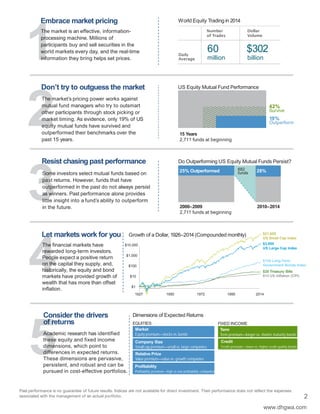
Embrace market pricing
The market is an effective, information-
processing machine. Millions of
participants buy and sell securities in the
world markets every day, and the real-time
information they bring helps set prices.
World Equity Trading in 2014
Number
of Trades
Dollar
Volume
Daily
Average
60
million
$302
billion
2
Don’t try to outguess the market
The market’s pricing power works against
mutual fund managers who try to outsmart
other participants through stock picking or
market timing. As evidence, only 19% of US
equity mutual funds have survived and
outperformed their benchmarks over the
past 15 years.
US Equity Mutual Fund Performance
42%
Survive
19%
Outperform
15 Years
2,711 funds at beginning
3
Resist chasing past performance
Some investors select mutual funds based on
past returns. However, funds that have
outperformed in the past do not always persist
as winners. Past performance alone provides
little insight into a fund’s ability to outperform
in the future.
Do Outperforming US Equity Mutual Funds Persist?
2000–2009
2,711 funds at beginning
2010–2014
25% Outperformed 682
funds 28%
4
The financial markets have
rewarded long-term investors.
People expect a positive return
on the capital they supply, and,
historically, the equity and bond
markets have provided growth of
wealth that has more than offset
inflation.
Growth of a Dollar, 1926–2014 (Compounded monthly)
1927 1950 1972 1995 2014
$10,000
$1,000
$100
$10
$1
$21,655
US Small Cap Index
$3,955
US Large Cap Index
$125 Long-Term
Government Bonds Index
$20 Treasury Bills
$13 US Inflation (CPI)
Let markets work for you
5
Consider the drivers
of returns
Academic research has identified
these equity and fixed income
dimensions, which point to
differences in expected returns.
These dimensions are pervasive,
persistent, and robust and can be
pursued in cost-effective portfolios.
Dimensions of Expected Returns
EQUITIES FIXED INCOME
Market
Equity premium—stocks vs. bonds
Company Size
Small cap premium—small vs. large companies
Term
Term premium—longer vs. shorter maturity bonds
Credit
Credit premium—lower vs. higher credit quality bonds
Relative Price
Value premium—value vs. growth companies
Profitability
Profitability premium—high vs.low profitability companies
www.dhgwa.com
2
Credit
Credit premium—lower vs. higher credit quality bonds
9
10
8
7
6
Focus on what you can control
A financial advisor can create a plan tailored to
your personal financial needs while helping you
focus on actions that add value. This can lead
to a better investment experience.
Look beyond the headlines
Daily market news and commentary can
challenge your investment discipline. Some
messages stir anxiety about the future while
others tempt you to chase the latest
investment fad. When tested, consider the
source and maintain a long-term perspective.
Manage your emotions
Many people struggle to separate their
emotions from investing. Markets go up
and down. Reacting to current market
conditions may lead to making poor
investment decisions at the worst times.
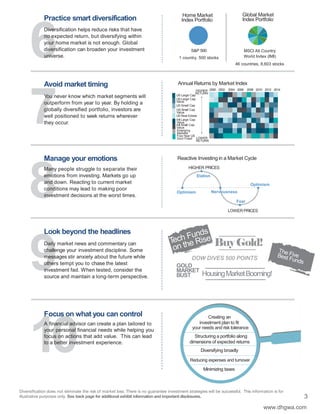
Practice smart diversification
Diversification helps reduce risks that have
no expected return, but diversifying within
your home market is not enough. Global
diversification can broaden your investment
universe.
Reactive Investing in a Market Cycle
HIGHER PRICES
LOWER PRICES
Optimism
Elation
Fear
Optimism
Nervousness
Avoid market timing
You never know which market segments will
outperform from year to year. By holding a
globally diversified portfolio, investors are
well positioned to seek returns wherever
they occur.
BuyGold!
DOW DIVES 500 POINTS
HousingMarketBooming!
GOLD
MARKET
BUST
S&P 500
1 country, 500 stocks
MSCI All Country
World Index (IMI)
46 countries, 8,603 stocks
Home Market
Index Portfolio
Global Market
Index Portfolio
Annual Returns by Market Index
HIGHER
RETURN
Five-Year US
Govt Fixed LOWER
RETURN
US Large Cap
US Large Cap
Value
US Small Cap
US Small Cap
Value
US Real Estate
Intl Large Cap
Value
Intl Small Cap
Value
Emerging
Markets
2000 2002 2004 2006 2008 2010 2012 2014
your needs and risk tolerance
Minimizing taxes
Structuring a portfolio along
dimensions of expected returns
Reducing expenses and turnover
Diversifying broadly
Creating an
investment plan to fit
Diversification does not eliminate the risk of market loss. There is no guarantee investment strategies will be successful. This information is for
illustrative purposes only. See back page for additional exhibit information and important disclosures.
www.dhgwa.com
3
Disclosures:
Exhibit 1: In US dollars. Global electronic order book (largest 50 exchanges). Source: World Federation of Exchanges.
Exhibit 2: Beginning sample includes US equity mutual funds as of the beginning of the 15-year period ending December 31, 2014.
Survivors are funds that were still in existence as of December 31, 2014. Non-survivors include funds that were either liquidated or
merged. Outperformers are funds that survived and beat their respective benchmarks over the period.
Exhibit 3: The graph shows the proportion of US equity mutual funds that outperformed and underperformed their respective
benchmarks (i.e., winners and losers) during the initial 10-year period ending December 31, 2009. Winning funds were re-
evaluated in the subsequent five-year period from 2010 through 2014, with the graph showing winners (outperformers) and
losers (underperformers). Fund count and percentages may not correspond due to rounding.
Data Source (Exhibits 2 and 3): The US Mutual Fund Landscape 2015, Dimensional Fund Advisors. US-domiciled mutual fund data is
from the CRSP Survivor-Bias-Free US Mutual Fund Database, provided by the Center for Research in Security Prices, University of
Chicago. Benchmark data provided by MSCI, Russell, and S&P. MSCI data © MSCI 2015, all rights reserved. Russell data © Russell
Investment Group 1995–2015, all rights reserved. The S&P data are provided by Standard & Poor’s Index Services Group.
Benchmark indices are not available for direct investment. Their performance does not reflect the expenses associated with the
management of an actual portfolio. Mutual fund investment values will fluctuate, and shares, when redeemed, may be worth
more or less than their original cost. Diversification neither assures a profit nor guarantees against a loss in a declining market.
Exhibit 4: In US dollars. Indices are not available for direct investment. Their performance does not reflect the expenses
associated with the management of an actual portfolio. USSmall Cap Index is the Fama/French US Small Cap Index; US Large Cap
Index is the Fama/French US Large Cap Index; Long-Term Government Bonds Index is 20-year US Government Bonds; Treasury Bills
are One-Month US Treasury bills; Inflation is the Consumer Price Index. Fama/French data provided by Fama/French. Eugene Fama
and Ken French are members of the Board of Directors for and provide consulting services to Dimensional Fund Advisors LP. Bonds,
T-bills, and inflation data © Stocks, Bonds, Bills, and Inflation Yearbook™, Ibbotson Associates, Chicago (annually updated work by
Roger G. Ibbotson and Rex A. Sinquefield). Past performance is no guarantee of future results.
Exhibit 5: Relative price is measured by the price-to-book ratio; value stocks are those with lower price-to-book ratios.
Profitability is a measure of current profitability, based on information from individual companies’ income statements.
Exhibit 6: Number of holdings for the S&P 500 and MSCI All Country World Index–Investable Market Index (MSCI ACWI IMI) as of
December 31, 2014. Indices are not available for direct investment and their performance does not reflect the expenses associated
with the management of an actual portfolio. International investing involves special risks such as currency fluctuation and political
instability. Investing in emerging markets may accentuate these risks. Past performance is not a guarantee of future results. The S&P
data are provided by Standard & Poor‘s Index Services Group. MSCI data © MSCI 2015, all rights reserved.
Exhibit 7: In US dollars. Chart is for illustrative purposes only. Index descriptions for asset groups: US Large Cap is the S&P 500 Index,
provided by Standard & Poor’s Index Services Group. US Large Cap Value is the Russell 1000 Value Index. US Small Cap is the
Russell 2000 Index. US Small Cap Value is the Russell 2000 Value Index. Russell data © Russell Investment Group 1995–2015, all
rights reserved. US Real Estate is the Dow Jones US Select REIT Index, provided by Dow Jones Indexes. International Large Cap
Value data provided by Fama/French from Bloomberg and MSCI securities data. International Small Cap Value data compiled by
Dimensional from Bloomberg and Style Research securities data. Emerging Markets is the MSCI Emerging Markets Index (gross
dividends), © MSCI 2015, all rights reserved. Five-Year US Government Fixed is the Barclays Capital Treasury Bond Index 1−5
Years, formerly Lehman Brothers, provided by Barclays Bank PLC. Indices are not available for direct investment. Index performance
does not reflect the expenses associated with the management of an actual portfolio. Past performance is not a guarantee of
future results.
Dimensional Fund Advisors LPis an investment advisor registered with the Securities and Exchange Commission.
www.dhgwa.com
4

DHGWA Brochure 2015 Portrait

  • 1.
    wealth advisors LLC pursuinga better investment experience
  • 2.
    Past performance isno guarantee of future results. Indices are not available for direct investment. Their performance does not reflect the expenses associated with the management of an actual portfolio. 1 Embrace market pricing The market is an effective, information- processing machine. Millions of participants buy and sell securities in the world markets every day, and the real-time information they bring helps set prices. World Equity Trading in 2014 Number of Trades Dollar Volume Daily Average 60 million $302 billion 2 Don’t try to outguess the market The market’s pricing power works against mutual fund managers who try to outsmart other participants through stock picking or market timing. As evidence, only 19% of US equity mutual funds have survived and outperformed their benchmarks over the past 15 years. US Equity Mutual Fund Performance 42% Survive 19% Outperform 15 Years 2,711 funds at beginning 3 Resist chasing past performance Some investors select mutual funds based on past returns. However, funds that have outperformed in the past do not always persist as winners. Past performance alone provides little insight into a fund’s ability to outperform in the future. Do Outperforming US Equity Mutual Funds Persist? 2000–2009 2,711 funds at beginning 2010–2014 25% Outperformed 682 funds 28% 4 The financial markets have rewarded long-term investors. People expect a positive return on the capital they supply, and, historically, the equity and bond markets have provided growth of wealth that has more than offset inflation. Growth of a Dollar, 1926–2014 (Compounded monthly) 1927 1950 1972 1995 2014 $10,000 $1,000 $100 $10 $1 $21,655 US Small Cap Index $3,955 US Large Cap Index $125 Long-Term Government Bonds Index $20 Treasury Bills $13 US Inflation (CPI) Let markets work for you 5 Consider the drivers of returns Academic research has identified these equity and fixed income dimensions, which point to differences in expected returns. These dimensions are pervasive, persistent, and robust and can be pursued in cost-effective portfolios. Dimensions of Expected Returns EQUITIES FIXED INCOME Market Equity premium—stocks vs. bonds Company Size Small cap premium—small vs. large companies Term Term premium—longer vs. shorter maturity bonds Credit Credit premium—lower vs. higher credit quality bonds Relative Price Value premium—value vs. growth companies Profitability Profitability premium—high vs.low profitability companies www.dhgwa.com 2
  • 3.
    Credit Credit premium—lower vs.higher credit quality bonds 9 10 8 7 6 Focus on what you can control A financial advisor can create a plan tailored to your personal financial needs while helping you focus on actions that add value. This can lead to a better investment experience. Look beyond the headlines Daily market news and commentary can challenge your investment discipline. Some messages stir anxiety about the future while others tempt you to chase the latest investment fad. When tested, consider the source and maintain a long-term perspective. Manage your emotions Many people struggle to separate their emotions from investing. Markets go up and down. Reacting to current market conditions may lead to making poor investment decisions at the worst times. Practice smart diversification Diversification helps reduce risks that have no expected return, but diversifying within your home market is not enough. Global diversification can broaden your investment universe. Reactive Investing in a Market Cycle HIGHER PRICES LOWER PRICES Optimism Elation Fear Optimism Nervousness Avoid market timing You never know which market segments will outperform from year to year. By holding a globally diversified portfolio, investors are well positioned to seek returns wherever they occur. BuyGold! DOW DIVES 500 POINTS HousingMarketBooming! GOLD MARKET BUST S&P 500 1 country, 500 stocks MSCI All Country World Index (IMI) 46 countries, 8,603 stocks Home Market Index Portfolio Global Market Index Portfolio Annual Returns by Market Index HIGHER RETURN Five-Year US Govt Fixed LOWER RETURN US Large Cap US Large Cap Value US Small Cap US Small Cap Value US Real Estate Intl Large Cap Value Intl Small Cap Value Emerging Markets 2000 2002 2004 2006 2008 2010 2012 2014 your needs and risk tolerance Minimizing taxes Structuring a portfolio along dimensions of expected returns Reducing expenses and turnover Diversifying broadly Creating an investment plan to fit Diversification does not eliminate the risk of market loss. There is no guarantee investment strategies will be successful. This information is for illustrative purposes only. See back page for additional exhibit information and important disclosures. www.dhgwa.com 3
  • 4.
    Disclosures: Exhibit 1: InUS dollars. Global electronic order book (largest 50 exchanges). Source: World Federation of Exchanges. Exhibit 2: Beginning sample includes US equity mutual funds as of the beginning of the 15-year period ending December 31, 2014. Survivors are funds that were still in existence as of December 31, 2014. Non-survivors include funds that were either liquidated or merged. Outperformers are funds that survived and beat their respective benchmarks over the period. Exhibit 3: The graph shows the proportion of US equity mutual funds that outperformed and underperformed their respective benchmarks (i.e., winners and losers) during the initial 10-year period ending December 31, 2009. Winning funds were re- evaluated in the subsequent five-year period from 2010 through 2014, with the graph showing winners (outperformers) and losers (underperformers). Fund count and percentages may not correspond due to rounding. Data Source (Exhibits 2 and 3): The US Mutual Fund Landscape 2015, Dimensional Fund Advisors. US-domiciled mutual fund data is from the CRSP Survivor-Bias-Free US Mutual Fund Database, provided by the Center for Research in Security Prices, University of Chicago. Benchmark data provided by MSCI, Russell, and S&P. MSCI data © MSCI 2015, all rights reserved. Russell data © Russell Investment Group 1995–2015, all rights reserved. The S&P data are provided by Standard & Poor’s Index Services Group. Benchmark indices are not available for direct investment. Their performance does not reflect the expenses associated with the management of an actual portfolio. Mutual fund investment values will fluctuate, and shares, when redeemed, may be worth more or less than their original cost. Diversification neither assures a profit nor guarantees against a loss in a declining market. Exhibit 4: In US dollars. Indices are not available for direct investment. Their performance does not reflect the expenses associated with the management of an actual portfolio. USSmall Cap Index is the Fama/French US Small Cap Index; US Large Cap Index is the Fama/French US Large Cap Index; Long-Term Government Bonds Index is 20-year US Government Bonds; Treasury Bills are One-Month US Treasury bills; Inflation is the Consumer Price Index. Fama/French data provided by Fama/French. Eugene Fama and Ken French are members of the Board of Directors for and provide consulting services to Dimensional Fund Advisors LP. Bonds, T-bills, and inflation data © Stocks, Bonds, Bills, and Inflation Yearbook™, Ibbotson Associates, Chicago (annually updated work by Roger G. Ibbotson and Rex A. Sinquefield). Past performance is no guarantee of future results. Exhibit 5: Relative price is measured by the price-to-book ratio; value stocks are those with lower price-to-book ratios. Profitability is a measure of current profitability, based on information from individual companies’ income statements. Exhibit 6: Number of holdings for the S&P 500 and MSCI All Country World Index–Investable Market Index (MSCI ACWI IMI) as of December 31, 2014. Indices are not available for direct investment and their performance does not reflect the expenses associated with the management of an actual portfolio. International investing involves special risks such as currency fluctuation and political instability. Investing in emerging markets may accentuate these risks. Past performance is not a guarantee of future results. The S&P data are provided by Standard & Poor‘s Index Services Group. MSCI data © MSCI 2015, all rights reserved. Exhibit 7: In US dollars. Chart is for illustrative purposes only. Index descriptions for asset groups: US Large Cap is the S&P 500 Index, provided by Standard & Poor’s Index Services Group. US Large Cap Value is the Russell 1000 Value Index. US Small Cap is the Russell 2000 Index. US Small Cap Value is the Russell 2000 Value Index. Russell data © Russell Investment Group 1995–2015, all rights reserved. US Real Estate is the Dow Jones US Select REIT Index, provided by Dow Jones Indexes. International Large Cap Value data provided by Fama/French from Bloomberg and MSCI securities data. International Small Cap Value data compiled by Dimensional from Bloomberg and Style Research securities data. Emerging Markets is the MSCI Emerging Markets Index (gross dividends), © MSCI 2015, all rights reserved. Five-Year US Government Fixed is the Barclays Capital Treasury Bond Index 1−5 Years, formerly Lehman Brothers, provided by Barclays Bank PLC. Indices are not available for direct investment. Index performance does not reflect the expenses associated with the management of an actual portfolio. Past performance is not a guarantee of future results. Dimensional Fund Advisors LPis an investment advisor registered with the Securities and Exchange Commission. www.dhgwa.com 4