Basic
Concepts in
Communication
• Modes of
Communication
• Principles and 7C’s
of Communication
• Functions of
Communication
Modes of
Communication
4 Modes of Communication
The following are the most common
modes of communication:
1. Visual
2. Aural
3. Gestural
4. Linguistic or Alphabetic
5. Spatial
5 Modes of Communication
Visual
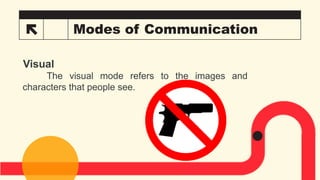
The visual mode refers to the images and
characters that people see.
6 Modes of Communication
It is sometimes possible to find compositions
that almost, if not completely, rely on a single mode.
For instance, the “No Guns” symbol has no alphabetic
text and no sound. Like many signs, it relies for its
meaning on visual information. However, we might be
able to say that the sign uses the spatial mode as
well, since the gun appears behind the red bar that
signals “no” or “not allowed.” So, while the visual
dominates in signs, even this composition is not
“purely” visual.
7 Modes of Communication
Aural
The aural mode is focused on sound including,
but not limited to, music, sound effects, ambient
noises, silence, tone of voice in spoken language,
volume of sound, emphasis, and accent (Arola,
Sheppard, & Ball, 2014).
An example of an aural mode—one that
depends almost exclusively on sound—might be the
recording of a public speech that is delivered orally to
a live audience, a radio address, or a podcast.
8 Modes of Communication
Gestural
The gestural mode refers to the way movement is
interpreted. Facial expressions, hand gestures, body
language, and interaction between people are all gestural
modes. This has always been important in face-to-face
conversations and in theater, but it has become more
apparent on the web lately with the wide use of YouTube
and other video players. The gestural mode works with
linguistic, visual, aural, and sometimes even spatial
modes to create more detail and communicate better to
the reader or consumer of the gestural text.
9 Modes of Communication
Linguistic or Alphabetic
The linguistic mode refers to written or spoken
words. The mode includes word choice, the delivery of
written or spoken text, the organization of words into
sentences and paragraphs, and the development and
coherence of words and ideas. Linguistic is not always the
most important mode; this depends on the other modes at
play in the text, the type of text, and other factors.
Linguistic is probably the most widely used mode because
it can be both read and heard on both paper or audio. The
linguistic mode is the best way to express details and lists.
10 Modes of Communication
Spatial
The spatial mode, as the name implies, refers to
the arrangement of elements in space. It involves the
organization of items and the physical closeness
between people and objects.
A good example of the spatial mode might be
the different ways in which chairs and desks are
arranged in a classroom.
Principles and
7C’s of
Communication
12 Principles and 7C’s of Communication
Principles of Communication
1. Notice your audience
2. Understand your purpose
3. Know your topic
4. Set a goal
5. Be clear and organized
13 Principles and 7C’s of Communication
Principles of Communication
Notice Your Audience
Communication is a two-way process.
The prime objective of communication is to
make the audience understand. The
communication should always be packaged to
suit the receiver's/listener's level of
understanding.
14 Principles and 7C’s of Communication
Understand Your Purpose
While communicating you should know
your purpose. You should make it clear that
you are sharing specific information or being
social.
15 Principles and 7C’s of Communication
Know Your Topic
Senders should be aware of all the facts
and details of the concerned topic. Take
feedback from time to time that will help in
making the topic clear.
Communicate a little at a time and check
whether the receiver understands or not. Ask
the questions to the audience and let them ask
the questions.
16 Principles and 7C’s of Communication
Set a Goal
While communicating you should set a
particular goal, because impacting your
audience is one of the important things in
effective communication. Everybody should
figure out their real outcome at the start.
17 Principles and 7C’s of Communication
Be Clear and Organized
Writing short sentences is essential to
keep things clear. Moreover, writing lengthy
sentences is one of the quickest ways to lose
the attention of your audience. To avoid such
problems, we should replace long sentences
with short ones.
18 Principles and 7C’s of Communication
Staying organized is not easy for most
people. Create a high-level outline before you
attempt to communicate with your audience.
Present information in several ways. The
things which work for one listener may not
work for another. Look at the audience and
communicate by making eye contact that will
help to build strong relationships.
19 Principles and 7C’s of Communication
7C’s of Communication
1. Conciseness
2. Correctness
3. Concreteness
4. Clarity
5. Completeness
6. Consideration
7. Courtesy
20 Principles and 7C’s of Communication
7C’s of Communication
1. Conciseness
In formal communication, we should be
very careful about the briefness/conciseness of
the message. As brevity is one of the principles of
formal communication. Also, it is one of the
important elements and prerequisites of effective
communication.
It is always helpful for both the sender and
the receiver because it saves their time. Concise
messages are helpful in getting the meaning.
21 Principles and 7C’s of Communication
2. Correctness
Correctness means the accuracy of
thoughts, figures, and words. If the given
information is not correctly conveyed, the
sender will lose reliability.
While communicating, we should be
careful about the correct use of grammar,
message composition, and appropriate words.
Successful communication depends on the
correct use of language & grammar.
22 Principles and 7C’s of Communication
3. Concreteness
While communicating, one should be very
specific. Concreteness is an important aspect of
effective communication. It is about being
specific and definite rather than general.
In oral communication, one cannot draw
tables and graphs to make our statement
specific, but we can use apt and precise words
to convey a message. If the message is
specific, that saves time and increases the
likelihood.
23 Principles and 7C’s of Communication
4. Clarity
Clarity is one of the principles of formal
communication. Whatever we
speak/communicate should have clarity. The
idea of the message should be very clear in
the mind of the sender.
The sender must be careful about the
clarity of thought and objective of
communication.
24 Principles and 7C’s of Communication
5. Completeness
Effective communication depends on the
completeness of the message. Incomplete
messages create ambiguity in the audience.
A complete message brings the desired
results without any expense or additional
information. Therefore, each message which
is sent by the sender should be complete.
25 Principles and 7C’s of Communication
6. Consideration
It is an act of consideration. While
sending a message, the sender should look
from the angle of the audience. The sender
should understand the feelings and emotions
of the receivers. It shows that in
communication we should consider the
audience.
26 Principles and 7C’s of Communication
7. Courtesy
Courtesy means polite behavior. While
communicating, everybody should show
politeness towards others. It facilitates
communication. The polite messages help to
strengthen relationships and to create
goodwill, which helps in expanding the
business.
Functions of
Communication
28 Functions of Communication
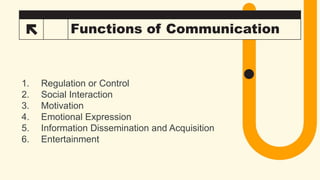
1. Regulation or Control
2. Social Interaction
3. Motivation
4. Emotional Expression
5. Information Dissemination and Acquisition
6. Entertainment
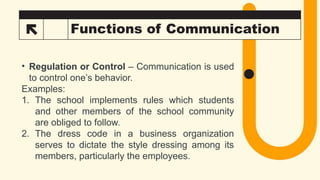
29 Functions of Communication
• Regulation or Control – Communication is used
to control one’s behavior.
Examples:
1. The school implements rules which students
and other members of the school community
are obliged to follow.
2. The dress code in a business organization
serves to dictate the style dressing among its
members, particularly the employees.
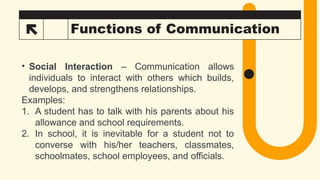
30 Functions of Communication
• Social Interaction – Communication allows
individuals to interact with others which builds,
develops, and strengthens relationships.
Examples:
1. A student has to talk with his parents about his
allowance and school requirements.
2. In school, it is inevitable for a student not to
converse with his/her teachers, classmates,
schoolmates, school employees, and officials.
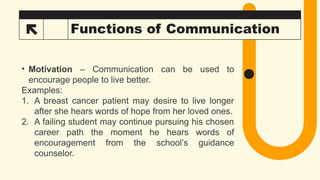
31 Functions of Communication
• Motivation – Communication can be used to
encourage people to live better.
Examples:
1. A breast cancer patient may desire to live longer
after she hears words of hope from her loved ones.
2. A failing student may continue pursuing his chosen
career path the moment he hears words of
encouragement from the school’s guidance
counselor.
32 Functions of Communication
• Emotional Expression – Communication
facilitates people’s expression of their feelings
and emotions.
Examples:
1. “I’m so glad that you came into my life.”
2. “I like you so much!”
3. “I want to finish up my studies with good grades
to be accepted in a good university.”
4. “I need you in my life.”
33 Functions of Communication
• Information Dissemination and Acquisition –
Communication can be used to convey and
acquire information.
Examples:
1. “Did you know that the tomato is a fruit?”
2. “Did you know that the Philippines was
colonized by the Spaniards for 333 year?”
3. “What is the biggest planet in our solar system?”
4. “What is biology?”
34 Functions of Communication
• Entertainment – Communication can be used to
entertain people.
Examples:
1. Telling jokes
2. Relating interesting stories
3. Doing spoken poetry
As we are ending today’s
lesson, what particular topic
we talked about today you find
very interesting, and you think
will definitely help you to
enhance your social and
communication skills?
That’s all,
thank you!

Presentation about the Basic Concepts in Communication

  • 1.
  • 2.
    • Modes of Communication •Principles and 7C’s of Communication • Functions of Communication
  • 3.
  • 4.
    4 Modes ofCommunication The following are the most common modes of communication: 1. Visual 2. Aural 3. Gestural 4. Linguistic or Alphabetic 5. Spatial
  • 5.
    5 Modes ofCommunication Visual The visual mode refers to the images and characters that people see.
  • 6.
    6 Modes ofCommunication It is sometimes possible to find compositions that almost, if not completely, rely on a single mode. For instance, the “No Guns” symbol has no alphabetic text and no sound. Like many signs, it relies for its meaning on visual information. However, we might be able to say that the sign uses the spatial mode as well, since the gun appears behind the red bar that signals “no” or “not allowed.” So, while the visual dominates in signs, even this composition is not “purely” visual.
  • 7.
    7 Modes ofCommunication Aural The aural mode is focused on sound including, but not limited to, music, sound effects, ambient noises, silence, tone of voice in spoken language, volume of sound, emphasis, and accent (Arola, Sheppard, & Ball, 2014). An example of an aural mode—one that depends almost exclusively on sound—might be the recording of a public speech that is delivered orally to a live audience, a radio address, or a podcast.
  • 8.
    8 Modes ofCommunication Gestural The gestural mode refers to the way movement is interpreted. Facial expressions, hand gestures, body language, and interaction between people are all gestural modes. This has always been important in face-to-face conversations and in theater, but it has become more apparent on the web lately with the wide use of YouTube and other video players. The gestural mode works with linguistic, visual, aural, and sometimes even spatial modes to create more detail and communicate better to the reader or consumer of the gestural text.
  • 9.
    9 Modes ofCommunication Linguistic or Alphabetic The linguistic mode refers to written or spoken words. The mode includes word choice, the delivery of written or spoken text, the organization of words into sentences and paragraphs, and the development and coherence of words and ideas. Linguistic is not always the most important mode; this depends on the other modes at play in the text, the type of text, and other factors. Linguistic is probably the most widely used mode because it can be both read and heard on both paper or audio. The linguistic mode is the best way to express details and lists.
  • 10.
    10 Modes ofCommunication Spatial The spatial mode, as the name implies, refers to the arrangement of elements in space. It involves the organization of items and the physical closeness between people and objects. A good example of the spatial mode might be the different ways in which chairs and desks are arranged in a classroom.
  • 11.
  • 12.
    12 Principles and7C’s of Communication Principles of Communication 1. Notice your audience 2. Understand your purpose 3. Know your topic 4. Set a goal 5. Be clear and organized
  • 13.
    13 Principles and7C’s of Communication Principles of Communication Notice Your Audience Communication is a two-way process. The prime objective of communication is to make the audience understand. The communication should always be packaged to suit the receiver's/listener's level of understanding.
  • 14.
    14 Principles and7C’s of Communication Understand Your Purpose While communicating you should know your purpose. You should make it clear that you are sharing specific information or being social.
  • 15.
    15 Principles and7C’s of Communication Know Your Topic Senders should be aware of all the facts and details of the concerned topic. Take feedback from time to time that will help in making the topic clear. Communicate a little at a time and check whether the receiver understands or not. Ask the questions to the audience and let them ask the questions.
  • 16.
    16 Principles and7C’s of Communication Set a Goal While communicating you should set a particular goal, because impacting your audience is one of the important things in effective communication. Everybody should figure out their real outcome at the start.
  • 17.
    17 Principles and7C’s of Communication Be Clear and Organized Writing short sentences is essential to keep things clear. Moreover, writing lengthy sentences is one of the quickest ways to lose the attention of your audience. To avoid such problems, we should replace long sentences with short ones.
  • 18.
    18 Principles and7C’s of Communication Staying organized is not easy for most people. Create a high-level outline before you attempt to communicate with your audience. Present information in several ways. The things which work for one listener may not work for another. Look at the audience and communicate by making eye contact that will help to build strong relationships.
  • 19.
    19 Principles and7C’s of Communication 7C’s of Communication 1. Conciseness 2. Correctness 3. Concreteness 4. Clarity 5. Completeness 6. Consideration 7. Courtesy
  • 20.
    20 Principles and7C’s of Communication 7C’s of Communication 1. Conciseness In formal communication, we should be very careful about the briefness/conciseness of the message. As brevity is one of the principles of formal communication. Also, it is one of the important elements and prerequisites of effective communication. It is always helpful for both the sender and the receiver because it saves their time. Concise messages are helpful in getting the meaning.
  • 21.
    21 Principles and7C’s of Communication 2. Correctness Correctness means the accuracy of thoughts, figures, and words. If the given information is not correctly conveyed, the sender will lose reliability. While communicating, we should be careful about the correct use of grammar, message composition, and appropriate words. Successful communication depends on the correct use of language & grammar.
  • 22.
    22 Principles and7C’s of Communication 3. Concreteness While communicating, one should be very specific. Concreteness is an important aspect of effective communication. It is about being specific and definite rather than general. In oral communication, one cannot draw tables and graphs to make our statement specific, but we can use apt and precise words to convey a message. If the message is specific, that saves time and increases the likelihood.
  • 23.
    23 Principles and7C’s of Communication 4. Clarity Clarity is one of the principles of formal communication. Whatever we speak/communicate should have clarity. The idea of the message should be very clear in the mind of the sender. The sender must be careful about the clarity of thought and objective of communication.
  • 24.
    24 Principles and7C’s of Communication 5. Completeness Effective communication depends on the completeness of the message. Incomplete messages create ambiguity in the audience. A complete message brings the desired results without any expense or additional information. Therefore, each message which is sent by the sender should be complete.
  • 25.
    25 Principles and7C’s of Communication 6. Consideration It is an act of consideration. While sending a message, the sender should look from the angle of the audience. The sender should understand the feelings and emotions of the receivers. It shows that in communication we should consider the audience.
  • 26.
    26 Principles and7C’s of Communication 7. Courtesy Courtesy means polite behavior. While communicating, everybody should show politeness towards others. It facilitates communication. The polite messages help to strengthen relationships and to create goodwill, which helps in expanding the business.
  • 27.
  • 28.
    28 Functions ofCommunication 1. Regulation or Control 2. Social Interaction 3. Motivation 4. Emotional Expression 5. Information Dissemination and Acquisition 6. Entertainment
  • 29.
    29 Functions ofCommunication • Regulation or Control – Communication is used to control one’s behavior. Examples: 1. The school implements rules which students and other members of the school community are obliged to follow. 2. The dress code in a business organization serves to dictate the style dressing among its members, particularly the employees.
  • 30.
    30 Functions ofCommunication • Social Interaction – Communication allows individuals to interact with others which builds, develops, and strengthens relationships. Examples: 1. A student has to talk with his parents about his allowance and school requirements. 2. In school, it is inevitable for a student not to converse with his/her teachers, classmates, schoolmates, school employees, and officials.
  • 31.
    31 Functions ofCommunication • Motivation – Communication can be used to encourage people to live better. Examples: 1. A breast cancer patient may desire to live longer after she hears words of hope from her loved ones. 2. A failing student may continue pursuing his chosen career path the moment he hears words of encouragement from the school’s guidance counselor.
  • 32.
    32 Functions ofCommunication • Emotional Expression – Communication facilitates people’s expression of their feelings and emotions. Examples: 1. “I’m so glad that you came into my life.” 2. “I like you so much!” 3. “I want to finish up my studies with good grades to be accepted in a good university.” 4. “I need you in my life.”
  • 33.
    33 Functions ofCommunication • Information Dissemination and Acquisition – Communication can be used to convey and acquire information. Examples: 1. “Did you know that the tomato is a fruit?” 2. “Did you know that the Philippines was colonized by the Spaniards for 333 year?” 3. “What is the biggest planet in our solar system?” 4. “What is biology?”
  • 34.
    34 Functions ofCommunication • Entertainment – Communication can be used to entertain people. Examples: 1. Telling jokes 2. Relating interesting stories 3. Doing spoken poetry
  • 35.
    As we areending today’s lesson, what particular topic we talked about today you find very interesting, and you think will definitely help you to enhance your social and communication skills?
  • 36.