Punctuation marks
help make
meaning clear in
written texts.The
punctuation
book
Jacqueline Nuñez
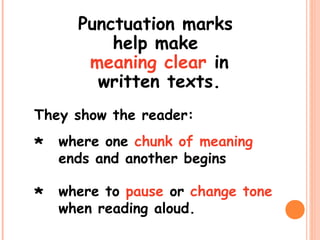
Punctuation marks
help make
meaning clear in
written texts.
where one chunk of meaning
ends and another begins
where to pause or change tone
when reading aloud.
They show the reader:
*
*
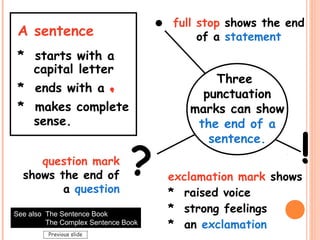
A sentence
* starts with a
capital letter
* ends with a .
* makes complete
sense.
?question mark
shows the end of
a question
See also The Sentence Book
The Complex Sentence Book
full stop shows the end
of a statement
!exclamation mark shows
* raised voice
* strong feelings
* an exclamation
Three
punctuation
marks can show
the end of a
sentence.
Previous slide
See also comma
splice.
separating the
items in a list
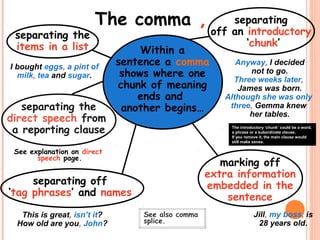
The comma ,
Within a
sentence a comma
shows where one
chunk of meaning
ends and
another begins…
I bought eggs, a pint of
milk, tea and sugar.
separating the
direct speech from
a reporting clause
This is great, isn’t it?
How old are you, John?
separating off
‘tag phrases’ and names
separating
off an introductory
‘chunk’
Anyway, I decided
not to go.
Three weeks later,
James was born.
Although she was only
three, Gemma knew
her tables.
marking off
extra information
embedded in the
sentence
Jill, my boss, is
28 years old.
The introductory ‘chunk’ could be a word,
a phrase or a subordinate clause.
If you remove it, the main clause would
still make sense.
See explanation on direct
speech page.
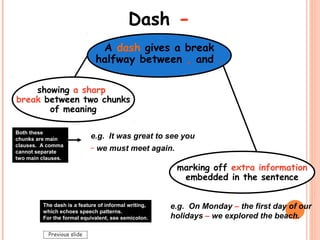
Dash -
A dash gives a break
halfway between , and .
e.g. It was great to see you
_
we must meet again.
e.g. On Monday – the first day of our
holidays – we explored the beach.
The dash is a feature of informal writing,
which echoes speech patterns.
For the formal equivalent, see semicolon.
marking off extra information
embedded in the sentence
showing a sharp
break between two chunks
of meaning
Both these
chunks are main
clauses. A comma
cannot separate
two main clauses.
Previous slide
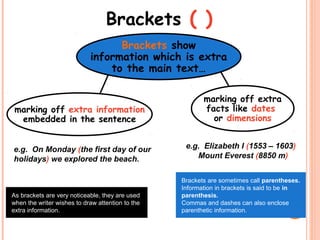
Brackets ( )
marking off extra information
embedded in the sentence
Brackets show
information which is extra
to the main text…
marking off extra
facts like dates
or dimensions
e.g. Elizabeth I (1553 – 1603)
Mount Everest (8850 m)
Brackets are sometimes call parentheses.
Information in brackets is said to be in
parenthesis.
Commas and dashes can also enclose
parenthetic information.
e.g. On Monday (the first day of our
holidays) we explored the beach.
As brackets are very noticeable, they are used
when the writer wishes to draw attention to the
extra information.
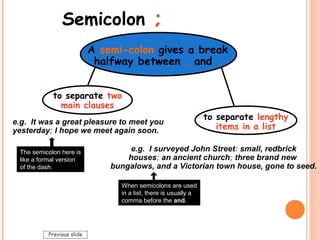
Semicolon ;
A semi-colon gives a break
halfway between , and .
to separate two
main clauses
e.g. It was a great pleasure to meet you
yesterday; I hope we meet again soon.
The semicolon here is
like a formal version
of the dash.
to separate lengthy
items in a list
e.g. I surveyed John Street: small, redbrick
houses; an ancient church; three brand new
bungalows, and a Victorian town house, gone to seed.
Previous slide
When semicolons are used
in a list, there is usually a
comma before the and.
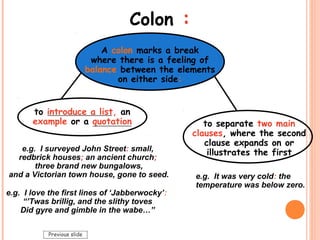
A colon marks a break
where there is a feeling of
balance between the elements
on either side:
e.g. I surveyed John Street: small,
redbrick houses; an ancient church;
three brand new bungalows,
and a Victorian town house, gone to seed.
to introduce a list, an
example or a quotation to separate two main
clauses, where the second
clause expands on or
illustrates the first
e.g. It was very cold: the
temperature was below zero.
Colon :
Previous slide
e.g. I love the first lines of ‘Jabberwocky’:
“’Twas brillig, and the slithy toves
Did gyre and gimble in the wabe…”
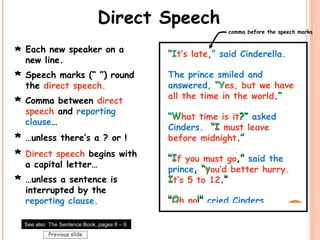
“It’s late,” said Cinderella.
The prince smiled and
answered, “Yes, but we have
all the time in the world.”
“What time is it?” asked
Cinders. “I must leave
before midnight.”
“If you must go,” said the
prince, “you’d better hurry.
It’s 5 to 12.”
“Oh no!” cried Cinders.
Direct Speech
* Each new speaker on a
new line.
* Speech marks (“ ”) round
the direct speech.
* Comma between direct
speech and reporting
clause…
* …unless there’s a ? or !
* Direct speech begins with
a capital letter…
* …unless a sentence is
interrupted by the
reporting clause.
See also The Sentence Book, pages 8 – 9.
“ ”
“
”
“ ”
“
”
“ ”
“
”
“ ”
,
,
,
,
?
!
I
W
Y
I
I
O
y
I
Previous slide
comma before the speech marks
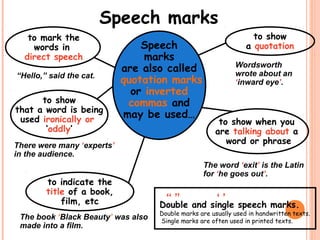
Speech marks
Speech
marks
are also called
quotation marks
or inverted
commas and
may be used…
to mark the
words in
direct speech
to show
that a word is being
used ironically or
‘oddly’
to indicate the
title of a book,
film, etc
to show
a quotation
to show when you
are talking about a
word or phrase
Wordsworth
wrote about an
‘inward eye’.
The word ‘exit’ is the Latin
for ‘he goes out’.
There were many ‘experts’
in the audience.
Double and single speech marks.
Double marks are usually used in handwritten texts.
Single marks are often used in printed texts.
“ ” ‘ ’
The book ‘Black Beauty’ was also
made into a film.
“Hello,” said the cat.
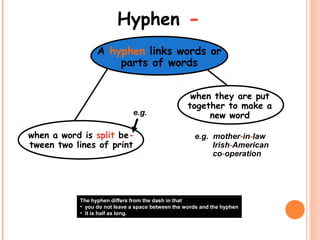
Hyphen -
A hyphen links words or
parts of words
when they are put
together to make a
new word
when a word is split be-
tween two lines of print
e.g. mother-in-law
Irish-American
co-operation
e.g.
The hyphen differs from the dash in that
• you do not leave a space between the words and the hyphen
• it is half as long.
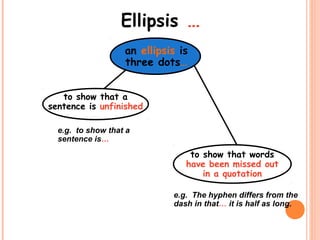
an ellipsis is
three dots…
to show that a
sentence is unfinished
e.g. to show that a
sentence is…
to show that words
have been missed out
in a quotation
e.g. The hyphen differs from the
dash in that… it is half as long.
Ellipsis …
Previous slide
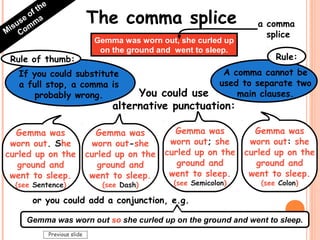
The comma splice
Gemma was worn out, she curled up
on the ground and went to sleep.
Misuse of the
Com
m
a
If you could substitute
a full stop, a comma is
probably wrong.
a comma
splice
You could use
alternative punctuation:
A comma cannot be
used to separate two
main clauses.
or you could add a conjunction, e.g.
Gemma was worn out so she curled up on the ground and went to sleep.
Rule of thumb: Rule:
Gemma was
worn out: she
curled up on the
ground and
went to sleep.
(see Colon)
Gemma was
worn out; she
curled up on the
ground and
went to sleep.
(see Semicolon)
Gemma was
worn out. She
curled up on the
ground and
went to sleep.
(see Sentence)
Gemma was
worn out-she
curled up on the
ground and
went to sleep.
(see Dash)
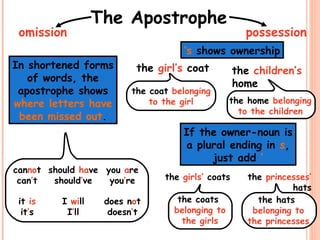
The Apostrophe
omission possession
In shortened forms
of words, the
apostrophe shows
where letters have
been missed out.
‘s shows ownership
the girl’s coat the children’s
home
If the owner-noun is
a plural ending in s,
just add ‘
the girls’ coats the princesses’
hats
cannot
can’t
should have
should’ve
you are
you’re
it is
it’s
I will
I’ll
does not
doesn’t
the hats
belonging to
the princesses
the coats
belonging to
the girls
the coat belonging
to the girl the home belonging
to the children
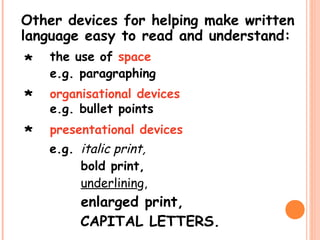
Other devices for helping make written
language easy to read and understand:
the use of space
e.g. paragraphing
organisational devices
e.g. bullet points
presentational devices
*
e.g. italic print,
bold print,
underlining,
enlarged print,
CAPITAL LETTERS.
*
*
The End

Punctuation jn

  • 1.
    Punctuation marks help make meaningclear in written texts.The punctuation book Jacqueline Nuñez
  • 2.
    Punctuation marks help make meaningclear in written texts. where one chunk of meaning ends and another begins where to pause or change tone when reading aloud. They show the reader: * *
  • 3.
    A sentence * startswith a capital letter * ends with a . * makes complete sense. ?question mark shows the end of a question See also The Sentence Book The Complex Sentence Book full stop shows the end of a statement !exclamation mark shows * raised voice * strong feelings * an exclamation Three punctuation marks can show the end of a sentence. Previous slide
  • 4.
    See also comma splice. separatingthe items in a list The comma , Within a sentence a comma shows where one chunk of meaning ends and another begins… I bought eggs, a pint of milk, tea and sugar. separating the direct speech from a reporting clause This is great, isn’t it? How old are you, John? separating off ‘tag phrases’ and names separating off an introductory ‘chunk’ Anyway, I decided not to go. Three weeks later, James was born. Although she was only three, Gemma knew her tables. marking off extra information embedded in the sentence Jill, my boss, is 28 years old. The introductory ‘chunk’ could be a word, a phrase or a subordinate clause. If you remove it, the main clause would still make sense. See explanation on direct speech page.
  • 5.
    Dash - A dashgives a break halfway between , and . e.g. It was great to see you _ we must meet again. e.g. On Monday – the first day of our holidays – we explored the beach. The dash is a feature of informal writing, which echoes speech patterns. For the formal equivalent, see semicolon. marking off extra information embedded in the sentence showing a sharp break between two chunks of meaning Both these chunks are main clauses. A comma cannot separate two main clauses. Previous slide
  • 6.
    Brackets ( ) markingoff extra information embedded in the sentence Brackets show information which is extra to the main text… marking off extra facts like dates or dimensions e.g. Elizabeth I (1553 – 1603) Mount Everest (8850 m) Brackets are sometimes call parentheses. Information in brackets is said to be in parenthesis. Commas and dashes can also enclose parenthetic information. e.g. On Monday (the first day of our holidays) we explored the beach. As brackets are very noticeable, they are used when the writer wishes to draw attention to the extra information.
  • 7.
    Semicolon ; A semi-colongives a break halfway between , and . to separate two main clauses e.g. It was a great pleasure to meet you yesterday; I hope we meet again soon. The semicolon here is like a formal version of the dash. to separate lengthy items in a list e.g. I surveyed John Street: small, redbrick houses; an ancient church; three brand new bungalows, and a Victorian town house, gone to seed. Previous slide When semicolons are used in a list, there is usually a comma before the and.
  • 8.
    A colon marksa break where there is a feeling of balance between the elements on either side: e.g. I surveyed John Street: small, redbrick houses; an ancient church; three brand new bungalows, and a Victorian town house, gone to seed. to introduce a list, an example or a quotation to separate two main clauses, where the second clause expands on or illustrates the first e.g. It was very cold: the temperature was below zero. Colon : Previous slide e.g. I love the first lines of ‘Jabberwocky’: “’Twas brillig, and the slithy toves Did gyre and gimble in the wabe…”
  • 9.
    “It’s late,” saidCinderella. The prince smiled and answered, “Yes, but we have all the time in the world.” “What time is it?” asked Cinders. “I must leave before midnight.” “If you must go,” said the prince, “you’d better hurry. It’s 5 to 12.” “Oh no!” cried Cinders. Direct Speech * Each new speaker on a new line. * Speech marks (“ ”) round the direct speech. * Comma between direct speech and reporting clause… * …unless there’s a ? or ! * Direct speech begins with a capital letter… * …unless a sentence is interrupted by the reporting clause. See also The Sentence Book, pages 8 – 9. “ ” “ ” “ ” “ ” “ ” “ ” “ ” , , , , ? ! I W Y I I O y I Previous slide comma before the speech marks
  • 10.
    Speech marks Speech marks are alsocalled quotation marks or inverted commas and may be used… to mark the words in direct speech to show that a word is being used ironically or ‘oddly’ to indicate the title of a book, film, etc to show a quotation to show when you are talking about a word or phrase Wordsworth wrote about an ‘inward eye’. The word ‘exit’ is the Latin for ‘he goes out’. There were many ‘experts’ in the audience. Double and single speech marks. Double marks are usually used in handwritten texts. Single marks are often used in printed texts. “ ” ‘ ’ The book ‘Black Beauty’ was also made into a film. “Hello,” said the cat.
  • 11.
    Hyphen - A hyphenlinks words or parts of words when they are put together to make a new word when a word is split be- tween two lines of print e.g. mother-in-law Irish-American co-operation e.g. The hyphen differs from the dash in that • you do not leave a space between the words and the hyphen • it is half as long.
  • 12.
    an ellipsis is threedots… to show that a sentence is unfinished e.g. to show that a sentence is… to show that words have been missed out in a quotation e.g. The hyphen differs from the dash in that… it is half as long. Ellipsis …
  • 13.
    Previous slide The commasplice Gemma was worn out, she curled up on the ground and went to sleep. Misuse of the Com m a If you could substitute a full stop, a comma is probably wrong. a comma splice You could use alternative punctuation: A comma cannot be used to separate two main clauses. or you could add a conjunction, e.g. Gemma was worn out so she curled up on the ground and went to sleep. Rule of thumb: Rule: Gemma was worn out: she curled up on the ground and went to sleep. (see Colon) Gemma was worn out; she curled up on the ground and went to sleep. (see Semicolon) Gemma was worn out. She curled up on the ground and went to sleep. (see Sentence) Gemma was worn out-she curled up on the ground and went to sleep. (see Dash)
  • 14.
    The Apostrophe omission possession Inshortened forms of words, the apostrophe shows where letters have been missed out. ‘s shows ownership the girl’s coat the children’s home If the owner-noun is a plural ending in s, just add ‘ the girls’ coats the princesses’ hats cannot can’t should have should’ve you are you’re it is it’s I will I’ll does not doesn’t the hats belonging to the princesses the coats belonging to the girls the coat belonging to the girl the home belonging to the children
  • 15.
    Other devices forhelping make written language easy to read and understand: the use of space e.g. paragraphing organisational devices e.g. bullet points presentational devices * e.g. italic print, bold print, underlining, enlarged print, CAPITAL LETTERS. * *
  • 16.