PumP classification
Hydrodynamic (or) non-positive
displacement pumps
Hydrostatic (or) positive
displacement pumps
Carries fluid from one location to another, relatively
at low pressure (17-21 bar).
Generally used for low pressure, high-volume, flow
applications.
These pumps are not self-priming, as there is a great
deal of clearance between the rotating and
stationary elements.
Cannot create enough vacuum at its inlet, hence
discharge rate is low.
Examples…..
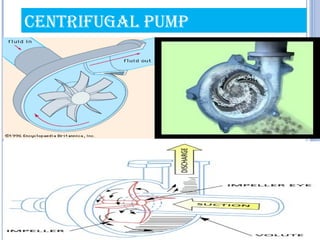
a) Centrifugal pumps
b) Axial flow propeller pump.
These pumps are called as non-positive displacement
pumps.
HYDRoDYnamic PumPs
HYDRostatic PumPs
Hydrostatic pumps uses fluid pressure to transmit
power.
These pumps have very close-fitting mating
components and hence a very small amount of
leakage could occur.
These pumps may be either…..
a) Fixed displacement
b) Variable displacement
These pumps requires protection against over
pressure if the resistance to flow becomes very
large or infinite, so pressure relief valve is
provided.
It is also called as positive displacement pumps.
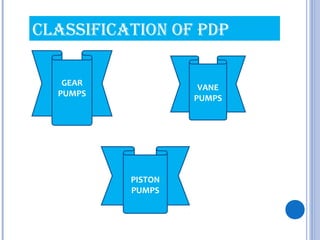
classification of PDP
GEAR
PUMPS
VANE
PUMPS
PISTON
PUMPS
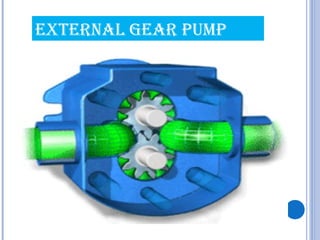
EXtERnal GEaR PumP
Common external gear pump applications
include, but are not limited to:
Various fuel oils and lube oils
Chemical additive and polymer metering
Chemical mixing and blending (double pump)
Industrial and mobile hydraulic applications
(log splitters, lifts, etc.)
Acids and caustic (stainless steel or
composite construction)
Low volume transfer or application
aPPlication
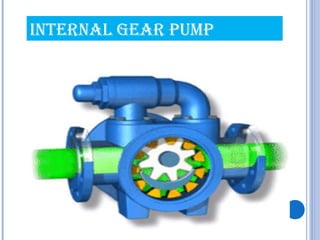
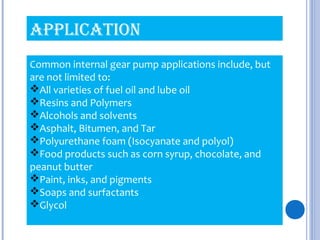
INTERNAL GEAR PUMP
Common internal gear pump applications include, but
are not limited to:
All varieties of fuel oil and lube oil
Resins and Polymers
Alcohols and solvents
Asphalt, Bitumen, and Tar
Polyurethane foam (Isocyanate and polyol)
Food products such as corn syrup, chocolate, and
peanut butter
Paint, inks, and pigments
Soaps and surfactants
Glycol
APPLICATION
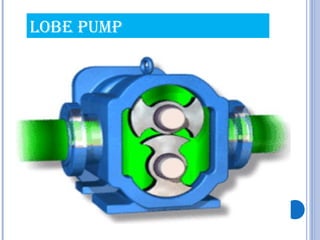
LOBE PUMP
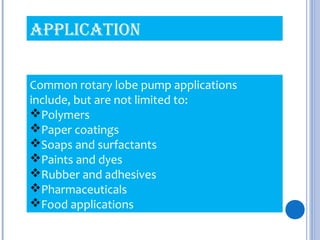
Common rotary lobe pump applications
include, but are not limited to:
Polymers
Paper coatings
Soaps and surfactants
Paints and dyes
Rubber and adhesives
Pharmaceuticals
Food applications
APPLICATION
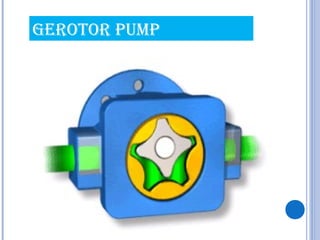
GEROTOR PUMP
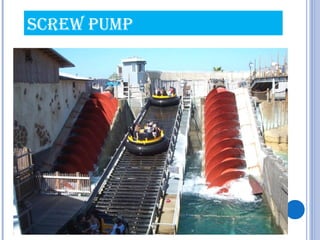
SCREW PUMP
PD pumps are found in a wide range of application
chemical-processing
liquid delivery
marine
biotechnology
 pharmaceutical
as well as food, dairy, and beverage processing.
Their versatility and popularity is due in part to
their relatively compact design, high-viscosity
performance, continuous flow regardless of
differential pressure, and ability to handle high
differential pressure.
APPLICATIONS OF PDP
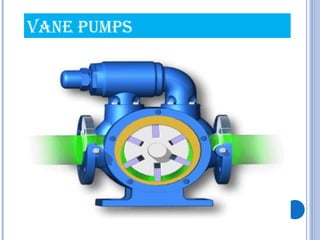
VANE PUMPS
Aerosol and Propellants
Aviation Service - Fuel Transfer, Deicing
Auto Industry - Fuels, Lubes,
Refrigeration Coolants
Bulk Transfer of LPG and NH3
LPG Cylinder Filling
Alcohols
Refrigeration - Freons, Ammonia
Solvents
Aqueous solutions
APPLICATION
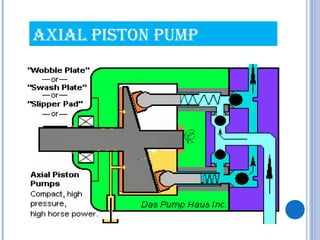
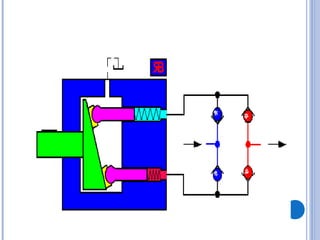
AXIAL PISTON PUMP
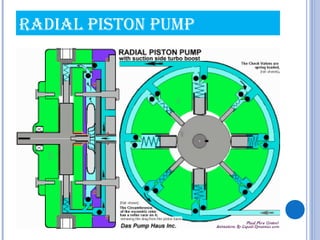
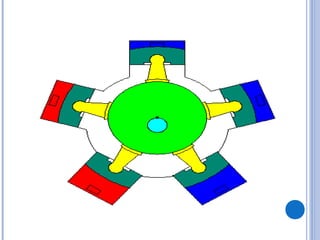
RADIAL PISTON PUMP
CENTRIfUgAL PUMP
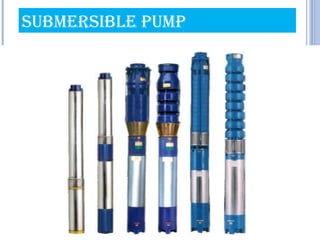
SubmerSible pump
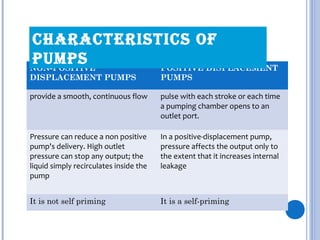
NON-POSITIVE
DISPLACEMENT PUMPS
POSITIVE DISPLACEMENT
PUMPS
provide a smooth, continuous flow pulse with each stroke or each time
a pumping chamber opens to an
outlet port.
Pressure can reduce a non positive
pump's delivery. High outlet
pressure can stop any output; the
liquid simply recirculates inside the
pump
In a positive-displacement pump,
pressure affects the output only to
the extent that it increases internal
leakage
It is not self priming It is a self-priming
CHArACTeriSTiCS OF
pumpS
perFOrmANCe OF pump
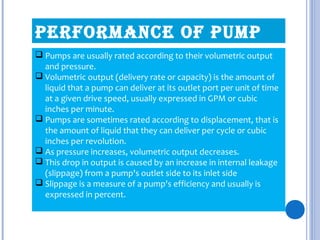
 Pumps are usually rated according to their volumetric output
and pressure.
 Volumetric output (delivery rate or capacity) is the amount of
liquid that a pump can deliver at its outlet port per unit of time
at a given drive speed, usually expressed in GPM or cubic
inches per minute.
 Pumps are sometimes rated according to displacement, that is
the amount of liquid that they can deliver per cycle or cubic
inches per revolution.
 As pressure increases, volumetric output decreases.
 This drop in output is caused by an increase in internal leakage
(slippage) from a pump's outlet side to its inlet side
 Slippage is a measure of a pump's efficiency and usually is
expressed in percent.
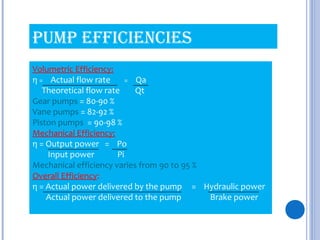
pump eFFiCieNCieS
Volumetric Efficiency:
η = Actual flow rate = Qa
Theoretical flow rate Qt
Gear pumps = 80-90 %
Vane pumps = 82-92 %
Piston pumps = 90-98 %
Mechanical Efficiency:
η = Output power = Po
Input power Pi
Mechanical efficiency varies from 90 to 95 %
Overall Efficiency:
η = Actual power delivered by the pump = Hydraulic power
Actual power delivered to the pump Brake power
reFFreNCe
1. WWW.PUMPSSCHOOL.COM
2. APPLIED HYDRAULICS AND
PNEUMATICS By T.Sunder Selwyn,
R.Jayendiran
3. www.authorstreem.com.
Pumps in chemical engineerimg

Pumps in chemical engineerimg

  • 2.
    PumP classification Hydrodynamic (or)non-positive displacement pumps Hydrostatic (or) positive displacement pumps
  • 3.
    Carries fluid fromone location to another, relatively at low pressure (17-21 bar). Generally used for low pressure, high-volume, flow applications. These pumps are not self-priming, as there is a great deal of clearance between the rotating and stationary elements. Cannot create enough vacuum at its inlet, hence discharge rate is low. Examples….. a) Centrifugal pumps b) Axial flow propeller pump. These pumps are called as non-positive displacement pumps. HYDRoDYnamic PumPs
  • 4.
    HYDRostatic PumPs Hydrostatic pumpsuses fluid pressure to transmit power. These pumps have very close-fitting mating components and hence a very small amount of leakage could occur. These pumps may be either….. a) Fixed displacement b) Variable displacement These pumps requires protection against over pressure if the resistance to flow becomes very large or infinite, so pressure relief valve is provided. It is also called as positive displacement pumps.
  • 5.
  • 6.
  • 7.
    Common external gearpump applications include, but are not limited to: Various fuel oils and lube oils Chemical additive and polymer metering Chemical mixing and blending (double pump) Industrial and mobile hydraulic applications (log splitters, lifts, etc.) Acids and caustic (stainless steel or composite construction) Low volume transfer or application aPPlication
  • 8.
  • 9.
    Common internal gearpump applications include, but are not limited to: All varieties of fuel oil and lube oil Resins and Polymers Alcohols and solvents Asphalt, Bitumen, and Tar Polyurethane foam (Isocyanate and polyol) Food products such as corn syrup, chocolate, and peanut butter Paint, inks, and pigments Soaps and surfactants Glycol APPLICATION
  • 10.
  • 11.
    Common rotary lobepump applications include, but are not limited to: Polymers Paper coatings Soaps and surfactants Paints and dyes Rubber and adhesives Pharmaceuticals Food applications APPLICATION
  • 12.
  • 13.
  • 14.
    PD pumps arefound in a wide range of application chemical-processing liquid delivery marine biotechnology  pharmaceutical as well as food, dairy, and beverage processing. Their versatility and popularity is due in part to their relatively compact design, high-viscosity performance, continuous flow regardless of differential pressure, and ability to handle high differential pressure. APPLICATIONS OF PDP
  • 15.
  • 16.
    Aerosol and Propellants AviationService - Fuel Transfer, Deicing Auto Industry - Fuels, Lubes, Refrigeration Coolants Bulk Transfer of LPG and NH3 LPG Cylinder Filling Alcohols Refrigeration - Freons, Ammonia Solvents Aqueous solutions APPLICATION
  • 17.
  • 19.
  • 21.
  • 22.
  • 23.
    NON-POSITIVE DISPLACEMENT PUMPS POSITIVE DISPLACEMENT PUMPS providea smooth, continuous flow pulse with each stroke or each time a pumping chamber opens to an outlet port. Pressure can reduce a non positive pump's delivery. High outlet pressure can stop any output; the liquid simply recirculates inside the pump In a positive-displacement pump, pressure affects the output only to the extent that it increases internal leakage It is not self priming It is a self-priming CHArACTeriSTiCS OF pumpS
  • 24.
    perFOrmANCe OF pump Pumps are usually rated according to their volumetric output and pressure.  Volumetric output (delivery rate or capacity) is the amount of liquid that a pump can deliver at its outlet port per unit of time at a given drive speed, usually expressed in GPM or cubic inches per minute.  Pumps are sometimes rated according to displacement, that is the amount of liquid that they can deliver per cycle or cubic inches per revolution.  As pressure increases, volumetric output decreases.  This drop in output is caused by an increase in internal leakage (slippage) from a pump's outlet side to its inlet side  Slippage is a measure of a pump's efficiency and usually is expressed in percent.
  • 25.
    pump eFFiCieNCieS Volumetric Efficiency: η= Actual flow rate = Qa Theoretical flow rate Qt Gear pumps = 80-90 % Vane pumps = 82-92 % Piston pumps = 90-98 % Mechanical Efficiency: η = Output power = Po Input power Pi Mechanical efficiency varies from 90 to 95 % Overall Efficiency: η = Actual power delivered by the pump = Hydraulic power Actual power delivered to the pump Brake power
  • 26.
    reFFreNCe 1. WWW.PUMPSSCHOOL.COM 2. APPLIEDHYDRAULICS AND PNEUMATICS By T.Sunder Selwyn, R.Jayendiran 3. www.authorstreem.com.