Downtime analysis of drilling
machines and suggestions for
improvements
Hussan S. Al-Chalabi
Division of Operation, Maintenance and Acoustics, Lule˚a University of Technology,
Lule˚a, Sweden and Mechanical Engineering Department, College of Engineering,
Mosul University, Mosul, Iraq, and
Jan Lundberg, Andi Wijaya and Behzad Ghodrati
Division of Operation, Maintenance and Acoustics,
Lule ˚a University of Technology, Lule˚a, Sweden
Abstract
Purpose – The purpose of this paper is to analyse and compare the downtime of four drilling
machines used in two underground mines in Sweden. The downtime of these machines was compared
to show what problems affect downtime and which strategies should be applied to reduce it.
Design/methodology/approach – The study collects failure data from a two-year period for four
drilling machines and performs reliability analysis. It also performs downtime analysis utilising a log-
log diagram with a confidence interval.
Findings – There are notable differences in the downtime of most of the studied components for all
machines. The hoses and feeder have relatively high downtime. Depending on their downtime, the
significant components can be ranked in three groups. The downtime of the studied components is due
to reliability problems. The study suggests the need to improve the reliability of critical components to
reduce the downtime of drilling machines.
Originality/value – The method of analysing the downtime, identifying dominant factors and the
interval estimation for the downtime, has never been studied on drilling machines. The research
proposed in this paper provides a general method to link downtime analysis with potential component
improvement. To increase the statistical accuracy; four case studies was performed in two different
mines with completely different working environment and ore properties. Using the above method
showed which components need to be improved and suggestions for improvement was proposed and
will be implemented accordingly.
Keywords Reliability analysis, Confidence interval, Downtime analysis, Drilling machine
Paper type Research paper
1. Introduction
Underground mines are a main source of minerals. Growing demand for metals as a
result of modern lifestyles and the industrial development of recent decades has
The current issue and full text archive of this journal is available at
www.emeraldinsight.com/1355-2511.htm
Received 20 November 2012
Revised 23 October 2013
Accepted 11 January 2014
Journal of Quality in Maintenance
Engineering
Vol. 20 No. 4, 2014
pp. 1-27
r Emerald Group Publishing Limited
1355-2511
DOI 10.1108/JQME-11-2012-0038
Boliden AB is gratefully acknowledged for their financial support. The maintenance personnel
and maintenance management system employees at Boliden AB who helped the authors in this
research are also thanked for their support.
r Hussan S. Al-Chalabi, Jan Lundberg, Andi Wijaya and Behzad Ghodrati. Boliden AB is
gratefully acknowledged for their financial support. Published by Emerald Group Publishing
Limited. This paper is published under the Creative Commons Attribution (CC BY 3.0) licence.
Anyone may reproduce, distribute, translate and create derivative works of this paper (for both
commercial and non-commercial purposes), subject to full attribution to the original publication
and authors. The full terms of this licence may be seen at http://creativecommons.org/licences/
by/3.0/legalcode
1
Downtime
analysis of
drilling machines
focused our attention on the factors affecting the extraction of minerals. One of
the most important factors is unscheduled downtime of the machines used in the
extraction of ore. Lost production due to downtime will obviously increase the
production costs (Roman and Daneshmend, 2000). A mine production system consists of
many subsystems. To make the system both profitable and practical, the optimisation of
each subsystem in relation with other subsystems should be considered (Barabady and
Kumar, 2008). To achieve this aim, reliability and maintainability analysis for each
subsystem in mine production system should be performed. Since the mid-1980s,
reliability analysis techniques have been essential tools in automatic mining systems
(Blischke and Murthy, 2003; Barabady and Kumar, 2008).
A drilling machine is very important to the extraction process. Drilling is the
process of making holes in the mining room face. From an economic viewpoint, the
drilling machine dominates a mine’s production rate, since drilling is the first process
of a typical mining cycle. Economic competition has pushed mining companies to
achieve higher production rates by enhancing techniques of drilling and blasting and
increasing mechanisation and automation. A significant cost issue is the maintenance
of underground mobile machines: 30-65 per cent of a mine’s total operation costs
typically come from maintenance (Cutifani et al., 1996; Gustafson et al., 2013). Maintenance
costs include the cost of planned and unplanned maintenance.
Historical data over the period of one year from an underground mine in Sweden
show that more than 15 per cent of unplanned downtime of mobile machines is related
to the drilling machine. Since the drilling machine is key to production, it is important
to find solutions for machine problems and reduce downtime.
This study performs downtime analysis of drilling machine to identify which
components and what type of problems (maintainability problems and/or reliability
problems) contribute to downtime, and to determine which strategies, designs for
maintainability and/or designs for reliability should be applied to reduce it. To better
understand the downtime of the drilling machine, we conducted an analysis of the
historical data for three machines of the same model used in one Swedish mine and for
one machine used in another mine, using jack-knife diagrams with confidence
intervals. The results of a study of downtime with or without confidence intervals for
only one machine used in only one mine may not give a clear picture of the overall
behaviour of the machine’s components. Thus, it will prevent the designers to give
good suggestions to improve the reliability and/or maintainability of the machine. To
overcome this shortcoming, a comparison study and an analysis of the downtime by
using jack-knife diagrams with confidence intervals for one machine used in mine X
and three machines same model used in mine Y was conducted during this study. The
reason of using data for one machine, which used in mine X, is that this mine has only
one machine of the same model of the machines that used in mine Y. This diagram was
used in order to overcome the shortcomings of using Pareto diagrams in maintenance
engineering applications (Knights, 2001).
A jack-knife diagram has one shortcoming; it presents downtime as a single value
(point estimated), and because of involved uncertainties it has been considered insufficient
(Altman et al., 2000; Curran-Everett and Benos, 2004; Wijaya et al., 2012). System
designers and users have a tendency to be risk-averse regarding downtime. They prefer a
design with a slightly higher estimated downtime (lower reliability) if the estimated value
is known to be accurate (as characterised by the upper limit of a confidence interval of the
downtime) rather than a design with possible inaccuracies in point estimation; therefore,
it is important to consider a confidence interval for system downtime (Colt, 1997).
2
JQME
20,4
1.1 Literature review
Many researchers studied the reliability and maintainability of mining equipment
and its failure behaviour. For example, Kumar et al. (1989) analysed the operational
reliability of a fleet of diesel operated load-haul-dump (LHD) machines in Kiruna
mine in Sweden. Kumar et al. (1992) performed reliability analysis on the power
transmission cables of electric mine loaders in Sweden. Kumar and Klefsjo¨ (1992)
analysed the maintenance data of one subsystem (hydraulic system) of a fleet of six
LHD machines divided into three independent groups at Kiruna mine.
Reliability assessment of mining equipment was performed by Vagenas and Nuziale
(2001); using genetic algorithms, they developed and tested mobile mining equipment
reliability assessment models. Vayenas and Xiangxi (2009) studied the availability of
13 LHD machines in an underground mine. They were interested in the influence of
machine downtime on productivity and operation costs and used a reliability-based
approach and a basic maintenance approach to determine the machine’s availability.
Wijaya et al. (2012) developed a method for visualising downtime by using a jack-knife
diagram; they applied the method on a scaling machine at a mine in Sweden. Gustafson
et al. (2013) used a fault tree analysis to analyse the idle times of automated LHD
machines at a Swedish underground mine. Hoseinie et al. (2012) performed reliability
modelling of the drum Shearer machine used at Taba’s coal mine in the central desert of
Iran. They analysed the failure rate of the machine’s subsystems.
As the literature review shows, there are many reliability and maintainability
studies of underground mining equipment but none of these has looked at drilling
machines. Given the importance of underground mining mobile equipment for production,
as well as the complexity of the equipment and the harsh mining environment, reliability
analysis of the drilling machine must meet rigorous requirements. This study is based
on data from several drilling machines working in different mines. In these mines the
working environment, ore properties and operators are different.
The aims of this study are as follows:
(1) to analyse the reliability and downtime of several drilling machines to
determine what kind of problems affect their downtime;
(2) to specify which strategies, design for maintainability and/or design for reliability
(DFR) should be applied to reduce the drilling machines downtime; and
(3) to suggest improvement for the components that most contribute to the
machines downtime.
2. Drilling machine and data collection
All drilling machines for mining applications are composed of similar operational
design units, such as cabin, boom, rock drill, feeder, service platform, front jacks,
hydraulic pump, rear jack, electric cabinet, hose reeling unit, cable reeling unit, diesel
engine, hydraulic oil reservoir, operator panel and water tank. A typical example of
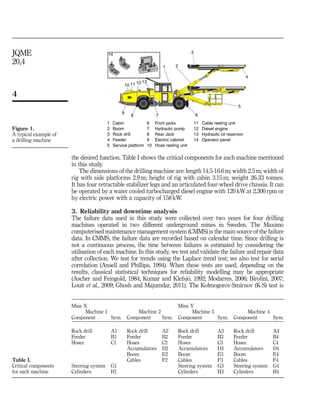
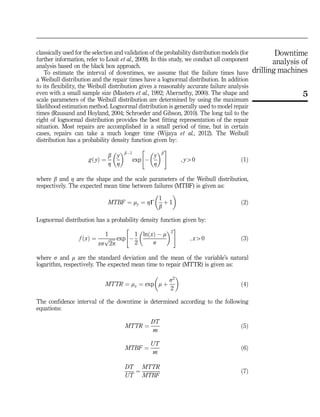
a drilling machine and its components are presented in Figure 1.
Drilling machines manufactured by different companies have different technical
characteristics, e.g. capacity and power. Based on the operation manuals, field
observations and maintenance reports from the collaborating mines, in this study the
drilling machine is considered a system divided into several components and
connected in series configuration; if any component fails, the operator will stop the
machine to maintain it. Thus, all machine components work simultaneously to achieve
3
Downtime
analysis of
drilling machines
the desired function. Table I shows the critical components for each machine mentioned
in this study.
The dimensions of the drilling machine are: length 14.5-16.6 m; width 2.5 m; width of
rig with side platforms 2.9 m; height of rig with cabin 3.15 m; weight 26-33 tonnes.
It has four retractable stabilizer legs and an articulated four-wheel drive chassis. It can
be operated by a water cooled turbocharged diesel engine with 120 kW at 2,300 rpm or
by electric power with a capacity of 158 kW.
3. Reliability and downtime analysis
The failure data used in this study were collected over two years for four drilling
machines operated in two different underground mines in Sweden. The Maximo
computerised maintenance management system (CMMS) is the main source of the failure
data. In CMMS, the failure data are recorded based on calendar time. Since drilling is
not a continuous process, the time between failures is estimated by considering the
utilisation of each machine. In this study, we test and validate the failure and repair data
after collection. We test for trends using the Laplace trend test; we also test for serial
correlation (Ansell and Phillips, 1994). When these tests are used, depending on the
results, classical statistical techniques for reliability modelling may be appropriate
(Ascher and Feingold, 1984; Kumar and Klefsjo¨, 1992; Modarres, 2006; Birolini, 2007;
Louit et al., 2009; Ghosh and Majumdar, 2011). The Kolmogorov-Smirnov (K-S) test is
1 Cabin 6 Front jacks 11 Cable reeling unit
2 Boom 7 Hydraulic pump 12 Diesel engine
3 Rock drill 8 Rear Jack 13 Hydraulic oil reservoir
4 Feeder 9 Electric cabinet 14 Operator panel
5 Service platform 10 Hose reeling unit
14
10
1211
13
1 2
3
4
5
678
9
Figure 1.
A typical example of
a drilling machine
Mine X Mine Y
Machine 1 Machine 2 Machine 3 Machine 4
Component Sym. Component Sym. Component Sym. Component Sym.
Rock drill A1 Rock drill A2 Rock drill A3 Rock drill A4
Feeder B1 Feeder B2 Feeder B3 Feeder B4
Hoses C1 Hoses C2 Hoses C3 Hoses C4
Accumulators D2 Accumulators D3 Accumulators D4
Boom E2 Boom E3 Boom E4
Cables F2 Cables F3 Cables F4
Steering system G1 Steering system G3 Steering system G4
Cylinders H1 Cylinders H3 Cylinders H4
Table I.
Critical components
for each machine
4
JQME
20,4
classically used for the selection and validation of the probability distribution models (for
further information, refer to Louit et al., 2009). In this study, we conduct all component
analysis based on the black box approach.
To estimate the interval of downtimes, we assume that the failure times have
a Weibull distribution and the repair times have a lognormal distribution. In addition
to its flexibility, the Weibull distribution gives a reasonably accurate failure analysis
even with a small sample size (Masters et al., 1992; Abernethy, 2000). The shape and
scale parameters of the Weibull distribution are determined by using the maximum
likelihood estimation method. Lognormal distribution is generally used to model repair
times (Rausand and Hoyland, 2004; Schroeder and Gibson, 2010). The long tail to the
right of lognormal distribution provides the best fitting representation of the repair
situation. Most repairs are accomplished in a small period of time, but in certain
cases, repairs can take a much longer time (Wijaya et al., 2012). The Weibull
distribution has a probability density function given by:
g yð Þ ¼
b
Z
y
Z
 bÀ1
exp À
y
Z
 b
 #
; y40 ð1Þ
where b and Z are the shape and the scale parameters of the Weibull distribution,
respectively. The expected mean time between failures (MTBF) is given as:
MTBF ¼ my ¼ ZG
1
b
þ 1
 
ð2Þ
Lognormal distribution has a probability density function given by:
f xð Þ ¼
1
xs
ffiffiffiffiffi
2p
p exp À
1
2
ln xð Þ À m
s
 2
 #
; x40 ð3Þ
where s and m are the standard deviation and the mean of the variable’s natural
logarithm, respectively. The expected mean time to repair (MTTR) is given as:
MTTR ¼ mx ¼ exp m þ
s2
2
 
ð4Þ
The confidence interval of the downtime is determined according to the following
equations:
MTTR ¼
DT
m
ð5Þ
MTBF ¼
UT
m
ð6Þ
DT
UT
¼
MTTR
MTBF
ð7Þ
5
Downtime
analysis of
drilling machines
where DT is the downtime, m is the number of failures and UT is the uptime. Thus, the
downtime can be formulated as (Wijaya et al., 2012):
DT ¼
mx
my
UT ð8Þ
The confidence interval of the estimated downtime can be solved by finding
a confidence interval for mx/my. In this study, the exact method (Masters et al., 1992) is
implemented to estimate the confidence interval of mx/my (for more clarification of the
method to estimate the interval of the downtime, see Wijaya et al., 2012). All tests are
conducted using the Minitab, Matlab and Easy Fit software; the significance level
a used in all tests is 0.05.
4. Methodology
A simple yet important graphical method to visualise downtime is the jack-knife
diagram (Knights, 2001). In this diagram, the failure data are presented as a log-log
graph. The graph shows log number of failures (vertical axis) and log repair time
(horizontal axis). The curves of constant downtime appear as straight lines with
a uniform and constant gradient (Knights, 2001). This study uses the jack-knife
diagram with the downtime confidence interval to analyse the downtime of the
components of the drilling machine. Three equations are used to establish the
confidence log-log plot. The estimation points are the mean, lower limit and upper
limit of the downtime. The value of these points can be estimated from the following
equations (Wijaya et al., 2012):
DTM ¼
exp m þ s2
2
 
ZG 1
b þ 1
 
2
4
3
5 Â UT ð9Þ
DTLL ¼ a Â
exp s2
2
 
G
G 1
b þ 1
 
2Z1Àb
Pm
i¼1 yb
i
2
4
3
5 Â UT ð10Þ
DTUL ¼ b Â
exp s2
2
 
G
G 1
b þ 1
 
2Z1Àb
Pm
i¼1 yb
i
2
4
3
5 Â UT ð11Þ
where DTM is mean downtime, DTLL is a lower limit of the downtime, a is a constant
for the lower limit, G is a geometric mean of the lognormal distribution, y is time
between failures, DTUL is an upper limit of the downtime and b is a constant for the
upper limit.
6
JQME
20,4
The next step is the determination of coordinates of the three previous estimated
points. For the DTM, the abscissa is the MTTR, and the ordinate is determined as:
mM ¼
UT
MTBF
ð12Þ
For the lower and upper limit of the downtime, the abscissa and the ordinate are
determined as:
TTRL ¼ 10 log
ffiffiffiffiffiffiffi
DTL
p
Àlog
ffiffiffiffiffiffiffiffi
DTM
p
þlog MTTRð Þ
 Ã
ð13Þ
mL ¼
DTL
TTRL
ð14Þ
where TTRL is time to repair of the limit (upper or lower); DTL is the downtime of the
limit (upper or lower); MTTR is mean time to repair; mL is the number of failures of the
limit (upper or lower). For more information on derivation of the abscissa, the lower
and upper limits of downtime refer to Wijaya et al. (2012).
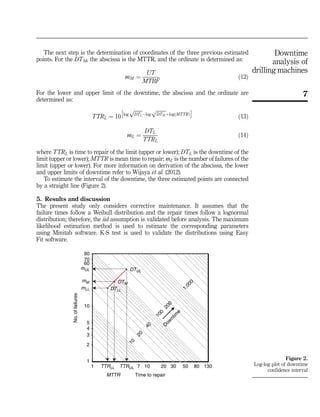
To estimate the interval of the downtime, the three estimated points are connected
by a straight line (Figure 2).
5. Results and discussion
The present study only considers corrective maintenance. It assumes that the
failure times follow a Weibull distribution and the repair times follow a lognormal
distribution; therefore, the iid assumption is validated before analysis. The maximum
likelihood estimation method is used to estimate the corresponding parameters
using Minitab software. K-S test is used to validate the distributions using Easy
Fit software.
60
mUL
10
90
2
7TTRUL
3
20
4
30
10
50 80 1301
1
5
Time to repair
70
mM
mLL
MTTR
TTRLL
DTUL
DTLL
DTM
No.offailures
10
20
40
100
D
ow
ntim
e
200
1,000
Figure 2.
Log-log plot of downtime
confidence interval
7
Downtime
analysis of
drilling machines
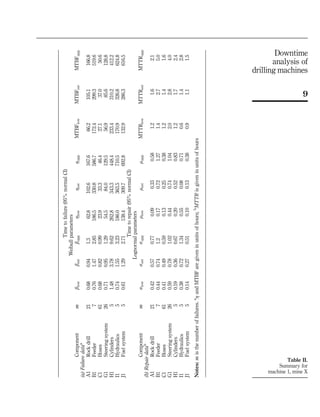
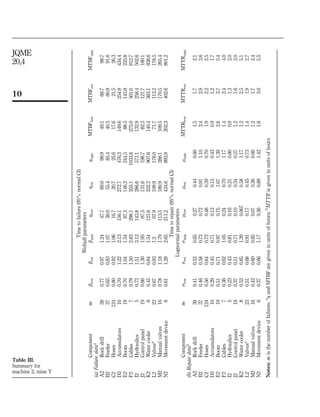
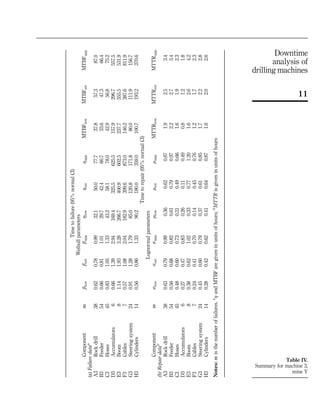
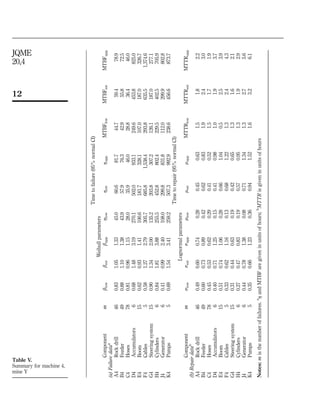
Parameters of the distributions are determined the lower bound, mean and upper
bound for a confidence interval of 95 per cent. For the failure data, blow and bupp are
the estimates of the lower and upper limits, respectively, of the maximum likelihood
estimate of shape parameter b, denoted by best. Zlow and Zupp are the estimates of the
lower and upper limits, respectively, of the maximum likelihood estimate of scale
parameter Z, denoted by Zest. MTBFlow and MTBFupp are the estimates of the lower
and upper limits, respectively, of the maximum likelihood estimate of the MTBF,
denoted by MTBFest. For the repair data, mlow and mupp are the estimates of the
lower and upper limits, respectively, of the maximum likelihood estimate of the mean
parameter m of the lognormal distribution, denoted by mest. slow and supp are the
estimates of the lower and upper limits, respectively, of the maximum likelihood
estimate of the standard deviation parameter s of the lognormal distribution, denoted
by sest. MTTRlow and MTTRupp are the estimates of the lower and upper limits,
respectively, of the maximum likelihood estimate of the MTTR, denoted by MTTRest.
Tables II-V show the data analysis of the critical components of four drilling
machines working in two different mines in Sweden.
We compare the machines’ downtime using a jack-knife diagram with a confidence
interval. Using Equations (9-11), we determine three downtime estimation points,
DTM, DTLL and DTUL. The study uses theoretical production hours for one year as
uptime. When the data were collected for this study, each mine averaged about 16.5
working hours per day, or approximately 115 hours per week. By fitting lognormal
distribution for preventive maintenance (PM) data (service data) to all machines, we
find that mean time to service averages 6.7 hours. Since PM is scheduled for every
week, the theoretical service time for 49 working weeks for one year is calculated as
approximately 330 hours. Consequently, the stoppage for PM is three weeks per year;
hence, each mine is worked for 46 weeks per year. We can conclude that each mine has
approximately 5,300 production hours per year. The coordinates of the three downtime
estimation points are determined by using Equations (4), (12-14). Tables VI-IX shows
the values of the three estimation points and their coordinates.
We make four types of comparisons of the downtime of the machines’ components.
Type 1 is a comparison of six components on three machines used only in mine Y. Type
2 is a comparison of three components on four machines (1, 2, 3 and 4) used in both
mines. Type 3 is a comparison of two components on three machines (1, 3 and 4) used
in both mines. Type 4 compares one component on two machines (1 and 2) used in both
mines. Figures 3-9 are visualisations of these four types of comparisons.
Since the number of failures and repair time are noted manually, we expect these
data have some errors. Based on interviews with several maintenance persons
who work in the mines collaborating in this study, we conclude that 80 per cent of the
data does not include documentation errors. With this in mind, we define a ratio R,
whereby R ¼ maximum mean downtime/minimum mean downtime, and determine
the following limits:
(1) no significant differences; 1pRp1.2;
(2) indicated differences; 1.2oRp1.4; and
(3) significant differences; R41.4.
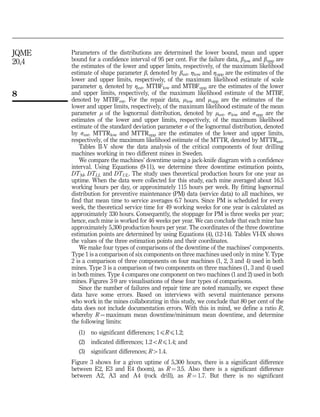
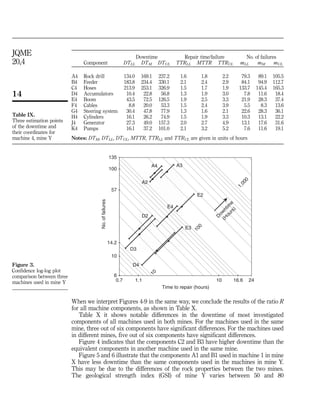
Figure 3 shows for a given uptime of 5,300 hours, there is a significant difference
between E2, E3 and E4 (boom), as R ¼ 3.5. Also there is a significant difference
between A2, A3 and A4 (rock drill), as R ¼ 1.7. But there is no significant
8
JQME
20,4
Timetofailure(95%normalCI)
Weibullparameters
ComponentmblowbestbuppZlowZestZuppMTBFlowMTBFestMTBFupp
(a)Failuredataa
A1Rockdrill210.680.941.362.8102.6167.666.2105.1166.8
B1Feeder70.761.472.85186.5330.8586.7172.4299.3519.6
C1Hoses610.680.820.9923.933.346.427.137.050.6
G1Steeringsystem260.710.951.2954.584.0129.556.985.6128.8
H1Cylinders51.483.789.62262.8343.3448.4233.4310.2412.2
I1Hydraulics50.741.553.23186.0363.5710.5170.9326.8624.8
J1Fuelsystem50.611.292.71138.4309.7692.8132.9286.3616.5
Timetorepair(95%normalCI)
Lognormalparameters
ComponentmslowsestsuppmlowmestmuppMTTRlowMTTRestMTTRupp
(b)Repairdatab
A1Rockdrill210.420.570.770.090.330.581.21.62.1
B1Feeder70.440.741.20.170.721.271.42.75.0
C1Hoses610.410.490.590.130.250.381.21.41.6
G1Steeringsystem260.590.781.020.440.741.042.02.84.0
H1Cylinders50.190.360.670.200.520.831.21.72.4
I1Hydraulics50.380.721.340.550.080.710.61.42.8
J1Fuelsystem50.140.270.510.100.130.380.91.11.5
Notes:misthenumberoffailures.a
ZandMTBFaregiveninunitsofhours;b
MTTRisgiveninunitsofhours
Table II.
Summary for
machine 1, mine X
9
Downtime
analysis of
drilling machines
Timetofailure(95%normalCI)
Weibullparameters
ComponentmblowbestbuppZlowZestZuppMTBFlowMTBFestMTBFupp
(a)Failuredataa
A2Rockdrill390.770.971.2447.769.099.949.169.798.7
B2Feeder370.650.831.0736.055.485.440.560.991.6
C2Hoses1240.800.921.0616.720.725.617.621.526.3
D2Accumulators100.701.222.13156.1272.7476.3149.6254.9434.4
E2Boom190.701.041.5487.5146.2244.588.5143.8233.8
F2Cables70.791.502.83298.1555.11033.8275.0501.0912.7
I2Hydraulics50.731.513.12143.8286.6571.1132.9258.4502.6
J2Controlpanel190.861.301.9587.5131.8198.782.3121.7180.1
K2Watercooler80.450.841.54121.6332.2907.6140.4363.1938.6
L2Valvesa
230.670.931.367.9109.9178.071.7113.2178.5
M2Manualvalves160.781.181.79113.5180.9288.1109.5170.5265.4
N2Movementdevice60.611.282.65211.2434.6893.9202.3402.6801.2
Timetorepair(95%normalCI)
Lognormalparameters
ComponentmslowsestsuppmlowmestmuppMTTRlowMTTRestMTTRupp
(b)Repairdatab
A2Rockdrill390.410.520.650.270.440.601.51.72.1
B2Feeder370.460.580.730.720.911.102.42.93.6
C2Hoses1240.560.640.720.480.590.701.92.22.5
D2Accumulators100.290.450.710.130.150.430.91.21.7
E2Boom190.510.710.970.751.071.392.63.75.4
F2Cables70.360.621.050.240.701.171.42.44.0
I2Hydraulics50.230.430.810.160.210.600.91.32.0
J2Controlpanel190.370.510.710.100.340.571.21.62.0
K2Watercooler80.520.851.390.0070.581.171.22.55.1
L2Valvesa
230.510.680.910.170.450.731.41.92.7
M2Manualvalves160.420.600.850.070.360.661.21.72.4
N2Movementdevice60.370.661.170.360.891.421.63.05.5
Notes:misthenumberoffailures.a
ZandMTBFaregiveninunitsofhours;b
MTTRisgiveninunitsofhours
Table III.
Summary for
machine 2, mine Y
10
JQME
20,4
Timetofailure(95%normalCI)
Weibullparameters
ComponentmblowbestbuppZlowZestZuppMTBFlowMTBFestMTBFupp
(a)Failuredataa
A3Rockdrill380.620.780.9932.150.077.737.857.387.0
B3Feeder540.660.811.0129.742.460.733.647.366.4
C3Hoses450.831.051.3343.258.178.042.956.875.2
D3Accumulators60.661.392.94169.4325.5625.5157.9296.7557.5
E3Boom81.141.933.28266.7400.9602.5237.7355.5531.9
F3Cables70.571.082.04182.9399.6873.0146.2387.6811.9
G3Steeringsystem240.911.281.7985.0120.8171.880.0111.9156.7
H3Cylinders140.560.861.3390.2180.0359.0100.7193.2370.6
Timetorepair(95%normalCI)
Lognormalparameters
ComponentmslowsestsuppmlowmestmuppMTTRlowMTTRestMTTRupp
(b)Repairdatab
A3Rockdrill380.630.790.990.360.620.871.92.53.4
B3Feeder540.560.680.820.610.790.972.22.73.4
C3Hoses450.480.600.730.310.490.661.61.92.3
D3Accumulators60.270.470.830.260.110.490.81.21.8
E3Boom80.380.621.020.330.771.201.62.64.2
F3Cables70.240.410.700.140.450.761.21.72.3
G3Steeringsystem240.450.600.790.370.610.851.72.22.8
H3Cylinders140.280.420.620.410.640.871.62.02.6
Notes:misthenumberoffailures.a
ZandMTBFaregiveninunitsofhours;b
MTTRisgiveninunitsofhours
Table IV.
Summary for machine 3,
mine Y
11
Downtime
analysis of
drilling machines
Timetofailure(95%normalCI)
Weibullparameters
ComponentmblowbestbuppZlowZestZuppMTBFlowMTBFestMTBFupp
(a)Failuredataa
A4Rockdrill460.831.051.3345.060.681.744.759.478.9
B4Feeder490.881.101.3843.957.976.342.955.872.5
C4Hoses780.810.961.1528.035.946.028.836.446.0
D4Accumulators60.681.483.19270.1502.0933.1249.6453.8825.0
E4Boom150.620.931.41100.6181.7328.1107.0187.0326.7
F4Cables50.581.272.79305.7685.81,538.4293.8635.51,374.6
G4Steeringsystem150.901.342.00135.2203.8307.2126.1187.0277.1
H4Cylinders60.841.813.88255.5452.8802.4229.5402.5705.9
J4Generator60.410.992.40108.0299.8831.8112.0299.9802.8
K4Pumps50.691.543.41259.2507.3992.9238.6456.6873.7
Timetorepair(95%normalCI)
Lognormalparameters
ComponentmslowsestsuppmlowmestmuppMTTRlowMTTRestMTTRupp
(b)Repairdatab
A4Rockdrill460.490.600.740.280.450.631.51.82.2
B4Feeder490.600.730.890.420.620.831.92.43.0
C4Hoses780.450.530.620.290.410.521.51.71.9
D4Accumulators60.400.711.250.150.410.981.01.93.7
E4Boom150.510.741.060.280.661.040.52.53.9
F4Cables50.330.621.160.130.681.221.32.44.3
G4Steeringsystem150.310.440.630.190.420.651.31.62.1
H4Cylinders60.270.470.830.190.570.951.31.92.9
J4Generator60.440.781.380.080.711.341.32.75.6
K4Pumps50.350.661.230.360.941.521.63.26.1
Notes:misthenumberoffailures.a
ZandMTBFaregiveninunitsofhours;b
MTTRisgiveninunitsofhours
Table V.
Summary for machine 4,
mine Y
12
JQME
20,4
difference between D2, D3 and D4 (accumulators), as R ¼ 1.2 in this particular case.
Moreover, component A3 in machine 3 has more downtime than the similar component
used in machines 2 and 4. Similarly, component E2 in machine 2 has more downtime
than components E3 and E4. Figure 3 shows there are notable differences in the
downtime of most of the studied components for all machines used in mine Y.
Downtime Repair time/failure No. of failures
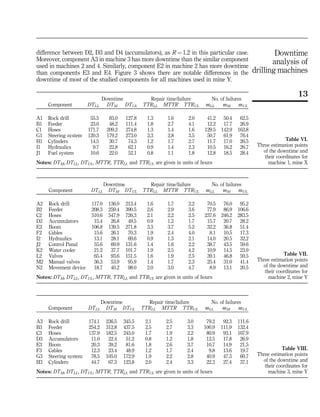
Component DTLL DTM DTUL TTRLL MTTR TTRUL mLL mM mUL
A1 Rock drill 55.5 83.0 127.8 1.3 1.6 2.0 41.2 50.4 62.5
B1 Feeder 23.0 48.2 111.4 1.8 2.7 4.1 12.2 17.7 26.9
C1 Hoses 171.7 209.2 274.8 1.3 1.4 1.6 129.5 142.9 163.8
G1 Steering system 120.3 179.2 273.0 2.3 2.8 3.5 50.7 61.9 76.4
H1 Cylinders 14.5 30.7 74.3 1.2 1.7 2.7 11.7 17.0 26.5
I1 Hydraulics 9.7 22.8 62.1 0.9 1.4 2.3 10.5 16.2 26.7
J1 Fuel system 10.6 22.0 52.1 0.8 1.1 1.8 12.8 18.5 28.4
Notes: DTM, DTLL, DTUL, MTTR, TTRLL and TTRUL are given in units of hours
Table VI.
Three estimation points
of the downtime and
their coordinates for
machine 1, mine X
Downtime Repair time/failure No. of failures
Component DTLL DTM DTUL TTRLL MTTR TTRUL mLL mM mUL
A2 Rock drill 117.0 136.0 213.4 1.6 1.7 2.2 70.5 76.0 95.2
B2 Feeder 208.3 259.4 390.5 2.6 2.9 3.6 77.9 86.9 106.6
C2 Hoses 510.6 547.9 726.3 2.1 2.2 2.5 237.6 246.2 283.5
D2 Accumulators 15.4 26.8 49.5 0.9 1.2 1.7 15.7 20.7 28.2
E2 Boom 106.8 139.5 271.8 3.3 3.7 5.2 32.2 36.8 51.4
F2 Cables 15.6 26.1 70.3 1.9 2.4 4.0 8.1 10.5 17.3
I2 Hydraulics 13.1 28.1 69.6 0.9 1.3 2.1 14.0 20.5 32.2
J2 Control Panal 55.6 69.9 131.6 1.4 1.6 2.2 38.7 43.5 59.6
K2 Water cooler 21.2 37.7 101.7 1.9 2.5 4.2 10.9 14.5 23.9
L2 Valves 65.4 93.6 151.5 1.6 1.9 2.5 39.1 46.8 59.5
M2 Manual valves 36.3 53.9 95.9 1.4 1.7 2.3 25.4 31.0 41.4
N2 Movement device 18.7 40.2 98.0 2.0 3.0 4.7 8.9 13.1 20.5
Notes: DTM, DTLL, DTUL, MTTR, TTRLL and TTRUL are given in units of hours
Table VII.
Three estimation points
of the downtime and
their coordinates for
machine 2, mine Y
Downtime Repair time/failure No. of failures
Component DTLL DTM DTUL TTRLL MTTR TTRUL mLL mM mUL
A3 Rock drill 174.1 236.5 345.5 2.1 2.5 3.0 79.2 92.3 111.6
B3 Feeder 254.2 312.8 437.5 2.5 2.7 3.3 100.9 111.9 132.4
C3 Hoses 137.9 182.5 245.0 1.7 1.9 2.2 80.9 93.1 107.9
D3 Accumulators 11.0 22.4 51.2 0.8 1.2 1.8 12.5 17.8 26.9
E3 Boom 20.3 39.2 81.6 1.8 2.6 3.7 10.7 14.9 21.5
F3 Cables 12.3 23.4 48.9 1.2 1.7 2.4 9.8 13.6 19.7
G3 Steering system 78.5 105.0 172.9 1.9 2.2 2.8 40.9 47.3 60.7
H3 Cylinders 44.7 67.3 123.8 2.0 2.4 3.3 22.3 27.4 37.1
Notes: DTM, DTLL, DTUL, MTTR, TTRLL and TTRUL are given in units of hours
Table VIII.
Three estimation points
of the downtime and
their coordinates for
machine 3, mine Y
13
Downtime
analysis of
drilling machines
When we interpret Figures 4-9 in the same way, we conclude the results of the ratio R
for all machine components, as shown in Table X.
Table X it shows notable differences in the downtime of most investigated
components of all machines used in both mines. For the machines used in the same
mine, three out of six components have significant differences. For the machines used
in different mines, five out of six components have significant differences.
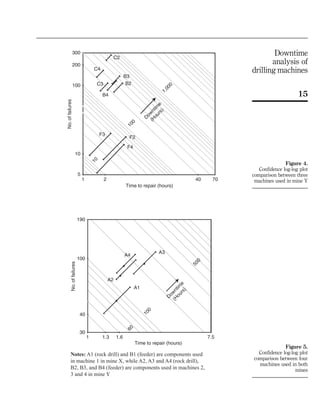
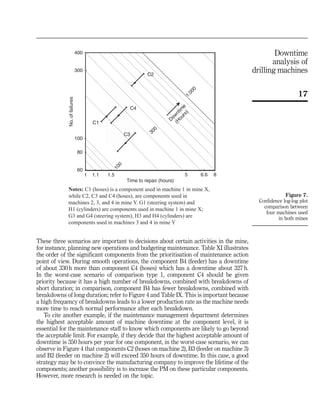
Figure 4 indicates that the components C2 and B3 have higher downtime than the
equivalent components in another machine used in the same mine.
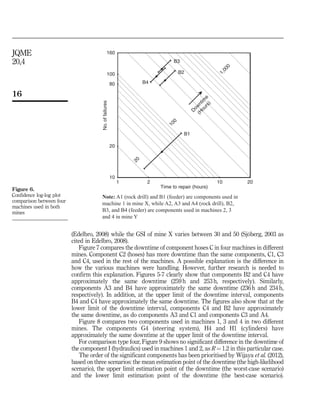
Figure 5 and 6 illustrate that the components A1 and B1 used in machine 1 in mine
X have less downtime than the same components used in the machines in mine Y.
This may be due to the differences of the rock properties between the two mines.
The geological strength index (GSI) of mine Y varies between 50 and 80
No.offailures
Time to repair (hours)
A3
A2
A4
D3
D4
10
100
1,000
D
ow
ntim
e
(H
ours)
E4
E2
E3
D2
0.7 1.1
14.2
100
6
16.6
10
57
10
135
24
Figure 3.
Confidence log-log plot
comparison between three
machines used in mine Y
Downtime Repair time/failure No. of failures
Component DTLL DTM DTUL TTRLL MTTR TTRUL mLL mM mUL
A4 Rock drill 134.0 169.1 237.2 1.6 1.8 2.2 79.3 89.1 105.5
B4 Feeder 183.8 234.4 330.1 2.1 2.4 2.9 84.1 94.9 112.7
C4 Hoses 213.9 253.1 326.9 1.5 1.7 1.9 133.7 145.4 165.3
D4 Accumulators 10.4 22.8 56.8 1.3 1.9 3.0 7.8 11.6 18.4
E4 Boom 43.5 72.5 126.5 1.9 2.5 3.3 21.9 28.3 37.4
F4 Cables 8.8 20.0 53.3 1.5 2.4 3.9 5.5 8.3 13.6
G4 Steering system 30.4 47.8 77.9 1.3 1.6 2.1 22.6 28.3 36.1
H4 Cylinders 16.1 26.2 74.9 1.5 1.9 3.3 10.3 13.1 22.2
J4 Generator 27.3 49.0 157.3 2.0 2.7 4.9 13.1 17.6 31.6
K4 Pumps 16.1 37.2 101.0 2.1 3.2 5.2 7.6 11.6 19.1
Notes: DTM, DTLL, DTUL, MTTR, TTRLL and TTRUL are given in units of hours
Table IX.
Three estimation points
of the downtime and
their coordinates for
machine 4, mine Y
14
JQME
20,4
Notes: A1 (rock drill) and B1 (feeder) are components used
in machine 1 in mine X, while A2, A3 and A4 (rock drill),
B2, B3, and B4 (feeder) are components used in machines 2,
3 and 4 in mine Y
A2
A1
60
100
D
ow
ntim
e
(H
ours)
500
A4
A3
30
40
1 1.6
190
100
1.3 7.5
Time to repair (hours)
No.offailures
Figure 5.
Confidence log-log plot
comparison between four
machines used in both
mines
No.offailures
Time to repair (hours)
C2
C3
C4
B3
B2
B4
F4
F3
10
100
1,000
D
ow
ntim
e
(H
ours)
F2
2 40
100
70
5
1
200
300
10
Figure 4.
Confidence log-log plot
comparison between three
machines used in mine Y
15
Downtime
analysis of
drilling machines
(Edelbro, 2008) while the GSI of mine X varies between 30 and 50 (Sjo¨berg, 2003 as
cited in Edelbro, 2008).
Figure 7 compares the downtime of component hoses C in four machines in different
mines. Component C2 (hoses) has more downtime than the same components, C1, C3
and C4, used in the rest of the machines. A possible explanation is the difference in
how the various machines were handling. However, further research is needed to
confirm this explanation. Figures 5-7 clearly show that components B2 and C4 have
approximately the same downtime (259 h and 253 h, respectively). Similarly,
components A3 and B4 have approximately the same downtime (236 h and 234 h,
respectively). In addition, at the upper limit of the downtime interval, components
B4 and C4 have approximately the same downtime. The figures also show that at the
lower limit of the downtime interval, components C4 and B2 have approximately
the same downtime, as do components A3 and C1 and components C3 and A4.
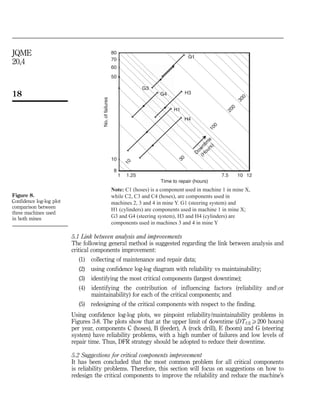
Figure 8 compares two components used in machines 1, 3 and 4 in two different
mines. The components G4 (steering system), H4 and H1 (cylinders) have
approximately the same downtime at the upper limit of the downtime interval.
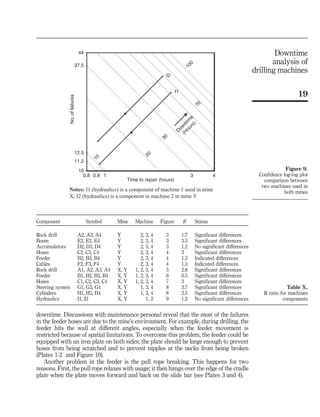
For comparison type four, Figure 9 shows no significant difference in the downtime of
the component I (hydraulics) used in machines 1 and 2, as R ¼ 1.2 in this particular case.
The order of the significant components has been prioritised by Wijaya et al. (2012),
based on three scenarios: the mean estimation point of the downtime (the high-likelihood
scenario), the upper limit estimation point of the downtime (the worst-case scenario)
and the lower limit estimation point of the downtime (the best-case scenario).
Time to repair (hours)
No.offailures
100 B2
B3
B4
20
10 202
80
1
10
160
B120
100
1,000
D
ow
ntim
e
(H
ours)
Note: A1 (rock drill) and B1 (feeder) are components used in
machine 1 in mine X, while A2, A3 and A4 (rock drill), B2,
B3, and B4 (feeder) are components used in machines 2, 3
and 4 in mine Y
Figure 6.
Confidence log-log plot
comparison between four
machines used in both
mines
16
JQME
20,4
These three scenarios are important to decisions about certain activities in the mine,
for instance, planning new operations and budgeting maintenance. Table XI illustrates
the order of the significant components from the prioritisation of maintenance action
point of view. During smooth operations, the component B4 (feeder) has a downtime
of about 330 h more than component C4 (hoses) which has a downtime about 327 h.
In the worst-case scenario of comparison type 1, component C4 should be given
priority because it has a high number of breakdowns, combined with breakdowns of
short duration; in comparison, component B4 has fewer breakdowns, combined with
breakdowns of long duration; refer to Figure 4 and Table IX. This is important because
a high frequency of breakdowns leads to a lower production rate as the machine needs
more time to reach normal performance after each breakdown.
To cite another example, if the maintenance management department determines
the highest acceptable amount of machine downtime at the component level, it is
essential for the maintenance staff to know which components are likely to go beyond
the acceptable limit. For example, if they decide that the highest acceptable amount of
downtime is 350 hours per year for one component, in the worst-case scenario, we can
observe in Figure 4 that components C2 (hoses on machine 2), B3 (feeder on machine 3)
and B2 (feeder on machine 2) will exceed 350 hours of downtime. In this case, a good
strategy may be to convince the manufacturing company to improve the lifetime of the
components; another possibility is to increase the PM on these particular components.
However, more research is needed on the topic.
Notes: C1 (hoses) is a component used in machine 1 in mine X,
while C2, C3 and C4 (hoses), are components used in
machines 2, 3, and 4 in mine Y. G1 (steering system) and
H1 (cylinders) are components used in machine 1 in mine X;
G3 and G4 (steering system), H3 and H4 (cylinders) are
components used in machines 3 and 4 in mine Y
No.offailures
Time to repair (hours)
C3
100
300
1,000
D
ow
ntim
e
(H
ours)
C4
1.5 8
C1
C2
6.6
80
60
300
100
400
1.11 5
Figure 7.
Confidence log-log plot
comparison between
four machines used
in both mines
17
Downtime
analysis of
drilling machines
5.1 Link between analysis and improvements
The following general method is suggested regarding the link between analysis and
critical components improvement:
(1) collecting of maintenance and repair data;
(2) using confidence log-log diagram with reliability vs maintainability;
(3) identifying the most critical components (largest downtime);
(4) identifying the contribution of influencing factors (reliability andor
maintainability) for each of the critical components; and
(5) redesigning of the critical components with respect to the finding.
Using confidence log-log plots, we pinpoint reliability/maintainability problems in
Figures 3-8. The plots show that at the upper limit of downtime (DTULX200 hours)
per year, components C (hoses), B (feeder), A (rock drill), E (boom) and G (steering
system) have reliability problems, with a high number of failures and low levels of
repair time. Thus, DFR strategy should be adopted to reduce their downtime.
5.2 Suggestions for critical components improvement
It has been concluded that the most common problem for all critical components
is reliability problems. Therefore, this section will focus on suggestions on how to
redesign the critical components to improve the reliability and reduce the machine’s
Time to repair (hours)
No.offailures
80
70
60
8
G1
G3
G4
10
H4
H3
H1
10
30
100
D
ow
ntim
e
(H
ours)
200
300
121 1.25 7.5 10
50
Note: C1 (hoses) is a component used in machine 1 in mine X,
while C2, C3 and C4 (hoses), are components used in
machines 2, 3 and 4 in mine Y. G1 (steering system) and
H1 (cylinders) are components used in machine 1 in mine X;
G3 and G4 (steering system), H3 and H4 (cylinders) are
components used in machines 3 and 4 in mine Y
Figure 8.
Confidence log-log plot
comparison between
three machines used
in both mines
18
JQME
20,4
downtime. Discussions with maintenance personal reveal that the most of the failures
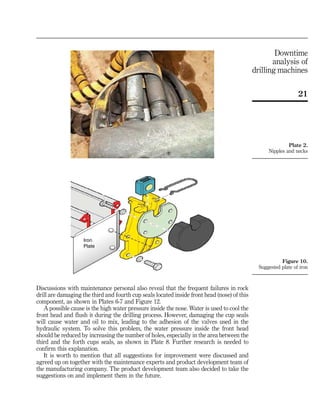
in the feeder hoses are due to the mine’s environment. For example, during drilling, the
feeder hits the wall at different angles, especially when the feeder movement is
restricted because of spatial limitations. To overcome this problem, the feeder could be
equipped with an iron plate on both sides; the plate should be large enough to prevent
hoses from being scratched and to prevent nipples at the necks from being broken
(Plates 1-2 and Figure 10).
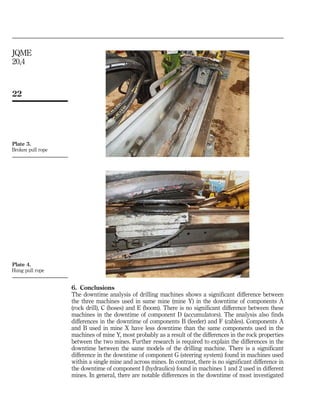
Another problem in the feeder is the pull rope breaking. This happens for two
reasons. First, the pull rope relaxes with usage; it then hangs over the edge of the cradle
plate when the plate moves forward and back on the slide bar (see Plates 3 and 4).
Component Symbol Mine Machine Figure R Status
Rock drill A2, A3, A4 Y 2, 3, 4 3 1.7 Significant differences
Boom E2, E3, E4 Y 2, 3, 4 3 3.5 Significant differences
Accumulators D2, D3, D4 Y 2, 3, 4 3 1.2 No significant differences
Hoses C2, C3, C4 Y 2, 3, 4 4 3 Significant differences
Feeder B2, B3, B4 Y 2, 3, 4 4 1.3 Indicated differences
Cables F2, F3, F4 Y 2, 3, 4 4 1.3 Indicated differences
Rock drill A1, A2, A3, A4 X, Y 1, 2, 3, 4 5 2.8 Significant differences
Feeder B1, B2, B3, B4 X, Y 1, 2, 3, 4 6 6.5 Significant differences
Hoses C1, C2, C3, C4 X, Y 1, 2, 3, 4 7 3 Significant differences
Steering system G1, G3, G4 X, Y 1, 3, 4 8 3.7 Significant differences
Cylinders H1, H3, H4 X, Y 1, 3, 4 8 2.5 Significant differences
Hydraulics I1, I2 X, Y 1, 2 9 1.2 No significant differences
Table X.
R ratio for machines
components
Notes: I1 (hydraulics) is a component of machine 1 used in mine
X; I2 (hydraulics) is a component in machine 2 in mine Y
Time to repair (hours)
No.offailures
I2
10
20
30
D
ow
ntim
e
(H
ours)70
100
I1
12.5
4
37.5
10
44
11.2
30.8 10.9
Figure 9.
Confidence log-log plot
comparison between
two machines used in
both mines
19
Downtime
analysis of
drilling machines
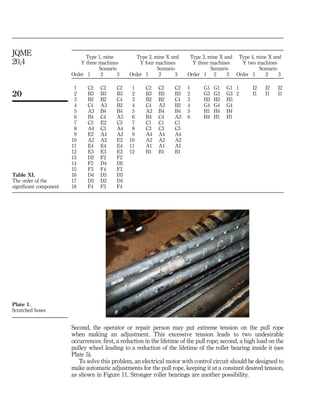
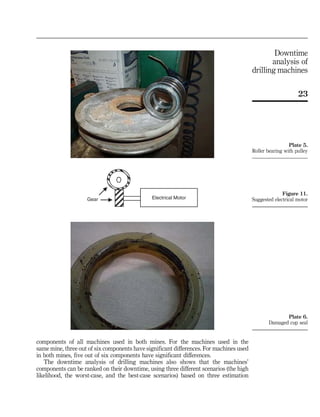
Second, the operator or repair person may put extreme tension on the pull rope
when making an adjustment. This excessive tension leads to two undesirable
occurrences: first, a reduction in the lifetime of the pull rope; second, a high load on the
pulley wheel leading to a reduction of the lifetime of the roller bearing inside it (see
Plate 5).
To solve this problem, an electrical motor with control circuit should be designed to
make automatic adjustments for the pull rope, keeping it at a constant desired tension,
as shown in Figure 11. Stronger roller bearings are another possibility.
Type 1, mine
Y three machines
Type 2, mine X and
Y four machines
Type 3, mine X and
Y three machines
Type 4, mine X and
Y two machines
Scenario Scenario Scenario Scenario
Order 1 2 3 Order 1 2 3 Order 1 2 3 Order 1 2 3
1 C2 C2 C2 1 C2 C2 C2 1 G1 G1 G1 1 I2 I2 I2
2 B3 B3 B3 2 B3 B3 B3 2 G3 G3 G3 2 I1 I1 I1
3 B2 B2 C4 3 B2 B2 C4 3 H3 H3 H3
4 C4 A3 B2 4 C4 A3 B2 4 G4 G4 G4
5 A3 B4 B4 5 A3 B4 B4 5 H1 H4 H4
6 B4 C4 A3 6 B4 C4 A3 6 H4 H1 H1
7 C3 E2 C3 7 C1 C1 C1
8 A4 C3 A4 8 C3 C3 C3
9 E2 A4 A2 9 A4 A4 A4
10 A2 A2 E2 10 A2 A2 A2
11 E4 E4 E4 11 A1 A1 A1
12 E3 E3 E3 12 B1 B1 B1
13 D2 F2 F2
14 F2 D4 D2
15 F3 F4 F3
16 D4 D3 D3
17 D3 D2 D4
18 F4 F3 F4
Table XI.
The order of the
significant component
Plate 1.
Scratched hoses
20
JQME
20,4
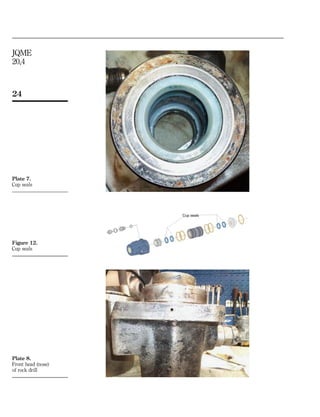
Discussions with maintenance personal also reveal that the frequent failures in rock
drill are damaging the third and fourth cup seals located inside front head (nose) of this
component, as shown in Plates 6-7 and Figure 12.
A possible cause is the high water pressure inside the nose. Water is used to cool the
front head and flush it during the drilling process. However, damaging the cup seals
will cause water and oil to mix, leading to the adhesion of the valves used in the
hydraulic system. To solve this problem, the water pressure inside the front head
should be reduced by increasing the number of holes, especially in the area between the
third and the forth cups seals, as shown in Plate 8. Further research is needed to
confirm this explanation.
It is worth to mention that all suggestions for improvement were discussed and
agreed up on together with the maintenance experts and product development team of
the manufacturing company. The product development team also decided to take the
suggestions on and implement them in the future.
Iron
Plate
Figure 10.
Suggested plate of iron
Plate 2.
Nipples and necks
21
Downtime
analysis of
drilling machines
6. Conclusions
The downtime analysis of drilling machines shows a significant difference between
the three machines used in same mine (mine Y) in the downtime of components A
(rock drill), C (hoses) and E (boom). There is no significant difference between these
machines in the downtime of component D (accumulators). The analysis also finds
differences in the downtime of components B (feeder) and F (cables). Components A
and B used in mine X have less downtime than the same components used in the
machines of mine Y, most probably as a result of the differences in the rock properties
between the two mines. Further research is required to explain the differences in the
downtime between the same models of the drilling machine. There is a significant
difference in the downtime of component G (steering system) found in machines used
within a single mine and across mines. In contrast, there is no significant difference in
the downtime of component I (hydraulics) found in machines 1 and 2 used in different
mines. In general, there are notable differences in the downtime of most investigated
Plate 4.
Hung pull rope
Plate 3.
Broken pull rope
22
JQME
20,4
components of all machines used in both mines. For the machines used in the
same mine, three out of six components have significant differences. For machines used
in both mines, five out of six components have significant differences.
The downtime analysis of drilling machines also shows that the machines’
components can be ranked on their downtime, using three different scenarios (the high
likelihood, the worst-case, and the best-case scenarios) based on three estimation
Electrical MotorGear
Figure 11.
Suggested electrical motor
Plate 6.
Damaged cup seal
Plate 5.
Roller bearing with pulley
23
Downtime
analysis of
drilling machines
Plate 7.
Cup seals
Cup seals
Figure 12.
Cup seals
Plate 8.
Front head (nose)
of rock drill
24
JQME
20,4
points of downtime. The components C2 (hoses on machine 2), B3 (feeder on machine 3)
and B2 (feeder on machine 2) have more downtime (DTULX350) hours per year.
The downtime (DTULX200) hours per year of components C (hoses), B (feeder), A (rock
drill), E (boom) and G (steering system) stem from reliability problems. Because they
have a high number of failures and short repair times, as shown in Figures 3-8, a DFR
should be created to decrease their downtime. Overall, no maintainability problems
were detected for the machines’ significant components; therefore, a design for a
maintainability strategy is not required. The failures of the feeder hoses are likely due
to the harsh work environment during drilling. In this case, putting iron plates on both
sides of the feeder may reduce the number of failures. The breakage of the feeder pull
rope is due to usage and excessive tension; this can be treated and reduced by
installing an electrical motor with a control circuit to keep the pull rope at a constant
desired tension. Finally, increasing the number of holes between the third and the
fourth cup seals inside the nose of the rock drill could solve the problem of cup
seal damage.
In summary, the suggested “DFR” solution is found to be applicable. In order to
judge for cost effectiveness, one should perform life cycle cost analysis to identify, if the
solution is also economically viable.
References
Abernethy, R. (2000), The New Weibull Handbook, Gulf Publishing Co., Houston, TX.
Altman, D.G., Machin, D., Bryant, T.N., Gardner, M.J., Gardner, S., Bird, S., Campbell, M.,
Daly, L.E. and Morris, J. (2000), Statistics with Confidence: Confidence Intervals and
Statistical Guidelines, BMJ Books, London.
Ansell, J. and Phillips, M.J. (1994), Practical Methods for Reliability Data Analysis, Oxford
University Press Inc., New York, NY.
Ascher, H. and Feingold, H. (1984), Repairable System Reliability, 7th ed., Dekker, New York, NY.
Barabady, J. and Kumar, U. (2008), “Reliability analysis of mining equipment: a case study of a
crushing plant at Jajarm Bauxite mine in Iran”, Reliability Engineering System Safety,
Vol. 93 No. 4, pp. 647-653.
Birolini, A. (2007), Reliability Engineering Theory and Practice, 5th ed., Springer-Verlag, Berlin,
Heidelberg, New York, NY.
Blischke, W. and Murthy, D. (2003), Case Studies in Reliability and Maintenance, Wiley-
Interscience, New Jersy.
Colt, D.W. (1997), “System-reliability confidence-intervals for complex-systems with estimated
component-reliability”, IEEE Transactions on Reliability, Vol. 46 No. 4, pp. 487-493.
Curran-Everett, D. and Benos, D.J. (2004), “Guidelines for reporting statistics in journals
published by the American physiological society”, American Journal of Physiology-Heart
and Circulatory Physiology, Vol. 287 No. 2, pp. H447-H449.
Cutifani, M., Quinn, B. and Gurgenci, H. (1996), “Increased equipment reliability, safety and
availability without necessarily increasing the cost of maintenance”, Proceedings, Mining
Technology Conference, Cooperative Research Center for Mining Technology, 11-12
September, Fremantle, WA.
Edelbro, C. (2008), Strength, Fallouts and Numerical Modelling of Hard Rock Masses, Lule˚a
University of Technology, Lule˚a.
Ghosh, S. and Majumdar, S.K. (2011), “Reliability modeling and prediction using classical and
Bayesian approach: a case study”, The International Journal of Quality Reliability
Management, Vol. 28 No. 5, pp. 556-586.
25
Downtime
analysis of
drilling machines
Gustafson, A., Schunnesson, H., Galar, D. and Kumar, U. (2013), “The influence of the
operating environment on manual and automated load-haul-dump machine: a fault
tree analysis”, International Journal of Mining, Reclamation and Environment, Vol. 27
No. 2, pp. 75-87.
Hoseinie, S.H., Ataei, M., Khalokakaie, R., Ghodrati, B. and Kumar, U. (2012), “Reliability analysis
of drum Shearer machine at mechanized longwall mines”, Journal of Quality in
Maintenance Engineering, Vol. 18 No. 1, pp. 98-119.
Knights, P.F. (2001), “Rethinking Pareto analysis: maintenance applications of logarithmic
scatterplots”, Journal of Quality in Maintenance Engineering, Vol. 7 No. 4,
pp. 252-263.
Kumar, D., Klefsjo, B. and Kumar, U. (1992), “Reliability analysis of power transmission cables of
electric mine loaders using the proportional hazards model”, Reliability Engineering
System Safety, Vol. 37 No. 3, pp. 217-222.
Kumar, U. and Klefsjo¨, B. (1992), “Reliability analysis of hydraulic systems of LHD machines
using the power law process model”, Reliability Engineering System Safety, Vol. 35 No. 3,
pp. 217-224.
Kumar, U., Klefsjo¨, B. and Granholm, S. (1989), “Reliability investigation for a fleet of load haul
dump machines in a Swedish mine”, Reliability Engineering System Safety, Vol. 26 No. 4,
pp. 341-361.
Louit, D.M., Pascual, R. and Jardine, A.K.S. (2009), “A practical procedure for the selection of
time-to-failure models based on the assessment of trends in maintenance data”, Reliability
Engineering System Safety, Vol. 94 No. 10, pp. 1618-1628.
Masters, B., Lewis, T. and Kolarik, W. (1992), “A confidence interval for the availability ratio for
systems with weibull operating time and lognormal repair time”, Microelectronics and
Reliability, Vol. 32 Nos 1/2, pp. 89-99.
Modarres, M. (2006), Risk Analysis in Engineering: Techniques, Tools, and Trends, Taylor 
Francis Group, Boca Raton, FL.
Rausand, M. and Hoyland, A. (2004), System Reliability Theory: Models, Statistical Methods, and
Applications, 2nd ed., John Wiley and Sons Inc., New Jersy.
Roman, P.A. and Daneshmend, L. (2000), “Economies of scale in mining – assessing upper
bounds with simulation”, The Engineering Economist, Vol. 45 No. 4, pp. 326-388.
Schroeder, B. and Gibson, G.A. (2010), “A large-scale study of failures in high-performance
computing systems”, IEEE Transactions on Dependable and Secure Computing, Vol. 7
No. 4, pp. 337-351.
Vagenas, N. and Nuziale, T. (2001), “Genetic algorithms for reliability assessment of mining
equipment”, Journal of Quality in Maintenance Engineering, Vol. 7 No. 4,
pp. 302-311.
Vayenas, N. and Xiangxi, W. (2009), “Maintenance and reliability analysis of a fleet of load-haul-
dump vehicles in an underground hard rock mine”, International Journal of Mining,
Reclamation and Environment, Vol. 23 No. 3, pp. 227-238.
Wijaya, A.R., Lundberg, J. and Kumar, U. (2011), “Downtime analysis of a scaling
machine”, International Journal of Mining, Reclamation and Environment, Vol. 26 No. 3,
pp. 244-260.
About the authors
Hussan S. Al-Chalabi received BEng Degree in Mechanical Engineering from the Mosul
University, Iraq in 1994 and MSc Degree in Mechanical Engineering in Thermal Power from the
Mosul University, Iraq in 2008. Then he joined the Department of Mechanical Engineering at the
Mosul University as a Lecturer. In 2011 he joined the Division of Operation, Maintenance and
26
JQME
20,4
Acoustics at the LTU as a Doctoral Student. Hussan S. Al-Chalabi is the corresponding author
and can be contacted at: hussan.hamodi@ltu.se
Jan Lundberg is a Professor of Machine Elements at the Lule˚a University of Technology
and also a Professor in Operation  Maintenance with focus on product development. During the
years 1983-2000, his research concerned mainly about engineering design in the field of machine
elements in industrial environments. During the years 2000-2006, his research concerned mainly
about industrial design, ergonomic and related problems as cultural aspects of design and
modern tools for effective industrial design in industrial environments. From 2006 and forward,
his research is completely focused on maintenance issues like methods for measuring failure
sources, how to do design out maintenance and how to design for easy maintenance.
Dr Andi Wijaya received BEng Degree in Mechanical Engineering from the Gadjah Mada
University (GMU), Indonesia in 1998 and MSc Degree in Industrial Ergonomics and Licentiate
Degree in Sound and Vibration from the Lulea University of Technology (LTU), Sweden in 2001
and 2003, respectively. Then he joined to the Department of Mechanical and Industrial
Engineering at the GMU as a Lecturer. Since 2009, he received PhD Degree from the Division of
Operation, Maintenance and Acoustics, Lule˚a University of Technology, Sweden in 2012.
Behzad Ghodrati is an Associate Professor of Maintenance and Reliability Engineering
at the Lule˚a University of Technology. He obtained his PhD Degree on “Reliability based spare
parts planning” from the Lule˚a University of Technology and he was awarded the Postdoctoral
Research Fellowship from the University of Toronto in 2008.
To purchase reprints of this article please e-mail: reprints@emeraldinsight.com
Or visit our web site for further details: www.emeraldinsight.com/reprints
27
Downtime
analysis of
drilling machines

Published 1

  • 1.
    Downtime analysis ofdrilling machines and suggestions for improvements Hussan S. Al-Chalabi Division of Operation, Maintenance and Acoustics, Lule˚a University of Technology, Lule˚a, Sweden and Mechanical Engineering Department, College of Engineering, Mosul University, Mosul, Iraq, and Jan Lundberg, Andi Wijaya and Behzad Ghodrati Division of Operation, Maintenance and Acoustics, Lule ˚a University of Technology, Lule˚a, Sweden Abstract Purpose – The purpose of this paper is to analyse and compare the downtime of four drilling machines used in two underground mines in Sweden. The downtime of these machines was compared to show what problems affect downtime and which strategies should be applied to reduce it. Design/methodology/approach – The study collects failure data from a two-year period for four drilling machines and performs reliability analysis. It also performs downtime analysis utilising a log- log diagram with a confidence interval. Findings – There are notable differences in the downtime of most of the studied components for all machines. The hoses and feeder have relatively high downtime. Depending on their downtime, the significant components can be ranked in three groups. The downtime of the studied components is due to reliability problems. The study suggests the need to improve the reliability of critical components to reduce the downtime of drilling machines. Originality/value – The method of analysing the downtime, identifying dominant factors and the interval estimation for the downtime, has never been studied on drilling machines. The research proposed in this paper provides a general method to link downtime analysis with potential component improvement. To increase the statistical accuracy; four case studies was performed in two different mines with completely different working environment and ore properties. Using the above method showed which components need to be improved and suggestions for improvement was proposed and will be implemented accordingly. Keywords Reliability analysis, Confidence interval, Downtime analysis, Drilling machine Paper type Research paper 1. Introduction Underground mines are a main source of minerals. Growing demand for metals as a result of modern lifestyles and the industrial development of recent decades has The current issue and full text archive of this journal is available at www.emeraldinsight.com/1355-2511.htm Received 20 November 2012 Revised 23 October 2013 Accepted 11 January 2014 Journal of Quality in Maintenance Engineering Vol. 20 No. 4, 2014 pp. 1-27 r Emerald Group Publishing Limited 1355-2511 DOI 10.1108/JQME-11-2012-0038 Boliden AB is gratefully acknowledged for their financial support. The maintenance personnel and maintenance management system employees at Boliden AB who helped the authors in this research are also thanked for their support. r Hussan S. Al-Chalabi, Jan Lundberg, Andi Wijaya and Behzad Ghodrati. Boliden AB is gratefully acknowledged for their financial support. Published by Emerald Group Publishing Limited. This paper is published under the Creative Commons Attribution (CC BY 3.0) licence. Anyone may reproduce, distribute, translate and create derivative works of this paper (for both commercial and non-commercial purposes), subject to full attribution to the original publication and authors. The full terms of this licence may be seen at http://creativecommons.org/licences/ by/3.0/legalcode 1 Downtime analysis of drilling machines
  • 2.
    focused our attentionon the factors affecting the extraction of minerals. One of the most important factors is unscheduled downtime of the machines used in the extraction of ore. Lost production due to downtime will obviously increase the production costs (Roman and Daneshmend, 2000). A mine production system consists of many subsystems. To make the system both profitable and practical, the optimisation of each subsystem in relation with other subsystems should be considered (Barabady and Kumar, 2008). To achieve this aim, reliability and maintainability analysis for each subsystem in mine production system should be performed. Since the mid-1980s, reliability analysis techniques have been essential tools in automatic mining systems (Blischke and Murthy, 2003; Barabady and Kumar, 2008). A drilling machine is very important to the extraction process. Drilling is the process of making holes in the mining room face. From an economic viewpoint, the drilling machine dominates a mine’s production rate, since drilling is the first process of a typical mining cycle. Economic competition has pushed mining companies to achieve higher production rates by enhancing techniques of drilling and blasting and increasing mechanisation and automation. A significant cost issue is the maintenance of underground mobile machines: 30-65 per cent of a mine’s total operation costs typically come from maintenance (Cutifani et al., 1996; Gustafson et al., 2013). Maintenance costs include the cost of planned and unplanned maintenance. Historical data over the period of one year from an underground mine in Sweden show that more than 15 per cent of unplanned downtime of mobile machines is related to the drilling machine. Since the drilling machine is key to production, it is important to find solutions for machine problems and reduce downtime. This study performs downtime analysis of drilling machine to identify which components and what type of problems (maintainability problems and/or reliability problems) contribute to downtime, and to determine which strategies, designs for maintainability and/or designs for reliability should be applied to reduce it. To better understand the downtime of the drilling machine, we conducted an analysis of the historical data for three machines of the same model used in one Swedish mine and for one machine used in another mine, using jack-knife diagrams with confidence intervals. The results of a study of downtime with or without confidence intervals for only one machine used in only one mine may not give a clear picture of the overall behaviour of the machine’s components. Thus, it will prevent the designers to give good suggestions to improve the reliability and/or maintainability of the machine. To overcome this shortcoming, a comparison study and an analysis of the downtime by using jack-knife diagrams with confidence intervals for one machine used in mine X and three machines same model used in mine Y was conducted during this study. The reason of using data for one machine, which used in mine X, is that this mine has only one machine of the same model of the machines that used in mine Y. This diagram was used in order to overcome the shortcomings of using Pareto diagrams in maintenance engineering applications (Knights, 2001). A jack-knife diagram has one shortcoming; it presents downtime as a single value (point estimated), and because of involved uncertainties it has been considered insufficient (Altman et al., 2000; Curran-Everett and Benos, 2004; Wijaya et al., 2012). System designers and users have a tendency to be risk-averse regarding downtime. They prefer a design with a slightly higher estimated downtime (lower reliability) if the estimated value is known to be accurate (as characterised by the upper limit of a confidence interval of the downtime) rather than a design with possible inaccuracies in point estimation; therefore, it is important to consider a confidence interval for system downtime (Colt, 1997). 2 JQME 20,4
  • 3.
    1.1 Literature review Manyresearchers studied the reliability and maintainability of mining equipment and its failure behaviour. For example, Kumar et al. (1989) analysed the operational reliability of a fleet of diesel operated load-haul-dump (LHD) machines in Kiruna mine in Sweden. Kumar et al. (1992) performed reliability analysis on the power transmission cables of electric mine loaders in Sweden. Kumar and Klefsjo¨ (1992) analysed the maintenance data of one subsystem (hydraulic system) of a fleet of six LHD machines divided into three independent groups at Kiruna mine. Reliability assessment of mining equipment was performed by Vagenas and Nuziale (2001); using genetic algorithms, they developed and tested mobile mining equipment reliability assessment models. Vayenas and Xiangxi (2009) studied the availability of 13 LHD machines in an underground mine. They were interested in the influence of machine downtime on productivity and operation costs and used a reliability-based approach and a basic maintenance approach to determine the machine’s availability. Wijaya et al. (2012) developed a method for visualising downtime by using a jack-knife diagram; they applied the method on a scaling machine at a mine in Sweden. Gustafson et al. (2013) used a fault tree analysis to analyse the idle times of automated LHD machines at a Swedish underground mine. Hoseinie et al. (2012) performed reliability modelling of the drum Shearer machine used at Taba’s coal mine in the central desert of Iran. They analysed the failure rate of the machine’s subsystems. As the literature review shows, there are many reliability and maintainability studies of underground mining equipment but none of these has looked at drilling machines. Given the importance of underground mining mobile equipment for production, as well as the complexity of the equipment and the harsh mining environment, reliability analysis of the drilling machine must meet rigorous requirements. This study is based on data from several drilling machines working in different mines. In these mines the working environment, ore properties and operators are different. The aims of this study are as follows: (1) to analyse the reliability and downtime of several drilling machines to determine what kind of problems affect their downtime; (2) to specify which strategies, design for maintainability and/or design for reliability (DFR) should be applied to reduce the drilling machines downtime; and (3) to suggest improvement for the components that most contribute to the machines downtime. 2. Drilling machine and data collection All drilling machines for mining applications are composed of similar operational design units, such as cabin, boom, rock drill, feeder, service platform, front jacks, hydraulic pump, rear jack, electric cabinet, hose reeling unit, cable reeling unit, diesel engine, hydraulic oil reservoir, operator panel and water tank. A typical example of a drilling machine and its components are presented in Figure 1. Drilling machines manufactured by different companies have different technical characteristics, e.g. capacity and power. Based on the operation manuals, field observations and maintenance reports from the collaborating mines, in this study the drilling machine is considered a system divided into several components and connected in series configuration; if any component fails, the operator will stop the machine to maintain it. Thus, all machine components work simultaneously to achieve 3 Downtime analysis of drilling machines
  • 4.
    the desired function.Table I shows the critical components for each machine mentioned in this study. The dimensions of the drilling machine are: length 14.5-16.6 m; width 2.5 m; width of rig with side platforms 2.9 m; height of rig with cabin 3.15 m; weight 26-33 tonnes. It has four retractable stabilizer legs and an articulated four-wheel drive chassis. It can be operated by a water cooled turbocharged diesel engine with 120 kW at 2,300 rpm or by electric power with a capacity of 158 kW. 3. Reliability and downtime analysis The failure data used in this study were collected over two years for four drilling machines operated in two different underground mines in Sweden. The Maximo computerised maintenance management system (CMMS) is the main source of the failure data. In CMMS, the failure data are recorded based on calendar time. Since drilling is not a continuous process, the time between failures is estimated by considering the utilisation of each machine. In this study, we test and validate the failure and repair data after collection. We test for trends using the Laplace trend test; we also test for serial correlation (Ansell and Phillips, 1994). When these tests are used, depending on the results, classical statistical techniques for reliability modelling may be appropriate (Ascher and Feingold, 1984; Kumar and Klefsjo¨, 1992; Modarres, 2006; Birolini, 2007; Louit et al., 2009; Ghosh and Majumdar, 2011). The Kolmogorov-Smirnov (K-S) test is 1 Cabin 6 Front jacks 11 Cable reeling unit 2 Boom 7 Hydraulic pump 12 Diesel engine 3 Rock drill 8 Rear Jack 13 Hydraulic oil reservoir 4 Feeder 9 Electric cabinet 14 Operator panel 5 Service platform 10 Hose reeling unit 14 10 1211 13 1 2 3 4 5 678 9 Figure 1. A typical example of a drilling machine Mine X Mine Y Machine 1 Machine 2 Machine 3 Machine 4 Component Sym. Component Sym. Component Sym. Component Sym. Rock drill A1 Rock drill A2 Rock drill A3 Rock drill A4 Feeder B1 Feeder B2 Feeder B3 Feeder B4 Hoses C1 Hoses C2 Hoses C3 Hoses C4 Accumulators D2 Accumulators D3 Accumulators D4 Boom E2 Boom E3 Boom E4 Cables F2 Cables F3 Cables F4 Steering system G1 Steering system G3 Steering system G4 Cylinders H1 Cylinders H3 Cylinders H4 Table I. Critical components for each machine 4 JQME 20,4
  • 5.
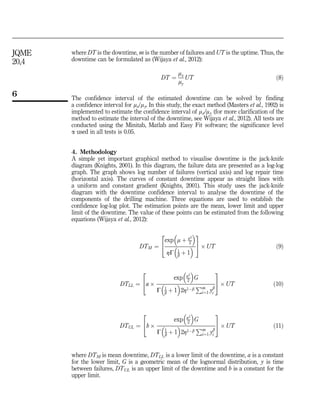
    classically used forthe selection and validation of the probability distribution models (for further information, refer to Louit et al., 2009). In this study, we conduct all component analysis based on the black box approach. To estimate the interval of downtimes, we assume that the failure times have a Weibull distribution and the repair times have a lognormal distribution. In addition to its flexibility, the Weibull distribution gives a reasonably accurate failure analysis even with a small sample size (Masters et al., 1992; Abernethy, 2000). The shape and scale parameters of the Weibull distribution are determined by using the maximum likelihood estimation method. Lognormal distribution is generally used to model repair times (Rausand and Hoyland, 2004; Schroeder and Gibson, 2010). The long tail to the right of lognormal distribution provides the best fitting representation of the repair situation. Most repairs are accomplished in a small period of time, but in certain cases, repairs can take a much longer time (Wijaya et al., 2012). The Weibull distribution has a probability density function given by: g yð Þ ¼ b Z y Z bÀ1 exp À y Z b # ; y40 ð1Þ where b and Z are the shape and the scale parameters of the Weibull distribution, respectively. The expected mean time between failures (MTBF) is given as: MTBF ¼ my ¼ ZG 1 b þ 1 ð2Þ Lognormal distribution has a probability density function given by: f xð Þ ¼ 1 xs ffiffiffiffiffi 2p p exp À 1 2 ln xð Þ À m s 2 # ; x40 ð3Þ where s and m are the standard deviation and the mean of the variable’s natural logarithm, respectively. The expected mean time to repair (MTTR) is given as: MTTR ¼ mx ¼ exp m þ s2 2 ð4Þ The confidence interval of the downtime is determined according to the following equations: MTTR ¼ DT m ð5Þ MTBF ¼ UT m ð6Þ DT UT ¼ MTTR MTBF ð7Þ 5 Downtime analysis of drilling machines
  • 6.
    where DT isthe downtime, m is the number of failures and UT is the uptime. Thus, the downtime can be formulated as (Wijaya et al., 2012): DT ¼ mx my UT ð8Þ The confidence interval of the estimated downtime can be solved by finding a confidence interval for mx/my. In this study, the exact method (Masters et al., 1992) is implemented to estimate the confidence interval of mx/my (for more clarification of the method to estimate the interval of the downtime, see Wijaya et al., 2012). All tests are conducted using the Minitab, Matlab and Easy Fit software; the significance level a used in all tests is 0.05. 4. Methodology A simple yet important graphical method to visualise downtime is the jack-knife diagram (Knights, 2001). In this diagram, the failure data are presented as a log-log graph. The graph shows log number of failures (vertical axis) and log repair time (horizontal axis). The curves of constant downtime appear as straight lines with a uniform and constant gradient (Knights, 2001). This study uses the jack-knife diagram with the downtime confidence interval to analyse the downtime of the components of the drilling machine. Three equations are used to establish the confidence log-log plot. The estimation points are the mean, lower limit and upper limit of the downtime. The value of these points can be estimated from the following equations (Wijaya et al., 2012): DTM ¼ exp m þ s2 2 ZG 1 b þ 1 2 4 3 5  UT ð9Þ DTLL ¼ a  exp s2 2 G G 1 b þ 1 2Z1Àb Pm i¼1 yb i 2 4 3 5  UT ð10Þ DTUL ¼ b  exp s2 2 G G 1 b þ 1 2Z1Àb Pm i¼1 yb i 2 4 3 5  UT ð11Þ where DTM is mean downtime, DTLL is a lower limit of the downtime, a is a constant for the lower limit, G is a geometric mean of the lognormal distribution, y is time between failures, DTUL is an upper limit of the downtime and b is a constant for the upper limit. 6 JQME 20,4
  • 7.
    The next stepis the determination of coordinates of the three previous estimated points. For the DTM, the abscissa is the MTTR, and the ordinate is determined as: mM ¼ UT MTBF ð12Þ For the lower and upper limit of the downtime, the abscissa and the ordinate are determined as: TTRL ¼ 10 log ffiffiffiffiffiffiffi DTL p Àlog ffiffiffiffiffiffiffiffi DTM p þlog MTTRð Þ Â Ã ð13Þ mL ¼ DTL TTRL ð14Þ where TTRL is time to repair of the limit (upper or lower); DTL is the downtime of the limit (upper or lower); MTTR is mean time to repair; mL is the number of failures of the limit (upper or lower). For more information on derivation of the abscissa, the lower and upper limits of downtime refer to Wijaya et al. (2012). To estimate the interval of the downtime, the three estimated points are connected by a straight line (Figure 2). 5. Results and discussion The present study only considers corrective maintenance. It assumes that the failure times follow a Weibull distribution and the repair times follow a lognormal distribution; therefore, the iid assumption is validated before analysis. The maximum likelihood estimation method is used to estimate the corresponding parameters using Minitab software. K-S test is used to validate the distributions using Easy Fit software. 60 mUL 10 90 2 7TTRUL 3 20 4 30 10 50 80 1301 1 5 Time to repair 70 mM mLL MTTR TTRLL DTUL DTLL DTM No.offailures 10 20 40 100 D ow ntim e 200 1,000 Figure 2. Log-log plot of downtime confidence interval 7 Downtime analysis of drilling machines
  • 8.
    Parameters of thedistributions are determined the lower bound, mean and upper bound for a confidence interval of 95 per cent. For the failure data, blow and bupp are the estimates of the lower and upper limits, respectively, of the maximum likelihood estimate of shape parameter b, denoted by best. Zlow and Zupp are the estimates of the lower and upper limits, respectively, of the maximum likelihood estimate of scale parameter Z, denoted by Zest. MTBFlow and MTBFupp are the estimates of the lower and upper limits, respectively, of the maximum likelihood estimate of the MTBF, denoted by MTBFest. For the repair data, mlow and mupp are the estimates of the lower and upper limits, respectively, of the maximum likelihood estimate of the mean parameter m of the lognormal distribution, denoted by mest. slow and supp are the estimates of the lower and upper limits, respectively, of the maximum likelihood estimate of the standard deviation parameter s of the lognormal distribution, denoted by sest. MTTRlow and MTTRupp are the estimates of the lower and upper limits, respectively, of the maximum likelihood estimate of the MTTR, denoted by MTTRest. Tables II-V show the data analysis of the critical components of four drilling machines working in two different mines in Sweden. We compare the machines’ downtime using a jack-knife diagram with a confidence interval. Using Equations (9-11), we determine three downtime estimation points, DTM, DTLL and DTUL. The study uses theoretical production hours for one year as uptime. When the data were collected for this study, each mine averaged about 16.5 working hours per day, or approximately 115 hours per week. By fitting lognormal distribution for preventive maintenance (PM) data (service data) to all machines, we find that mean time to service averages 6.7 hours. Since PM is scheduled for every week, the theoretical service time for 49 working weeks for one year is calculated as approximately 330 hours. Consequently, the stoppage for PM is three weeks per year; hence, each mine is worked for 46 weeks per year. We can conclude that each mine has approximately 5,300 production hours per year. The coordinates of the three downtime estimation points are determined by using Equations (4), (12-14). Tables VI-IX shows the values of the three estimation points and their coordinates. We make four types of comparisons of the downtime of the machines’ components. Type 1 is a comparison of six components on three machines used only in mine Y. Type 2 is a comparison of three components on four machines (1, 2, 3 and 4) used in both mines. Type 3 is a comparison of two components on three machines (1, 3 and 4) used in both mines. Type 4 compares one component on two machines (1 and 2) used in both mines. Figures 3-9 are visualisations of these four types of comparisons. Since the number of failures and repair time are noted manually, we expect these data have some errors. Based on interviews with several maintenance persons who work in the mines collaborating in this study, we conclude that 80 per cent of the data does not include documentation errors. With this in mind, we define a ratio R, whereby R ¼ maximum mean downtime/minimum mean downtime, and determine the following limits: (1) no significant differences; 1pRp1.2; (2) indicated differences; 1.2oRp1.4; and (3) significant differences; R41.4. Figure 3 shows for a given uptime of 5,300 hours, there is a significant difference between E2, E3 and E4 (boom), as R ¼ 3.5. Also there is a significant difference between A2, A3 and A4 (rock drill), as R ¼ 1.7. But there is no significant 8 JQME 20,4
  • 9.
    Timetofailure(95%normalCI) Weibullparameters ComponentmblowbestbuppZlowZestZuppMTBFlowMTBFestMTBFupp (a)Failuredataa A1Rockdrill210.680.941.362.8102.6167.666.2105.1166.8 B1Feeder70.761.472.85186.5330.8586.7172.4299.3519.6 C1Hoses610.680.820.9923.933.346.427.137.050.6 G1Steeringsystem260.710.951.2954.584.0129.556.985.6128.8 H1Cylinders51.483.789.62262.8343.3448.4233.4310.2412.2 I1Hydraulics50.741.553.23186.0363.5710.5170.9326.8624.8 J1Fuelsystem50.611.292.71138.4309.7692.8132.9286.3616.5 Timetorepair(95%normalCI) Lognormalparameters ComponentmslowsestsuppmlowmestmuppMTTRlowMTTRestMTTRupp (b)Repairdatab A1Rockdrill210.420.570.770.090.330.581.21.62.1 B1Feeder70.440.741.20.170.721.271.42.75.0 C1Hoses610.410.490.590.130.250.381.21.41.6 G1Steeringsystem260.590.781.020.440.741.042.02.84.0 H1Cylinders50.190.360.670.200.520.831.21.72.4 I1Hydraulics50.380.721.340.550.080.710.61.42.8 J1Fuelsystem50.140.270.510.100.130.380.91.11.5 Notes:misthenumberoffailures.a ZandMTBFaregiveninunitsofhours;b MTTRisgiveninunitsofhours Table II. Summary for machine1, mine X 9 Downtime analysis of drilling machines
  • 10.
    Timetofailure(95%normalCI) Weibullparameters ComponentmblowbestbuppZlowZestZuppMTBFlowMTBFestMTBFupp (a)Failuredataa A2Rockdrill390.770.971.2447.769.099.949.169.798.7 B2Feeder370.650.831.0736.055.485.440.560.991.6 C2Hoses1240.800.921.0616.720.725.617.621.526.3 D2Accumulators100.701.222.13156.1272.7476.3149.6254.9434.4 E2Boom190.701.041.5487.5146.2244.588.5143.8233.8 F2Cables70.791.502.83298.1555.11033.8275.0501.0912.7 I2Hydraulics50.731.513.12143.8286.6571.1132.9258.4502.6 J2Controlpanel190.861.301.9587.5131.8198.782.3121.7180.1 K2Watercooler80.450.841.54121.6332.2907.6140.4363.1938.6 L2Valvesa 230.670.931.367.9109.9178.071.7113.2178.5 M2Manualvalves160.781.181.79113.5180.9288.1109.5170.5265.4 N2Movementdevice60.611.282.65211.2434.6893.9202.3402.6801.2 Timetorepair(95%normalCI) Lognormalparameters ComponentmslowsestsuppmlowmestmuppMTTRlowMTTRestMTTRupp (b)Repairdatab A2Rockdrill390.410.520.650.270.440.601.51.72.1 B2Feeder370.460.580.730.720.911.102.42.93.6 C2Hoses1240.560.640.720.480.590.701.92.22.5 D2Accumulators100.290.450.710.130.150.430.91.21.7 E2Boom190.510.710.970.751.071.392.63.75.4 F2Cables70.360.621.050.240.701.171.42.44.0 I2Hydraulics50.230.430.810.160.210.600.91.32.0 J2Controlpanel190.370.510.710.100.340.571.21.62.0 K2Watercooler80.520.851.390.0070.581.171.22.55.1 L2Valvesa 230.510.680.910.170.450.731.41.92.7 M2Manualvalves160.420.600.850.070.360.661.21.72.4 N2Movementdevice60.370.661.170.360.891.421.63.05.5 Notes:misthenumberoffailures.a ZandMTBFaregiveninunitsofhours;b MTTRisgiveninunitsofhours Table III. Summary for machine2, mine Y 10 JQME 20,4
  • 11.
    Timetofailure(95%normalCI) Weibullparameters ComponentmblowbestbuppZlowZestZuppMTBFlowMTBFestMTBFupp (a)Failuredataa A3Rockdrill380.620.780.9932.150.077.737.857.387.0 B3Feeder540.660.811.0129.742.460.733.647.366.4 C3Hoses450.831.051.3343.258.178.042.956.875.2 D3Accumulators60.661.392.94169.4325.5625.5157.9296.7557.5 E3Boom81.141.933.28266.7400.9602.5237.7355.5531.9 F3Cables70.571.082.04182.9399.6873.0146.2387.6811.9 G3Steeringsystem240.911.281.7985.0120.8171.880.0111.9156.7 H3Cylinders140.560.861.3390.2180.0359.0100.7193.2370.6 Timetorepair(95%normalCI) Lognormalparameters ComponentmslowsestsuppmlowmestmuppMTTRlowMTTRestMTTRupp (b)Repairdatab A3Rockdrill380.630.790.990.360.620.871.92.53.4 B3Feeder540.560.680.820.610.790.972.22.73.4 C3Hoses450.480.600.730.310.490.661.61.92.3 D3Accumulators60.270.470.830.260.110.490.81.21.8 E3Boom80.380.621.020.330.771.201.62.64.2 F3Cables70.240.410.700.140.450.761.21.72.3 G3Steeringsystem240.450.600.790.370.610.851.72.22.8 H3Cylinders140.280.420.620.410.640.871.62.02.6 Notes:misthenumberoffailures.a ZandMTBFaregiveninunitsofhours;b MTTRisgiveninunitsofhours Table IV. Summary formachine 3, mine Y 11 Downtime analysis of drilling machines
  • 12.
    Timetofailure(95%normalCI) Weibullparameters ComponentmblowbestbuppZlowZestZuppMTBFlowMTBFestMTBFupp (a)Failuredataa A4Rockdrill460.831.051.3345.060.681.744.759.478.9 B4Feeder490.881.101.3843.957.976.342.955.872.5 C4Hoses780.810.961.1528.035.946.028.836.446.0 D4Accumulators60.681.483.19270.1502.0933.1249.6453.8825.0 E4Boom150.620.931.41100.6181.7328.1107.0187.0326.7 F4Cables50.581.272.79305.7685.81,538.4293.8635.51,374.6 G4Steeringsystem150.901.342.00135.2203.8307.2126.1187.0277.1 H4Cylinders60.841.813.88255.5452.8802.4229.5402.5705.9 J4Generator60.410.992.40108.0299.8831.8112.0299.9802.8 K4Pumps50.691.543.41259.2507.3992.9238.6456.6873.7 Timetorepair(95%normalCI) Lognormalparameters ComponentmslowsestsuppmlowmestmuppMTTRlowMTTRestMTTRupp (b)Repairdatab A4Rockdrill460.490.600.740.280.450.631.51.82.2 B4Feeder490.600.730.890.420.620.831.92.43.0 C4Hoses780.450.530.620.290.410.521.51.71.9 D4Accumulators60.400.711.250.150.410.981.01.93.7 E4Boom150.510.741.060.280.661.040.52.53.9 F4Cables50.330.621.160.130.681.221.32.44.3 G4Steeringsystem150.310.440.630.190.420.651.31.62.1 H4Cylinders60.270.470.830.190.570.951.31.92.9 J4Generator60.440.781.380.080.711.341.32.75.6 K4Pumps50.350.661.230.360.941.521.63.26.1 Notes:misthenumberoffailures.a ZandMTBFaregiveninunitsofhours;b MTTRisgiveninunitsofhours Table V. Summary formachine 4, mine Y 12 JQME 20,4
  • 13.
    difference between D2,D3 and D4 (accumulators), as R ¼ 1.2 in this particular case. Moreover, component A3 in machine 3 has more downtime than the similar component used in machines 2 and 4. Similarly, component E2 in machine 2 has more downtime than components E3 and E4. Figure 3 shows there are notable differences in the downtime of most of the studied components for all machines used in mine Y. Downtime Repair time/failure No. of failures Component DTLL DTM DTUL TTRLL MTTR TTRUL mLL mM mUL A1 Rock drill 55.5 83.0 127.8 1.3 1.6 2.0 41.2 50.4 62.5 B1 Feeder 23.0 48.2 111.4 1.8 2.7 4.1 12.2 17.7 26.9 C1 Hoses 171.7 209.2 274.8 1.3 1.4 1.6 129.5 142.9 163.8 G1 Steering system 120.3 179.2 273.0 2.3 2.8 3.5 50.7 61.9 76.4 H1 Cylinders 14.5 30.7 74.3 1.2 1.7 2.7 11.7 17.0 26.5 I1 Hydraulics 9.7 22.8 62.1 0.9 1.4 2.3 10.5 16.2 26.7 J1 Fuel system 10.6 22.0 52.1 0.8 1.1 1.8 12.8 18.5 28.4 Notes: DTM, DTLL, DTUL, MTTR, TTRLL and TTRUL are given in units of hours Table VI. Three estimation points of the downtime and their coordinates for machine 1, mine X Downtime Repair time/failure No. of failures Component DTLL DTM DTUL TTRLL MTTR TTRUL mLL mM mUL A2 Rock drill 117.0 136.0 213.4 1.6 1.7 2.2 70.5 76.0 95.2 B2 Feeder 208.3 259.4 390.5 2.6 2.9 3.6 77.9 86.9 106.6 C2 Hoses 510.6 547.9 726.3 2.1 2.2 2.5 237.6 246.2 283.5 D2 Accumulators 15.4 26.8 49.5 0.9 1.2 1.7 15.7 20.7 28.2 E2 Boom 106.8 139.5 271.8 3.3 3.7 5.2 32.2 36.8 51.4 F2 Cables 15.6 26.1 70.3 1.9 2.4 4.0 8.1 10.5 17.3 I2 Hydraulics 13.1 28.1 69.6 0.9 1.3 2.1 14.0 20.5 32.2 J2 Control Panal 55.6 69.9 131.6 1.4 1.6 2.2 38.7 43.5 59.6 K2 Water cooler 21.2 37.7 101.7 1.9 2.5 4.2 10.9 14.5 23.9 L2 Valves 65.4 93.6 151.5 1.6 1.9 2.5 39.1 46.8 59.5 M2 Manual valves 36.3 53.9 95.9 1.4 1.7 2.3 25.4 31.0 41.4 N2 Movement device 18.7 40.2 98.0 2.0 3.0 4.7 8.9 13.1 20.5 Notes: DTM, DTLL, DTUL, MTTR, TTRLL and TTRUL are given in units of hours Table VII. Three estimation points of the downtime and their coordinates for machine 2, mine Y Downtime Repair time/failure No. of failures Component DTLL DTM DTUL TTRLL MTTR TTRUL mLL mM mUL A3 Rock drill 174.1 236.5 345.5 2.1 2.5 3.0 79.2 92.3 111.6 B3 Feeder 254.2 312.8 437.5 2.5 2.7 3.3 100.9 111.9 132.4 C3 Hoses 137.9 182.5 245.0 1.7 1.9 2.2 80.9 93.1 107.9 D3 Accumulators 11.0 22.4 51.2 0.8 1.2 1.8 12.5 17.8 26.9 E3 Boom 20.3 39.2 81.6 1.8 2.6 3.7 10.7 14.9 21.5 F3 Cables 12.3 23.4 48.9 1.2 1.7 2.4 9.8 13.6 19.7 G3 Steering system 78.5 105.0 172.9 1.9 2.2 2.8 40.9 47.3 60.7 H3 Cylinders 44.7 67.3 123.8 2.0 2.4 3.3 22.3 27.4 37.1 Notes: DTM, DTLL, DTUL, MTTR, TTRLL and TTRUL are given in units of hours Table VIII. Three estimation points of the downtime and their coordinates for machine 3, mine Y 13 Downtime analysis of drilling machines
  • 14.
    When we interpretFigures 4-9 in the same way, we conclude the results of the ratio R for all machine components, as shown in Table X. Table X it shows notable differences in the downtime of most investigated components of all machines used in both mines. For the machines used in the same mine, three out of six components have significant differences. For the machines used in different mines, five out of six components have significant differences. Figure 4 indicates that the components C2 and B3 have higher downtime than the equivalent components in another machine used in the same mine. Figure 5 and 6 illustrate that the components A1 and B1 used in machine 1 in mine X have less downtime than the same components used in the machines in mine Y. This may be due to the differences of the rock properties between the two mines. The geological strength index (GSI) of mine Y varies between 50 and 80 No.offailures Time to repair (hours) A3 A2 A4 D3 D4 10 100 1,000 D ow ntim e (H ours) E4 E2 E3 D2 0.7 1.1 14.2 100 6 16.6 10 57 10 135 24 Figure 3. Confidence log-log plot comparison between three machines used in mine Y Downtime Repair time/failure No. of failures Component DTLL DTM DTUL TTRLL MTTR TTRUL mLL mM mUL A4 Rock drill 134.0 169.1 237.2 1.6 1.8 2.2 79.3 89.1 105.5 B4 Feeder 183.8 234.4 330.1 2.1 2.4 2.9 84.1 94.9 112.7 C4 Hoses 213.9 253.1 326.9 1.5 1.7 1.9 133.7 145.4 165.3 D4 Accumulators 10.4 22.8 56.8 1.3 1.9 3.0 7.8 11.6 18.4 E4 Boom 43.5 72.5 126.5 1.9 2.5 3.3 21.9 28.3 37.4 F4 Cables 8.8 20.0 53.3 1.5 2.4 3.9 5.5 8.3 13.6 G4 Steering system 30.4 47.8 77.9 1.3 1.6 2.1 22.6 28.3 36.1 H4 Cylinders 16.1 26.2 74.9 1.5 1.9 3.3 10.3 13.1 22.2 J4 Generator 27.3 49.0 157.3 2.0 2.7 4.9 13.1 17.6 31.6 K4 Pumps 16.1 37.2 101.0 2.1 3.2 5.2 7.6 11.6 19.1 Notes: DTM, DTLL, DTUL, MTTR, TTRLL and TTRUL are given in units of hours Table IX. Three estimation points of the downtime and their coordinates for machine 4, mine Y 14 JQME 20,4
  • 15.
    Notes: A1 (rockdrill) and B1 (feeder) are components used in machine 1 in mine X, while A2, A3 and A4 (rock drill), B2, B3, and B4 (feeder) are components used in machines 2, 3 and 4 in mine Y A2 A1 60 100 D ow ntim e (H ours) 500 A4 A3 30 40 1 1.6 190 100 1.3 7.5 Time to repair (hours) No.offailures Figure 5. Confidence log-log plot comparison between four machines used in both mines No.offailures Time to repair (hours) C2 C3 C4 B3 B2 B4 F4 F3 10 100 1,000 D ow ntim e (H ours) F2 2 40 100 70 5 1 200 300 10 Figure 4. Confidence log-log plot comparison between three machines used in mine Y 15 Downtime analysis of drilling machines
  • 16.
    (Edelbro, 2008) whilethe GSI of mine X varies between 30 and 50 (Sjo¨berg, 2003 as cited in Edelbro, 2008). Figure 7 compares the downtime of component hoses C in four machines in different mines. Component C2 (hoses) has more downtime than the same components, C1, C3 and C4, used in the rest of the machines. A possible explanation is the difference in how the various machines were handling. However, further research is needed to confirm this explanation. Figures 5-7 clearly show that components B2 and C4 have approximately the same downtime (259 h and 253 h, respectively). Similarly, components A3 and B4 have approximately the same downtime (236 h and 234 h, respectively). In addition, at the upper limit of the downtime interval, components B4 and C4 have approximately the same downtime. The figures also show that at the lower limit of the downtime interval, components C4 and B2 have approximately the same downtime, as do components A3 and C1 and components C3 and A4. Figure 8 compares two components used in machines 1, 3 and 4 in two different mines. The components G4 (steering system), H4 and H1 (cylinders) have approximately the same downtime at the upper limit of the downtime interval. For comparison type four, Figure 9 shows no significant difference in the downtime of the component I (hydraulics) used in machines 1 and 2, as R ¼ 1.2 in this particular case. The order of the significant components has been prioritised by Wijaya et al. (2012), based on three scenarios: the mean estimation point of the downtime (the high-likelihood scenario), the upper limit estimation point of the downtime (the worst-case scenario) and the lower limit estimation point of the downtime (the best-case scenario). Time to repair (hours) No.offailures 100 B2 B3 B4 20 10 202 80 1 10 160 B120 100 1,000 D ow ntim e (H ours) Note: A1 (rock drill) and B1 (feeder) are components used in machine 1 in mine X, while A2, A3 and A4 (rock drill), B2, B3, and B4 (feeder) are components used in machines 2, 3 and 4 in mine Y Figure 6. Confidence log-log plot comparison between four machines used in both mines 16 JQME 20,4
  • 17.
    These three scenariosare important to decisions about certain activities in the mine, for instance, planning new operations and budgeting maintenance. Table XI illustrates the order of the significant components from the prioritisation of maintenance action point of view. During smooth operations, the component B4 (feeder) has a downtime of about 330 h more than component C4 (hoses) which has a downtime about 327 h. In the worst-case scenario of comparison type 1, component C4 should be given priority because it has a high number of breakdowns, combined with breakdowns of short duration; in comparison, component B4 has fewer breakdowns, combined with breakdowns of long duration; refer to Figure 4 and Table IX. This is important because a high frequency of breakdowns leads to a lower production rate as the machine needs more time to reach normal performance after each breakdown. To cite another example, if the maintenance management department determines the highest acceptable amount of machine downtime at the component level, it is essential for the maintenance staff to know which components are likely to go beyond the acceptable limit. For example, if they decide that the highest acceptable amount of downtime is 350 hours per year for one component, in the worst-case scenario, we can observe in Figure 4 that components C2 (hoses on machine 2), B3 (feeder on machine 3) and B2 (feeder on machine 2) will exceed 350 hours of downtime. In this case, a good strategy may be to convince the manufacturing company to improve the lifetime of the components; another possibility is to increase the PM on these particular components. However, more research is needed on the topic. Notes: C1 (hoses) is a component used in machine 1 in mine X, while C2, C3 and C4 (hoses), are components used in machines 2, 3, and 4 in mine Y. G1 (steering system) and H1 (cylinders) are components used in machine 1 in mine X; G3 and G4 (steering system), H3 and H4 (cylinders) are components used in machines 3 and 4 in mine Y No.offailures Time to repair (hours) C3 100 300 1,000 D ow ntim e (H ours) C4 1.5 8 C1 C2 6.6 80 60 300 100 400 1.11 5 Figure 7. Confidence log-log plot comparison between four machines used in both mines 17 Downtime analysis of drilling machines
  • 18.
    5.1 Link betweenanalysis and improvements The following general method is suggested regarding the link between analysis and critical components improvement: (1) collecting of maintenance and repair data; (2) using confidence log-log diagram with reliability vs maintainability; (3) identifying the most critical components (largest downtime); (4) identifying the contribution of influencing factors (reliability andor maintainability) for each of the critical components; and (5) redesigning of the critical components with respect to the finding. Using confidence log-log plots, we pinpoint reliability/maintainability problems in Figures 3-8. The plots show that at the upper limit of downtime (DTULX200 hours) per year, components C (hoses), B (feeder), A (rock drill), E (boom) and G (steering system) have reliability problems, with a high number of failures and low levels of repair time. Thus, DFR strategy should be adopted to reduce their downtime. 5.2 Suggestions for critical components improvement It has been concluded that the most common problem for all critical components is reliability problems. Therefore, this section will focus on suggestions on how to redesign the critical components to improve the reliability and reduce the machine’s Time to repair (hours) No.offailures 80 70 60 8 G1 G3 G4 10 H4 H3 H1 10 30 100 D ow ntim e (H ours) 200 300 121 1.25 7.5 10 50 Note: C1 (hoses) is a component used in machine 1 in mine X, while C2, C3 and C4 (hoses), are components used in machines 2, 3 and 4 in mine Y. G1 (steering system) and H1 (cylinders) are components used in machine 1 in mine X; G3 and G4 (steering system), H3 and H4 (cylinders) are components used in machines 3 and 4 in mine Y Figure 8. Confidence log-log plot comparison between three machines used in both mines 18 JQME 20,4
  • 19.
    downtime. Discussions withmaintenance personal reveal that the most of the failures in the feeder hoses are due to the mine’s environment. For example, during drilling, the feeder hits the wall at different angles, especially when the feeder movement is restricted because of spatial limitations. To overcome this problem, the feeder could be equipped with an iron plate on both sides; the plate should be large enough to prevent hoses from being scratched and to prevent nipples at the necks from being broken (Plates 1-2 and Figure 10). Another problem in the feeder is the pull rope breaking. This happens for two reasons. First, the pull rope relaxes with usage; it then hangs over the edge of the cradle plate when the plate moves forward and back on the slide bar (see Plates 3 and 4). Component Symbol Mine Machine Figure R Status Rock drill A2, A3, A4 Y 2, 3, 4 3 1.7 Significant differences Boom E2, E3, E4 Y 2, 3, 4 3 3.5 Significant differences Accumulators D2, D3, D4 Y 2, 3, 4 3 1.2 No significant differences Hoses C2, C3, C4 Y 2, 3, 4 4 3 Significant differences Feeder B2, B3, B4 Y 2, 3, 4 4 1.3 Indicated differences Cables F2, F3, F4 Y 2, 3, 4 4 1.3 Indicated differences Rock drill A1, A2, A3, A4 X, Y 1, 2, 3, 4 5 2.8 Significant differences Feeder B1, B2, B3, B4 X, Y 1, 2, 3, 4 6 6.5 Significant differences Hoses C1, C2, C3, C4 X, Y 1, 2, 3, 4 7 3 Significant differences Steering system G1, G3, G4 X, Y 1, 3, 4 8 3.7 Significant differences Cylinders H1, H3, H4 X, Y 1, 3, 4 8 2.5 Significant differences Hydraulics I1, I2 X, Y 1, 2 9 1.2 No significant differences Table X. R ratio for machines components Notes: I1 (hydraulics) is a component of machine 1 used in mine X; I2 (hydraulics) is a component in machine 2 in mine Y Time to repair (hours) No.offailures I2 10 20 30 D ow ntim e (H ours)70 100 I1 12.5 4 37.5 10 44 11.2 30.8 10.9 Figure 9. Confidence log-log plot comparison between two machines used in both mines 19 Downtime analysis of drilling machines
  • 20.
    Second, the operatoror repair person may put extreme tension on the pull rope when making an adjustment. This excessive tension leads to two undesirable occurrences: first, a reduction in the lifetime of the pull rope; second, a high load on the pulley wheel leading to a reduction of the lifetime of the roller bearing inside it (see Plate 5). To solve this problem, an electrical motor with control circuit should be designed to make automatic adjustments for the pull rope, keeping it at a constant desired tension, as shown in Figure 11. Stronger roller bearings are another possibility. Type 1, mine Y three machines Type 2, mine X and Y four machines Type 3, mine X and Y three machines Type 4, mine X and Y two machines Scenario Scenario Scenario Scenario Order 1 2 3 Order 1 2 3 Order 1 2 3 Order 1 2 3 1 C2 C2 C2 1 C2 C2 C2 1 G1 G1 G1 1 I2 I2 I2 2 B3 B3 B3 2 B3 B3 B3 2 G3 G3 G3 2 I1 I1 I1 3 B2 B2 C4 3 B2 B2 C4 3 H3 H3 H3 4 C4 A3 B2 4 C4 A3 B2 4 G4 G4 G4 5 A3 B4 B4 5 A3 B4 B4 5 H1 H4 H4 6 B4 C4 A3 6 B4 C4 A3 6 H4 H1 H1 7 C3 E2 C3 7 C1 C1 C1 8 A4 C3 A4 8 C3 C3 C3 9 E2 A4 A2 9 A4 A4 A4 10 A2 A2 E2 10 A2 A2 A2 11 E4 E4 E4 11 A1 A1 A1 12 E3 E3 E3 12 B1 B1 B1 13 D2 F2 F2 14 F2 D4 D2 15 F3 F4 F3 16 D4 D3 D3 17 D3 D2 D4 18 F4 F3 F4 Table XI. The order of the significant component Plate 1. Scratched hoses 20 JQME 20,4
  • 21.
    Discussions with maintenancepersonal also reveal that the frequent failures in rock drill are damaging the third and fourth cup seals located inside front head (nose) of this component, as shown in Plates 6-7 and Figure 12. A possible cause is the high water pressure inside the nose. Water is used to cool the front head and flush it during the drilling process. However, damaging the cup seals will cause water and oil to mix, leading to the adhesion of the valves used in the hydraulic system. To solve this problem, the water pressure inside the front head should be reduced by increasing the number of holes, especially in the area between the third and the forth cups seals, as shown in Plate 8. Further research is needed to confirm this explanation. It is worth to mention that all suggestions for improvement were discussed and agreed up on together with the maintenance experts and product development team of the manufacturing company. The product development team also decided to take the suggestions on and implement them in the future. Iron Plate Figure 10. Suggested plate of iron Plate 2. Nipples and necks 21 Downtime analysis of drilling machines
  • 22.
    6. Conclusions The downtimeanalysis of drilling machines shows a significant difference between the three machines used in same mine (mine Y) in the downtime of components A (rock drill), C (hoses) and E (boom). There is no significant difference between these machines in the downtime of component D (accumulators). The analysis also finds differences in the downtime of components B (feeder) and F (cables). Components A and B used in mine X have less downtime than the same components used in the machines of mine Y, most probably as a result of the differences in the rock properties between the two mines. Further research is required to explain the differences in the downtime between the same models of the drilling machine. There is a significant difference in the downtime of component G (steering system) found in machines used within a single mine and across mines. In contrast, there is no significant difference in the downtime of component I (hydraulics) found in machines 1 and 2 used in different mines. In general, there are notable differences in the downtime of most investigated Plate 4. Hung pull rope Plate 3. Broken pull rope 22 JQME 20,4
  • 23.
    components of allmachines used in both mines. For the machines used in the same mine, three out of six components have significant differences. For machines used in both mines, five out of six components have significant differences. The downtime analysis of drilling machines also shows that the machines’ components can be ranked on their downtime, using three different scenarios (the high likelihood, the worst-case, and the best-case scenarios) based on three estimation Electrical MotorGear Figure 11. Suggested electrical motor Plate 6. Damaged cup seal Plate 5. Roller bearing with pulley 23 Downtime analysis of drilling machines
  • 24.
    Plate 7. Cup seals Cupseals Figure 12. Cup seals Plate 8. Front head (nose) of rock drill 24 JQME 20,4
  • 25.
    points of downtime.The components C2 (hoses on machine 2), B3 (feeder on machine 3) and B2 (feeder on machine 2) have more downtime (DTULX350) hours per year. The downtime (DTULX200) hours per year of components C (hoses), B (feeder), A (rock drill), E (boom) and G (steering system) stem from reliability problems. Because they have a high number of failures and short repair times, as shown in Figures 3-8, a DFR should be created to decrease their downtime. Overall, no maintainability problems were detected for the machines’ significant components; therefore, a design for a maintainability strategy is not required. The failures of the feeder hoses are likely due to the harsh work environment during drilling. In this case, putting iron plates on both sides of the feeder may reduce the number of failures. The breakage of the feeder pull rope is due to usage and excessive tension; this can be treated and reduced by installing an electrical motor with a control circuit to keep the pull rope at a constant desired tension. Finally, increasing the number of holes between the third and the fourth cup seals inside the nose of the rock drill could solve the problem of cup seal damage. In summary, the suggested “DFR” solution is found to be applicable. In order to judge for cost effectiveness, one should perform life cycle cost analysis to identify, if the solution is also economically viable. References Abernethy, R. (2000), The New Weibull Handbook, Gulf Publishing Co., Houston, TX. Altman, D.G., Machin, D., Bryant, T.N., Gardner, M.J., Gardner, S., Bird, S., Campbell, M., Daly, L.E. and Morris, J. (2000), Statistics with Confidence: Confidence Intervals and Statistical Guidelines, BMJ Books, London. Ansell, J. and Phillips, M.J. (1994), Practical Methods for Reliability Data Analysis, Oxford University Press Inc., New York, NY. Ascher, H. and Feingold, H. (1984), Repairable System Reliability, 7th ed., Dekker, New York, NY. Barabady, J. and Kumar, U. (2008), “Reliability analysis of mining equipment: a case study of a crushing plant at Jajarm Bauxite mine in Iran”, Reliability Engineering System Safety, Vol. 93 No. 4, pp. 647-653. Birolini, A. (2007), Reliability Engineering Theory and Practice, 5th ed., Springer-Verlag, Berlin, Heidelberg, New York, NY. Blischke, W. and Murthy, D. (2003), Case Studies in Reliability and Maintenance, Wiley- Interscience, New Jersy. Colt, D.W. (1997), “System-reliability confidence-intervals for complex-systems with estimated component-reliability”, IEEE Transactions on Reliability, Vol. 46 No. 4, pp. 487-493. Curran-Everett, D. and Benos, D.J. (2004), “Guidelines for reporting statistics in journals published by the American physiological society”, American Journal of Physiology-Heart and Circulatory Physiology, Vol. 287 No. 2, pp. H447-H449. Cutifani, M., Quinn, B. and Gurgenci, H. (1996), “Increased equipment reliability, safety and availability without necessarily increasing the cost of maintenance”, Proceedings, Mining Technology Conference, Cooperative Research Center for Mining Technology, 11-12 September, Fremantle, WA. Edelbro, C. (2008), Strength, Fallouts and Numerical Modelling of Hard Rock Masses, Lule˚a University of Technology, Lule˚a. Ghosh, S. and Majumdar, S.K. (2011), “Reliability modeling and prediction using classical and Bayesian approach: a case study”, The International Journal of Quality Reliability Management, Vol. 28 No. 5, pp. 556-586. 25 Downtime analysis of drilling machines
  • 26.
    Gustafson, A., Schunnesson,H., Galar, D. and Kumar, U. (2013), “The influence of the operating environment on manual and automated load-haul-dump machine: a fault tree analysis”, International Journal of Mining, Reclamation and Environment, Vol. 27 No. 2, pp. 75-87. Hoseinie, S.H., Ataei, M., Khalokakaie, R., Ghodrati, B. and Kumar, U. (2012), “Reliability analysis of drum Shearer machine at mechanized longwall mines”, Journal of Quality in Maintenance Engineering, Vol. 18 No. 1, pp. 98-119. Knights, P.F. (2001), “Rethinking Pareto analysis: maintenance applications of logarithmic scatterplots”, Journal of Quality in Maintenance Engineering, Vol. 7 No. 4, pp. 252-263. Kumar, D., Klefsjo, B. and Kumar, U. (1992), “Reliability analysis of power transmission cables of electric mine loaders using the proportional hazards model”, Reliability Engineering System Safety, Vol. 37 No. 3, pp. 217-222. Kumar, U. and Klefsjo¨, B. (1992), “Reliability analysis of hydraulic systems of LHD machines using the power law process model”, Reliability Engineering System Safety, Vol. 35 No. 3, pp. 217-224. Kumar, U., Klefsjo¨, B. and Granholm, S. (1989), “Reliability investigation for a fleet of load haul dump machines in a Swedish mine”, Reliability Engineering System Safety, Vol. 26 No. 4, pp. 341-361. Louit, D.M., Pascual, R. and Jardine, A.K.S. (2009), “A practical procedure for the selection of time-to-failure models based on the assessment of trends in maintenance data”, Reliability Engineering System Safety, Vol. 94 No. 10, pp. 1618-1628. Masters, B., Lewis, T. and Kolarik, W. (1992), “A confidence interval for the availability ratio for systems with weibull operating time and lognormal repair time”, Microelectronics and Reliability, Vol. 32 Nos 1/2, pp. 89-99. Modarres, M. (2006), Risk Analysis in Engineering: Techniques, Tools, and Trends, Taylor Francis Group, Boca Raton, FL. Rausand, M. and Hoyland, A. (2004), System Reliability Theory: Models, Statistical Methods, and Applications, 2nd ed., John Wiley and Sons Inc., New Jersy. Roman, P.A. and Daneshmend, L. (2000), “Economies of scale in mining – assessing upper bounds with simulation”, The Engineering Economist, Vol. 45 No. 4, pp. 326-388. Schroeder, B. and Gibson, G.A. (2010), “A large-scale study of failures in high-performance computing systems”, IEEE Transactions on Dependable and Secure Computing, Vol. 7 No. 4, pp. 337-351. Vagenas, N. and Nuziale, T. (2001), “Genetic algorithms for reliability assessment of mining equipment”, Journal of Quality in Maintenance Engineering, Vol. 7 No. 4, pp. 302-311. Vayenas, N. and Xiangxi, W. (2009), “Maintenance and reliability analysis of a fleet of load-haul- dump vehicles in an underground hard rock mine”, International Journal of Mining, Reclamation and Environment, Vol. 23 No. 3, pp. 227-238. Wijaya, A.R., Lundberg, J. and Kumar, U. (2011), “Downtime analysis of a scaling machine”, International Journal of Mining, Reclamation and Environment, Vol. 26 No. 3, pp. 244-260. About the authors Hussan S. Al-Chalabi received BEng Degree in Mechanical Engineering from the Mosul University, Iraq in 1994 and MSc Degree in Mechanical Engineering in Thermal Power from the Mosul University, Iraq in 2008. Then he joined the Department of Mechanical Engineering at the Mosul University as a Lecturer. In 2011 he joined the Division of Operation, Maintenance and 26 JQME 20,4
  • 27.
    Acoustics at theLTU as a Doctoral Student. Hussan S. Al-Chalabi is the corresponding author and can be contacted at: hussan.hamodi@ltu.se Jan Lundberg is a Professor of Machine Elements at the Lule˚a University of Technology and also a Professor in Operation Maintenance with focus on product development. During the years 1983-2000, his research concerned mainly about engineering design in the field of machine elements in industrial environments. During the years 2000-2006, his research concerned mainly about industrial design, ergonomic and related problems as cultural aspects of design and modern tools for effective industrial design in industrial environments. From 2006 and forward, his research is completely focused on maintenance issues like methods for measuring failure sources, how to do design out maintenance and how to design for easy maintenance. Dr Andi Wijaya received BEng Degree in Mechanical Engineering from the Gadjah Mada University (GMU), Indonesia in 1998 and MSc Degree in Industrial Ergonomics and Licentiate Degree in Sound and Vibration from the Lulea University of Technology (LTU), Sweden in 2001 and 2003, respectively. Then he joined to the Department of Mechanical and Industrial Engineering at the GMU as a Lecturer. Since 2009, he received PhD Degree from the Division of Operation, Maintenance and Acoustics, Lule˚a University of Technology, Sweden in 2012. Behzad Ghodrati is an Associate Professor of Maintenance and Reliability Engineering at the Lule˚a University of Technology. He obtained his PhD Degree on “Reliability based spare parts planning” from the Lule˚a University of Technology and he was awarded the Postdoctoral Research Fellowship from the University of Toronto in 2008. To purchase reprints of this article please e-mail: reprints@emeraldinsight.com Or visit our web site for further details: www.emeraldinsight.com/reprints 27 Downtime analysis of drilling machines