Public Sector Collaboration in British ColumbiaPrepared By: Julie ClementsShahdin FarsaiBob ParkerDavid Skerik
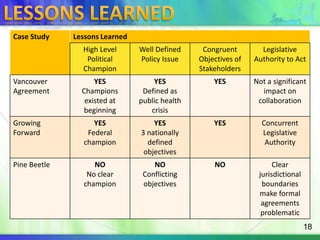
LESSONS LEARNED High level political champions are an asset to collaboration.A well defined policy issue implies better collaborationWhen objectives align, public sector collaboration is likely to be successfulCapacity and the legislative authority to act, are necessary conditions for collaboration
Rationale“Great discoveries and improvements invariably involve the cooperation of many minds.”- Alexander Graham BellWhy collaborate?Response to complex public policy challenges Improved service delivery through coordinationSignificant variation in the nature and extent of  collaborative arrangementsThe challenge of collaboration
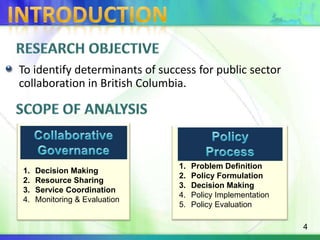
IntroductionRESEArch ObjectiveTo identify determinants of success for public sector collaboration in British Columbia.Collaborative GovernanceScope of analysisDecision MakingResource SharingService CoordinationMonitoring & EvaluationPolicy ProcessProblem DefinitionPolicy FormulationDecision MakingPolicy ImplementationPolicy Evaluation
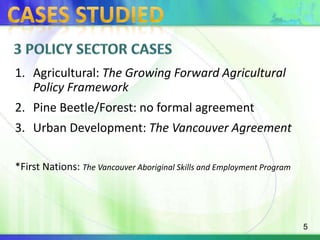
CASES STUDIED3 Policy Sector CasesAgricultural: The Growing Forward Agricultural Policy FrameworkPine Beetle/Forest: no formal agreementUrban Development: The Vancouver Agreement *First Nations: The Vancouver Aboriginal Skills and Employment Program
Analytical FrameworkFeatures of collaborative governanceDecision MakingHorizontal or vertical?Resource SharingExisting funding or common pool?Equal contributions or Capacity-based?Service CoordinationEliminate gaps or reduce overlaps?
Policy Sector FeaturesPolicy Issue definitionImpacts, Causes and TimeframeStakeholder characteristicsGovernments involvedGeneral CharacteristicsDiversity of stakeholders objectivesStakeholder capacityNon-governmental stakeholdersLegislative authority
Case #1: Growing ForwardVisionA profitable and innovative agriculture industry with agri-food and agri-based products that seize opportunities in response to market demands and contributes to the health and well-being of CanadiansOutcomesA Competitive and Innovative Sector,A Sector that Contributes to Society's Priorities, andA Sector that is Proactive in Managing Risk.Features of Collaborative GovernanceDecision MakingResource SharingService Coordination
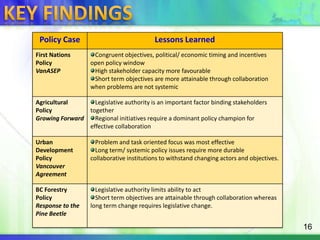
Case #1: GROWING FORWARDPolicy Issue CharacteristicsRegional vastnessSector diversityThis problem is concentrated on price stability, efficiency, and trade barriers. Stakeholder CharacteristicsFederal ChampionLegislative AuthorityConcurrent authority between Federal and Provincial GovernmentsLessons LearnedLegislative authority important  collaborative factor to bind stakeholders togetherCross-Region initiatives  need  a champion for  effective collaboration
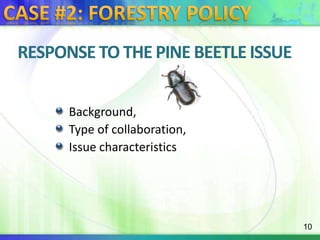
Case #2: Forestry PolicyResponse to the pine beetle issueBackground, Type of collaboration, Issue characteristics
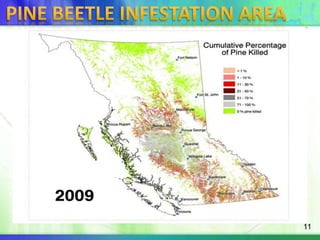
Pine beetle infestation area
Case #2: type of collaborationDecision making is vertical (mostly)Resources are not formally pooled.The response to the mountain pine beetle infestation is guided by the Mountain Pine Beetle Action Plan.
Case #2: Forestry PolicyResponse to the pine beetle issueConclusionLegislative authority  limits ability to act; therefore,  common for only marginal change to resultShort term objectives attainable through collaboration whereas long term change may require legislative change.
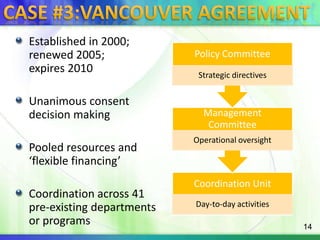
Case #3:Vancouver AgreementEstablished in 2000; renewed 2005;       expires 2010Unanimous consent decision makingPooled resources and ‘flexible financing’Coordination across 41 pre-existing departments or programs
Case #3: Vancouver agreementLessons learnedTask-based and problem-oriented teams work bestLong term/ systemic policy issues require more durable collaborative institutions to withstand changing actors and  objectives (e.g. VPD’s Project Lockstep)
Key findings
CASE STUDY CONCLUSIONS High level political champions are an asset to collaboration.A well defined policy issue implies better collaborationWhen objectives align, public sector collaboration is likely to be successfulCapacity and the legislative authority to act, are necessary conditions for collaboration
LESSONS LEARNED
“Public sector collaboration is like an orchestra with the user as the conductor, leading a set of service providers- who may play different instruments, form different musical parts, but which together form a harmonic whole.”Thank you.We invite your questions.

Public Sector Collaboration Presentation

  • 1.
    Public Sector Collaborationin British ColumbiaPrepared By: Julie ClementsShahdin FarsaiBob ParkerDavid Skerik
  • 2.
    LESSONS LEARNED Highlevel political champions are an asset to collaboration.A well defined policy issue implies better collaborationWhen objectives align, public sector collaboration is likely to be successfulCapacity and the legislative authority to act, are necessary conditions for collaboration
  • 3.
    Rationale“Great discoveries andimprovements invariably involve the cooperation of many minds.”- Alexander Graham BellWhy collaborate?Response to complex public policy challenges Improved service delivery through coordinationSignificant variation in the nature and extent of collaborative arrangementsThe challenge of collaboration
  • 4.
    IntroductionRESEArch ObjectiveTo identifydeterminants of success for public sector collaboration in British Columbia.Collaborative GovernanceScope of analysisDecision MakingResource SharingService CoordinationMonitoring & EvaluationPolicy ProcessProblem DefinitionPolicy FormulationDecision MakingPolicy ImplementationPolicy Evaluation
  • 5.
    CASES STUDIED3 PolicySector CasesAgricultural: The Growing Forward Agricultural Policy FrameworkPine Beetle/Forest: no formal agreementUrban Development: The Vancouver Agreement *First Nations: The Vancouver Aboriginal Skills and Employment Program
  • 6.
    Analytical FrameworkFeatures ofcollaborative governanceDecision MakingHorizontal or vertical?Resource SharingExisting funding or common pool?Equal contributions or Capacity-based?Service CoordinationEliminate gaps or reduce overlaps?
  • 7.
    Policy Sector FeaturesPolicyIssue definitionImpacts, Causes and TimeframeStakeholder characteristicsGovernments involvedGeneral CharacteristicsDiversity of stakeholders objectivesStakeholder capacityNon-governmental stakeholdersLegislative authority
  • 8.
    Case #1: GrowingForwardVisionA profitable and innovative agriculture industry with agri-food and agri-based products that seize opportunities in response to market demands and contributes to the health and well-being of CanadiansOutcomesA Competitive and Innovative Sector,A Sector that Contributes to Society's Priorities, andA Sector that is Proactive in Managing Risk.Features of Collaborative GovernanceDecision MakingResource SharingService Coordination
  • 9.
    Case #1: GROWINGFORWARDPolicy Issue CharacteristicsRegional vastnessSector diversityThis problem is concentrated on price stability, efficiency, and trade barriers. Stakeholder CharacteristicsFederal ChampionLegislative AuthorityConcurrent authority between Federal and Provincial GovernmentsLessons LearnedLegislative authority important collaborative factor to bind stakeholders togetherCross-Region initiatives need a champion for effective collaboration
  • 10.
    Case #2: ForestryPolicyResponse to the pine beetle issueBackground, Type of collaboration, Issue characteristics
  • 11.
  • 12.
    Case #2: typeof collaborationDecision making is vertical (mostly)Resources are not formally pooled.The response to the mountain pine beetle infestation is guided by the Mountain Pine Beetle Action Plan.
  • 13.
    Case #2: ForestryPolicyResponse to the pine beetle issueConclusionLegislative authority limits ability to act; therefore, common for only marginal change to resultShort term objectives attainable through collaboration whereas long term change may require legislative change.
  • 14.
    Case #3:Vancouver AgreementEstablishedin 2000; renewed 2005; expires 2010Unanimous consent decision makingPooled resources and ‘flexible financing’Coordination across 41 pre-existing departments or programs
  • 15.
    Case #3: VancouveragreementLessons learnedTask-based and problem-oriented teams work bestLong term/ systemic policy issues require more durable collaborative institutions to withstand changing actors and objectives (e.g. VPD’s Project Lockstep)
  • 16.
  • 17.
    CASE STUDY CONCLUSIONSHigh level political champions are an asset to collaboration.A well defined policy issue implies better collaborationWhen objectives align, public sector collaboration is likely to be successfulCapacity and the legislative authority to act, are necessary conditions for collaboration
  • 18.
  • 19.
    “Public sector collaborationis like an orchestra with the user as the conductor, leading a set of service providers- who may play different instruments, form different musical parts, but which together form a harmonic whole.”Thank you.We invite your questions.

Editor's Notes

  • #9 The Growing Forward Framework Agreement lays the groundwork for coordinated federal-provincialaction over five years (2008 to 2012) to help the sector become more prosperous, competitive, and innovative. The agreement builds on the vision of a A profitable and innovative agriculture industry with agri-food and agri-based products that seize opportunities in response to market demands and contributes to the health and well-being of CanadiansThe Growing Forward policy outlines details of national cost shared initiatives aimed to achieve the outcomes of: A Competitive and Innovative Sector,A Sector that Contributes to Society's Priorities, andA Sector that is Proactive in Managing Risk.The vast and diverse nature of the agricultural sector in Canada requires coordinated policy to effectively address the needs and regional priorities of agriculture stakeholders.I will discuss three elements of collaborative governance: i)Decision-making.The management strategy of the Growing Forward Policy is characterized as vertical decision making. The federal government, specifically the department of Agriculture and Agri-Food Canada, is the champion of the Growing Forward Policy.  ii) Resource Sharing. The Growing Forward Policy allocates money to projects pertaining to the objectives of the policy on a 60:40 cost sharing basis. Between 2008 and 2013, the Province of British Columbia has been allocated 47 million dollars for Growing Forward initiatives.  iii) Service Coordination.The Growing Forward Policy is aimed at creating national standards for the agricultural sector in Canada taking into account regional and sectoral differences. The policy reduced redundancy in the areas of the Business Risk Management Suite which protects agricultural producers via insurance.
  • #10 PULL IN MORE REFERENCES TO THE BC GOVERNMENTBreak down conclusions and reference independent variables. Here are my lessons learned.. This is how I got to here with the framework
  • #11 Background:The pine beetle problem has been re-occurring since the early 1970’s. The pine beetle does not respect political or administrative boundaries. The pine beetle infestation is occurring on federal lands (reserve lands, military lands, and the dominion coal blocks) provincial lands, and aboriginal title lands.Contributing factors: forest management and climate change.
  • #12 Bob will get carpet bomb map
  • #19 This matrix does not score the case studies against each other but gives perspective on how they inform the conclusions.