Agenda
Overview of KeyTopics
1. Legislative and Institutional Framework
2. Disaster Management and Risk
Reduction Laws
3. Environmental Protection Laws
4. Management of Toxic Substances
5. Conclusion
3.
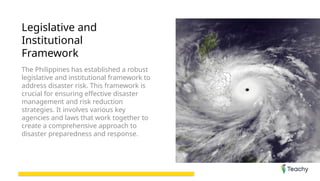
Legislative and
Institutional
Framework
The Philippineshas established a robust
legislative and institutional framework to
address disaster risk. This framework is
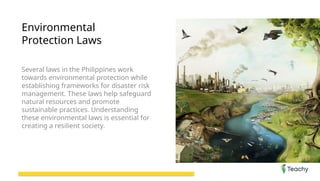
crucial for ensuring effective disaster
management and risk reduction
strategies. It involves various key
agencies and laws that work together to
create a comprehensive approach to
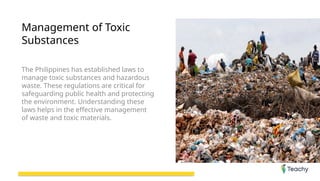
disaster preparedness and response.
4.
NDRRMC (National DisasterRisk Reduction and
Management Council)
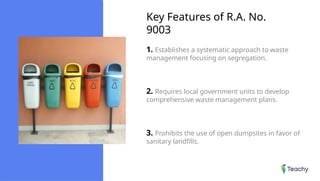
The NDRRMC serves as the primary agency in coordinating
disaster response across multiple sectors in the Philippines. It
ensures collaboration among national and local government
units, as well as non-governmental organizations and the
private sector. This coordination is vital for efficient resource
allocation and effective disaster management.
5.
Thematic Areas of
NDRRMC
1.Prevention and Mitigation: Programs reduce
disaster risks to safeguard communities.
2. Preparedness: Planning and training are
essential to effectively handle disasters.
3. Response: Immediate actions ensure safety
and support during and after disasters.
6.
Republic Act 10121
RepublicAct 10121 lays the foundation for a national
framework aimed at reducing disaster risk. It mandates the
establishment of local Disaster Risk Reduction and
Management (DRRM) councils in every locality. This act
integrates disaster risk management into local governance
and planning processes.
7.
Mandatory Budget Allocationfor DRRM
The law requires local governments to allocate at least 5% of
their revenue for Disaster Risk Reduction and Management
activities. This budgeting is essential for funding disaster
preparedness, response, and recovery programs. By
integrating these allocations into local development planning,
communities can enhance their resilience to disasters.
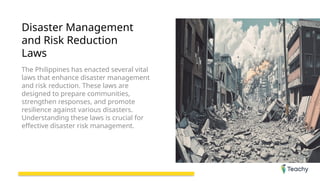
8.
Disaster Management
and RiskReduction
Laws
The Philippines has enacted several vital
laws that enhance disaster management
and risk reduction. These laws are
designed to prepare communities,
strengthen responses, and promote
resilience against various disasters.
Understanding these laws is crucial for
effective disaster risk management.
9.
Philippine Disaster RiskReduction Management
Act of 2010 (R.A. No. 10121)
This act aims to strengthen the country's disaster risk
reduction and management framework. It establishes
guidelines for disaster preparedness, response, recovery, and
rehabilitation. By promoting a systematic approach to
disaster management, the act enhances community
resilience.
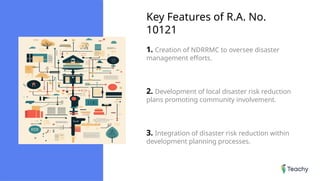
10.
Key Features ofR.A. No.
10121
1. Creation of NDRRMC to oversee disaster
management efforts.
2. Development of local disaster risk reduction
plans promoting community involvement.
3. Integration of disaster risk reduction within
development planning processes.
11.
Risk Reduction andPreparedness Equipment
Protection Act (R.A. 10344)
This act focuses on the protection and proper maintenance of
equipment used for disaster risk reduction and preparedness.
It ensures that equipment is ready for use during
emergencies, which is crucial for effective disaster response.
The act also encourages collaboration between government
agencies and local communities.
12.
Key Features ofR.A.
10344
1. Ensures that disaster response equipment is
protected and maintained.
2. Provides guidelines for the procurement and
management of equipment.
3. Encourages collaboration between government
agencies and local communities.
13.
Children's Emergency Reliefand Protection Act
(R.A. 10821)
This law is dedicated to ensuring the protection and welfare
of children during emergencies and disasters. It establishes
guidelines for delivering emergency relief to children affected
by disasters. Additionally, it emphasizes creating child-friendly
spaces in evacuation centers.
14.
Key Features ofR.A.
10821
1. Establishes guidelines for providing emergency
relief specifically for children.
2. Mandates the creation of child-friendly spaces
in evacuation centers.
3. Encourages children’s involvement in disaster
risk reduction activities.
15.
Environmental
Protection Laws
Several lawsin the Philippines work
towards environmental protection while
establishing frameworks for disaster risk
management. These laws help safeguard
natural resources and promote
sustainable practices. Understanding
these environmental laws is essential for
creating a resilient society.
16.
Philippine Clean AirAct (R.A. 8749)
The Philippine Clean Air Act aims to achieve and maintain
healthy air quality across the country. It establishes air quality
standards and promotes sustainable practices to reduce air
pollution. Local government units are mandated to prepare
air quality management plans.
17.
Key Features ofR.A. 8749
1. Establishes air quality standards and guidelines
for pollution control.
2. Promotes the use of clean technology and
sustainable practices.
3. Mandates local government units prepare air
quality management plans.
18.
Tobacco Regulation Actof 2003 (R.A. No. 9211)
This law regulates the sale, use, and advertisement of tobacco
products to protect public health. It prohibits smoking in
public places and establishes designated smoking areas.
Moreover, it mandates health warning labels on tobacco
products and promotes public awareness campaigns about
the dangers of tobacco use.
19.
Key Features ofR.A. No.
9211
1. Prohibits smoking in public places and
establishes designated smoking areas.
2. Mandates warning labels on tobacco products
for consumer awareness.
3. Promotes public awareness campaigns
regarding the dangers of tobacco use.
20.
Management of Toxic
Substances
ThePhilippines has established laws to
manage toxic substances and hazardous
waste. These regulations are critical for
safeguarding public health and protecting
the environment. Understanding these
laws helps in the effective management
of waste and toxic materials.
21.
Toxic Substances andHazardous Waste Control
Act of 1990 (R.A. No. 6969)
This act regulates the importation, manufacture, and disposal
of toxic substances and hazardous waste. It aims to protect
human health and the environment by establishing safety
standards and requiring proper labeling of hazardous
materials. The law mandates monitoring and enforcement to
prevent environmental contamination.
22.
Key Features ofR.A. No.
6969
1. Establishes a comprehensive system for the
management of hazardous waste.
2. Requires registration of toxic substances and
adherence to safety standards.
3. Mandates proper labeling, storage, and
disposal of hazardous materials.
23.
Ecological Solid WasteManagement Act of 2000
(R.A. No. 9003)
This act promotes sustainable management of solid waste
throughout the Philippines. It emphasizes waste segregation,
recycling, and composting as key strategies. Local
government units are required to develop effective solid
waste management plans and programs.
24.
Key Features ofR.A. No.
9003
1. Establishes a systematic approach to waste
management focusing on segregation.
2. Requires local government units to develop
comprehensive waste management plans.
3. Prohibits the use of open dumpsites in favor of
sanitary landfills.
25.
Wildlife Resources Conservationand Protection
Act (R.A. No. 9147)
This act aims to conserve and protect wildlife resources and
their habitats in the Philippines. It prohibits hunting,
collecting, and trading endangered species without
appropriate permits. The law also establishes protected areas
to preserve biodiversity and promote public awareness about
wildlife conservation.
26.
Key Features ofR.A. No.
9147
1. Prohibits hunting, collection, and trade of
endangered species without permits.
2. Establishes protected areas for the
conservation of biodiversity.
3. Promotes public awareness and education on
wildlife conservation.
27.
National Integrated ProtectedAreas System
(NIPAS) Act (R.A. No. 7586)
The NIPAS Act provides a framework for the establishment
and management of protected areas in the Philippines. It
focuses on conserving biodiversity and natural resources vital
for ecological balance. The law also emphasizes local
community involvement in conservation efforts and the
creation of management plans for each protected area.
28.
Conclusion
Summary of
Legislative
Frameworks
1. Thecomprehensive disaster
mitigation framework in the Philippines
is crucial for effective risk management.
2. Legislative bodies and laws play a
significant role in enhancing
preparedness and resilience.
3. Understanding these frameworks
ensures better community involvement
and environmental stewardship.



![ONFH[AVN HIP] -TRIPLE REGIME -A NOVAL SURGICAL CONCEPT .pptx](https://cdn.slidesharecdn.com/ss_thumbnails/onfhavnhip2026koaconcalicutdrgokuldevdrmashraf-260210064517-213ec005-thumbnail.jpg?width=640&height=640&fit=bounds)


![CTEV [ clubfoot] DR ARUN LAL ,DR MOHAMED ASHRAF travancore medical college k...](https://cdn.slidesharecdn.com/ss_thumbnails/ctevclubfootdrarunlaldrmohamedashraftravancoremedicalcollegekollamkeralaindia-260208063247-18fc466c-thumbnail.jpg?width=640&height=640&fit=bounds)


