66
February 2016
www.InfralinePlus.com
almost 65 percent of freight and
90 per cent of passenger traffic.
The value of roadways and bridge
infrastructure in India is expected
to grow at a compound annual
growth rate of 17.4% between
2012-17, to reach USD 10 Billion.
In the current transport infra-
structure, private sector is playing
a key role as its participation in the
infrastructure projects has increased
from 22% (INR 2 trillion) in 10th Five
year plan to 37% (INR 8.9 trillion) in
the 11th Five year plan. It is expected
to rise further to around 48% (INR 26.8
trillion) in the Twelfth Five year plan.
Sector witnessed a decline in private
participation due to flimsy financial
funding, rigidities in contractual
arrangements, land acquisition, delay
in dispute resolution and various
departmental clearances issues which
impacted overall project awards. Post
decline there was a shift from PPP
mode to EPC mode for awarding new
projects. In order to incentivize private
sector participation, government has
launched major initiatives along with
Public private partnership (PPP) is
considered as an important policy
instrument for central and state
government in the implementation
of commercially viable projects. In
the ideal scenario PPP should be
an equitable partnership between
all stakeholders. It is important to
revive the PPP in India as only two
three decades are left to transform
the Indian economy from middle
income to the high income economy.
It’s the crucial time to get the PPP
set up in the right mode as country’s
demographic deadlines are staring
at us and under constant transition.
Administration in power should be
more accountable so that PPP mode
can achieve next level of maturity
and sophistication.
Overview of the PPPs in
Road sector
Road Transport is a critical infrastruc-
ture for economic development of
a country. It Influences the pace,
structure and pattern
of development.
India heavily
relies on its
robust road
network,
which is
expected to
grow from
97,135 kms
in 2014-15 to
100,000 kms by the
end of 2017. At present, India has the
world’s second largest road network
after the United States that carries
Success of PPP depends on change
in attitude of public agencies
Deepti Mahajan, Consultant - Roads
Infrastructure, Infraline Energy
The Vijay Kelkar Committee recently came out with its set of
recommendations on reviving the PPP mode of project execution in
India. If implemented, it would result in a major overhaul of the existing
framework, designed primarily to incentivise private investment in
infrastructure. In this context, Deepti Mahajan, Consultant - Roads
Infrastructure, Infraline Energy, provides an overview of PPP in the roads
sector and steps needed to restore momentum in PPP implementation.
Admin-
istration in
power should be
more accountable
so that PPP mode
can achieve
next level of
maturity
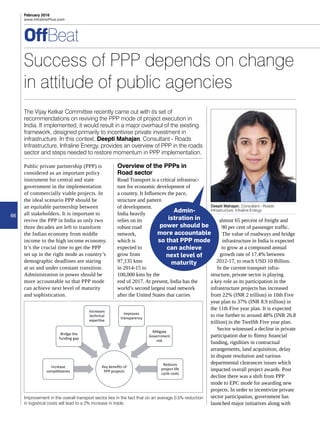
Key benefits of
PPP projects
Increase
comptitivenes
Bridge the
funding gap
Increases
technical
expertise
Improves
transparency
Mitigate
Government
risk
Reduces
project life
cycle costs
Improvement in the overall transport sector lies in the fact that on an average 0.5% reduction
in logistical costs will lead to a 2% increase in trade.
OffBeat
67
February 2016
www.InfralinePlus.com
the amendments in old policies to
upgrade and strengthen the road sector.
The current government aims that the
investment in this sector should be
cost-effective, responsive, safe and
environmentally sustainable.
Restoring the momentum in
PPP implementation:
PPP has to evolve from merely
an asset creation to operation of
infrastructure projects. A 10 member
committee was formed to analyze,
revisit and revitalize the PPP Model
of Infrastructure Development. The
committee was chaired by Dr. Vijay
Kelkar, Chairman, National Institute
of Public Finance & Policy. India is
one the largest PPP markets with an
experience of over 15 years at various
stages of project development. This
report aims to focus on the specific
improvement and amendment of
PPP has to evolve from merely an asset creation
to operation of infrastructure projects. A 10
member committee was formed to analyze,
revisit and revitalize the PPP Model of
Infrastructure Development. The committee was
chaired by Dr. Vijay Kelkar, Chairman, National
Institute of Public Finance & Policy.
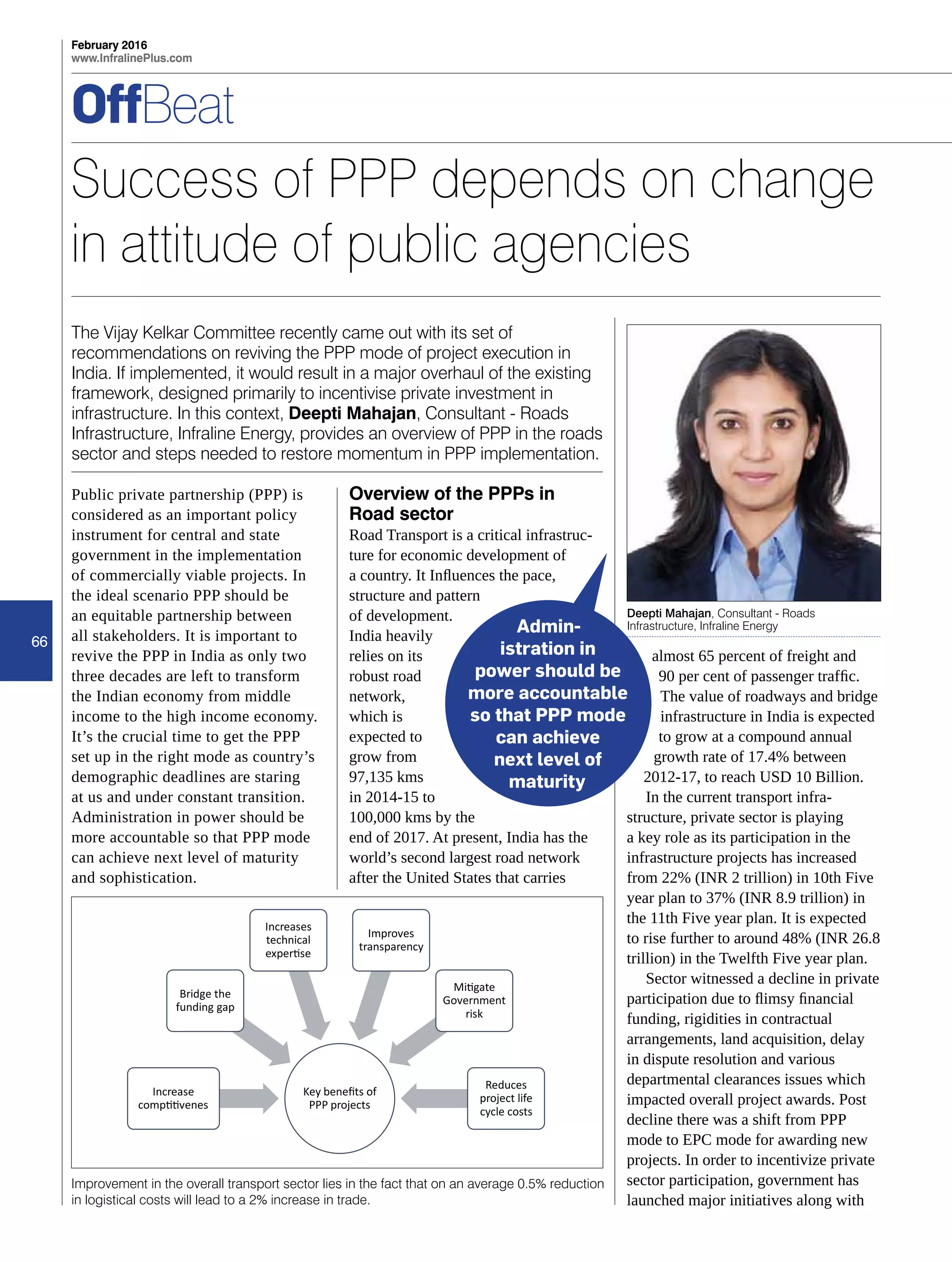
14
11
9
0 2 4 6 8 10 12 14 16
INDIA
JAPAN
US
Cost of logistics operations to the economy as % GDP
Source: Systematix group equity research, Sep 2012
Amendments in Model Concession Agreement :
End of premium payment
Deemed termination of projects
Refinancing schemes
Financing Path:
Introduction of:
Hybrid Annuity Model
Toll Operate Transfer Model
Inflation-linked toll rate hikes
Vendor Ranking and Corporatization
Allowing developers to divest 100% equity in road projects
irrespective of the year of project award
One time fund infusion in languishing projects subject to
approval by Ministry
NHAI to pay compensation to road developers, in case of
delays not attributable to them
Segregation of construction cost from land acquisition cost
Recent major initiatives:
policies, institutional structure
and financial framework which
will accelerate growth of the roads
network in the near future. Early
improvement in the pace of PPP
project implementation will certainly
provide a conductive environment to
boost India on a stronger footing.
68
February 2016
www.InfralinePlus.com
OffBeat
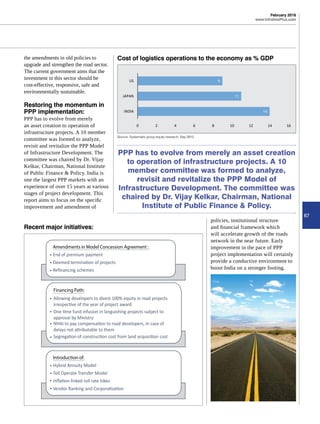
Snapshot of recommendations of Vijay Kelkar Committee:
•	 Contractual Amendments
i.	 PPP contracts needs to be more target oriented and focus should be on
service delivery instead of fiscal benefit. Appropriate disclosure of long
term cost, risk and profits is desired.
ii.	 Changes in MCA (Model Concession Agreement)-Request for proposal
may not be issued until 80% of land is acquired. Prequalification process
should be streamline in order to shortlist the appropriate contenders.
iii.	Ultimate aim is to achieve COD on time and no penalties should be
imposed even if any milestones is missed.
•	 Dispute Resolution Mechanism
i.	 Change of scope, delay in land acquisition, delay in achieving COD, termi-
nation, cost over-run, delay in payment and claims etc. should be disposed
in a time bound manner through an independent body. Introduction of
National PPP policy- External and independent agency to provide guidance
for finalization of national PPP policy document to improve capacity building,
governance capabilities and professional support at a programmatic level.
ii.	 Introduction of National facilitation committee-In order to resolve inter-min-
isterial issues involving state and center government an institutionalized
mechanism should be formed.
iii.	In order to facilitate expansion of PPP into other sectors including health,
urban transport and other social sectors legal framework in terms of PPP
law should be introduced.
•	 Institutional Framework
i.	 Establishment of IPRC (Infrastructure Project Review Committee) - The
detailed evaluation of the underlying technical and financial issues should
be considered by the IPRC.
ii.	 Establishment of IPAT (Infrastructure PPP Adjudication Tribunal-In case a
substantial question of law is involved, the matter should be directly heard
by the Tribunal.
•	 Financial framework
i.	 It is high time to strengthen the process of lending by institutions by
refining project appraisal skills in them. Lending institutions should build
up their own risk assessment and appraisal capabilities.
ii.	 Restrict banks to form consortium with large no.
iii.	Adoption of new funding mode e.g. Hybrid Annuity Model, VGF grant,
debt instruments may be explored. For suggestions email at feedback@infraline.com
The success of PPP mode in India
will largely depend on the change in
attitude and mindset of all the author-
ities including public agencies part-
nering the private sector, government
departments supervising the PPPs,
and auditing and legislative institu-
tions providing oversight of the PPPs.
The fundamental of PPP is moving
away from transaction to relationship
accommodating and promoting give
and take association.
Importance should be given to
timely valuation of “Actionable
Stress” which might pose an imminent
threat to the economic foundation of
PPP. The report urges to keep intact
the charisma of PPP mode by fostering
trust between the private sector and
public sector partners in infrastructure
development.
Vijay Kelkar,

Public Private Partnership

  • 1.
    66 February 2016 www.InfralinePlus.com almost 65percent of freight and 90 per cent of passenger traffic. The value of roadways and bridge infrastructure in India is expected to grow at a compound annual growth rate of 17.4% between 2012-17, to reach USD 10 Billion. In the current transport infra- structure, private sector is playing a key role as its participation in the infrastructure projects has increased from 22% (INR 2 trillion) in 10th Five year plan to 37% (INR 8.9 trillion) in the 11th Five year plan. It is expected to rise further to around 48% (INR 26.8 trillion) in the Twelfth Five year plan. Sector witnessed a decline in private participation due to flimsy financial funding, rigidities in contractual arrangements, land acquisition, delay in dispute resolution and various departmental clearances issues which impacted overall project awards. Post decline there was a shift from PPP mode to EPC mode for awarding new projects. In order to incentivize private sector participation, government has launched major initiatives along with Public private partnership (PPP) is considered as an important policy instrument for central and state government in the implementation of commercially viable projects. In the ideal scenario PPP should be an equitable partnership between all stakeholders. It is important to revive the PPP in India as only two three decades are left to transform the Indian economy from middle income to the high income economy. It’s the crucial time to get the PPP set up in the right mode as country’s demographic deadlines are staring at us and under constant transition. Administration in power should be more accountable so that PPP mode can achieve next level of maturity and sophistication. Overview of the PPPs in Road sector Road Transport is a critical infrastruc- ture for economic development of a country. It Influences the pace, structure and pattern of development. India heavily relies on its robust road network, which is expected to grow from 97,135 kms in 2014-15 to 100,000 kms by the end of 2017. At present, India has the world’s second largest road network after the United States that carries Success of PPP depends on change in attitude of public agencies Deepti Mahajan, Consultant - Roads Infrastructure, Infraline Energy The Vijay Kelkar Committee recently came out with its set of recommendations on reviving the PPP mode of project execution in India. If implemented, it would result in a major overhaul of the existing framework, designed primarily to incentivise private investment in infrastructure. In this context, Deepti Mahajan, Consultant - Roads Infrastructure, Infraline Energy, provides an overview of PPP in the roads sector and steps needed to restore momentum in PPP implementation. Admin- istration in power should be more accountable so that PPP mode can achieve next level of maturity Key benefits of PPP projects Increase comptitivenes Bridge the funding gap Increases technical expertise Improves transparency Mitigate Government risk Reduces project life cycle costs Improvement in the overall transport sector lies in the fact that on an average 0.5% reduction in logistical costs will lead to a 2% increase in trade. OffBeat
  • 2.
    67 February 2016 www.InfralinePlus.com the amendmentsin old policies to upgrade and strengthen the road sector. The current government aims that the investment in this sector should be cost-effective, responsive, safe and environmentally sustainable. Restoring the momentum in PPP implementation: PPP has to evolve from merely an asset creation to operation of infrastructure projects. A 10 member committee was formed to analyze, revisit and revitalize the PPP Model of Infrastructure Development. The committee was chaired by Dr. Vijay Kelkar, Chairman, National Institute of Public Finance & Policy. India is one the largest PPP markets with an experience of over 15 years at various stages of project development. This report aims to focus on the specific improvement and amendment of PPP has to evolve from merely an asset creation to operation of infrastructure projects. A 10 member committee was formed to analyze, revisit and revitalize the PPP Model of Infrastructure Development. The committee was chaired by Dr. Vijay Kelkar, Chairman, National Institute of Public Finance & Policy. 14 11 9 0 2 4 6 8 10 12 14 16 INDIA JAPAN US Cost of logistics operations to the economy as % GDP Source: Systematix group equity research, Sep 2012 Amendments in Model Concession Agreement : End of premium payment Deemed termination of projects Refinancing schemes Financing Path: Introduction of: Hybrid Annuity Model Toll Operate Transfer Model Inflation-linked toll rate hikes Vendor Ranking and Corporatization Allowing developers to divest 100% equity in road projects irrespective of the year of project award One time fund infusion in languishing projects subject to approval by Ministry NHAI to pay compensation to road developers, in case of delays not attributable to them Segregation of construction cost from land acquisition cost Recent major initiatives: policies, institutional structure and financial framework which will accelerate growth of the roads network in the near future. Early improvement in the pace of PPP project implementation will certainly provide a conductive environment to boost India on a stronger footing.
  • 3.
    68 February 2016 www.InfralinePlus.com OffBeat Snapshot ofrecommendations of Vijay Kelkar Committee: • Contractual Amendments i. PPP contracts needs to be more target oriented and focus should be on service delivery instead of fiscal benefit. Appropriate disclosure of long term cost, risk and profits is desired. ii. Changes in MCA (Model Concession Agreement)-Request for proposal may not be issued until 80% of land is acquired. Prequalification process should be streamline in order to shortlist the appropriate contenders. iii. Ultimate aim is to achieve COD on time and no penalties should be imposed even if any milestones is missed. • Dispute Resolution Mechanism i. Change of scope, delay in land acquisition, delay in achieving COD, termi- nation, cost over-run, delay in payment and claims etc. should be disposed in a time bound manner through an independent body. Introduction of National PPP policy- External and independent agency to provide guidance for finalization of national PPP policy document to improve capacity building, governance capabilities and professional support at a programmatic level. ii. Introduction of National facilitation committee-In order to resolve inter-min- isterial issues involving state and center government an institutionalized mechanism should be formed. iii. In order to facilitate expansion of PPP into other sectors including health, urban transport and other social sectors legal framework in terms of PPP law should be introduced. • Institutional Framework i. Establishment of IPRC (Infrastructure Project Review Committee) - The detailed evaluation of the underlying technical and financial issues should be considered by the IPRC. ii. Establishment of IPAT (Infrastructure PPP Adjudication Tribunal-In case a substantial question of law is involved, the matter should be directly heard by the Tribunal. • Financial framework i. It is high time to strengthen the process of lending by institutions by refining project appraisal skills in them. Lending institutions should build up their own risk assessment and appraisal capabilities. ii. Restrict banks to form consortium with large no. iii. Adoption of new funding mode e.g. Hybrid Annuity Model, VGF grant, debt instruments may be explored. For suggestions email at feedback@infraline.com The success of PPP mode in India will largely depend on the change in attitude and mindset of all the author- ities including public agencies part- nering the private sector, government departments supervising the PPPs, and auditing and legislative institu- tions providing oversight of the PPPs. The fundamental of PPP is moving away from transaction to relationship accommodating and promoting give and take association. Importance should be given to timely valuation of “Actionable Stress” which might pose an imminent threat to the economic foundation of PPP. The report urges to keep intact the charisma of PPP mode by fostering trust between the private sector and public sector partners in infrastructure development. Vijay Kelkar,