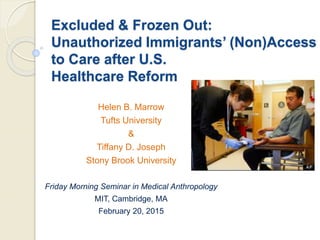
Excluded & Frozen Out:
Unauthorized Immigrants’ (Non)Access
to Care after U.S.
Healthcare Reform
Helen B. Marrow
Tufts University
&
Tiffany D. Joseph
Stony Brook University
Friday Morning Seminar in Medical Anthropology
MIT, Cambridge, MA
February 20, 2015
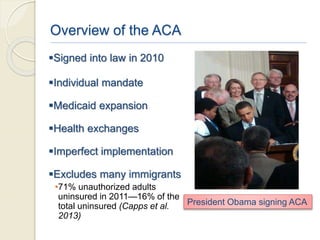
Overview of the ACA
Signed into law in 2010
Individual mandate
Medicaid expansion
Health exchanges
Imperfect implementation
Excludes many immigrants
•71% unauthorized adults
uninsured in 2011—16% of the
total uninsured (Capps et al.
2013)
President Obama signing ACA
The ACA & Boundary Brightening
Boundaries in sociology (Lamont and Molnar 2002; Alba
2005; Wimmer 2008, 2013)
•Us versus Them
•Symbolic versus Social boundaries
•Bright versus Blurred boundaries
Boundary-making & change
•Brightening: Boundary becomes more salient & visible
•Expansion/shift: New people are included in a group from
which they were previously excluded
ACA “brightening” the boundary btw unauthorized
immigrants & the “deserving” American body politic
In his presidential address
before the joint session of
Congress on September 10,
2009, President Obama
presented key aspects of the
ACA. When he explicitly
stated that unauthorized
immigrants would be
excluded from the policy,
South Carolina
Congressman Joe Wilson
famously interrupted him,
retorting, “You lie!”
*****
The outburst symbolized
Wilson’s and the American
public’s dominant
construction of unauthorized
immigrants as illegal,
immoral, and undeserving
outsiders to the American
body politic.
Boundary Blurring and Brightening
in 2010
Healthcare options:
Private insurance via private
employment (very $)
Pay out-of-pocket (very $)
Forego care
Self-medicate
Informal providers &
alternative medicines (incl.
abroad)
Rely on the “categorically
unequal” safety net (Light
2012)
FQHCs (+ $ under
ACA)
EDs (- $ DSH funding
under ACA)
Boundary Blurring and Brightening
Alternate Possibilities?
New trends in immigration & integration policy
•Devolution of responsibility to subnational & nongovernmental
actors + “grassroots” interest rising from below (states &
localities)
•Comparative institutional context of integration model (Crul
and Schneider 2010)
Recategorization” into local sense of “we” (Matthew 2012)
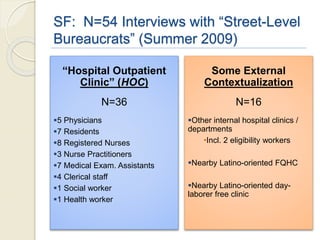
SF: N=54 Interviews with “Street-Level
Bureaucrats” (Summer 2009)
“Hospital Outpatient
Clinic” (HOC)
N=36
5 Physicians
7 Residents
8 Registered Nurses
3 Nurse Practitioners
7 Medical Exam. Assistants
4 Clerical staff
1 Social worker
1 Health worker
Some External
Contextualization
N=16
Other internal hospital clinics /
departments
•Incl. 2 eligibility workers
Nearby Latino-oriented FQHC
Nearby Latino-oriented day-
laborer free clinic
MA: N=70 Interviews with Patients,
Providers, & Leaders (2012-2013)
Latin American
Immigrants (N=31)
Brazilians ( N=21)
Dominicans (N =10)
-Health Coverage
-Healthcare Access
-System Experiences
-Migration Experiences
-Transnational Health
Immigrant Org.
Leaders (N=19)
Brazilians (N=6)
Dominicans (N=2)
Miscellaneous (N=11)
-Immigrant Health issues
- Migration Experiences
- Immigration Policy
- Local Context: Boston
Healthcare Staff
(N=20)
- Immigrant Patients
- Institutional Barriers
-System Navigation
- Immigrant Health
Issues
Robust & highly-integrated public/nonprofit safety net
•SF identity: leading edge of progressive social change
•Public providers: local DPH salaries
Protective environment for
~40,000 undocumented
•Active sanctuary policy in
Administrative Code since 1989
•Municipal ID ordinance since 2009
Ostensible universal healthcare “access”
•San Francisco Healthy Kids (SFHK) initiative since 2002
•Healthy San Francisco (HSF) ordinance since April 2007
Offers most preventive/primary care services (some specialty)
In HSF-participating institutions (mostly in safety net)
About making access to safety net more integrated, efficient, &
oriented toward primary care (not about cost-savings)
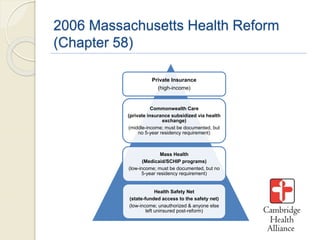
Health Safety Net
(state-funded access to the safety net)
(low-income; unauthorized & anyone else
left uninsured post-reform)
Mass Health
(Medicaid/SCHIP programs)
(low-income; must be documented, but no
5-year residency requirement)
Commonwealth Care
(private insurance subsidized via health
exchange)
(middle-income; must be documented, but
no 5-year residency requirement)
2006 Massachusetts Health Reform
(Chapter 58)
Private Insurance
(high-income)
Recategorization:
Greater Symbolic & Social Inclusion
Allows providers to not think about legal status, & to
marshal resources more effectively
Mary (SFGH physician , San Francisco): “We often don’t know [legal status]
because we are very lucky here in having no [constraints placed on us] for
anything we can provide on site [at this hospital] to anyone who lacks health
insurance. And then the city has a contract that they can pay for certain things [at
another nearby hospital] that we can’t offer here.”
Facilitates buffering & advocacy
Lynne (SFGH NP, San Francisco): “I really do encourage people. ‘It’s okay.
You’re not going to get arrested. You’re not going to get deported just because
you’re seeking health care. You can use your real name.’ Or, ‘If you’re really
scared, go to the refugee clinic.’ Or I’ll try to send them to the social worker to get
some referrals to a Spanish-speaking advocacy agency where they can get
reassurance if that’s what they need.”
Formal Barriers to “Uncovered”
Specialty & Ancillary Services
Blocked access by legal status quickly emerges
Mary (SFGH physician, San Francisco): “[My patient] is someone who by like
every criterion would get a liver transplant. She’s socially stable, she’s married,
she’s adherent to absolutely everything that you ask her to do, there’s like
nothing wrong. And I asked the liver specialist here to see her [but] as soon as
they found out she didn’t have papers it was like very clear. So she’s alive and
she’s doing okay but she is not eligible for a [liver] transplant, like it literally can’t
be done. That’s just a devastating conversation to have [with a patient].”
“And so when I sent a patient to the social workers, I asked them, “Is there any
miracle we can pull off here [hooking him up to unemployment or disability
benefits]?” And they basically said “No.” And at this point, you know, the city’s
about to pay $100,000 to get an ICD [implantable cardioverter-defibrillator]
implanted in him [for cardiac arrythmia]. So it’s hard. We work to send him to the
food bank and stuff, but he’s basically losing his housing and it’s just a mess. He
wound up having to send his children, who are American-born and are U.S.
citizens, and his wife back to his home country, because he can’t afford to keep
them fed or anything. He’s someone who, because he can get this procedure,
should be able to recover, be a productive member of our society, and be able to
raise two kids who will be, too. But there’s nothing we can do right now. And so I
would say that our hands get tied for those kinds of things.”
Informal and/or Bureaucratic Barriers
Internal paperwork requirements a deterrent to care
Catarina (SFGH RN, San Francisco): “Even if HSF and [this hospital] may not
do anything with that information, if you’re undocumented and you know that
there's a possibility you could get deported, there is wariness to submit all this
documentation or have to come up with it. So, it may not be meant as a barrier
but it definitely is serving as one.”
Leticia (Brazilian Immigrant Center, Boston): “Going to the doctor means
giving your name, your address, you know, disclosing that you're in this country
and that is the first big barrier for most people to get treated. And they only go
when they have to. So it's real hard to follow up on some, you know, preventive
care... And when they hear that word “social security”, all bets are off. People will
freak out. Many places, you have to provide a valid ID to get any kind of care too.
If you don't have that valid ID and you are not dying, they won't even see you.
External enforcement/policing a deterrent to care
Marcus (Community Worker, Boston): One of the anecdotal stories is a guy,
and I think he was coming here, they [healthcare providers] called him up and
they said your blood work is really bad. You have to come in right away. He
drives 45 minutes, pulls on to Somerville Avenue which was being totally torn up
and repaired, filled with Somerville cops, hanging around having coffee on their
detail. They [police] could care less who’s driving by, but he sees all those police,
he turns around and goes home which is the rational thing to do but it just
mitigates against doing anything.
Whither the Great “Unfreeze”?
Recategorization” into local sense of “we” (Matthew 2012)
•But still as “least” deserving
•Formal & informal/bureaucratic barriers remain
•Ultimately “place-bound & limited” (de Graauw 2012)
•Exclusion by policy design, not just implementation/resistance
Those remaining more visible & vulnerable?
Boston Health Alliance Physician: “I suspect that a whole bunch of [the
unauthorized] have left [the national system]. And the major leaving in our
[MA] situation was the [2006] health care reform because what happened
was that the Free Care pool […] the state funds to pay for people who didn’t
have insurance […before 2006] healthcare reform, that included everyone –
small business owners, whole mass of students, or people just out of
college who didn’t have jobs, as well as [the] undocumented. So everyone
was bunched. The undocumented group was bunched together with other
people. With [2006 MA] health care reform and [2010 ACA] Obamacare,
now naturally what it’s going to do is it pulls those people out so it makes the
Free Care pool [the remaining funding to the uninsured] much smaller and
more likely [to be] the undocumented, and it’s much easier to cut them off.”

Helen marrow 02.20.15 presentation

  • 1.
    Excluded & FrozenOut: Unauthorized Immigrants’ (Non)Access to Care after U.S. Healthcare Reform Helen B. Marrow Tufts University & Tiffany D. Joseph Stony Brook University Friday Morning Seminar in Medical Anthropology MIT, Cambridge, MA February 20, 2015
  • 2.
    Overview of theACA Signed into law in 2010 Individual mandate Medicaid expansion Health exchanges Imperfect implementation Excludes many immigrants •71% unauthorized adults uninsured in 2011—16% of the total uninsured (Capps et al. 2013) President Obama signing ACA
  • 3.
    The ACA &Boundary Brightening Boundaries in sociology (Lamont and Molnar 2002; Alba 2005; Wimmer 2008, 2013) •Us versus Them •Symbolic versus Social boundaries •Bright versus Blurred boundaries Boundary-making & change •Brightening: Boundary becomes more salient & visible •Expansion/shift: New people are included in a group from which they were previously excluded ACA “brightening” the boundary btw unauthorized immigrants & the “deserving” American body politic
  • 4.
    In his presidentialaddress before the joint session of Congress on September 10, 2009, President Obama presented key aspects of the ACA. When he explicitly stated that unauthorized immigrants would be excluded from the policy, South Carolina Congressman Joe Wilson famously interrupted him, retorting, “You lie!” ***** The outburst symbolized Wilson’s and the American public’s dominant construction of unauthorized immigrants as illegal, immoral, and undeserving outsiders to the American body politic.
  • 5.
  • 6.
    in 2010 Healthcare options: Privateinsurance via private employment (very $) Pay out-of-pocket (very $) Forego care Self-medicate Informal providers & alternative medicines (incl. abroad) Rely on the “categorically unequal” safety net (Light 2012) FQHCs (+ $ under ACA) EDs (- $ DSH funding under ACA) Boundary Blurring and Brightening
  • 7.
    Alternate Possibilities? New trendsin immigration & integration policy •Devolution of responsibility to subnational & nongovernmental actors + “grassroots” interest rising from below (states & localities) •Comparative institutional context of integration model (Crul and Schneider 2010) Recategorization” into local sense of “we” (Matthew 2012)
  • 8.
    SF: N=54 Interviewswith “Street-Level Bureaucrats” (Summer 2009) “Hospital Outpatient Clinic” (HOC) N=36 5 Physicians 7 Residents 8 Registered Nurses 3 Nurse Practitioners 7 Medical Exam. Assistants 4 Clerical staff 1 Social worker 1 Health worker Some External Contextualization N=16 Other internal hospital clinics / departments •Incl. 2 eligibility workers Nearby Latino-oriented FQHC Nearby Latino-oriented day- laborer free clinic
  • 9.
    MA: N=70 Interviewswith Patients, Providers, & Leaders (2012-2013) Latin American Immigrants (N=31) Brazilians ( N=21) Dominicans (N =10) -Health Coverage -Healthcare Access -System Experiences -Migration Experiences -Transnational Health Immigrant Org. Leaders (N=19) Brazilians (N=6) Dominicans (N=2) Miscellaneous (N=11) -Immigrant Health issues - Migration Experiences - Immigration Policy - Local Context: Boston Healthcare Staff (N=20) - Immigrant Patients - Institutional Barriers -System Navigation - Immigrant Health Issues
  • 10.
    Robust & highly-integratedpublic/nonprofit safety net •SF identity: leading edge of progressive social change •Public providers: local DPH salaries Protective environment for ~40,000 undocumented •Active sanctuary policy in Administrative Code since 1989 •Municipal ID ordinance since 2009 Ostensible universal healthcare “access” •San Francisco Healthy Kids (SFHK) initiative since 2002 •Healthy San Francisco (HSF) ordinance since April 2007 Offers most preventive/primary care services (some specialty) In HSF-participating institutions (mostly in safety net) About making access to safety net more integrated, efficient, & oriented toward primary care (not about cost-savings)
  • 11.
    Health Safety Net (state-fundedaccess to the safety net) (low-income; unauthorized & anyone else left uninsured post-reform) Mass Health (Medicaid/SCHIP programs) (low-income; must be documented, but no 5-year residency requirement) Commonwealth Care (private insurance subsidized via health exchange) (middle-income; must be documented, but no 5-year residency requirement) 2006 Massachusetts Health Reform (Chapter 58) Private Insurance (high-income)
  • 12.
    Recategorization: Greater Symbolic &Social Inclusion Allows providers to not think about legal status, & to marshal resources more effectively Mary (SFGH physician , San Francisco): “We often don’t know [legal status] because we are very lucky here in having no [constraints placed on us] for anything we can provide on site [at this hospital] to anyone who lacks health insurance. And then the city has a contract that they can pay for certain things [at another nearby hospital] that we can’t offer here.” Facilitates buffering & advocacy Lynne (SFGH NP, San Francisco): “I really do encourage people. ‘It’s okay. You’re not going to get arrested. You’re not going to get deported just because you’re seeking health care. You can use your real name.’ Or, ‘If you’re really scared, go to the refugee clinic.’ Or I’ll try to send them to the social worker to get some referrals to a Spanish-speaking advocacy agency where they can get reassurance if that’s what they need.”
  • 13.
    Formal Barriers to“Uncovered” Specialty & Ancillary Services Blocked access by legal status quickly emerges Mary (SFGH physician, San Francisco): “[My patient] is someone who by like every criterion would get a liver transplant. She’s socially stable, she’s married, she’s adherent to absolutely everything that you ask her to do, there’s like nothing wrong. And I asked the liver specialist here to see her [but] as soon as they found out she didn’t have papers it was like very clear. So she’s alive and she’s doing okay but she is not eligible for a [liver] transplant, like it literally can’t be done. That’s just a devastating conversation to have [with a patient].” “And so when I sent a patient to the social workers, I asked them, “Is there any miracle we can pull off here [hooking him up to unemployment or disability benefits]?” And they basically said “No.” And at this point, you know, the city’s about to pay $100,000 to get an ICD [implantable cardioverter-defibrillator] implanted in him [for cardiac arrythmia]. So it’s hard. We work to send him to the food bank and stuff, but he’s basically losing his housing and it’s just a mess. He wound up having to send his children, who are American-born and are U.S. citizens, and his wife back to his home country, because he can’t afford to keep them fed or anything. He’s someone who, because he can get this procedure, should be able to recover, be a productive member of our society, and be able to raise two kids who will be, too. But there’s nothing we can do right now. And so I would say that our hands get tied for those kinds of things.”
  • 14.
    Informal and/or BureaucraticBarriers Internal paperwork requirements a deterrent to care Catarina (SFGH RN, San Francisco): “Even if HSF and [this hospital] may not do anything with that information, if you’re undocumented and you know that there's a possibility you could get deported, there is wariness to submit all this documentation or have to come up with it. So, it may not be meant as a barrier but it definitely is serving as one.” Leticia (Brazilian Immigrant Center, Boston): “Going to the doctor means giving your name, your address, you know, disclosing that you're in this country and that is the first big barrier for most people to get treated. And they only go when they have to. So it's real hard to follow up on some, you know, preventive care... And when they hear that word “social security”, all bets are off. People will freak out. Many places, you have to provide a valid ID to get any kind of care too. If you don't have that valid ID and you are not dying, they won't even see you. External enforcement/policing a deterrent to care Marcus (Community Worker, Boston): One of the anecdotal stories is a guy, and I think he was coming here, they [healthcare providers] called him up and they said your blood work is really bad. You have to come in right away. He drives 45 minutes, pulls on to Somerville Avenue which was being totally torn up and repaired, filled with Somerville cops, hanging around having coffee on their detail. They [police] could care less who’s driving by, but he sees all those police, he turns around and goes home which is the rational thing to do but it just mitigates against doing anything.
  • 15.
    Whither the Great“Unfreeze”? Recategorization” into local sense of “we” (Matthew 2012) •But still as “least” deserving •Formal & informal/bureaucratic barriers remain •Ultimately “place-bound & limited” (de Graauw 2012) •Exclusion by policy design, not just implementation/resistance Those remaining more visible & vulnerable? Boston Health Alliance Physician: “I suspect that a whole bunch of [the unauthorized] have left [the national system]. And the major leaving in our [MA] situation was the [2006] health care reform because what happened was that the Free Care pool […] the state funds to pay for people who didn’t have insurance […before 2006] healthcare reform, that included everyone – small business owners, whole mass of students, or people just out of college who didn’t have jobs, as well as [the] undocumented. So everyone was bunched. The undocumented group was bunched together with other people. With [2006 MA] health care reform and [2010 ACA] Obamacare, now naturally what it’s going to do is it pulls those people out so it makes the Free Care pool [the remaining funding to the uninsured] much smaller and more likely [to be] the undocumented, and it’s much easier to cut them off.”

Editor's Notes