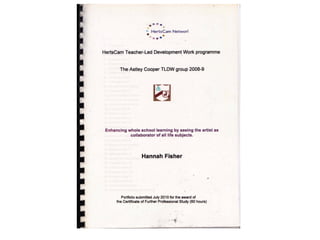
Professional Certificate – The
University of Cambridge
Faculty of Education Teacher
-Lead Development Work
Group
This is a portfolio of a
professional qualification I
undertook while teaching
See below a powerpoint that I created for a presentation to other Hertfordshire schools
as part of my project
TLDW PRESENTATION
Art isn't created in a vacuum. It usually reflects what is going
on elsewhere in a culture.
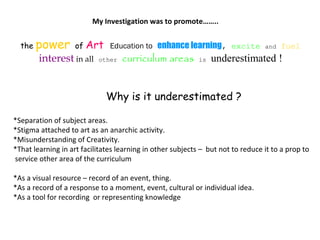
the power of Art Education to enhance learning, excite and fuel
interest in all other curriculum areas is underestimated !
Why is it underestimated ?
*Separation of subject areas.
*Stigma attached to art as an anarchic activity.
*Misunderstanding of Creativity.
*That learning in art facilitates learning in other subjects – but not to reduce it to a prop to
service other area of the curriculum
*As a visual resource – record of an event, thing.
*As a record of a response to a moment, event, cultural or individual idea.
*As a tool for recording or representing knowledge
My Investigation was to promote……..
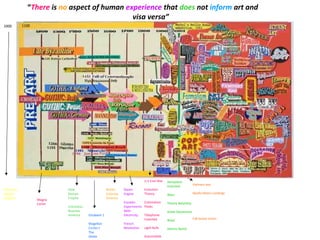
11001000
Normans
Invade
England Magna
Carter
Holy
Roman
Empire
Columbus
Reaches
America Elizabeth 1
Magellon
Circles t
The
Globe
British
Colonize
America
Steam
Engine
Franklin
Experiments
With
Electricity
French
Revolution
U.S Civil War
Evolution
Theory
Colonialism
Peaks
Telephone
Invented
Light Bulb
Automobile
Aeroplane
Invented
Ww1
Theory Relativity
Great Depression
Ww2
Atomic Bomb
Vietnam war
Apollo Moon Landings
Fall Soviet Union
“There is no aspect of human experience that does not inform art and
visa versa”
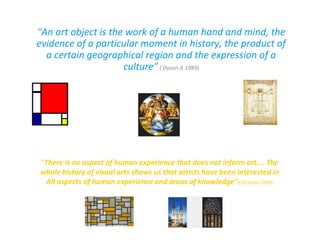
“An art object is the work of a human hand and mind, the
evidence of a particular moment in history, the product of
a certain geographical region and the expression of a
culture”( Dyson A 1989)
“There is no aspect of human experience that does not inform art…. The
whole history of visual arts shows us that artists have been interested in
All aspects of human experience and areas of knowledge”( Hickman 2004)
Here is the history of Secondary Art and Design Education
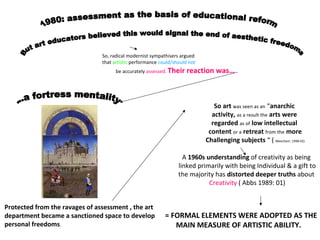
So, radical modernist sympathisers argued
that artistic performance could/should not
be accurately assessed. Their reaction was…
Protected from the ravages of assessment , the art
department became a sanctioned space to develop
personal freedoms.
So art was seen as an “anarchic
activity, as a result the arts were
regarded as of low intellectual
content or a retreat from the more
Challenging subjects “ ( Meecham: 1998:42)
A 1960s understanding of creativity as being
linked primarily with being Individual & a gift to
the majority has distorted deeper truths about
Creativity ( Abbs 1989: 01)
= FORMAL ELEMENTS WERE ADOPTED AS THE
MAIN MEASURE OF ARTISTIC ABILITY.
• Art department being physically as well as philosophically set apart
from the rest of the School ( Hickman 2004; 107)
• Art education can become perceived to be a discrete domain within education, one that
has no connection with other subject areas.
• A major flaw in the system was…“ Precisely our habit of establishing separate territories and
inviolable frontiers” ( Read,H; 11)
• Barriers are erected between art and other subjects that prevent students from having access to
knowledge, facts and ideas that are fundamental to understanding the visual arts and all subjects.
Many art departments are Isolated from other subject rooms in schools
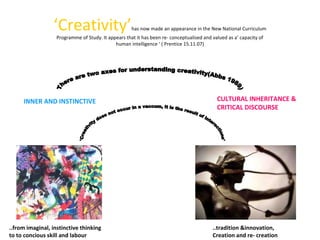
‘Creativity’has now made an appearance in the New National Curriculum
Programme of Study. It appears that it has been re- conceptualised and valued as a’ capacity of
human intelligence ‘ ( Prentice 15.11.07)
INNER AND INSTINCTIVE CULTURAL INHERITANCE &
CRITICAL DISCOURSE
..from imaginal, instinctive thinking
to to concious skill and labour
..tradition &innovation,
Creation and re- creation
Here are some examples of how other subject areas can use Art
and Design in their lessons
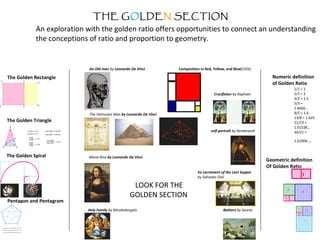
THE GOLDEN SECTION
An exploration with the golden ratio offers opportunities to connect an understanding
the conceptions of ratio and proportion to geometry.
The Golden Rectangle
The Golden Triangle
The Golden Spiral
Pentagon and Pentagram
Numeric definition
of Golden Ratio
1/1 = 1
2/1 = 2
3/2 = 1.5
5/3 =
1.6666...
8/5 = 1.6
13/8 = 1.625
21/13 =
1.61538...
34/21 =
1.61904...
Geometric definition
Of Golden Ratio
An Old man by Leonardo Da Vinci
The Vetruvian Man by Leonardo Da Vinci
Mona-Risa by Leonardo Da Vinci
Holy Family by Micahelangelo
Crucifixion by Raphael
self-portrait by Rembrandt
he sacrament of the Last Supper
by Salvador Dali
Bathers by Seurat
Composition in Red, Yellow, and Blue(1926)
LOOK FOR THE
GOLDEN SECTION
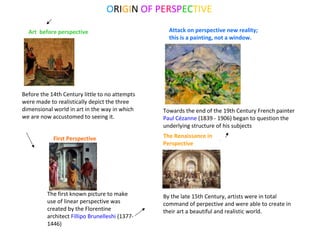
ORIGIN OF PERSPECTIVE
Before the 14th Century little to no attempts
were made to realistically depict the three
dimensional world in art in the way in which
we are now accustomed to seeing it.
The first known picture to make
use of linear perspective was
created by the Florentine
architect Fillipo Brunelleshi (1377-
1446)
The Renaissance in
Perspective
Towards the end of the 19th Century French painter
Paul Cézanne (1839 - 1906) began to question the
underlying structure of his subjects
First Perspective
Art before perspective
By the late 15th Century, artists were in total
command of perpective and were able to create in
their art a beautiful and realistic world.
Attack on perspective new reality;
this is a painting, not a window.
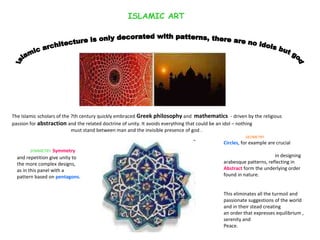
ISLAMIC ART
The Islamic scholars of the 7th century quickly embraced Greek philosophy and mathematics - driven by the religious
passion for abstraction and the related doctrine of unity. It avoids everything that could be an idol – nothing
must stand between man and the invisible presence of god .
GEOMETRY
Circles, for example are crucial
in designing
arabesque patterns, reflecting in
Abstract form the underlying order
found in nature.
This eliminates all the turmoil and
passionate suggestions of the world
and in their stead creating
an order that expresses equilibrium ,
serenity and
Peace.
SYMMETRY Symmetry
and repetition give unity to
the more complex designs,
as in this panel with a
pattern based on pentagons.
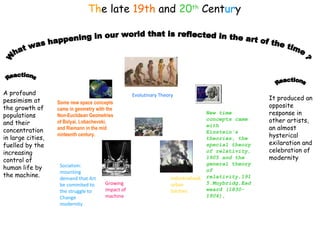
The late 19th and 20th
Century
Some new space concepts
came in geometry with the
Non-Euclidean Geometries
of Bolyai, Lobachevski,
and Riemann in the mid
ninteenth century.
New time
concepts came
with
Einstein's
theories, the
special theory
of relativity,
1905 and the
general theory
of
relativity,191
5.Muybridg,Ead
weard (1830-
1904),
Industrialised,
urban
Socities.
Growing
impact of
machine
A profound
pessimism at
the growth of
populations
and their
concentration
in large cities,
fuelled by the
increasing
control of
human life by
the machine.
It produced an
opposite
response in
other artists,
an almost
hysterical
exilaration and
celebration of
modernity
Socialism:
mounting
demand that Art
be commited to
the struggle to
Change
modernity
Evolutinary Theory
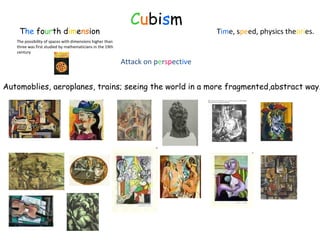
Cubism
The possibility of spaces with dimensions higher than
three was first studied by mathematicians in the 19th
century
The fourth dimension Time, speed, physics theories.
Automoblies, aeroplanes, trains; seeing the world in a more fragmented,abstract way.
Attack on perspective
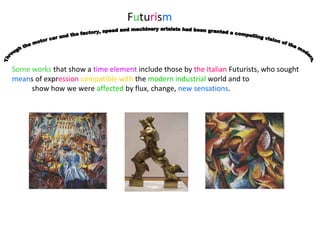
Some works that show a time element include those by the Italian Futurists, who sought
means of expression compatible with the modern industrial world and to
show how we were affected by flux, change, new sensations.
Futurism
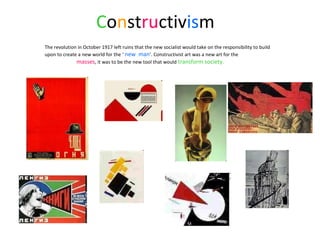
Constructivism
The revolution in October 1917 left ruins that the new socialist would take on the responsibility to build
upon to create a new world for the ‘ new man’. Constructivist art was a new art for the
masses, it was to be the new tool that would transform society.
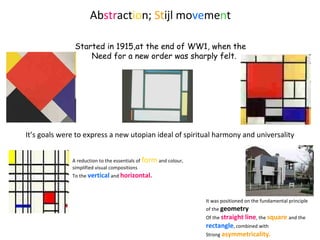
Abstraction; Stijl movement
A reduction to the essentials of form and colour,
simplified visual compositions
To the vertical and horizontal.
It was positioned on the fundamental principle
of the geometry
Of the straight line, the square and the
rectangle, combined with
Strong asymmetricality.
Started in 1915,at the end of WW1, when the
Need for a new order was sharply felt.
It’s goals were to express a new utopian ideal of spiritual harmony and universality
What did I do
• Questionnaires to gage what the students views were on how art could be used or exists in
other subject areas
• Created and delivered joint lessons with Mr Pearcy on , Perspective and geometry
• Delivered a project introducing students to the renaissance understanding of perspective;
students created their own Renaissance Landscape design.
• Altered year 12 Contextual Unit 5 project and introduced linking of all other subject areas
into their analysis of art works.
What did i improve, challenge and learn.
• Improved awareness of Cross Curricular
Opportunities to students and teachers
• Challenged students preconceptions of how
art can be used in other subjects
• Shared, imparted knowledge , utilised and
used others as a resource.
• Learned knowledge, recent, current
initiatives.
It is fitting to consider that the NewNational Curriculum
It is notdivided into subjects as such, so as to enable, facilitate and promote
cross-disciplinary work.
This begins to loosethe educational system that was founded in modernity
and reflects a post-modern education system for a post-
modern society. As Herbert Read states
“a major flaw in the system was precisely our habit of
establishing separate territories and inviolable frontiers”.
(Hickman, R. 2004:p 107)
The common physical separation of the art department connotes a message that
it has no connection with other subject areas.

Portfolio 3 Further Professional Development Certificate

  • 1.
    Professional Certificate –The University of Cambridge Faculty of Education Teacher -Lead Development Work Group This is a portfolio of a professional qualification I undertook while teaching
  • 3.
    See below apowerpoint that I created for a presentation to other Hertfordshire schools as part of my project
  • 4.
    TLDW PRESENTATION Art isn'tcreated in a vacuum. It usually reflects what is going on elsewhere in a culture.
  • 5.
    the power ofArt Education to enhance learning, excite and fuel interest in all other curriculum areas is underestimated ! Why is it underestimated ? *Separation of subject areas. *Stigma attached to art as an anarchic activity. *Misunderstanding of Creativity. *That learning in art facilitates learning in other subjects – but not to reduce it to a prop to service other area of the curriculum *As a visual resource – record of an event, thing. *As a record of a response to a moment, event, cultural or individual idea. *As a tool for recording or representing knowledge My Investigation was to promote……..
  • 6.
    11001000 Normans Invade England Magna Carter Holy Roman Empire Columbus Reaches America Elizabeth1 Magellon Circles t The Globe British Colonize America Steam Engine Franklin Experiments With Electricity French Revolution U.S Civil War Evolution Theory Colonialism Peaks Telephone Invented Light Bulb Automobile Aeroplane Invented Ww1 Theory Relativity Great Depression Ww2 Atomic Bomb Vietnam war Apollo Moon Landings Fall Soviet Union “There is no aspect of human experience that does not inform art and visa versa”
  • 7.
    “An art objectis the work of a human hand and mind, the evidence of a particular moment in history, the product of a certain geographical region and the expression of a culture”( Dyson A 1989) “There is no aspect of human experience that does not inform art…. The whole history of visual arts shows us that artists have been interested in All aspects of human experience and areas of knowledge”( Hickman 2004)
  • 8.
    Here is thehistory of Secondary Art and Design Education
  • 9.
    So, radical modernistsympathisers argued that artistic performance could/should not be accurately assessed. Their reaction was… Protected from the ravages of assessment , the art department became a sanctioned space to develop personal freedoms. So art was seen as an “anarchic activity, as a result the arts were regarded as of low intellectual content or a retreat from the more Challenging subjects “ ( Meecham: 1998:42) A 1960s understanding of creativity as being linked primarily with being Individual & a gift to the majority has distorted deeper truths about Creativity ( Abbs 1989: 01) = FORMAL ELEMENTS WERE ADOPTED AS THE MAIN MEASURE OF ARTISTIC ABILITY.
  • 10.
    • Art departmentbeing physically as well as philosophically set apart from the rest of the School ( Hickman 2004; 107) • Art education can become perceived to be a discrete domain within education, one that has no connection with other subject areas. • A major flaw in the system was…“ Precisely our habit of establishing separate territories and inviolable frontiers” ( Read,H; 11) • Barriers are erected between art and other subjects that prevent students from having access to knowledge, facts and ideas that are fundamental to understanding the visual arts and all subjects. Many art departments are Isolated from other subject rooms in schools
  • 11.
    ‘Creativity’has now madean appearance in the New National Curriculum Programme of Study. It appears that it has been re- conceptualised and valued as a’ capacity of human intelligence ‘ ( Prentice 15.11.07) INNER AND INSTINCTIVE CULTURAL INHERITANCE & CRITICAL DISCOURSE ..from imaginal, instinctive thinking to to concious skill and labour ..tradition &innovation, Creation and re- creation
  • 12.
    Here are someexamples of how other subject areas can use Art and Design in their lessons
  • 13.
    THE GOLDEN SECTION Anexploration with the golden ratio offers opportunities to connect an understanding the conceptions of ratio and proportion to geometry. The Golden Rectangle The Golden Triangle The Golden Spiral Pentagon and Pentagram Numeric definition of Golden Ratio 1/1 = 1 2/1 = 2 3/2 = 1.5 5/3 = 1.6666... 8/5 = 1.6 13/8 = 1.625 21/13 = 1.61538... 34/21 = 1.61904... Geometric definition Of Golden Ratio An Old man by Leonardo Da Vinci The Vetruvian Man by Leonardo Da Vinci Mona-Risa by Leonardo Da Vinci Holy Family by Micahelangelo Crucifixion by Raphael self-portrait by Rembrandt he sacrament of the Last Supper by Salvador Dali Bathers by Seurat Composition in Red, Yellow, and Blue(1926) LOOK FOR THE GOLDEN SECTION
  • 14.
    ORIGIN OF PERSPECTIVE Beforethe 14th Century little to no attempts were made to realistically depict the three dimensional world in art in the way in which we are now accustomed to seeing it. The first known picture to make use of linear perspective was created by the Florentine architect Fillipo Brunelleshi (1377- 1446) The Renaissance in Perspective Towards the end of the 19th Century French painter Paul Cézanne (1839 - 1906) began to question the underlying structure of his subjects First Perspective Art before perspective By the late 15th Century, artists were in total command of perpective and were able to create in their art a beautiful and realistic world. Attack on perspective new reality; this is a painting, not a window.
  • 15.
    ISLAMIC ART The Islamicscholars of the 7th century quickly embraced Greek philosophy and mathematics - driven by the religious passion for abstraction and the related doctrine of unity. It avoids everything that could be an idol – nothing must stand between man and the invisible presence of god . GEOMETRY Circles, for example are crucial in designing arabesque patterns, reflecting in Abstract form the underlying order found in nature. This eliminates all the turmoil and passionate suggestions of the world and in their stead creating an order that expresses equilibrium , serenity and Peace. SYMMETRY Symmetry and repetition give unity to the more complex designs, as in this panel with a pattern based on pentagons.
  • 16.
    The late 19thand 20th Century Some new space concepts came in geometry with the Non-Euclidean Geometries of Bolyai, Lobachevski, and Riemann in the mid ninteenth century. New time concepts came with Einstein's theories, the special theory of relativity, 1905 and the general theory of relativity,191 5.Muybridg,Ead weard (1830- 1904), Industrialised, urban Socities. Growing impact of machine A profound pessimism at the growth of populations and their concentration in large cities, fuelled by the increasing control of human life by the machine. It produced an opposite response in other artists, an almost hysterical exilaration and celebration of modernity Socialism: mounting demand that Art be commited to the struggle to Change modernity Evolutinary Theory
  • 17.
    Cubism The possibility ofspaces with dimensions higher than three was first studied by mathematicians in the 19th century The fourth dimension Time, speed, physics theories. Automoblies, aeroplanes, trains; seeing the world in a more fragmented,abstract way. Attack on perspective
  • 18.
    Some works thatshow a time element include those by the Italian Futurists, who sought means of expression compatible with the modern industrial world and to show how we were affected by flux, change, new sensations. Futurism
  • 19.
    Constructivism The revolution inOctober 1917 left ruins that the new socialist would take on the responsibility to build upon to create a new world for the ‘ new man’. Constructivist art was a new art for the masses, it was to be the new tool that would transform society.
  • 20.
    Abstraction; Stijl movement Areduction to the essentials of form and colour, simplified visual compositions To the vertical and horizontal. It was positioned on the fundamental principle of the geometry Of the straight line, the square and the rectangle, combined with Strong asymmetricality. Started in 1915,at the end of WW1, when the Need for a new order was sharply felt. It’s goals were to express a new utopian ideal of spiritual harmony and universality
  • 21.
    What did Ido • Questionnaires to gage what the students views were on how art could be used or exists in other subject areas • Created and delivered joint lessons with Mr Pearcy on , Perspective and geometry • Delivered a project introducing students to the renaissance understanding of perspective; students created their own Renaissance Landscape design. • Altered year 12 Contextual Unit 5 project and introduced linking of all other subject areas into their analysis of art works.
  • 22.
    What did iimprove, challenge and learn. • Improved awareness of Cross Curricular Opportunities to students and teachers • Challenged students preconceptions of how art can be used in other subjects • Shared, imparted knowledge , utilised and used others as a resource. • Learned knowledge, recent, current initiatives.
  • 23.
    It is fittingto consider that the NewNational Curriculum It is notdivided into subjects as such, so as to enable, facilitate and promote cross-disciplinary work. This begins to loosethe educational system that was founded in modernity and reflects a post-modern education system for a post- modern society. As Herbert Read states “a major flaw in the system was precisely our habit of establishing separate territories and inviolable frontiers”. (Hickman, R. 2004:p 107) The common physical separation of the art department connotes a message that it has no connection with other subject areas.

Editor's Notes

  • #10 Usher and edwards – education and practice is founded on the discourse of modernity – Hickman 25. This reflects the 1970s – 1980s education system where art and design was to prepare students for technology and craft based employment or serve as a reatreat.
  • #12 jWe need to submit ourselves to the intrinsic qualities of great works of art across time – but we need to preserve simultaneously , the freedom to change, to subvert, to tell again, with a different outcome. The formalist model as stated by – that treats a work of art a s a self sufficient entity – makes no provision for acquisiton of relevant background 1998 298