PUBLIC AND PRIVATE
ISSUES IN LTC FINANCING
FOR THE ELDERLY
By Mark J. Warshawsky, Ph.D.
Vice-Chairman of the 2013 Federal
Commission on Long-term Care
Retirement and Savings Forum
ICI
February 25, 2014
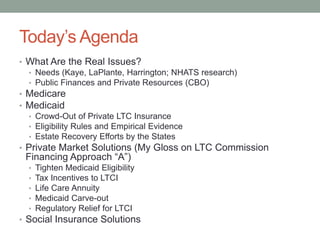
Today’s Agenda
• What Are the Real Issues?
• Needs (Kaye, LaPlante, Harrington; NHATS research)
• Public Finances and Private Resources (CBO)
• Medicare
• Medicaid
• Crowd-Out of Private LTC Insurance
• Eligibility Rules and Empirical Evidence
• Estate Recovery Efforts by the States
• Private Market Solutions (My Gloss on LTC Commission

Financing Approach ―A‖)
•
•
•
•
•

Tighten Medicaid Eligibility
Tax Incentives to LTCI
Life Care Annuity
Medicaid Carve-out
Regulatory Relief for LTCI

• Social Insurance Solutions
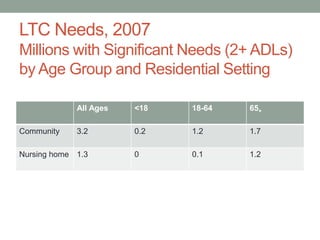
LTC Needs, 2007
Millions with Significant Needs (2+ ADLs)
by Age Group and Residential Setting
All Ages
Community

<18

18-64

65+

3.2

0.2

1.2

1.7

0

0.1

1.2

Nursing home 1.3
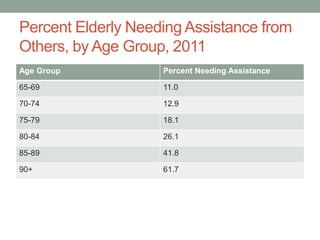
Percent Elderly Needing Assistance from
Others, by Age Group, 2011
Age Group

Percent Needing Assistance

65-69

11.0

70-74

12.9

75-79

18.1

80-84

26.1

85-89

41.8

90+

61.7
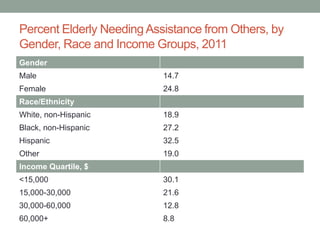
Percent Elderly Needing Assistance from Others, by
Gender, Race and Income Groups, 2011
Gender
Male

14.7

Female

24.8

Race/Ethnicity
White, non-Hispanic

18.9

Black, non-Hispanic

27.2

Hispanic

32.5

Other

19.0

Income Quartile, $
<15,000

30.1

15,000-30,000

21.6

30,000-60,000

12.8

60,000+

8.8
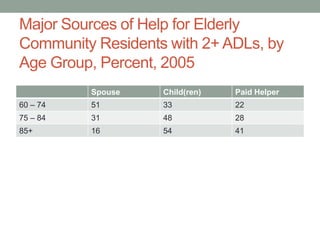
Major Sources of Help for Elderly
Community Residents with 2+ ADLs, by
Age Group, Percent, 2005
Spouse

Child(ren)

Paid Helper

60 – 74

51

33

22

75 – 84

31

48

28

85+

16

54

41
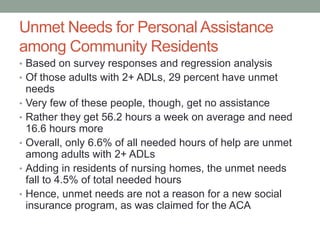
Unmet Needs for Personal Assistance
among Community Residents
• Based on survey responses and regression analysis
• Of those adults with 2+ ADLs, 29 percent have unmet
•
•
•
•

•

needs
Very few of these people, though, get no assistance
Rather they get 56.2 hours a week on average and need
16.6 hours more
Overall, only 6.6% of all needed hours of help are unmet
among adults with 2+ ADLs
Adding in residents of nursing homes, the unmet needs
fall to 4.5% of total needed hours
Hence, unmet needs are not a reason for a new social
insurance program, as was claimed for the ACA
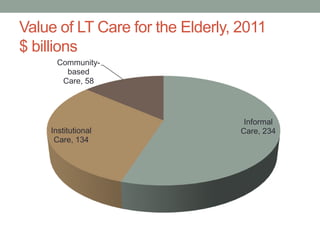
Value of LT Care for the Elderly, 2011
$ billions
Communitybased
Care, 58

Institutional
Care, 134

Informal
Care, 234
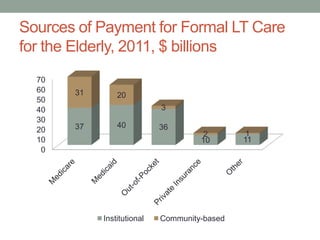
Sources of Payment for Formal LT Care
for the Elderly, 2011, $ billions
70
60
50
40
30
20
10
0

31

20
3

37

40

Institutional

36

2
10

Community-based

1
11
Projected LTC Spending for the Elderly
• Spending on LTC for the elderly is projected to climb from

1.3 percent of GDP currently to 3.0 percent in 2050 at
current prevalence rates.
• From 2013 to 2023, Medicaid spending on LTC will grow
5.5 percent annually.
• From 2013 to 2023, Medicare spending on LTC will grow
6.5 percent annually.
• Considering the rapid growth in our other retiree income
and health obligations and their poor funding, public LTC
spending for the elderly is not sustainable, although costsavings technological or medical breakthroughs are
always possible.
Private Long-term Care Insurance (LTCI)
• About 11 percent of the elderly have LTCI.
• Coverage for the adult population is 3 percent in 2011, up

from 2 percent in 1999.
• Coverage grew 12 percent annually from 1999 to
2005, but increased only 1.5 percent annually thereafter.
• Since 2005, many insurers have exited the
market, premiums have risen significantly, and benefit
provisions have been tightened (e.g. lifetime benefit is
hard to find).
• These problems were caused by insurer misjudgment on
lapse rates and Federal Reserve policy on interest
rates, as well as, sometimes, higher claims than
expected.
Partnership Programs
• The Partnership for Long-Term Care is an arrangement

between states and private insurers intended to reduce
dependence on Medicaid for financing LTC.
• LTCI offered through a state’s partnership program
enables policyholders to maintain larger amounts of
countable assets and still qualify for LTC under Medicaid
once the private policy is exhausted.
• States have established their own programs in response
to the DRA of 2005. By 2009, 30 states had established
programs in addition to the original four states.
• Partnership policies accounted for about 10 percent of all
LTC policies in 2011, up from 3 percent in 2007.
Medicare
• Medicare and private health insurance cover LTC through a post-

•
•

•
•

•

acute care benefit that covers rehabilitative care—short-term stays in
skilled nursing facilities (SNFs) and home health visits.
Medicare will pay for SNF care for up to 100 days only after a prior
hospitalization lasting at least 3 days.
Since 1965, overall hospital lengths of stay have declined. Also
hospitals are increasingly holding patients in observation status.
The LTC Commission recommended eliminating the 3-day hospital
stay requirement.
This change could possibly reduce costs. Still, a new and better
trigger would be needed to protect against the use of Medicare to pay
inappropriate LTC expenses.
Something else to note: the Jimmo v. Sebelius settlement eliminates
the administrative ―improvement standard‖ requirement for
determining Medicare eligibility for LTC services.
Medicaid Crowd-out of LTCI
• First discussed by Pauly, modeled extensively by Brown and

•

•

•

•

Finkelstein in comprehensive simulation work
They estimate that Medicaid can explain the lack of private
insurance purchases for at least two-thirds and as much as 90
percent of the wealth distribution, even if
comprehensive, actuarially fair private policies were available.
In another empirical study, they find that states with more
generous Medicaid eligibility had lower rates of private LTCI
coverage.
An implication of their findings is that public policies designed
to stimulate private insurance demand will be of limited efficacy
as long as Medicaid continues to impose a large implicit tax.
Other surveys find public confusion about the current extent of
social insurance coverage of LTC.
Medicaid Eligibility
• Asset and income tests have been thought to require

spend-down/impoverishment to get LTC benefits paid by
Medicaid.
• But the rules explicitly exclude housing (up to
$802,000), automobile, personal valuables, term life
insurance, (in many states) retirement assets in
distribution (not necessarily lifetime), and $116,000 for a
community spouse.
• Plus there are reports that it is possible to ―game‖ the
system further through the use of trusts and life insurance;
listen to late night radio and TV ads from attorneys.
Empirical Evidence on Use of Medicaid by
the Upper-Income Elderly
• Study by deNardi, French and Jones
• They estimate that fifteen percent of elderly individuals in the

middle income quintile, 8 percent in the upper middle
quintile, and 5 percent in the top quintile receive government
LTC benefits.
• Moreover, because they live longer, beneficiaries in the top
income quintile receive, on average, double the lifetime
payouts of those less well-off.
• Because of the costs of these undeserved benefits to the
upper-income groups, Medicaid lowers reimbursement rates to
providers and restricts benefits to contain overall costs; the
poor, who really have to rely on Medicaid, are thereby tied to
lower quality care and decreased provider flexibility.
Estate Recovery Efforts by the States
• The asset exclusions and gamesmanship would not

matter, so much, if states tried to recover assets from the
estates of decedents who benefited from Medicaid.
• But all the available evidence indicates the states don’t
devote much effort to this legally required activity.
• The most recent study on the subject finds that most
states recouped less than 2 percent of total LTC
spending. Four states even reported no reimbursements
whatsoever.
• It is interesting to note as an aside that this has become
something of an issue for the ACA, as estate recovery
applies not just to LTC benefits but may also apply to
health care benefits provided to those age 55 and older.
Private Market Solutions: Tighten
Medicaid Eligibility Rules
• Require that a reverse mortgage be taken on the

•

•

•

•

home, and that that cash flow be included in the income
test.
Require that an immediate life annuity be taken from the
retirement account and that that cash flow be included in
the income test.
Include the face value of term life insurance in countable
assets, as well as personal valuables and cars in excess
of de minimus amounts.
Reinvigorate state efforts at estate recovery by
carefully, repeatedly and prominently investigating the
extent of their activities.
Conduct a public education campaign on what Medicaid
and Medicare do and do not cover for LTC.
Private Market Solutions: Tax Incentives
for LTCI
• Allow withdrawals from existing 401k, IRA, or Section 125

accounts to pay LTCI premiums without triggering a
taxable distribution event. This policy change effectively
lowers the cost of LTCI, especially for those in higher tax
brackets.
• We guess that this change would have minimal net
budget implications.
• The tax costs of incentivizing broader LTCI participation
would be more than offset over time as those newly
covered by private LTCI coverage draw on private rather
than public resources to finance their care.
Private Market Solutions: Life Care
Annuity
• Insurance product innovation proposed and investigated by

•
•

•

•

Warshawsky and colleagues
Would combine LTCI and immediate life annuity, issued at
retirement ages.
Because those with impaired longevity are generally not able to
get LTCI, but in APV terms are not (much) more expensive
than those with normal or superior longevity, they are attractive
to and should invited by the superior longevity pool who select
into life annuities and who can pass current LTCI underwriting.
This combination means that underwriting can be minimal for
the life care annuity and it can be offered at a slight discount
overall.
The proposal would change the tax law to allow investment and
distribution in the LTCI portion of the life care annuity through
tax-advantaged retirement accounts.
Private Market Solutions: Medicaid CarveOut
• Most direct assault on problem identified by Brown and

Finkelstein.
• Upon retirement, individuals should have the choice of
receiving a lump-sum payment from the government for a
significant portion of the expected value of their Medicaid
benefits—most for the poor, with little or nothing for the
better off.
• Retirees would be obliged to use the payment to
purchase private, permanent LTCI in place of Medicaid
coverage. This would further reduce Medicaid’s future
liabilities.
• One could envision the creation of a LTCI exchange to
facilitate this solution.
Private Market Solutions: Regulatory
Relief for LTCI
• Currently regulated tightly at both the federal and state

levels
• Relieve state regulations on high-deductible LTCI, thereby
providing for catastrophic insurance coverage and for
clarity to families about the amount they need to save for
deductibles or provide for in their Medigap policies.
• For sufficiently large changes in the macroeconomic
environment, allow (in the upward direction) and require
(in the downward direction) writers of LTCI to change
automatically the pricing of existing outstanding LTCI
policies on an actuarially fair basis.
• Similarly, the requirement to offer a 5% COLA for benefits
should be softened to reflect recent inflation rates.
Social Insurance Solutions
• There were several Commission members who proposed

social insurance solutions – either expanding Medicare or
creating a new mandatory federal LTCI program.
• The exact (or even approximate) scope of these programs
were not specified. And no CBO scores were obtained.
• But relevant are the following calculations: if the federal
government bought every adult (18+) in the US a fairly
generous LTCI policy (plan D) from the OPM FLTCIP, it
would cost $812.5 billion annually for a 5% ACIO or
$378.2 billion for a FPO policy. There is considerable
advance savings implicit even in a FPO policy (perhaps
there should be term LTCI), but anyways, even in
Washington, DC, that is a lot of money!

Public and private issues in LTC financing for the elderly

  • 1.
    PUBLIC AND PRIVATE ISSUESIN LTC FINANCING FOR THE ELDERLY By Mark J. Warshawsky, Ph.D. Vice-Chairman of the 2013 Federal Commission on Long-term Care Retirement and Savings Forum ICI February 25, 2014
  • 2.
    Today’s Agenda • WhatAre the Real Issues? • Needs (Kaye, LaPlante, Harrington; NHATS research) • Public Finances and Private Resources (CBO) • Medicare • Medicaid • Crowd-Out of Private LTC Insurance • Eligibility Rules and Empirical Evidence • Estate Recovery Efforts by the States • Private Market Solutions (My Gloss on LTC Commission Financing Approach ―A‖) • • • • • Tighten Medicaid Eligibility Tax Incentives to LTCI Life Care Annuity Medicaid Carve-out Regulatory Relief for LTCI • Social Insurance Solutions
  • 3.
    LTC Needs, 2007 Millionswith Significant Needs (2+ ADLs) by Age Group and Residential Setting All Ages Community <18 18-64 65+ 3.2 0.2 1.2 1.7 0 0.1 1.2 Nursing home 1.3
  • 4.
    Percent Elderly NeedingAssistance from Others, by Age Group, 2011 Age Group Percent Needing Assistance 65-69 11.0 70-74 12.9 75-79 18.1 80-84 26.1 85-89 41.8 90+ 61.7
  • 5.
    Percent Elderly NeedingAssistance from Others, by Gender, Race and Income Groups, 2011 Gender Male 14.7 Female 24.8 Race/Ethnicity White, non-Hispanic 18.9 Black, non-Hispanic 27.2 Hispanic 32.5 Other 19.0 Income Quartile, $ <15,000 30.1 15,000-30,000 21.6 30,000-60,000 12.8 60,000+ 8.8
  • 6.
    Major Sources ofHelp for Elderly Community Residents with 2+ ADLs, by Age Group, Percent, 2005 Spouse Child(ren) Paid Helper 60 – 74 51 33 22 75 – 84 31 48 28 85+ 16 54 41
  • 7.
    Unmet Needs forPersonal Assistance among Community Residents • Based on survey responses and regression analysis • Of those adults with 2+ ADLs, 29 percent have unmet • • • • • needs Very few of these people, though, get no assistance Rather they get 56.2 hours a week on average and need 16.6 hours more Overall, only 6.6% of all needed hours of help are unmet among adults with 2+ ADLs Adding in residents of nursing homes, the unmet needs fall to 4.5% of total needed hours Hence, unmet needs are not a reason for a new social insurance program, as was claimed for the ACA
  • 8.
    Value of LTCare for the Elderly, 2011 $ billions Communitybased Care, 58 Institutional Care, 134 Informal Care, 234
  • 9.
    Sources of Paymentfor Formal LT Care for the Elderly, 2011, $ billions 70 60 50 40 30 20 10 0 31 20 3 37 40 Institutional 36 2 10 Community-based 1 11
  • 10.
    Projected LTC Spendingfor the Elderly • Spending on LTC for the elderly is projected to climb from 1.3 percent of GDP currently to 3.0 percent in 2050 at current prevalence rates. • From 2013 to 2023, Medicaid spending on LTC will grow 5.5 percent annually. • From 2013 to 2023, Medicare spending on LTC will grow 6.5 percent annually. • Considering the rapid growth in our other retiree income and health obligations and their poor funding, public LTC spending for the elderly is not sustainable, although costsavings technological or medical breakthroughs are always possible.
  • 11.
    Private Long-term CareInsurance (LTCI) • About 11 percent of the elderly have LTCI. • Coverage for the adult population is 3 percent in 2011, up from 2 percent in 1999. • Coverage grew 12 percent annually from 1999 to 2005, but increased only 1.5 percent annually thereafter. • Since 2005, many insurers have exited the market, premiums have risen significantly, and benefit provisions have been tightened (e.g. lifetime benefit is hard to find). • These problems were caused by insurer misjudgment on lapse rates and Federal Reserve policy on interest rates, as well as, sometimes, higher claims than expected.
  • 12.
    Partnership Programs • ThePartnership for Long-Term Care is an arrangement between states and private insurers intended to reduce dependence on Medicaid for financing LTC. • LTCI offered through a state’s partnership program enables policyholders to maintain larger amounts of countable assets and still qualify for LTC under Medicaid once the private policy is exhausted. • States have established their own programs in response to the DRA of 2005. By 2009, 30 states had established programs in addition to the original four states. • Partnership policies accounted for about 10 percent of all LTC policies in 2011, up from 3 percent in 2007.
  • 13.
    Medicare • Medicare andprivate health insurance cover LTC through a post- • • • • • acute care benefit that covers rehabilitative care—short-term stays in skilled nursing facilities (SNFs) and home health visits. Medicare will pay for SNF care for up to 100 days only after a prior hospitalization lasting at least 3 days. Since 1965, overall hospital lengths of stay have declined. Also hospitals are increasingly holding patients in observation status. The LTC Commission recommended eliminating the 3-day hospital stay requirement. This change could possibly reduce costs. Still, a new and better trigger would be needed to protect against the use of Medicare to pay inappropriate LTC expenses. Something else to note: the Jimmo v. Sebelius settlement eliminates the administrative ―improvement standard‖ requirement for determining Medicare eligibility for LTC services.
  • 14.
    Medicaid Crowd-out ofLTCI • First discussed by Pauly, modeled extensively by Brown and • • • • Finkelstein in comprehensive simulation work They estimate that Medicaid can explain the lack of private insurance purchases for at least two-thirds and as much as 90 percent of the wealth distribution, even if comprehensive, actuarially fair private policies were available. In another empirical study, they find that states with more generous Medicaid eligibility had lower rates of private LTCI coverage. An implication of their findings is that public policies designed to stimulate private insurance demand will be of limited efficacy as long as Medicaid continues to impose a large implicit tax. Other surveys find public confusion about the current extent of social insurance coverage of LTC.
  • 15.
    Medicaid Eligibility • Assetand income tests have been thought to require spend-down/impoverishment to get LTC benefits paid by Medicaid. • But the rules explicitly exclude housing (up to $802,000), automobile, personal valuables, term life insurance, (in many states) retirement assets in distribution (not necessarily lifetime), and $116,000 for a community spouse. • Plus there are reports that it is possible to ―game‖ the system further through the use of trusts and life insurance; listen to late night radio and TV ads from attorneys.
  • 16.
    Empirical Evidence onUse of Medicaid by the Upper-Income Elderly • Study by deNardi, French and Jones • They estimate that fifteen percent of elderly individuals in the middle income quintile, 8 percent in the upper middle quintile, and 5 percent in the top quintile receive government LTC benefits. • Moreover, because they live longer, beneficiaries in the top income quintile receive, on average, double the lifetime payouts of those less well-off. • Because of the costs of these undeserved benefits to the upper-income groups, Medicaid lowers reimbursement rates to providers and restricts benefits to contain overall costs; the poor, who really have to rely on Medicaid, are thereby tied to lower quality care and decreased provider flexibility.
  • 17.
    Estate Recovery Effortsby the States • The asset exclusions and gamesmanship would not matter, so much, if states tried to recover assets from the estates of decedents who benefited from Medicaid. • But all the available evidence indicates the states don’t devote much effort to this legally required activity. • The most recent study on the subject finds that most states recouped less than 2 percent of total LTC spending. Four states even reported no reimbursements whatsoever. • It is interesting to note as an aside that this has become something of an issue for the ACA, as estate recovery applies not just to LTC benefits but may also apply to health care benefits provided to those age 55 and older.
  • 18.
    Private Market Solutions:Tighten Medicaid Eligibility Rules • Require that a reverse mortgage be taken on the • • • • home, and that that cash flow be included in the income test. Require that an immediate life annuity be taken from the retirement account and that that cash flow be included in the income test. Include the face value of term life insurance in countable assets, as well as personal valuables and cars in excess of de minimus amounts. Reinvigorate state efforts at estate recovery by carefully, repeatedly and prominently investigating the extent of their activities. Conduct a public education campaign on what Medicaid and Medicare do and do not cover for LTC.
  • 19.
    Private Market Solutions:Tax Incentives for LTCI • Allow withdrawals from existing 401k, IRA, or Section 125 accounts to pay LTCI premiums without triggering a taxable distribution event. This policy change effectively lowers the cost of LTCI, especially for those in higher tax brackets. • We guess that this change would have minimal net budget implications. • The tax costs of incentivizing broader LTCI participation would be more than offset over time as those newly covered by private LTCI coverage draw on private rather than public resources to finance their care.
  • 20.
    Private Market Solutions:Life Care Annuity • Insurance product innovation proposed and investigated by • • • • Warshawsky and colleagues Would combine LTCI and immediate life annuity, issued at retirement ages. Because those with impaired longevity are generally not able to get LTCI, but in APV terms are not (much) more expensive than those with normal or superior longevity, they are attractive to and should invited by the superior longevity pool who select into life annuities and who can pass current LTCI underwriting. This combination means that underwriting can be minimal for the life care annuity and it can be offered at a slight discount overall. The proposal would change the tax law to allow investment and distribution in the LTCI portion of the life care annuity through tax-advantaged retirement accounts.
  • 21.
    Private Market Solutions:Medicaid CarveOut • Most direct assault on problem identified by Brown and Finkelstein. • Upon retirement, individuals should have the choice of receiving a lump-sum payment from the government for a significant portion of the expected value of their Medicaid benefits—most for the poor, with little or nothing for the better off. • Retirees would be obliged to use the payment to purchase private, permanent LTCI in place of Medicaid coverage. This would further reduce Medicaid’s future liabilities. • One could envision the creation of a LTCI exchange to facilitate this solution.
  • 22.
    Private Market Solutions:Regulatory Relief for LTCI • Currently regulated tightly at both the federal and state levels • Relieve state regulations on high-deductible LTCI, thereby providing for catastrophic insurance coverage and for clarity to families about the amount they need to save for deductibles or provide for in their Medigap policies. • For sufficiently large changes in the macroeconomic environment, allow (in the upward direction) and require (in the downward direction) writers of LTCI to change automatically the pricing of existing outstanding LTCI policies on an actuarially fair basis. • Similarly, the requirement to offer a 5% COLA for benefits should be softened to reflect recent inflation rates.
  • 23.
    Social Insurance Solutions •There were several Commission members who proposed social insurance solutions – either expanding Medicare or creating a new mandatory federal LTCI program. • The exact (or even approximate) scope of these programs were not specified. And no CBO scores were obtained. • But relevant are the following calculations: if the federal government bought every adult (18+) in the US a fairly generous LTCI policy (plan D) from the OPM FLTCIP, it would cost $812.5 billion annually for a 5% ACIO or $378.2 billion for a FPO policy. There is considerable advance savings implicit even in a FPO policy (perhaps there should be term LTCI), but anyways, even in Washington, DC, that is a lot of money!