The Devolution of Appraisal and 
Underwriting Theory and Practice 
Edward Pinto 
Codirector and Chief Risk Officer 
AEI International Center on Housing Risk 
Edward.Pinto@AEI.org 
HousingRisk.org 
Third International Conference on Housing Risk: New Risk 
Measures and their Applications 
September 17, 2014 
The views expressed are those of the author alone and do not necessarily represent those of the 
American Enterprise Institute. 
1
INTRODUCTION 
2
‘Mortgage’ has become another word for 
‘Mortgage’ has become another word for trouble 
‘trouble’ 
• Long term home price appreciation rates are 
modest and averages mask volatility 
– No diversification when one’s wealth is in a single asset 
– “The housing market is a ‘crapshoot’”—Professor Karl 
Case1 
• Excessive leverage promotes volatility 
1 http://money.cnn.com/2014/07/07/investing/housing-market-case/ July 7, 2014 3
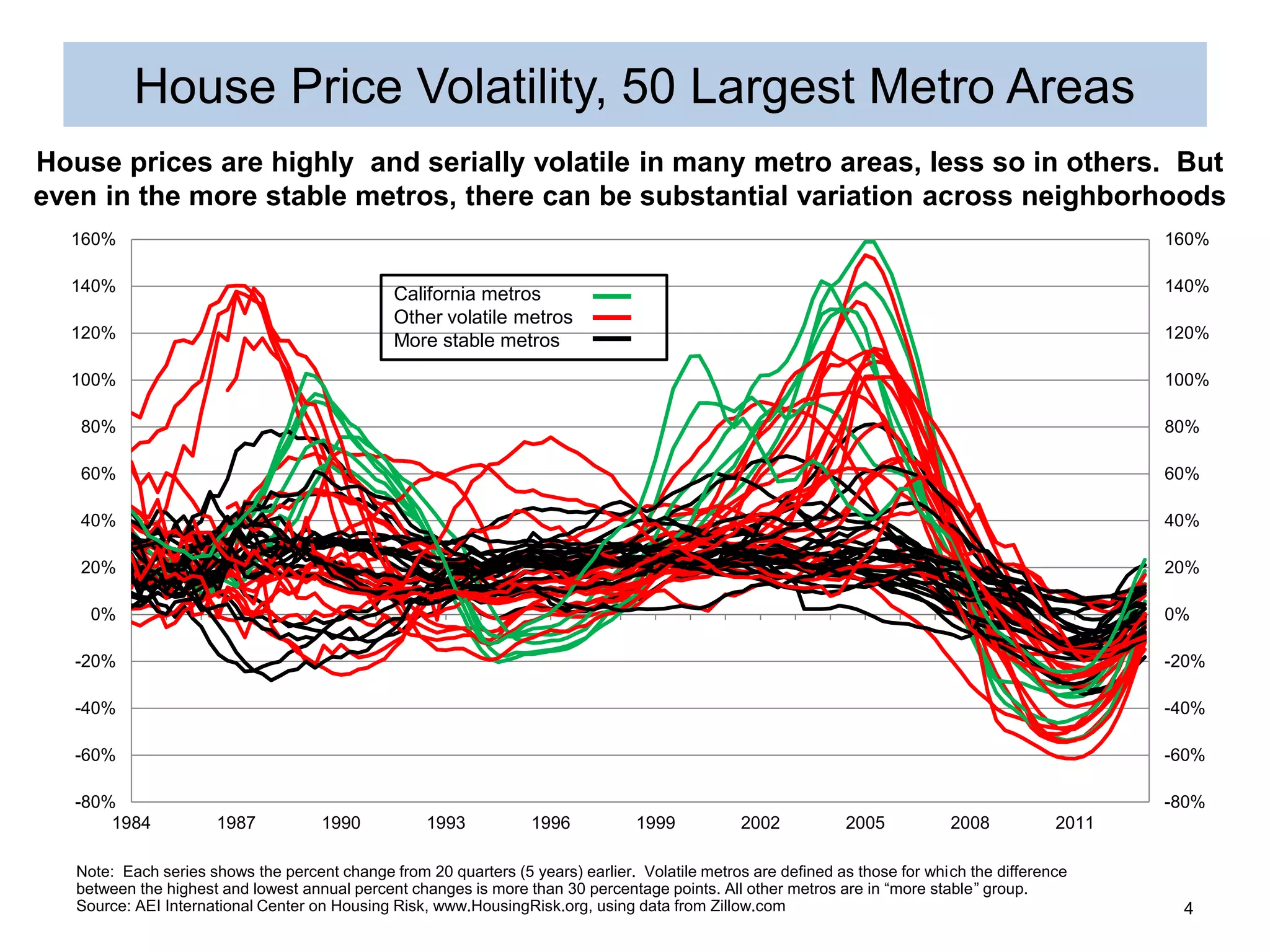
House Price Volatility, 50 Largest Metro Areas 
House prices are highly and serially volatile in many metro areas, less so in others. But 
even in the more stable metros, there can be substantial variation across neighborhoods 
160% 
140% 
120% 
100% 
80% 
60% 
40% 
20% 
0% 
-20% 
-40% 
-60% 
-80% 
160% 
140% 
120% 
100% 
80% 
60% 
40% 
20% 
0% 
-20% 
-40% 
-60% 
-80% 
California metros 
Other volatile metros 
More stable metros 
1984 1987 1990 1993 1996 1999 2002 2005 2008 2011 
Note: Each series shows the percent change from 20 quarters (5 years) earlier. Volatile metros are defined as those for which the difference 
between the highest and lowest annual percent changes is more than 30 percentage points. All other metros are in “more stable” group. 
Source: AEI International Center on Housing Risk, www.HousingRisk.org, using data from Zillow.com 4
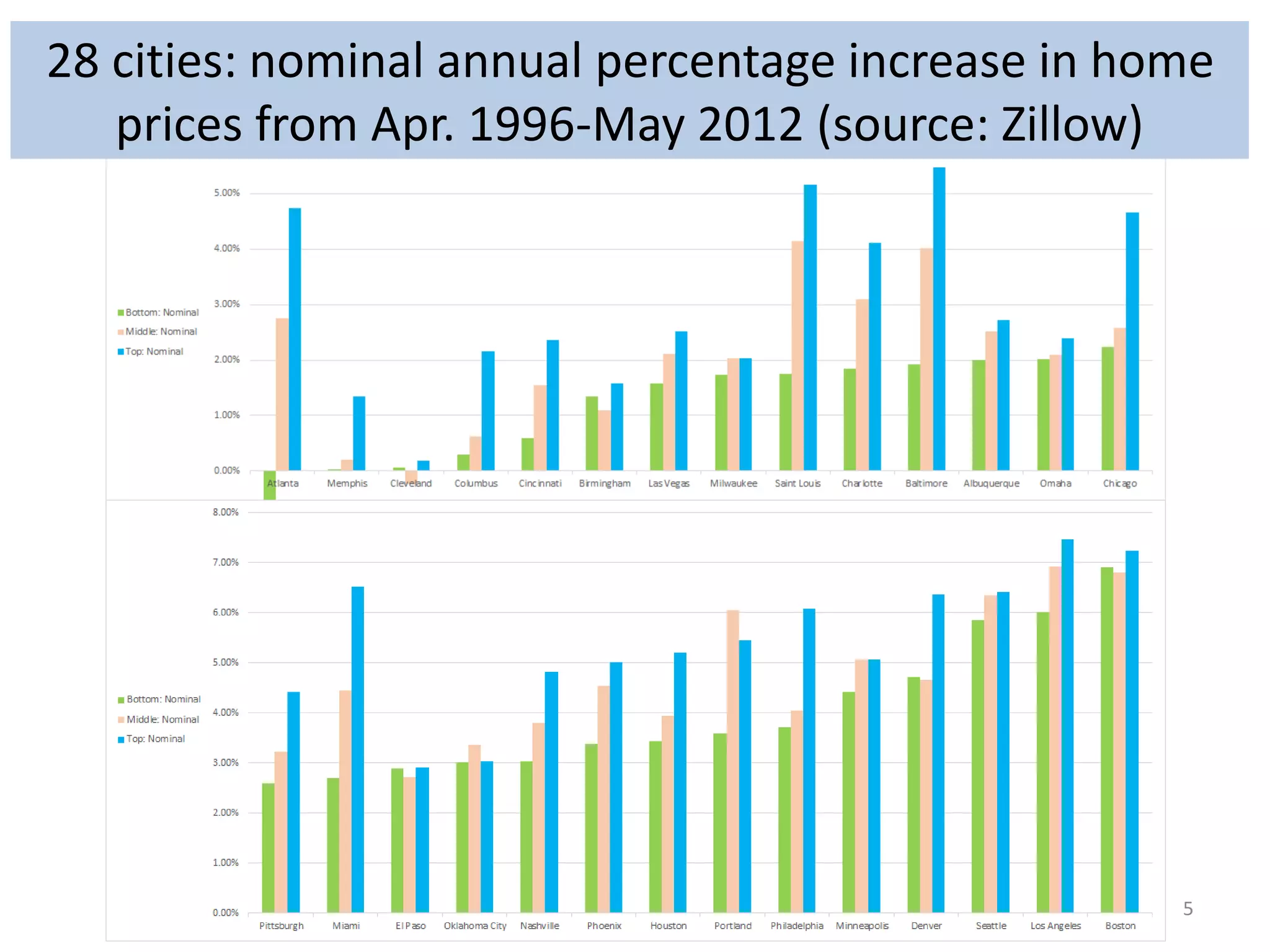
28 cities: nominal annual percentage increase in home 
5 
prices from Apr. 1996-May 2012 (source: Zillow)
City of Atlanta: cumulative price change for lowest price 
tier and constituent zips from Apr. 1996-May 2012* 
6 
*Source: Zillow
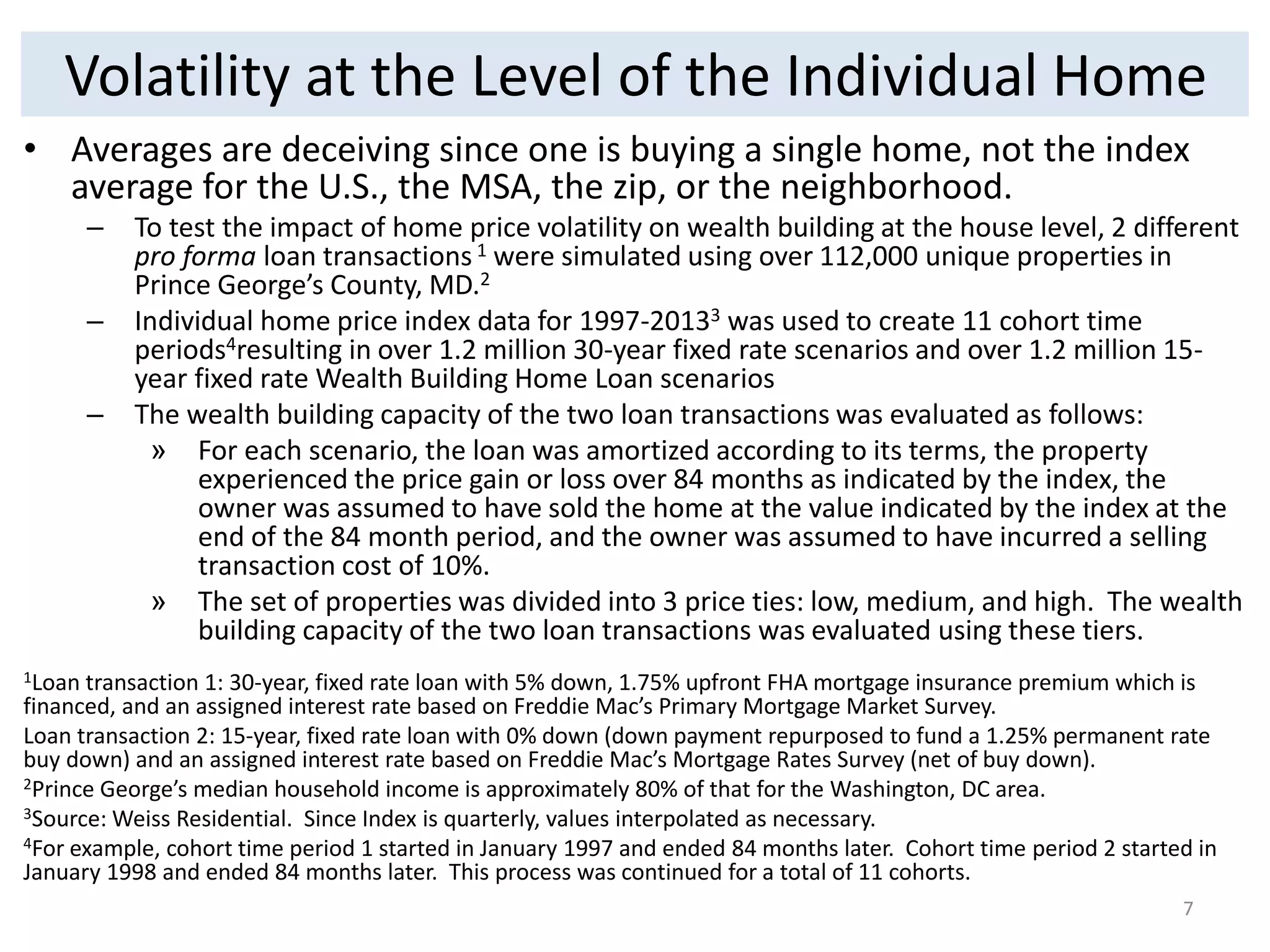
Volatility at the Level of the Individual Home 
• Averages are deceiving since one is buying a single home, not the index 
average for the U.S., the MSA, the zip, or the neighborhood. 
– To test the impact of home price volatility on wealth building at the house level, 2 different 
pro forma loan transactions 1 were simulated using over 112,000 unique properties in 
Prince George’s County, MD.2 
– Individual home price index data for 1997-20133 was used to create 11 cohort time 
periods4resulting in over 1.2 million 30-year fixed rate scenarios and over 1.2 million 15- 
year fixed rate Wealth Building Home Loan scenarios 
– The wealth building capacity of the two loan transactions was evaluated as follows: 
» For each scenario, the loan was amortized according to its terms, the property 
experienced the price gain or loss over 84 months as indicated by the index, the 
owner was assumed to have sold the home at the value indicated by the index at the 
end of the 84 month period, and the owner was assumed to have incurred a selling 
transaction cost of 10%. 
» The set of properties was divided into 3 price ties: low, medium, and high. The wealth 
building capacity of the two loan transactions was evaluated using these tiers. 
1Loan transaction 1: 30-year, fixed rate loan with 5% down, 1.75% upfront FHA mortgage insurance premium which is 
financed, and an assigned interest rate based on Freddie Mac’s Primary Mortgage Market Survey. 
Loan transaction 2: 15-year, fixed rate loan with 0% down (down payment repurposed to fund a 1.25% permanent rate 
buy down) and an assigned interest rate based on Freddie Mac’s Mortgage Rates Survey (net of buy down). 
2Prince George’s median household income is approximately 80% of that for the Washington, DC area. 
3Source: Weiss Residential. Since Index is quarterly, values interpolated as necessary. 
4For example, cohort time period 1 started in January 1997 and ended 84 months later. Cohort time period 2 started in 
January 1998 and ended 84 months later. This process was continued for a total of 11 cohorts. 
7
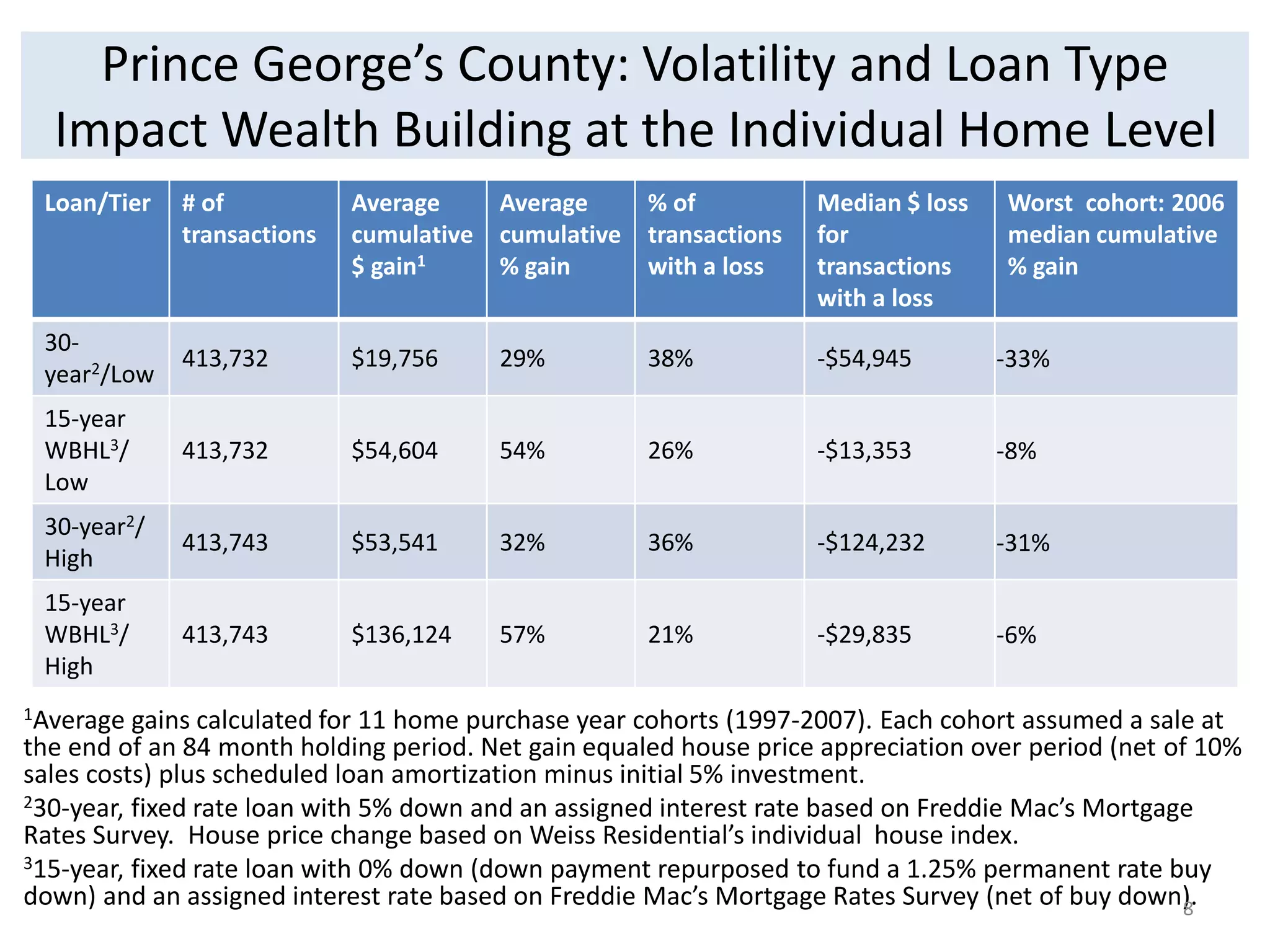
Prince George’s County: Volatility and Loan Type 
Impact Wealth Building at the Individual Home Level 
Loan/Tier # of 
transactions 
Average 
cumulative 
$ gain1 
Average 
cumulative 
% gain 
% of 
transactions 
with a loss 
Median $ loss 
for 
transactions 
with a loss 
Worst cohort: 2006 
median cumulative 
% gain 
30- 
year2/Low 
413,732 $19,756 29% 38% -$54,945 -33% 
15-year 
WBHL3/ 
Low 
413,732 $54,604 54% 26% -$13,353 -8% 
30-year2/ 
High 
413,743 $53,541 32% 36% -$124,232 -31% 
15-year 
WBHL3/ 
High 
413,743 $136,124 57% 21% -$29,835 -6% 
1Average gains calculated for 11 home purchase year cohorts (1997-2007). Each cohort assumed a sale at 
the end of an 84 month holding period. Net gain equaled house price appreciation over period (net of 10% 
sales costs) plus scheduled loan amortization minus initial 5% investment. 
230-year, fixed rate loan with 5% down and an assigned interest rate based on Freddie Mac’s Mortgage 
Rates Survey. House price change based on Weiss Residential’s individual house index. 
315-year, fixed rate loan with 0% down (down payment repurposed to fund a 1.25% permanent rate buy 
down) and an assigned interest rate based on Freddie Mac’s Mortgage Rates Survey (net of buy down). 8
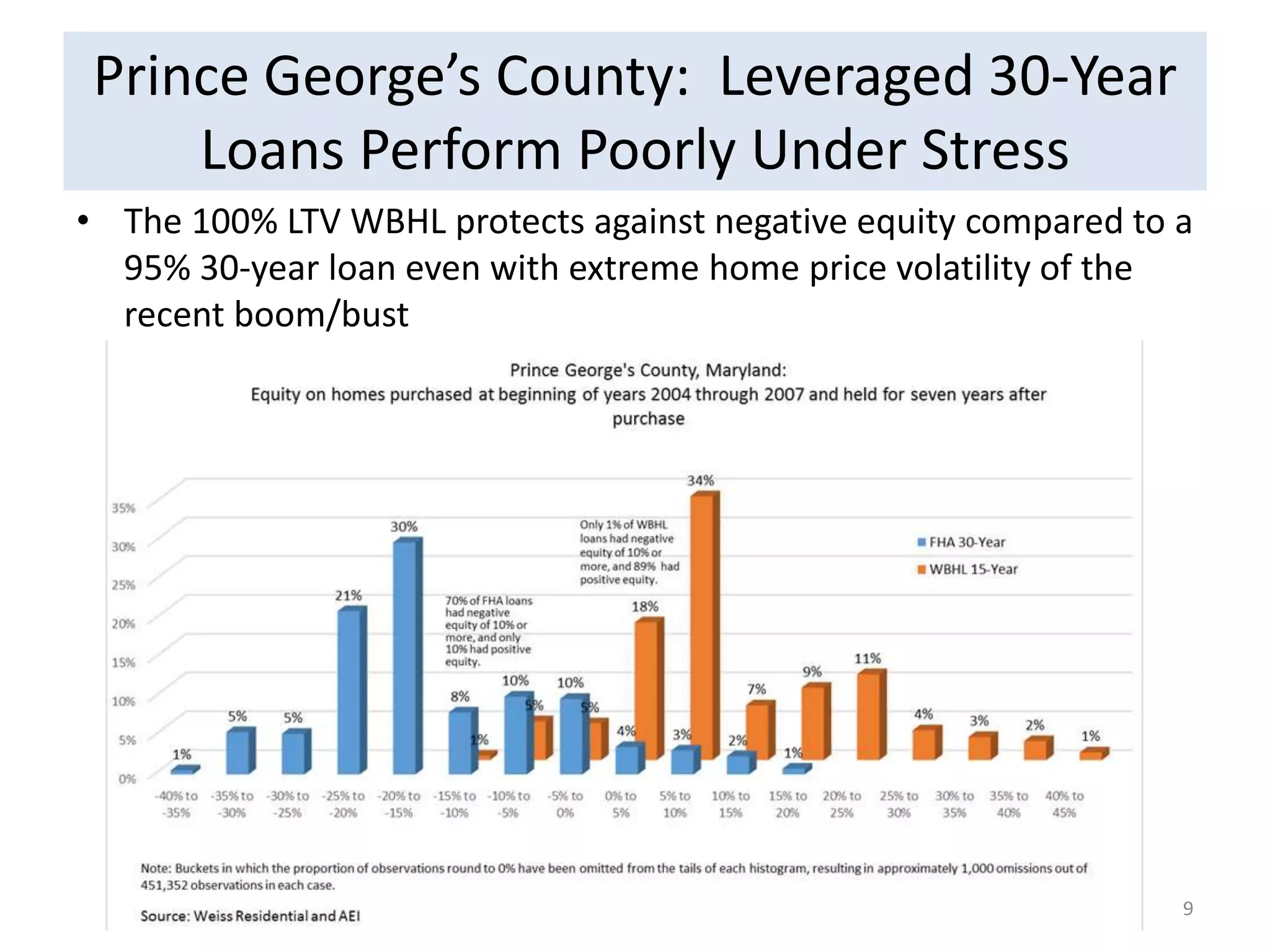
Prince George’s County: Leveraged 30-Year 
Loans Perform Poorly Under Stress 
• The 100% LTV WBHL protects against negative equity compared to a 
95% 30-year loan even with extreme home price volatility of the 
recent boom/bust 
9
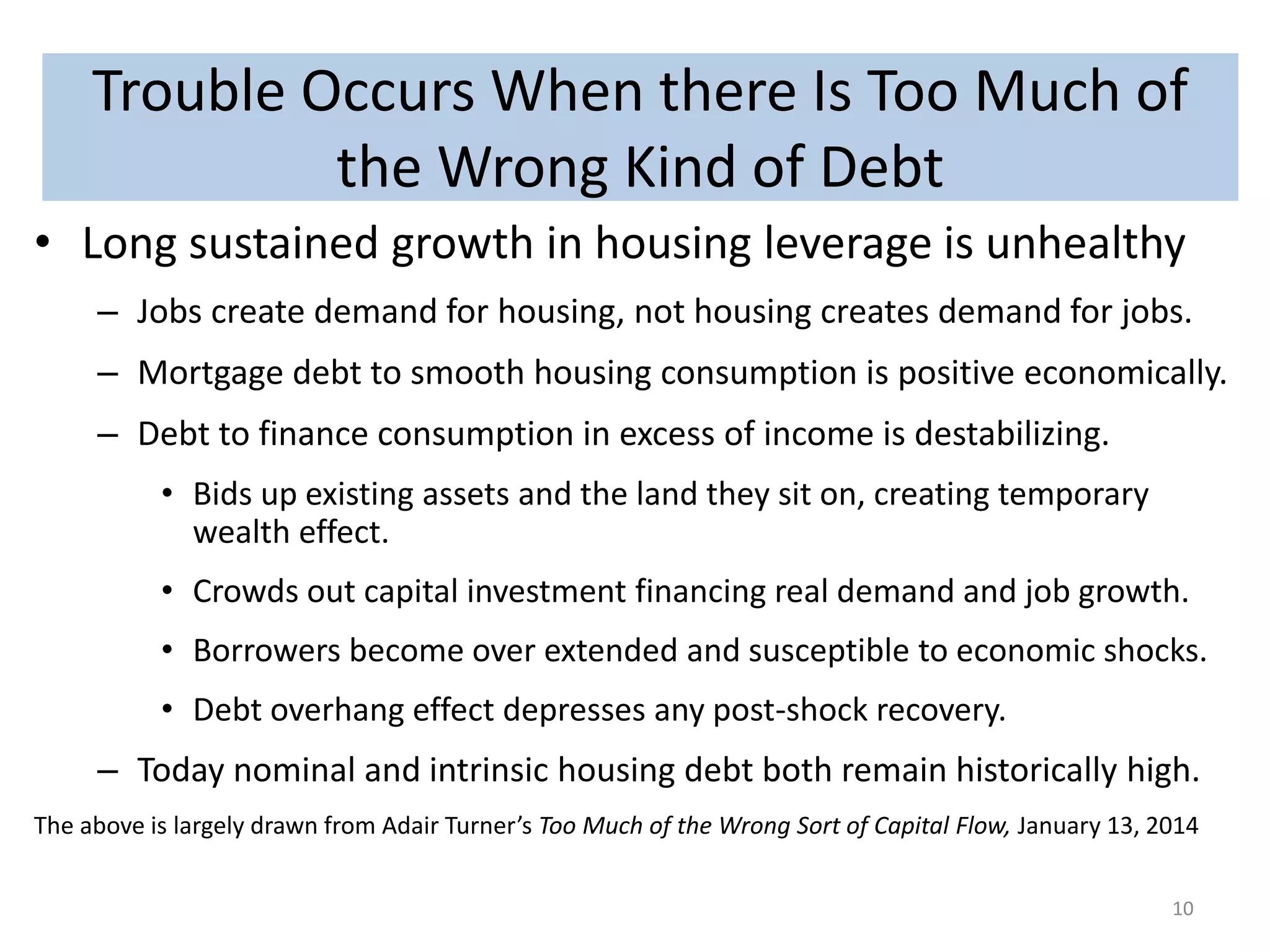
Trouble Occurs When there Is Too Much of 
the Wrong Kind of Debt 
• Long sustained growth in housing leverage is unhealthy 
– Jobs create demand for housing, not housing creates demand for jobs. 
– Mortgage debt to smooth housing consumption is positive economically. 
– Debt to finance consumption in excess of income is destabilizing. 
• Bids up existing assets and the land they sit on, creating temporary 
wealth effect. 
• Crowds out capital investment financing real demand and job growth. 
• Borrowers become over extended and susceptible to economic shocks. 
• Debt overhang effect depresses any post-shock recovery. 
– Today nominal and intrinsic housing debt both remain historically high. 
The above is largely drawn from Adair Turner’s Too Much of the Wrong Sort of Capital Flow, January 13, 2014 
10
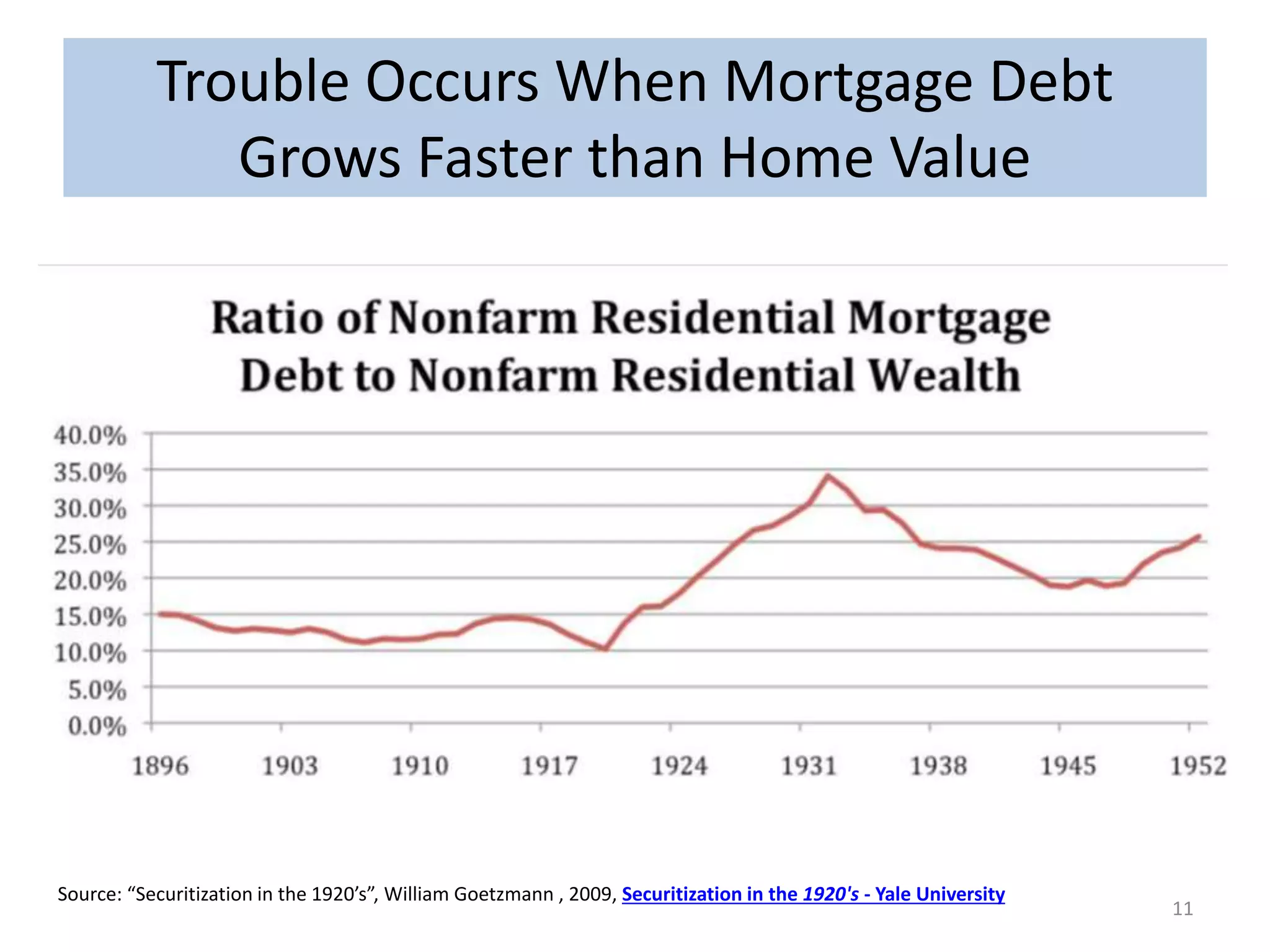
Source: “Securitization in the 1920’s”, William Goetzmann , 2009, Securitization in the 1920's - Yale University 
11 
Trouble Occurs When Mortgage Debt 
Grows Faster than Home Value
Trouble Occurs When Loan to Value Grows 
Faster than Fundamentals 
12
Leverage Leverage takes takes many forms 
forms 
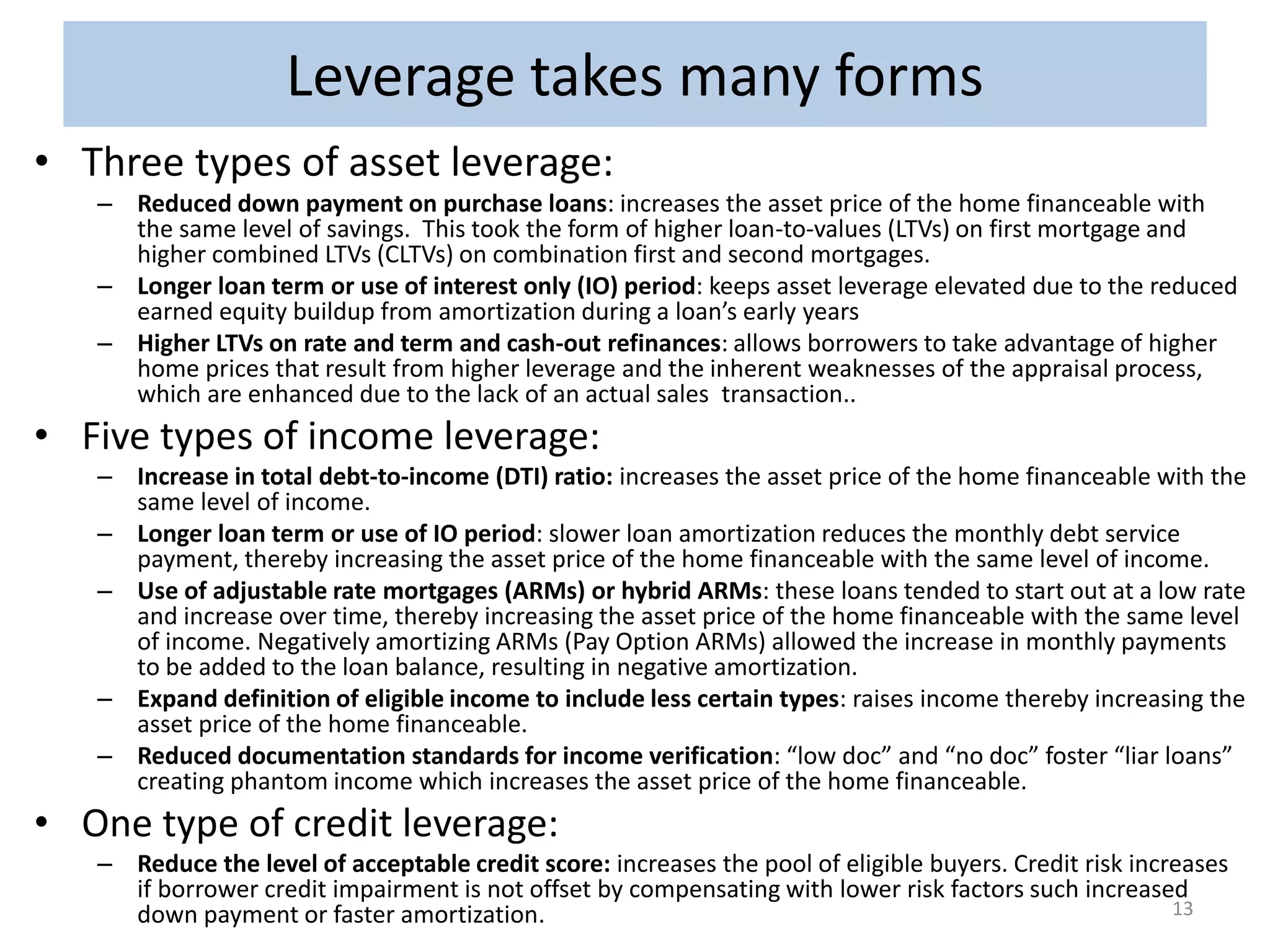
• Three types of asset leverage: 
– Reduced down payment on purchase loans: increases the asset price of the home financeable with 
the same level of savings. This took the form of higher loan-to-values (LTVs) on first mortgage and 
higher combined LTVs (CLTVs) on combination first and second mortgages. 
– Longer loan term or use of interest only (IO) period: keeps asset leverage elevated due to the reduced 
earned equity buildup from amortization during a loan’s early years 
– Higher LTVs on rate and term and cash-out refinances: allows borrowers to take advantage of higher 
home prices that result from higher leverage and the inherent weaknesses of the appraisal process, 
which are enhanced due to the lack of an actual sales transaction.. 
• Five types of income leverage: 
– Increase in total debt-to-income (DTI) ratio: increases the asset price of the home financeable with the 
same level of income. 
– Longer loan term or use of IO period: slower loan amortization reduces the monthly debt service 
payment, thereby increasing the asset price of the home financeable with the same level of income. 
– Use of adjustable rate mortgages (ARMs) or hybrid ARMs: these loans tended to start out at a low rate 
and increase over time, thereby increasing the asset price of the home financeable with the same level 
of income. Negatively amortizing ARMs (Pay Option ARMs) allowed the increase in monthly payments 
to be added to the loan balance, resulting in negative amortization. 
– Expand definition of eligible income to include less certain types: raises income thereby increasing the 
asset price of the home financeable. 
– Reduced documentation standards for income verification: “low doc” and “no doc” foster “liar loans” 
creating phantom income which increases the asset price of the home financeable. 
• One type of credit leverage: 
– Reduce the level of acceptable credit score: increases the pool of eligible buyers. Credit risk increases 
if borrower credit impairment is not offset by compensating with lower risk factors such increased 
down payment or faster amortization. 13
Ignoring expenses adds to leverage 
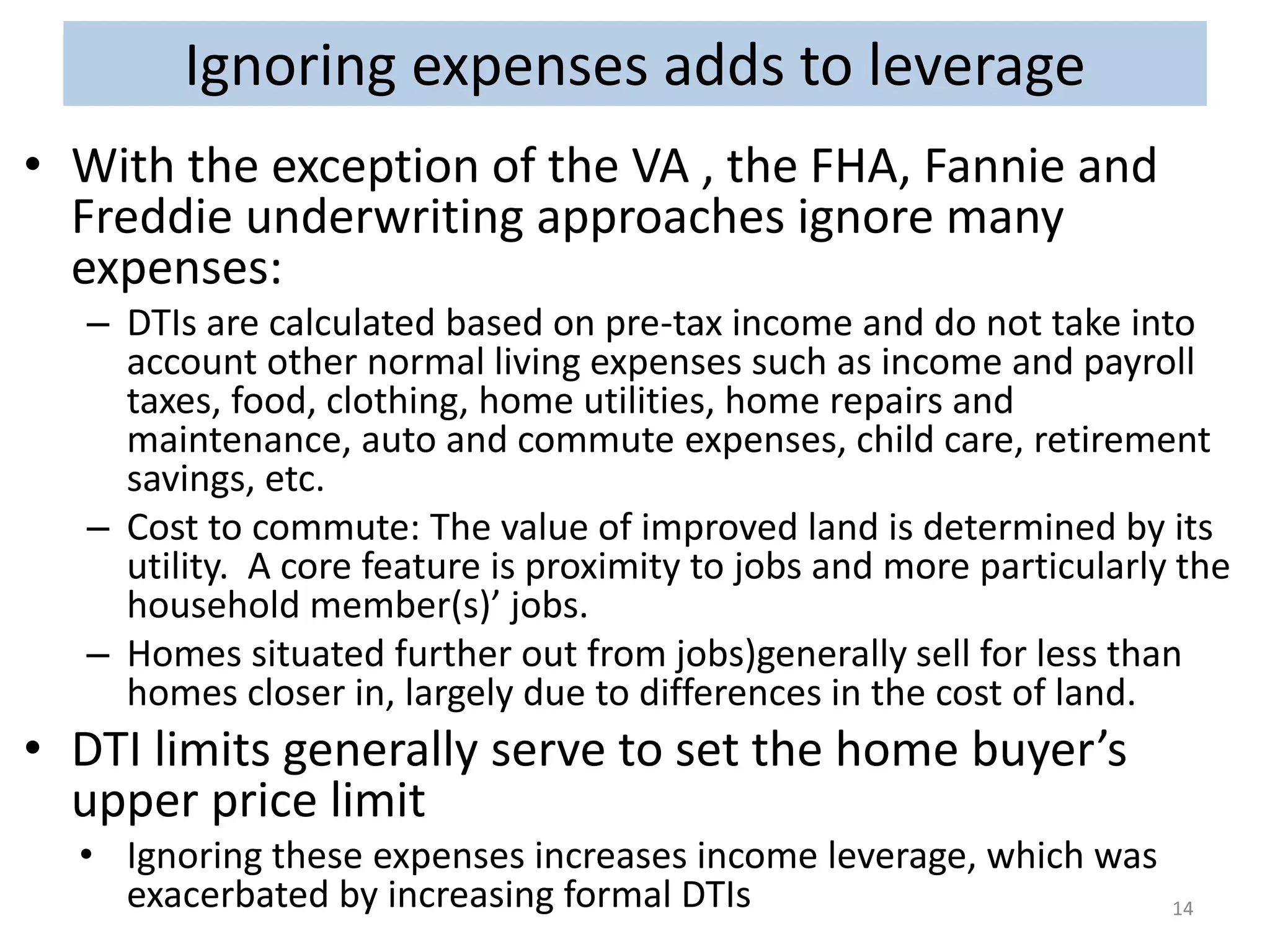
• With the exception of the VA , the FHA, Fannie and 
Freddie underwriting approaches ignore many 
expenses: 
– DTIs are calculated based on pre-tax income and do not take into 
account other normal living expenses such as income and payroll 
taxes, food, clothing, home utilities, home repairs and 
maintenance, auto and commute expenses, child care, retirement 
savings, etc. 
– Cost to commute: The value of improved land is determined by its 
utility. A core feature is proximity to jobs and more particularly the 
household member(s)’ jobs. 
– Homes situated further out from jobs)generally sell for less than 
homes closer in, largely due to differences in the cost of land. 
• DTI limits generally serve to set the home buyer’s 
upper price limit 
• Ignoring these expenses increases income leverage, which was 
exacerbated by increasing formal DTIs 14
EVOLUTION OF APPRAISAL AND 
LENDING THEORY AND PRACTICE 
15
1890 to 1920s: Ely Advances Early US Research on 
Land Economics and Appraisal Theory and Practice 
• University of Wisconsin Professor Richard T. Ely ("Under all, 
the land”) recognizes land use as the product of economics, 
institutional forces, and physical constraints (1854-1943). 
– Studied at the University of Heidelberg (1878-1879) with, Karl 
Knies (1821-1898), a leading historical economist , who: 
• Authors Money and Credit (1873). 
• Advances concepts of “value in use” and “value in exchange (price)” 
– 1892-1925: Professor of political economy and director of the 
School of Economics, Political Science, and History, University of 
Wisconsin 
• “Father of Land Economics” and real estate studies. 
• 1920: Establishes the Institute for Research in Land Economics and 
Public Utilities 16
1903: Hurd - Principles of City Land Values 
• 1903: The Principles of City Land Values (Richard M. Hurd, 1865- 
1941)--considered first United States’ treatise on city (non-farm) 
land values. 
– While intrinsic value is correctly derived by capitalizing ground rent, exchange value 
may differ widely from it. 
– Value in urban land, as in farm land, results from economic or ground rent 
capitalized. 
– Since value depends on economic rent, and rent on location, and location on 
convenience, and convenience on nearness, the intermediate steps may be 
eliminated and say that value depends on nearness. 
– In cities, economic rent is based on the superiority of location only, the sole function 
of urban land being to furnish area on which to erect buildings. 
– Land prices on the outskirts are lower as area increases as the square of the distance 
from any given point. 
– If a new utility does not arise, exchange prices may advance and recede, while 
intrinsic values do not change. 
– If a new utility arises, both exchange prices and intrinsic values will alter their 
levels. 
– General financial and economic conditions enter so largely into exchange values, that 
values are at times not based on income, or supply and demand, but represent 
simply a condition of the public mind. 
17
1920s: Ely and Colleagues Continue Working on 
Land Economics and Appraisal Theory and Practice 
• Books by individuals that Ely collaborates with, trains, 
or are within his circle of influence: 
– 1923: Ernest Fisher (1893-1981), student of Ely and member of 
Ely’s Institute, writes Principles of Real Estate Practice (edited 
by Ely and published by the Institute). 
– 1924: Frederick Babcock (1897-1983) writes The Appraisal of 
Real Estate (1st generalized appraisal book and part of Ely’s Land 
Economics Series) 
18
1920’s: Lending and Appraisal Practice 
• The concept of intrinsic value was largely forgotten, as lending 
became based on exchange value only.. 
• Property appraising largely the province of local real estate boards. 
– Boards comprised of those realtors who also held themselves out as 
appraisers. 
– There were neither training nor certification requirements. 
• Lending standards were loose. 
– In 1927-28, first mortgages were available at 100% of exchange value. 
– In 1927-28, second mortgages were available at 120% of exchange value. 
– Commonplace for mortgage underwriting to be based on the mortgaged 
collateral, ignoring income and credit. 
– Fraudulent lending and appraisal practices were rampant. 
– Mortgage backed bonds were relatively common-place (all failed in the 
1930s). 19
1930s: Ely’s Colleagues Lay Foundation for the FHA 
and Sustainable Lending Practices 
• Individuals Ely collaborates with, trains, or within circle of 
influence: 
– 1932: Frederick Babcock (1897-1983) writes The Valuation of Real Estate 
(considered to be the most significant appraisal book since Hurd’s in 1903). 
Ernest Fisher helped Babcock with this second book as both were at the 
University of Michigan in the early 1930s. 
– 1933: Homer Hoyt (1895-1984) receives PhD (U. of Chicago), publishes his 
dissertation, 100 Years of Land Values in Chicago (influenced by Chicago-based 
research done by Institute members). Writes The Structure and 
Growth of Residential Neighborhoods in American Cities (1939) with Ernest 
Fisher and Principles of Urban Real Estate with Arthur Weimar (1939). 
– Early-1930s: Richard Ratcliff (1906-1980), student of Richard Ely and Ernest 
Fisher. Writes Urban Land Economics (1949). 
– 1934: Arthur Weimer (1909-1987) receives PhD (U. of Chicago). Writes 
Principles of Urban Real Estate with Hoyt (1939). 
– Fisher (Chief Economist), Babcock (Chief Underwriter), Hoyt (chief housing 
economist), Ratcliff (economist), and Weimer (economist) are all at FHA 
starting in 1934. 
20
FHA and Sustainable Lending 
• 1935: “‘Mortgage’ was just another word for trouble—an epitaph 
on the tombstone of their aspirations for home ownership.”* 
– Replaces loose and dangerous lending practices that had made foreclosures 
commonplace with “a straight, broad highway to debt-free ownership.”* 
• “[s]uccessful mortgage lending must be predicated upon a measurement of risk 
factors in mortgage investment. Mortgage risk comes into existence in the 
moment mortgage funds are disbursed to a borrower. The risk continues until 
there has been a complete recapture of the money which has been lent. This risk 
is greater in some loans than in others. It differs from time to time for each loan. 
The best we can hope to do is establish a method by means of which to estimate 
the degree of risk at the time the loan is submitted. If the measurement of risk 
indicates hazards which are too great, the institution must necessarily refuse to 
make the loan. In other cases it is highly important that the institution 
determine not only that it is willing to make the loan but the intrinsic quality of 
the loan as a portion of its mortgage portfolio.” Frederick M Babcock, FHA’s first 
chief underwriter 
– Sound lending practices include: 
• A sizable down payments (a minimum of 20%) and a maximum 20-year term; 
• Solid borrower credit histories and solid appraisals; 
• Ability to pay (imposed on FHA by the1934 National Housing Act): proper 
income documentation and sufficient income to make regular payments 
(includes review of a borrower’s monthly expenses and residual income); 
• Fully amortized loan with a ban on second mortgages. 
* Federal Housing Administration, “How to Have the Home You Want,” 1936. 
21
A Broad, Straight Highway to Debt-free Home 
Ownership 
• In 1935 FHA provided a “broad, straight highway to debt-free home ownership” 
• The homeownership rate soared from 44% in 1940 to 62% in 1960 
• The 30-year loan played a minimal role throughout 1940-1960 
– Role limited to FHA and VA new construction in the latter part of the 1950’s 
• The Debt-Free Highway enabled the Greatest Generation to burn their mortgages 
*Source: John P. Herzog and James S. Earley, Home Mortgage Delinquency and Foreclosure. 
22
FHA and Sustainable Lending 
• FHA’s highway to debt-free ownership led to: 
– An explosion in the homeownership rate 
• From 43.6 percent in 1940 to 61.9 percent in 1960 
– The virtual elimination of foreclosures 
• Over its first 20 years, the FHA paid only 5,712 claims 
out of 2.9 million insured mortgages, for a cumulative 
claims rate of 0.2 percent. 
• Claim loss severity was 9 percent of the original 
insured mortgage balance, or a total of $3 million on 
5,712 claims.* 
*Thomas N. Herzog, A Brief History of Mortgage Finance with an Emphasis on Mortgage Insurance, Society of Actuaries, 2009, 
www.soa.org/library/monographs/finance/housing-wealth/2009/september/mono-2009-mfi09-herzog-history-comments.pdf. 
23
Basis for FHA’s Valuation Theory 
• Babcock in his The Valuation of Real Estate (1932) 
establishes the concept of warranted value. 
– Fair market value would then be the price which a buyer were 
warranted in paying in view of the potential utility of the property. 
The fact that several hundred purchasers have been found who were 
willing to buy certain undesirable subdivision lots at exorbitant prices 
would in no way be presentable as evidence of market value. 
– Value will be used to designate the concept in which the thoroughly 
informed buyer is present and market price will be used to designate 
the prices which properties actually do bring in the real estate 
market. 
• In 1934 Babcock becomes Chief Underwriter for FHA and 
proceeds to implement his concept of warranted value. 
24
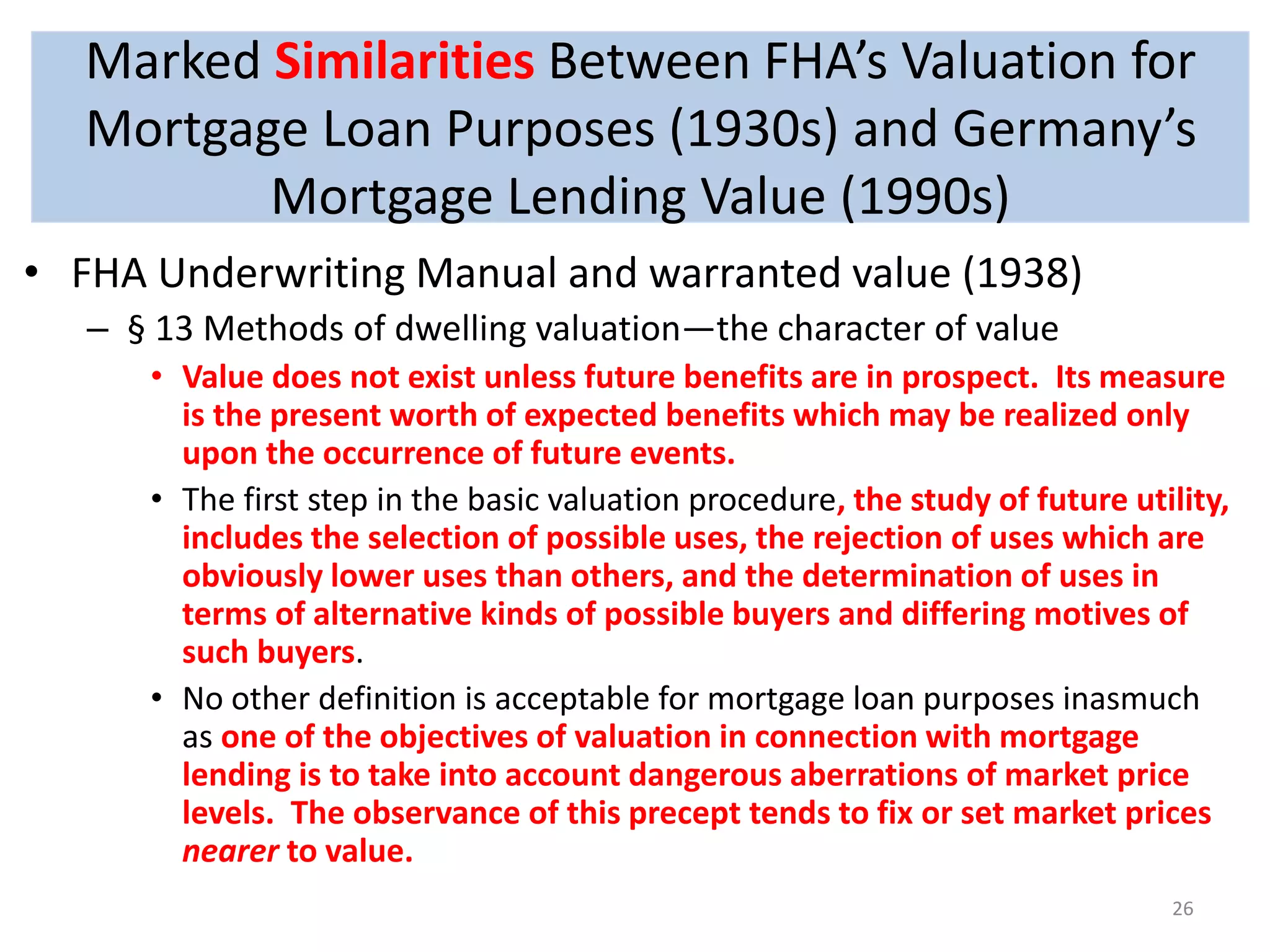
Marked Similarities Between FHA’s Valuation for 
Mortgage Loan Purposes (1930s) and Germany’s 
Mortgage Lending Value (1990s) 
• FHA Underwriting Manual and warranted value (1938) 
– § 13 Methods of dwelling valuation—the character of value 
• The word “value” refers to the price which a purchaser is warranted in 
paying for a property for continued use or a long-term investment. 
• The value to be estimated, therefore, is the probable price which typical 
buyers are warranted in paying. 
• This valuation is sometimes hypothetical in character, especially under 
market conditions where abnormalities in price levels indicate the 
presence of serious quantitative differentials the two value concepts 
[warranted value and available market price]. 
• Marked differences between “available market prices” and “values” will 
be evident under both boom and depression conditions of market. 
• Attention is directed to the fact that speculative elements cannot be 
considered as enhancing the security of residential loans. On the 
contrary, such elements enhance the risk of loss to mortgagees who 
permit them to creep into the valuations of properties upon which they 
make loans. 
25
Marked Similarities Between FHA’s Valuation for 
Mortgage Loan Purposes (1930s) and Germany’s 
Mortgage Lending Value (1990s) 
• FHA Underwriting Manual and warranted value (1938) 
– § 13 Methods of dwelling valuation—the character of value 
• Value does not exist unless future benefits are in prospect. Its measure 
is the present worth of expected benefits which may be realized only 
upon the occurrence of future events. 
• The first step in the basic valuation procedure, the study of future utility, 
includes the selection of possible uses, the rejection of uses which are 
obviously lower uses than others, and the determination of uses in 
terms of alternative kinds of possible buyers and differing motives of 
such buyers. 
• No other definition is acceptable for mortgage loan purposes inasmuch 
as one of the objectives of valuation in connection with mortgage 
lending is to take into account dangerous aberrations of market price 
levels. The observance of this precept tends to fix or set market prices 
nearer to value. 
26
Marked Similarities Between FHA’s Valuation for 
Mortgage Loan Purposes (1930s) and Germany’s 
Mortgage Lending Value (1990s) 
• From Pfandbrief Act 
– § 3 Principle of the determination of the mortgage lending value 
(1) The value on which the lending is based (mortgage lending value) is the 
value of the property which based on experience may throughout the life 
of the lending be expected to be generated in the event of sale, 
unattached by temporary, e.g. economically induced, fluctuations in 
value on the relevant property market and excluding speculative 
elements. 
(2) To determine the mortgage lending value, the future marketability of 
the property is to be taken as a basis within the scope of a prudent 
valuation, by taking into account long-term sustainable aspects of the 
property, the normal and local market conditions, the current use and 
alternative appropriate uses of the property. 
27
DEVOLUTION OF APPRAISAL AND 
LENDING THEORY AND PRACTICE 
28
1930s to Today – Policy Pressures to Increase All 
Forms of Leverage 
• Late-1930s on: Congress raises FHA leverage limits 
– FHA’s underwriting grid and valuation practices limit layering of risk for 20 
years 
• 1992 and on: Congress places Fannie and Freddie in competition 
with FHA and private subprime 
• The result is a ‘curious’ policy whereby low income home buyers 
with volatile incomes are encouraged to buy homes in areas with 
volatile prices using high leverage 
• Policies based on a view that “[o]ne unique aspect of 
homeownership is that it is one of the few leveraged 
investments available to households with little wealth, 
enabling homeowners with very little equity in their homes to 
benefit from appreciation in the overall home value.”1 
1Herbert and Belsky, 2008, The Homeownership Experience of Low-Income and Minority Households: A Review 
and Synthesis of the Literature, Cityscape: A Journal of Policy Development and Research 
• T 
29
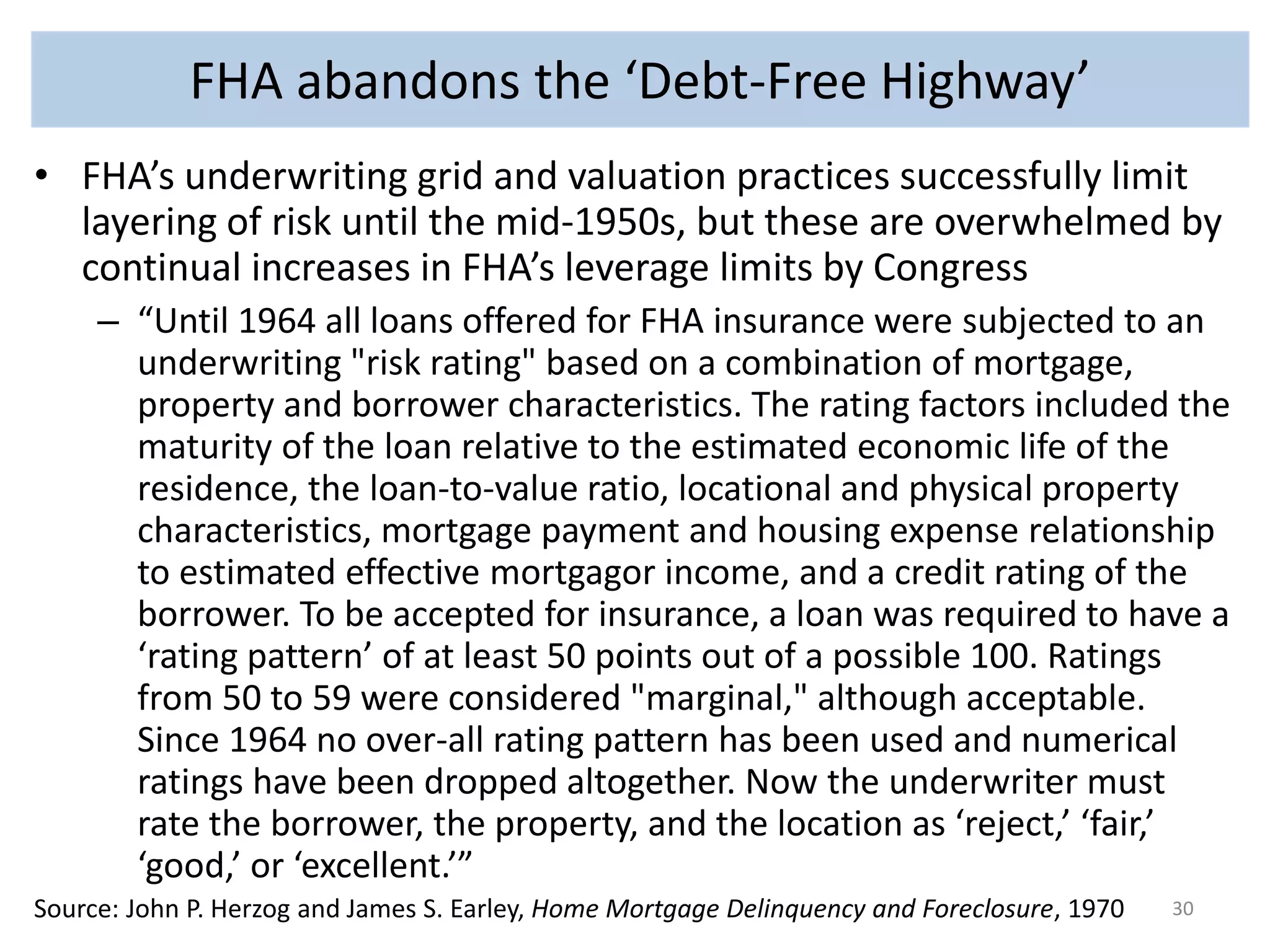
FHA abandons the ‘Debt-Free Highway’ 
• FHA’s underwriting grid and valuation practices successfully limit 
layering of risk until the mid-1950s, but these are overwhelmed by 
continual increases in FHA’s leverage limits by Congress 
– “Until 1964 all loans offered for FHA insurance were subjected to an 
underwriting "risk rating" based on a combination of mortgage, 
property and borrower characteristics. The rating factors included the 
maturity of the loan relative to the estimated economic life of the 
residence, the loan-to-value ratio, locational and physical property 
characteristics, mortgage payment and housing expense relationship 
to estimated effective mortgagor income, and a credit rating of the 
borrower. To be accepted for insurance, a loan was required to have a 
‘rating pattern’ of at least 50 points out of a possible 100. Ratings 
from 50 to 59 were considered "marginal," although acceptable. 
Since 1964 no over-all rating pattern has been used and numerical 
ratings have been dropped altogether. Now the underwriter must 
rate the borrower, the property, and the location as ‘reject,’ ‘fair,’ 
‘good,’ or ‘excellent.’” 
Source: John P. Herzog and James S. Earley, Home Mortgage Delinquency and Foreclosure, 1970 30
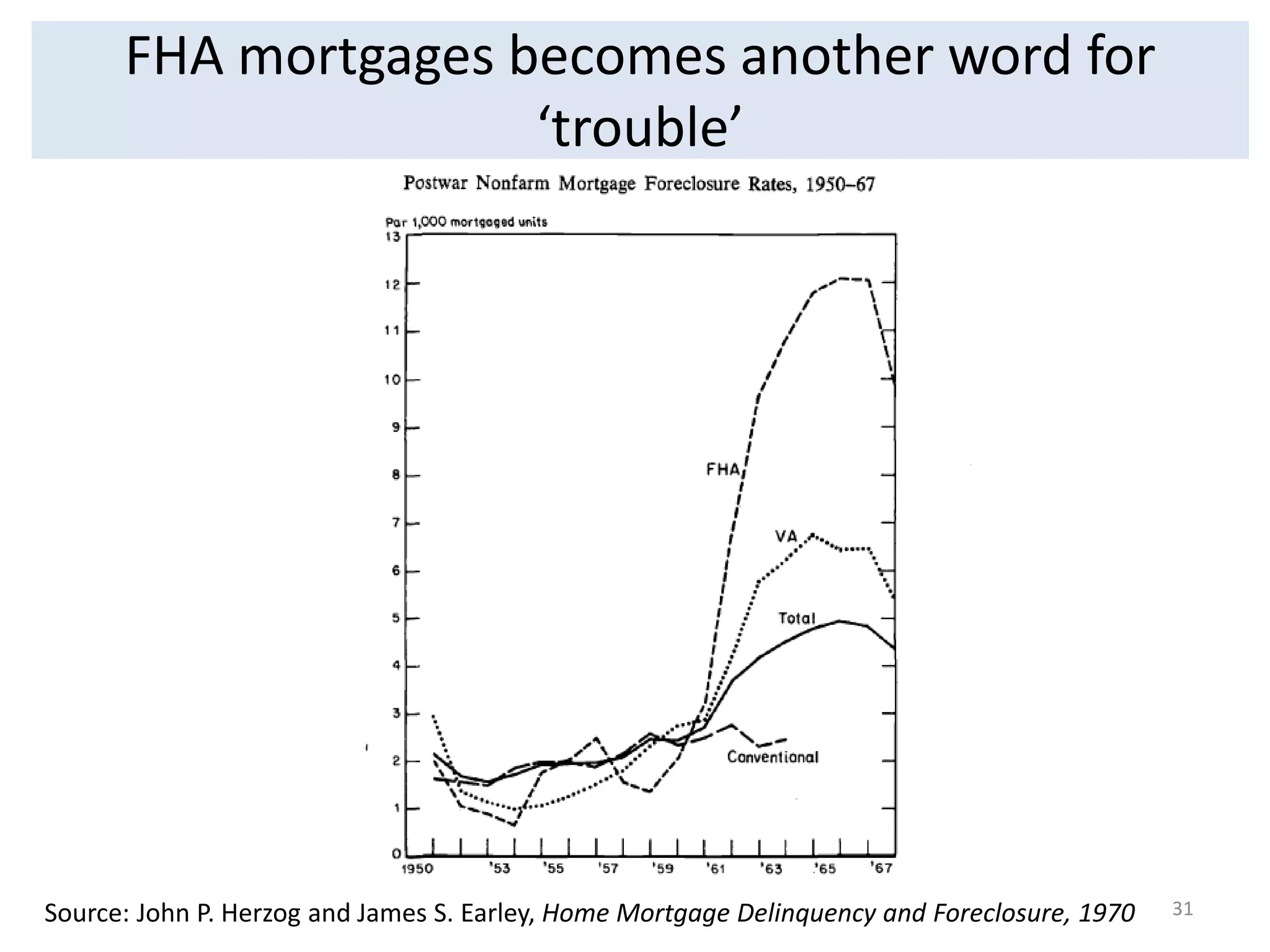
FHA mortgages becomes another word for 
‘trouble’ 
Source: John P. Herzog and James S. Earley, Home Mortgage Delinquency and Foreclosure, 1970 31
FHA mortgages = ‘trouble’: 
3.39 million foreclosures and 1 in 8 families 
FHA’s WEIGHTED AVERAGE FORECLOSURE CLAIM RATE OF 12.8% FOR 1975-2013 
| 32
1930s to Today – Competing Valuation Theories 
• FHA’s warranted value/German Mortgage Lending Value 
• Exchange value/price , point-in-time value/price, or market 
value/price. 
– Over time this approach received support from the rational pricing 
theory. 
• The same asset must trade at the same price on all markets. 
• Reconciliation of the three approaches: market, income, and 
cost. 
– These derived from classical economic theory based on the three 
aspects of value. 
33
1992: CONGRESS MANDATES 
FANNIE AND FREDDIE TO COMPETE 
WITH FHA AND SUBPRIME 
34
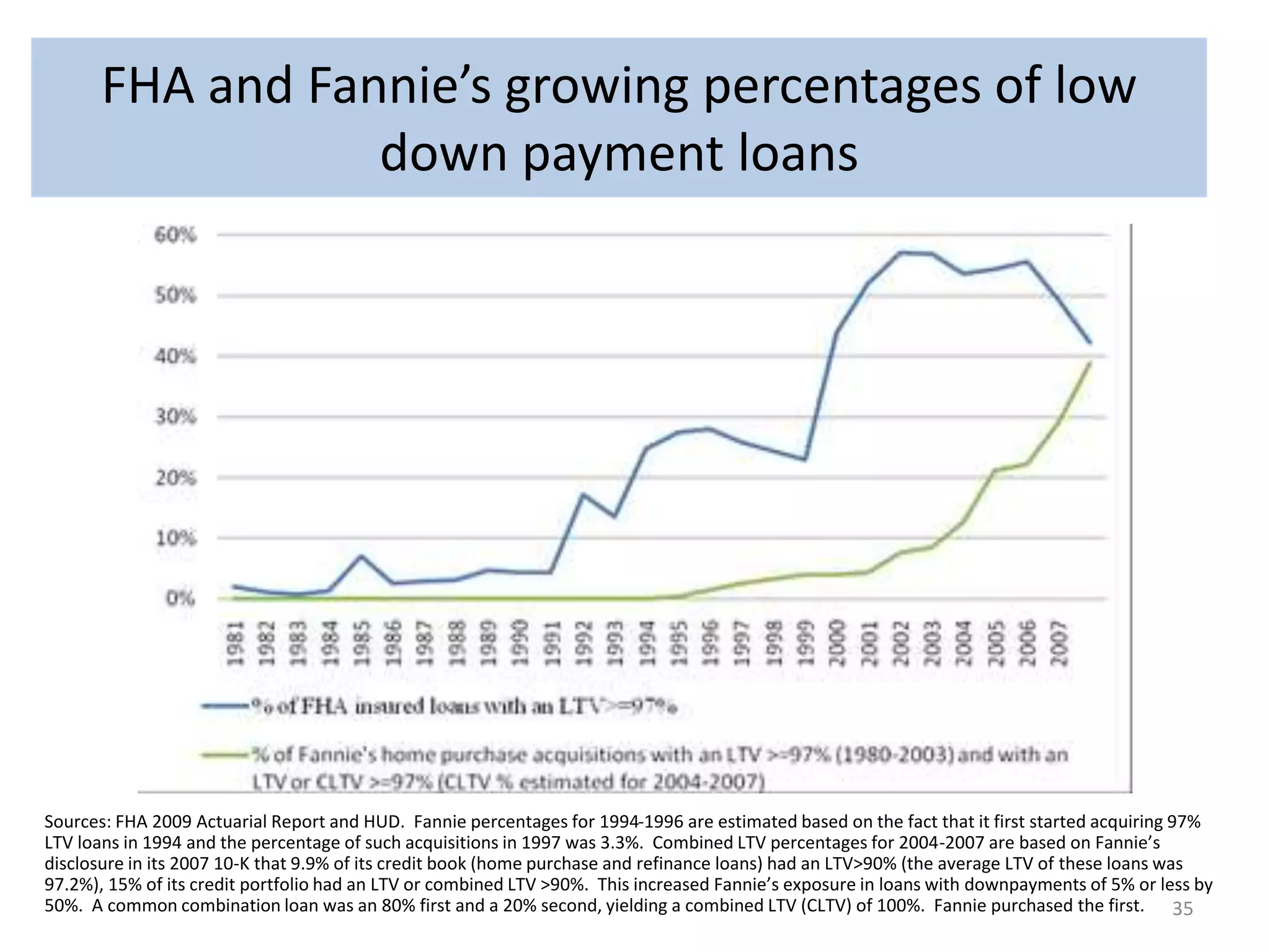
FHA and Fannie’s growing percentages of low 
down payment loans 
Sources: FHA 2009 Actuarial Report and HUD. Fannie percentages for 1994-1996 are estimated based on the fact that it first started acquiring 97% 
LTV loans in 1994 and the percentage of such acquisitions in 1997 was 3.3%. Combined LTV percentages for 2004-2007 are based on Fannie’s 
disclosure in its 2007 10-K that 9.9% of its credit book (home purchase and refinance loans) had an LTV>90% (the average LTV of these loans was 
97.2%), 15% of its credit portfolio had an LTV or combined LTV >90%. This increased Fannie’s exposure in loans with downpayments of 5% or less by 
50%. A common combination loan was an 80% first and a 20% second, yielding a combined LTV (CLTV) of 100%. Fannie purchased the first. 35
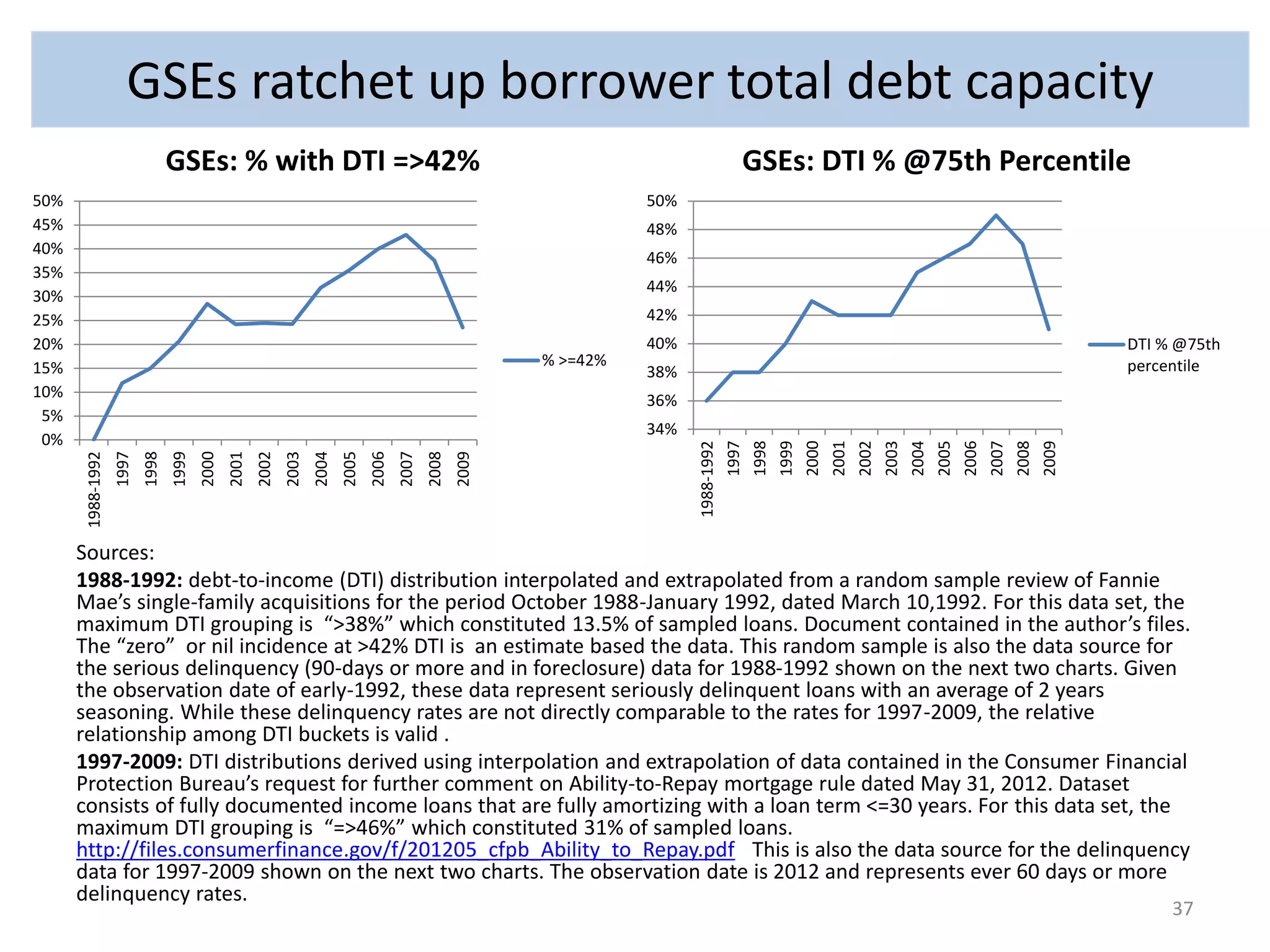
• The first panel on the next page demonstrates 
that the percentage of verified DTIs >42% 
increased dramatically from the late- 
1980s/early-1990s when it was effectively 0% to 
43% for 2007. 
• The second panel presents the data in a slightly 
different format. It demonstrates that the DTI 
percentage at the 75th percentile increased from 
a 36% DTI in the late-1980s/early-1990s to a 
49% DTI in 2007. 
36 
DTIs in excess of traditional levels become 
commonplace for the GSEs
GSEs ratchet up borrower total debt capacity 
GSEs: % with DTI =>42% 
50% 
48% 
46% 
44% 
42% 
40% 
38% 
36% 
GSEs: DTI % @75th Percentile 
Sources: 
1988-1992: debt-to-income (DTI) distribution interpolated and extrapolated from a random sample review of Fannie 
Mae’s single-family acquisitions for the period October 1988-January 1992, dated March 10,1992. For this data set, the 
maximum DTI grouping is “>38%” which constituted 13.5% of sampled loans. Document contained in the author’s files. 
The “zero” or nil incidence at >42% DTI is an estimate based the data. This random sample is also the data source for 
the serious delinquency (90-days or more and in foreclosure) data for 1988-1992 shown on the next two charts. Given 
the observation date of early-1992, these data represent seriously delinquent loans with an average of 2 years 
seasoning. While these delinquency rates are not directly comparable to the rates for 1997-2009, the relative 
relationship among DTI buckets is valid . 
1997-2009: DTI distributions derived using interpolation and extrapolation of data contained in the Consumer Financial 
Protection Bureau’s request for further comment on Ability-to-Repay mortgage rule dated May 31, 2012. Dataset 
consists of fully documented income loans that are fully amortizing with a loan term <=30 years. For this data set, the 
maximum DTI grouping is “=>46%” which constituted 31% of sampled loans. 
http://files.consumerfinance.gov/f/201205_cfpb_Ability_to_Repay.pdf This is also the data source for the delinquency 
data for 1997-2009 shown on the next two charts. The observation date is 2012 and represents ever 60 days or more 
delinquency rates. 
37 
50% 
45% 
40% 
35% 
30% 
25% 
20% 
15% 
10% 
5% 
0% 
1988-1992 
1997 
1998 
1999 
2000 
2001 
2002 
2003 
2004 
2005 
2006 
2007 
2008 
2009 
% >=42% 
34% 
1988-1992 
1997 
1998 
1999 
2000 
2001 
2002 
2003 
2004 
2005 
2006 
2007 
2008 
2009 
DTI % @75th 
percentile
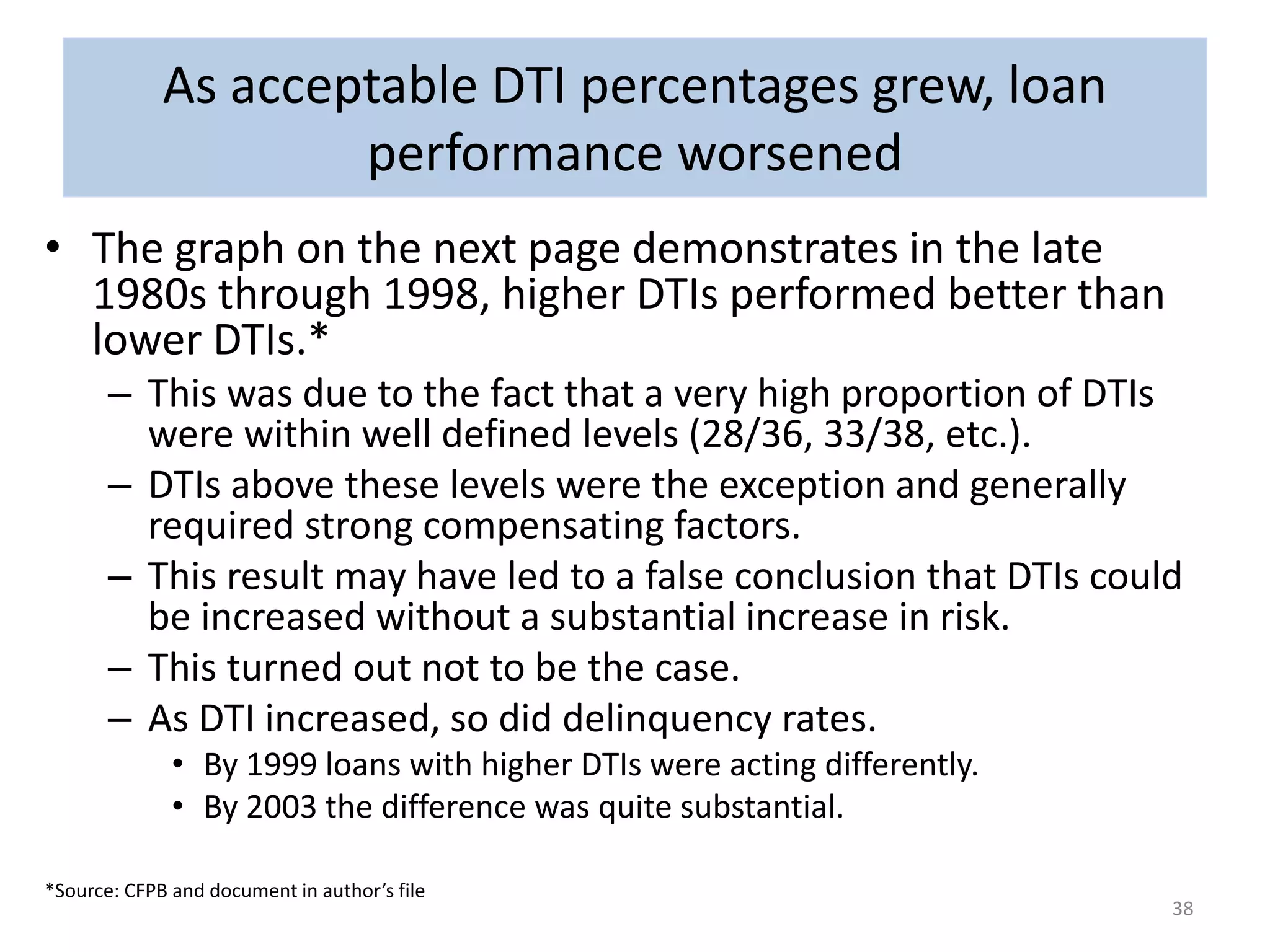
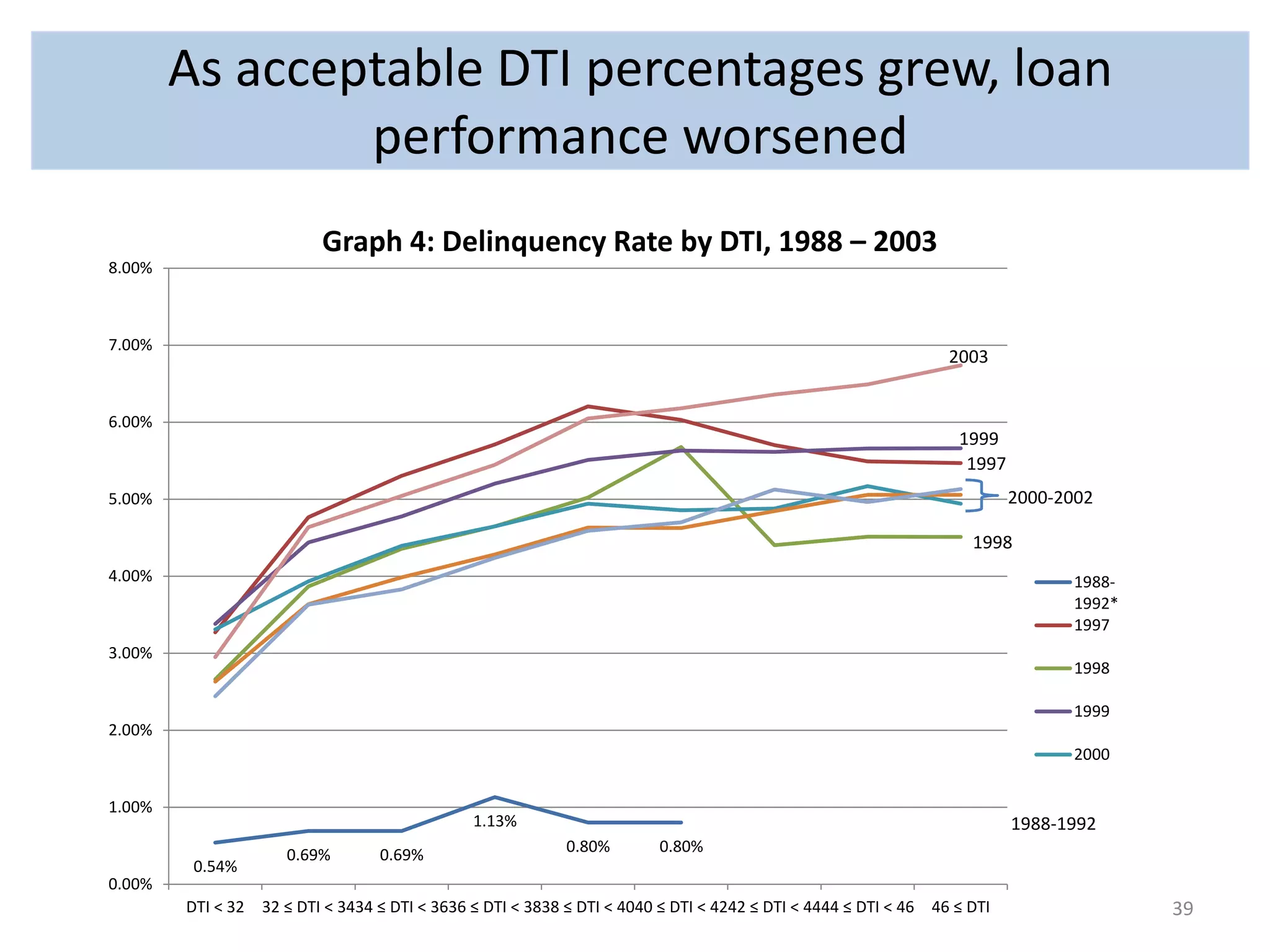
• The graph on the next page demonstrates in the late 
1980s through 1998, higher DTIs performed better than 
lower DTIs.* 
– This was due to the fact that a very high proportion of DTIs 
were within well defined levels (28/36, 33/38, etc.). 
– DTIs above these levels were the exception and generally 
required strong compensating factors. 
– This result may have led to a false conclusion that DTIs could 
be increased without a substantial increase in risk. 
– This turned out not to be the case. 
– As DTI increased, so did delinquency rates. 
• By 1999 loans with higher DTIs were acting differently. 
• By 2003 the difference was quite substantial. 
*Source: CFPB and document in author’s file 
38 
As acceptable DTI percentages grew, loan 
performance worsened
39 
As acceptable DTI percentages grew, loan 
0.54% 
Graph 4: Delinquency Rate by DTI, 1988 – 2003 
0.69% 0.69% 
1.13% 
0.80% 0.80% 
8.00% 
7.00% 
6.00% 
5.00% 
4.00% 
3.00% 
2.00% 
1.00% 
0.00% 
1997 
DTI < 32 32 ≤ DTI < 3434 ≤ DTI < 3636 ≤ DTI < 3838 ≤ DTI < 4040 ≤ DTI < 4242 ≤ DTI < 4444 ≤ DTI < 46 46 ≤ DTI 
2000-2002 
1988- 
1992* 
1997 
1998 
1999 
2000 
2003 
1999 
1998 
1988-1992 
performance worsened
• The graph on the next page demonstrates that this 
trend accelerated in 2004-2007. 
– For the 2007 cohort, loans with DTIs>46% experienced 
over 3 times the default rate of loans with DTIs <32%. 
– For the 2007 cohort 31% and 43% of loans had a DTI>46% 
and 42% respectively. 
– This was dramatic change from earlier years when the 
percentage of DTIs >42% was 15% or less. 
• Clearly DTI mattered when it comes to a borrower 
having a reasonable ability to repay. 
40 
As acceptable DTI percentages grew, loan 
performance deteriorated markedly
41 
As acceptable DTI percentages grew, loan 
performance deteriorated markedly 
0.54% 0.69% 0.69% 
Delinquency Rate by DTI 
1.13% 0.80% 0.80% 
35.00% 
30.00% 
25.00% 
20.00% 
15.00% 
10.00% 
5.00% 
0.00% 
DTI < 32 32 ≤ DTI < 34 34 ≤ DTI < 36 36 ≤ DTI < 38 38 ≤ DTI < 40 40 ≤ DTI < 42 42 ≤ DTI < 44 44 ≤ DTI < 46 46 ≤ DTI 
1988-1992* 
1997 
1998 
1999 
2000 
2001 
2002 
2003 
2004 
2005 
2006 
2007 
2007 
2006 
2005 
2004 
2003 
1997, 1999- 
1998 2002 
1988-1991
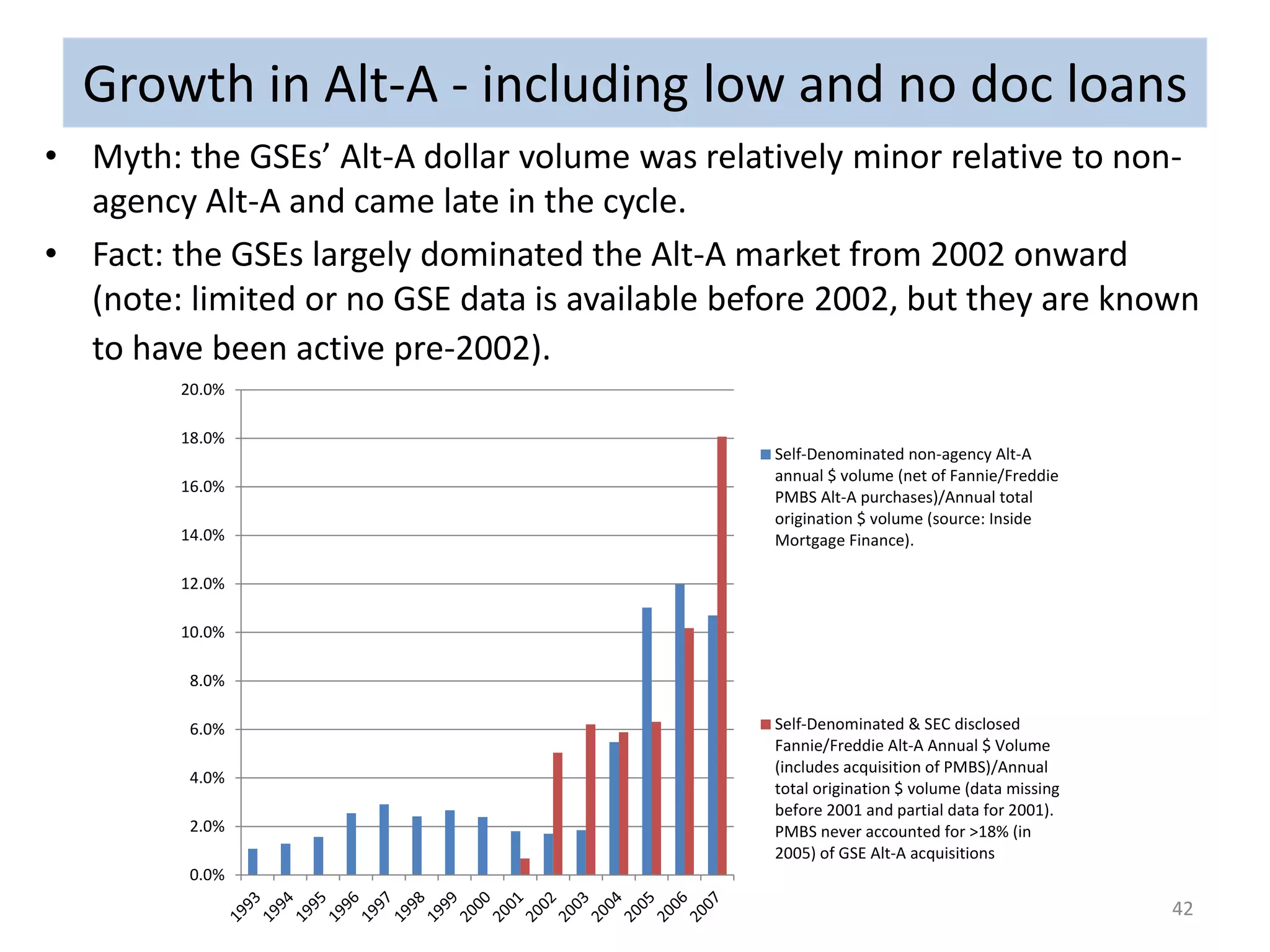
Growth in Alt-A - including low and no doc loans 
• Myth: the GSEs’ Alt-A dollar volume was relatively minor relative to non-agency 
Alt-A and came late in the cycle. 
• Fact: the GSEs largely dominated the Alt-A market from 2002 onward 
(note: limited or no GSE data is available before 2002, but they are known 
to have been active pre-2002). 
42 
20.0% 
18.0% 
16.0% 
14.0% 
12.0% 
10.0% 
8.0% 
6.0% 
4.0% 
2.0% 
0.0% 
Self-Denominated non-agency Alt-A 
annual $ volume (net of Fannie/Freddie 
PMBS Alt-A purchases)/Annual total 
origination $ volume (source: Inside 
Mortgage Finance). 
Self-Denominated & SEC disclosed 
Fannie/Freddie Alt-A Annual $ Volume 
(includes acquisition of PMBS)/Annual 
total origination $ volume (data missing 
before 2001 and partial data for 2001). 
PMBS never accounted for >18% (in 
2005) of GSE Alt-A acquisitions
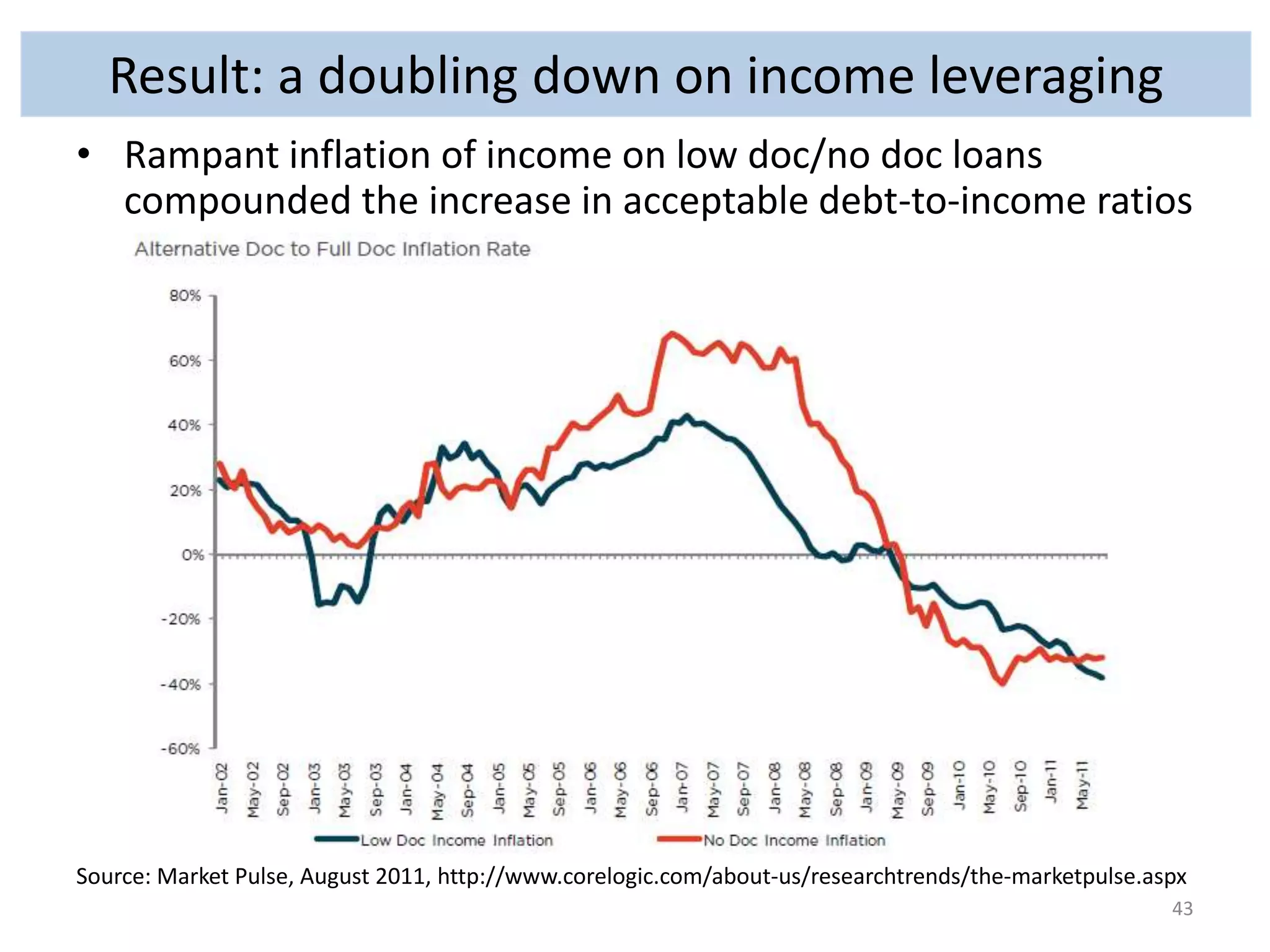
• Rampant inflation of income on low doc/no doc loans 
compounded the increase in acceptable debt-to-income ratios 
Source: Market Pulse, August 2011, http://www.corelogic.com/about-us/researchtrends/the-marketpulse.aspx 
43 
Result: a doubling down on income leveraging
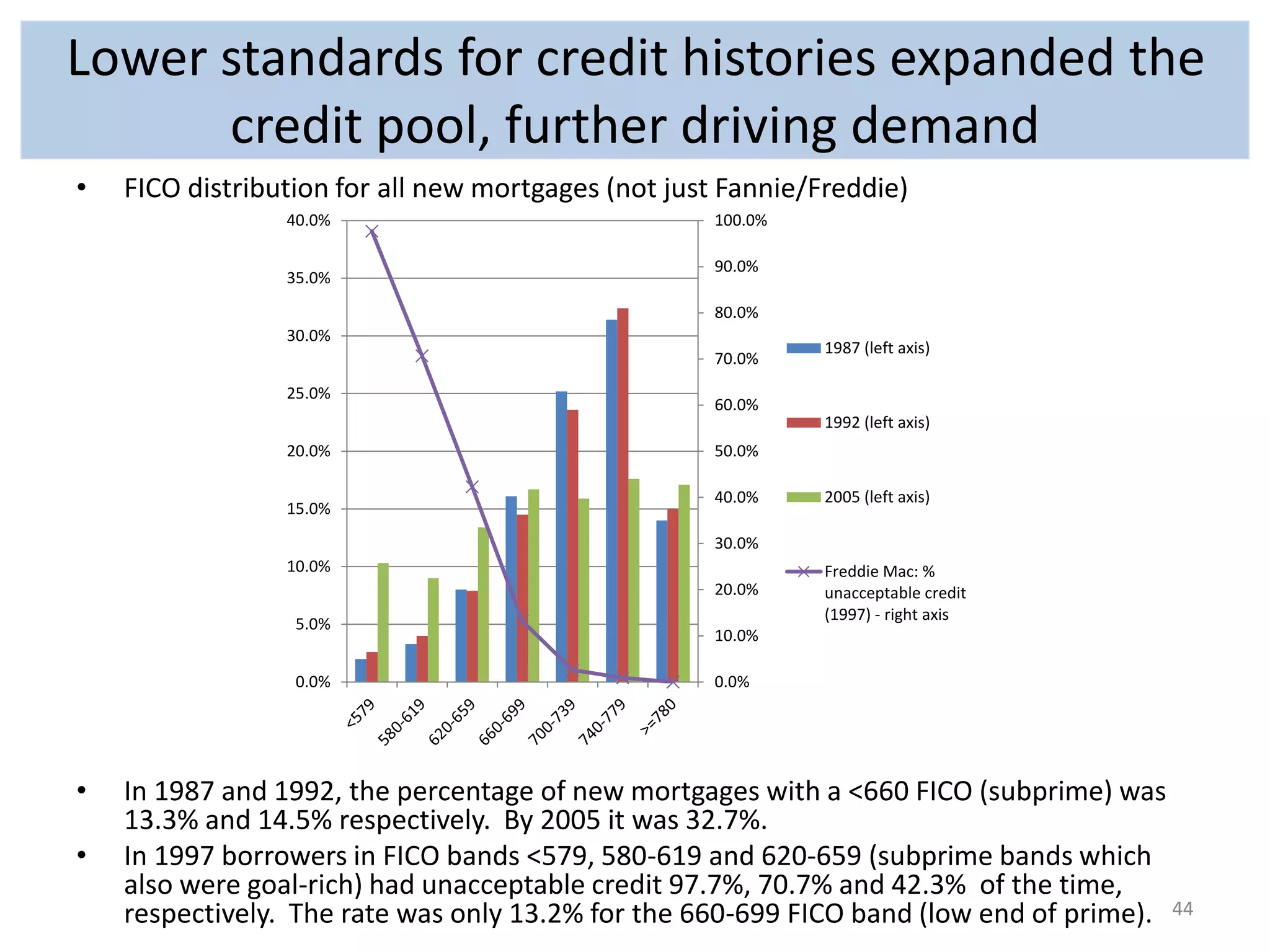
Lower standards for credit histories expanded the 
credit pool, further driving demand 
• FICO distribution for all new mortgages (not just Fannie/Freddie) 
100.0% 
90.0% 
80.0% 
70.0% 
60.0% 
50.0% 
40.0% 
30.0% 
20.0% 
10.0% 
0.0% 
40.0% 
35.0% 
30.0% 
25.0% 
20.0% 
15.0% 
10.0% 
5.0% 
0.0% 
1987 (left axis) 
1992 (left axis) 
2005 (left axis) 
Freddie Mac: % 
unacceptable credit 
(1997) - right axis 
• In 1987 and 1992, the percentage of new mortgages with a <660 FICO (subprime) was 
13.3% and 14.5% respectively. By 2005 it was 32.7%. 
• In 1997 borrowers in FICO bands <579, 580-619 and 620-659 (subprime bands which 
also were goal-rich) had unacceptable credit 97.7%, 70.7% and 42.3% of the time, 
respectively. The rate was only 13.2% for the 660-699 FICO band (low end of prime). 44
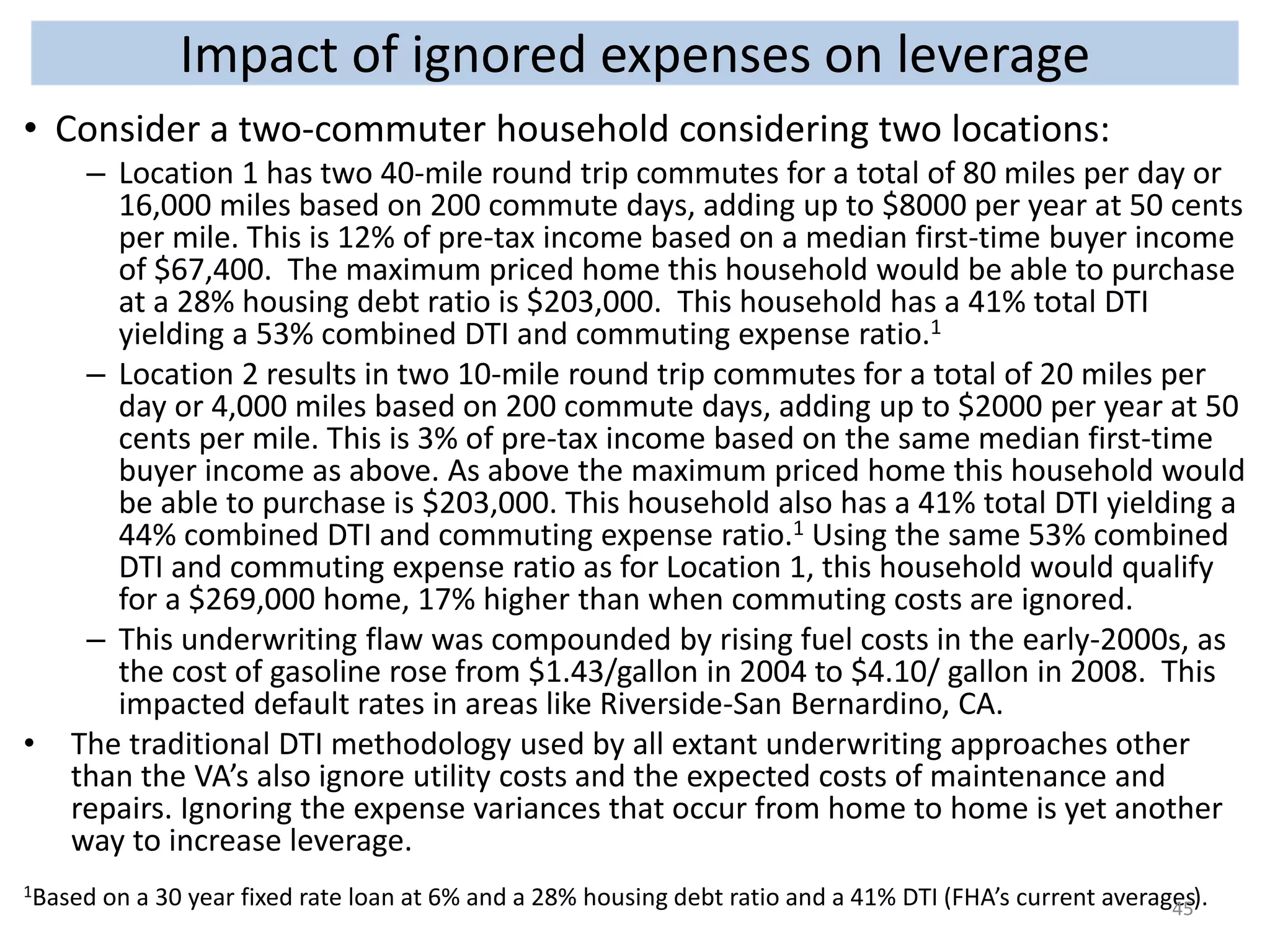
Impact of ignored expenses on leverage 
• Consider a two-commuter household considering two locations: 
– Location 1 has two 40-mile round trip commutes for a total of 80 miles per day or 
16,000 miles based on 200 commute days, adding up to $8000 per year at 50 cents 
per mile. This is 12% of pre-tax income based on a median first-time buyer income 
of $67,400. The maximum priced home this household would be able to purchase 
at a 28% housing debt ratio is $203,000. This household has a 41% total DTI 
yielding a 53% combined DTI and commuting expense ratio.1 
– Location 2 results in two 10-mile round trip commutes for a total of 20 miles per 
day or 4,000 miles based on 200 commute days, adding up to $2000 per year at 50 
cents per mile. This is 3% of pre-tax income based on the same median first-time 
buyer income as above. As above the maximum priced home this household would 
be able to purchase is $203,000. This household also has a 41% total DTI yielding a 
44% combined DTI and commuting expense ratio.1 Using the same 53% combined 
DTI and commuting expense ratio as for Location 1, this household would qualify 
for a $269,000 home, 17% higher than when commuting costs are ignored. 
– This underwriting flaw was compounded by rising fuel costs in the early-2000s, as 
the cost of gasoline rose from $1.43/gallon in 2004 to $4.10/ gallon in 2008. This 
impacted default rates in areas like Riverside-San Bernardino, CA. 
• The traditional DTI methodology used by all extant underwriting approaches other 
than the VA’s also ignore utility costs and the expected costs of maintenance and 
repairs. Ignoring the expense variances that occur from home to home is yet another 
way to increase leverage. 
1Based on a 30 year fixed rate loan at 6% and a 28% housing debt ratio and a 41% DTI (FHA’s current averages). 45
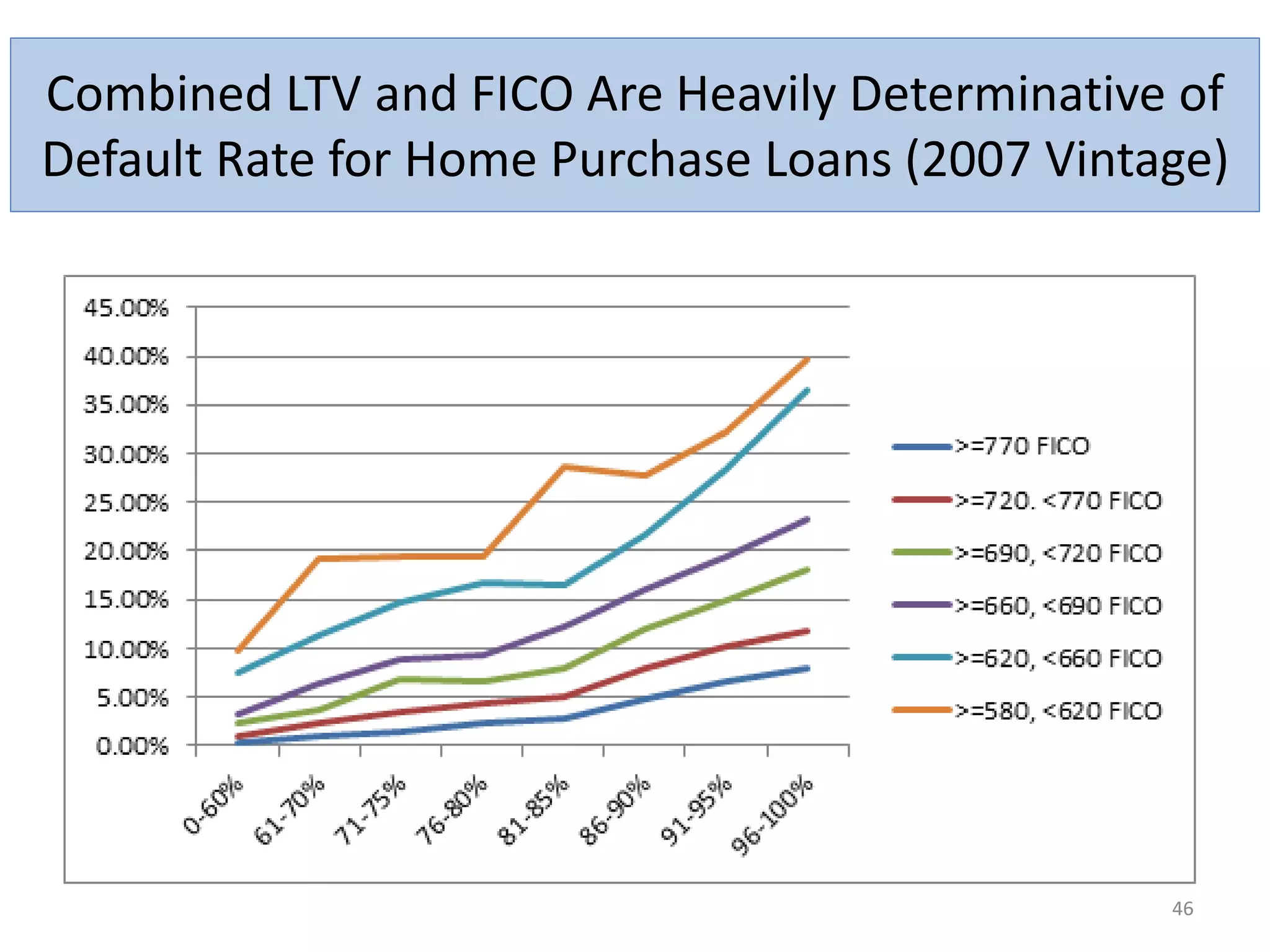
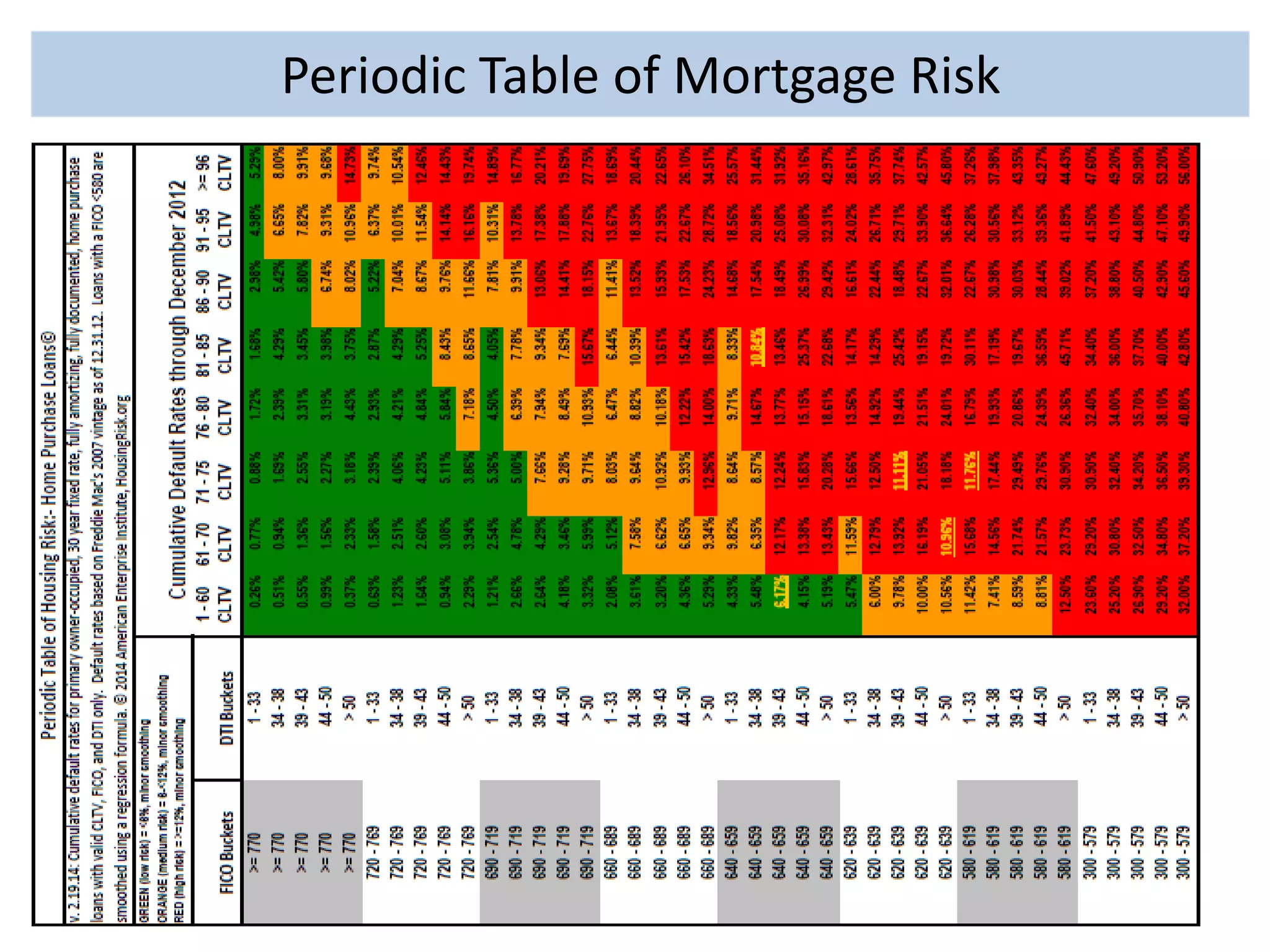
Combined LTV and FICO Are Heavily Determinative of 
Default Rate for Home Purchase Loans (2007 Vintage) 
• t 
46
47 
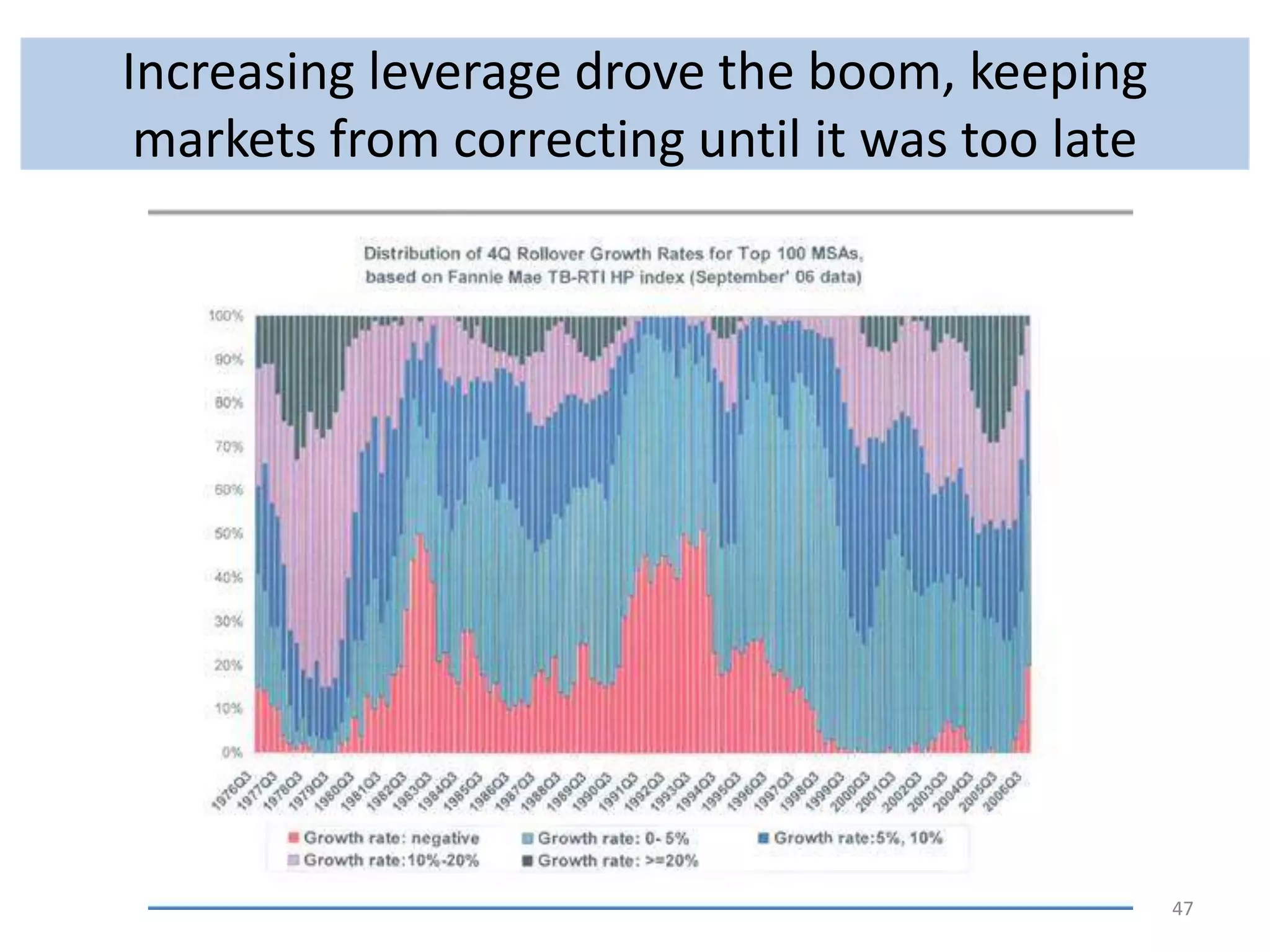
Increasing leverage drove the boom, keeping 
markets from correcting until it was too late
What kind of mortgage product best 
meets the needs of today’s borrowers? 
• Is the thirty year fixed-rate mortgage what we need? 
– While it is a proven “affordability product” of long standing, the 
thirty-year fixed-rate mortgage does not build equity very quickly. 
– Lots of things can happen to a borrower over those thirty years– job 
loss, health problems, divorce. 
– As Monitor of the National Mortgage Settlement, I have done a lot 
of listening in the last two and a half years; including to distressed 
borrowers, the people who represent them, and public officials who 
deal with the fallout from increased foreclosures and bankruptcies. 
– What I have heard confirms what I know from prior experience: that 
one or two of those life issues – or, in many, many cases, the trifecta 
– have resulted in real financial crisis on a large scale. 
– Absent substantial home equity at the outset, the thirty-year fixed 
rate mortgage increases the fragility of a borrower’s overall financial 
position and puts the borrower at risk for a very long time. 
Remarks by Joseph Smith at the American Mortgage Conference, September 11, 2014 
48
PeArpipoednidcix T 1a: bPeleri oodfic M Tabolret ogfa Rgisek Risk

The devolution of appraisal and underwriting theory and practice

  • 1.
    The Devolution ofAppraisal and Underwriting Theory and Practice Edward Pinto Codirector and Chief Risk Officer AEI International Center on Housing Risk Edward.Pinto@AEI.org HousingRisk.org Third International Conference on Housing Risk: New Risk Measures and their Applications September 17, 2014 The views expressed are those of the author alone and do not necessarily represent those of the American Enterprise Institute. 1
  • 2.
  • 3.
    ‘Mortgage’ has becomeanother word for ‘Mortgage’ has become another word for trouble ‘trouble’ • Long term home price appreciation rates are modest and averages mask volatility – No diversification when one’s wealth is in a single asset – “The housing market is a ‘crapshoot’”—Professor Karl Case1 • Excessive leverage promotes volatility 1 http://money.cnn.com/2014/07/07/investing/housing-market-case/ July 7, 2014 3
  • 4.
    House Price Volatility,50 Largest Metro Areas House prices are highly and serially volatile in many metro areas, less so in others. But even in the more stable metros, there can be substantial variation across neighborhoods 160% 140% 120% 100% 80% 60% 40% 20% 0% -20% -40% -60% -80% 160% 140% 120% 100% 80% 60% 40% 20% 0% -20% -40% -60% -80% California metros Other volatile metros More stable metros 1984 1987 1990 1993 1996 1999 2002 2005 2008 2011 Note: Each series shows the percent change from 20 quarters (5 years) earlier. Volatile metros are defined as those for which the difference between the highest and lowest annual percent changes is more than 30 percentage points. All other metros are in “more stable” group. Source: AEI International Center on Housing Risk, www.HousingRisk.org, using data from Zillow.com 4
  • 5.
    28 cities: nominalannual percentage increase in home 5 prices from Apr. 1996-May 2012 (source: Zillow)
  • 6.
    City of Atlanta:cumulative price change for lowest price tier and constituent zips from Apr. 1996-May 2012* 6 *Source: Zillow
  • 7.
    Volatility at theLevel of the Individual Home • Averages are deceiving since one is buying a single home, not the index average for the U.S., the MSA, the zip, or the neighborhood. – To test the impact of home price volatility on wealth building at the house level, 2 different pro forma loan transactions 1 were simulated using over 112,000 unique properties in Prince George’s County, MD.2 – Individual home price index data for 1997-20133 was used to create 11 cohort time periods4resulting in over 1.2 million 30-year fixed rate scenarios and over 1.2 million 15- year fixed rate Wealth Building Home Loan scenarios – The wealth building capacity of the two loan transactions was evaluated as follows: » For each scenario, the loan was amortized according to its terms, the property experienced the price gain or loss over 84 months as indicated by the index, the owner was assumed to have sold the home at the value indicated by the index at the end of the 84 month period, and the owner was assumed to have incurred a selling transaction cost of 10%. » The set of properties was divided into 3 price ties: low, medium, and high. The wealth building capacity of the two loan transactions was evaluated using these tiers. 1Loan transaction 1: 30-year, fixed rate loan with 5% down, 1.75% upfront FHA mortgage insurance premium which is financed, and an assigned interest rate based on Freddie Mac’s Primary Mortgage Market Survey. Loan transaction 2: 15-year, fixed rate loan with 0% down (down payment repurposed to fund a 1.25% permanent rate buy down) and an assigned interest rate based on Freddie Mac’s Mortgage Rates Survey (net of buy down). 2Prince George’s median household income is approximately 80% of that for the Washington, DC area. 3Source: Weiss Residential. Since Index is quarterly, values interpolated as necessary. 4For example, cohort time period 1 started in January 1997 and ended 84 months later. Cohort time period 2 started in January 1998 and ended 84 months later. This process was continued for a total of 11 cohorts. 7
  • 8.
    Prince George’s County:Volatility and Loan Type Impact Wealth Building at the Individual Home Level Loan/Tier # of transactions Average cumulative $ gain1 Average cumulative % gain % of transactions with a loss Median $ loss for transactions with a loss Worst cohort: 2006 median cumulative % gain 30- year2/Low 413,732 $19,756 29% 38% -$54,945 -33% 15-year WBHL3/ Low 413,732 $54,604 54% 26% -$13,353 -8% 30-year2/ High 413,743 $53,541 32% 36% -$124,232 -31% 15-year WBHL3/ High 413,743 $136,124 57% 21% -$29,835 -6% 1Average gains calculated for 11 home purchase year cohorts (1997-2007). Each cohort assumed a sale at the end of an 84 month holding period. Net gain equaled house price appreciation over period (net of 10% sales costs) plus scheduled loan amortization minus initial 5% investment. 230-year, fixed rate loan with 5% down and an assigned interest rate based on Freddie Mac’s Mortgage Rates Survey. House price change based on Weiss Residential’s individual house index. 315-year, fixed rate loan with 0% down (down payment repurposed to fund a 1.25% permanent rate buy down) and an assigned interest rate based on Freddie Mac’s Mortgage Rates Survey (net of buy down). 8
  • 9.
    Prince George’s County:Leveraged 30-Year Loans Perform Poorly Under Stress • The 100% LTV WBHL protects against negative equity compared to a 95% 30-year loan even with extreme home price volatility of the recent boom/bust 9
  • 10.
    Trouble Occurs Whenthere Is Too Much of the Wrong Kind of Debt • Long sustained growth in housing leverage is unhealthy – Jobs create demand for housing, not housing creates demand for jobs. – Mortgage debt to smooth housing consumption is positive economically. – Debt to finance consumption in excess of income is destabilizing. • Bids up existing assets and the land they sit on, creating temporary wealth effect. • Crowds out capital investment financing real demand and job growth. • Borrowers become over extended and susceptible to economic shocks. • Debt overhang effect depresses any post-shock recovery. – Today nominal and intrinsic housing debt both remain historically high. The above is largely drawn from Adair Turner’s Too Much of the Wrong Sort of Capital Flow, January 13, 2014 10
  • 11.
    Source: “Securitization inthe 1920’s”, William Goetzmann , 2009, Securitization in the 1920's - Yale University 11 Trouble Occurs When Mortgage Debt Grows Faster than Home Value
  • 12.
    Trouble Occurs WhenLoan to Value Grows Faster than Fundamentals 12
  • 13.
    Leverage Leverage takestakes many forms forms • Three types of asset leverage: – Reduced down payment on purchase loans: increases the asset price of the home financeable with the same level of savings. This took the form of higher loan-to-values (LTVs) on first mortgage and higher combined LTVs (CLTVs) on combination first and second mortgages. – Longer loan term or use of interest only (IO) period: keeps asset leverage elevated due to the reduced earned equity buildup from amortization during a loan’s early years – Higher LTVs on rate and term and cash-out refinances: allows borrowers to take advantage of higher home prices that result from higher leverage and the inherent weaknesses of the appraisal process, which are enhanced due to the lack of an actual sales transaction.. • Five types of income leverage: – Increase in total debt-to-income (DTI) ratio: increases the asset price of the home financeable with the same level of income. – Longer loan term or use of IO period: slower loan amortization reduces the monthly debt service payment, thereby increasing the asset price of the home financeable with the same level of income. – Use of adjustable rate mortgages (ARMs) or hybrid ARMs: these loans tended to start out at a low rate and increase over time, thereby increasing the asset price of the home financeable with the same level of income. Negatively amortizing ARMs (Pay Option ARMs) allowed the increase in monthly payments to be added to the loan balance, resulting in negative amortization. – Expand definition of eligible income to include less certain types: raises income thereby increasing the asset price of the home financeable. – Reduced documentation standards for income verification: “low doc” and “no doc” foster “liar loans” creating phantom income which increases the asset price of the home financeable. • One type of credit leverage: – Reduce the level of acceptable credit score: increases the pool of eligible buyers. Credit risk increases if borrower credit impairment is not offset by compensating with lower risk factors such increased down payment or faster amortization. 13
  • 14.
    Ignoring expenses addsto leverage • With the exception of the VA , the FHA, Fannie and Freddie underwriting approaches ignore many expenses: – DTIs are calculated based on pre-tax income and do not take into account other normal living expenses such as income and payroll taxes, food, clothing, home utilities, home repairs and maintenance, auto and commute expenses, child care, retirement savings, etc. – Cost to commute: The value of improved land is determined by its utility. A core feature is proximity to jobs and more particularly the household member(s)’ jobs. – Homes situated further out from jobs)generally sell for less than homes closer in, largely due to differences in the cost of land. • DTI limits generally serve to set the home buyer’s upper price limit • Ignoring these expenses increases income leverage, which was exacerbated by increasing formal DTIs 14
  • 15.
    EVOLUTION OF APPRAISALAND LENDING THEORY AND PRACTICE 15
  • 16.
    1890 to 1920s:Ely Advances Early US Research on Land Economics and Appraisal Theory and Practice • University of Wisconsin Professor Richard T. Ely ("Under all, the land”) recognizes land use as the product of economics, institutional forces, and physical constraints (1854-1943). – Studied at the University of Heidelberg (1878-1879) with, Karl Knies (1821-1898), a leading historical economist , who: • Authors Money and Credit (1873). • Advances concepts of “value in use” and “value in exchange (price)” – 1892-1925: Professor of political economy and director of the School of Economics, Political Science, and History, University of Wisconsin • “Father of Land Economics” and real estate studies. • 1920: Establishes the Institute for Research in Land Economics and Public Utilities 16
  • 17.
    1903: Hurd -Principles of City Land Values • 1903: The Principles of City Land Values (Richard M. Hurd, 1865- 1941)--considered first United States’ treatise on city (non-farm) land values. – While intrinsic value is correctly derived by capitalizing ground rent, exchange value may differ widely from it. – Value in urban land, as in farm land, results from economic or ground rent capitalized. – Since value depends on economic rent, and rent on location, and location on convenience, and convenience on nearness, the intermediate steps may be eliminated and say that value depends on nearness. – In cities, economic rent is based on the superiority of location only, the sole function of urban land being to furnish area on which to erect buildings. – Land prices on the outskirts are lower as area increases as the square of the distance from any given point. – If a new utility does not arise, exchange prices may advance and recede, while intrinsic values do not change. – If a new utility arises, both exchange prices and intrinsic values will alter their levels. – General financial and economic conditions enter so largely into exchange values, that values are at times not based on income, or supply and demand, but represent simply a condition of the public mind. 17
  • 18.
    1920s: Ely andColleagues Continue Working on Land Economics and Appraisal Theory and Practice • Books by individuals that Ely collaborates with, trains, or are within his circle of influence: – 1923: Ernest Fisher (1893-1981), student of Ely and member of Ely’s Institute, writes Principles of Real Estate Practice (edited by Ely and published by the Institute). – 1924: Frederick Babcock (1897-1983) writes The Appraisal of Real Estate (1st generalized appraisal book and part of Ely’s Land Economics Series) 18
  • 19.
    1920’s: Lending andAppraisal Practice • The concept of intrinsic value was largely forgotten, as lending became based on exchange value only.. • Property appraising largely the province of local real estate boards. – Boards comprised of those realtors who also held themselves out as appraisers. – There were neither training nor certification requirements. • Lending standards were loose. – In 1927-28, first mortgages were available at 100% of exchange value. – In 1927-28, second mortgages were available at 120% of exchange value. – Commonplace for mortgage underwriting to be based on the mortgaged collateral, ignoring income and credit. – Fraudulent lending and appraisal practices were rampant. – Mortgage backed bonds were relatively common-place (all failed in the 1930s). 19
  • 20.
    1930s: Ely’s ColleaguesLay Foundation for the FHA and Sustainable Lending Practices • Individuals Ely collaborates with, trains, or within circle of influence: – 1932: Frederick Babcock (1897-1983) writes The Valuation of Real Estate (considered to be the most significant appraisal book since Hurd’s in 1903). Ernest Fisher helped Babcock with this second book as both were at the University of Michigan in the early 1930s. – 1933: Homer Hoyt (1895-1984) receives PhD (U. of Chicago), publishes his dissertation, 100 Years of Land Values in Chicago (influenced by Chicago-based research done by Institute members). Writes The Structure and Growth of Residential Neighborhoods in American Cities (1939) with Ernest Fisher and Principles of Urban Real Estate with Arthur Weimar (1939). – Early-1930s: Richard Ratcliff (1906-1980), student of Richard Ely and Ernest Fisher. Writes Urban Land Economics (1949). – 1934: Arthur Weimer (1909-1987) receives PhD (U. of Chicago). Writes Principles of Urban Real Estate with Hoyt (1939). – Fisher (Chief Economist), Babcock (Chief Underwriter), Hoyt (chief housing economist), Ratcliff (economist), and Weimer (economist) are all at FHA starting in 1934. 20
  • 21.
    FHA and SustainableLending • 1935: “‘Mortgage’ was just another word for trouble—an epitaph on the tombstone of their aspirations for home ownership.”* – Replaces loose and dangerous lending practices that had made foreclosures commonplace with “a straight, broad highway to debt-free ownership.”* • “[s]uccessful mortgage lending must be predicated upon a measurement of risk factors in mortgage investment. Mortgage risk comes into existence in the moment mortgage funds are disbursed to a borrower. The risk continues until there has been a complete recapture of the money which has been lent. This risk is greater in some loans than in others. It differs from time to time for each loan. The best we can hope to do is establish a method by means of which to estimate the degree of risk at the time the loan is submitted. If the measurement of risk indicates hazards which are too great, the institution must necessarily refuse to make the loan. In other cases it is highly important that the institution determine not only that it is willing to make the loan but the intrinsic quality of the loan as a portion of its mortgage portfolio.” Frederick M Babcock, FHA’s first chief underwriter – Sound lending practices include: • A sizable down payments (a minimum of 20%) and a maximum 20-year term; • Solid borrower credit histories and solid appraisals; • Ability to pay (imposed on FHA by the1934 National Housing Act): proper income documentation and sufficient income to make regular payments (includes review of a borrower’s monthly expenses and residual income); • Fully amortized loan with a ban on second mortgages. * Federal Housing Administration, “How to Have the Home You Want,” 1936. 21
  • 22.
    A Broad, StraightHighway to Debt-free Home Ownership • In 1935 FHA provided a “broad, straight highway to debt-free home ownership” • The homeownership rate soared from 44% in 1940 to 62% in 1960 • The 30-year loan played a minimal role throughout 1940-1960 – Role limited to FHA and VA new construction in the latter part of the 1950’s • The Debt-Free Highway enabled the Greatest Generation to burn their mortgages *Source: John P. Herzog and James S. Earley, Home Mortgage Delinquency and Foreclosure. 22
  • 23.
    FHA and SustainableLending • FHA’s highway to debt-free ownership led to: – An explosion in the homeownership rate • From 43.6 percent in 1940 to 61.9 percent in 1960 – The virtual elimination of foreclosures • Over its first 20 years, the FHA paid only 5,712 claims out of 2.9 million insured mortgages, for a cumulative claims rate of 0.2 percent. • Claim loss severity was 9 percent of the original insured mortgage balance, or a total of $3 million on 5,712 claims.* *Thomas N. Herzog, A Brief History of Mortgage Finance with an Emphasis on Mortgage Insurance, Society of Actuaries, 2009, www.soa.org/library/monographs/finance/housing-wealth/2009/september/mono-2009-mfi09-herzog-history-comments.pdf. 23
  • 24.
    Basis for FHA’sValuation Theory • Babcock in his The Valuation of Real Estate (1932) establishes the concept of warranted value. – Fair market value would then be the price which a buyer were warranted in paying in view of the potential utility of the property. The fact that several hundred purchasers have been found who were willing to buy certain undesirable subdivision lots at exorbitant prices would in no way be presentable as evidence of market value. – Value will be used to designate the concept in which the thoroughly informed buyer is present and market price will be used to designate the prices which properties actually do bring in the real estate market. • In 1934 Babcock becomes Chief Underwriter for FHA and proceeds to implement his concept of warranted value. 24
  • 25.
    Marked Similarities BetweenFHA’s Valuation for Mortgage Loan Purposes (1930s) and Germany’s Mortgage Lending Value (1990s) • FHA Underwriting Manual and warranted value (1938) – § 13 Methods of dwelling valuation—the character of value • The word “value” refers to the price which a purchaser is warranted in paying for a property for continued use or a long-term investment. • The value to be estimated, therefore, is the probable price which typical buyers are warranted in paying. • This valuation is sometimes hypothetical in character, especially under market conditions where abnormalities in price levels indicate the presence of serious quantitative differentials the two value concepts [warranted value and available market price]. • Marked differences between “available market prices” and “values” will be evident under both boom and depression conditions of market. • Attention is directed to the fact that speculative elements cannot be considered as enhancing the security of residential loans. On the contrary, such elements enhance the risk of loss to mortgagees who permit them to creep into the valuations of properties upon which they make loans. 25
  • 26.
    Marked Similarities BetweenFHA’s Valuation for Mortgage Loan Purposes (1930s) and Germany’s Mortgage Lending Value (1990s) • FHA Underwriting Manual and warranted value (1938) – § 13 Methods of dwelling valuation—the character of value • Value does not exist unless future benefits are in prospect. Its measure is the present worth of expected benefits which may be realized only upon the occurrence of future events. • The first step in the basic valuation procedure, the study of future utility, includes the selection of possible uses, the rejection of uses which are obviously lower uses than others, and the determination of uses in terms of alternative kinds of possible buyers and differing motives of such buyers. • No other definition is acceptable for mortgage loan purposes inasmuch as one of the objectives of valuation in connection with mortgage lending is to take into account dangerous aberrations of market price levels. The observance of this precept tends to fix or set market prices nearer to value. 26
  • 27.
    Marked Similarities BetweenFHA’s Valuation for Mortgage Loan Purposes (1930s) and Germany’s Mortgage Lending Value (1990s) • From Pfandbrief Act – § 3 Principle of the determination of the mortgage lending value (1) The value on which the lending is based (mortgage lending value) is the value of the property which based on experience may throughout the life of the lending be expected to be generated in the event of sale, unattached by temporary, e.g. economically induced, fluctuations in value on the relevant property market and excluding speculative elements. (2) To determine the mortgage lending value, the future marketability of the property is to be taken as a basis within the scope of a prudent valuation, by taking into account long-term sustainable aspects of the property, the normal and local market conditions, the current use and alternative appropriate uses of the property. 27
  • 28.
    DEVOLUTION OF APPRAISALAND LENDING THEORY AND PRACTICE 28
  • 29.
    1930s to Today– Policy Pressures to Increase All Forms of Leverage • Late-1930s on: Congress raises FHA leverage limits – FHA’s underwriting grid and valuation practices limit layering of risk for 20 years • 1992 and on: Congress places Fannie and Freddie in competition with FHA and private subprime • The result is a ‘curious’ policy whereby low income home buyers with volatile incomes are encouraged to buy homes in areas with volatile prices using high leverage • Policies based on a view that “[o]ne unique aspect of homeownership is that it is one of the few leveraged investments available to households with little wealth, enabling homeowners with very little equity in their homes to benefit from appreciation in the overall home value.”1 1Herbert and Belsky, 2008, The Homeownership Experience of Low-Income and Minority Households: A Review and Synthesis of the Literature, Cityscape: A Journal of Policy Development and Research • T 29
  • 30.
    FHA abandons the‘Debt-Free Highway’ • FHA’s underwriting grid and valuation practices successfully limit layering of risk until the mid-1950s, but these are overwhelmed by continual increases in FHA’s leverage limits by Congress – “Until 1964 all loans offered for FHA insurance were subjected to an underwriting "risk rating" based on a combination of mortgage, property and borrower characteristics. The rating factors included the maturity of the loan relative to the estimated economic life of the residence, the loan-to-value ratio, locational and physical property characteristics, mortgage payment and housing expense relationship to estimated effective mortgagor income, and a credit rating of the borrower. To be accepted for insurance, a loan was required to have a ‘rating pattern’ of at least 50 points out of a possible 100. Ratings from 50 to 59 were considered "marginal," although acceptable. Since 1964 no over-all rating pattern has been used and numerical ratings have been dropped altogether. Now the underwriter must rate the borrower, the property, and the location as ‘reject,’ ‘fair,’ ‘good,’ or ‘excellent.’” Source: John P. Herzog and James S. Earley, Home Mortgage Delinquency and Foreclosure, 1970 30
  • 31.
    FHA mortgages becomesanother word for ‘trouble’ Source: John P. Herzog and James S. Earley, Home Mortgage Delinquency and Foreclosure, 1970 31
  • 32.
    FHA mortgages =‘trouble’: 3.39 million foreclosures and 1 in 8 families FHA’s WEIGHTED AVERAGE FORECLOSURE CLAIM RATE OF 12.8% FOR 1975-2013 | 32
  • 33.
    1930s to Today– Competing Valuation Theories • FHA’s warranted value/German Mortgage Lending Value • Exchange value/price , point-in-time value/price, or market value/price. – Over time this approach received support from the rational pricing theory. • The same asset must trade at the same price on all markets. • Reconciliation of the three approaches: market, income, and cost. – These derived from classical economic theory based on the three aspects of value. 33
  • 34.
    1992: CONGRESS MANDATES FANNIE AND FREDDIE TO COMPETE WITH FHA AND SUBPRIME 34
  • 35.
    FHA and Fannie’sgrowing percentages of low down payment loans Sources: FHA 2009 Actuarial Report and HUD. Fannie percentages for 1994-1996 are estimated based on the fact that it first started acquiring 97% LTV loans in 1994 and the percentage of such acquisitions in 1997 was 3.3%. Combined LTV percentages for 2004-2007 are based on Fannie’s disclosure in its 2007 10-K that 9.9% of its credit book (home purchase and refinance loans) had an LTV>90% (the average LTV of these loans was 97.2%), 15% of its credit portfolio had an LTV or combined LTV >90%. This increased Fannie’s exposure in loans with downpayments of 5% or less by 50%. A common combination loan was an 80% first and a 20% second, yielding a combined LTV (CLTV) of 100%. Fannie purchased the first. 35
  • 36.
    • The firstpanel on the next page demonstrates that the percentage of verified DTIs >42% increased dramatically from the late- 1980s/early-1990s when it was effectively 0% to 43% for 2007. • The second panel presents the data in a slightly different format. It demonstrates that the DTI percentage at the 75th percentile increased from a 36% DTI in the late-1980s/early-1990s to a 49% DTI in 2007. 36 DTIs in excess of traditional levels become commonplace for the GSEs
  • 37.
    GSEs ratchet upborrower total debt capacity GSEs: % with DTI =>42% 50% 48% 46% 44% 42% 40% 38% 36% GSEs: DTI % @75th Percentile Sources: 1988-1992: debt-to-income (DTI) distribution interpolated and extrapolated from a random sample review of Fannie Mae’s single-family acquisitions for the period October 1988-January 1992, dated March 10,1992. For this data set, the maximum DTI grouping is “>38%” which constituted 13.5% of sampled loans. Document contained in the author’s files. The “zero” or nil incidence at >42% DTI is an estimate based the data. This random sample is also the data source for the serious delinquency (90-days or more and in foreclosure) data for 1988-1992 shown on the next two charts. Given the observation date of early-1992, these data represent seriously delinquent loans with an average of 2 years seasoning. While these delinquency rates are not directly comparable to the rates for 1997-2009, the relative relationship among DTI buckets is valid . 1997-2009: DTI distributions derived using interpolation and extrapolation of data contained in the Consumer Financial Protection Bureau’s request for further comment on Ability-to-Repay mortgage rule dated May 31, 2012. Dataset consists of fully documented income loans that are fully amortizing with a loan term <=30 years. For this data set, the maximum DTI grouping is “=>46%” which constituted 31% of sampled loans. http://files.consumerfinance.gov/f/201205_cfpb_Ability_to_Repay.pdf This is also the data source for the delinquency data for 1997-2009 shown on the next two charts. The observation date is 2012 and represents ever 60 days or more delinquency rates. 37 50% 45% 40% 35% 30% 25% 20% 15% 10% 5% 0% 1988-1992 1997 1998 1999 2000 2001 2002 2003 2004 2005 2006 2007 2008 2009 % >=42% 34% 1988-1992 1997 1998 1999 2000 2001 2002 2003 2004 2005 2006 2007 2008 2009 DTI % @75th percentile
  • 38.
    • The graphon the next page demonstrates in the late 1980s through 1998, higher DTIs performed better than lower DTIs.* – This was due to the fact that a very high proportion of DTIs were within well defined levels (28/36, 33/38, etc.). – DTIs above these levels were the exception and generally required strong compensating factors. – This result may have led to a false conclusion that DTIs could be increased without a substantial increase in risk. – This turned out not to be the case. – As DTI increased, so did delinquency rates. • By 1999 loans with higher DTIs were acting differently. • By 2003 the difference was quite substantial. *Source: CFPB and document in author’s file 38 As acceptable DTI percentages grew, loan performance worsened
  • 39.
    39 As acceptableDTI percentages grew, loan 0.54% Graph 4: Delinquency Rate by DTI, 1988 – 2003 0.69% 0.69% 1.13% 0.80% 0.80% 8.00% 7.00% 6.00% 5.00% 4.00% 3.00% 2.00% 1.00% 0.00% 1997 DTI < 32 32 ≤ DTI < 3434 ≤ DTI < 3636 ≤ DTI < 3838 ≤ DTI < 4040 ≤ DTI < 4242 ≤ DTI < 4444 ≤ DTI < 46 46 ≤ DTI 2000-2002 1988- 1992* 1997 1998 1999 2000 2003 1999 1998 1988-1992 performance worsened
  • 40.
    • The graphon the next page demonstrates that this trend accelerated in 2004-2007. – For the 2007 cohort, loans with DTIs>46% experienced over 3 times the default rate of loans with DTIs <32%. – For the 2007 cohort 31% and 43% of loans had a DTI>46% and 42% respectively. – This was dramatic change from earlier years when the percentage of DTIs >42% was 15% or less. • Clearly DTI mattered when it comes to a borrower having a reasonable ability to repay. 40 As acceptable DTI percentages grew, loan performance deteriorated markedly
  • 41.
    41 As acceptableDTI percentages grew, loan performance deteriorated markedly 0.54% 0.69% 0.69% Delinquency Rate by DTI 1.13% 0.80% 0.80% 35.00% 30.00% 25.00% 20.00% 15.00% 10.00% 5.00% 0.00% DTI < 32 32 ≤ DTI < 34 34 ≤ DTI < 36 36 ≤ DTI < 38 38 ≤ DTI < 40 40 ≤ DTI < 42 42 ≤ DTI < 44 44 ≤ DTI < 46 46 ≤ DTI 1988-1992* 1997 1998 1999 2000 2001 2002 2003 2004 2005 2006 2007 2007 2006 2005 2004 2003 1997, 1999- 1998 2002 1988-1991
  • 42.
    Growth in Alt-A- including low and no doc loans • Myth: the GSEs’ Alt-A dollar volume was relatively minor relative to non-agency Alt-A and came late in the cycle. • Fact: the GSEs largely dominated the Alt-A market from 2002 onward (note: limited or no GSE data is available before 2002, but they are known to have been active pre-2002). 42 20.0% 18.0% 16.0% 14.0% 12.0% 10.0% 8.0% 6.0% 4.0% 2.0% 0.0% Self-Denominated non-agency Alt-A annual $ volume (net of Fannie/Freddie PMBS Alt-A purchases)/Annual total origination $ volume (source: Inside Mortgage Finance). Self-Denominated & SEC disclosed Fannie/Freddie Alt-A Annual $ Volume (includes acquisition of PMBS)/Annual total origination $ volume (data missing before 2001 and partial data for 2001). PMBS never accounted for >18% (in 2005) of GSE Alt-A acquisitions
  • 43.
    • Rampant inflationof income on low doc/no doc loans compounded the increase in acceptable debt-to-income ratios Source: Market Pulse, August 2011, http://www.corelogic.com/about-us/researchtrends/the-marketpulse.aspx 43 Result: a doubling down on income leveraging
  • 44.
    Lower standards forcredit histories expanded the credit pool, further driving demand • FICO distribution for all new mortgages (not just Fannie/Freddie) 100.0% 90.0% 80.0% 70.0% 60.0% 50.0% 40.0% 30.0% 20.0% 10.0% 0.0% 40.0% 35.0% 30.0% 25.0% 20.0% 15.0% 10.0% 5.0% 0.0% 1987 (left axis) 1992 (left axis) 2005 (left axis) Freddie Mac: % unacceptable credit (1997) - right axis • In 1987 and 1992, the percentage of new mortgages with a <660 FICO (subprime) was 13.3% and 14.5% respectively. By 2005 it was 32.7%. • In 1997 borrowers in FICO bands <579, 580-619 and 620-659 (subprime bands which also were goal-rich) had unacceptable credit 97.7%, 70.7% and 42.3% of the time, respectively. The rate was only 13.2% for the 660-699 FICO band (low end of prime). 44
  • 45.
    Impact of ignoredexpenses on leverage • Consider a two-commuter household considering two locations: – Location 1 has two 40-mile round trip commutes for a total of 80 miles per day or 16,000 miles based on 200 commute days, adding up to $8000 per year at 50 cents per mile. This is 12% of pre-tax income based on a median first-time buyer income of $67,400. The maximum priced home this household would be able to purchase at a 28% housing debt ratio is $203,000. This household has a 41% total DTI yielding a 53% combined DTI and commuting expense ratio.1 – Location 2 results in two 10-mile round trip commutes for a total of 20 miles per day or 4,000 miles based on 200 commute days, adding up to $2000 per year at 50 cents per mile. This is 3% of pre-tax income based on the same median first-time buyer income as above. As above the maximum priced home this household would be able to purchase is $203,000. This household also has a 41% total DTI yielding a 44% combined DTI and commuting expense ratio.1 Using the same 53% combined DTI and commuting expense ratio as for Location 1, this household would qualify for a $269,000 home, 17% higher than when commuting costs are ignored. – This underwriting flaw was compounded by rising fuel costs in the early-2000s, as the cost of gasoline rose from $1.43/gallon in 2004 to $4.10/ gallon in 2008. This impacted default rates in areas like Riverside-San Bernardino, CA. • The traditional DTI methodology used by all extant underwriting approaches other than the VA’s also ignore utility costs and the expected costs of maintenance and repairs. Ignoring the expense variances that occur from home to home is yet another way to increase leverage. 1Based on a 30 year fixed rate loan at 6% and a 28% housing debt ratio and a 41% DTI (FHA’s current averages). 45
  • 46.
    Combined LTV andFICO Are Heavily Determinative of Default Rate for Home Purchase Loans (2007 Vintage) • t 46
  • 47.
    47 Increasing leveragedrove the boom, keeping markets from correcting until it was too late
  • 48.
    What kind ofmortgage product best meets the needs of today’s borrowers? • Is the thirty year fixed-rate mortgage what we need? – While it is a proven “affordability product” of long standing, the thirty-year fixed-rate mortgage does not build equity very quickly. – Lots of things can happen to a borrower over those thirty years– job loss, health problems, divorce. – As Monitor of the National Mortgage Settlement, I have done a lot of listening in the last two and a half years; including to distressed borrowers, the people who represent them, and public officials who deal with the fallout from increased foreclosures and bankruptcies. – What I have heard confirms what I know from prior experience: that one or two of those life issues – or, in many, many cases, the trifecta – have resulted in real financial crisis on a large scale. – Absent substantial home equity at the outset, the thirty-year fixed rate mortgage increases the fragility of a borrower’s overall financial position and puts the borrower at risk for a very long time. Remarks by Joseph Smith at the American Mortgage Conference, September 11, 2014 48
  • 49.
    PeArpipoednidcix T 1a:bPeleri oodfic M Tabolret ogfa Rgisek Risk