Emissions Modelling in the PTV Vision Suite PTV VISION Asia-Pacific User Group, Melbourne,  November2009
The Problem
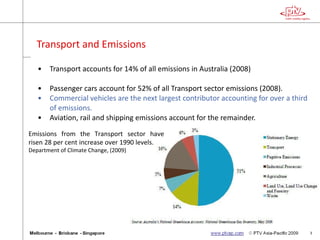
Transport and Emissions Transport accounts for 14% of all emissions in Australia (2008)  Passenger cars account for 52% of all Transport sector emissions (2008). Commercial vehicles are the next largest contributor accounting for over a third of emissions.  Aviation, rail and shipping emissions account for the remainder. Emissions from the Transport sector have risen 28 per cent increase over 1990 levels.  Department of Climate Change, (2009)
Vehicle Emissions Sulfur oxides (SO x ) - a chemical compound with the formula is one of the causes of acid rain  Nitrogen oxides (NO x ) - especially nitrogen dioxide are emitted from high temperature combustion. Can be seen as the brown haze dome above or plume downwind of cities. NO 2  is one of the most prominent air pollutants.  Carbon monoxide - is a colourless, odourless, non-irritating but very poisonous gas. Vehicular exhaust is a major source of carbon monoxide.  Carbon dioxide (CO 2 ) - a greenhouse gas emitted from combustion.  Volatile organic compounds - VOCs are an important outdoor air pollutant. Some compounds (benzene, toluene and xylene) are suspected carcinogens and may lead to leukemia through prolonged exposure. 1,3-butadiene is another dangerous compound which is often associated with industrial uses.  Particulate matter (PM) - Particulates, alternatively referred to as particulate matter (PM) or fine particles, are tiny particles of solid or liquid suspended in a gas.  In contrast, aerosol refers to particles and the gas together. Sources of particulate matter can be man made or natural.  Those made by human activities—currently account for about 10 percent of the total amount of aerosols in our atmosphere. Increased levels of fine particles in the air are linked to health hazards such as heart disease, altered lung function and lung cancer.
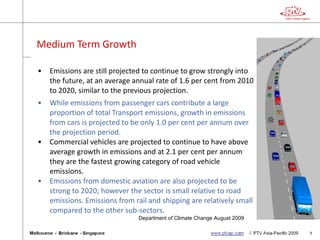
Medium Term Growth Emissions are still projected to continue to grow strongly into the future, at an average annual rate of 1.6 per cent from 2010 to 2020, similar to the previous projection.  While emissions from passenger cars contribute a large proportion of total Transport emissions, growth in emissions from cars is projected to be only 1.0 per cent per annum over the projection period.  Commercial vehicles are projected to continue to have above average growth in emissions and at 2.1 per cent per annum they are the fastest growing category of road vehicle emissions. Emissions from domestic aviation are also projected to be strong to 2020; however the sector is small relative to road emissions. Emissions from rail and shipping are relatively small compared to the other sub-sectors. Department of Climate Change August 2009
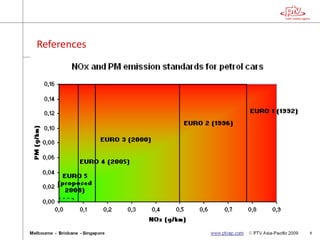
References
Carbon Pollution Trading The sale and allocation of carbon pollution permits valued at around $4.5 billion in 2011-12 and $13 billion in 2012-2013 http://www.climatechange.gov.au/en/government/reduce.aspx http://www.mcwupgrade.com.au/gallery/pages/gallery001.aspx
Software to Calculate Emissions
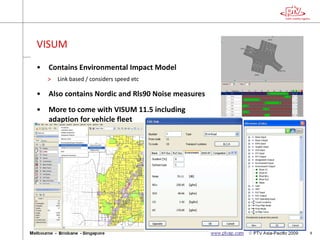
VISUM Contains Environmental Impact Model Link based / considers speed etc Also contains Nordic and Rls90 Noise measures More to come with VISUM 11.5 including adaption for vehicle fleet
VISSIM – Volkswagen (EMI) Emissions Model within VISSIM Developed by Volkswagen  Range of emissions based on simulation operations Emission Engine Maps are binary files containing the emission data for a given emission layer and a given emission component.  There are 12 possible emission components: Benzene, CO, CO2, HC, Fuel, NMOG, NMHC, NOx, Particulate, Soot, SO2 and Evaporation.
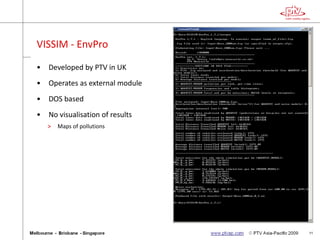
VISSIM - EnvPro Developed by PTV in UK Operates as external module DOS based No visualisation of results Maps of pollutions
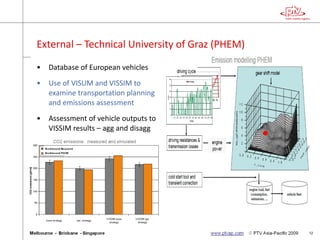
External – Technical University of Graz (PHEM) Database of European vehicles Use of VISUM and VISSIM to examine transportation planning and emissions assessment  Assessment of vehicle outputs to VISSIM results – agg and disagg
Enviver
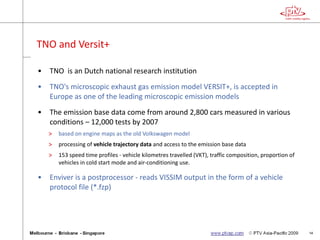
TNO and Versit+ TNO  is an Dutch national research institution TNO's microscopic exhaust gas emission model VERSIT+, is accepted in Europe as one of the leading microscopic emission models The emission base data come from around 2,800 cars measured in various conditions – 12,000 tests by 2007 based on engine maps as the old Volkswagen model processing of  vehicle trajectory  data  and access to the emission base data 153 speed time profiles - vehicle kilometres travelled (VKT), traffic composition, proportion of vehicles in cold start mode and air-conditioning use. Enviver is a postprocessor -  reads VISSIM output in the form of a vehicle protocol file (*.fzp)
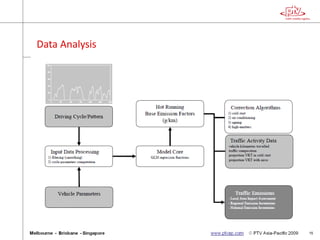
Data Analysis
Example
Examination Site
Individual Vehicle Record
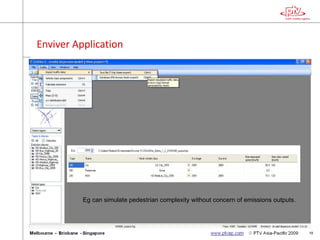
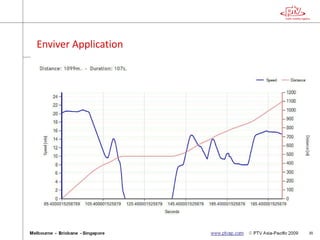
Enviver Application Eg can simulate pedestrian complexity without concern of emissions outputs.
Enviver Application
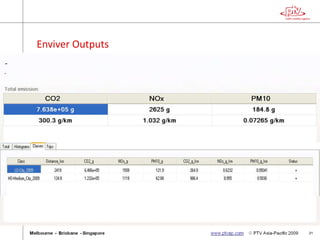
Enviver Outputs
Enviver Outputs ie can model network complexity but evaluate for subarea conditions. Eg tunnel emissions or council boundary
Licensing
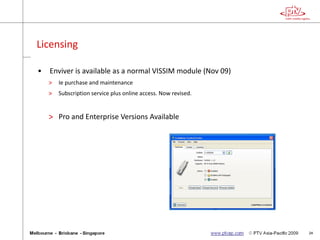
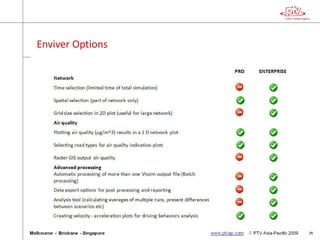
Licensing Enviver is available as a normal VISSIM module (Nov 09) Ie purchase and maintenance Subscription service plus online access. Now revised. Pro and Enterprise Versions Available
Enviver Licensing Enterprise version for larger models/ analysis
Enviver Options
References Department of Climate Change, (2009), “2009  Tracking to Kyoto and 2020: Australia’s Greenhouse Gas Emissions, 1990 to 2008–2012 and 2020”, August 2009, Canberra Planung Transport Verkehr AG (2009) VISSIM 5.20 User Manual, November 2009 Keogh, D (2008) “Derivation of motor vehicle particle emission factors” presentation to PTV Asia-Pacific, February 2008 Smit,R., Smokers, R., Shoen, E. and Hensema, A. (2006) “A new modelling Approach for Road traffic Emissions: VERSIT +LD – Background and Methodology” TNO Science and Industry Smit,R., Smokers, R. and Rabe, E. (2007) “ A new modelling approach for road  traffic emissions: VERSIT+”  Transportation Research Part D 12 (2007) 414–422
PTV – Powering Transportation Visions WWW.PTVAP.COM

PTV Emissions & Enviver

  • 1.
    Emissions Modelling inthe PTV Vision Suite PTV VISION Asia-Pacific User Group, Melbourne, November2009
  • 2.
  • 3.
    Transport and EmissionsTransport accounts for 14% of all emissions in Australia (2008) Passenger cars account for 52% of all Transport sector emissions (2008). Commercial vehicles are the next largest contributor accounting for over a third of emissions. Aviation, rail and shipping emissions account for the remainder. Emissions from the Transport sector have risen 28 per cent increase over 1990 levels. Department of Climate Change, (2009)
  • 4.
    Vehicle Emissions Sulfuroxides (SO x ) - a chemical compound with the formula is one of the causes of acid rain Nitrogen oxides (NO x ) - especially nitrogen dioxide are emitted from high temperature combustion. Can be seen as the brown haze dome above or plume downwind of cities. NO 2 is one of the most prominent air pollutants. Carbon monoxide - is a colourless, odourless, non-irritating but very poisonous gas. Vehicular exhaust is a major source of carbon monoxide. Carbon dioxide (CO 2 ) - a greenhouse gas emitted from combustion. Volatile organic compounds - VOCs are an important outdoor air pollutant. Some compounds (benzene, toluene and xylene) are suspected carcinogens and may lead to leukemia through prolonged exposure. 1,3-butadiene is another dangerous compound which is often associated with industrial uses. Particulate matter (PM) - Particulates, alternatively referred to as particulate matter (PM) or fine particles, are tiny particles of solid or liquid suspended in a gas. In contrast, aerosol refers to particles and the gas together. Sources of particulate matter can be man made or natural. Those made by human activities—currently account for about 10 percent of the total amount of aerosols in our atmosphere. Increased levels of fine particles in the air are linked to health hazards such as heart disease, altered lung function and lung cancer.
  • 5.
    Medium Term GrowthEmissions are still projected to continue to grow strongly into the future, at an average annual rate of 1.6 per cent from 2010 to 2020, similar to the previous projection. While emissions from passenger cars contribute a large proportion of total Transport emissions, growth in emissions from cars is projected to be only 1.0 per cent per annum over the projection period. Commercial vehicles are projected to continue to have above average growth in emissions and at 2.1 per cent per annum they are the fastest growing category of road vehicle emissions. Emissions from domestic aviation are also projected to be strong to 2020; however the sector is small relative to road emissions. Emissions from rail and shipping are relatively small compared to the other sub-sectors. Department of Climate Change August 2009
  • 6.
  • 7.
    Carbon Pollution TradingThe sale and allocation of carbon pollution permits valued at around $4.5 billion in 2011-12 and $13 billion in 2012-2013 http://www.climatechange.gov.au/en/government/reduce.aspx http://www.mcwupgrade.com.au/gallery/pages/gallery001.aspx
  • 8.
  • 9.
    VISUM Contains EnvironmentalImpact Model Link based / considers speed etc Also contains Nordic and Rls90 Noise measures More to come with VISUM 11.5 including adaption for vehicle fleet
  • 10.
    VISSIM – Volkswagen(EMI) Emissions Model within VISSIM Developed by Volkswagen Range of emissions based on simulation operations Emission Engine Maps are binary files containing the emission data for a given emission layer and a given emission component. There are 12 possible emission components: Benzene, CO, CO2, HC, Fuel, NMOG, NMHC, NOx, Particulate, Soot, SO2 and Evaporation.
  • 11.
    VISSIM - EnvProDeveloped by PTV in UK Operates as external module DOS based No visualisation of results Maps of pollutions
  • 12.
    External – TechnicalUniversity of Graz (PHEM) Database of European vehicles Use of VISUM and VISSIM to examine transportation planning and emissions assessment Assessment of vehicle outputs to VISSIM results – agg and disagg
  • 13.
  • 14.
    TNO and Versit+TNO is an Dutch national research institution TNO's microscopic exhaust gas emission model VERSIT+, is accepted in Europe as one of the leading microscopic emission models The emission base data come from around 2,800 cars measured in various conditions – 12,000 tests by 2007 based on engine maps as the old Volkswagen model processing of vehicle trajectory data and access to the emission base data 153 speed time profiles - vehicle kilometres travelled (VKT), traffic composition, proportion of vehicles in cold start mode and air-conditioning use. Enviver is a postprocessor - reads VISSIM output in the form of a vehicle protocol file (*.fzp)
  • 15.
  • 16.
  • 17.
  • 18.
  • 19.
    Enviver Application Egcan simulate pedestrian complexity without concern of emissions outputs.
  • 20.
  • 21.
  • 22.
    Enviver Outputs iecan model network complexity but evaluate for subarea conditions. Eg tunnel emissions or council boundary
  • 23.
  • 24.
    Licensing Enviver isavailable as a normal VISSIM module (Nov 09) Ie purchase and maintenance Subscription service plus online access. Now revised. Pro and Enterprise Versions Available
  • 25.
    Enviver Licensing Enterpriseversion for larger models/ analysis
  • 26.
  • 27.
    References Department ofClimate Change, (2009), “2009 Tracking to Kyoto and 2020: Australia’s Greenhouse Gas Emissions, 1990 to 2008–2012 and 2020”, August 2009, Canberra Planung Transport Verkehr AG (2009) VISSIM 5.20 User Manual, November 2009 Keogh, D (2008) “Derivation of motor vehicle particle emission factors” presentation to PTV Asia-Pacific, February 2008 Smit,R., Smokers, R., Shoen, E. and Hensema, A. (2006) “A new modelling Approach for Road traffic Emissions: VERSIT +LD – Background and Methodology” TNO Science and Industry Smit,R., Smokers, R. and Rabe, E. (2007) “ A new modelling approach for road traffic emissions: VERSIT+” Transportation Research Part D 12 (2007) 414–422
  • 28.
    PTV – PoweringTransportation Visions WWW.PTVAP.COM