Uses of vehicle emissions remote sensing
data for emission factor development
Jack Davison, PhD Student
Wolfson Atmospheric Chemistry Laboratories, University of York
📧📧 jd1184@york.ac.uk 🐤🐤 @JDavison_
FROM ROADSIDE TO NATION-WIDE
Road Transport Emissions
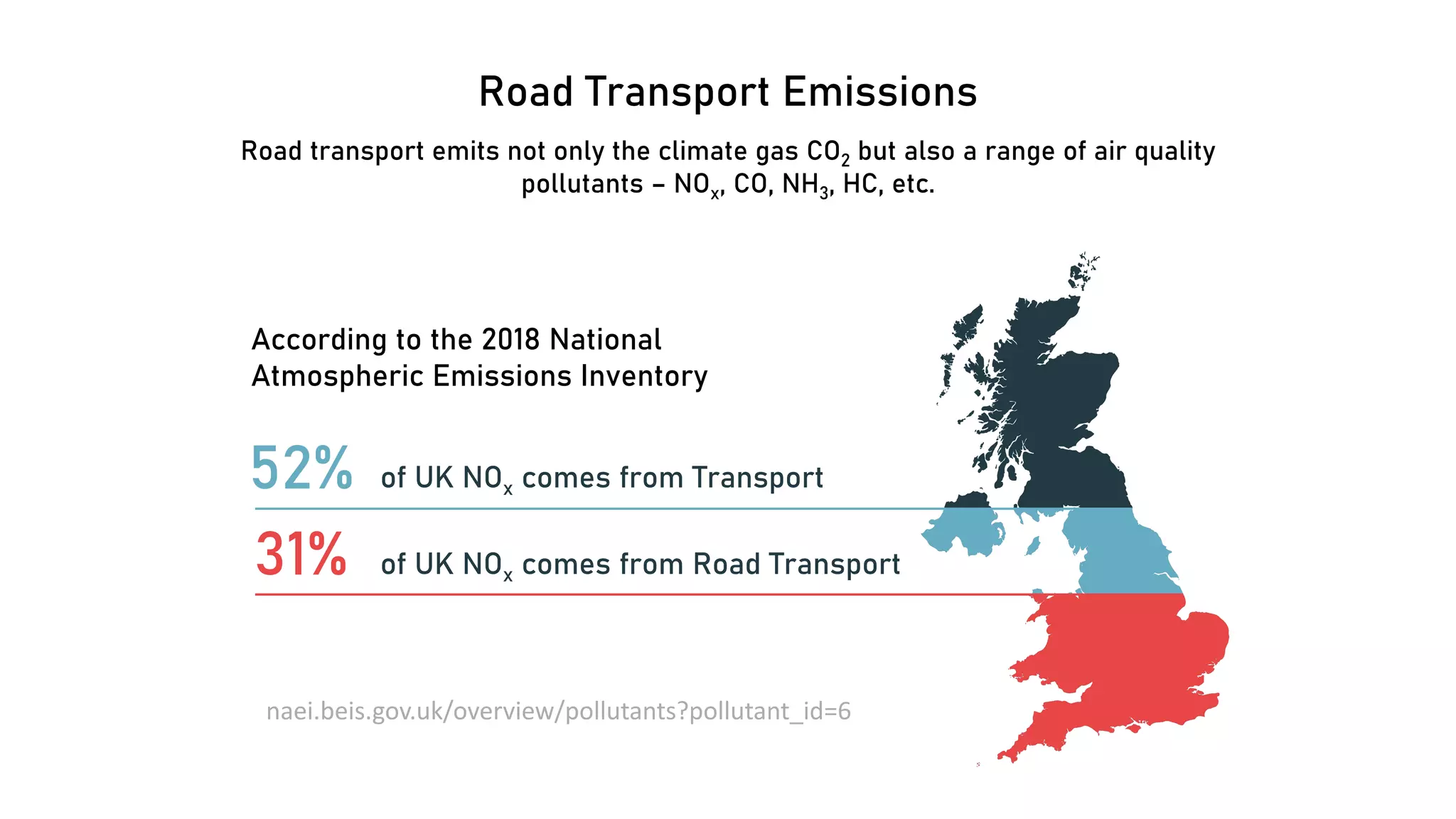
Road transport emits not only the climate gas CO2 but also a range of air quality
pollutants – NOx, CO, NH3, HC, etc.
52%
31%
of UK NOx comes from Transport
of UK NOx comes from Road Transport
According to the 2018 National
Atmospheric Emissions Inventory
naei.beis.gov.uk/overview/pollutants?pollutant_id=6
Road Transport Emissions
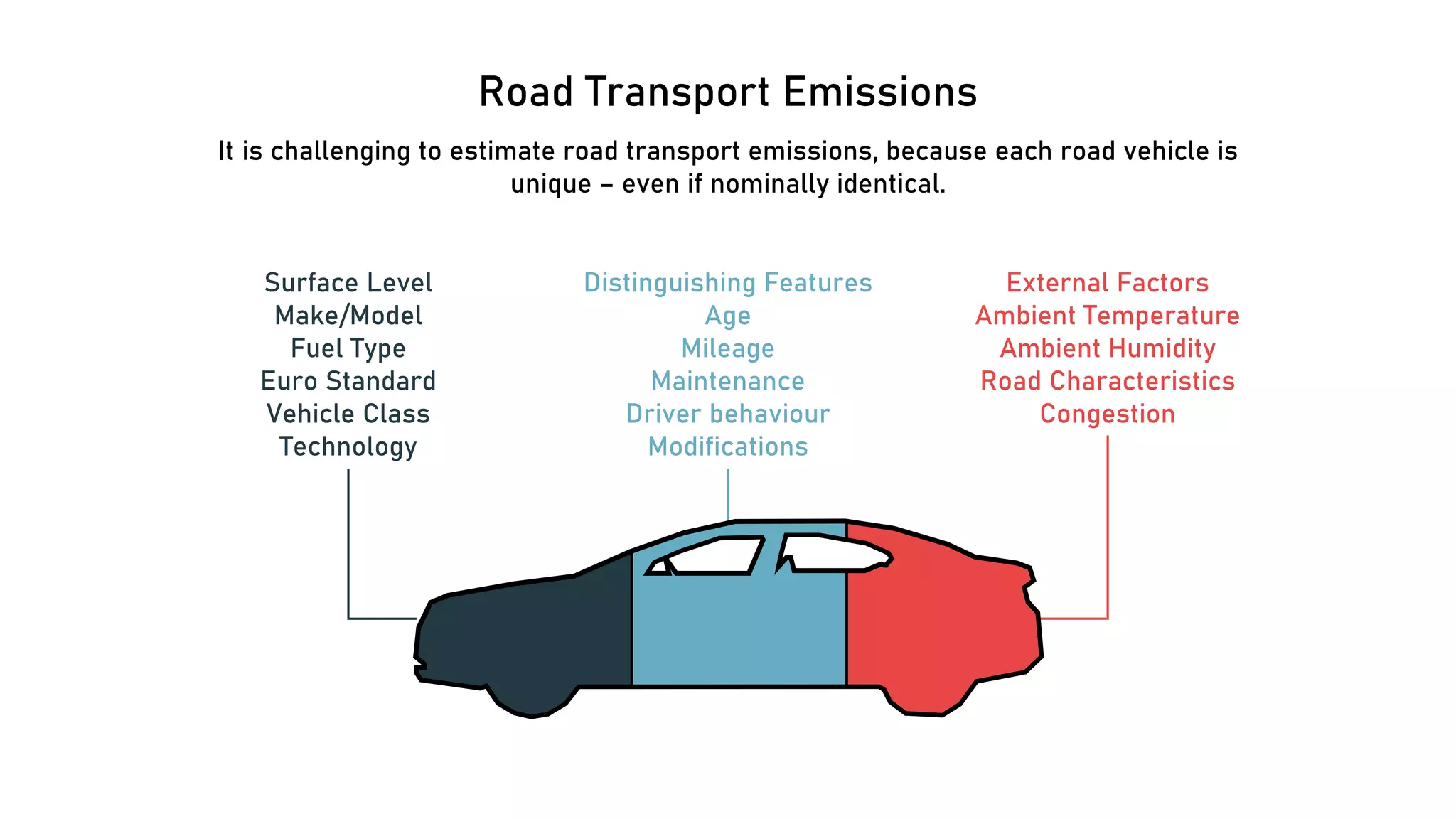
It is challenging to estimate road transport emissions, because each road vehicle is
unique – even if nominally identical.
Surface Level
Make/Model
Fuel Type
Euro Standard
Vehicle Class
Technology
Distinguishing Features
Age
Mileage
Maintenance
Driver behaviour
Modifications
External Factors
Ambient Temperature
Ambient Humidity
Road Characteristics
Congestion
Measuring Road Transport Emissions
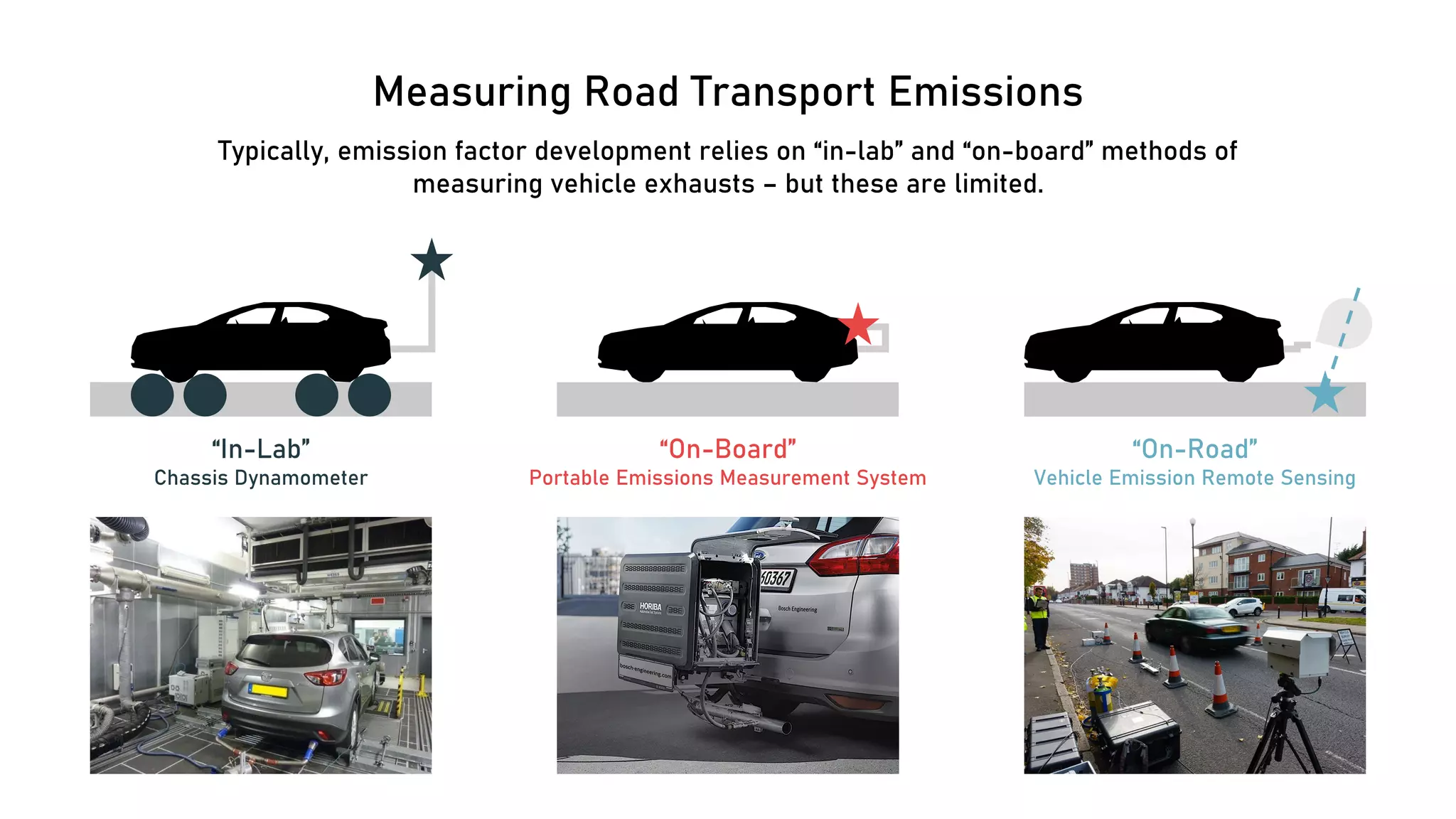
Typically, emission factor development relies on “in-lab” and “on-board” methods of
measuring vehicle exhausts – but these are limited.
“In-Lab”
Chassis Dynamometer
“On-Board”
Portable Emissions Measurement System
“On-Road”
Vehicle Emission Remote Sensing
Measuring Road Transport Emissions
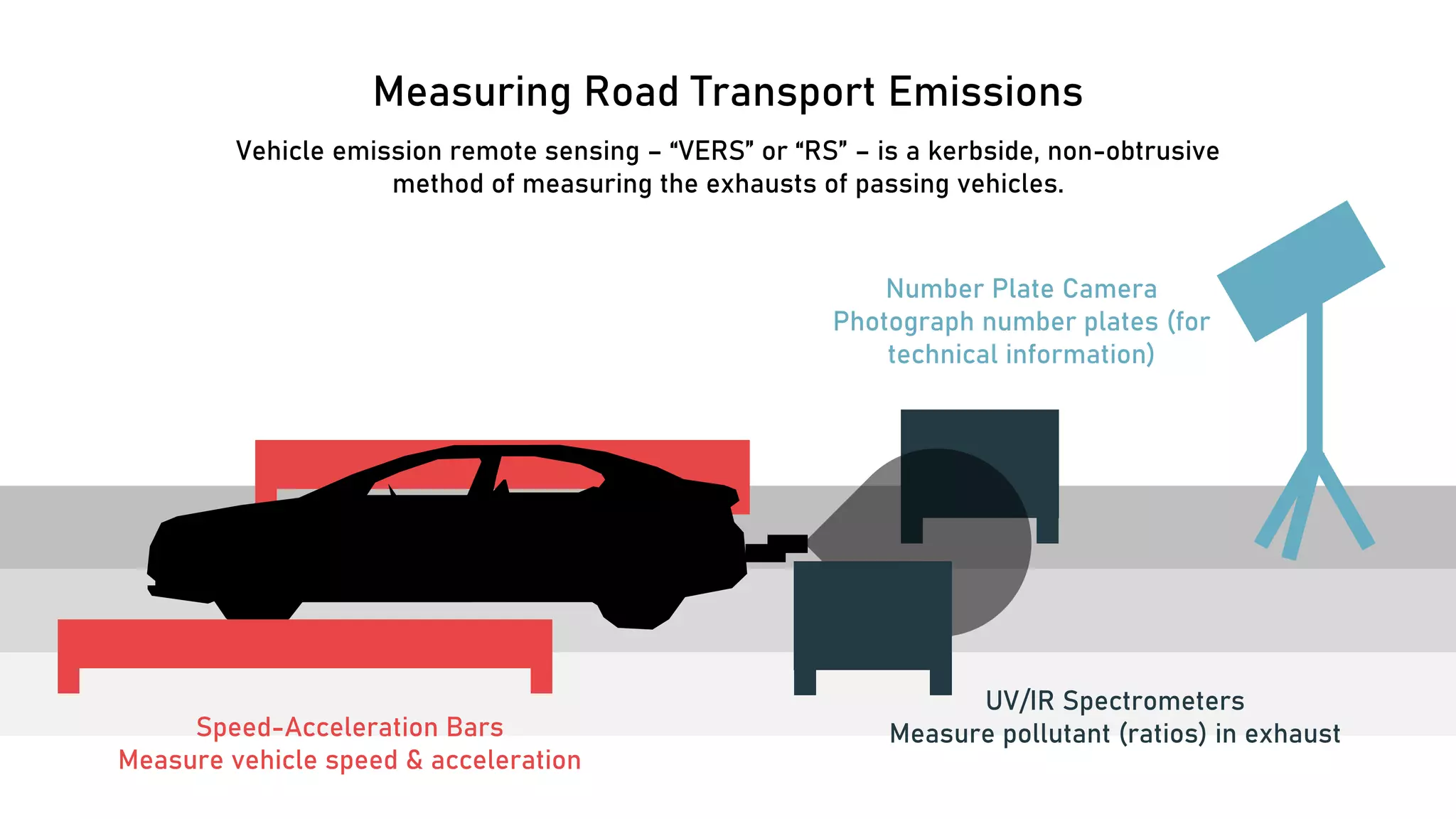
Vehicle emission remote sensing – “VERS” or “RS” – is a kerbside, non-obtrusive
method of measuring the exhausts of passing vehicles.
UV/IR Spectrometers
Measure pollutant (ratios) in exhaust
Speed-Acceleration Bars
Measure vehicle speed & acceleration
Number Plate Camera
Photograph number plates (for
technical information)
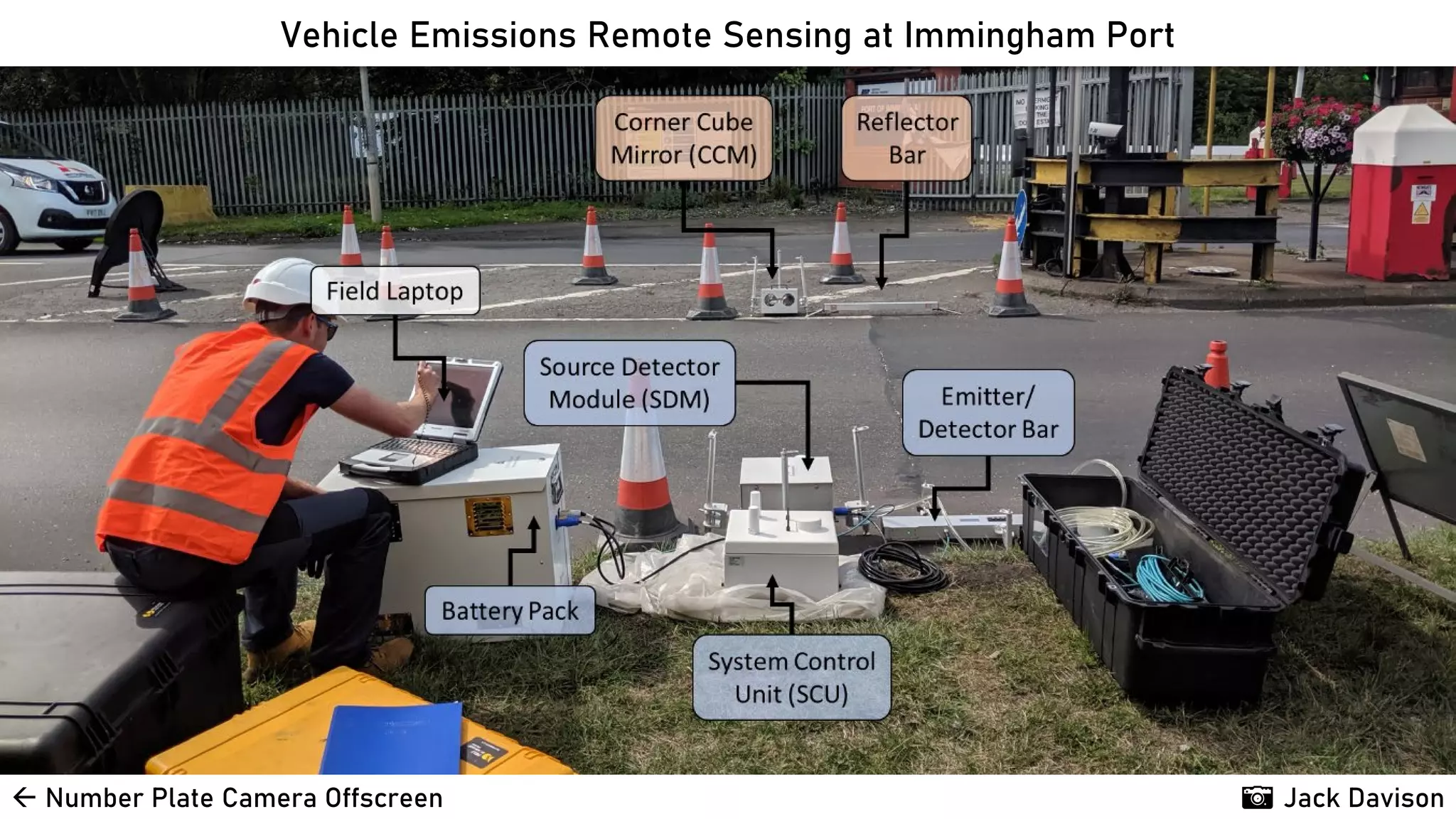
 Number Plate Camera Offscreen 📷📷 Jack Davison
Vehicle Emissions Remote Sensing at Immingham Port
Emission Factors from VERS
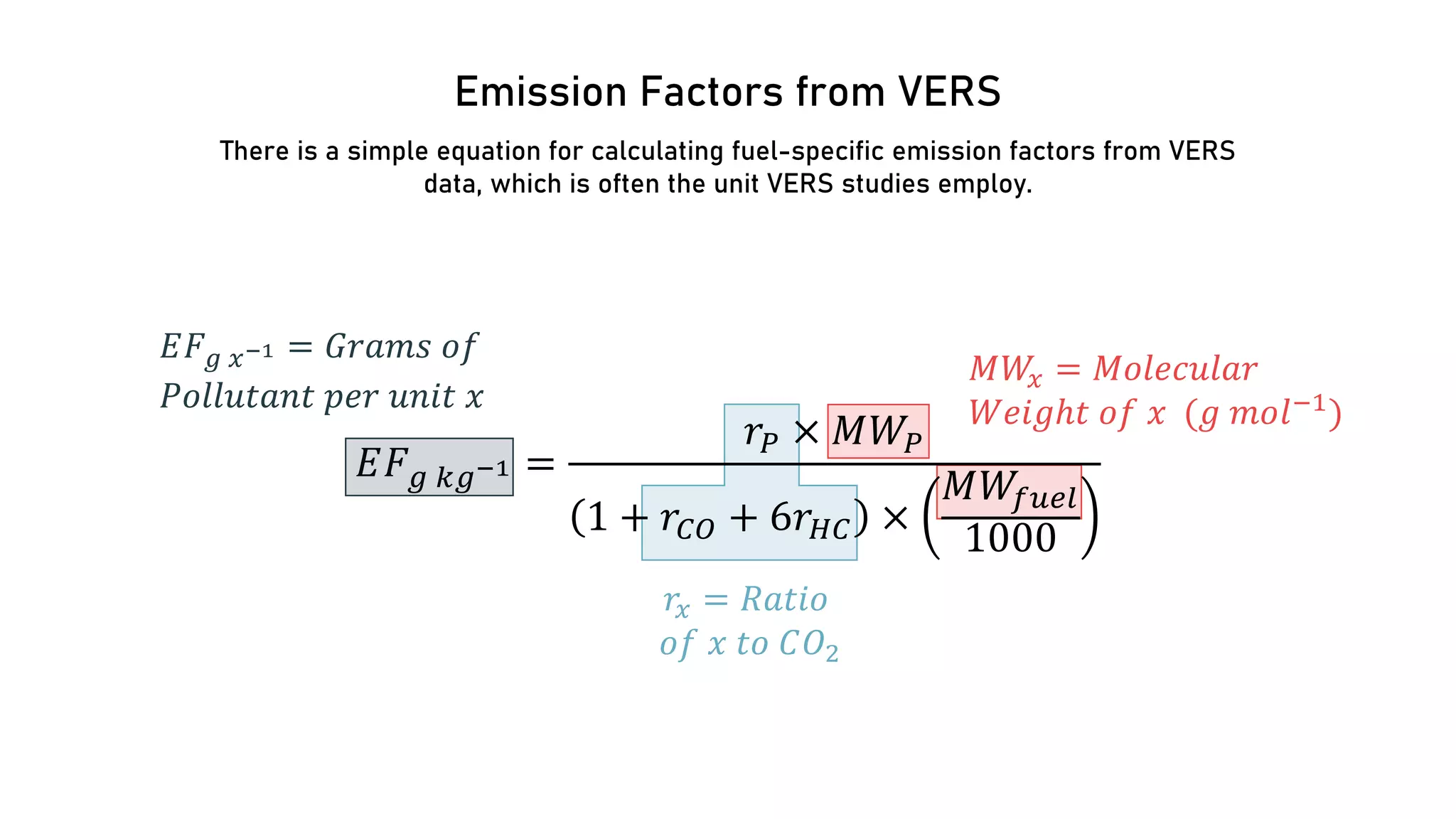
There is a simple equation for calculating fuel-specific emission factors from VERS
data, which is often the unit VERS studies employ.
𝐸𝐸𝐹𝐹𝑔𝑔 𝑘𝑘𝑔𝑔−1 =
𝑟𝑟𝑃𝑃 × 𝑀𝑀𝑊𝑊𝑃𝑃
1 + 𝑟𝑟𝐶𝐶𝐶𝐶 + 6𝑟𝑟𝐻𝐻𝐻𝐻 ×
𝑀𝑀𝑊𝑊𝑓𝑓𝑓𝑓𝑓𝑓𝑓𝑓
1000
𝑀𝑀𝑊𝑊
𝑥𝑥 = 𝑀𝑀𝑀𝑀𝑀𝑀𝑀𝑀𝑀𝑀𝑀𝑀𝑀𝑀𝑀𝑀𝑀𝑀
𝑊𝑊𝑊𝑊𝑊𝑊𝑊𝑊𝑊𝑊𝑊 𝑜𝑜𝑜𝑜 𝑥𝑥 (𝑔𝑔 𝑚𝑚𝑚𝑚𝑙𝑙−1
)
𝑟𝑟𝑥𝑥 = 𝑅𝑅𝑅𝑅𝑅𝑅𝑅𝑅𝑅𝑅
𝑜𝑜𝑜𝑜 𝑥𝑥 𝑡𝑡𝑡𝑡 𝐶𝐶𝑂𝑂2
𝐸𝐸𝐹𝐹𝑔𝑔 𝑥𝑥−1 = 𝐺𝐺𝐺𝐺𝐺𝐺𝐺𝐺𝐺𝐺 𝑜𝑜𝑜𝑜
𝑃𝑃𝑃𝑃𝑃𝑃𝑃𝑃𝑃𝑃𝑃𝑃𝑃𝑃𝑃𝑃𝑃𝑃 𝑝𝑝𝑝𝑝𝑝𝑝 𝑢𝑢𝑢𝑢𝑢𝑢𝑢𝑢 𝑥𝑥
Emission Factors from VERS
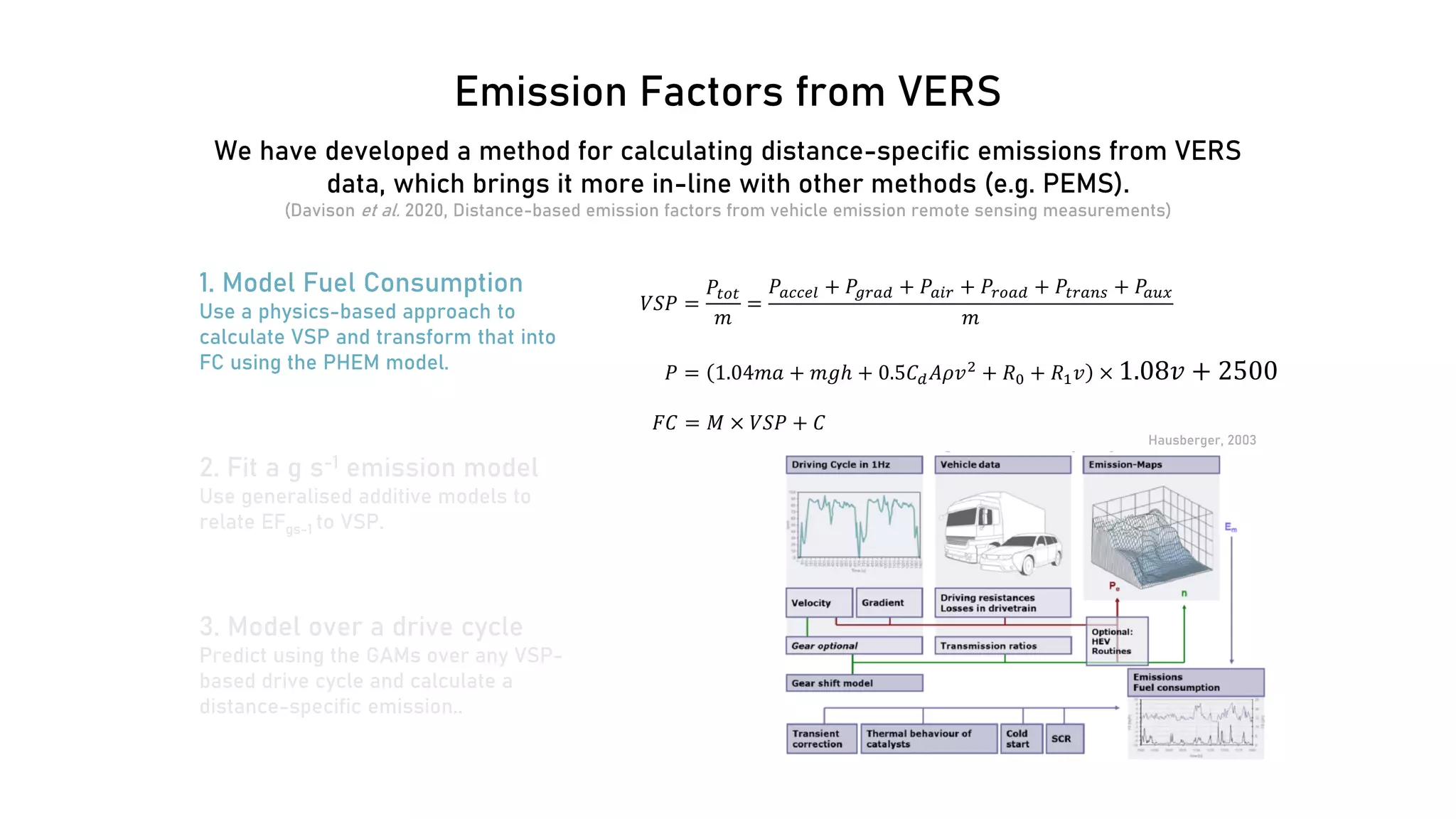
1. Model Fuel Consumption
Use a physics-based approach to
calculate VSP and transform that into
FC using the PHEM model.
𝑉𝑉𝑉𝑉𝑉𝑉 =
𝑃𝑃𝑡𝑡𝑡𝑡𝑡𝑡
𝑚𝑚
=
𝑃𝑃𝑎𝑎𝑎𝑎𝑎𝑎𝑎𝑎𝑎𝑎 + 𝑃𝑃𝑔𝑔𝑔𝑔𝑔𝑔𝑔𝑔 + 𝑃𝑃𝑎𝑎𝑎𝑎𝑎𝑎 + 𝑃𝑃𝑟𝑟𝑟𝑟𝑟𝑟𝑟𝑟 + 𝑃𝑃𝑡𝑡𝑡𝑡𝑡𝑡𝑡𝑡𝑡𝑡 + 𝑃𝑃𝑎𝑎𝑎𝑎𝑎𝑎
𝑚𝑚
𝐹𝐹𝐹𝐹 = 𝑀𝑀 × 𝑉𝑉𝑉𝑉𝑉𝑉 + 𝐶𝐶
Hausberger, 2003
2. Fit a g s-1 emission model
Use generalised additive models to
relate EFgs-1 to VSP.
3. Model over a drive cycle
Predict using the GAMs over any VSP-
based drive cycle and calculate a
distance-specific emission..
𝑃𝑃 = 1.04𝑚𝑚𝑚𝑚 + 𝑚𝑚𝑚𝑚𝑚 + 0.5𝐶𝐶𝑑𝑑𝐴𝐴𝐴𝐴𝑣𝑣2 + 𝑅𝑅0 + 𝑅𝑅1𝑣𝑣 × 1.08𝑣𝑣 + 2500
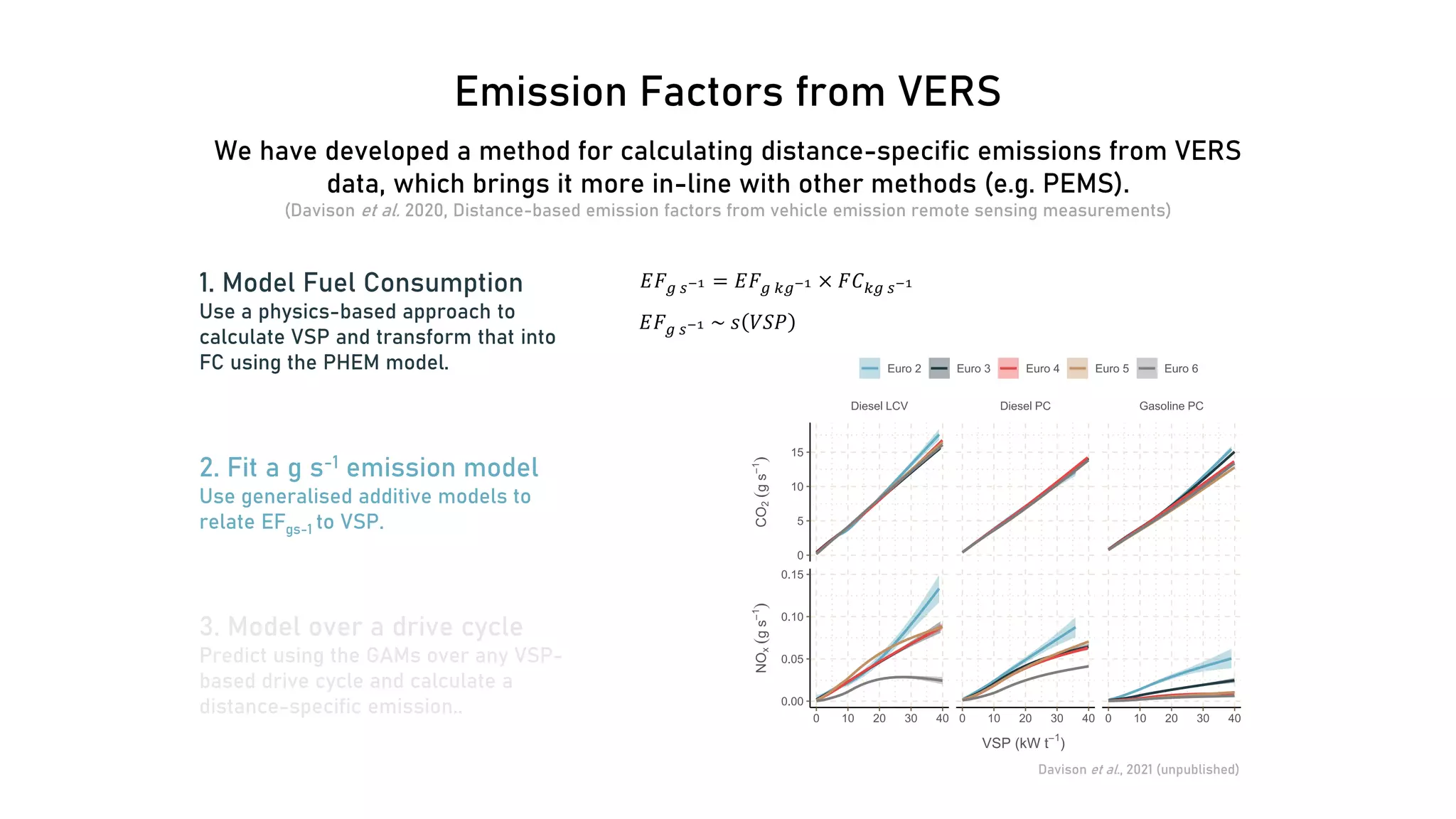
We have developed a method for calculating distance-specific emissions from VERS
data, which brings it more in-line with other methods (e.g. PEMS).
(Davison et al. 2020, Distance-based emission factors from vehicle emission remote sensing measurements)
Emission Factors from VERS
1. Model Fuel Consumption
Use a physics-based approach to
calculate VSP and transform that into
FC using the PHEM model.
Davison et al., 2021 (unpublished)
2. Fit a g s-1 emission model
Use generalised additive models to
relate EFgs-1 to VSP.
𝐸𝐸𝐹𝐹𝑔𝑔 𝑠𝑠−1 = 𝐸𝐸𝐹𝐹𝑔𝑔 𝑘𝑘𝑔𝑔−1 × 𝐹𝐹𝐶𝐶𝑘𝑘𝑘𝑘 𝑠𝑠−1
𝐸𝐸𝐹𝐹𝑔𝑔 𝑠𝑠−1 ~ 𝑠𝑠 𝑉𝑉𝑉𝑉𝑉𝑉
3. Model over a drive cycle
Predict using the GAMs over any VSP-
based drive cycle and calculate a
distance-specific emission..
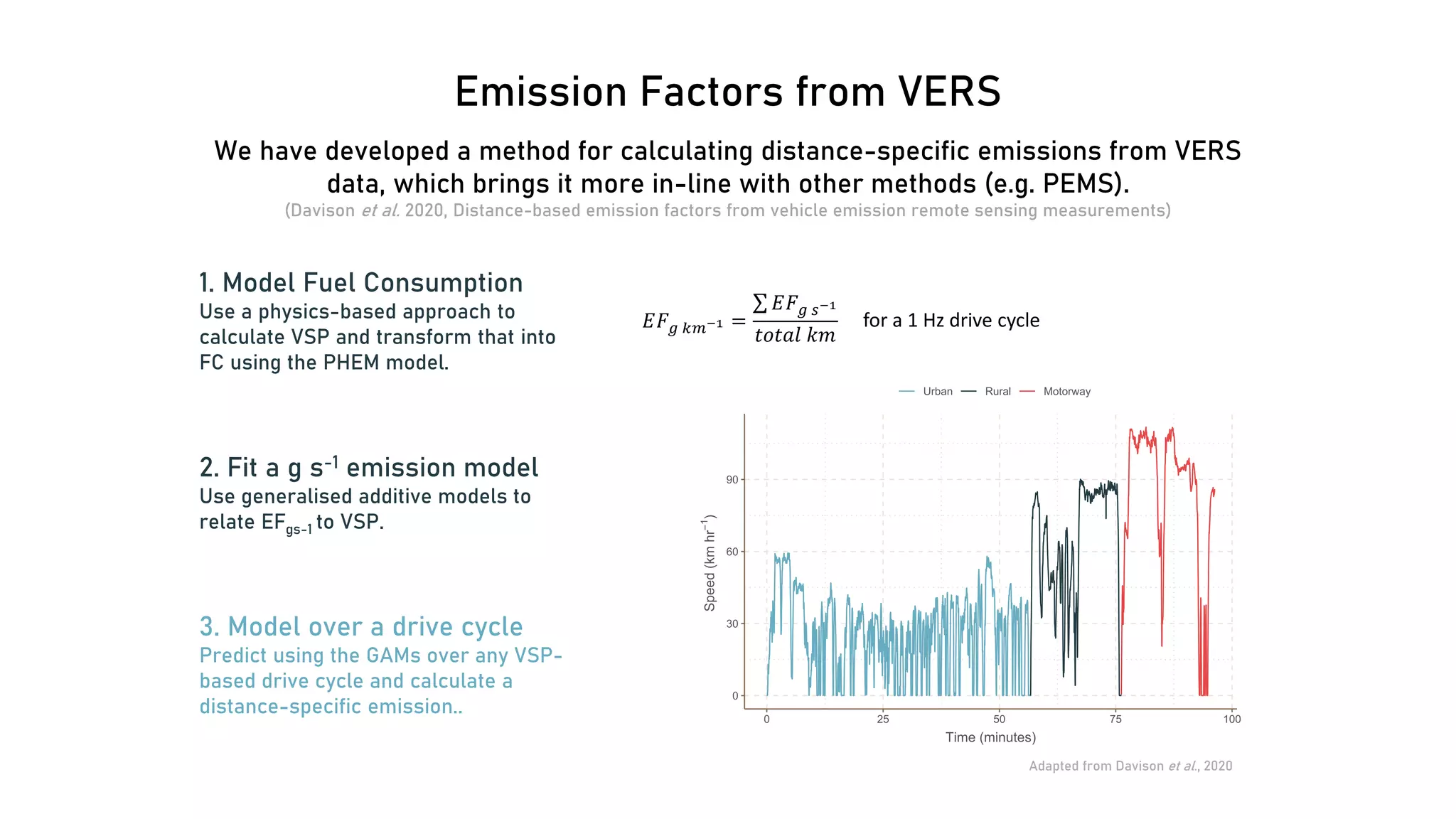
We have developed a method for calculating distance-specific emissions from VERS
data, which brings it more in-line with other methods (e.g. PEMS).
(Davison et al. 2020, Distance-based emission factors from vehicle emission remote sensing measurements)
Emission Factors from VERS
1. Model Fuel Consumption
Use a physics-based approach to
calculate VSP and transform that into
FC using the PHEM model.
Adapted from Davison et al., 2020
2. Fit a g s-1 emission model
Use generalised additive models to
relate EFgs-1 to VSP.
𝐸𝐸𝐹𝐹𝑔𝑔 𝑘𝑘𝑚𝑚−1 =
∑ 𝐸𝐸𝐹𝐹𝑔𝑔 𝑠𝑠−1
𝑡𝑡𝑡𝑡𝑡𝑡𝑡𝑡𝑡𝑡 𝑘𝑘𝑘𝑘
We have developed a method for calculating distance-specific emissions from VERS
data, which brings it more in-line with other methods (e.g. PEMS).
(Davison et al. 2020, Distance-based emission factors from vehicle emission remote sensing measurements)
3. Model over a drive cycle
Predict using the GAMs over any VSP-
based drive cycle and calculate a
distance-specific emission..
for a 1 Hz drive cycle
Method Validation
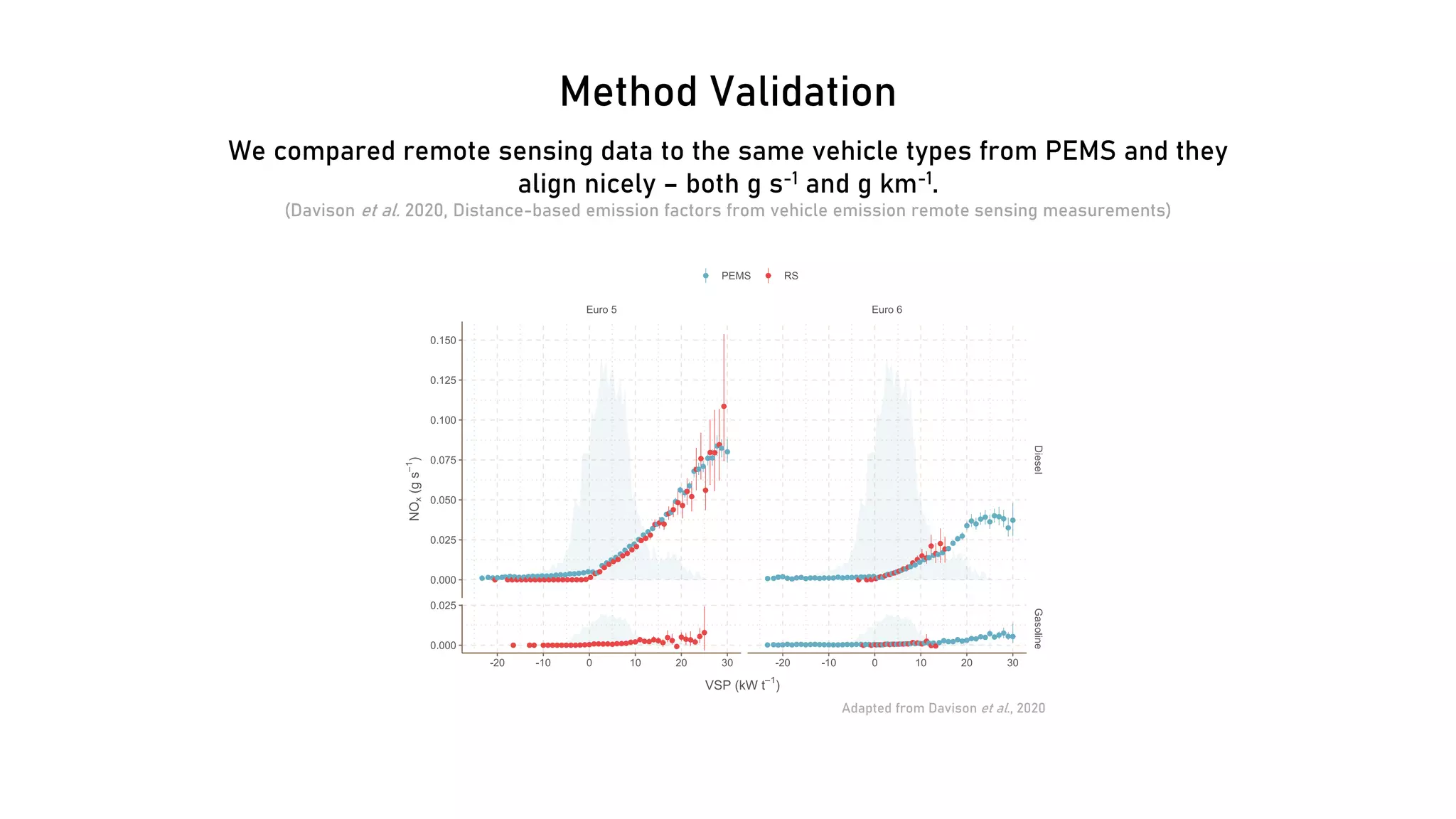
We compared remote sensing data to the same vehicle types from PEMS and they
align nicely – both g s-1 and g km-1.
(Davison et al. 2020, Distance-based emission factors from vehicle emission remote sensing measurements)
Adapted from Davison et al., 2020
Method Validation
Adapted from Davison et al., 2020
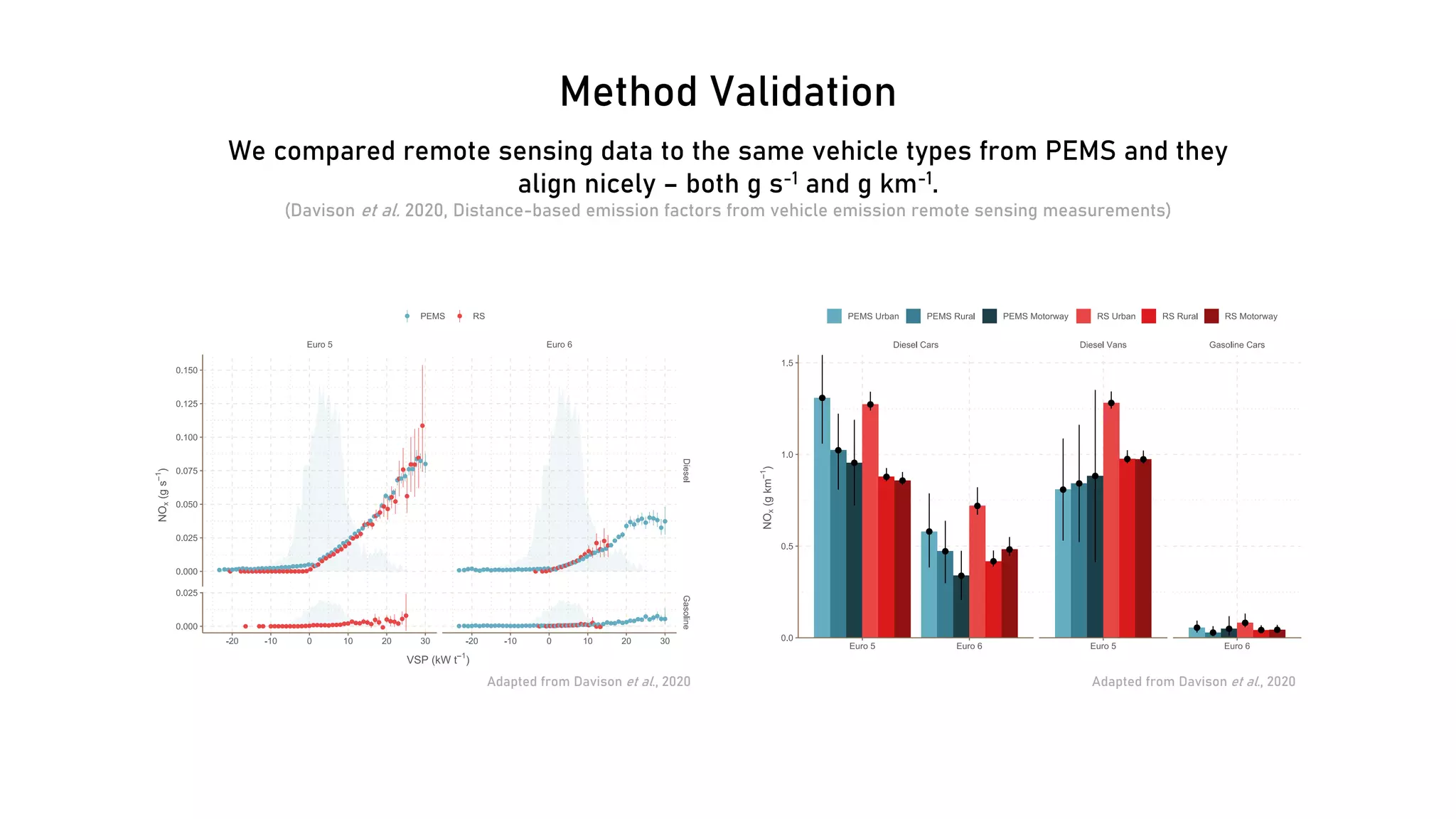
We compared remote sensing data to the same vehicle types from PEMS and they
align nicely – both g s-1 and g km-1.
(Davison et al. 2020, Distance-based emission factors from vehicle emission remote sensing measurements)
Adapted from Davison et al., 2020
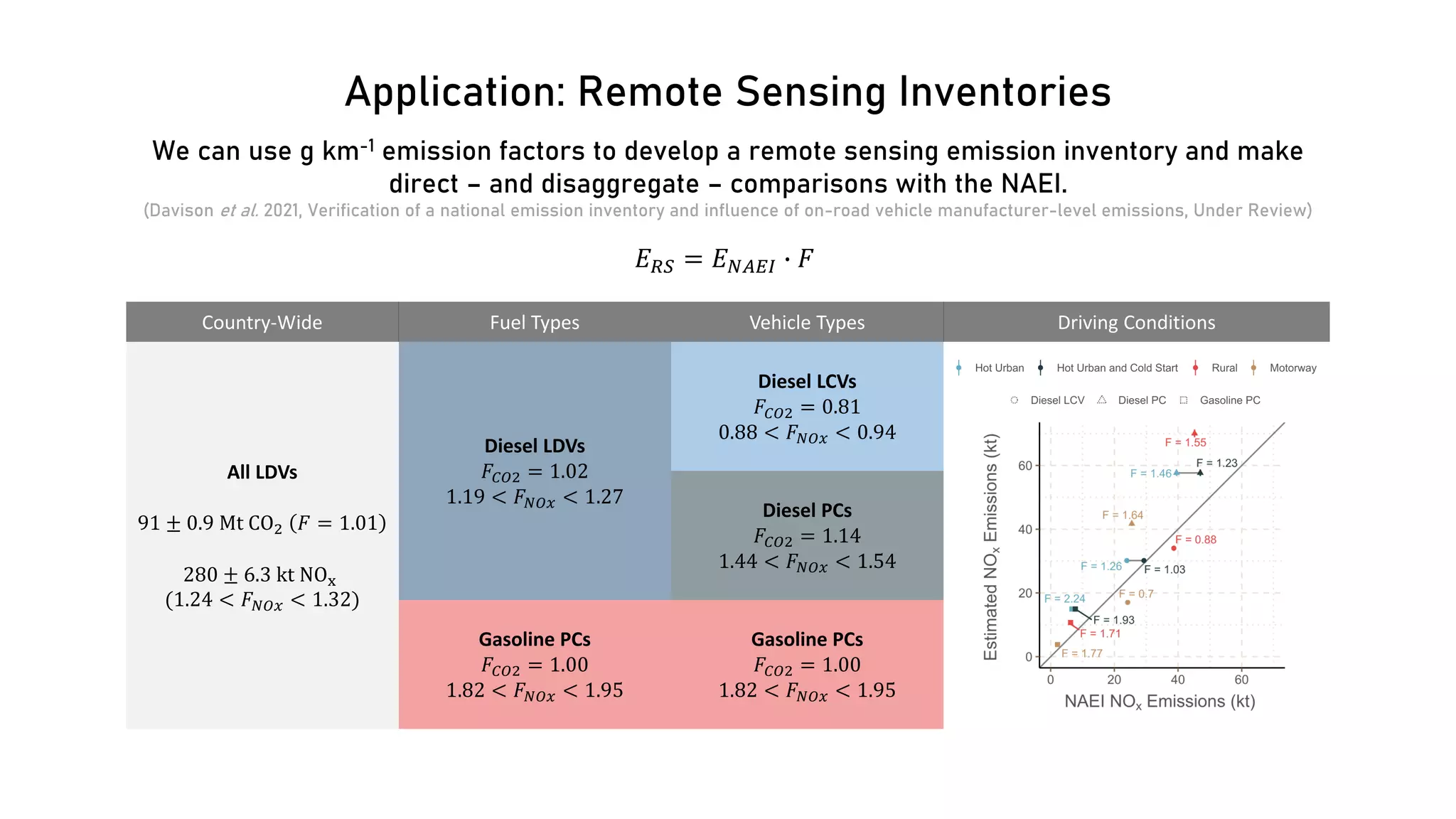
Application: Remote Sensing Inventories
We can use g km-1 emission factors to develop a remote sensing emission inventory and make
direct – and disaggregate – comparisons with the NAEI.
(Davison et al. 2021, Verification of a national emission inventory and influence of on-road vehicle manufacturer-level emissions, Under Review)
𝐸𝐸𝑅𝑅𝑅𝑅 = 𝐸𝐸𝑁𝑁𝑁𝑁𝑁𝑁𝑁𝑁 � 𝐹𝐹
Diesel LCVs
𝐹𝐹𝐶𝐶𝐶𝐶𝐶 = 0.81
0.88 < 𝐹𝐹𝑁𝑁𝑁𝑁𝑁𝑁 < 0.94
Diesel PCs
𝐹𝐹𝐶𝐶𝐶𝐶𝐶 = 1.14
1.44 < 𝐹𝐹𝑁𝑁𝑁𝑁𝑁𝑁 < 1.54
Gasoline PCs
𝐹𝐹𝐶𝐶𝐶𝐶𝐶 = 1.00
1.82 < 𝐹𝐹𝑁𝑁𝑁𝑁𝑁𝑁 < 1.95
Vehicle Types
Diesel LDVs
𝐹𝐹𝐶𝐶𝐶𝐶𝐶 = 1.02
1.19 < 𝐹𝐹𝑁𝑁𝑁𝑁𝑁𝑁 < 1.27
Gasoline PCs
𝐹𝐹𝐶𝐶𝐶𝐶𝐶 = 1.00
1.82 < 𝐹𝐹𝑁𝑁𝑁𝑁𝑁𝑁 < 1.95
Fuel Types
All LDVs
91 ± 0.9 Mt CO2 𝐹𝐹 = 1.01
280 ± 6.3 kt NOx
(1.24 < 𝐹𝐹𝑁𝑁𝑁𝑁𝑁𝑁 < 1.32)
Country-Wide Driving Conditions
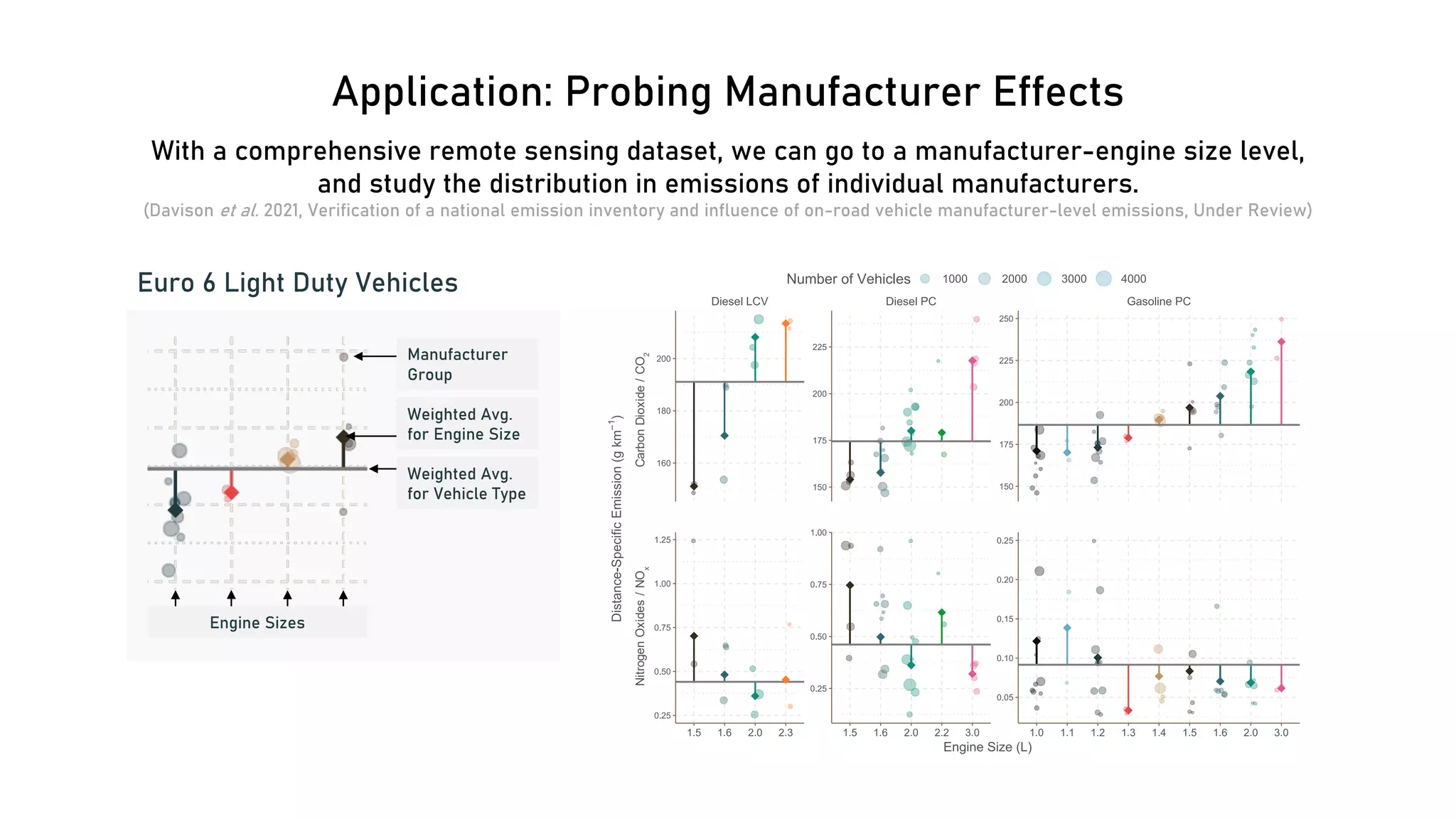
Application: Probing Manufacturer Effects
With a comprehensive remote sensing dataset, we can go to a manufacturer-engine size level,
and study the distribution in emissions of individual manufacturers.
(Davison et al. 2021, Verification of a national emission inventory and influence of on-road vehicle manufacturer-level emissions, Under Review)
Carbon
Dioxide
/
CO
2
Nitrogen
Oxides
/
NO
x
Manufacturer
Group
Weighted Avg.
for Engine Size
Weighted Avg.
for Vehicle Type
Engine Sizes
Euro 6 Light Duty Vehicles
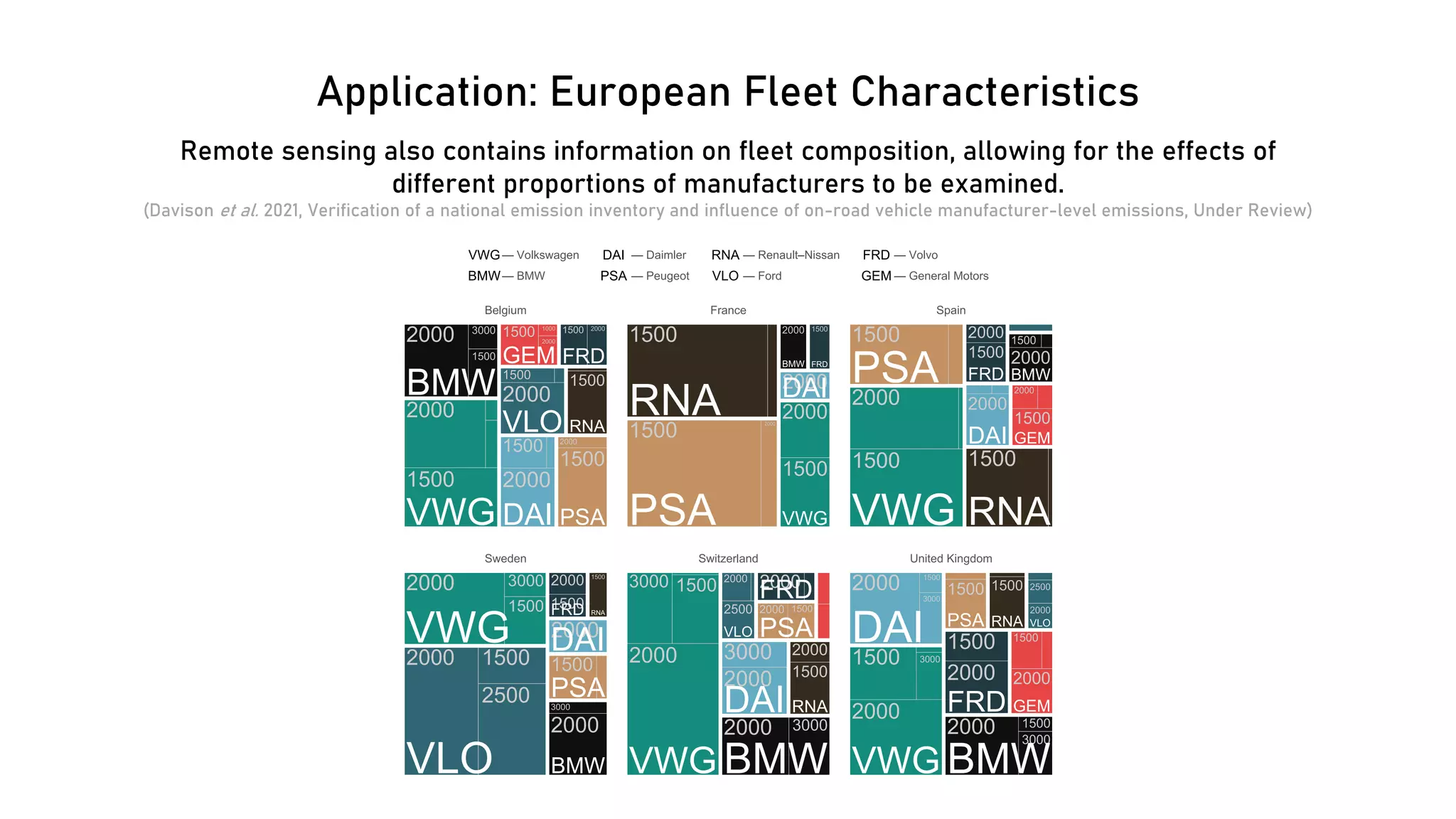
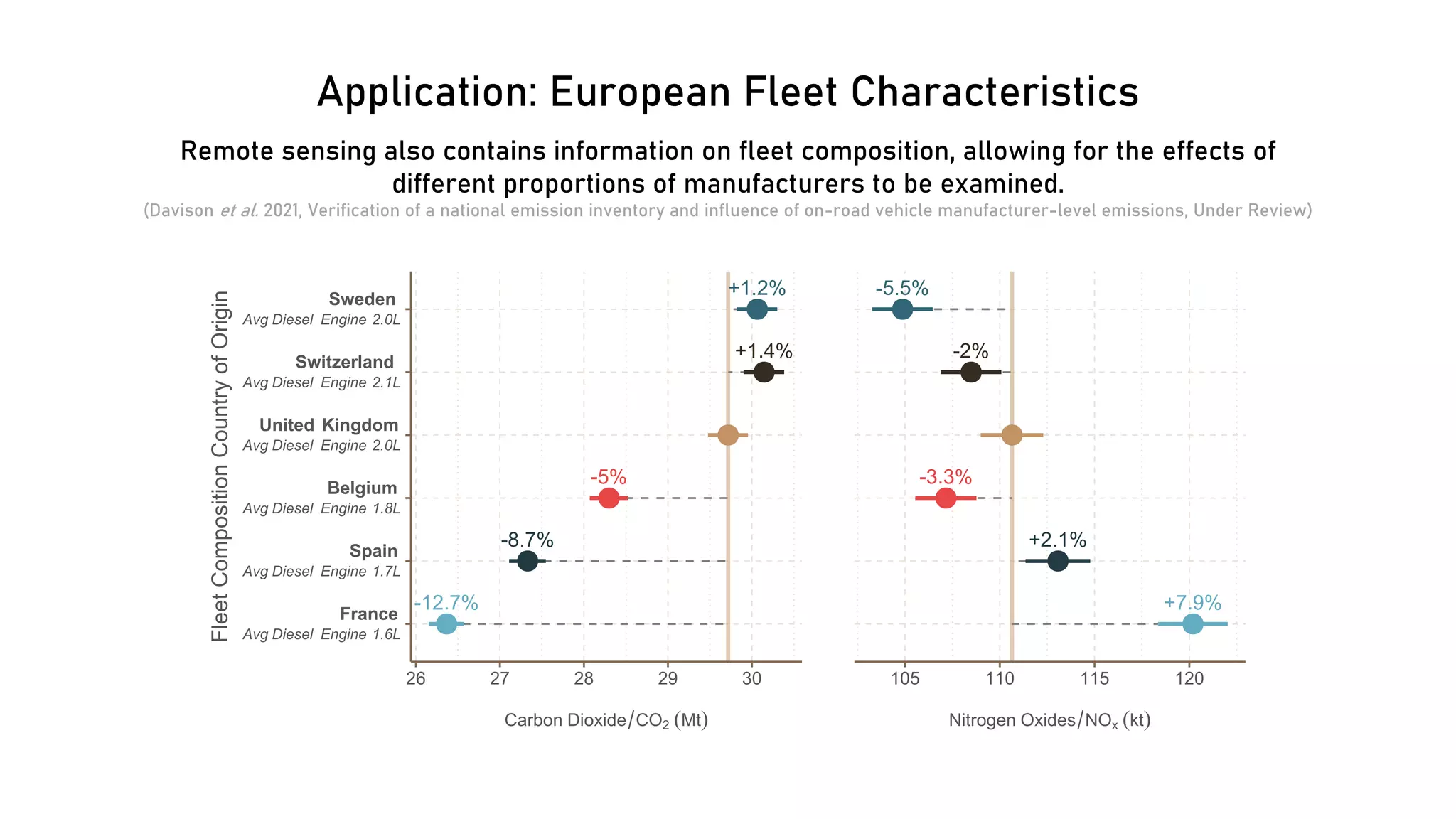
Application: European Fleet Characteristics
Remote sensing also contains information on fleet composition, allowing for the effects of
different proportions of manufacturers to be examined.
(Davison et al. 2021, Verification of a national emission inventory and influence of on-road vehicle manufacturer-level emissions, Under Review)
Application: European Fleet Characteristics
Remote sensing also contains information on fleet composition, allowing for the effects of
different proportions of manufacturers to be examined.
(Davison et al. 2021, Verification of a national emission inventory and influence of on-road vehicle manufacturer-level emissions, Under Review)
United Kingdom United Kingdom United Kingdom
United Kingdom
United Kingdom
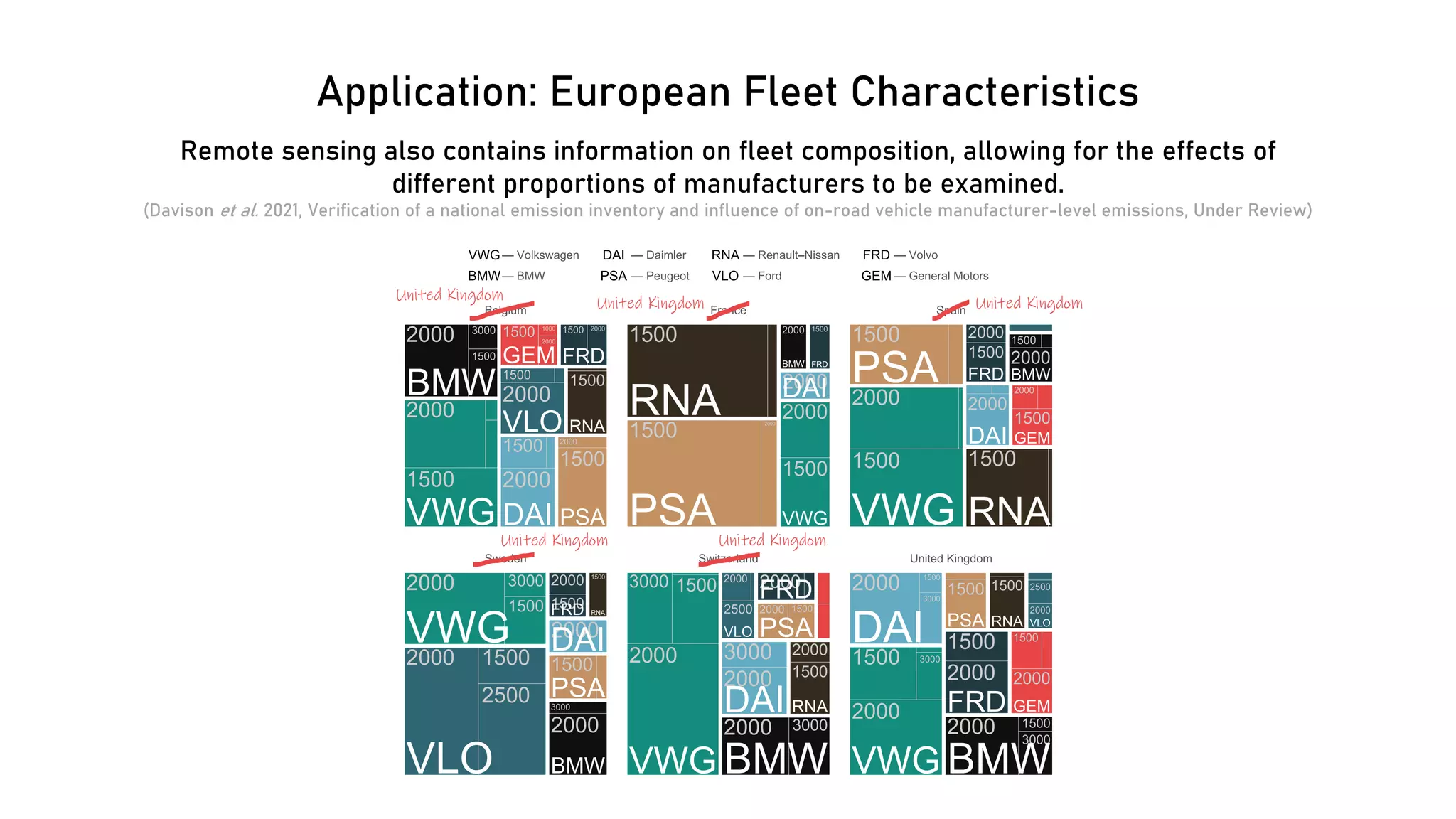
Application: European Fleet Characteristics
Remote sensing also contains information on fleet composition, allowing for the effects of
different proportions of manufacturers to be examined.
(Davison et al. 2021, Verification of a national emission inventory and influence of on-road vehicle manufacturer-level emissions, Under Review)
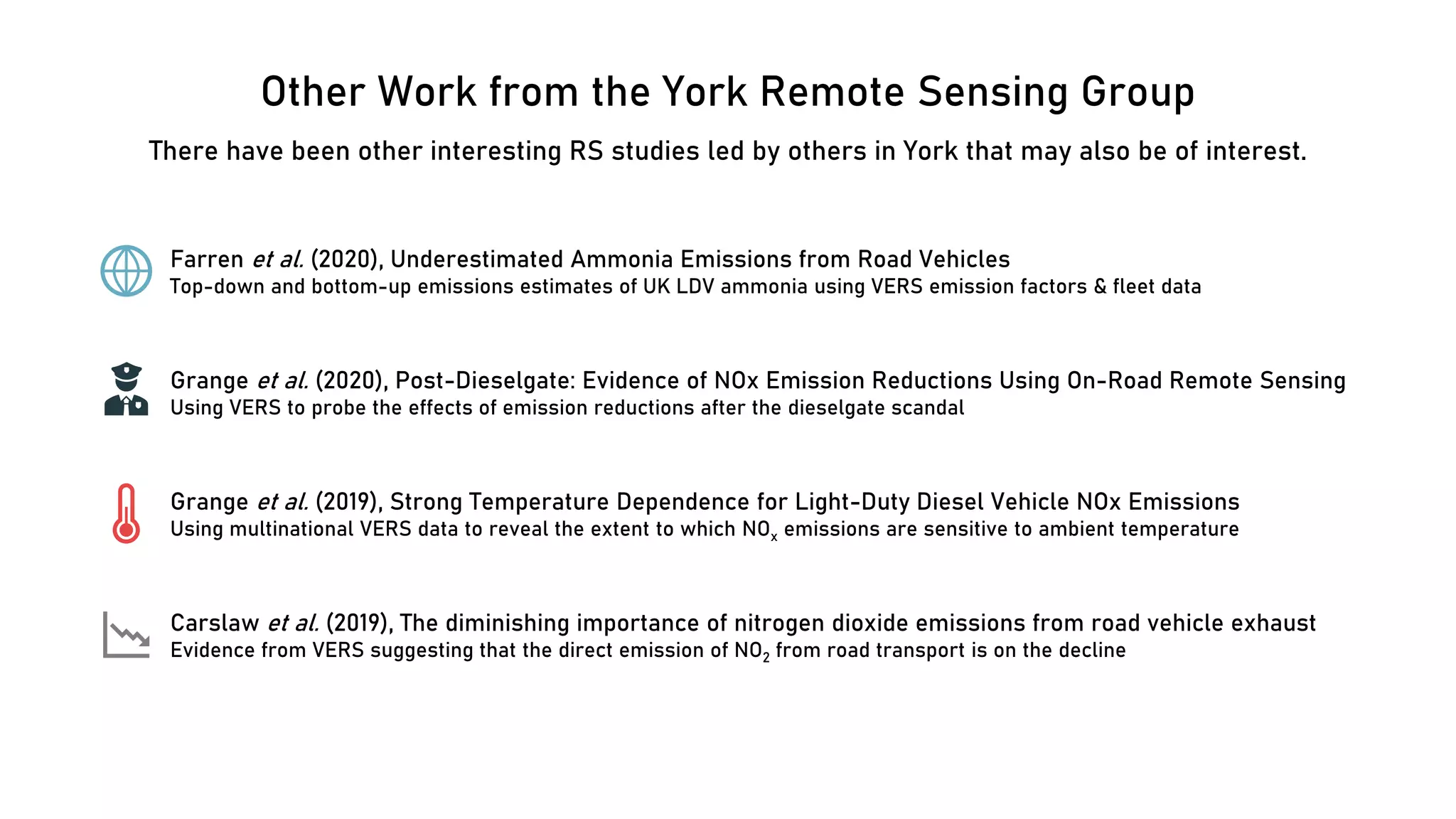
Other Work from the York Remote Sensing Group
There have been other interesting RS studies led by others in York that may also be of interest.
Grange et al. (2020), Post-Dieselgate: Evidence of NOx Emission Reductions Using On-Road Remote Sensing
Using VERS to probe the effects of emission reductions after the dieselgate scandal
Grange et al. (2019), Strong Temperature Dependence for Light-Duty Diesel Vehicle NOx Emissions
Using multinational VERS data to reveal the extent to which NOx emissions are sensitive to ambient temperature
Carslaw et al. (2019), The diminishing importance of nitrogen dioxide emissions from road vehicle exhaust
Evidence from VERS suggesting that the direct emission of NO2 from road transport is on the decline
Farren et al. (2020), Underestimated Ammonia Emissions from Road Vehicles
Top-down and bottom-up emissions estimates of UK LDV ammonia using VERS emission factors & fleet data
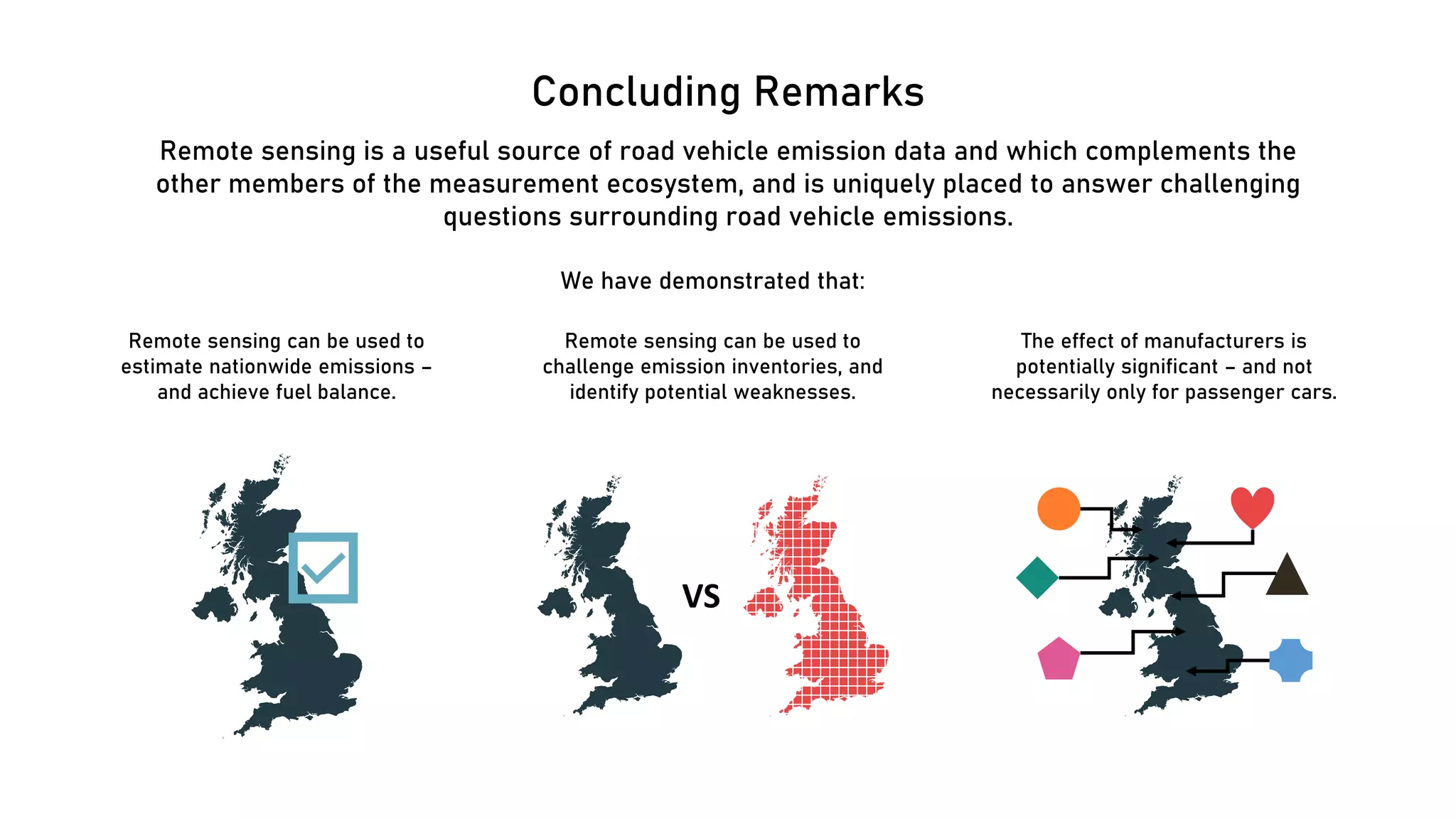
Concluding Remarks
Remote sensing is a useful source of road vehicle emission data and which complements the
other members of the measurement ecosystem, and is uniquely placed to answer challenging
questions surrounding road vehicle emissions.
We have demonstrated that:
Remote sensing can be used to
challenge emission inventories, and
identify potential weaknesses.
VS
Remote sensing can be used to
estimate nationwide emissions –
and achieve fuel balance.
The effect of manufacturers is
potentially significant – and not
necessarily only for passenger cars.
Uses of vehicle emissions remote sensing
data for emission factor development
Jack Davison, PhD Student
Wolfson Atmospheric Chemistry Laboratories, University of York
📧📧 jd1184@york.ac.uk 🐤🐤 @JDavison_
Acknowledgements
Dr David Carslaw
Dr Naomi Farren
National Centre for Atmospheric Science / UK Department for Transport
The CONOX Project
(Jens Borken-Kleefeld, Stefan Hausberger, James Tate,
Yoann Bernard, Åke Sjödin)
FROM ROADSIDE TO NATION-WIDE
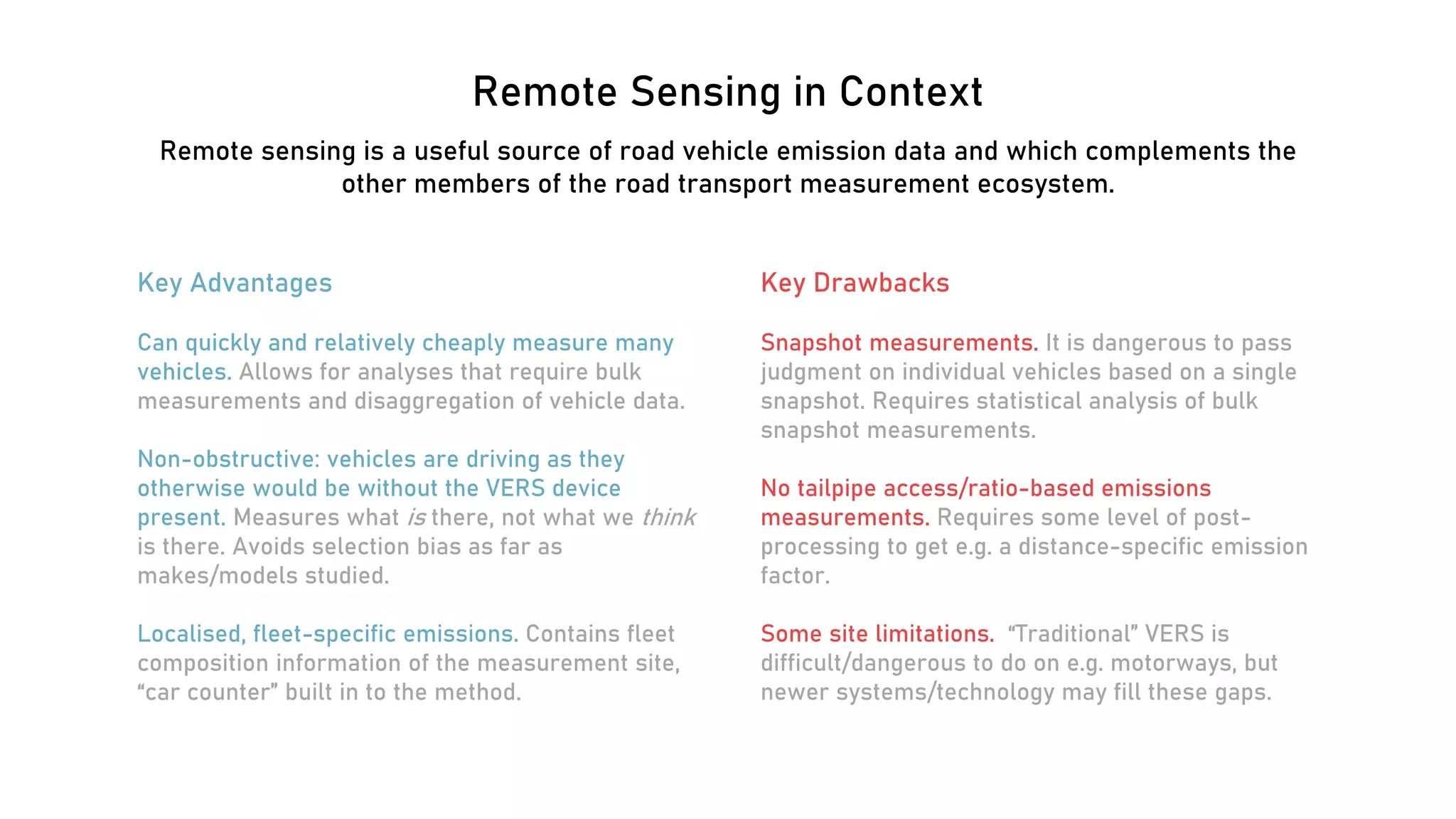
Remote Sensing in Context
Remote sensing is a useful source of road vehicle emission data and which complements the
other members of the road transport measurement ecosystem.
Key Advantages
Can quickly and relatively cheaply measure many
vehicles. Allows for analyses that require bulk
measurements and disaggregation of vehicle data.
Non-obstructive: vehicles are driving as they
otherwise would be without the VERS device
present. Measures what is there, not what we think
is there. Avoids selection bias as far as
makes/models studied.
Localised, fleet-specific emissions. Contains fleet
composition information of the measurement site,
“car counter” built in to the method.
Key Drawbacks
Snapshot measurements. It is dangerous to pass
judgment on individual vehicles based on a single
snapshot. Requires statistical analysis of bulk
snapshot measurements.
No tailpipe access/ratio-based emissions
measurements. Requires some level of post-
processing to get e.g. a distance-specific emission
factor.
Some site limitations. “Traditional” VERS is
difficult/dangerous to do on e.g. motorways, but
newer systems/technology may fill these gaps.

Uses of vehicle emissions remote sensing data for emission factor development

  • 1.
    Uses of vehicleemissions remote sensing data for emission factor development Jack Davison, PhD Student Wolfson Atmospheric Chemistry Laboratories, University of York 📧📧 jd1184@york.ac.uk 🐤🐤 @JDavison_ FROM ROADSIDE TO NATION-WIDE
  • 2.
    Road Transport Emissions Roadtransport emits not only the climate gas CO2 but also a range of air quality pollutants – NOx, CO, NH3, HC, etc. 52% 31% of UK NOx comes from Transport of UK NOx comes from Road Transport According to the 2018 National Atmospheric Emissions Inventory naei.beis.gov.uk/overview/pollutants?pollutant_id=6
  • 3.
    Road Transport Emissions Itis challenging to estimate road transport emissions, because each road vehicle is unique – even if nominally identical. Surface Level Make/Model Fuel Type Euro Standard Vehicle Class Technology Distinguishing Features Age Mileage Maintenance Driver behaviour Modifications External Factors Ambient Temperature Ambient Humidity Road Characteristics Congestion
  • 4.
    Measuring Road TransportEmissions Typically, emission factor development relies on “in-lab” and “on-board” methods of measuring vehicle exhausts – but these are limited. “In-Lab” Chassis Dynamometer “On-Board” Portable Emissions Measurement System “On-Road” Vehicle Emission Remote Sensing
  • 5.
    Measuring Road TransportEmissions Vehicle emission remote sensing – “VERS” or “RS” – is a kerbside, non-obtrusive method of measuring the exhausts of passing vehicles. UV/IR Spectrometers Measure pollutant (ratios) in exhaust Speed-Acceleration Bars Measure vehicle speed & acceleration Number Plate Camera Photograph number plates (for technical information)
  • 6.
     Number PlateCamera Offscreen 📷📷 Jack Davison Vehicle Emissions Remote Sensing at Immingham Port
  • 7.
    Emission Factors fromVERS There is a simple equation for calculating fuel-specific emission factors from VERS data, which is often the unit VERS studies employ. 𝐸𝐸𝐹𝐹𝑔𝑔 𝑘𝑘𝑔𝑔−1 = 𝑟𝑟𝑃𝑃 × 𝑀𝑀𝑊𝑊𝑃𝑃 1 + 𝑟𝑟𝐶𝐶𝐶𝐶 + 6𝑟𝑟𝐻𝐻𝐻𝐻 × 𝑀𝑀𝑊𝑊𝑓𝑓𝑓𝑓𝑓𝑓𝑓𝑓 1000 𝑀𝑀𝑊𝑊 𝑥𝑥 = 𝑀𝑀𝑀𝑀𝑀𝑀𝑀𝑀𝑀𝑀𝑀𝑀𝑀𝑀𝑀𝑀𝑀𝑀 𝑊𝑊𝑊𝑊𝑊𝑊𝑊𝑊𝑊𝑊𝑊 𝑜𝑜𝑜𝑜 𝑥𝑥 (𝑔𝑔 𝑚𝑚𝑚𝑚𝑙𝑙−1 ) 𝑟𝑟𝑥𝑥 = 𝑅𝑅𝑅𝑅𝑅𝑅𝑅𝑅𝑅𝑅 𝑜𝑜𝑜𝑜 𝑥𝑥 𝑡𝑡𝑡𝑡 𝐶𝐶𝑂𝑂2 𝐸𝐸𝐹𝐹𝑔𝑔 𝑥𝑥−1 = 𝐺𝐺𝐺𝐺𝐺𝐺𝐺𝐺𝐺𝐺 𝑜𝑜𝑜𝑜 𝑃𝑃𝑃𝑃𝑃𝑃𝑃𝑃𝑃𝑃𝑃𝑃𝑃𝑃𝑃𝑃𝑃𝑃 𝑝𝑝𝑝𝑝𝑝𝑝 𝑢𝑢𝑢𝑢𝑢𝑢𝑢𝑢 𝑥𝑥
  • 8.
    Emission Factors fromVERS 1. Model Fuel Consumption Use a physics-based approach to calculate VSP and transform that into FC using the PHEM model. 𝑉𝑉𝑉𝑉𝑉𝑉 = 𝑃𝑃𝑡𝑡𝑡𝑡𝑡𝑡 𝑚𝑚 = 𝑃𝑃𝑎𝑎𝑎𝑎𝑎𝑎𝑎𝑎𝑎𝑎 + 𝑃𝑃𝑔𝑔𝑔𝑔𝑔𝑔𝑔𝑔 + 𝑃𝑃𝑎𝑎𝑎𝑎𝑎𝑎 + 𝑃𝑃𝑟𝑟𝑟𝑟𝑟𝑟𝑟𝑟 + 𝑃𝑃𝑡𝑡𝑡𝑡𝑡𝑡𝑡𝑡𝑡𝑡 + 𝑃𝑃𝑎𝑎𝑎𝑎𝑎𝑎 𝑚𝑚 𝐹𝐹𝐹𝐹 = 𝑀𝑀 × 𝑉𝑉𝑉𝑉𝑉𝑉 + 𝐶𝐶 Hausberger, 2003 2. Fit a g s-1 emission model Use generalised additive models to relate EFgs-1 to VSP. 3. Model over a drive cycle Predict using the GAMs over any VSP- based drive cycle and calculate a distance-specific emission.. 𝑃𝑃 = 1.04𝑚𝑚𝑚𝑚 + 𝑚𝑚𝑚𝑚𝑚 + 0.5𝐶𝐶𝑑𝑑𝐴𝐴𝐴𝐴𝑣𝑣2 + 𝑅𝑅0 + 𝑅𝑅1𝑣𝑣 × 1.08𝑣𝑣 + 2500 We have developed a method for calculating distance-specific emissions from VERS data, which brings it more in-line with other methods (e.g. PEMS). (Davison et al. 2020, Distance-based emission factors from vehicle emission remote sensing measurements)
  • 9.
    Emission Factors fromVERS 1. Model Fuel Consumption Use a physics-based approach to calculate VSP and transform that into FC using the PHEM model. Davison et al., 2021 (unpublished) 2. Fit a g s-1 emission model Use generalised additive models to relate EFgs-1 to VSP. 𝐸𝐸𝐹𝐹𝑔𝑔 𝑠𝑠−1 = 𝐸𝐸𝐹𝐹𝑔𝑔 𝑘𝑘𝑔𝑔−1 × 𝐹𝐹𝐶𝐶𝑘𝑘𝑘𝑘 𝑠𝑠−1 𝐸𝐸𝐹𝐹𝑔𝑔 𝑠𝑠−1 ~ 𝑠𝑠 𝑉𝑉𝑉𝑉𝑉𝑉 3. Model over a drive cycle Predict using the GAMs over any VSP- based drive cycle and calculate a distance-specific emission.. We have developed a method for calculating distance-specific emissions from VERS data, which brings it more in-line with other methods (e.g. PEMS). (Davison et al. 2020, Distance-based emission factors from vehicle emission remote sensing measurements)
  • 10.
    Emission Factors fromVERS 1. Model Fuel Consumption Use a physics-based approach to calculate VSP and transform that into FC using the PHEM model. Adapted from Davison et al., 2020 2. Fit a g s-1 emission model Use generalised additive models to relate EFgs-1 to VSP. 𝐸𝐸𝐹𝐹𝑔𝑔 𝑘𝑘𝑚𝑚−1 = ∑ 𝐸𝐸𝐹𝐹𝑔𝑔 𝑠𝑠−1 𝑡𝑡𝑡𝑡𝑡𝑡𝑡𝑡𝑡𝑡 𝑘𝑘𝑘𝑘 We have developed a method for calculating distance-specific emissions from VERS data, which brings it more in-line with other methods (e.g. PEMS). (Davison et al. 2020, Distance-based emission factors from vehicle emission remote sensing measurements) 3. Model over a drive cycle Predict using the GAMs over any VSP- based drive cycle and calculate a distance-specific emission.. for a 1 Hz drive cycle
  • 11.
    Method Validation We comparedremote sensing data to the same vehicle types from PEMS and they align nicely – both g s-1 and g km-1. (Davison et al. 2020, Distance-based emission factors from vehicle emission remote sensing measurements) Adapted from Davison et al., 2020
  • 12.
    Method Validation Adapted fromDavison et al., 2020 We compared remote sensing data to the same vehicle types from PEMS and they align nicely – both g s-1 and g km-1. (Davison et al. 2020, Distance-based emission factors from vehicle emission remote sensing measurements) Adapted from Davison et al., 2020
  • 13.
    Application: Remote SensingInventories We can use g km-1 emission factors to develop a remote sensing emission inventory and make direct – and disaggregate – comparisons with the NAEI. (Davison et al. 2021, Verification of a national emission inventory and influence of on-road vehicle manufacturer-level emissions, Under Review) 𝐸𝐸𝑅𝑅𝑅𝑅 = 𝐸𝐸𝑁𝑁𝑁𝑁𝑁𝑁𝑁𝑁 � 𝐹𝐹 Diesel LCVs 𝐹𝐹𝐶𝐶𝐶𝐶𝐶 = 0.81 0.88 < 𝐹𝐹𝑁𝑁𝑁𝑁𝑁𝑁 < 0.94 Diesel PCs 𝐹𝐹𝐶𝐶𝐶𝐶𝐶 = 1.14 1.44 < 𝐹𝐹𝑁𝑁𝑁𝑁𝑁𝑁 < 1.54 Gasoline PCs 𝐹𝐹𝐶𝐶𝐶𝐶𝐶 = 1.00 1.82 < 𝐹𝐹𝑁𝑁𝑁𝑁𝑁𝑁 < 1.95 Vehicle Types Diesel LDVs 𝐹𝐹𝐶𝐶𝐶𝐶𝐶 = 1.02 1.19 < 𝐹𝐹𝑁𝑁𝑁𝑁𝑁𝑁 < 1.27 Gasoline PCs 𝐹𝐹𝐶𝐶𝐶𝐶𝐶 = 1.00 1.82 < 𝐹𝐹𝑁𝑁𝑁𝑁𝑁𝑁 < 1.95 Fuel Types All LDVs 91 ± 0.9 Mt CO2 𝐹𝐹 = 1.01 280 ± 6.3 kt NOx (1.24 < 𝐹𝐹𝑁𝑁𝑁𝑁𝑁𝑁 < 1.32) Country-Wide Driving Conditions
  • 14.
    Application: Probing ManufacturerEffects With a comprehensive remote sensing dataset, we can go to a manufacturer-engine size level, and study the distribution in emissions of individual manufacturers. (Davison et al. 2021, Verification of a national emission inventory and influence of on-road vehicle manufacturer-level emissions, Under Review) Carbon Dioxide / CO 2 Nitrogen Oxides / NO x Manufacturer Group Weighted Avg. for Engine Size Weighted Avg. for Vehicle Type Engine Sizes Euro 6 Light Duty Vehicles
  • 15.
    Application: European FleetCharacteristics Remote sensing also contains information on fleet composition, allowing for the effects of different proportions of manufacturers to be examined. (Davison et al. 2021, Verification of a national emission inventory and influence of on-road vehicle manufacturer-level emissions, Under Review)
  • 16.
    Application: European FleetCharacteristics Remote sensing also contains information on fleet composition, allowing for the effects of different proportions of manufacturers to be examined. (Davison et al. 2021, Verification of a national emission inventory and influence of on-road vehicle manufacturer-level emissions, Under Review) United Kingdom United Kingdom United Kingdom United Kingdom United Kingdom
  • 17.
    Application: European FleetCharacteristics Remote sensing also contains information on fleet composition, allowing for the effects of different proportions of manufacturers to be examined. (Davison et al. 2021, Verification of a national emission inventory and influence of on-road vehicle manufacturer-level emissions, Under Review)
  • 18.
    Other Work fromthe York Remote Sensing Group There have been other interesting RS studies led by others in York that may also be of interest. Grange et al. (2020), Post-Dieselgate: Evidence of NOx Emission Reductions Using On-Road Remote Sensing Using VERS to probe the effects of emission reductions after the dieselgate scandal Grange et al. (2019), Strong Temperature Dependence for Light-Duty Diesel Vehicle NOx Emissions Using multinational VERS data to reveal the extent to which NOx emissions are sensitive to ambient temperature Carslaw et al. (2019), The diminishing importance of nitrogen dioxide emissions from road vehicle exhaust Evidence from VERS suggesting that the direct emission of NO2 from road transport is on the decline Farren et al. (2020), Underestimated Ammonia Emissions from Road Vehicles Top-down and bottom-up emissions estimates of UK LDV ammonia using VERS emission factors & fleet data
  • 19.
    Concluding Remarks Remote sensingis a useful source of road vehicle emission data and which complements the other members of the measurement ecosystem, and is uniquely placed to answer challenging questions surrounding road vehicle emissions. We have demonstrated that: Remote sensing can be used to challenge emission inventories, and identify potential weaknesses. VS Remote sensing can be used to estimate nationwide emissions – and achieve fuel balance. The effect of manufacturers is potentially significant – and not necessarily only for passenger cars.
  • 20.
    Uses of vehicleemissions remote sensing data for emission factor development Jack Davison, PhD Student Wolfson Atmospheric Chemistry Laboratories, University of York 📧📧 jd1184@york.ac.uk 🐤🐤 @JDavison_ Acknowledgements Dr David Carslaw Dr Naomi Farren National Centre for Atmospheric Science / UK Department for Transport The CONOX Project (Jens Borken-Kleefeld, Stefan Hausberger, James Tate, Yoann Bernard, Åke Sjödin) FROM ROADSIDE TO NATION-WIDE
  • 21.
    Remote Sensing inContext Remote sensing is a useful source of road vehicle emission data and which complements the other members of the road transport measurement ecosystem. Key Advantages Can quickly and relatively cheaply measure many vehicles. Allows for analyses that require bulk measurements and disaggregation of vehicle data. Non-obstructive: vehicles are driving as they otherwise would be without the VERS device present. Measures what is there, not what we think is there. Avoids selection bias as far as makes/models studied. Localised, fleet-specific emissions. Contains fleet composition information of the measurement site, “car counter” built in to the method. Key Drawbacks Snapshot measurements. It is dangerous to pass judgment on individual vehicles based on a single snapshot. Requires statistical analysis of bulk snapshot measurements. No tailpipe access/ratio-based emissions measurements. Requires some level of post- processing to get e.g. a distance-specific emission factor. Some site limitations. “Traditional” VERS is difficult/dangerous to do on e.g. motorways, but newer systems/technology may fill these gaps.