INTRODUCTION
INTRODUCTION
INTRODUCTION
Nature-Nurture Interplay: Intelligenceis influenced by
Nature-Nurture Interplay: Intelligence is influenced by
both genetic (Nature) and environmental (Nurture)
both genetic (Nature) and environmental (Nurture)
factors.
factors.
1
1.
.
2.
2.Dynamic Nature of Intelligence: Intelligence can change
Dynamic Nature of Intelligence: Intelligence can change
and develop over time.
and develop over time.
3.Inheritance of Intelligence: Intelligence Quotient (IQ) is
3.Inheritance of Intelligence: Intelligence Quotient (IQ) is
partially influenced by parents' IQ levels.
partially influenced by parents' IQ levels.
HEREDITY
HEREDITY
HEREDITY
1
1
1.
.
.
Heredity refers tothe passing of genetically transmitted
Heredity refers to the passing of genetically transmitted
Heredity refers to the passing of genetically transmitted
characteristics from one generation to the next.
characteristics from one generation to the next.
characteristics from one generation to the next.
The genotype express itself in observable appearance
The genotype express itself in observable appearance
The genotype express itself in observable appearance
and behaviour.
and behaviour.
and behaviour.
The phenotype include Intelligence, personality and
The phenotype include Intelligence, personality and
The phenotype include Intelligence, personality and
creativity.
creativity.
creativity.
Children's IQ tends to correlate with their parents' IQ, with
Children's IQ tends to correlate with their parents' IQ, with
Children's IQ tends to correlate with their parents' IQ, with
high-IQ parents having high-IQ children and low-IQ parents
high-IQ parents having high-IQ children and low-IQ parents
high-IQ parents having high-IQ children and low-IQ parents
having relatively low-IQ children.
having relatively low-IQ children.
having relatively low-IQ children.
8.
2. ENVIRONMENTAL
FACTOR
2. ENVIRONMENTAL
FACTOR
Environmentprovides the necessary input and
experimental base for intellectual development of child.
Environment or deficiency of environment would produce
diffrence in his abilities.
Environment provides the necessary input and
experimental base for intellectual development of child.
Environment or deficiency of environment would produce
diffrence in his abilities.
9.
The prenatal stageis the period from conception to birth,
during which the fertilized egg develops into a human being.
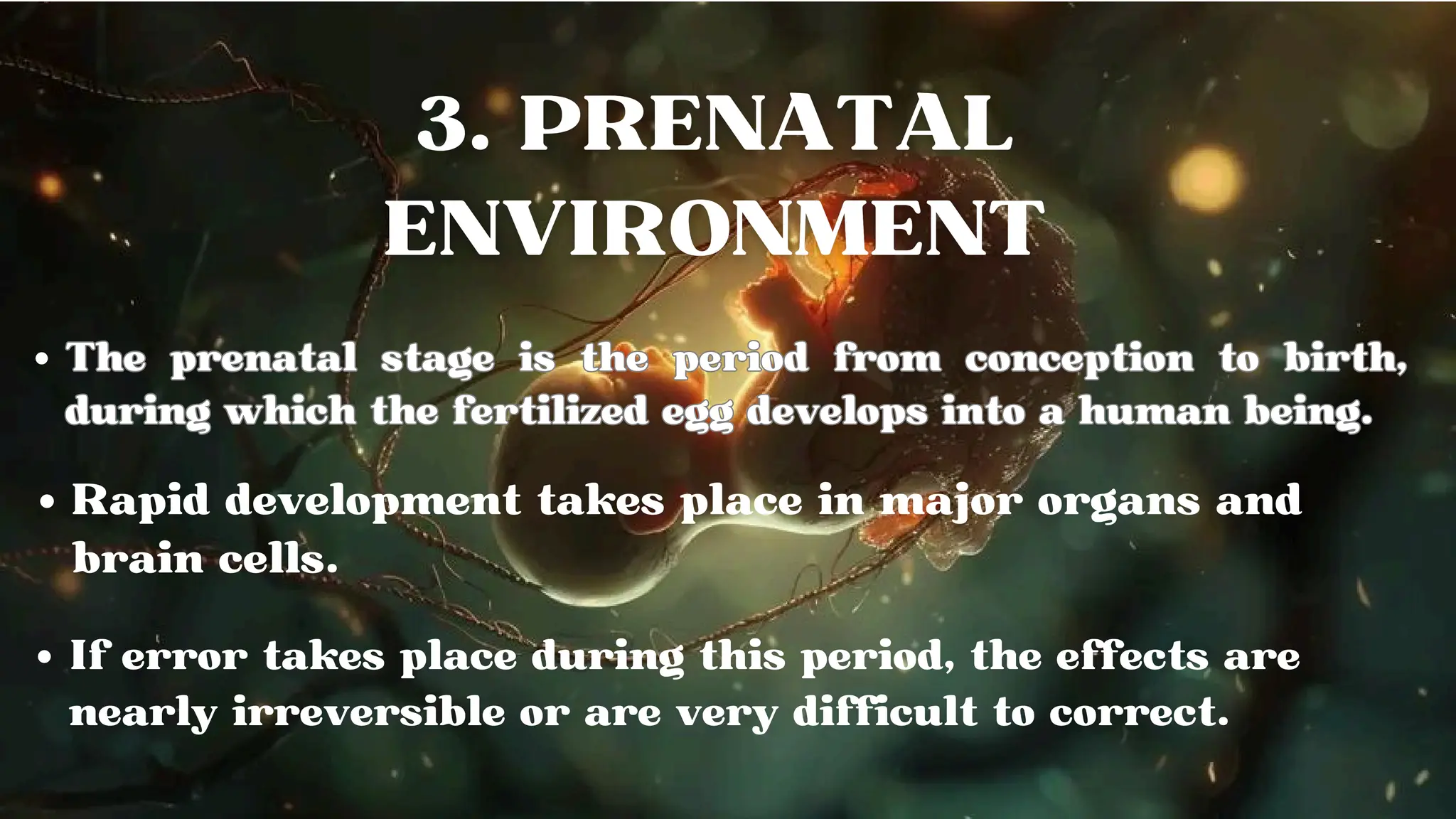
The prenatal stage is the period from conception to birth,
during which the fertilized egg develops into a human being.
Rapid development takes place in major organs and
brain cells.
If error takes place during this period, the effects are
nearly irreversible or are very difficult to correct.
10.
THE MAJOR PRENATALENVIRONMENTAL INFLUENCES
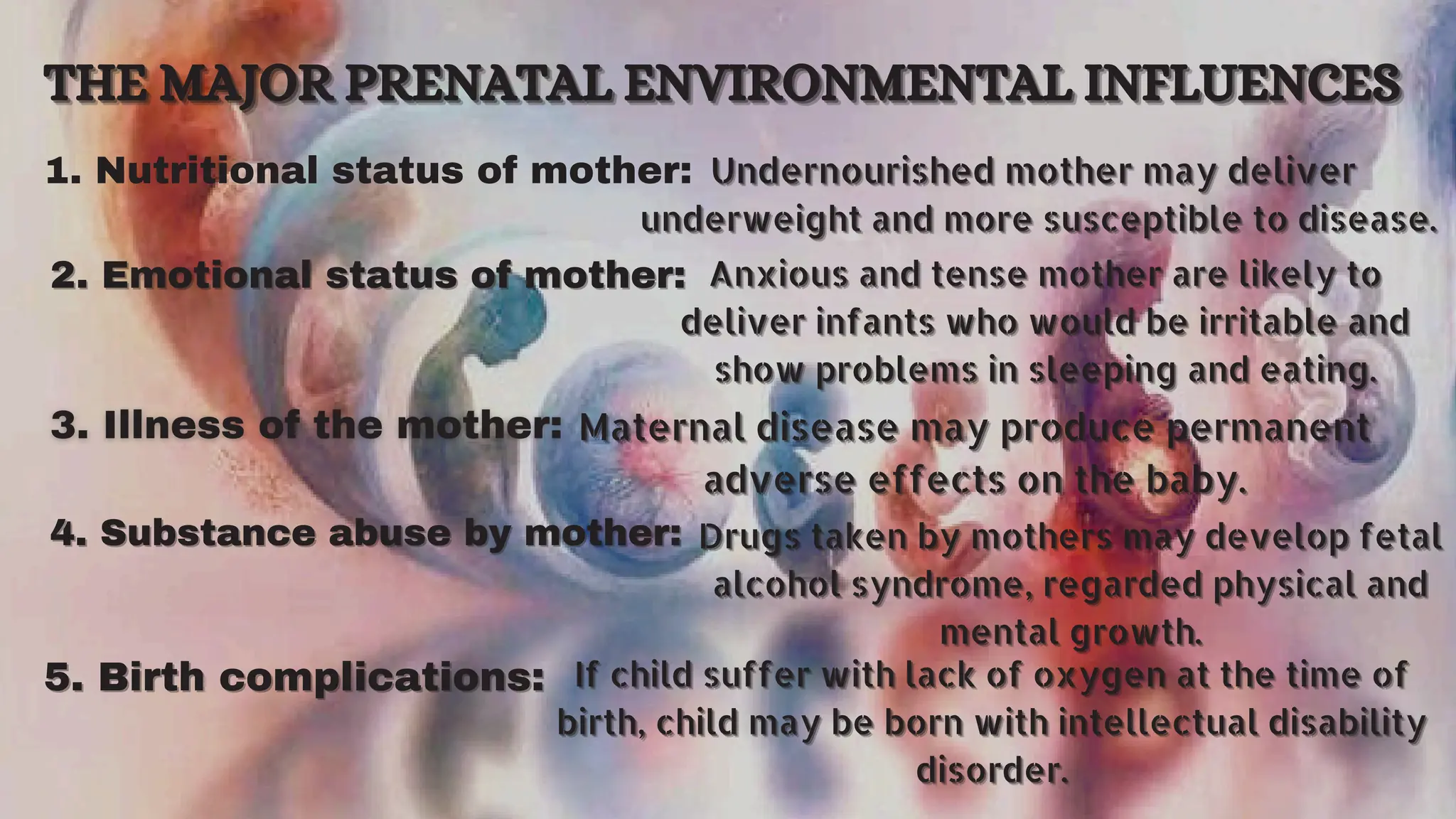
THE MAJOR PRENATAL ENVIRONMENTAL INFLUENCES
THE MAJOR PRENATAL ENVIRONMENTAL INFLUENCES
1. Nutritional status of mother: Undernourished mother may deliver
Undernourished mother may deliver
Undernourished mother may deliver
underweight and more susceptible to disease.
underweight and more susceptible to disease.
underweight and more susceptible to disease.
2. Emotional status of mother:
2. Emotional status of mother: Anxious and tense mother are likely to
Anxious and tense mother are likely to
Anxious and tense mother are likely to
deliver infants who would be irritable and
deliver infants who would be irritable and
deliver infants who would be irritable and
show problems in sleeping and eating.
show problems in sleeping and eating.
show problems in sleeping and eating.
Maternal disease may produce permanent
Maternal disease may produce permanent
Maternal disease may produce permanent
adverse effects on the baby.
adverse effects on the baby.
adverse effects on the baby.
4. Substance abuse by mother:
4. Substance abuse by mother: Drugs taken by mothers may develop fetal
Drugs taken by mothers may develop fetal
Drugs taken by mothers may develop fetal
alcohol syndrome, regarded physical and
alcohol syndrome, regarded physical and
alcohol syndrome, regarded physical and
mental growth.
mental growth.
mental growth.
5. Birth complications:
5. Birth complications: If child suffer with lack of oxygen at the time of
If child suffer with lack of oxygen at the time of
If child suffer with lack of oxygen at the time of
birth, child may be born with intellectual disability
birth, child may be born with intellectual disability
birth, child may be born with intellectual disability
disorder.
disorder.
disorder.
11.
4. Home environment
4.Home environment
4. Home environment
The home environment refers to the mental and behavioral interactions
The home environment refers to the mental and behavioral interactions
The home environment refers to the mental and behavioral interactions
among family members that influence a child's development.
among family members that influence a child's development.
among family members that influence a child's development.
Home is the first learning institution for a child, playing a crucial role
Home is the first learning institution for a child, playing a crucial role
Home is the first learning institution for a child, playing a crucial role
in early years of development.
in early years of development.
in early years of development.
Types of home environment and there effect :-
1. Supportive home environment - warm and encouraging, Forsters
exploration, curiosity & self-reliance, Leads to higher intellectual
communication in childrens.
2. Unsupportive home environment - punitive and rejecting, extremely
authoritarian with rigid rules, leads to lower intellectual communication
in childrens.
6. SOCIAL &ENVIRONMENTAL
6. SOCIAL & ENVIRONMENTAL
6. SOCIAL & ENVIRONMENTAL
DEPRIVATION
DEPRIVATION
DEPRIVATION
If the environmental opportunities and stimulations
are low children show poor cognitive performance.
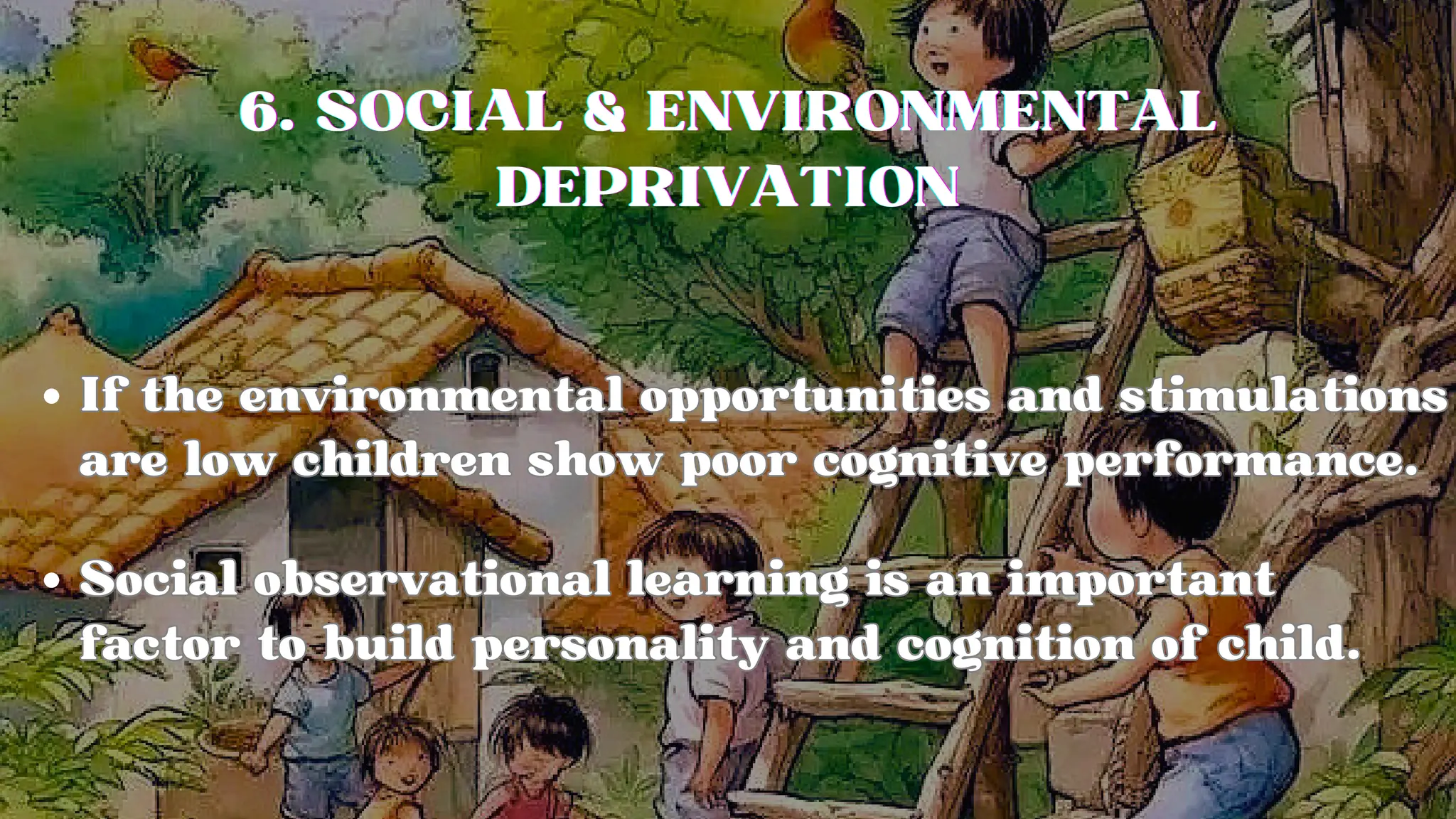
If the environmental opportunities and stimulations
are low children show poor cognitive performance.
Social observational learning is an important
factor to build personality and cognition of child.
Social observational learning is an important
factor to build personality and cognition of child.
14.
7. SOCIO ECONOMICSTATUS
7. SOCIO ECONOMIC STATUS
7. SOCIO ECONOMIC STATUS
15.
8. PHYSIOLOGICAL CONDITIONS
8.PHYSIOLOGICAL CONDITIONS
Healthy body gives healthy mind.
Healthy body gives healthy mind.
The biological processes within the body provides a
necessary but not sufficient condition for intellectual
development.
The biological processes within the body provides a
necessary but not sufficient condition for intellectual
development.
Poor health and suspectibility to disease would
retard the growth of brain cells and consequently
thantellectual skills.
Poor health and suspectibility to disease would
retard the growth of brain cells and consequently
thantellectual skills.
16.
Intelligence is influencedby hereditary and environmental
factors
Environmental factors include parental, prenatal, home,
social, socioeconomic, and physiological conditions.
Nurturing environment and positive interactions foster
healthy cognitive growth.
Deprivation and neglect hinder intellectual development.
Understanding the interplay between factors promotes
optimal cognitive development.
Intelligence is influenced by hereditary and environmental
factors
Environmental factors include parental, prenatal, home,
social, socioeconomic, and physiological conditions.
Nurturing environment and positive interactions foster
healthy cognitive growth.
Deprivation and neglect hinder intellectual development.
Understanding the interplay between factors promotes
optimal cognitive development.
CONCLUSION
CONCLUSION
CONCLUSION