1
2
Submitted by
Tayyaba Yousaf 485
Harmain Akhther 499
Asma Maqsood 510
Submitted to:
Amar Ata
Assighment:
“Psychology”
Topic:
“ Auditary Sensation”
Class:
Bs-Hons (mass communication) 3 semester.
3
Definition:
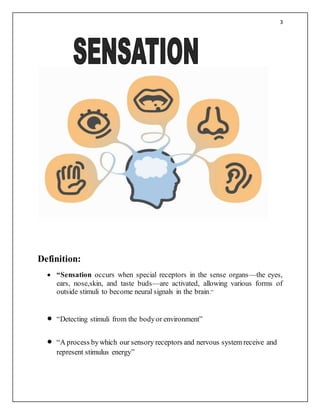
 “Sensation occurs when special receptors in the sense organs—the eyes,
ears, nose,skin, and taste buds—are activated, allowing various forms of
outside stimuli to become neural signals in the brain.”
 “Detecting stimuli from the bodyor environment”
 “A process bywhich our sensory receptors and nervous system receive and
represent stimulus energy”
4
Auditary System
The human auditory system allows the bodyto collect and interpret sound waves
into meaningful messages. The main sensory organ responsible for the ability to
hear is the ear, which can be broken down into the outer ear, middle ear, and inner
ear. The inner ear contains the receptor cells necessary for both hearing and
equilibrium maintenance. Human beings also have the special ability of being able
to estimate where sounds originate from, commonly called sound localization.
The Ear
The ear is the main sensory organ of the auditory system. It performs the first
processing of sound and houses all of the sensory receptors required for hearing.
The ear's three divisions (outer, middle, and inner) have specialized functions that
combine to allow us to hear
5
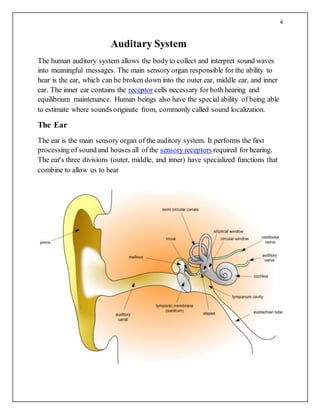
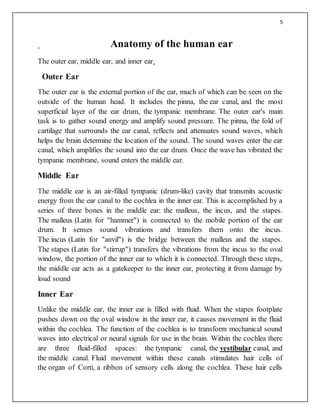
Anatomy of the human ear
The outer ear, middle ear, and inner ear.
Outer Ear
The outer ear is the external portion of the ear, much of which can be seen on the
outside of the human head. It includes the pinna, the ear canal, and the most
superficial layer of the ear drum, the tympanic membrane. The outer ear's main
task is to gather sound energy and amplify sound pressure. The pinna, the fold of
cartilage that surrounds the ear canal, reflects and attenuates sound waves, which
helps the brain determine the location of the sound. The sound waves enter the ear
canal, which amplifies the sound into the ear drum. Once the wave has vibrated the
tympanic membrane, sound enters the middle ear.
Middle Ear
The middle ear is an air-filled tympanic (drum-like) cavity that transmits acoustic
energy from the ear canal to the cochlea in the inner ear. This is accomplished by a
series of three bones in the middle ear: the malleus, the incus, and the stapes.
The malleus (Latin for "hammer") is connected to the mobile portion of the ear
drum. It senses sound vibrations and transfers them onto the incus.
The incus (Latin for "anvil") is the bridge between the malleus and the stapes.
The stapes (Latin for "stirrup") transfers the vibrations from the incus to the oval
window, the portion of the inner ear to which it is connected. Through these steps,
the middle ear acts as a gatekeeper to the inner ear, protecting it from damage by
loud sound
Inner Ear
Unlike the middle ear, the inner ear is filled with fluid. When the stapes footplate
pushes down on the oval window in the inner ear, it causes movement in the fluid
within the cochlea. The function of the cochlea is to transform mechanical sound
waves into electrical or neural signals for use in the brain. Within the cochlea there
are three fluid-filled spaces: the tympanic canal, the vestibular canal, and
the middle canal. Fluid movement within these canals stimulates hair cells of
the organ of Corti, a ribbon of sensory cells along the cochlea. These hair cells
6
transform the fluid waves into electrical impulses using cilia, a specialized type of
mechanosensor.
The Process of Hearing
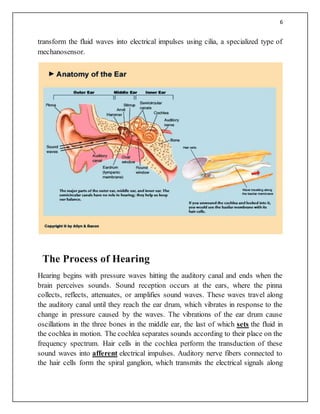
Hearing begins with pressure waves hitting the auditory canal and ends when the
brain perceives sounds. Sound reception occurs at the ears, where the pinna
collects, reflects, attenuates, or amplifies sound waves. These waves travel along
the auditory canal until they reach the ear drum, which vibrates in response to the
change in pressure caused by the waves. The vibrations of the ear drum cause
oscillations in the three bones in the middle ear, the last of which sets the fluid in
the cochlea in motion. The cochlea separates sounds according to their place on the
frequency spectrum. Hair cells in the cochlea perform the transduction of these
sound waves into afferent electrical impulses. Auditory nerve fibers connected to
the hair cells form the spiral ganglion, which transmits the electrical signals along
7
the auditory nerve and eventually on to the brain stem. The brain responds to these
separate frequencies and composes a complete sound from them.
Sound Localization
Humans are able to hear a wide variety of sound frequencies, from approximately
20 to 20,000 Hz. Our ability to judge or estimate where a sound originates, called
sound localization, is dependent on the hearing ability of each ear and the exact
quality of the sound. Since each ear lies on an opposite side of the head, a sound
reaches the closest ear first, and the sound's amplitude will be larger (and therefore
louder) in that ear. Much of the brain's ability to localize sound depends on
these interaural (between-the-ears) differences in sound intensity and timing.
Bushy neurons can resolve time differences as small as ten milliseconds, or
approximately the time it takes for sound to pass one ear and reach the other.
8
PERCEIVING PITCH
Pitch refers to how high or low a sound is. For example, the bass tones in the
music pounding through the wall of your apartment from the neighbors next door
is a low pitch, whereas the scream of a 2-year-old child is a very high pitch. Very
high. There are three primary theories about how the brain receives information
about pitch.The oldest of the three theories,
Placed Theory
place theory, is based on an idea proposed in 1863 by Hermann von Helmholtz
and elaborated on and modified by Georg von Békésy,beginning with experiments
first published in 1928 (Békésy, 1960). In this theory, the pitch a person hears
depends on where the hair cells that are stimulated are located on the organ of
Corti. For example, if the person is hearing a high-pitched sound, all of the hair
cells near the oval window will be stimulated, but if the sound is low pitched, all of
the hair cells that are stimulated will be located farther away on the organ of Corti.
Frequency Theory
Frequency theory, developed by Ernest Rutherford in 1886, states that pitch is
related to how fast the basilar membrane vibrates. The faster this membrane
vibrates,the higher the pitch; the slower it vibrates, the lower the pitch. (In this
theory, all of the auditory neurons would be firing at the same time.)
So which of these first two theories is right? It turns out that both are right—up
to a point. For place-theory research to be accurate, the basilar membrane has to
vibrate unevenly—which it does when the frequency of the sound is above 1000
Hz.For the frequency theory to be correct, the neurons associated with the hair
cells would have to fire as fast as the basilar membrane vibrates. This only works
up to 1000 Hz,because neurons don’t appear to fire at exactly the same time and
rate when frequencies are faster than 1000 times per second.
Volley principle
The frequency theory works for low pitches, and place theory works for moderate
to high pitches. Is there another explanation? Yes, and it is a third theory,
developed by Ernest Wever and Charles Bray, called the volley principle (Wever,
1949;Wever & Bray, 1930), which appears to account for pitches from about 400
Hz up to about 4000. In this explanation, groups of auditory neurons take turns
9
firing in a process called volleying. If a person hears a tone of about 3000 Hz, it
means that three groups of neurons have taken turns sending the message to the
brain—the first group for the first 1000 Hz, the second group for the next 1000 and
so on
TYPES OF HEARING IMPAIRMENT
Hearing impairment is the term used to refer to difficulties in hearing. A person
can be partially hearing impaired or totally hearing impaired, and the treatment for
hearing loss will vary according to the reason for the impairment.
Why are some people unable to hear, and how can their hearing be
improved?
CONDUCTION HEARING IMPAIRMENT
Conduction hearing impairment means that sound vibrations cannot be passed
from the eardrum to the cochlea. The cause might be a damaged eardrum or
damage to the bones of the middle ear (usually from an infection).In this kind of
impairment, hearing aids may be of some use in restoring hearing.
NERVE HEARING IMPAIRMENT
In nerve hearing impairment, the problem lies either in the inner ear or in the
auditory pathways and cortical areas of the brain. Normal aging causesloss ofhair
cells in the cochlea, and exposure to loud noises can damage hair cells. Tinnitusis
a fancy word for an extremely annoying ringing in one’s ears, and it can also be
caused by infections or loud noises—including loud music in headphones, so you
might want to turn down that music player!Because the damage is to the nerves or
the brain, nerve hearing impairment cannot be helped with ordinary hearing aids,
which are basically sound amplifiers. A technique for restoring some hearing to
those with nerve hearing impairment makes use of an electronic device called a
cochlear implant. This device sends signals from a microphone worn behind the
ear to a sound processorworn on the belt or in a pocket, which then translates
those signals into electrical stimuli that are sent to a series of electrodes implanted
10
directly into the cochlea, allowing transduction to take place and stimulating the
auditory nerve. The brain then processes the electrode information as sound.
Conclusion
The ear responds to pressure waves in the air gathered by the outer ear and
directed down the auditory canal to the tympanic membrane or eardrum.
Movements of the eardrum are amplified by a chain of three tiny bones in the
middle ear: the ossicles. The cochlea of the inner ear is the part of the auditory
system responsible for transduction (conversion of energy from one form to
another). The cochlea converts movements of the oval window into standing
waves along the cochlear membranes. Hair-like cells along the membranes
respond to the movement. They produce nerve impulses that are sent to the
brain along the auditory nerve. Normal adults hear frequencies from about 20-
20,000 Hz (or, with advancing age, about 50-15,000 Hz).
Sensory hallucinations can be quite vivid and realistic. They occur in all the
senses. When people lose normal input to sensory cortex due to accident or old
age, the brain tissue may grow irritable and stimulate itself. Normal perception
is also a construction like this, but normal perception is constrained and guided
by the sensory input, producing results accurate enough to be treated as
veridical or faithful to the outside world.
11
Reference
 souurce: Boundless. “Audition: Hearing, the Ear, and Sound
Localization.” BoundlessPsychology. Boundless, 26 May. 2016. Retrieved
07 Nov. 2016
from https://www.boundless.com/psychology/textbooks/boundless-
psychology-textbook/sensation-and-perception-5/sensory-processes-
38/audition-hearing-the-ear-and-sound-localization-162-12697/
 Chapter 3 Perception and sensation pdf

Psychology 001

  • 1.
  • 2.
    2 Submitted by Tayyaba Yousaf485 Harmain Akhther 499 Asma Maqsood 510 Submitted to: Amar Ata Assighment: “Psychology” Topic: “ Auditary Sensation” Class: Bs-Hons (mass communication) 3 semester.
  • 3.
    3 Definition:  “Sensation occurswhen special receptors in the sense organs—the eyes, ears, nose,skin, and taste buds—are activated, allowing various forms of outside stimuli to become neural signals in the brain.”  “Detecting stimuli from the bodyor environment”  “A process bywhich our sensory receptors and nervous system receive and represent stimulus energy”
  • 4.
    4 Auditary System The humanauditory system allows the bodyto collect and interpret sound waves into meaningful messages. The main sensory organ responsible for the ability to hear is the ear, which can be broken down into the outer ear, middle ear, and inner ear. The inner ear contains the receptor cells necessary for both hearing and equilibrium maintenance. Human beings also have the special ability of being able to estimate where sounds originate from, commonly called sound localization. The Ear The ear is the main sensory organ of the auditory system. It performs the first processing of sound and houses all of the sensory receptors required for hearing. The ear's three divisions (outer, middle, and inner) have specialized functions that combine to allow us to hear
  • 5.
    5 Anatomy of thehuman ear The outer ear, middle ear, and inner ear. Outer Ear The outer ear is the external portion of the ear, much of which can be seen on the outside of the human head. It includes the pinna, the ear canal, and the most superficial layer of the ear drum, the tympanic membrane. The outer ear's main task is to gather sound energy and amplify sound pressure. The pinna, the fold of cartilage that surrounds the ear canal, reflects and attenuates sound waves, which helps the brain determine the location of the sound. The sound waves enter the ear canal, which amplifies the sound into the ear drum. Once the wave has vibrated the tympanic membrane, sound enters the middle ear. Middle Ear The middle ear is an air-filled tympanic (drum-like) cavity that transmits acoustic energy from the ear canal to the cochlea in the inner ear. This is accomplished by a series of three bones in the middle ear: the malleus, the incus, and the stapes. The malleus (Latin for "hammer") is connected to the mobile portion of the ear drum. It senses sound vibrations and transfers them onto the incus. The incus (Latin for "anvil") is the bridge between the malleus and the stapes. The stapes (Latin for "stirrup") transfers the vibrations from the incus to the oval window, the portion of the inner ear to which it is connected. Through these steps, the middle ear acts as a gatekeeper to the inner ear, protecting it from damage by loud sound Inner Ear Unlike the middle ear, the inner ear is filled with fluid. When the stapes footplate pushes down on the oval window in the inner ear, it causes movement in the fluid within the cochlea. The function of the cochlea is to transform mechanical sound waves into electrical or neural signals for use in the brain. Within the cochlea there are three fluid-filled spaces: the tympanic canal, the vestibular canal, and the middle canal. Fluid movement within these canals stimulates hair cells of the organ of Corti, a ribbon of sensory cells along the cochlea. These hair cells
  • 6.
    6 transform the fluidwaves into electrical impulses using cilia, a specialized type of mechanosensor. The Process of Hearing Hearing begins with pressure waves hitting the auditory canal and ends when the brain perceives sounds. Sound reception occurs at the ears, where the pinna collects, reflects, attenuates, or amplifies sound waves. These waves travel along the auditory canal until they reach the ear drum, which vibrates in response to the change in pressure caused by the waves. The vibrations of the ear drum cause oscillations in the three bones in the middle ear, the last of which sets the fluid in the cochlea in motion. The cochlea separates sounds according to their place on the frequency spectrum. Hair cells in the cochlea perform the transduction of these sound waves into afferent electrical impulses. Auditory nerve fibers connected to the hair cells form the spiral ganglion, which transmits the electrical signals along
  • 7.
    7 the auditory nerveand eventually on to the brain stem. The brain responds to these separate frequencies and composes a complete sound from them. Sound Localization Humans are able to hear a wide variety of sound frequencies, from approximately 20 to 20,000 Hz. Our ability to judge or estimate where a sound originates, called sound localization, is dependent on the hearing ability of each ear and the exact quality of the sound. Since each ear lies on an opposite side of the head, a sound reaches the closest ear first, and the sound's amplitude will be larger (and therefore louder) in that ear. Much of the brain's ability to localize sound depends on these interaural (between-the-ears) differences in sound intensity and timing. Bushy neurons can resolve time differences as small as ten milliseconds, or approximately the time it takes for sound to pass one ear and reach the other.
  • 8.
    8 PERCEIVING PITCH Pitch refersto how high or low a sound is. For example, the bass tones in the music pounding through the wall of your apartment from the neighbors next door is a low pitch, whereas the scream of a 2-year-old child is a very high pitch. Very high. There are three primary theories about how the brain receives information about pitch.The oldest of the three theories, Placed Theory place theory, is based on an idea proposed in 1863 by Hermann von Helmholtz and elaborated on and modified by Georg von Békésy,beginning with experiments first published in 1928 (Békésy, 1960). In this theory, the pitch a person hears depends on where the hair cells that are stimulated are located on the organ of Corti. For example, if the person is hearing a high-pitched sound, all of the hair cells near the oval window will be stimulated, but if the sound is low pitched, all of the hair cells that are stimulated will be located farther away on the organ of Corti. Frequency Theory Frequency theory, developed by Ernest Rutherford in 1886, states that pitch is related to how fast the basilar membrane vibrates. The faster this membrane vibrates,the higher the pitch; the slower it vibrates, the lower the pitch. (In this theory, all of the auditory neurons would be firing at the same time.) So which of these first two theories is right? It turns out that both are right—up to a point. For place-theory research to be accurate, the basilar membrane has to vibrate unevenly—which it does when the frequency of the sound is above 1000 Hz.For the frequency theory to be correct, the neurons associated with the hair cells would have to fire as fast as the basilar membrane vibrates. This only works up to 1000 Hz,because neurons don’t appear to fire at exactly the same time and rate when frequencies are faster than 1000 times per second. Volley principle The frequency theory works for low pitches, and place theory works for moderate to high pitches. Is there another explanation? Yes, and it is a third theory, developed by Ernest Wever and Charles Bray, called the volley principle (Wever, 1949;Wever & Bray, 1930), which appears to account for pitches from about 400 Hz up to about 4000. In this explanation, groups of auditory neurons take turns
  • 9.
    9 firing in aprocess called volleying. If a person hears a tone of about 3000 Hz, it means that three groups of neurons have taken turns sending the message to the brain—the first group for the first 1000 Hz, the second group for the next 1000 and so on TYPES OF HEARING IMPAIRMENT Hearing impairment is the term used to refer to difficulties in hearing. A person can be partially hearing impaired or totally hearing impaired, and the treatment for hearing loss will vary according to the reason for the impairment. Why are some people unable to hear, and how can their hearing be improved? CONDUCTION HEARING IMPAIRMENT Conduction hearing impairment means that sound vibrations cannot be passed from the eardrum to the cochlea. The cause might be a damaged eardrum or damage to the bones of the middle ear (usually from an infection).In this kind of impairment, hearing aids may be of some use in restoring hearing. NERVE HEARING IMPAIRMENT In nerve hearing impairment, the problem lies either in the inner ear or in the auditory pathways and cortical areas of the brain. Normal aging causesloss ofhair cells in the cochlea, and exposure to loud noises can damage hair cells. Tinnitusis a fancy word for an extremely annoying ringing in one’s ears, and it can also be caused by infections or loud noises—including loud music in headphones, so you might want to turn down that music player!Because the damage is to the nerves or the brain, nerve hearing impairment cannot be helped with ordinary hearing aids, which are basically sound amplifiers. A technique for restoring some hearing to those with nerve hearing impairment makes use of an electronic device called a cochlear implant. This device sends signals from a microphone worn behind the ear to a sound processorworn on the belt or in a pocket, which then translates those signals into electrical stimuli that are sent to a series of electrodes implanted
  • 10.
    10 directly into thecochlea, allowing transduction to take place and stimulating the auditory nerve. The brain then processes the electrode information as sound. Conclusion The ear responds to pressure waves in the air gathered by the outer ear and directed down the auditory canal to the tympanic membrane or eardrum. Movements of the eardrum are amplified by a chain of three tiny bones in the middle ear: the ossicles. The cochlea of the inner ear is the part of the auditory system responsible for transduction (conversion of energy from one form to another). The cochlea converts movements of the oval window into standing waves along the cochlear membranes. Hair-like cells along the membranes respond to the movement. They produce nerve impulses that are sent to the brain along the auditory nerve. Normal adults hear frequencies from about 20- 20,000 Hz (or, with advancing age, about 50-15,000 Hz). Sensory hallucinations can be quite vivid and realistic. They occur in all the senses. When people lose normal input to sensory cortex due to accident or old age, the brain tissue may grow irritable and stimulate itself. Normal perception is also a construction like this, but normal perception is constrained and guided by the sensory input, producing results accurate enough to be treated as veridical or faithful to the outside world.
  • 11.
    11 Reference  souurce: Boundless.“Audition: Hearing, the Ear, and Sound Localization.” BoundlessPsychology. Boundless, 26 May. 2016. Retrieved 07 Nov. 2016 from https://www.boundless.com/psychology/textbooks/boundless- psychology-textbook/sensation-and-perception-5/sensory-processes- 38/audition-hearing-the-ear-and-sound-localization-162-12697/  Chapter 3 Perception and sensation pdf