Incentives and Behaviour
Change: Demystifying Market
Transformation
October 20, 2015
Christopher Russell
Visiting Fellow, ACEEE
crussell@aceee.org
1
American Council for an Energy-
Efficient Economy (ACEEE)
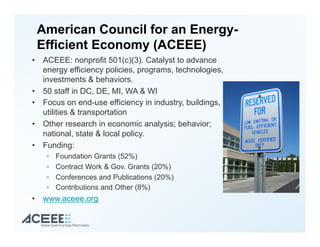
•  ACEEE: nonprofit 501(c)(3). Catalyst to advance
energy efficiency policies, programs, technologies,
investments & behaviors.
•  50 staff in DC, DE, MI, WA & WI
•  Focus on end-use efficiency in industry, buildings,
utilities & transportation
•  Other research in economic analysis; behavior;
national, state & local policy.
•  Funding:
◦  Foundation Grants (52%)
◦  Contract Work & Gov. Grants (20%)
◦  Conferences and Publications (20%)
◦  Contributions and Other (8%)
•  www.aceee.org
About&Christopher&Russell,&C.E.M.,&C.R.M.&
!  Independent consulting since 2006
Principal, Energy Pathfinder
!  Visiting Fellow, American Council for
an Energy Efficient Economy, 2012+
!  Energy Manager, Howard County, MD,
2010-2012
!  Director of Industrial Programs,
Alliance to Save Energy, 1999-2006
!  Comm. & Indus. Program Manager,
American Gas Association, 1995-1999
!  MBA, M.A., University of MD;
B.A., McGill University
Published
2008
Published
2010
33
OUTLINE
•  Incentives: basic concepts
•  Program theory/ barriers analysis
•  Incentive design options
•  Incentive types
•  Developing incentives collaboratively
•  Leading N. American examples
•  Why bother, why care?
4
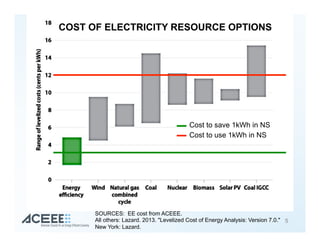
5
Cost to save 1kWh in NS
Cost to use 1kWh in NS
COST OF ELECTRICITY RESOURCE OPTIONS
SOURCES: EE cost from ACEEE.
All others: Lazard. 2013. "Levelized Cost of Energy Analysis: Version 7.0."
New York: Lazard.
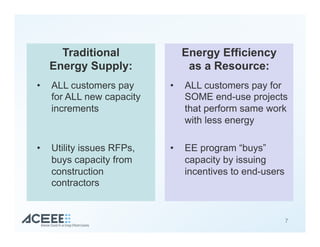
Energy Efficiency
as a Resource:
Traditional
Energy Supply:
•  ALL customers pay
for ALL new capacity
increments
•  Utility issues RFPs,
buys capacity from
construction
contractors
7
•  ALL customers pay for
SOME end-use projects
that perform same work
with less energy
•  EE program “buys”
capacity by issuing
incentives to end-users
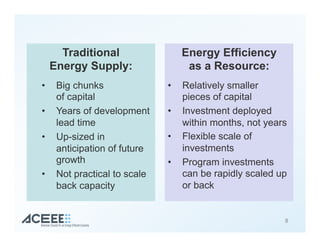
Energy Efficiency
as a Resource:
Traditional
Energy Supply:
•  Big chunks
of capital
•  Years of development
lead time
•  Up-sized in
anticipation of future
growth
•  Not practical to scale
back capacity
8
•  Relatively smaller
pieces of capital
•  Investment deployed
within months, not years
•  Flexible scale of
investments
•  Program investments
can be rapidly scaled up
or back
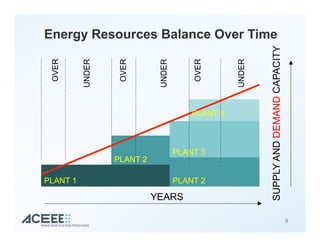
9
YEARS
SUPPLYANDDEMANDCAPACITY
OVER
OVER
OVER
UNDER
UNDER
UNDER
PLANT 1
PLANT 2
PLANT 2
PLANT 3
PLANT 4
Energy Resources Balance Over Time
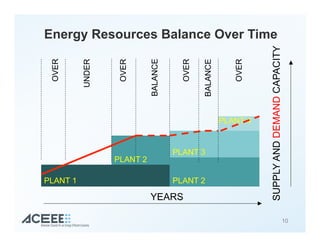
10
YEARS
SUPPLYANDDEMANDCAPACITY
OVER
OVER
OVER
UNDER
BALANCE
Energy Resources Balance Over Time
PLANT 1
PLANT 2
PLANT 2
PLANT 3
PLANT 4
BALANCE
OVER
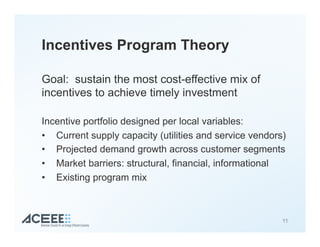
Incentives Program Theory
Goal: sustain the most cost-effective mix of
incentives to achieve timely investment
Incentive portfolio designed per local variables:
•  Current supply capacity (utilities and service vendors)
•  Projected demand growth across customer segments
•  Market barriers: structural, financial, informational
•  Existing program mix
11
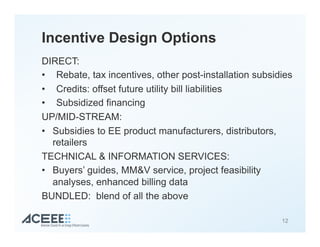
Incentive Design Options
DIRECT:
•  Rebate, tax incentives, other post-installation subsidies
•  Credits: offset future utility bill liabilities
•  Subsidized financing
UP/MID-STREAM:
•  Subsidies to EE product manufacturers, distributors,
retailers
TECHNICAL & INFORMATION SERVICES:
•  Buyers’ guides, MM&V service, project feasibility
analyses, enhanced billing data
BUNDLED: blend of all the above
12
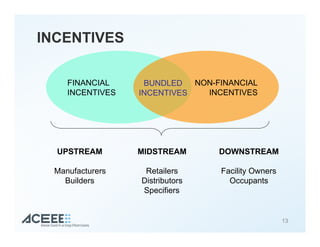
INCENTIVES
13
FINANCIAL
INCENTIVES
NON-FINANCIAL
INCENTIVES
BUNDLED
INCENTIVES
UPSTREAM
Manufacturers
Builders
MIDSTREAM
Retailers
Distributors
Specifiers
DOWNSTREAM
Facility Owners
Occupants
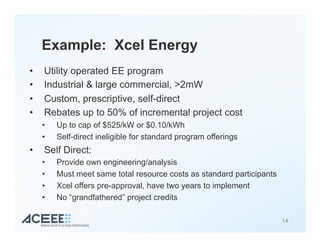
Example: Xcel Energy
•  Utility operated EE program
•  Industrial & large commercial, >2mW
•  Custom, prescriptive, self-direct
•  Rebates up to 50% of incremental project cost
•  Up to cap of $525/kW or $0.10/kWh
•  Self-direct ineligible for standard program offerings
•  Self Direct:
•  Provide own engineering/analysis
•  Must meet same total resource costs as standard participants
•  Xcel offers pre-approval, have two years to implement
•  No “grandfathered” project credits
14
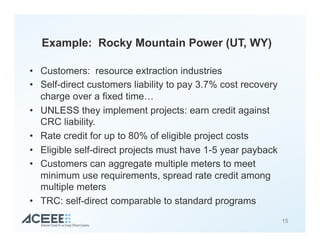
Example: Rocky Mountain Power (UT, WY)
•  Customers: resource extraction industries
•  Self-direct customers liability to pay 3.7% cost recovery
charge over a fixed time…
•  UNLESS they implement projects: earn credit against
CRC liability.
•  Rate credit for up to 80% of eligible project costs
•  Eligible self-direct projects must have 1-5 year payback
•  Customers can aggregate multiple meters to meet
minimum use requirements, spread rate credit among
multiple meters
•  TRC: self-direct comparable to standard programs
15
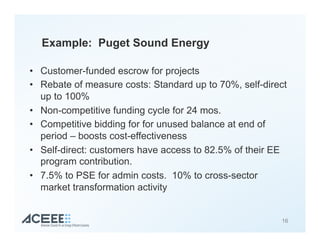
Example: Puget Sound Energy
•  Customer-funded escrow for projects
•  Rebate of measure costs: Standard up to 70%, self-direct
up to 100%
•  Non-competitive funding cycle for 24 mos.
•  Competitive bidding for for unused balance at end of
period – boosts cost-effectiveness
•  Self-direct: customers have access to 82.5% of their EE
program contribution.
•  7.5% to PSE for admin costs. 10% to cross-sector
market transformation activity
16
Example: Energy Trust of Oregon
•  All customers pay 3% public purpose charge (PPC)
•  Full program participants: incentive = 50% of project
costs
•  Option: self-direct for meters over 1 mW:
•  Deduct 100% cost of self-installed EE measures as credit against PPC
liability
•  Escrow credits for 36 months
•  Use or lose: implement projects against credits, or repay
•  80 out of 170 eligible customers chose self-direct
•  Many customers failed to self-implement – rush to revert
to full program participation
•  Now only 15 out of 180 are self-direct
17
Commercial & Industrial Consumers
Why bother, why care?
18
“We’re already as efficient as we can be.”
I’ll agree with you on several conditions:
!  All&the&energy&improvements&you&made&in&the&past&remain&
fully&implemented&
&
!  Technology&has&remained&sta>c,&so&no&new&opportuni>es&
have&emerged,&or…&
&
!  You&have&all&the&>me&in&the&world&to&keep&up&with&new&
technology&
!  All&staff&with&ins>tu>onal&knowledge&of&energy&use&are&s>ll&in&
place&
&
!  Your&assets&have&not&been&depreciated&through&use&
&
!  Fuel&prices&have&remained&stable&since&you&became&“100%”&
efficient.&
19
Energy Premium: You Choose.
20
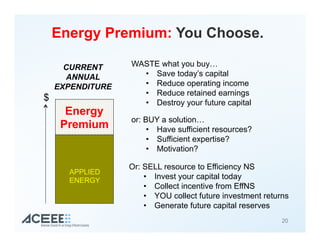
CURRENT
ANNUAL
EXPENDITURE
Energy
Premium
APPLIED
ENERGY
WASTE what you buy…
•  Save today’s capital
•  Reduce operating income
•  Reduce retained earnings
•  Destroy your future capital
$
or: BUY a solution…
•  Have sufficient resources?
•  Sufficient expertise?
•  Motivation?
Or: SELL resource to Efficiency NS
•  Invest your capital today
•  Collect incentive from EffNS
•  YOU collect future investment returns
•  Generate future capital reserves
?
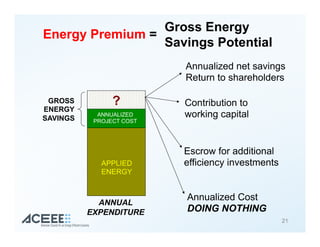
21
ANNUAL
EXPENDITURE
APPLIED
ENERGY
ANNUALIZED
PROJECT COST
GROSS
ENERGY
SAVINGS
Annualized net savings
Return to shareholders
Escrow for additional
efficiency investments
Annualized Cost
DOING NOTHING
Contribution to
working capital
Energy Premium =
Gross Energy
Savings Potential
Take-Aways
•  Energy efficiency is the cheapest energy resource
•  Energy users: invest in efficiency, sell their offset
•  More choices… more innovation… more flexibility…
more competitiveness… STRONGER ECONOMY
22
Christopher Russell
THANK YOU!
Questions?
23

RUSSELL EffNS 20151020 copy

  • 1.
    Incentives and Behaviour Change:Demystifying Market Transformation October 20, 2015 Christopher Russell Visiting Fellow, ACEEE crussell@aceee.org 1
  • 2.
    American Council foran Energy- Efficient Economy (ACEEE) •  ACEEE: nonprofit 501(c)(3). Catalyst to advance energy efficiency policies, programs, technologies, investments & behaviors. •  50 staff in DC, DE, MI, WA & WI •  Focus on end-use efficiency in industry, buildings, utilities & transportation •  Other research in economic analysis; behavior; national, state & local policy. •  Funding: ◦  Foundation Grants (52%) ◦  Contract Work & Gov. Grants (20%) ◦  Conferences and Publications (20%) ◦  Contributions and Other (8%) •  www.aceee.org
  • 3.
    About&Christopher&Russell,&C.E.M.,&C.R.M.& !  Independent consultingsince 2006 Principal, Energy Pathfinder !  Visiting Fellow, American Council for an Energy Efficient Economy, 2012+ !  Energy Manager, Howard County, MD, 2010-2012 !  Director of Industrial Programs, Alliance to Save Energy, 1999-2006 !  Comm. & Indus. Program Manager, American Gas Association, 1995-1999 !  MBA, M.A., University of MD; B.A., McGill University Published 2008 Published 2010 33
  • 4.
    OUTLINE •  Incentives: basicconcepts •  Program theory/ barriers analysis •  Incentive design options •  Incentive types •  Developing incentives collaboratively •  Leading N. American examples •  Why bother, why care? 4
  • 5.
    5 Cost to save1kWh in NS Cost to use 1kWh in NS COST OF ELECTRICITY RESOURCE OPTIONS SOURCES: EE cost from ACEEE. All others: Lazard. 2013. "Levelized Cost of Energy Analysis: Version 7.0." New York: Lazard.
  • 7.
    Energy Efficiency as aResource: Traditional Energy Supply: •  ALL customers pay for ALL new capacity increments •  Utility issues RFPs, buys capacity from construction contractors 7 •  ALL customers pay for SOME end-use projects that perform same work with less energy •  EE program “buys” capacity by issuing incentives to end-users
  • 8.
    Energy Efficiency as aResource: Traditional Energy Supply: •  Big chunks of capital •  Years of development lead time •  Up-sized in anticipation of future growth •  Not practical to scale back capacity 8 •  Relatively smaller pieces of capital •  Investment deployed within months, not years •  Flexible scale of investments •  Program investments can be rapidly scaled up or back
  • 9.
  • 10.
    10 YEARS SUPPLYANDDEMANDCAPACITY OVER OVER OVER UNDER BALANCE Energy Resources BalanceOver Time PLANT 1 PLANT 2 PLANT 2 PLANT 3 PLANT 4 BALANCE OVER
  • 11.
    Incentives Program Theory Goal:sustain the most cost-effective mix of incentives to achieve timely investment Incentive portfolio designed per local variables: •  Current supply capacity (utilities and service vendors) •  Projected demand growth across customer segments •  Market barriers: structural, financial, informational •  Existing program mix 11
  • 12.
    Incentive Design Options DIRECT: • Rebate, tax incentives, other post-installation subsidies •  Credits: offset future utility bill liabilities •  Subsidized financing UP/MID-STREAM: •  Subsidies to EE product manufacturers, distributors, retailers TECHNICAL & INFORMATION SERVICES: •  Buyers’ guides, MM&V service, project feasibility analyses, enhanced billing data BUNDLED: blend of all the above 12
  • 13.
  • 14.
    Example: Xcel Energy • Utility operated EE program •  Industrial & large commercial, >2mW •  Custom, prescriptive, self-direct •  Rebates up to 50% of incremental project cost •  Up to cap of $525/kW or $0.10/kWh •  Self-direct ineligible for standard program offerings •  Self Direct: •  Provide own engineering/analysis •  Must meet same total resource costs as standard participants •  Xcel offers pre-approval, have two years to implement •  No “grandfathered” project credits 14
  • 15.
    Example: Rocky MountainPower (UT, WY) •  Customers: resource extraction industries •  Self-direct customers liability to pay 3.7% cost recovery charge over a fixed time… •  UNLESS they implement projects: earn credit against CRC liability. •  Rate credit for up to 80% of eligible project costs •  Eligible self-direct projects must have 1-5 year payback •  Customers can aggregate multiple meters to meet minimum use requirements, spread rate credit among multiple meters •  TRC: self-direct comparable to standard programs 15
  • 16.
    Example: Puget SoundEnergy •  Customer-funded escrow for projects •  Rebate of measure costs: Standard up to 70%, self-direct up to 100% •  Non-competitive funding cycle for 24 mos. •  Competitive bidding for for unused balance at end of period – boosts cost-effectiveness •  Self-direct: customers have access to 82.5% of their EE program contribution. •  7.5% to PSE for admin costs. 10% to cross-sector market transformation activity 16
  • 17.
    Example: Energy Trustof Oregon •  All customers pay 3% public purpose charge (PPC) •  Full program participants: incentive = 50% of project costs •  Option: self-direct for meters over 1 mW: •  Deduct 100% cost of self-installed EE measures as credit against PPC liability •  Escrow credits for 36 months •  Use or lose: implement projects against credits, or repay •  80 out of 170 eligible customers chose self-direct •  Many customers failed to self-implement – rush to revert to full program participation •  Now only 15 out of 180 are self-direct 17
  • 18.
    Commercial & IndustrialConsumers Why bother, why care? 18
  • 19.
    “We’re already asefficient as we can be.” I’ll agree with you on several conditions: !  All&the&energy&improvements&you&made&in&the&past&remain& fully&implemented& & !  Technology&has&remained&sta>c,&so&no&new&opportuni>es& have&emerged,&or…& & !  You&have&all&the&>me&in&the&world&to&keep&up&with&new& technology& !  All&staff&with&ins>tu>onal&knowledge&of&energy&use&are&s>ll&in& place& & !  Your&assets&have&not&been&depreciated&through&use& & !  Fuel&prices&have&remained&stable&since&you&became&“100%”& efficient.& 19
  • 20.
    Energy Premium: YouChoose. 20 CURRENT ANNUAL EXPENDITURE Energy Premium APPLIED ENERGY WASTE what you buy… •  Save today’s capital •  Reduce operating income •  Reduce retained earnings •  Destroy your future capital $ or: BUY a solution… •  Have sufficient resources? •  Sufficient expertise? •  Motivation? Or: SELL resource to Efficiency NS •  Invest your capital today •  Collect incentive from EffNS •  YOU collect future investment returns •  Generate future capital reserves
  • 21.
    ? 21 ANNUAL EXPENDITURE APPLIED ENERGY ANNUALIZED PROJECT COST GROSS ENERGY SAVINGS Annualized netsavings Return to shareholders Escrow for additional efficiency investments Annualized Cost DOING NOTHING Contribution to working capital Energy Premium = Gross Energy Savings Potential
  • 22.
    Take-Aways •  Energy efficiencyis the cheapest energy resource •  Energy users: invest in efficiency, sell their offset •  More choices… more innovation… more flexibility… more competitiveness… STRONGER ECONOMY 22
  • 23.