1. Introduction
1.1 Report
This report consists of four sections. The first section briefly explains the theoretical background of the
test. Your personality profile is discussed in the second section based on your scores for the five
personality traits of the Big Five theory. In the third section, whether combinations of the five personality
traits result in additional key personality traits is reviewed. The last section explains the meaning of the
test and how the results can be interpreted or used.
1.2 Theoretical background
The list of all of the personality traits that can be measured with questionnaires is very long. Virtually
effortlessly, more than fifty traits can be found that have been researched by test developers and
psychologists. All of these traits, however, are derived from five main personality traits. This test refers to
these five traits as Emotional stability, Extraversion, Conscientiousness, Agreeableness and Openness.
Professional literature also refers to these as the Big Five. These are the five traits that can be found in
numerous personality tests. Some personality tests consist of six, seven or even more personality traits.
In these tests, one of the five main traits is often subdivided. As you read the results of your test, you will
understand exactly what each personality trait stands for.
To one extent or another, all of the traits listed above affect the way people deal with or respond to
others. High, low or average scores on personality traits all have their own advantages and
disadvantages depending on the situation or the people involved in the interaction. An accommodating
person, for example, will be liked by many people. By contrast, a critical person will not be liked very well
by some people. However, the critical individual will not be easily brushed aside.
Tests in which the Big Five personality traits are measured provide insight into your primary personality
traits in relation to other relevant people. This is rather essential. Take a person's height, for example.
With a height of six feet, the average Western European or American person will seem like a giant in
Japan. The same types of phenomena also affect the personality. The extent of your Extraversion, for
example, is another relative score: you are an extravert to a certain extent in comparison to others. Sadly,
many free tests are available on the Internet that do not provide results based on a comparison between
you and the right reference group. The person who made up the test has decided what is considered a
high or a low score: developing a standard is time consuming and expensive. This personality test
provides goog insight into your personality, particularly in relation to the average Western person.
2. Introduction to your scores
Your personality is described based on five personality traits: Emotional stability, Extraversion,
Conscientiousness, Agreeableness and Openness. Each personality trait has two extremes. The
meaning of the two extremes is explained to the left and right of the scale with your score. If your score is
more to the left on the scale, the words on the left apply more to you. If your score is more to the right, the
words on the right are more applicable. If your score is in the middle, the words on both sides apply to
some degree. Scores to the left of the middle are called low or below-average scores. Scores to the right
of the middle are above-average or high. An average score means that your score for that particular
personality trait is generally the same as the average for the reference group. Statistical analysis is used
to calculate the extent to which your scores differ from the average score. Qualifications like low, below-
average, average or high are not results that can be considered good or poor. Some situations call for a
certain trait while the same trait is not appreciated in other situations. A person who is usually calm and
collected will generally suffer little from stress. Others may consider that person to be unenthusiastic or
unsympathetic.
Your scores are calculated in relation to the adult Western population. Generally, a distinction is made
between people who have taken the test to gain more personal insight and those who have done it for an
assessment or job interview. In general, people who do a test to gain personal insight are more critical of
themselves than those doing it for an assessment or job interview. It is important to compare scores with
the correct reference group as this will affect your results. You are considered to have taken this test to
gain more insight into your personality. Your scores were therefore determined based on a reference
group of people who completed the test for the same reason.
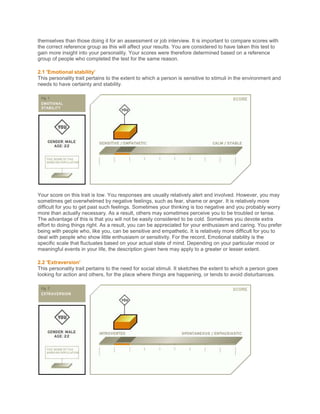
2.1 'Emotional stability'
This personality trait pertains to the extent to which a person is sensitive to stimuli in the environment and
needs to have certainty and stability.
Your score on this trait is low. You responses are usually relatively alert and involved. However, you may
sometimes get overwhelmed by negative feelings, such as fear, shame or anger. It is relatively more
difficult for you to get past such feelings. Sometimes your thinking is too negative and you probably worry
more than actually necessary. As a result, others may sometimes perceive you to be troubled or tense.
The advantage of this is that you will not be easily considered to be cold. Sometimes you devote extra
effort to doing things right. As a result, you can be appreciated for your enthusiasm and caring. You prefer
being with people who, like you, can be sensitive and empathetic. It is relatively more difficult for you to
deal with people who show little enthusiasm or sensitivity. For the record, Emotional stability is the
specific scale that fluctuates based on your actual state of mind. Depending on your particular mood or
meaningful events in your life, the description given here may apply to a greater or lesser extent.
2.2 'Extraversion'
This personality trait pertains to the need for social stimuli. It sketches the extent to which a person goes
looking for action and others, for the place where things are happening, or tends to avoid disturbances.
Your score on this trait is low. With others, your attitude is somewhat reserved or formal. Your need for
external stimuli varies, and you sometimes like being alone. This does not mean that you are anti-social
at all. You simply do not always feel the need to be heard or to voice your opinion unasked. You can
appear to be reserved and are sometimes less outspoken with others. You may prefer to take things
slowly, and you can enjoy being alone. You can be typified as a person who sometimes tests the waters.
Others may consider you to be rigid and closed at times. You prefer to be with people who, like yourself,
prefer to stay in the background. It is more difficult for you to identify with people who are extremely
spontaneous or overly enthusiastic.
2.3 'Conscientiousness'
This personality trait pertains to purposefulness. It reflects the extent to which a person is focused, exact
and orderly, or flexible instead.
Your score on this trait is below average. You are capable of taking whatever life brings. Sometimes you
seem to be careless. You can be relaxed and spontaneous. However, you are sometimes less organized
than others as a result. You may tend to avoid obligations. Your actions are sometimes more intuitive:
based on feelings rather than on what has been agreed or is considered appropriate. As a result,
sometimes you may appear to be somewhat disorganized and therefore easily distracted. Thus
sometimes you need to be careful of forgetting things or losing understanding of the big picture. Specific
others will sometimes even consider you to be lazy or uncaring. However, this also means that you can
be flexible. In general, you prefer to be with people who take life as it comes. You generally have more
difficulty dealing with people who are very cautious, exact or somewhat prudent. You do not always feel
at ease in a more structured, extremely orderly environment.
2.4 'Agreeableness'
This personality trait pertains to attentiveness and people mindedness. It indicates the extent to which a
person is interested in other people, and how affable the person is. A lower score points to a more
business-like and functional approach.
Your score on this trait is low. In comparison to others, you can be relatively direct. You approach others
sometimes in a business-like and sometimes in a somewhat functional manner. As a result, you may
leave the impression of being detached. In comparison with others, you are sometimes strong-willed. This
means that you are a person who can be competitive. You are not always the first to quickly or
spontaneously help others with their personal problems. You may even appear to be somewhat stubborn
and business-like to specific others. In the worst case, this may make you seem less nice. However,
people can also respect or appreciate you for your direct and outspoken attitude. In general, you get
along well with people who, like yourself, are unafraid to be independent and can be straightforward. It is
usually more difficult for you to deal with people who tend to be extremely mild or who try to be indirect.
2.5 'Openess'
This personality trait pertains to originality and intellect. It is related to the extent to which a person
searches for new insights, or has a more practical, routine-like attitude.
Your score on this trait is extremely low. You are clearly more focused than others on the here and now.
Instead of thinking new things up or considering alternatives, you prefer to get right down to work. Why
make things difficult? Thus you are also not the type who readily wants things discussed. As a result, you
will appear polite and correct. In general, you prefer routine and take a practical approach. As a result,
others may think you are conservative or rigid, but also loyal and rule abiding. It will be difficult for you to
deal with people who are very dreamy, vague or always wondering whether there is a better way to do
things. You prefer to accept things as they are. Your preference is for people who take a level-headed
approach.
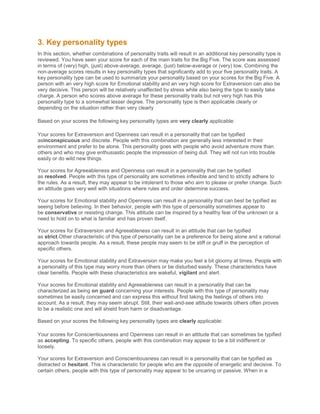
3. Key personality types
In this section, whether combinations of personality traits will result in an additional key personality type is
reviewed. You have seen your score for each of the main traits for the Big Five. The score was assessed
in terms of (very) high, (just) above-average, average, (just) below-average or (very) low. Combining the
non-average scores results in key personality types that significantly add to your five personality traits. A
key personality type can be used to summarize your personality based on your scores for the Big Five. A
person with an very high score for Emotional stability and an very high score for Extraversion can also be
very decisive. This person will be relatively unaffected by stress while also being the type to easily take
charge. A person who scores above average for these personality traits but not very high has this
personality type to a somewhat lesser degree. The personality type is then applicable clearly or
depending on the situation rather than very clearly
Based on your scores the following key personality types are very clearly applicable:
Your scores for Extraversion and Openness can result in a personality that can be typified
asinconspicuous and discrete. People with this combination are generally less interested in their
environment and prefer to be alone. This personality goes with people who avoid adventure more than
others and who may give enthusiastic people the impression of being dull. They will not run into trouble
easily or do wild new things.
Your scores for Agreeableness and Openness can result in a personality that can be typified
as resolved. People with this type of personality are sometimes inflexible and tend to strictly adhere to
the rules. As a result, they may appear to be intolerant to those who aim to please or prefer change. Such
an attitude goes very well with situations where rules and order determine success.
Your scores for Emotional stability and Openness can result in a personality that can best be typified as
seeing before believing. In their behavior, people with this type of personality sometimes appear to
be conservative or resisting change. This attitude can be inspired by a healthy fear of the unknown or a
need to hold on to what is familiar and has proven itself.
Your scores for Extraversion and Agreeableness can result in an attitude that can be typified
as strict.Other characteristic of this type of personality can be a preference for being alone and a rational
approach towards people. As a result, these people may seem to be stiff or gruff in the perception of
specific others.
Your scores for Emotional stability and Extraversion may make you feel a bit gloomy at times. People with
a personality of this type may worry more than others or be disturbed easily. These characteristics have
clear benefits. People with these characteristics are wakeful, vigilant and alert.
Your scores for Emotional stability and Agreeableness can result in a personality that can be
characterized as being on guard concerning your interests. People with this type of personality may
sometimes be easily concerned and can express this without first taking the feelings of others into
account. As a result, they may seem abrupt. Still, their wait-and-see attitude towards others often proves
to be a realistic one and will shield from harm or disadvantage.
Based on your scores the following key personality types are clearly applicable:
Your scores for Conscientiousness and Openness can result in an attitude that can sometimes be typified
as accepting. To specific others, people with this combination may appear to be a bit indifferent or
loosely.
Your scores for Extraversion and Conscientiousness can result in a personality that can be typified as
distracted or hesitant. This is characteristic for people who are the opposite of energetic and decisive. To
certain others, people with this type of personality may appear to be uncaring or passive. When in a
group, these people will often leave taking the initiative to others.
Your scores for Conscientiousness and Agreeableness can result in an attitude that can best be typified
as individualistic. This personality goes with people who others perceive as not always equally tactful or
attentive to the situation. This can make these people appear to be uninterested.
Your scores for Emotional stability and Conscientiousness can result in a personality that at times may be
typified as unorganized. People with this type of personality are more easily distracted by whims than
others or sometimes find it more difficult to withstand distractions. This, however, also makes people
flexible and succinct.
4. Summary
Some people are naturally more modest while others gladly sing their own praises. Because this report
reflects how you see yourself, the results may have been influenced in a certain direction. You can also
have someone else who knows you relatively well complete the test about you. Differences as compared
to the test you completed for yourself may say something about your self-image or the way you show
yourself to others.
Personality traits are generally considered to be relatively constant over the course of time. It is therefore
wiser to look at the traits that you have and how they can be used to your advantage than to try to change
a trait. That is much more difficult if not impossible, and requires relatively much more energy. Moreover,
a certain trait that is less desirable in some situations can be highly advantageous in another situation,
work or otherwise. The challenge is finding a hobby, study, partner, and home or work environment that is
the best suited to your personality. The better the fit between your environment and your personality, the
more at ease you will be and the better you will feel. This can be translated into happiness, success or
pleasant relationships with others.
Lastly, it should be noted that this test measures five of your personality traits. A person's personality
cannot, however, be completely expressed in five traits. Each individual is too unique to determine exactly
how his or her personality works merely based on a list of questions. This test gives you the vocabulary
with which you can look at yourself in comparison to others and learn from that comparison. In other
words, understand that the test summarizes your personality without an ultimate total judgment. That is
theoretically nearly impossible to do.
Please share this test
If you enjoy taking free tests here at 123test.com, please help us grow and spread the word. That's the
best thank you, you can give us and we appreciate it greatly!

Psycho test

  • 1.
    1. Introduction 1.1 Report Thisreport consists of four sections. The first section briefly explains the theoretical background of the test. Your personality profile is discussed in the second section based on your scores for the five personality traits of the Big Five theory. In the third section, whether combinations of the five personality traits result in additional key personality traits is reviewed. The last section explains the meaning of the test and how the results can be interpreted or used. 1.2 Theoretical background The list of all of the personality traits that can be measured with questionnaires is very long. Virtually effortlessly, more than fifty traits can be found that have been researched by test developers and psychologists. All of these traits, however, are derived from five main personality traits. This test refers to these five traits as Emotional stability, Extraversion, Conscientiousness, Agreeableness and Openness. Professional literature also refers to these as the Big Five. These are the five traits that can be found in numerous personality tests. Some personality tests consist of six, seven or even more personality traits. In these tests, one of the five main traits is often subdivided. As you read the results of your test, you will understand exactly what each personality trait stands for. To one extent or another, all of the traits listed above affect the way people deal with or respond to others. High, low or average scores on personality traits all have their own advantages and disadvantages depending on the situation or the people involved in the interaction. An accommodating person, for example, will be liked by many people. By contrast, a critical person will not be liked very well by some people. However, the critical individual will not be easily brushed aside. Tests in which the Big Five personality traits are measured provide insight into your primary personality traits in relation to other relevant people. This is rather essential. Take a person's height, for example. With a height of six feet, the average Western European or American person will seem like a giant in Japan. The same types of phenomena also affect the personality. The extent of your Extraversion, for example, is another relative score: you are an extravert to a certain extent in comparison to others. Sadly, many free tests are available on the Internet that do not provide results based on a comparison between you and the right reference group. The person who made up the test has decided what is considered a high or a low score: developing a standard is time consuming and expensive. This personality test provides goog insight into your personality, particularly in relation to the average Western person. 2. Introduction to your scores Your personality is described based on five personality traits: Emotional stability, Extraversion, Conscientiousness, Agreeableness and Openness. Each personality trait has two extremes. The meaning of the two extremes is explained to the left and right of the scale with your score. If your score is more to the left on the scale, the words on the left apply more to you. If your score is more to the right, the words on the right are more applicable. If your score is in the middle, the words on both sides apply to some degree. Scores to the left of the middle are called low or below-average scores. Scores to the right of the middle are above-average or high. An average score means that your score for that particular personality trait is generally the same as the average for the reference group. Statistical analysis is used to calculate the extent to which your scores differ from the average score. Qualifications like low, below- average, average or high are not results that can be considered good or poor. Some situations call for a certain trait while the same trait is not appreciated in other situations. A person who is usually calm and collected will generally suffer little from stress. Others may consider that person to be unenthusiastic or unsympathetic. Your scores are calculated in relation to the adult Western population. Generally, a distinction is made between people who have taken the test to gain more personal insight and those who have done it for an assessment or job interview. In general, people who do a test to gain personal insight are more critical of
  • 2.
    themselves than thosedoing it for an assessment or job interview. It is important to compare scores with the correct reference group as this will affect your results. You are considered to have taken this test to gain more insight into your personality. Your scores were therefore determined based on a reference group of people who completed the test for the same reason. 2.1 'Emotional stability' This personality trait pertains to the extent to which a person is sensitive to stimuli in the environment and needs to have certainty and stability. Your score on this trait is low. You responses are usually relatively alert and involved. However, you may sometimes get overwhelmed by negative feelings, such as fear, shame or anger. It is relatively more difficult for you to get past such feelings. Sometimes your thinking is too negative and you probably worry more than actually necessary. As a result, others may sometimes perceive you to be troubled or tense. The advantage of this is that you will not be easily considered to be cold. Sometimes you devote extra effort to doing things right. As a result, you can be appreciated for your enthusiasm and caring. You prefer being with people who, like you, can be sensitive and empathetic. It is relatively more difficult for you to deal with people who show little enthusiasm or sensitivity. For the record, Emotional stability is the specific scale that fluctuates based on your actual state of mind. Depending on your particular mood or meaningful events in your life, the description given here may apply to a greater or lesser extent. 2.2 'Extraversion' This personality trait pertains to the need for social stimuli. It sketches the extent to which a person goes looking for action and others, for the place where things are happening, or tends to avoid disturbances.
  • 3.
    Your score onthis trait is low. With others, your attitude is somewhat reserved or formal. Your need for external stimuli varies, and you sometimes like being alone. This does not mean that you are anti-social at all. You simply do not always feel the need to be heard or to voice your opinion unasked. You can appear to be reserved and are sometimes less outspoken with others. You may prefer to take things slowly, and you can enjoy being alone. You can be typified as a person who sometimes tests the waters. Others may consider you to be rigid and closed at times. You prefer to be with people who, like yourself, prefer to stay in the background. It is more difficult for you to identify with people who are extremely spontaneous or overly enthusiastic. 2.3 'Conscientiousness' This personality trait pertains to purposefulness. It reflects the extent to which a person is focused, exact and orderly, or flexible instead. Your score on this trait is below average. You are capable of taking whatever life brings. Sometimes you seem to be careless. You can be relaxed and spontaneous. However, you are sometimes less organized than others as a result. You may tend to avoid obligations. Your actions are sometimes more intuitive: based on feelings rather than on what has been agreed or is considered appropriate. As a result, sometimes you may appear to be somewhat disorganized and therefore easily distracted. Thus sometimes you need to be careful of forgetting things or losing understanding of the big picture. Specific others will sometimes even consider you to be lazy or uncaring. However, this also means that you can be flexible. In general, you prefer to be with people who take life as it comes. You generally have more difficulty dealing with people who are very cautious, exact or somewhat prudent. You do not always feel at ease in a more structured, extremely orderly environment. 2.4 'Agreeableness' This personality trait pertains to attentiveness and people mindedness. It indicates the extent to which a person is interested in other people, and how affable the person is. A lower score points to a more business-like and functional approach.
  • 4.
    Your score onthis trait is low. In comparison to others, you can be relatively direct. You approach others sometimes in a business-like and sometimes in a somewhat functional manner. As a result, you may leave the impression of being detached. In comparison with others, you are sometimes strong-willed. This means that you are a person who can be competitive. You are not always the first to quickly or spontaneously help others with their personal problems. You may even appear to be somewhat stubborn and business-like to specific others. In the worst case, this may make you seem less nice. However, people can also respect or appreciate you for your direct and outspoken attitude. In general, you get along well with people who, like yourself, are unafraid to be independent and can be straightforward. It is usually more difficult for you to deal with people who tend to be extremely mild or who try to be indirect. 2.5 'Openess' This personality trait pertains to originality and intellect. It is related to the extent to which a person searches for new insights, or has a more practical, routine-like attitude. Your score on this trait is extremely low. You are clearly more focused than others on the here and now. Instead of thinking new things up or considering alternatives, you prefer to get right down to work. Why make things difficult? Thus you are also not the type who readily wants things discussed. As a result, you will appear polite and correct. In general, you prefer routine and take a practical approach. As a result, others may think you are conservative or rigid, but also loyal and rule abiding. It will be difficult for you to deal with people who are very dreamy, vague or always wondering whether there is a better way to do things. You prefer to accept things as they are. Your preference is for people who take a level-headed approach.
  • 5.
    3. Key personalitytypes In this section, whether combinations of personality traits will result in an additional key personality type is reviewed. You have seen your score for each of the main traits for the Big Five. The score was assessed in terms of (very) high, (just) above-average, average, (just) below-average or (very) low. Combining the non-average scores results in key personality types that significantly add to your five personality traits. A key personality type can be used to summarize your personality based on your scores for the Big Five. A person with an very high score for Emotional stability and an very high score for Extraversion can also be very decisive. This person will be relatively unaffected by stress while also being the type to easily take charge. A person who scores above average for these personality traits but not very high has this personality type to a somewhat lesser degree. The personality type is then applicable clearly or depending on the situation rather than very clearly Based on your scores the following key personality types are very clearly applicable: Your scores for Extraversion and Openness can result in a personality that can be typified asinconspicuous and discrete. People with this combination are generally less interested in their environment and prefer to be alone. This personality goes with people who avoid adventure more than others and who may give enthusiastic people the impression of being dull. They will not run into trouble easily or do wild new things. Your scores for Agreeableness and Openness can result in a personality that can be typified as resolved. People with this type of personality are sometimes inflexible and tend to strictly adhere to the rules. As a result, they may appear to be intolerant to those who aim to please or prefer change. Such an attitude goes very well with situations where rules and order determine success. Your scores for Emotional stability and Openness can result in a personality that can best be typified as seeing before believing. In their behavior, people with this type of personality sometimes appear to be conservative or resisting change. This attitude can be inspired by a healthy fear of the unknown or a need to hold on to what is familiar and has proven itself. Your scores for Extraversion and Agreeableness can result in an attitude that can be typified as strict.Other characteristic of this type of personality can be a preference for being alone and a rational approach towards people. As a result, these people may seem to be stiff or gruff in the perception of specific others. Your scores for Emotional stability and Extraversion may make you feel a bit gloomy at times. People with a personality of this type may worry more than others or be disturbed easily. These characteristics have clear benefits. People with these characteristics are wakeful, vigilant and alert. Your scores for Emotional stability and Agreeableness can result in a personality that can be characterized as being on guard concerning your interests. People with this type of personality may sometimes be easily concerned and can express this without first taking the feelings of others into account. As a result, they may seem abrupt. Still, their wait-and-see attitude towards others often proves to be a realistic one and will shield from harm or disadvantage. Based on your scores the following key personality types are clearly applicable: Your scores for Conscientiousness and Openness can result in an attitude that can sometimes be typified as accepting. To specific others, people with this combination may appear to be a bit indifferent or loosely. Your scores for Extraversion and Conscientiousness can result in a personality that can be typified as distracted or hesitant. This is characteristic for people who are the opposite of energetic and decisive. To certain others, people with this type of personality may appear to be uncaring or passive. When in a
  • 6.
    group, these peoplewill often leave taking the initiative to others. Your scores for Conscientiousness and Agreeableness can result in an attitude that can best be typified as individualistic. This personality goes with people who others perceive as not always equally tactful or attentive to the situation. This can make these people appear to be uninterested. Your scores for Emotional stability and Conscientiousness can result in a personality that at times may be typified as unorganized. People with this type of personality are more easily distracted by whims than others or sometimes find it more difficult to withstand distractions. This, however, also makes people flexible and succinct. 4. Summary Some people are naturally more modest while others gladly sing their own praises. Because this report reflects how you see yourself, the results may have been influenced in a certain direction. You can also have someone else who knows you relatively well complete the test about you. Differences as compared to the test you completed for yourself may say something about your self-image or the way you show yourself to others. Personality traits are generally considered to be relatively constant over the course of time. It is therefore wiser to look at the traits that you have and how they can be used to your advantage than to try to change a trait. That is much more difficult if not impossible, and requires relatively much more energy. Moreover, a certain trait that is less desirable in some situations can be highly advantageous in another situation, work or otherwise. The challenge is finding a hobby, study, partner, and home or work environment that is the best suited to your personality. The better the fit between your environment and your personality, the more at ease you will be and the better you will feel. This can be translated into happiness, success or pleasant relationships with others. Lastly, it should be noted that this test measures five of your personality traits. A person's personality cannot, however, be completely expressed in five traits. Each individual is too unique to determine exactly how his or her personality works merely based on a list of questions. This test gives you the vocabulary with which you can look at yourself in comparison to others and learn from that comparison. In other words, understand that the test summarizes your personality without an ultimate total judgment. That is theoretically nearly impossible to do. Please share this test If you enjoy taking free tests here at 123test.com, please help us grow and spread the word. That's the best thank you, you can give us and we appreciate it greatly!