Chapter 9
PERSONALITY and CULTURAL
VALUES
1. Something like some people and something like some other people
and something unlike to everyone (unique) is called personality.
2. Personality is not made up of only nature (heredity) or nurture
(envirment) but both togather make personality.
Personality
Definition- personality refers to the structures and propensities inside
people that explain their characteristics, patterns of thought, emotions,
and behaviors.
Personality creates people’s social reputation- the way they are
perceived by their friends, family, coworkers, and supervisors. It
captures what people are like.
Good Personality- combination of multiple traits- trait means
recurring regularities or trends in people’s responses to their
environment. Adjectives like: responsible, easygoing, polite, and
reserved are used to summarize someone’s personality.
Cultural Values
Definition- cultural values are defined as shared beliefs about desirable end
states or modes of conduct in a given culture.
We can think of values “what cultures are like”. Adjectives such as
“traditional,” “informal,” “risk aversive,” or “assertive” are all examples of
values that can be used to summarize a nation’s culture.
Examples:
1. Responsible person will act differently in US and in China.
2. Easygoing person will act differently in France and in Indonesia.
3. Polite person will act differently in Pakistan and in Malaysia.
4. Reserved person will act differently in Iran and in England.
TRAIT Adjectives Associated with Big Five.
As traits of one person or a group of persons are countless and it is near
to impossible to prepare an exhaustive list of personality traits but there are
Five Big traits that are representatives of huge number of traits in human
personalities.
BIG FIVE TRAITS:
1. Conscientiousness
2. Agreeableness-
3. Neuroticism-
4. Openness to experience-
5. Extraversion-
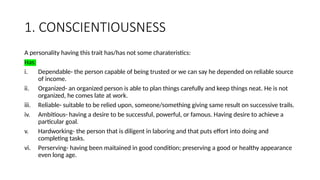
1. CONSCIENTIOUSNESS
A personality having this trait has/has not some charateristics:
Has:
i. Dependable- the person capable of being trusted or we can say he depended on reliable source
of income.
ii. Organized- an organized person is able to plan things carefully and keep things neat. He is not
organized, he comes late at work.
iii. Reliable- suitable to be relied upon, someone/something giving same result on successive trails.
iv. Ambitious- having a desire to be successful, powerful, or famous. Having desire to achieve a
particular goal.
v. Hardworking- the person that is diligent in laboring and that puts effort into doing and
completing tasks.
vi. Perserving- having been maitained in good condition; preserving a good or healthy appearance
even long age.
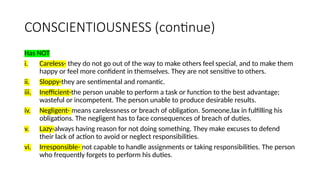
CONSCIENTIOUSNESS (continue)
Has NOT
i. Careless- they do not go out of the way to make others feel special, and to make them
happy or feel more confident in themselves. They are not sensitive to others.
ii. Sloppy-they are sentimental and romantic.
iii. Inefficient-the person unable to perform a task or function to the best advantage;
wasteful or incompetent. The person unable to produce desirable results.
iv. Negligent- means carelessness or breach of obligation. Someone,lax in fulfilling his
obligations. The negligent has to face consequences of breach of duties.
v. Lazy-always having reason for not doing something. They make excuses to defend
their lack of action to avoid or neglect responsibilities.
vi. Irresponsible- not capable to handle assignments or taking responsibilities. The person
who frequently forgets to perform his duties.
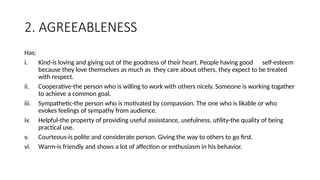
2. AGREEABLENESS
Has:
i. Kind-is loving and giving out of the goodness of their heart. People having good self-esteem
because they love themselves as much as they care about others, they expect to be treated
with respect.
ii. Cooperative-the person who is willing to work with others nicely. Someone is working togather
to achieve a common goal.
iii. Sympathetic-the person who is motivated by compassion. The one who is likable or who
evokes feelings of sympathy from audience.
iv. Helpful-the property of providing useful assisstance, usefulness, utility-the quality of being
practical use.
v. Courteous-is polite and considerate person. Giving the way to others to go first.
vi. Warm-is friendly and shows a lot of affection or enthusiasm in his behavior.
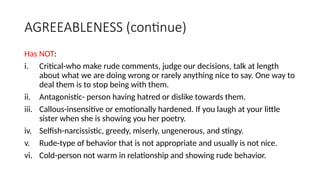
AGREEABLENESS (continue)
Has NOT:
i. Critical-who make rude comments, judge our decisions, talk at length
about what we are doing wrong or rarely anything nice to say. One way to
deal them is to stop being with them.
ii. Antagonistic- person having hatred or dislike towards them.
iii. Callous-insensitive or emotionally hardened. If you laugh at your little
sister when she is showing you her poetry.
iv. Selfish-narcissistic, greedy, miserly, ungenerous, and stingy.
v. Rude-type of behavior that is not appropriate and usually is not nice.
vi. Cold-person not warm in relationship and showing rude behavior.
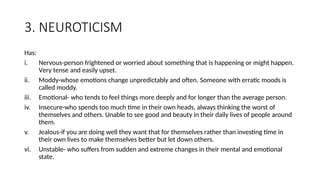
3. NEUROTICISM
Has:
i. Nervous-person frightened or worried about something that is happening or might happen.
Very tense and easily upset.
ii. Moddy-whose emotions change unpredictably and often. Someone with erratic moods is
called moddy.
iii. Emotional- who tends to feel things more deeply and for longer than the average person.
iv. Insecure-who spends too much time in their own heads, always thinking the worst of
themselves and others. Unable to see good and beauty in their daily lives of people around
them.
v. Jealous-if you are doing well they want that for themselves rather than investing time in
their own lives to make themselves better but let down others.
vi. Unstable- who suffers from sudden and extreme changes in their mental and emotional
state.
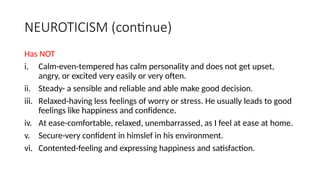
NEUROTICISM (continue)
Has NOT
i. Calm-even-tempered has calm personality and does not get upset,
angry, or excited very easily or very often.
ii. Steady- a sensible and reliable and able make good decision.
iii. Relaxed-having less feelings of worry or stress. He usually leads to good
feelings like happiness and confidence.
iv. At ease-comfortable, relaxed, unembarrassed, as I feel at ease at home.
v. Secure-very confident in himslef in his environment.
vi. Contented-feeling and expressing happiness and satisfaction.
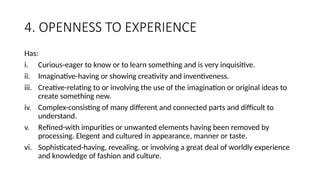
4. OPENNESS TO EXPERIENCE
Has:
i. Curious-eager to know or to learn something and is very inquisitive.
ii. Imaginative-having or showing creativity and inventiveness.
iii. Creative-relating to or involving the use of the imagination or original ideas to
create something new.
iv. Complex-consisting of many different and connected parts and difficult to
understand.
v. Refined-with impurities or unwanted elements having been removed by
processing. Elegent and cultured in appearance, manner or taste.
vi. Sophisticated-having, revealing, or involving a great deal of worldly experience
and knowledge of fashion and culture.
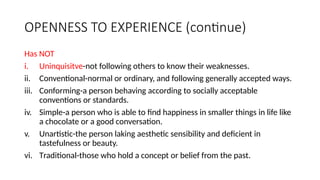
OPENNESS TO EXPERIENCE (continue)
Has NOT
i. Uninquisitve-not following others to know their weaknesses.
ii. Conventional-normal or ordinary, and following generally accepted ways.
iii. Conforming-a person behaving according to socially acceptable
conventions or standards.
iv. Simple-a person who is able to find happiness in smaller things in life like
a chocolate or a good conversation.
v. Unartistic-the person laking aesthetic sensibility and deficient in
tastefulness or beauty.
vi. Traditional-those who hold a concept or belief from the past.
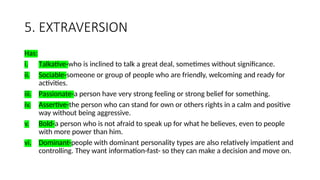
5. EXTRAVERSION
Has:
i. Talkative-who is inclined to talk a great deal, sometimes without significance.
ii. Sociable-someone or group of people who are friendly, welcoming and ready for
activities.
iii. Passionate-a person have very strong feeling or strong belief for something.
iv. Assertive-the person who can stand for own or others rights in a calm and positive
way without being aggressive.
v. Bold-a person who is not afraid to speak up for what he believes, even to people
with more power than him.
vi. Dominant-people with dominant personality types are also relatively impatient and
controlling. They want information-fast- so they can make a decision and move on.
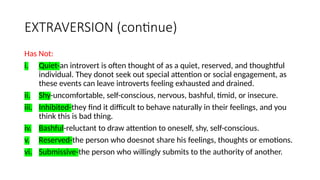
EXTRAVERSION (continue)
Has Not:
i. Quiet-an introvert is often thought of as a quiet, reserved, and thoughtful
individual. They donot seek out special attention or social engagement, as
these events can leave introverts feeling exhausted and drained.
ii. Shy-uncomfortable, self-conscious, nervous, bashful, timid, or insecure.
iii. Inhibited-they find it difficult to behave naturally in their feelings, and you
think this is bad thing.
iv. Bashful-reluctant to draw attention to oneself, shy, self-conscious.
v. Reserved-the person who doesnot share his feelings, thoughts or emotions.
vi. Submissive-the person who willingly submits to the authority of another.
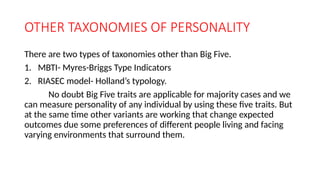
OTHER TAXONOMIES OF PERSONALITY
There are two types of taxonomies other than Big Five.
1. MBTI- Myres-Briggs Type Indicators
2. RIASEC model- Holland’s typology.
No doubt Big Five traits are applicable for majority cases and we
can measure personality of any individual by using these five traits. But
at the same time other variants are working that change expected
outcomes due some preferences of different people living and facing
varying environments that surround them.
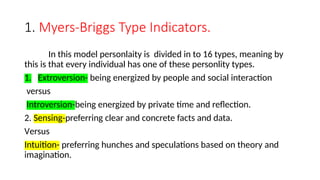
1. Myers-Briggs Type Indicators.
In this model personlaity is divided in to 16 types, meaning by
this is that every individual has one of these personlity types.
1. Extroversion- being energized by people and social interaction
versus
Introversion-being energized by private time and reflection.
2. Sensing-preferring clear and concrete facts and data.
Versus
Intuition- preferring hunches and speculations based on theory and
imagination.
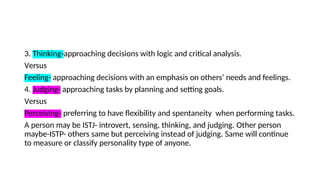
3. Thinking-approaching decisions with logic and critical analysis.
Versus
Feeling- approaching decisions with an emphasis on others’ needs and feelings.
4. Judging- approaching tasks by planning and setting goals.
Versus
Perceiving- preferring to have flexibility and spentaneity when performing tasks.
A person may be ISTJ- introvert, sensing, thinking, and judging. Other person
maybe-ISTP- others same but perceiving instead of judging. Same will continue
to measure or classify personality type of anyone.
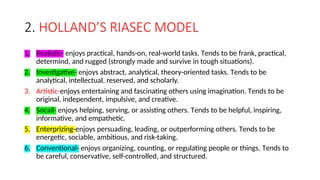
2. HOLLAND’S RIASEC MODEL
1. Realistic- enjoys practical, hands-on, real-world tasks. Tends to be frank, practical,
determind, and rugged (strongly made and survive in tough situations).
2. Investigative- enjoys abstract, analytical, theory-oriented tasks. Tends to be
analytical, intellectual, reserved, and scholarly.
3. Artistic-enjoys entertaining and fascinating others using imagination. Tends to be
original, independent, impulsive, and creative.
4. Socail- enjoys helping, serving, or assisting others. Tends to be helpful, inspiring,
informative, and empathetic.
5. Enterprizing-enjoys persuading, leading, or outperforming others. Tends to be
energetic, sociable, ambitious, and risk-taking.
6. Conventional- enjoys organizing, counting, or regulating people or things. Tends to
be careful, conservative, self-controlled, and structured.
CULTURAL VALUES
Definition- cultural values are defined as shared beliefs about desirable end states or modes of
conduct in a given culture.
We can think of values “what cultures are like”. Adjectives such as “traditional,”
“informal,” “risk aversive,” or “assertive” are all examples of values that can be used to
summarize a nation’s culture.
CULTURE DEFINED-shared values, beliefs, motives, indentities, and interpretations that result
from common experiences of members of a society and are transmitted across generations.
Moreover, it is societal traditions, and collective programming that underlies culture influence
the development of our personalities while also shaping the way our traits are expressed.
In this way, explaining “what we are like” requires an awareness of “where we are from” means
family we belong, area we belong, friends we have, religion we believe, society we belong so
on and so forth.
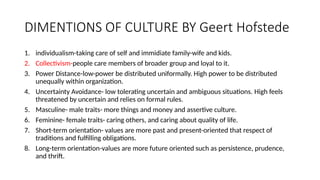
DIMENTIONS OF CULTURE BY Geert Hofstede
1. individualism-taking care of self and immidiate family-wife and kids.
2. Collectivism-people care members of broader group and loyal to it.
3. Power Distance-low-power be distributed uniformally. High power to be distributed
unequally within organization.
4. Uncertainty Avoidance- low tolerating uncertain and ambiguous situations. High feels
threatened by uncertain and relies on formal rules.
5. Masculine- male traits- more things and money and assertive culture.
6. Feminine- female traits- caring others, and caring about quality of life.
7. Short-term orientation- values are more past and present-oriented that respect of
traditions and fulfilling obligations.
8. Long-term orientation-values are more future oriented such as persistence, prudence,
and thrift.
Effects of Personality on Task Performance and
Organizational Commitment
1. Conscientiousness on Job Performance- conscientiousness has
moderate positive effect on Performance. Conscientious employees
have higher levels of task performance. They are also more likely to
engage in Citizenship Behavior and less likely to engage in
Counterproductive Behavior.
2. Conscientiousness on Organizational Commitment-
conscientiousness has a moderate effect on commitment.
Conscientious employees have higher levels of Affective
Commitment and higher levels of Normative commitment and
nothing is known effect on Continuance Commitment.

chapter 9 Personality.pptx business plan

  • 1.
    Chapter 9 PERSONALITY andCULTURAL VALUES 1. Something like some people and something like some other people and something unlike to everyone (unique) is called personality. 2. Personality is not made up of only nature (heredity) or nurture (envirment) but both togather make personality.
  • 2.
    Personality Definition- personality refersto the structures and propensities inside people that explain their characteristics, patterns of thought, emotions, and behaviors. Personality creates people’s social reputation- the way they are perceived by their friends, family, coworkers, and supervisors. It captures what people are like. Good Personality- combination of multiple traits- trait means recurring regularities or trends in people’s responses to their environment. Adjectives like: responsible, easygoing, polite, and reserved are used to summarize someone’s personality.
  • 3.
    Cultural Values Definition- culturalvalues are defined as shared beliefs about desirable end states or modes of conduct in a given culture. We can think of values “what cultures are like”. Adjectives such as “traditional,” “informal,” “risk aversive,” or “assertive” are all examples of values that can be used to summarize a nation’s culture. Examples: 1. Responsible person will act differently in US and in China. 2. Easygoing person will act differently in France and in Indonesia. 3. Polite person will act differently in Pakistan and in Malaysia. 4. Reserved person will act differently in Iran and in England.
  • 4.
    TRAIT Adjectives Associatedwith Big Five. As traits of one person or a group of persons are countless and it is near to impossible to prepare an exhaustive list of personality traits but there are Five Big traits that are representatives of huge number of traits in human personalities. BIG FIVE TRAITS: 1. Conscientiousness 2. Agreeableness- 3. Neuroticism- 4. Openness to experience- 5. Extraversion-
  • 5.
    1. CONSCIENTIOUSNESS A personalityhaving this trait has/has not some charateristics: Has: i. Dependable- the person capable of being trusted or we can say he depended on reliable source of income. ii. Organized- an organized person is able to plan things carefully and keep things neat. He is not organized, he comes late at work. iii. Reliable- suitable to be relied upon, someone/something giving same result on successive trails. iv. Ambitious- having a desire to be successful, powerful, or famous. Having desire to achieve a particular goal. v. Hardworking- the person that is diligent in laboring and that puts effort into doing and completing tasks. vi. Perserving- having been maitained in good condition; preserving a good or healthy appearance even long age.
  • 6.
    CONSCIENTIOUSNESS (continue) Has NOT i.Careless- they do not go out of the way to make others feel special, and to make them happy or feel more confident in themselves. They are not sensitive to others. ii. Sloppy-they are sentimental and romantic. iii. Inefficient-the person unable to perform a task or function to the best advantage; wasteful or incompetent. The person unable to produce desirable results. iv. Negligent- means carelessness or breach of obligation. Someone,lax in fulfilling his obligations. The negligent has to face consequences of breach of duties. v. Lazy-always having reason for not doing something. They make excuses to defend their lack of action to avoid or neglect responsibilities. vi. Irresponsible- not capable to handle assignments or taking responsibilities. The person who frequently forgets to perform his duties.
  • 7.
    2. AGREEABLENESS Has: i. Kind-isloving and giving out of the goodness of their heart. People having good self-esteem because they love themselves as much as they care about others, they expect to be treated with respect. ii. Cooperative-the person who is willing to work with others nicely. Someone is working togather to achieve a common goal. iii. Sympathetic-the person who is motivated by compassion. The one who is likable or who evokes feelings of sympathy from audience. iv. Helpful-the property of providing useful assisstance, usefulness, utility-the quality of being practical use. v. Courteous-is polite and considerate person. Giving the way to others to go first. vi. Warm-is friendly and shows a lot of affection or enthusiasm in his behavior.
  • 8.
    AGREEABLENESS (continue) Has NOT: i.Critical-who make rude comments, judge our decisions, talk at length about what we are doing wrong or rarely anything nice to say. One way to deal them is to stop being with them. ii. Antagonistic- person having hatred or dislike towards them. iii. Callous-insensitive or emotionally hardened. If you laugh at your little sister when she is showing you her poetry. iv. Selfish-narcissistic, greedy, miserly, ungenerous, and stingy. v. Rude-type of behavior that is not appropriate and usually is not nice. vi. Cold-person not warm in relationship and showing rude behavior.
  • 9.
    3. NEUROTICISM Has: i. Nervous-personfrightened or worried about something that is happening or might happen. Very tense and easily upset. ii. Moddy-whose emotions change unpredictably and often. Someone with erratic moods is called moddy. iii. Emotional- who tends to feel things more deeply and for longer than the average person. iv. Insecure-who spends too much time in their own heads, always thinking the worst of themselves and others. Unable to see good and beauty in their daily lives of people around them. v. Jealous-if you are doing well they want that for themselves rather than investing time in their own lives to make themselves better but let down others. vi. Unstable- who suffers from sudden and extreme changes in their mental and emotional state.
  • 10.
    NEUROTICISM (continue) Has NOT i.Calm-even-tempered has calm personality and does not get upset, angry, or excited very easily or very often. ii. Steady- a sensible and reliable and able make good decision. iii. Relaxed-having less feelings of worry or stress. He usually leads to good feelings like happiness and confidence. iv. At ease-comfortable, relaxed, unembarrassed, as I feel at ease at home. v. Secure-very confident in himslef in his environment. vi. Contented-feeling and expressing happiness and satisfaction.
  • 11.
    4. OPENNESS TOEXPERIENCE Has: i. Curious-eager to know or to learn something and is very inquisitive. ii. Imaginative-having or showing creativity and inventiveness. iii. Creative-relating to or involving the use of the imagination or original ideas to create something new. iv. Complex-consisting of many different and connected parts and difficult to understand. v. Refined-with impurities or unwanted elements having been removed by processing. Elegent and cultured in appearance, manner or taste. vi. Sophisticated-having, revealing, or involving a great deal of worldly experience and knowledge of fashion and culture.
  • 12.
    OPENNESS TO EXPERIENCE(continue) Has NOT i. Uninquisitve-not following others to know their weaknesses. ii. Conventional-normal or ordinary, and following generally accepted ways. iii. Conforming-a person behaving according to socially acceptable conventions or standards. iv. Simple-a person who is able to find happiness in smaller things in life like a chocolate or a good conversation. v. Unartistic-the person laking aesthetic sensibility and deficient in tastefulness or beauty. vi. Traditional-those who hold a concept or belief from the past.
  • 13.
    5. EXTRAVERSION Has: i. Talkative-whois inclined to talk a great deal, sometimes without significance. ii. Sociable-someone or group of people who are friendly, welcoming and ready for activities. iii. Passionate-a person have very strong feeling or strong belief for something. iv. Assertive-the person who can stand for own or others rights in a calm and positive way without being aggressive. v. Bold-a person who is not afraid to speak up for what he believes, even to people with more power than him. vi. Dominant-people with dominant personality types are also relatively impatient and controlling. They want information-fast- so they can make a decision and move on.
  • 14.
    EXTRAVERSION (continue) Has Not: i.Quiet-an introvert is often thought of as a quiet, reserved, and thoughtful individual. They donot seek out special attention or social engagement, as these events can leave introverts feeling exhausted and drained. ii. Shy-uncomfortable, self-conscious, nervous, bashful, timid, or insecure. iii. Inhibited-they find it difficult to behave naturally in their feelings, and you think this is bad thing. iv. Bashful-reluctant to draw attention to oneself, shy, self-conscious. v. Reserved-the person who doesnot share his feelings, thoughts or emotions. vi. Submissive-the person who willingly submits to the authority of another.
  • 15.
    OTHER TAXONOMIES OFPERSONALITY There are two types of taxonomies other than Big Five. 1. MBTI- Myres-Briggs Type Indicators 2. RIASEC model- Holland’s typology. No doubt Big Five traits are applicable for majority cases and we can measure personality of any individual by using these five traits. But at the same time other variants are working that change expected outcomes due some preferences of different people living and facing varying environments that surround them.
  • 16.
    1. Myers-Briggs TypeIndicators. In this model personlaity is divided in to 16 types, meaning by this is that every individual has one of these personlity types. 1. Extroversion- being energized by people and social interaction versus Introversion-being energized by private time and reflection. 2. Sensing-preferring clear and concrete facts and data. Versus Intuition- preferring hunches and speculations based on theory and imagination.
  • 17.
    3. Thinking-approaching decisionswith logic and critical analysis. Versus Feeling- approaching decisions with an emphasis on others’ needs and feelings. 4. Judging- approaching tasks by planning and setting goals. Versus Perceiving- preferring to have flexibility and spentaneity when performing tasks. A person may be ISTJ- introvert, sensing, thinking, and judging. Other person maybe-ISTP- others same but perceiving instead of judging. Same will continue to measure or classify personality type of anyone.
  • 18.
    2. HOLLAND’S RIASECMODEL 1. Realistic- enjoys practical, hands-on, real-world tasks. Tends to be frank, practical, determind, and rugged (strongly made and survive in tough situations). 2. Investigative- enjoys abstract, analytical, theory-oriented tasks. Tends to be analytical, intellectual, reserved, and scholarly. 3. Artistic-enjoys entertaining and fascinating others using imagination. Tends to be original, independent, impulsive, and creative. 4. Socail- enjoys helping, serving, or assisting others. Tends to be helpful, inspiring, informative, and empathetic. 5. Enterprizing-enjoys persuading, leading, or outperforming others. Tends to be energetic, sociable, ambitious, and risk-taking. 6. Conventional- enjoys organizing, counting, or regulating people or things. Tends to be careful, conservative, self-controlled, and structured.
  • 19.
    CULTURAL VALUES Definition- culturalvalues are defined as shared beliefs about desirable end states or modes of conduct in a given culture. We can think of values “what cultures are like”. Adjectives such as “traditional,” “informal,” “risk aversive,” or “assertive” are all examples of values that can be used to summarize a nation’s culture. CULTURE DEFINED-shared values, beliefs, motives, indentities, and interpretations that result from common experiences of members of a society and are transmitted across generations. Moreover, it is societal traditions, and collective programming that underlies culture influence the development of our personalities while also shaping the way our traits are expressed. In this way, explaining “what we are like” requires an awareness of “where we are from” means family we belong, area we belong, friends we have, religion we believe, society we belong so on and so forth.
  • 20.
    DIMENTIONS OF CULTUREBY Geert Hofstede 1. individualism-taking care of self and immidiate family-wife and kids. 2. Collectivism-people care members of broader group and loyal to it. 3. Power Distance-low-power be distributed uniformally. High power to be distributed unequally within organization. 4. Uncertainty Avoidance- low tolerating uncertain and ambiguous situations. High feels threatened by uncertain and relies on formal rules. 5. Masculine- male traits- more things and money and assertive culture. 6. Feminine- female traits- caring others, and caring about quality of life. 7. Short-term orientation- values are more past and present-oriented that respect of traditions and fulfilling obligations. 8. Long-term orientation-values are more future oriented such as persistence, prudence, and thrift.
  • 21.
    Effects of Personalityon Task Performance and Organizational Commitment 1. Conscientiousness on Job Performance- conscientiousness has moderate positive effect on Performance. Conscientious employees have higher levels of task performance. They are also more likely to engage in Citizenship Behavior and less likely to engage in Counterproductive Behavior. 2. Conscientiousness on Organizational Commitment- conscientiousness has a moderate effect on commitment. Conscientious employees have higher levels of Affective Commitment and higher levels of Normative commitment and nothing is known effect on Continuance Commitment.