Schizophrenia
 In relation to schizophrenia candidates should be familiar with the following:
 Clinical characteristics of schizophrenia
 Issues surrounding the classification and diagnosis of schizophrenia including
reliability and validity
 Biological explanations of schizophrenia
 Psychological explanations of schizophrenia
 Biological therapies for schizophrenia, including their evaluation in terms of
appropriateness and effectiveness
 Psychological therapies for schizophrenia, including their evaluation in terms of
appropriateness and effectiveness
 Positive symptoms
 Reflect an excess of normal functions
 Delusions-bizarre beliefs that seem real
to the sufferer but are not actually real
 Experiences of control-believing that
someone or something else is
controlling their mind and/or body
 Hallucinations-bizarre and unreal
perception of the environment. Can be
auditory (sound), visual (sights),
olfactory (smells) or tactile (feelings)
 Disordered thinking-the feeling that
thoughts are being inserted of
withdrawn from their minds
 Negative symptoms
 Reflect a loss of normal functions
 Affective flattening-a reduction in the
range and/or intensity of emotional
expression
 Alogia-poverty of speech.
Characterised by less speech fluency
and productivity.This symptom is
believed to reflect blocked thoughts
 Avolition-relates to reduced or lost
ability to persist in goal-directed
behaviours
 2 or more positive symptoms are
required for the duration of one month
 Reliability =the consistency of a measuring instrument to assess the severity of
schizophrenic symptoms
 Inter-rater reliability-whether two independent assessors give the same diagnosis
 Carson claims that the release of the DSM-III in 1980 solved problems relating to
inter-rater reliability as psychiatrists had a reliable classification system that
allowed them to more easily distinguish between schizophrenic and non-
schizophrenic patients
 Test-retest reliability-whether a test used to deliver a diagnosis is consistent over
time
 Cognitive screening tests measure neuropsychological impairment and help
diagnose schizophrenia. RBANS test is an example of this
 Wilks et al gave two forms of the RBANS test to patients over a period of 1-134 days
and found that test-retest reliability was very high at 0.84
 Whaley (2001)- inter-rater reliability correlations for sz as low as 0.11
 Rosenhan (1973)-8 participants volunteered to claim that they were hearing a voice
in their head saying ‘empty’,‘hollow’ and ‘thud’. All were diagnosed as Sz and
admitted to psychiatric hospitals in the US. No staff realised they were actually
healthy despite their protests
 Mojtabi and Nicholson (1995) only one symptom is required by the DSM if
delusions are considered ‘bizaare’. 50 US senior psychiatrists were given a case
study of a Sz patient and asked to determine whether the delusions were bizarre or
non-bizarre.The inter-rater reliability correlation was 0.4; this is fairly low
considering it is such an important part of diagnosis
 Copeland (1971) looked into cultural differences in Sz diagnosis. 134 American
psychiatrists and 194 British psychiatrists were given a case study of a patient and
asked to diagnose him. 69% of the US psychiatrists diagnosed the patient as Sz but
only 2% of the British psychiatrists gave the same diagnosis
 Cheniaux et al(2009)-tested the inter-rater reliability of the DSM-IV and the ICD-10
and found that the inter-rater reliability was over 0.50 for both measures
 Prescott et al (1986) looked into the test-retest reliability of several tests that
measure attention and information processing. A sample of 14 chronic
schizophrenic patients were used to test for reliability. It was found that
performance on these tests was stable over a six month period
 Wilks et al (2003) gave two forms of the RBANS test to patients over a period of 1-
134 days and found that test-retest reliability was very high at 0.84
 Validity=refers to the extent that a diagnosis represents something that is real and
distinct from other disorders and the extent that a classification system measures
what it claims to measure.
 Validity and reliability are linked because a diagnosis cannot be valid if it isn’t
reliable
 Comorbidity- refers to the extent that 2 or more conditions co-occur
 Buckly et al (2009) found that 50% of Sz patients have comorbid depression and
47% have a comorbid diagnosis of lifetime substance abuse
 Comorbidities create difficulties in diagnosing and treating a disorder
 Positive or negative symptoms?-Klossterkotter et al looked at 489 psychiatric
hospital admissions and found that positive symptoms were better at providing a
valid diagnosis than negative symptoms
 Prognosis(predictive validity) schizophrenics rarely share the symptoms or the
same outcomes. 20% fully recover, 10% achieve significant and lasting
improvements and 30% show improvement with intermittent relapses.This means
that a Sz diagnosis has low predictive validity
 Some psychologists claim that the poor functioning seen in Sz patients may not be
due to their Sz but may be caused by untreated comorbid physical disorders
 Weber et al(2009) examined nearly 6 million hospital discharge records to
calculate comorbidity rates. It was found that 45% of comorbidities were
psychiatric related but many were non-psychiatric comorbid diagnoses. Many
patients with a primary diagnosis of schizophrenia were also diagnosed with
conditions including hypothyroidism, asthma, hypertension and type 2 diabetes.
Researchers concluded that patients diagnosed with psychiatric disorders receive
a lower standard of medical care which affects their prognosis
 As 50% of Sz suffer from comorbid depression it is no surprise that they pose a
high risk of suicide
 Kessler et al’s National Comorbidity Survey (NCS) found that risk of suicide for
those suffering Sz alone was 1% but the risk increased to 40% for the Sz with a
comorbid mood disorder
 Research has shown that the diagnosis of schizophrenia is much more prevalent
among African-Caribbean populations compared to white populations in the UK
 Harrison et al(1997) reported that a diagnosis of Sz was 8x more common in
African-Caribbean groups than white groups
 Some of the increase can be explained as a result of poor housing, higher
unemployment rates and social isolation
 It is possible that misdiagnosis may result from the difficulties associated with
white clinicians and black patients and cultural differences in mannerisms and
language
 For example, the body movements of an African-Caribbean man may be
misinterpreted by a white psychiatrist as catatonic behaviour
 Identifying the symptoms of schizophrenia doesn’t necessarily mean that a
diagnosis is more valid
 Many symptoms of schizophrenia are found in other disorders
 Ellason and Ross (1995) point out that people with dissociative identity disorder
(DID) have more schizophrenic symptoms than actual schizophrenics
 Family studies look at schizophrenic individuals and their families to determine
whether biological relatives are more similarly effected than non-biological
relatives
 They assume that members within the family were raised in the same way and
shared an environment; this helps to rule out environmental influences
 Family studies have established that sz is more common among biological relatives
or schizophrenics and the closer they are genetically the greater the risk
 Gottesman found that children with two schizophrenic parents have a concordance
rate of 46%, children with one sz parent have a concordance rate of 13% and
people with one sz sibling have a concordance rate of 9%
 Family studies
 Research has shown that family studies tend to report a high incidence of Sz or Sz
tendencies among biologically related individuals
 However, researchers now believe that this may be more due to the common rearing
patterns in a family-these patterns are not related to biology and are due to the
environment
 See psychological explanations of Sz where expressed emotion and the double-bind
theory explain how family dynamics can influence the development of sz
 The following is an example of how this could be used as an A02 point:
 “Although family studies, such as Gottesman’s, have reported a high incidence of
schizophrenia among biologically related family members, many psychologists argue
that this is more to do with common rearing patterns than it is to do with biological
factors. Recent evidence has shown that unusual family communication styles can lead
to increased likelihood of developing schizophrenia.The psychological explanations of
the double-bind theory and the expressed emotion communicative style have received
strong research support from a variety of sources.The support for these psychological
explanations suggests that the biological explanation is reductionist; it reduces a
complex disorder to basics and aims to explain it through only one discipline. It does
not consider psychological factors and the influence of our environment in the
development of schizophrenia despite their being strong evidence for this.”
 Twin studies help researchers distinguish between genetic and environmental
influences because all twins are believed to share an environment but Mz twins are
100% genetically identically but Dz twins are 50% genetically identical.
 If the Mz twins are more alike in the prevalence of a trait than Dz twins then it
follows that the trait can be attributed to genetics
 Joseph conducted meta-analysis and calculated that Mz twins have a concordance
rate of 40.4% and Dz twins have a concordance rate of 7.4%
 Studies using blind diagnosis (where researchers don’t know whether the twin is
Mz or Dz) have reported much lower concordance rates for Mz twins
 The rates were still much higher than the Dz rates though
 This suggests a biological basis for Sz
 Twin studies have one key methodological problem
 They assume that Mz and Dz twins have equivalent environments
 Joseph points out this may not be the case. Mz twins look identical and may be
treated as one person, they may share the same friends, go to the same places and
do the same activities. Dz twins do not look alike and are treat more like individuals
and they do different things
 Joseph explains that the difference in concordance rates might just reflect the role
of the environment rather than the role of genetics
 It might be possible to carry out more methodologically sound twin studies by
asking participants to fill in a survey about their activities, friend groups and
activities that they carry out with and without their sibling.This would allow
researchers to control for environmental factors
 Adoption studies help to distinguish between the role of genes and the
environment.They look at adopted children and their biological parents (who did
not raise them) to find similarities in the prevalence of Sz
 Tienari et al carried out a Finnish adoption study using 164 adoptees
 All of these participants had biological mothers who were diagnosed with Sz
 6.7% of the adoptees were also diagnosed as Sz
 2% of the 197 control group (adopted children with no family history of Sz) were
diagnosed
 The fact that a higher percentage of adoptees with sz biological mothers were
diagnosed as sz than adoptees with non-sz biological mothers suggests that there
is a genetic liability to sz
 Adoption studies are useful in untangling genetic and environmental factor
 However, they are methodologically flawed
 They assume that adoptees are not selectively placed and parents who adopt a
child with a schizophrenic biological parent are not different from those who adopt
a child with a normal genetic background
 This is unlikely to be the case
 In many modern countries adoptive parents are made aware of the potential child’s
genetic background
 Joseph points out that only certain people may be willing to a child with
schizophrenic biological parents
 These adoptive parents might have shared traits that skew the results of adoption
studies or may behave differently towards the child than they would towards any
other adoptive child
 The dopamine hypothesis states that messages from neurons that transmit D fire
too easily or too often-this causes the characteristic symptoms of Sz
 Schizophrenics are thought to have abnormal numbers of D2 receptors on
receiving neurons resulting in more D binding and more neurons firing
 D neurons play a key role in guiding attention-disturbances lead the problems
relating to perception, attention and thought seen in sz patients
 The role of D in sz is highlighted in three sources of evidence
 Amphetamines-D agonist. Stimulates nerve cells containing D which causes the
synapse to be flooded by the neurotransmitter. Large doses cause Sz symptoms
 Antipsychotics-D antagonist. Block dopamine activity in the brain. Reducing D
stimulation eliminates the positive symptoms of Sz.
 Parkinson’s disease-sufferers have low levels of D activity. Parkinson’s is a
neurological degenerative disease.Treated with the D agonist L-dopa to raise D
levels and improve functioning. Some taking L-dopa developed Sz symptoms
 A major issue with the dopamine hypothesis is that antipsychotics can actually
increases levels of dopamine as neurons struggle to cope with the sudden
deficiency
 Haracz carried out a meta-analysis of post mortem studies on schizophrenic
patients. It was found that those with higher levels of dopamine had taken
antipsychotic medication shortly before their death and vice versa
 Evidence from neuroimaging is limited. Even though neuroimaging technology has
advanced and allowed researchers to investigate dopamine activity more precisely
than previous methods there is a resounding lack of convincing evidence to show
altered dopamine activity in the brain’s of Sz individuals.
 Psychological theories come from the psychological approaches to psychology
 The psychodynamic explanation. Freud believed that Sz was the result of two
related processes; -regression to a pre-ego stage and attempts to re-establish ego
control
 A harsh world may cause an individual to regress to a pre-ego stage early in their
development before a realistic view of the external world had developed. Freud
believed that some Sz symptoms reflected this infantile state(i.e. delusions of
grandeur) and others (i.e. auditory hallucinations) reflected the attempts to re-
establish ego control.
 The cognitive explanation acknowledges the role of biology in causing the initial
sensory experiences of sz but claims that further features of the disorder appear as
the individual tries to understand those experiences
 This is sometimes seen as a rational path to madness.The Sz patient experiences
worrying hallucinations, turns to peers to confirm their experiences, the reality of
them is denied, the sz patient believes that others are hiding the truth from them,
this causes the sz to reject all feedback and develop delusional beliefs that they are
being manipulated and persecuted by others
 Psychodynamic-There is no research evidence to support Frued’s specific ideas on
sz. However, many psychoanalysts have claimed that disordered family patterns
cause the disorder.
 Fromm-Reichmann described the schizophrenogenic mother/family-they are
rejecting, overprotective, dominant and moralistic.
 Oltmanns et al found that parents of Sz patients do behave differently to parents of
other types of patients, particularly in the presence of their Sz child. However, we
cannot whether this is due to cause of effect.
 Cognitive-there is a lot of evidence for this explanation
 Meyer-Lindenberg et al found a link between excess dopamine in the prefrontal
cortex and working memory.This provides a physical basis for cognitive deficits
 Yellowleess et al have suggested an unusual treatment based on the cognitive
explanation. Researchers developed a machine that produces virtual hallucinations
(auditory and visual).The machine is intended to show the Sz patient that their
hallucinations are not real.
 Socio-cultural explanations stress the role of social and family relationships in the
development of schizophrenia
 Life events and schizophrenia-stressful life events have been cited as major stress
factors that could triggers a schizophrenic episode. Examples of live events include
job losses, relationship losses, family bereavement,etc.
 It is believed that the physical arousal associated with these events causes
neurotransmitter changes that trigger a sz episode
 Brown and Birley found that 50% of schizophrenic patients experienced a life event
in the three weeks preceding a sz episode
 They also found that 12% of sz patients experienced a life event in the 9 weeks
prior to that
 Those who had previously experienced schizophrenia reported twice as many life
events prior to an episode than healthy controls who reported low and unchanging
levels of life events
 Research into the effects of life events of schizophrenia has been inconclusive
 Van Os et al found no link between life events and the onset of schizophrenia.
Patients were not more likely to have had a major stressful life event in the three
months preceding the onset of their illness,
 The same research found that those who had experienced major life events were
less likely to relapse
 Brown and Birley’s research from the previous slide does support the link between
life events and the onset of schizophrenia
 Research that has found a link is only correlational and it cannot establish a a cause
and effect relationship
 For example, it is possible that a job loss and relationship loss triggered
schizophrenia but it is equally likely that the early signs of schizophrenia (erratic
behaviour for example) could have caused a person to be fired or dumped
 The double-bind theory is a explanation of sz based on family relationships
 Bateson et al suggest that children who frequently receive contradictory messages
from their parents are more likely to develop schizophrenia because the
contradictions mean they are unable to effectively respond to their parents
 This prevents them from forming an internally coherent construction of reality
 The messages invalidate each other and the child’s inability to have an internal
grasp of reality manifests itself as schizophrenic symptoms in the long run (inc.
affective flattening and avolition)
 An example of such messages would be the following:
 A mother tells her son that she loves him but looks away from him in disgust at the
same time
 The verbal message of love is invalidated by the non-verbal message of hatred and
the child develops a warped sense of what is real
 There is some evidence for the double-bind theory as an family relationship
explanation of schizophrenia
 Berger found that schizophrenics reported a higher recall of double-bind
statements made by their mothers than non-sz controls
 However, this higher recall may be affected by their illness so validity may be low
 Liem measured patterns of parental communication in families with a sz child and
found no difference in communication style or the incidences of double-bind
messages compared to families with healthy children
 Hall and Levin conducted a meta-analysis of several double-bind studies
 It was found that there was no significant difference between families with and
without a schizophrenic child in the degree which verbal and non-verbal
communication were in agreement
 However, many of the studies in the meta-analysis were observational. Results may
be skewed by observer bias and/or social desirability factors
 Expressed emotion is a family communication style involving criticism, hostility
and emotional over-involvement
 This high degree of expressed emotion and the negative emotional climate is a
family variable associated with the development of schizophrenia
 High EE levels have a strong influence on relapse rates
 Patients returning to high EE families following treatment are four times more likely
to relapse than those patients returning to families with low EE levels
 Kalafi and Torabi found that the high prevalence of EE in Iranian cultures was one of
the main causes of relapse in recovering sz patients
 It is believed that the negative emotional climate in these families arouses the
schizophrenic and leads to stress beyond their already impaired coping
mechanisms and this triggers an episode
 Research into EE has been almost universally supportive of the theory
 There are issues determining whether EE is a cause or effect of sz. For example, it
is possible that high EE levels trigger sz but it is equally possible that families of sz
patients become critical, hostile and over-involved emotionally as a result of their
diagnosis (and this causes relapse)
 Criticism, hostility and emotional over-involvement may be reactions to a sz
diagnosis as family member often struggle to accept it all.
 Knowledge of EE has led to an effective form of therapy where high EE relatives of
a schizophrenic are taught techniques to help them lower their levels of EE
 Hogarty et al found that such therapy can significantly reduce relapse rates
 The labelling theory of schizophrenia was popularised by Scheff in 1999
 The theory states that social groups construct rules for members of the group to
follow and those that do not follow these rules are seen as deviant
 The symptoms of schizophrenia are seen as deviating from these group norms and
are seen as abnormal
 If a person displays these unusual behaviours they are considered deviant and the
label of ‘schizophrenia’ may be applied
 Cromer claims that once this diagnostic label has been applied it becomes a self-
fulfilling prophecy that promotes the development of other sz symptoms
 Scheff conducted a meta-analysis of 18 studies carried out before 1974 that were
explicitly related to the labelling theory
 He judged 13 of them to be consistent with the theory and concluded that the
theory was generally supported by the evidence
 However, these judgements may have been biased considering Scheff carried out
the meta-analysis to find support for the theory that he publicly popularised
 Rosenhan’s study also supports the theory-according to Scheff
 Once the label of schizophrenia had been applied to the 8 pseudo patients they
found that this label was extremely difficult to shift
 Despite claiming that they were healthy they were dismissed by medical
professionals who attributed these claims to their diagnosis
 Antipsychotic medications treat severe psychotic illnesses.They help the patient
function as well as they can in their life and also help them feel better subjectively
 Conventional antipsychotics are used to combat the positive symptoms of Sz
 Atypical antipsychotics combat positive symptoms of Sz too but psychiatrists have
claimed that they also improve negative symptoms
 Conventional antipsychotics (such as chlorpromazine) work by reducing the
effects of dopamine which reduces the symptoms of Sz
 They are dopamine antagonists because they bind the dopamine receptors
together but do not stimulate them; this blocks the receptors’ action
 By reducing dopamine system stimulation in the patient’s brain the conventional
antipsychotics can eliminate some positive symptoms (i.e. hallucinations and
delusions) that are experienced by Sz sufferers
 Continued..
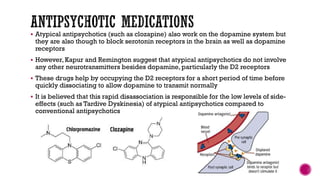
 Atypical antipsychotics (such as clozapine) also work on the dopamine system but
they are also though to block serotonin receptors in the brain as well as dopamine
receptors
 However, Kapur and Remington suggest that atypical antipsychotics do not involve
any other neurotransmitters besides dopamine, particularly the D2 receptors
 These drugs help by occupying the D2 receptors for a short period of time before
quickly dissociating to allow dopamine to transmit normally
 It is believed that this rapid disassociation is responsible for the low levels of side-
effects (such as Tardive Dyskinesia) of atypical antipsychotics compared to
conventional antipsychotics
 Effectiveness-Relapse rates-studies tend to determine the effectiveness of
conventional antipsychotics by comparing relapse rates with a placebo
 Davis et al’s meta-analysis of 29 studies found that average relapse rates were 55%
for those in placebo conditions and 19% in those who took the actual drug
 Research has also shown that other factors are important
 Vaughn and Leff found that antipsychotic medication only made a significant
difference for those living with hostility and criticism
 Relapse rates in hostile conditions were 53% for drugs and 92% for placebo but
relapse rates in supportive conditions were 12% for drugs and 15% for placebo
 Appropriateness-Tardive dyskinesia-about 30% of those taking conventional
antipsychotics develop tardive dyskinesia-it is irreversible in 75% of cases
 Ross and Read argues that prescribing medication creates motivational deficits
because it reinforces the idea that there is ‘something wrong with you’ and this
prevents patients identifying and dealing with triggers of the condition
 Effectiveness
 Leucht et al’s meta-analysis of 1999 studies found that, of four drugs tested, 2
atypical antipsychotics were ‘slightly’ more effective than conventional ones and
the other 2 were no more effected.The study also found that 2 of the atypical
antipsychotics were only slightly better at treating negative symptoms
 Appropriateness
 Jeste et al found that 30% of patients taking conventional antipsychotics developed
tardive dyskinesia compared to only 5% of those taking atypical antipsychotics
 It is believed that atypical antipsychotics are more appropriate simply because
there are fewer side effects
 Fewer side effects mean that sz patients are more likely to benefit from the drugs
because they are less likely to stop taking them
 ECT was developed in response to the observation that dementia praecox (an early
name for sz) was very rare in severe epileptics. It was observed that inducing
seizures in dementia praecox patients significantly reduced their symptoms
 ECT is not used willy nilly because of the dangers, ethics and how unpleasant it is;
it’s only used a last resort when all other treatments have been tried
 During ECT an electrical current is passed between to electrodes that are placed
on the scalp to induce a seizure; one is placed above the temple of the non-
dominant side of the brain and another is placed on the forehead
 Before the ECT begins the patient receives one injection to render them
unconscious and another to block their nerves; this paralyses their muscles so they
don’t contract during treatment as this could cause damage to their limbs
 ECT begins once the patient is unconscious and their muscles are relaxed. A small
electric current (about 0.6 amps) is passed through the brain for about half a
second; it induces a seizure that is up to one minute long and affects the entire
brain. 3-15 treatments are usually required
 Effectiveness
 A meta-analysis by an American Psychiatrist Association looked at 19 studies that
compared ECT with stimulated ECT.The study found ECT produced results that
were no different from or worse than antipsychotic medication
 Sarita et al’s study of 36 sz patients found no difference in symptom reduction
between real ECT and stimulated ECT
 Appropriateness
 Read reports that the use of ECT declined by 59% from 1979 and 1999 because of
the associated risks
 These risks include memory dysfunction, brain damage and even death
 CBT treats the schizophrenic’s distorted beliefs that cause their maladaptive
behaviours
 It works on the assumption that their delusions are a result of faulty thoughts and
interpretations of events; CBT helps the Sz patient identify and correct these thoughts
 In CBT the psychologist helps the patient trace the origins of their symptoms to help
see how they may have developed.They are encouraged to evaluate their delusions;
they listen to what any internal voices are saying and are told to think of ways that
they would be able to challenge their validity
 Maladaptive responses to ordinary situations are caused by distorted thinking and
mistakes in finding cause and effect relationships
 During CBT, the therapist allows the sz to explore alternative explanations of these
maladaptive beliefs. By looking for alternative responses and learning rational
coping mechanisms the patient is able to challenge their own thoughts and respond
more rationally in the future
 The psychologist might set behavioural assignments where the patient must
challenge their own behaviours with the aim of improving their general level of
functioning in private and in public
 An outcome study is a study that measure how well a patient is recovering following a
different treatment to a condition than the typical treatment that is used
 Outcome studies for CBT on schizophrenic patients suggest that those who receive
CBT experience fewer positive symptoms and recover more of their previous level of
functioning than Sz patients who were only treated with drugs
 Drury et al found a significant reduction in positive symptoms and a 25-50%
reduction in recovery time for those patients who received a combination of
antipsychotic medication and cognitive behavioural therapy
 Kuipers et al’s research confirmed Drury’s findings.
 Effectiveness
 Gould et al’s meta-analysis of seven studies reported a significant decrease in the
positive symptoms of schizophrenia after CBT treatment
 However, some psychologists argue that studies into effectiveness lack validity
because participants are usually being treated with antipsychotics too
 Appropriateness
 CBT aims to reduce psychotic symptoms, not eliminate them. Some psychologists
claim that negative symptoms are useful to the schizophrenic and can be classed as
‘safety behaviours’
 For example, inactivity and withdrawal (avolition) may be seen as ways to avoid
making positive symptoms worse. Affective flattening may be seen as a way to avoid
increased treatment has high levels of expressed emotion may be seen as psychotic
 Not everyone can benefit from CBT- a study of 142 sz patients found many were
unsuitable for CBT because they wouldn’t fully engage with the therapy.
 Psychodynamic therapies are based on Sigmund Freud’s psychodynamic approach
to psychology
 Psychoanalysis therapy is based on Freud’s iceberg theory; individuals are not aware
of the influence that conflicts in their unconscious mind have on their current
psychological state
 Psychoanalysis aims to bring conflicts into the individual’s conscious mind in order
to deal with them.This approach to Sz assumes that all the symptoms (both positive
and negative) are meaningful and are a product of the patient’s life experiences
 Freud didn’t initially believe that psychoanalysis would work with Sz patients
because of their inability to form a transference with their therapist
 A transference is where someone unconsciously transfers the emotions that were
originally directed with person A onto person B (the therapist). An example of this is
when a person undergoing psychotherapy claims that they feel belittled by their
therapist (person B) but in reality they have unconsciously transferred their feelings
of belittlement from their father (person A)
 Very few therapists used psychoanalysis to help Sz patients because of Freud’s
beliefs about how ineffective it would be
 This resulted in other forms of psychodynamic therapy being trailed (often
successfully) on Sz patients.These are similar to psychoanalysis because they also
focus on the importance of establishing a relationship and gaining the trust of the
patient
 In order to do this the therapist must replace the harsh and punishing conscience of
the schizophrenic (that is probably based on their parents) with a more supportive
conscience (the patient may have lacked this growing up)
 As the patient improves they take a more active role in their own recovery and the
therapist takes the back seat so to speak
 Gottdiener conducted a meta-analysis of studies of psychological therapies in the
treatment of schizophrenia.The meta-analysis included 37 studies published
between 1954 and 1999
 Gottdiener conducted a meta-analysis of studies of psychological therapies in the
treatment of schizophrenia.The meta-analysis included 37 studies published
between 1954 and 1999
 It was found that 66% of those who received psychotherapy improved after treatment
but only 35% of those who did not receive psychotherapy improved after treatment
 The results also found that psychoanalysis therapies and CBT were equally effective
 Patients who were treated with a combination of drugs and psychotherapy didn’t
show more improvements than those treated with psychotherapy alone
 Those treated as outpatients (without a stay in an institution) improved faster than
inpatients
 Effectiveness
 Malmber and Fenton claim that it is impossible to conclude about the effectiveness of
psychodynamic therapies
 Schizophrenia Patient Outcome Research Team (PORT) claim that psychodynamic
therapies are actually harmful to some patients
 Gottdeiner (see previous slide) supports the treatment
 May found that patients treated with psychodynamic therapy and drugs improved
more than those treated with therapy alone, drugs alone were found to work better
than psychodynamic therapy
 Vandenbos found that patients treated with psychodynamic therapy improved more
than those treated only with antipsychotics
 Appropriateness
 Combination therapy-despite limited and contradictory research into the
effectiveness of psychodynamic therapies, the American Psychiatric Association
recommend a combination of supportive therapies and drug treatment
 One argument against the appropriateness of psychodynamic therapies is the costs
associated.Treatment is long term and very expensive and this prevents it being
widely used. Critics argue that, because no strong evidence has shown that it is more
effective than antipsychotic medication, it is not worth the extra cost
 Karon and VandenBos explain that the long term costs of psychodynamic therapies
are actually less than for drugs because the patient is less likely to relapse, less
likely to seek inpatient treatment and are more likely to succeed in getting a job
PSYA4 Schizophrenia Revision

PSYA4 Schizophrenia Revision

  • 1.
  • 3.
     In relationto schizophrenia candidates should be familiar with the following:  Clinical characteristics of schizophrenia  Issues surrounding the classification and diagnosis of schizophrenia including reliability and validity  Biological explanations of schizophrenia  Psychological explanations of schizophrenia  Biological therapies for schizophrenia, including their evaluation in terms of appropriateness and effectiveness  Psychological therapies for schizophrenia, including their evaluation in terms of appropriateness and effectiveness
  • 5.
     Positive symptoms Reflect an excess of normal functions  Delusions-bizarre beliefs that seem real to the sufferer but are not actually real  Experiences of control-believing that someone or something else is controlling their mind and/or body  Hallucinations-bizarre and unreal perception of the environment. Can be auditory (sound), visual (sights), olfactory (smells) or tactile (feelings)  Disordered thinking-the feeling that thoughts are being inserted of withdrawn from their minds  Negative symptoms  Reflect a loss of normal functions  Affective flattening-a reduction in the range and/or intensity of emotional expression  Alogia-poverty of speech. Characterised by less speech fluency and productivity.This symptom is believed to reflect blocked thoughts  Avolition-relates to reduced or lost ability to persist in goal-directed behaviours  2 or more positive symptoms are required for the duration of one month
  • 6.
     Reliability =theconsistency of a measuring instrument to assess the severity of schizophrenic symptoms  Inter-rater reliability-whether two independent assessors give the same diagnosis  Carson claims that the release of the DSM-III in 1980 solved problems relating to inter-rater reliability as psychiatrists had a reliable classification system that allowed them to more easily distinguish between schizophrenic and non- schizophrenic patients  Test-retest reliability-whether a test used to deliver a diagnosis is consistent over time  Cognitive screening tests measure neuropsychological impairment and help diagnose schizophrenia. RBANS test is an example of this  Wilks et al gave two forms of the RBANS test to patients over a period of 1-134 days and found that test-retest reliability was very high at 0.84
  • 7.
     Whaley (2001)-inter-rater reliability correlations for sz as low as 0.11  Rosenhan (1973)-8 participants volunteered to claim that they were hearing a voice in their head saying ‘empty’,‘hollow’ and ‘thud’. All were diagnosed as Sz and admitted to psychiatric hospitals in the US. No staff realised they were actually healthy despite their protests  Mojtabi and Nicholson (1995) only one symptom is required by the DSM if delusions are considered ‘bizaare’. 50 US senior psychiatrists were given a case study of a Sz patient and asked to determine whether the delusions were bizarre or non-bizarre.The inter-rater reliability correlation was 0.4; this is fairly low considering it is such an important part of diagnosis  Copeland (1971) looked into cultural differences in Sz diagnosis. 134 American psychiatrists and 194 British psychiatrists were given a case study of a patient and asked to diagnose him. 69% of the US psychiatrists diagnosed the patient as Sz but only 2% of the British psychiatrists gave the same diagnosis  Cheniaux et al(2009)-tested the inter-rater reliability of the DSM-IV and the ICD-10 and found that the inter-rater reliability was over 0.50 for both measures
  • 8.
     Prescott etal (1986) looked into the test-retest reliability of several tests that measure attention and information processing. A sample of 14 chronic schizophrenic patients were used to test for reliability. It was found that performance on these tests was stable over a six month period  Wilks et al (2003) gave two forms of the RBANS test to patients over a period of 1- 134 days and found that test-retest reliability was very high at 0.84
  • 9.
     Validity=refers tothe extent that a diagnosis represents something that is real and distinct from other disorders and the extent that a classification system measures what it claims to measure.  Validity and reliability are linked because a diagnosis cannot be valid if it isn’t reliable  Comorbidity- refers to the extent that 2 or more conditions co-occur  Buckly et al (2009) found that 50% of Sz patients have comorbid depression and 47% have a comorbid diagnosis of lifetime substance abuse  Comorbidities create difficulties in diagnosing and treating a disorder  Positive or negative symptoms?-Klossterkotter et al looked at 489 psychiatric hospital admissions and found that positive symptoms were better at providing a valid diagnosis than negative symptoms  Prognosis(predictive validity) schizophrenics rarely share the symptoms or the same outcomes. 20% fully recover, 10% achieve significant and lasting improvements and 30% show improvement with intermittent relapses.This means that a Sz diagnosis has low predictive validity
  • 10.
     Some psychologistsclaim that the poor functioning seen in Sz patients may not be due to their Sz but may be caused by untreated comorbid physical disorders  Weber et al(2009) examined nearly 6 million hospital discharge records to calculate comorbidity rates. It was found that 45% of comorbidities were psychiatric related but many were non-psychiatric comorbid diagnoses. Many patients with a primary diagnosis of schizophrenia were also diagnosed with conditions including hypothyroidism, asthma, hypertension and type 2 diabetes. Researchers concluded that patients diagnosed with psychiatric disorders receive a lower standard of medical care which affects their prognosis  As 50% of Sz suffer from comorbid depression it is no surprise that they pose a high risk of suicide  Kessler et al’s National Comorbidity Survey (NCS) found that risk of suicide for those suffering Sz alone was 1% but the risk increased to 40% for the Sz with a comorbid mood disorder
  • 11.
     Research hasshown that the diagnosis of schizophrenia is much more prevalent among African-Caribbean populations compared to white populations in the UK  Harrison et al(1997) reported that a diagnosis of Sz was 8x more common in African-Caribbean groups than white groups  Some of the increase can be explained as a result of poor housing, higher unemployment rates and social isolation  It is possible that misdiagnosis may result from the difficulties associated with white clinicians and black patients and cultural differences in mannerisms and language  For example, the body movements of an African-Caribbean man may be misinterpreted by a white psychiatrist as catatonic behaviour
  • 12.
     Identifying thesymptoms of schizophrenia doesn’t necessarily mean that a diagnosis is more valid  Many symptoms of schizophrenia are found in other disorders  Ellason and Ross (1995) point out that people with dissociative identity disorder (DID) have more schizophrenic symptoms than actual schizophrenics
  • 14.
     Family studieslook at schizophrenic individuals and their families to determine whether biological relatives are more similarly effected than non-biological relatives  They assume that members within the family were raised in the same way and shared an environment; this helps to rule out environmental influences  Family studies have established that sz is more common among biological relatives or schizophrenics and the closer they are genetically the greater the risk  Gottesman found that children with two schizophrenic parents have a concordance rate of 46%, children with one sz parent have a concordance rate of 13% and people with one sz sibling have a concordance rate of 9%
  • 15.
     Family studies Research has shown that family studies tend to report a high incidence of Sz or Sz tendencies among biologically related individuals  However, researchers now believe that this may be more due to the common rearing patterns in a family-these patterns are not related to biology and are due to the environment  See psychological explanations of Sz where expressed emotion and the double-bind theory explain how family dynamics can influence the development of sz  The following is an example of how this could be used as an A02 point:  “Although family studies, such as Gottesman’s, have reported a high incidence of schizophrenia among biologically related family members, many psychologists argue that this is more to do with common rearing patterns than it is to do with biological factors. Recent evidence has shown that unusual family communication styles can lead to increased likelihood of developing schizophrenia.The psychological explanations of the double-bind theory and the expressed emotion communicative style have received strong research support from a variety of sources.The support for these psychological explanations suggests that the biological explanation is reductionist; it reduces a complex disorder to basics and aims to explain it through only one discipline. It does not consider psychological factors and the influence of our environment in the development of schizophrenia despite their being strong evidence for this.”
  • 16.
     Twin studieshelp researchers distinguish between genetic and environmental influences because all twins are believed to share an environment but Mz twins are 100% genetically identically but Dz twins are 50% genetically identical.  If the Mz twins are more alike in the prevalence of a trait than Dz twins then it follows that the trait can be attributed to genetics  Joseph conducted meta-analysis and calculated that Mz twins have a concordance rate of 40.4% and Dz twins have a concordance rate of 7.4%  Studies using blind diagnosis (where researchers don’t know whether the twin is Mz or Dz) have reported much lower concordance rates for Mz twins  The rates were still much higher than the Dz rates though  This suggests a biological basis for Sz
  • 17.
     Twin studieshave one key methodological problem  They assume that Mz and Dz twins have equivalent environments  Joseph points out this may not be the case. Mz twins look identical and may be treated as one person, they may share the same friends, go to the same places and do the same activities. Dz twins do not look alike and are treat more like individuals and they do different things  Joseph explains that the difference in concordance rates might just reflect the role of the environment rather than the role of genetics  It might be possible to carry out more methodologically sound twin studies by asking participants to fill in a survey about their activities, friend groups and activities that they carry out with and without their sibling.This would allow researchers to control for environmental factors
  • 18.
     Adoption studieshelp to distinguish between the role of genes and the environment.They look at adopted children and their biological parents (who did not raise them) to find similarities in the prevalence of Sz  Tienari et al carried out a Finnish adoption study using 164 adoptees  All of these participants had biological mothers who were diagnosed with Sz  6.7% of the adoptees were also diagnosed as Sz  2% of the 197 control group (adopted children with no family history of Sz) were diagnosed  The fact that a higher percentage of adoptees with sz biological mothers were diagnosed as sz than adoptees with non-sz biological mothers suggests that there is a genetic liability to sz
  • 19.
     Adoption studiesare useful in untangling genetic and environmental factor  However, they are methodologically flawed  They assume that adoptees are not selectively placed and parents who adopt a child with a schizophrenic biological parent are not different from those who adopt a child with a normal genetic background  This is unlikely to be the case  In many modern countries adoptive parents are made aware of the potential child’s genetic background  Joseph points out that only certain people may be willing to a child with schizophrenic biological parents  These adoptive parents might have shared traits that skew the results of adoption studies or may behave differently towards the child than they would towards any other adoptive child
  • 20.
     The dopaminehypothesis states that messages from neurons that transmit D fire too easily or too often-this causes the characteristic symptoms of Sz  Schizophrenics are thought to have abnormal numbers of D2 receptors on receiving neurons resulting in more D binding and more neurons firing  D neurons play a key role in guiding attention-disturbances lead the problems relating to perception, attention and thought seen in sz patients  The role of D in sz is highlighted in three sources of evidence  Amphetamines-D agonist. Stimulates nerve cells containing D which causes the synapse to be flooded by the neurotransmitter. Large doses cause Sz symptoms  Antipsychotics-D antagonist. Block dopamine activity in the brain. Reducing D stimulation eliminates the positive symptoms of Sz.  Parkinson’s disease-sufferers have low levels of D activity. Parkinson’s is a neurological degenerative disease.Treated with the D agonist L-dopa to raise D levels and improve functioning. Some taking L-dopa developed Sz symptoms
  • 21.
     A majorissue with the dopamine hypothesis is that antipsychotics can actually increases levels of dopamine as neurons struggle to cope with the sudden deficiency  Haracz carried out a meta-analysis of post mortem studies on schizophrenic patients. It was found that those with higher levels of dopamine had taken antipsychotic medication shortly before their death and vice versa  Evidence from neuroimaging is limited. Even though neuroimaging technology has advanced and allowed researchers to investigate dopamine activity more precisely than previous methods there is a resounding lack of convincing evidence to show altered dopamine activity in the brain’s of Sz individuals.
  • 23.
     Psychological theoriescome from the psychological approaches to psychology  The psychodynamic explanation. Freud believed that Sz was the result of two related processes; -regression to a pre-ego stage and attempts to re-establish ego control  A harsh world may cause an individual to regress to a pre-ego stage early in their development before a realistic view of the external world had developed. Freud believed that some Sz symptoms reflected this infantile state(i.e. delusions of grandeur) and others (i.e. auditory hallucinations) reflected the attempts to re- establish ego control.  The cognitive explanation acknowledges the role of biology in causing the initial sensory experiences of sz but claims that further features of the disorder appear as the individual tries to understand those experiences  This is sometimes seen as a rational path to madness.The Sz patient experiences worrying hallucinations, turns to peers to confirm their experiences, the reality of them is denied, the sz patient believes that others are hiding the truth from them, this causes the sz to reject all feedback and develop delusional beliefs that they are being manipulated and persecuted by others
  • 24.
     Psychodynamic-There isno research evidence to support Frued’s specific ideas on sz. However, many psychoanalysts have claimed that disordered family patterns cause the disorder.  Fromm-Reichmann described the schizophrenogenic mother/family-they are rejecting, overprotective, dominant and moralistic.  Oltmanns et al found that parents of Sz patients do behave differently to parents of other types of patients, particularly in the presence of their Sz child. However, we cannot whether this is due to cause of effect.  Cognitive-there is a lot of evidence for this explanation  Meyer-Lindenberg et al found a link between excess dopamine in the prefrontal cortex and working memory.This provides a physical basis for cognitive deficits  Yellowleess et al have suggested an unusual treatment based on the cognitive explanation. Researchers developed a machine that produces virtual hallucinations (auditory and visual).The machine is intended to show the Sz patient that their hallucinations are not real.
  • 25.
     Socio-cultural explanationsstress the role of social and family relationships in the development of schizophrenia  Life events and schizophrenia-stressful life events have been cited as major stress factors that could triggers a schizophrenic episode. Examples of live events include job losses, relationship losses, family bereavement,etc.  It is believed that the physical arousal associated with these events causes neurotransmitter changes that trigger a sz episode  Brown and Birley found that 50% of schizophrenic patients experienced a life event in the three weeks preceding a sz episode  They also found that 12% of sz patients experienced a life event in the 9 weeks prior to that  Those who had previously experienced schizophrenia reported twice as many life events prior to an episode than healthy controls who reported low and unchanging levels of life events
  • 26.
     Research intothe effects of life events of schizophrenia has been inconclusive  Van Os et al found no link between life events and the onset of schizophrenia. Patients were not more likely to have had a major stressful life event in the three months preceding the onset of their illness,  The same research found that those who had experienced major life events were less likely to relapse  Brown and Birley’s research from the previous slide does support the link between life events and the onset of schizophrenia  Research that has found a link is only correlational and it cannot establish a a cause and effect relationship  For example, it is possible that a job loss and relationship loss triggered schizophrenia but it is equally likely that the early signs of schizophrenia (erratic behaviour for example) could have caused a person to be fired or dumped
  • 27.
     The double-bindtheory is a explanation of sz based on family relationships  Bateson et al suggest that children who frequently receive contradictory messages from their parents are more likely to develop schizophrenia because the contradictions mean they are unable to effectively respond to their parents  This prevents them from forming an internally coherent construction of reality  The messages invalidate each other and the child’s inability to have an internal grasp of reality manifests itself as schizophrenic symptoms in the long run (inc. affective flattening and avolition)  An example of such messages would be the following:  A mother tells her son that she loves him but looks away from him in disgust at the same time  The verbal message of love is invalidated by the non-verbal message of hatred and the child develops a warped sense of what is real
  • 28.
     There issome evidence for the double-bind theory as an family relationship explanation of schizophrenia  Berger found that schizophrenics reported a higher recall of double-bind statements made by their mothers than non-sz controls  However, this higher recall may be affected by their illness so validity may be low  Liem measured patterns of parental communication in families with a sz child and found no difference in communication style or the incidences of double-bind messages compared to families with healthy children  Hall and Levin conducted a meta-analysis of several double-bind studies  It was found that there was no significant difference between families with and without a schizophrenic child in the degree which verbal and non-verbal communication were in agreement  However, many of the studies in the meta-analysis were observational. Results may be skewed by observer bias and/or social desirability factors
  • 29.
     Expressed emotionis a family communication style involving criticism, hostility and emotional over-involvement  This high degree of expressed emotion and the negative emotional climate is a family variable associated with the development of schizophrenia  High EE levels have a strong influence on relapse rates  Patients returning to high EE families following treatment are four times more likely to relapse than those patients returning to families with low EE levels  Kalafi and Torabi found that the high prevalence of EE in Iranian cultures was one of the main causes of relapse in recovering sz patients  It is believed that the negative emotional climate in these families arouses the schizophrenic and leads to stress beyond their already impaired coping mechanisms and this triggers an episode
  • 30.
     Research intoEE has been almost universally supportive of the theory  There are issues determining whether EE is a cause or effect of sz. For example, it is possible that high EE levels trigger sz but it is equally possible that families of sz patients become critical, hostile and over-involved emotionally as a result of their diagnosis (and this causes relapse)  Criticism, hostility and emotional over-involvement may be reactions to a sz diagnosis as family member often struggle to accept it all.  Knowledge of EE has led to an effective form of therapy where high EE relatives of a schizophrenic are taught techniques to help them lower their levels of EE  Hogarty et al found that such therapy can significantly reduce relapse rates
  • 31.
     The labellingtheory of schizophrenia was popularised by Scheff in 1999  The theory states that social groups construct rules for members of the group to follow and those that do not follow these rules are seen as deviant  The symptoms of schizophrenia are seen as deviating from these group norms and are seen as abnormal  If a person displays these unusual behaviours they are considered deviant and the label of ‘schizophrenia’ may be applied  Cromer claims that once this diagnostic label has been applied it becomes a self- fulfilling prophecy that promotes the development of other sz symptoms
  • 32.
     Scheff conducteda meta-analysis of 18 studies carried out before 1974 that were explicitly related to the labelling theory  He judged 13 of them to be consistent with the theory and concluded that the theory was generally supported by the evidence  However, these judgements may have been biased considering Scheff carried out the meta-analysis to find support for the theory that he publicly popularised  Rosenhan’s study also supports the theory-according to Scheff  Once the label of schizophrenia had been applied to the 8 pseudo patients they found that this label was extremely difficult to shift  Despite claiming that they were healthy they were dismissed by medical professionals who attributed these claims to their diagnosis
  • 34.
     Antipsychotic medicationstreat severe psychotic illnesses.They help the patient function as well as they can in their life and also help them feel better subjectively  Conventional antipsychotics are used to combat the positive symptoms of Sz  Atypical antipsychotics combat positive symptoms of Sz too but psychiatrists have claimed that they also improve negative symptoms  Conventional antipsychotics (such as chlorpromazine) work by reducing the effects of dopamine which reduces the symptoms of Sz  They are dopamine antagonists because they bind the dopamine receptors together but do not stimulate them; this blocks the receptors’ action  By reducing dopamine system stimulation in the patient’s brain the conventional antipsychotics can eliminate some positive symptoms (i.e. hallucinations and delusions) that are experienced by Sz sufferers  Continued..
  • 35.
     Atypical antipsychotics(such as clozapine) also work on the dopamine system but they are also though to block serotonin receptors in the brain as well as dopamine receptors  However, Kapur and Remington suggest that atypical antipsychotics do not involve any other neurotransmitters besides dopamine, particularly the D2 receptors  These drugs help by occupying the D2 receptors for a short period of time before quickly dissociating to allow dopamine to transmit normally  It is believed that this rapid disassociation is responsible for the low levels of side- effects (such as Tardive Dyskinesia) of atypical antipsychotics compared to conventional antipsychotics
  • 36.
     Effectiveness-Relapse rates-studiestend to determine the effectiveness of conventional antipsychotics by comparing relapse rates with a placebo  Davis et al’s meta-analysis of 29 studies found that average relapse rates were 55% for those in placebo conditions and 19% in those who took the actual drug  Research has also shown that other factors are important  Vaughn and Leff found that antipsychotic medication only made a significant difference for those living with hostility and criticism  Relapse rates in hostile conditions were 53% for drugs and 92% for placebo but relapse rates in supportive conditions were 12% for drugs and 15% for placebo  Appropriateness-Tardive dyskinesia-about 30% of those taking conventional antipsychotics develop tardive dyskinesia-it is irreversible in 75% of cases  Ross and Read argues that prescribing medication creates motivational deficits because it reinforces the idea that there is ‘something wrong with you’ and this prevents patients identifying and dealing with triggers of the condition
  • 37.
     Effectiveness  Leuchtet al’s meta-analysis of 1999 studies found that, of four drugs tested, 2 atypical antipsychotics were ‘slightly’ more effective than conventional ones and the other 2 were no more effected.The study also found that 2 of the atypical antipsychotics were only slightly better at treating negative symptoms  Appropriateness  Jeste et al found that 30% of patients taking conventional antipsychotics developed tardive dyskinesia compared to only 5% of those taking atypical antipsychotics  It is believed that atypical antipsychotics are more appropriate simply because there are fewer side effects  Fewer side effects mean that sz patients are more likely to benefit from the drugs because they are less likely to stop taking them
  • 38.
     ECT wasdeveloped in response to the observation that dementia praecox (an early name for sz) was very rare in severe epileptics. It was observed that inducing seizures in dementia praecox patients significantly reduced their symptoms  ECT is not used willy nilly because of the dangers, ethics and how unpleasant it is; it’s only used a last resort when all other treatments have been tried  During ECT an electrical current is passed between to electrodes that are placed on the scalp to induce a seizure; one is placed above the temple of the non- dominant side of the brain and another is placed on the forehead  Before the ECT begins the patient receives one injection to render them unconscious and another to block their nerves; this paralyses their muscles so they don’t contract during treatment as this could cause damage to their limbs  ECT begins once the patient is unconscious and their muscles are relaxed. A small electric current (about 0.6 amps) is passed through the brain for about half a second; it induces a seizure that is up to one minute long and affects the entire brain. 3-15 treatments are usually required
  • 39.
     Effectiveness  Ameta-analysis by an American Psychiatrist Association looked at 19 studies that compared ECT with stimulated ECT.The study found ECT produced results that were no different from or worse than antipsychotic medication  Sarita et al’s study of 36 sz patients found no difference in symptom reduction between real ECT and stimulated ECT  Appropriateness  Read reports that the use of ECT declined by 59% from 1979 and 1999 because of the associated risks  These risks include memory dysfunction, brain damage and even death
  • 41.
     CBT treatsthe schizophrenic’s distorted beliefs that cause their maladaptive behaviours  It works on the assumption that their delusions are a result of faulty thoughts and interpretations of events; CBT helps the Sz patient identify and correct these thoughts  In CBT the psychologist helps the patient trace the origins of their symptoms to help see how they may have developed.They are encouraged to evaluate their delusions; they listen to what any internal voices are saying and are told to think of ways that they would be able to challenge their validity  Maladaptive responses to ordinary situations are caused by distorted thinking and mistakes in finding cause and effect relationships  During CBT, the therapist allows the sz to explore alternative explanations of these maladaptive beliefs. By looking for alternative responses and learning rational coping mechanisms the patient is able to challenge their own thoughts and respond more rationally in the future
  • 42.
     The psychologistmight set behavioural assignments where the patient must challenge their own behaviours with the aim of improving their general level of functioning in private and in public  An outcome study is a study that measure how well a patient is recovering following a different treatment to a condition than the typical treatment that is used  Outcome studies for CBT on schizophrenic patients suggest that those who receive CBT experience fewer positive symptoms and recover more of their previous level of functioning than Sz patients who were only treated with drugs  Drury et al found a significant reduction in positive symptoms and a 25-50% reduction in recovery time for those patients who received a combination of antipsychotic medication and cognitive behavioural therapy  Kuipers et al’s research confirmed Drury’s findings.
  • 43.
     Effectiveness  Gouldet al’s meta-analysis of seven studies reported a significant decrease in the positive symptoms of schizophrenia after CBT treatment  However, some psychologists argue that studies into effectiveness lack validity because participants are usually being treated with antipsychotics too  Appropriateness  CBT aims to reduce psychotic symptoms, not eliminate them. Some psychologists claim that negative symptoms are useful to the schizophrenic and can be classed as ‘safety behaviours’  For example, inactivity and withdrawal (avolition) may be seen as ways to avoid making positive symptoms worse. Affective flattening may be seen as a way to avoid increased treatment has high levels of expressed emotion may be seen as psychotic  Not everyone can benefit from CBT- a study of 142 sz patients found many were unsuitable for CBT because they wouldn’t fully engage with the therapy.
  • 44.
     Psychodynamic therapiesare based on Sigmund Freud’s psychodynamic approach to psychology  Psychoanalysis therapy is based on Freud’s iceberg theory; individuals are not aware of the influence that conflicts in their unconscious mind have on their current psychological state  Psychoanalysis aims to bring conflicts into the individual’s conscious mind in order to deal with them.This approach to Sz assumes that all the symptoms (both positive and negative) are meaningful and are a product of the patient’s life experiences  Freud didn’t initially believe that psychoanalysis would work with Sz patients because of their inability to form a transference with their therapist  A transference is where someone unconsciously transfers the emotions that were originally directed with person A onto person B (the therapist). An example of this is when a person undergoing psychotherapy claims that they feel belittled by their therapist (person B) but in reality they have unconsciously transferred their feelings of belittlement from their father (person A)
  • 45.
     Very fewtherapists used psychoanalysis to help Sz patients because of Freud’s beliefs about how ineffective it would be  This resulted in other forms of psychodynamic therapy being trailed (often successfully) on Sz patients.These are similar to psychoanalysis because they also focus on the importance of establishing a relationship and gaining the trust of the patient  In order to do this the therapist must replace the harsh and punishing conscience of the schizophrenic (that is probably based on their parents) with a more supportive conscience (the patient may have lacked this growing up)  As the patient improves they take a more active role in their own recovery and the therapist takes the back seat so to speak  Gottdiener conducted a meta-analysis of studies of psychological therapies in the treatment of schizophrenia.The meta-analysis included 37 studies published between 1954 and 1999
  • 46.
     Gottdiener conducteda meta-analysis of studies of psychological therapies in the treatment of schizophrenia.The meta-analysis included 37 studies published between 1954 and 1999  It was found that 66% of those who received psychotherapy improved after treatment but only 35% of those who did not receive psychotherapy improved after treatment  The results also found that psychoanalysis therapies and CBT were equally effective  Patients who were treated with a combination of drugs and psychotherapy didn’t show more improvements than those treated with psychotherapy alone  Those treated as outpatients (without a stay in an institution) improved faster than inpatients
  • 47.
     Effectiveness  Malmberand Fenton claim that it is impossible to conclude about the effectiveness of psychodynamic therapies  Schizophrenia Patient Outcome Research Team (PORT) claim that psychodynamic therapies are actually harmful to some patients  Gottdeiner (see previous slide) supports the treatment  May found that patients treated with psychodynamic therapy and drugs improved more than those treated with therapy alone, drugs alone were found to work better than psychodynamic therapy  Vandenbos found that patients treated with psychodynamic therapy improved more than those treated only with antipsychotics
  • 48.
     Appropriateness  Combinationtherapy-despite limited and contradictory research into the effectiveness of psychodynamic therapies, the American Psychiatric Association recommend a combination of supportive therapies and drug treatment  One argument against the appropriateness of psychodynamic therapies is the costs associated.Treatment is long term and very expensive and this prevents it being widely used. Critics argue that, because no strong evidence has shown that it is more effective than antipsychotic medication, it is not worth the extra cost  Karon and VandenBos explain that the long term costs of psychodynamic therapies are actually less than for drugs because the patient is less likely to relapse, less likely to seek inpatient treatment and are more likely to succeed in getting a job