Schizophrenia –
Recent Updates
14th
January, 2015
Methodology of Literature Review
 Search Terms
– Different combinations of following terms:
‘schizophrenia’, ‘psychosis’, ‘recent updates’, ‘changes in
classification’, ‘community interventions’, ‘psychosocial’,
‘epidemiology’, ‘genetics’, ‘neurobiology’, ‘treatment’,
‘phenomenology’, etc. were used
 Search Engines
– PubMed, Google Scholar, Cochrane
 Time Period
– Last 7 years (2008 to 2014)
 Books Reviewed
– Comprehensive Textbook of Psychiatry, 9th
Edition;
Advances in Schizophrenia Research, 2009
Ms. Jinu Abraham, IMHANS, Calicut 2
Presentation Outline
 Introduction
– Definition
 Changing Classifications
– DSM-V
– Major Changes
– Research Domain Criteria
 Phenomenology
– Delusions
– Hallucinations
– Negative Symptoms
 Epidemiological Aspects
– Global Burden of Illness
– Burden of Illness
– Treatment Gap
– Issues in Epidemiological
Studies
– Cross Cultural Aspects
– Migration
 Neurobiology
– Genetics
– Epigenetics
– Neurobiology
– Imaging Research
Ms. Jinu Abraham, IMHANS, Calicut 3
Presentation Outline…contd
 Interventions
– Prevention Strategies
– Early Phase Interventions
– Pharmacotherapy
– Introduction to
Antipsychotics
– Newer Antipsychotics
– PORT Treatment
Recommendations
– Adjunctive Pharmacological
Agents
– M.A.T.R.I.C.S.
– Psychosocial Interventions
– Community Interventions
 Course and Outcome
– Deficit Syndrome
– Co-morbidities
Ms. Jinu Abraham, IMHANS, Calicut 4
INTRODUCTION
Ms. Jinu Abraham, IMHANS, Calicut 5
Definition
“Schizophrenia is characterized by disordered
cognition, including a “gain of–function” in
psychotic symptoms and a “loss of–function” in
specific cognitive functions, such as working and
declarative memory, but without the progressive
dementia that characterizes classical
neurodegenerative disorders.”
- (CTP, 9th
Ed.)
Ms. Jinu Abraham, IMHANS, Calicut 6
CHANGING CLASSIFICATIONS
Ms. Jinu Abraham, IMHANS, Calicut 7
DSM-V
 Schizophrenia Spectrum and Other Psychotic
Disorders
 Criteria A: Characteristic Symptoms
– Two (or more) of the following, each present for a
significant portion of time during a one-month
period (or less if successfully treated). At least one
of these should include 1-3
1. Delusions
2. Hallucinations
3. Disorganized Speech
Ms. Jinu Abraham, IMHANS, Calicut 8
DSM-V…contd
4. Grossly Disorganized or Catatonic Behavior
5. Negative Symptoms (i.e. diminished emotional
expression or avoilition)
 Criteria B: Social/Occupational Dysfunction
 Criteria C: Duration of 6 Months
 Criteria D: Schizoaffective and Mood Disorder
exclusion
 Criteria E: Substance/General Medical Condition
exclusion
Ms. Jinu Abraham, IMHANS, Calicut 9
DSM-V…contd
 Criteria F: Relationship to Global Developmental
Delay or Autism Spectrum Disorder
– If there is a history of autism spectrum disorder or
other communication disorder of childhood onset,
the additional diagnosis of schizophrenia is made
only if prominent delusions or hallucinations are
also present for at least one month (or less if
successfully treated).
Ms. Jinu Abraham, IMHANS, Calicut 10
Major Changes
 Elimination of bizarre delusions and Schneiderian
‘first-rank’ hallucinations
 Clarity regarding negative symptoms
 Requirement of minimum two characteristic
symptoms
 Elimination of subtypes and psychopathological
dimensions
 Distinction of course specifiers
 Harmonization with ICD 11
– (Tandon, et al., 2013)
Ms. Jinu Abraham, IMHANS, Calicut 11
Research Domain Criteria
 Current diagnostic system not informed by
breakthroughs in genetics and molecular, cellular and
systems neuroscience
 RDoC project (NIMH):
– “Develop, for research purposes, new ways of
classifying mental disorders based on dimensions of
observable behavior and neurobiological measures”
 Interfaces with genomics, neuroscience and
behavioral science explicating etiology and
suggesting new treatments
- (NIMH, 2014)
Ms. Jinu Abraham, IMHANS, Calicut 12
PHENOMENOLOGY
Ms. Jinu Abraham, IMHANS, Calicut 13
Delusions
Ms. Jinu Abraham, IMHANS, Calicut 14
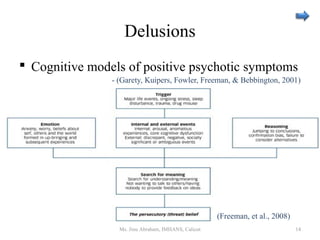
 Cognitive models of positive psychotic symptoms
- (Garety, Kuipers, Fowler, Freeman, & Bebbington, 2001)
(Freeman, et al., 2008)
Delusions…contd
 50% variability in levels of paranoia in population
is due to genes
- (Zavos, et al., 2014)
 Worry plausible factor in occurrence of paranoid
thinking
– Worry Intervention Trial
- (Freeman, et al., 2012 & Freeman, et al., 2014)
Ms. Jinu Abraham, IMHANS, Calicut 15
Delusions…contd
 Interpersonal sensitivity –
– ‘feeling vulnerable in the presence of others due to the
expectation of criticism or rejection’
High in patients with persecutory delusions and those at high
risk of psychosis
- (Bell & Freeman, 2014; Freeman, Pugh, Vorontsova, Antley, & Slater, 2010 & Masillo, et
al., 2012)
 Higher levels of paranoia associated with less analytic,
experiential and rational reasoning
– ‘Belief inflexibility’
Failure to consider alternative explanations, resistance to
hypothetical contradiction
- (Freeman, Evans, & Lister, 2012, Freeman, Lister, & Evans, 2014 & So, et al.,
2012)
Ms. Jinu Abraham, IMHANS, Calicut 16
Hallucinations
 Occurring in 60%–70% of people with schizophrenia,
auditory hallucinations most common
 Also, occurs in 15% of healthy population
– (Boksa, 2009)
 Neurophysiological approaches to study auditory
hallucinations
– Assessments of State
– Assessments of Trait
– Mechanistic Studies of Trait
– (Ford, et al., 2012)
Ms. Jinu Abraham, IMHANS, Calicut 17
Hallucinations…contd
 International Consortium on Hallucination
Research [InCoHR]
– Contribution of disease-related process
– Novel theoretical cognitive framework
– Neurobiological substrates
– Hallucination-related alterations in
neurophysiology
– Review of different treatment options
– (Waters, 2012)
Ms. Jinu Abraham, IMHANS, Calicut 18
Negative Symptoms
 Consensus statement 2006 (NIMH) suggest five categories of
negative symptoms
– Avolition
– Anhedonia
– Affective blunting
– Social withdrawal
– Alogia
- (CTP, 9th
Ed.)
 Limitations of current instruments
– Item content, outdated; does not incorporate contemporary
research findings
– Reflects conceptually distinct domains that are not necessarily
part of negative symptom domain
– Include behavioral referents of what are essentially experiential
deficits
– (Blanchard, et al., 2011)
Ms. Jinu Abraham, IMHANS, Calicut 19
Negative Symptoms…contd
 Collaboration to Advance Negative Symptom
Assessment in Schizophrenia
– Inclusive development process
– Scale refinement in iterative data-driven process
 Initial test
– Good reliability
– Excellent convergent validity
– Discriminant validity
– (Forbes, et al., 2010)
Ms. Jinu Abraham, IMHANS, Calicut 20
EPIDEMIOLOGICAL ASPECTS
Ms. Jinu Abraham, IMHANS, Calicut 21
Global Burden of Illness
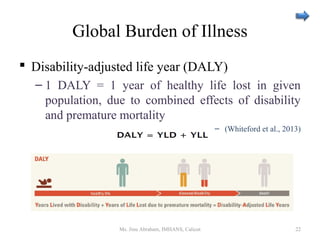
 Disability-adjusted life year (DALY)
– 1 DALY = 1 year of healthy life lost in given
population, due to combined effects of disability
and premature mortality
– (Whiteford et al., 2013)
Ms. Jinu Abraham, IMHANS, Calicut 22
Global Burden of Illness…contd
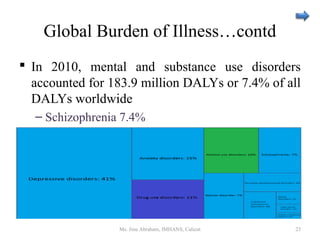
 In 2010, mental and substance use disorders
accounted for 183.9 million DALYs or 7.4% of all
DALYs worldwide
– Schizophrenia 7.4%
Ms. Jinu Abraham, IMHANS, Calicut 23
Burden of Illness
 Life expectancy decreased (15-12 years)
– long-lasting negative health habits
– disease- and treatment-related metabolic disorders
– increased frequencies of cardiovascular diseases
 Co-existing depression - adverse consequence on course,
progression, morbidity and mortality
 Cognitive impairment
 Social impairment
– Stigmatisation
– Lack of corresponding awareness within professional and
social spheres
 Considerable caregiver burden
– (Millier, et al., 2014)
Ms. Jinu Abraham, IMHANS, Calicut 24
Treatment Gap
 Treatment Gap for Schizophrenia, including non
affective psychoses, across the world – 32.2%
- (WHO, 2004)
 Systematic World Psychiatry Association Survey
suggest strategies to reduce gap:
– Task shifting to non-specialist providers
– Increase in specialist mental health resources to provide
effective and sustained supervision and support
– Decentralization of specialized mental health resources
– (Tempier, et al., 2010)
Ms. Jinu Abraham, IMHANS, Calicut 25
Issues in Epidemiological Studies
 Incidence
– estimated annual number of first-onset cases in
defined population per 1,000 persons at risk
 Objective biomarkers lacking, onset defined
– point in time when clinical manifestations become
recognizable and can be diagnosed according to
specified criteria
 Data on incidence and outcome scarce, especially
in LAMICs
– (CTP, 9th
Ed.)
Ms. Jinu Abraham, IMHANS, Calicut 26
Cross Cultural Aspects
 WHO undertaken three multi-country
epidemiological studies
– Determine prevalence, cultural expression, natural
history and outcome at multiple sites throughout
industrialized and developing world
 International Pilot Study of Schizophrenia (IPSS)
– Nine countries
– Prevalence roughly equal in all sites
– Better outcome in developing countries
– (WHO, 1973)
Ms. Jinu Abraham, IMHANS, Calicut 27
Cross Cultural Aspects…contd
 International Study of Schizophrenia (ISoS)
– Incorporated IPSS and DOSMeD cohorts
– Findings consistent, outcome differentials favor
developing countries, remained robust
– (Hopper &Wanderling, 2000)
 Acute onset and catatonic subtype more common
in traditional rural communities
– Over-diagnosis in developing countries?
• Organic psychoses (tropical communicable diseases,
TLE), ATPD, culture-bound syndromes and
affective disorders
– (CTP, 9th
Ed.)Ms. Jinu Abraham, IMHANS, Calicut 28
Migration
 High incidence rate (6.0 per 1,000) found in
African Caribbean population in UK
– Includes second generation migrants also
– No excess morbidity in indigenous populations
 “Horizontal” increase in risk
– Environmental factor boosting penetrance of
predisposing genes carried?
 Psychosocial hypotheses are being explored
– (CTP, 9th
Ed.)
Ms. Jinu Abraham, IMHANS, Calicut 29
NEUROBIOLOGY
Ms. Jinu Abraham, IMHANS, Calicut 30
Genetics
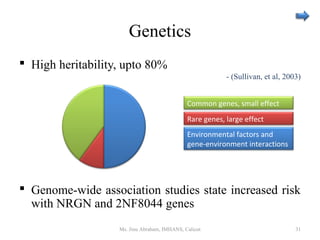
 High heritability, upto 80%
- (Sullivan, et al, 2003)
 Genome-wide association studies state increased risk
with NRGN and 2NF8044 genes
Ms. Jinu Abraham, IMHANS, Calicut 31
Common genes, small effect
Rare genes, large effect
Environmental factors and
gene-environment interactions
Epigenetics
 Gene environment interactions
 Proven results on interaction between cannabis use
and AKT1 gene on risk of psychosis
- (Di Forti, et al, 2012)
 Inconsistent associations
– fetal hypoxia and hypoxia-related genes on volume of
hippocampus
– childhood trauma and variants of serotonin transporter on
cognitive functioning
– childhood trauma and COMT gene on cognitive
functioning
Ms. Jinu Abraham, IMHANS, Calicut 32
Neurobiology
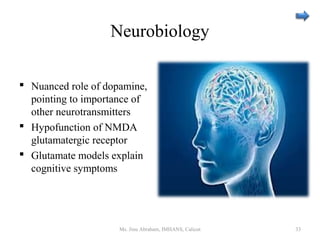
 Nuanced role of dopamine,
pointing to importance of
other neurotransmitters
 Hypofunction of NMDA
glutamatergic receptor
 Glutamate models explain
cognitive symptoms
Ms. Jinu Abraham, IMHANS, Calicut 33
Neurobiology…contd
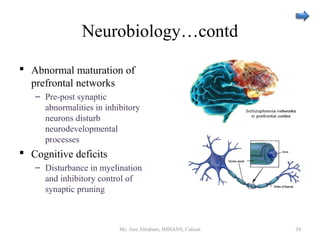
 Abnormal maturation of
prefrontal networks
– Pre-post synaptic
abnormalities in inhibitory
neurons disturb
neurodevelopmental
processes
 Cognitive deficits
– Disturbance in myelination
and inhibitory control of
synaptic pruning
Ms. Jinu Abraham, IMHANS, Calicut 34
Neurobiology…contd
 Exposure to infectious or inflammatory agents in
utero
– Oxidative stress elevated in schizophrenia
 Autoimmune dysfunction
– Immune system activation (cytokines elevation, etc.)
seen in psychoses
– Anti NMDA-receptor encephalitis -
– Auto-antibodies- neuronal proteins
– Bi-directional association with common autoimmune
diseases
- (Song, et al, 2013; Finke, et al, 2012; Zandi, et al, 2011; Benros, et al, 2012)
Ms. Jinu Abraham, IMHANS, Calicut 35
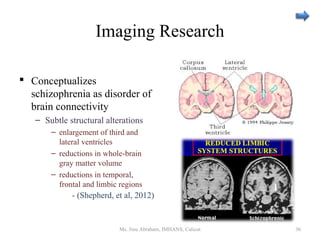
Imaging Research
 Conceptualizes
schizophrenia as disorder of
brain connectivity
– Subtle structural alterations
– enlargement of third and
lateral ventricles
– reductions in whole-brain
gray matter volume
– reductions in temporal,
frontal and limbic regions
- (Shepherd, et al, 2012)
Ms. Jinu Abraham, IMHANS, Calicut 36
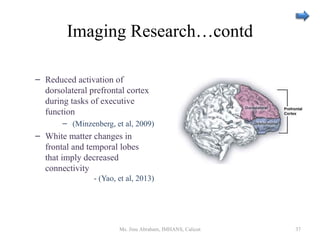
Imaging Research…contd
– Reduced activation of
dorsolateral prefrontal cortex
during tasks of executive
function
– (Minzenberg, et al, 2009)
– White matter changes in
frontal and temporal lobes
that imply decreased
connectivity
- (Yao, et al, 2013)
Ms. Jinu Abraham, IMHANS, Calicut 37
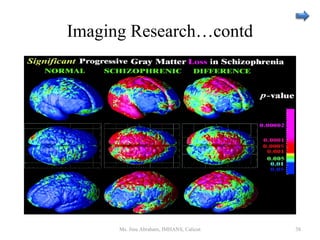
Imaging Research…contd
Ms. Jinu Abraham, IMHANS, Calicut 38
Imaging Research…contd
 Challenge: Translate neuroimaging findings into
clinical settings
 Search for Biomarkers
– Research underway to integrate imaging
modalities with genetic electrophysiological and
clinical data
Ms. Jinu Abraham, IMHANS, Calicut 39
INTERVENTIONS
Ms. Jinu Abraham, IMHANS, Calicut 40
Prevention Strategies
 No scientically established interventions for
primary prevention
– (Brown, A. S., & McGrath, 2011)
 Apart from positive family history, our ability to
identify those at-risk currently poor
 Reducing risks of obstetric complications
 New Scales
– Bonn Scale for the Assessment of Basic Symptoms
Ms. Jinu Abraham, IMHANS, Calicut 41
Early Phase Interventions
 Ultra High Risk State
– Attenuated positive and negative symptoms
– several years to months before schizophrenia
 Approx. 35% convert to schizophrenia
- (Ruhrmann, et al, 2010)
 Neuroanatomical, neurophysiological,
neurocognitive and neurohormonal changes
Changes proximal to onset of psychosis
Early recognition and intervention targeted to
pathophysiological processes needed
Ms. Jinu Abraham, IMHANS, Calicut 42
Early Phase Interventions…
 UHR
– Psychosocial intervention or supplementation with
eicosapentaenoic acid
– Pharmacological approach if needed (aripiprazole
best choice)
 FEP
– Both psychosocial and pharmacology
– Second generation antipsychotics
Ms. Jinu Abraham, IMHANS, Calicut 43
Early Phase Interventions…
 CPEP
– Minimize risk of relapse and disability, maximize
social and functional recovery
– Focus on
Maximizing chances of treatment engagement
Continuity of care
Appropriate lifestyle
Family support
Vocational recovery and progress
Ms. Jinu Abraham, IMHANS, Calicut 44
Introduction to Antipsychotics
 Antipsychotic drugs mainstay of treatment
– Adverse effects and suboptimal outcomes led to
development of second-generation antipsychotics
(SGAs)
 CATIE (Clinical Antipsychotic Trials in Intervention
Effectiveness); CUtLASS (Cost Utility of the Latest
Antipsychotic drugs in Schizophrenia Study)
Except for adverse effects as a reason for
discontinuation, differences minimal
do not markedly differ from FGAs regarding
compliance, quality of life and effectiveness
Ms. Jinu Abraham, IMHANS, Calicut 45
Newer Antipsychotics
 Introduced since 2007
Paliperidone (Invega, Ortho-McNeil-Janssen),
Iloperidone (Fanapt, Vanda)
Asenapine (Saphris, Organon)
Lurasidone (Latuda, Sunovion)
Ms. Jinu Abraham, IMHANS, Calicut 46
PORT Treatment Recommendations
 Schizophrenia Patient Outcome Research Team
(PORT)
– Strong empirical support for FGAs and SGAs in
acute and maintenance treatment
– Clozapine for treatment-resistant positive
symptoms, hostility and suicidal behaviors
- Kreyenbuhl, et al, 2011
Ms. Jinu Abraham, IMHANS, Calicut 47
Adjunctive Pharmacological Agents
 Agents stimulating NMDA glutamate receptor
may ameliorate negative symptoms
- Patil, et al, 2007
 Information on use of adjunctive pharmacological
agents and treatment of co-occurring substance
abuse
 Pro-cognitive medications
– dopaminergic, nicotinergic, glutamatergic,
GABAergic and other novel targets
– Larger, more rigorous studies needed
Ms. Jinu Abraham, IMHANS, Calicut 48
M.A.T.R.I.C.S.
 Current antipsychotics little or no effect on
negative symptoms and cognitive impairment
 Measurement and Treatment Research to Improve
Cognition in Schizophrenia (MATRICS)
– Development of consensus for measuring
cognition in clinical trials
– NIMH-FDA consensus on trial design
– FDA advice regarding path to drug approval
– Recommendations for promising molecular targets
Ms. Jinu Abraham, IMHANS, Calicut 49
Psychosocial Interventions
 Unmet needs to be assessed in evaluation
– Healthcare Needs: Complications and Co-
morbidities
–Related to negative symptoms
–Adverse effects of medication
–Substance abuse
–Life style issues
–Medical problems
–Compliance issues
Ms. Jinu Abraham, IMHANS, Calicut 50
Psychosocial Interventions…contd
 Psychosocial and Economic Needs
– Differ according to socio-cultural environment
– Daily activities, need for company and intimate
relationships affected by stigma and social
exclusion
– Patients using long term services require
Promotion of independence
Stability in social networks
Consistency of care
Addressing theme of loss
Ms. Jinu Abraham, IMHANS, Calicut 51
Functional Recovery
 Objective dimensions of recovery
– remission of symptoms and patient’s return to
socio-occupational functioning
– BPRS and PANSS
 Subjective dimensions of recovery
– life satisfaction, hope, knowledge about illness,
and empowerment
– Liberman, et al, 2002
Ms. Jinu Abraham, IMHANS, Calicut 52
Therapy
 4 treatments focused on, all differ in their
selection of treatment targets
– Social Skills Training
– Cognitive Behavioral Therapy
– Cognitive Remediation
– Social Cognition Training
Ms. Jinu Abraham, IMHANS, Calicut 53
Social Skills Training
 Has well established history but…
 Outcome domains of earlier studies affected by
multiple variables
 Kurtz and Mueser (2008), suggest SST affects:
– Social skills knowledge
– Social and daily living skills
– Functioning in community
– Relapse
Ms. Jinu Abraham, IMHANS, Calicut 54
Cognitive Behavior Therapy
 Faulty cognitive appraisal + Early learning
experience = Negative mood states
 Core Components
– Engagement and assessment
– Coping enhancement
– Developing shared understanding of experience of
psychosis
– Working of delusions and hallucinations
– Addressing mood and negative self evaluations
– Managing risk of relapse and social disability
- Garety, et al, 2000
Ms. Jinu Abraham, IMHANS, Calicut 55
Cognitive Behavior Therapy…contd
 Small to medium effect on:
– Treatment of positive and negative symptoms
– Mood
– Community functioning
Ms. Jinu Abraham, IMHANS, Calicut 56
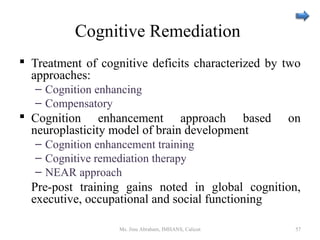
Cognitive Remediation
 Treatment of cognitive deficits characterized by two
approaches:
– Cognition enhancing
– Compensatory
 Cognition enhancement approach based on
neuroplasticity model of brain development
– Cognition enhancement training
– Cognitive remediation therapy
– NEAR approach
Pre-post training gains noted in global cognition,
executive, occupational and social functioning
Ms. Jinu Abraham, IMHANS, Calicut 57
Cognitive Remediation…contd
 Compensatory approach targets functional deficits
but with consideration of cognitive impairments
– Errorless training
– Cognitive adaptation training
Improvements noted in error elimination,
medication and appointment adherence, grooming
and hygiene, care of living space and leisure and
social activities
Ms. Jinu Abraham, IMHANS, Calicut 58
Social Cognition Training
 Social cognition defined as,
– “the ability to construct representations of the relations
between oneself and others, and to use those
representations flexibly to guide social behavior”
- Adolphs R., 2011
 Deficits in areas of:
– Affect perception
– Social perception
– Attributional style
– Theory of mind
Ms. Jinu Abraham, IMHANS, Calicut 59
Social Cognition Training…contd
 2 types of studies
– ‘broad treatment’, embeds SCT within multi-
component training packages
– ‘targeted treatment’, employs SCT to target social
cognition
 Social Cognitive and Interpersonal Training found
to improve social networks and cause fewer
aggressive incidents
Ms. Jinu Abraham, IMHANS, Calicut 60
Community Interventions
 Assertive Community
Treatment
 Banyan Model
 Community Psychiatry
Ms. Jinu Abraham, IMHANS, Calicut 61
COURSE AND OUTCOME
Ms. Jinu Abraham, IMHANS, Calicut 62
Prognosis
 10% commit suicide
 Deficit Syndrome
– Multiple negative symptoms + careful history
suggesting enduring symptoms
– Poor prognosis regarding full functional recovery
– CTP, 9th
Ed.
Ms. Jinu Abraham, IMHANS, Calicut 63
Cannabis Use
 Psychoactive constituent delta-9-THC
– produces euphoric high, feeling of relaxation and
intensification of sensation, can cause some short-
lived schizophrenic symptoms
– (D’Souza, 2009)
 Reduction in cannabis use
– Currently no evidence for any psychological
therapy or medication, being better than standard
 Results of review limited as trial sizes were small
and data poorly reported
Ms. Jinu Abraham, IMHANS, Calicut 64
Smoking
 Among mentally ill, smoking prevalence highest
in Schizophrenia (approx 70-80%)
 Ill effects
– Financial burden
– Smoking-related morbidity and mortality
 Not just ‘bad habit’ but self medication of clinical
symptoms and side effects of antipsychotic drugs
Ms. Jinu Abraham, IMHANS, Calicut 65
Conclusions
 Current understanding of schizophrenia has
expanded dramatically in last two decades
 Research in the neurobiology has led to questions
regarding the essential aspects of the diagnosis
itself
 More focus on the functional aspects in addition
to ‘symptoms’ of schizophrenia
Ms. Jinu Abraham, IMHANS, Calicut 66
THANK YOU
Ms. Jinu Abraham, IMHANS, Calicut 67

Schizophrenia

  • 1.
  • 2.
    Methodology of LiteratureReview  Search Terms – Different combinations of following terms: ‘schizophrenia’, ‘psychosis’, ‘recent updates’, ‘changes in classification’, ‘community interventions’, ‘psychosocial’, ‘epidemiology’, ‘genetics’, ‘neurobiology’, ‘treatment’, ‘phenomenology’, etc. were used  Search Engines – PubMed, Google Scholar, Cochrane  Time Period – Last 7 years (2008 to 2014)  Books Reviewed – Comprehensive Textbook of Psychiatry, 9th Edition; Advances in Schizophrenia Research, 2009 Ms. Jinu Abraham, IMHANS, Calicut 2
  • 3.
    Presentation Outline  Introduction –Definition  Changing Classifications – DSM-V – Major Changes – Research Domain Criteria  Phenomenology – Delusions – Hallucinations – Negative Symptoms  Epidemiological Aspects – Global Burden of Illness – Burden of Illness – Treatment Gap – Issues in Epidemiological Studies – Cross Cultural Aspects – Migration  Neurobiology – Genetics – Epigenetics – Neurobiology – Imaging Research Ms. Jinu Abraham, IMHANS, Calicut 3
  • 4.
    Presentation Outline…contd  Interventions –Prevention Strategies – Early Phase Interventions – Pharmacotherapy – Introduction to Antipsychotics – Newer Antipsychotics – PORT Treatment Recommendations – Adjunctive Pharmacological Agents – M.A.T.R.I.C.S. – Psychosocial Interventions – Community Interventions  Course and Outcome – Deficit Syndrome – Co-morbidities Ms. Jinu Abraham, IMHANS, Calicut 4
  • 5.
  • 6.
    Definition “Schizophrenia is characterizedby disordered cognition, including a “gain of–function” in psychotic symptoms and a “loss of–function” in specific cognitive functions, such as working and declarative memory, but without the progressive dementia that characterizes classical neurodegenerative disorders.” - (CTP, 9th Ed.) Ms. Jinu Abraham, IMHANS, Calicut 6
  • 7.
    CHANGING CLASSIFICATIONS Ms. JinuAbraham, IMHANS, Calicut 7
  • 8.
    DSM-V  Schizophrenia Spectrumand Other Psychotic Disorders  Criteria A: Characteristic Symptoms – Two (or more) of the following, each present for a significant portion of time during a one-month period (or less if successfully treated). At least one of these should include 1-3 1. Delusions 2. Hallucinations 3. Disorganized Speech Ms. Jinu Abraham, IMHANS, Calicut 8
  • 9.
    DSM-V…contd 4. Grossly Disorganizedor Catatonic Behavior 5. Negative Symptoms (i.e. diminished emotional expression or avoilition)  Criteria B: Social/Occupational Dysfunction  Criteria C: Duration of 6 Months  Criteria D: Schizoaffective and Mood Disorder exclusion  Criteria E: Substance/General Medical Condition exclusion Ms. Jinu Abraham, IMHANS, Calicut 9
  • 10.
    DSM-V…contd  Criteria F:Relationship to Global Developmental Delay or Autism Spectrum Disorder – If there is a history of autism spectrum disorder or other communication disorder of childhood onset, the additional diagnosis of schizophrenia is made only if prominent delusions or hallucinations are also present for at least one month (or less if successfully treated). Ms. Jinu Abraham, IMHANS, Calicut 10
  • 11.
    Major Changes  Eliminationof bizarre delusions and Schneiderian ‘first-rank’ hallucinations  Clarity regarding negative symptoms  Requirement of minimum two characteristic symptoms  Elimination of subtypes and psychopathological dimensions  Distinction of course specifiers  Harmonization with ICD 11 – (Tandon, et al., 2013) Ms. Jinu Abraham, IMHANS, Calicut 11
  • 12.
    Research Domain Criteria Current diagnostic system not informed by breakthroughs in genetics and molecular, cellular and systems neuroscience  RDoC project (NIMH): – “Develop, for research purposes, new ways of classifying mental disorders based on dimensions of observable behavior and neurobiological measures”  Interfaces with genomics, neuroscience and behavioral science explicating etiology and suggesting new treatments - (NIMH, 2014) Ms. Jinu Abraham, IMHANS, Calicut 12
  • 13.
  • 14.
    Delusions Ms. Jinu Abraham,IMHANS, Calicut 14  Cognitive models of positive psychotic symptoms - (Garety, Kuipers, Fowler, Freeman, & Bebbington, 2001) (Freeman, et al., 2008)
  • 15.
    Delusions…contd  50% variabilityin levels of paranoia in population is due to genes - (Zavos, et al., 2014)  Worry plausible factor in occurrence of paranoid thinking – Worry Intervention Trial - (Freeman, et al., 2012 & Freeman, et al., 2014) Ms. Jinu Abraham, IMHANS, Calicut 15
  • 16.
    Delusions…contd  Interpersonal sensitivity– – ‘feeling vulnerable in the presence of others due to the expectation of criticism or rejection’ High in patients with persecutory delusions and those at high risk of psychosis - (Bell & Freeman, 2014; Freeman, Pugh, Vorontsova, Antley, & Slater, 2010 & Masillo, et al., 2012)  Higher levels of paranoia associated with less analytic, experiential and rational reasoning – ‘Belief inflexibility’ Failure to consider alternative explanations, resistance to hypothetical contradiction - (Freeman, Evans, & Lister, 2012, Freeman, Lister, & Evans, 2014 & So, et al., 2012) Ms. Jinu Abraham, IMHANS, Calicut 16
  • 17.
    Hallucinations  Occurring in60%–70% of people with schizophrenia, auditory hallucinations most common  Also, occurs in 15% of healthy population – (Boksa, 2009)  Neurophysiological approaches to study auditory hallucinations – Assessments of State – Assessments of Trait – Mechanistic Studies of Trait – (Ford, et al., 2012) Ms. Jinu Abraham, IMHANS, Calicut 17
  • 18.
    Hallucinations…contd  International Consortiumon Hallucination Research [InCoHR] – Contribution of disease-related process – Novel theoretical cognitive framework – Neurobiological substrates – Hallucination-related alterations in neurophysiology – Review of different treatment options – (Waters, 2012) Ms. Jinu Abraham, IMHANS, Calicut 18
  • 19.
    Negative Symptoms  Consensusstatement 2006 (NIMH) suggest five categories of negative symptoms – Avolition – Anhedonia – Affective blunting – Social withdrawal – Alogia - (CTP, 9th Ed.)  Limitations of current instruments – Item content, outdated; does not incorporate contemporary research findings – Reflects conceptually distinct domains that are not necessarily part of negative symptom domain – Include behavioral referents of what are essentially experiential deficits – (Blanchard, et al., 2011) Ms. Jinu Abraham, IMHANS, Calicut 19
  • 20.
    Negative Symptoms…contd  Collaborationto Advance Negative Symptom Assessment in Schizophrenia – Inclusive development process – Scale refinement in iterative data-driven process  Initial test – Good reliability – Excellent convergent validity – Discriminant validity – (Forbes, et al., 2010) Ms. Jinu Abraham, IMHANS, Calicut 20
  • 21.
    EPIDEMIOLOGICAL ASPECTS Ms. JinuAbraham, IMHANS, Calicut 21
  • 22.
    Global Burden ofIllness  Disability-adjusted life year (DALY) – 1 DALY = 1 year of healthy life lost in given population, due to combined effects of disability and premature mortality – (Whiteford et al., 2013) Ms. Jinu Abraham, IMHANS, Calicut 22
  • 23.
    Global Burden ofIllness…contd  In 2010, mental and substance use disorders accounted for 183.9 million DALYs or 7.4% of all DALYs worldwide – Schizophrenia 7.4% Ms. Jinu Abraham, IMHANS, Calicut 23
  • 24.
    Burden of Illness Life expectancy decreased (15-12 years) – long-lasting negative health habits – disease- and treatment-related metabolic disorders – increased frequencies of cardiovascular diseases  Co-existing depression - adverse consequence on course, progression, morbidity and mortality  Cognitive impairment  Social impairment – Stigmatisation – Lack of corresponding awareness within professional and social spheres  Considerable caregiver burden – (Millier, et al., 2014) Ms. Jinu Abraham, IMHANS, Calicut 24
  • 25.
    Treatment Gap  TreatmentGap for Schizophrenia, including non affective psychoses, across the world – 32.2% - (WHO, 2004)  Systematic World Psychiatry Association Survey suggest strategies to reduce gap: – Task shifting to non-specialist providers – Increase in specialist mental health resources to provide effective and sustained supervision and support – Decentralization of specialized mental health resources – (Tempier, et al., 2010) Ms. Jinu Abraham, IMHANS, Calicut 25
  • 26.
    Issues in EpidemiologicalStudies  Incidence – estimated annual number of first-onset cases in defined population per 1,000 persons at risk  Objective biomarkers lacking, onset defined – point in time when clinical manifestations become recognizable and can be diagnosed according to specified criteria  Data on incidence and outcome scarce, especially in LAMICs – (CTP, 9th Ed.) Ms. Jinu Abraham, IMHANS, Calicut 26
  • 27.
    Cross Cultural Aspects WHO undertaken three multi-country epidemiological studies – Determine prevalence, cultural expression, natural history and outcome at multiple sites throughout industrialized and developing world  International Pilot Study of Schizophrenia (IPSS) – Nine countries – Prevalence roughly equal in all sites – Better outcome in developing countries – (WHO, 1973) Ms. Jinu Abraham, IMHANS, Calicut 27
  • 28.
    Cross Cultural Aspects…contd International Study of Schizophrenia (ISoS) – Incorporated IPSS and DOSMeD cohorts – Findings consistent, outcome differentials favor developing countries, remained robust – (Hopper &Wanderling, 2000)  Acute onset and catatonic subtype more common in traditional rural communities – Over-diagnosis in developing countries? • Organic psychoses (tropical communicable diseases, TLE), ATPD, culture-bound syndromes and affective disorders – (CTP, 9th Ed.)Ms. Jinu Abraham, IMHANS, Calicut 28
  • 29.
    Migration  High incidencerate (6.0 per 1,000) found in African Caribbean population in UK – Includes second generation migrants also – No excess morbidity in indigenous populations  “Horizontal” increase in risk – Environmental factor boosting penetrance of predisposing genes carried?  Psychosocial hypotheses are being explored – (CTP, 9th Ed.) Ms. Jinu Abraham, IMHANS, Calicut 29
  • 30.
  • 31.
    Genetics  High heritability,upto 80% - (Sullivan, et al, 2003)  Genome-wide association studies state increased risk with NRGN and 2NF8044 genes Ms. Jinu Abraham, IMHANS, Calicut 31 Common genes, small effect Rare genes, large effect Environmental factors and gene-environment interactions
  • 32.
    Epigenetics  Gene environmentinteractions  Proven results on interaction between cannabis use and AKT1 gene on risk of psychosis - (Di Forti, et al, 2012)  Inconsistent associations – fetal hypoxia and hypoxia-related genes on volume of hippocampus – childhood trauma and variants of serotonin transporter on cognitive functioning – childhood trauma and COMT gene on cognitive functioning Ms. Jinu Abraham, IMHANS, Calicut 32
  • 33.
    Neurobiology  Nuanced roleof dopamine, pointing to importance of other neurotransmitters  Hypofunction of NMDA glutamatergic receptor  Glutamate models explain cognitive symptoms Ms. Jinu Abraham, IMHANS, Calicut 33
  • 34.
    Neurobiology…contd  Abnormal maturationof prefrontal networks – Pre-post synaptic abnormalities in inhibitory neurons disturb neurodevelopmental processes  Cognitive deficits – Disturbance in myelination and inhibitory control of synaptic pruning Ms. Jinu Abraham, IMHANS, Calicut 34
  • 35.
    Neurobiology…contd  Exposure toinfectious or inflammatory agents in utero – Oxidative stress elevated in schizophrenia  Autoimmune dysfunction – Immune system activation (cytokines elevation, etc.) seen in psychoses – Anti NMDA-receptor encephalitis - – Auto-antibodies- neuronal proteins – Bi-directional association with common autoimmune diseases - (Song, et al, 2013; Finke, et al, 2012; Zandi, et al, 2011; Benros, et al, 2012) Ms. Jinu Abraham, IMHANS, Calicut 35
  • 36.
    Imaging Research  Conceptualizes schizophreniaas disorder of brain connectivity – Subtle structural alterations – enlargement of third and lateral ventricles – reductions in whole-brain gray matter volume – reductions in temporal, frontal and limbic regions - (Shepherd, et al, 2012) Ms. Jinu Abraham, IMHANS, Calicut 36
  • 37.
    Imaging Research…contd – Reducedactivation of dorsolateral prefrontal cortex during tasks of executive function – (Minzenberg, et al, 2009) – White matter changes in frontal and temporal lobes that imply decreased connectivity - (Yao, et al, 2013) Ms. Jinu Abraham, IMHANS, Calicut 37
  • 38.
    Imaging Research…contd Ms. JinuAbraham, IMHANS, Calicut 38
  • 39.
    Imaging Research…contd  Challenge:Translate neuroimaging findings into clinical settings  Search for Biomarkers – Research underway to integrate imaging modalities with genetic electrophysiological and clinical data Ms. Jinu Abraham, IMHANS, Calicut 39
  • 40.
  • 41.
    Prevention Strategies  Noscientically established interventions for primary prevention – (Brown, A. S., & McGrath, 2011)  Apart from positive family history, our ability to identify those at-risk currently poor  Reducing risks of obstetric complications  New Scales – Bonn Scale for the Assessment of Basic Symptoms Ms. Jinu Abraham, IMHANS, Calicut 41
  • 42.
    Early Phase Interventions Ultra High Risk State – Attenuated positive and negative symptoms – several years to months before schizophrenia  Approx. 35% convert to schizophrenia - (Ruhrmann, et al, 2010)  Neuroanatomical, neurophysiological, neurocognitive and neurohormonal changes Changes proximal to onset of psychosis Early recognition and intervention targeted to pathophysiological processes needed Ms. Jinu Abraham, IMHANS, Calicut 42
  • 43.
    Early Phase Interventions… UHR – Psychosocial intervention or supplementation with eicosapentaenoic acid – Pharmacological approach if needed (aripiprazole best choice)  FEP – Both psychosocial and pharmacology – Second generation antipsychotics Ms. Jinu Abraham, IMHANS, Calicut 43
  • 44.
    Early Phase Interventions… CPEP – Minimize risk of relapse and disability, maximize social and functional recovery – Focus on Maximizing chances of treatment engagement Continuity of care Appropriate lifestyle Family support Vocational recovery and progress Ms. Jinu Abraham, IMHANS, Calicut 44
  • 45.
    Introduction to Antipsychotics Antipsychotic drugs mainstay of treatment – Adverse effects and suboptimal outcomes led to development of second-generation antipsychotics (SGAs)  CATIE (Clinical Antipsychotic Trials in Intervention Effectiveness); CUtLASS (Cost Utility of the Latest Antipsychotic drugs in Schizophrenia Study) Except for adverse effects as a reason for discontinuation, differences minimal do not markedly differ from FGAs regarding compliance, quality of life and effectiveness Ms. Jinu Abraham, IMHANS, Calicut 45
  • 46.
    Newer Antipsychotics  Introducedsince 2007 Paliperidone (Invega, Ortho-McNeil-Janssen), Iloperidone (Fanapt, Vanda) Asenapine (Saphris, Organon) Lurasidone (Latuda, Sunovion) Ms. Jinu Abraham, IMHANS, Calicut 46
  • 47.
    PORT Treatment Recommendations Schizophrenia Patient Outcome Research Team (PORT) – Strong empirical support for FGAs and SGAs in acute and maintenance treatment – Clozapine for treatment-resistant positive symptoms, hostility and suicidal behaviors - Kreyenbuhl, et al, 2011 Ms. Jinu Abraham, IMHANS, Calicut 47
  • 48.
    Adjunctive Pharmacological Agents Agents stimulating NMDA glutamate receptor may ameliorate negative symptoms - Patil, et al, 2007  Information on use of adjunctive pharmacological agents and treatment of co-occurring substance abuse  Pro-cognitive medications – dopaminergic, nicotinergic, glutamatergic, GABAergic and other novel targets – Larger, more rigorous studies needed Ms. Jinu Abraham, IMHANS, Calicut 48
  • 49.
    M.A.T.R.I.C.S.  Current antipsychoticslittle or no effect on negative symptoms and cognitive impairment  Measurement and Treatment Research to Improve Cognition in Schizophrenia (MATRICS) – Development of consensus for measuring cognition in clinical trials – NIMH-FDA consensus on trial design – FDA advice regarding path to drug approval – Recommendations for promising molecular targets Ms. Jinu Abraham, IMHANS, Calicut 49
  • 50.
    Psychosocial Interventions  Unmetneeds to be assessed in evaluation – Healthcare Needs: Complications and Co- morbidities –Related to negative symptoms –Adverse effects of medication –Substance abuse –Life style issues –Medical problems –Compliance issues Ms. Jinu Abraham, IMHANS, Calicut 50
  • 51.
    Psychosocial Interventions…contd  Psychosocialand Economic Needs – Differ according to socio-cultural environment – Daily activities, need for company and intimate relationships affected by stigma and social exclusion – Patients using long term services require Promotion of independence Stability in social networks Consistency of care Addressing theme of loss Ms. Jinu Abraham, IMHANS, Calicut 51
  • 52.
    Functional Recovery  Objectivedimensions of recovery – remission of symptoms and patient’s return to socio-occupational functioning – BPRS and PANSS  Subjective dimensions of recovery – life satisfaction, hope, knowledge about illness, and empowerment – Liberman, et al, 2002 Ms. Jinu Abraham, IMHANS, Calicut 52
  • 53.
    Therapy  4 treatmentsfocused on, all differ in their selection of treatment targets – Social Skills Training – Cognitive Behavioral Therapy – Cognitive Remediation – Social Cognition Training Ms. Jinu Abraham, IMHANS, Calicut 53
  • 54.
    Social Skills Training Has well established history but…  Outcome domains of earlier studies affected by multiple variables  Kurtz and Mueser (2008), suggest SST affects: – Social skills knowledge – Social and daily living skills – Functioning in community – Relapse Ms. Jinu Abraham, IMHANS, Calicut 54
  • 55.
    Cognitive Behavior Therapy Faulty cognitive appraisal + Early learning experience = Negative mood states  Core Components – Engagement and assessment – Coping enhancement – Developing shared understanding of experience of psychosis – Working of delusions and hallucinations – Addressing mood and negative self evaluations – Managing risk of relapse and social disability - Garety, et al, 2000 Ms. Jinu Abraham, IMHANS, Calicut 55
  • 56.
    Cognitive Behavior Therapy…contd Small to medium effect on: – Treatment of positive and negative symptoms – Mood – Community functioning Ms. Jinu Abraham, IMHANS, Calicut 56
  • 57.
    Cognitive Remediation  Treatmentof cognitive deficits characterized by two approaches: – Cognition enhancing – Compensatory  Cognition enhancement approach based on neuroplasticity model of brain development – Cognition enhancement training – Cognitive remediation therapy – NEAR approach Pre-post training gains noted in global cognition, executive, occupational and social functioning Ms. Jinu Abraham, IMHANS, Calicut 57
  • 58.
    Cognitive Remediation…contd  Compensatoryapproach targets functional deficits but with consideration of cognitive impairments – Errorless training – Cognitive adaptation training Improvements noted in error elimination, medication and appointment adherence, grooming and hygiene, care of living space and leisure and social activities Ms. Jinu Abraham, IMHANS, Calicut 58
  • 59.
    Social Cognition Training Social cognition defined as, – “the ability to construct representations of the relations between oneself and others, and to use those representations flexibly to guide social behavior” - Adolphs R., 2011  Deficits in areas of: – Affect perception – Social perception – Attributional style – Theory of mind Ms. Jinu Abraham, IMHANS, Calicut 59
  • 60.
    Social Cognition Training…contd 2 types of studies – ‘broad treatment’, embeds SCT within multi- component training packages – ‘targeted treatment’, employs SCT to target social cognition  Social Cognitive and Interpersonal Training found to improve social networks and cause fewer aggressive incidents Ms. Jinu Abraham, IMHANS, Calicut 60
  • 61.
    Community Interventions  AssertiveCommunity Treatment  Banyan Model  Community Psychiatry Ms. Jinu Abraham, IMHANS, Calicut 61
  • 62.
    COURSE AND OUTCOME Ms.Jinu Abraham, IMHANS, Calicut 62
  • 63.
    Prognosis  10% commitsuicide  Deficit Syndrome – Multiple negative symptoms + careful history suggesting enduring symptoms – Poor prognosis regarding full functional recovery – CTP, 9th Ed. Ms. Jinu Abraham, IMHANS, Calicut 63
  • 64.
    Cannabis Use  Psychoactiveconstituent delta-9-THC – produces euphoric high, feeling of relaxation and intensification of sensation, can cause some short- lived schizophrenic symptoms – (D’Souza, 2009)  Reduction in cannabis use – Currently no evidence for any psychological therapy or medication, being better than standard  Results of review limited as trial sizes were small and data poorly reported Ms. Jinu Abraham, IMHANS, Calicut 64
  • 65.
    Smoking  Among mentallyill, smoking prevalence highest in Schizophrenia (approx 70-80%)  Ill effects – Financial burden – Smoking-related morbidity and mortality  Not just ‘bad habit’ but self medication of clinical symptoms and side effects of antipsychotic drugs Ms. Jinu Abraham, IMHANS, Calicut 65
  • 66.
    Conclusions  Current understandingof schizophrenia has expanded dramatically in last two decades  Research in the neurobiology has led to questions regarding the essential aspects of the diagnosis itself  More focus on the functional aspects in addition to ‘symptoms’ of schizophrenia Ms. Jinu Abraham, IMHANS, Calicut 66
  • 67.
    THANK YOU Ms. JinuAbraham, IMHANS, Calicut 67

Editor's Notes

  • #17 and share genetic and environmental influence
  • #28 Determinants of Outcome of Severe Mental Disorders (DOSMeD) ‘Ten Country Study’ - 12 sites in ten countries IPSS cohort not necessarily representative and selection bias Replicated major finding of IPSS (Jablensky, et al., 1992)
  • #30 Little support for biological risk factors
  • #50 Initiative by National Institute of Mental Health (NIMH),