A320 CFM version Tutorial Flt


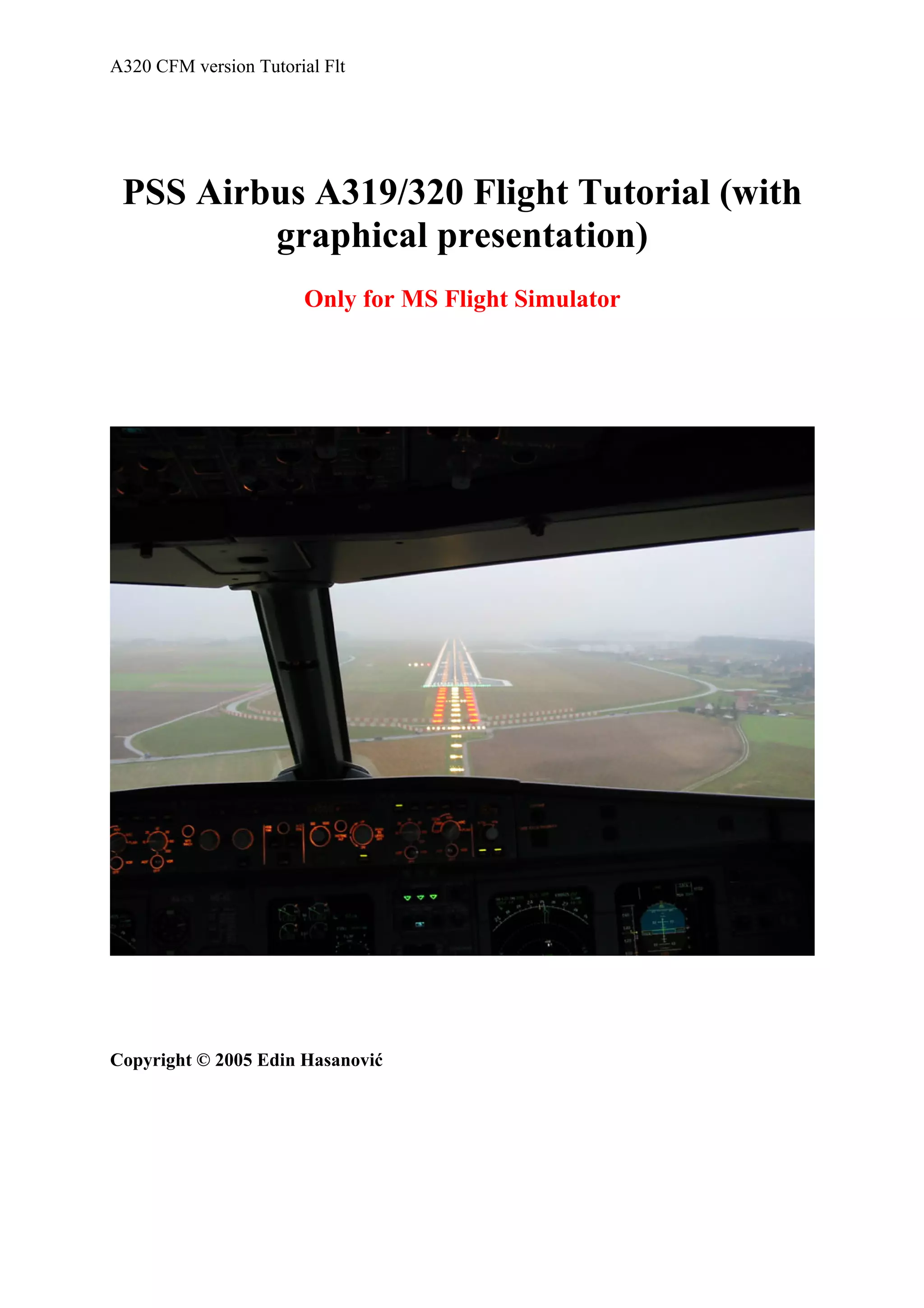
 PSS Airbus A319/320 Flight Tutorial (with
         graphical presentation)
                       Only for MS Flight Simulator


Copyright © 2005 Edin Hasanović
A320 CFM version Tutorial Flt
                       PSS Airbus A320 Flight Tutorial.
This tutorial will show You how to prepare aircraft for flight. Our a/c is PSS a320c (CFM
engines)
We will make short flight from LDZA RWY23 to LDPL RWY27.

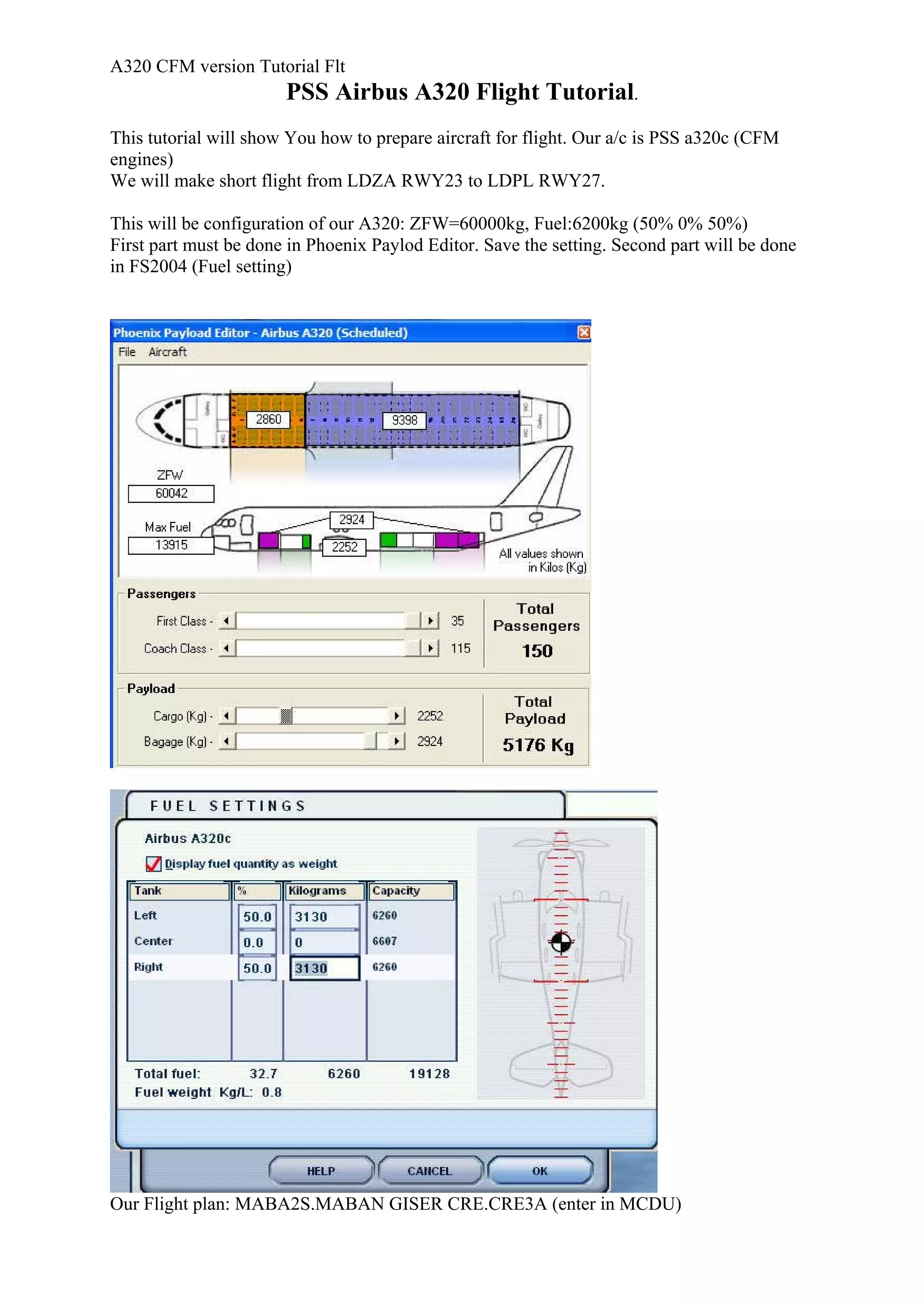
This will be configuration of our A320: ZFW=60000kg, Fuel:6200kg (50% 0% 50%)
First part must be done in Phoenix Paylod Editor. Save the setting. Second part will be done
in FS2004 (Fuel setting)


Our Flight plan: MABA2S.MABAN GISER CRE.CRE3A (enter in MCDU)
A320 CFM version Tutorial Flt
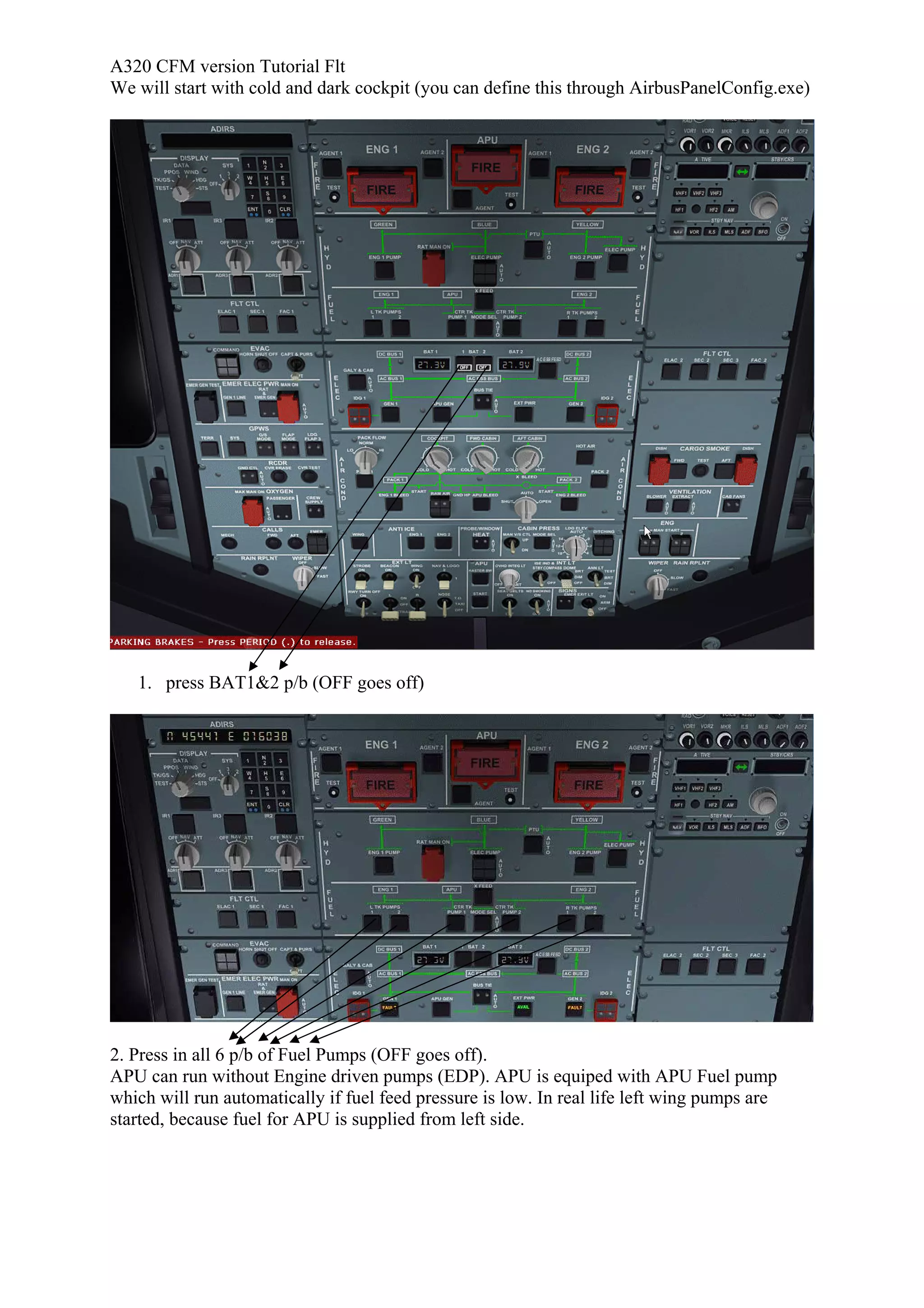
We will start with cold and dark cockpit (you can define this through AirbusPanelConfig.exe)


   1. press BAT1&2 p/b (OFF goes off)


2. Press in all 6 p/b of Fuel Pumps (OFF goes off).
APU can run without Engine driven pumps (EDP). APU is equiped with APU Fuel pump
which will run automatically if fuel feed pressure is low. In real life left wing pumps are
started, because fuel for APU is supplied from left side.
A320 CFM version Tutorial Flt


   3. Now we can start APU by pressing APU Master Sw P/B
   4. After few seconds (on lower ECAM FLAP OPEN appears and green AVAIL on P/B)
      we can press Start (blue ON appears)

   5. APU ECAM page appears. After 99% N, we can start APU Bleed which is neccessary
      for engine start


   6. Open MCDU (shift+3)


  LSK1                                                        RSK1

  LSK                                                         RSK2

  LSK3                                                        RSK3

  LSK4                                                        RSK4

  LSK5                                                        RSK5

  LSK6                                                        RSK6
A320 CFM version Tutorial Flt

   7. Enter LDZA/LDPL and press RSK1

                                                       You will see that screen. Next
                                                       step is entering of cruise FL,
                                                       which will be in our case
                                                       FL160. Enter FL160 and press
                                                       LSK6


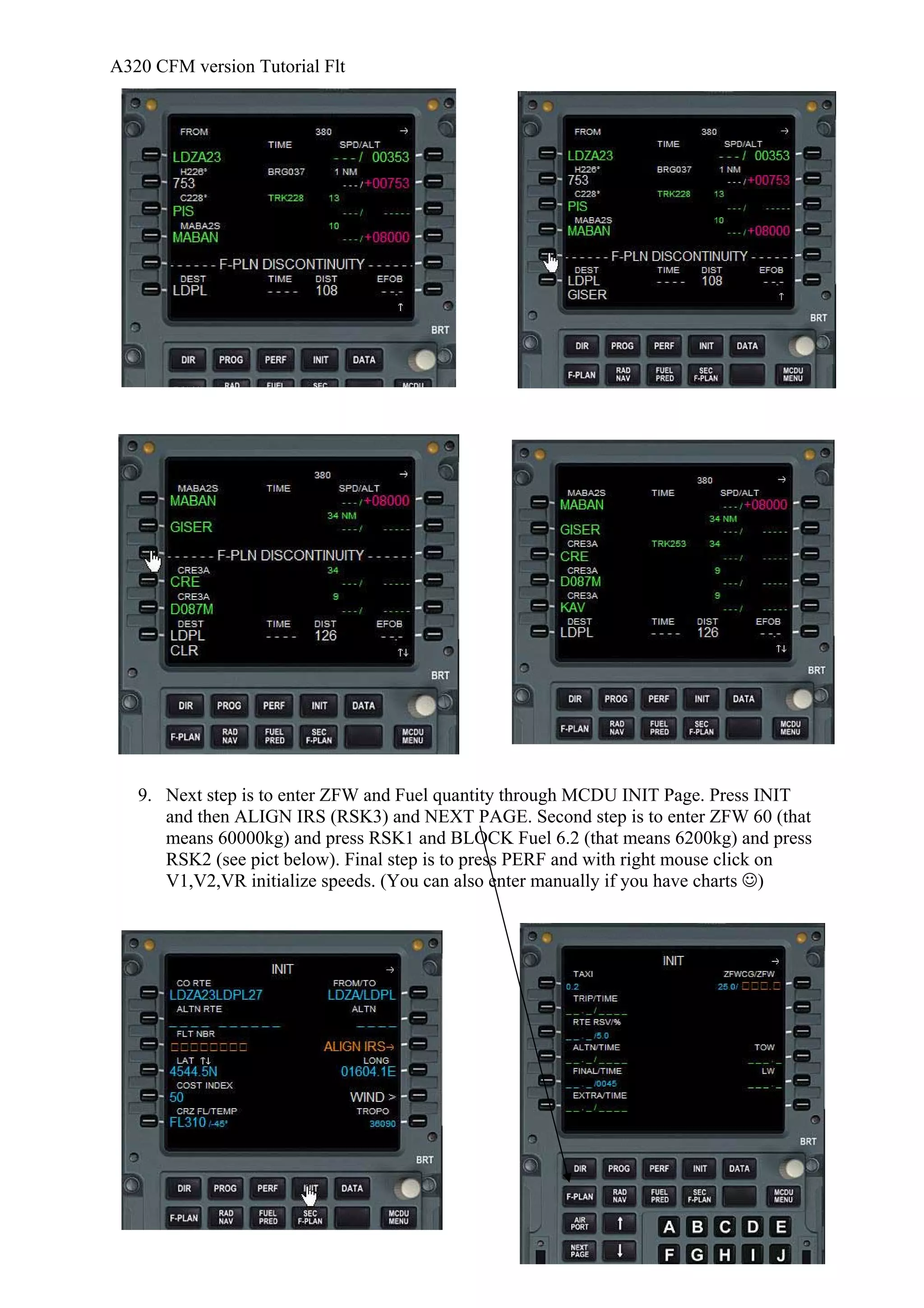
   8. Now we are ready to enter our Flight plan ☺. Press F-PLAN on our MCDU
                                                     Now press LSK1. LAT REV FROM
                                                     LDZA        page   appears.   Select
                                                     DEPARTURE (LSK1). Now we are
                                                     choosing SID (Standard Instrument
                                                     Departure which will be MABA2S.
                                                     You can scroll with arrows
                                                     (up,down). Scroll until you see
                                                     MABA2S, and then press key next
                                                     to it (in our case LSK5), and then
                                                     INSERT (RSK6). See picture below.
                                                     After MABAN enter GISER and
                                                     press LSK5L. Final step is choosing
                                                     LDPL -> ARRIVE -> 27-> CRE3A
                                                     -> INSERT (this is the STAR-
                                                     Standard Arrival Procedure for Rwy
                                                     27).     If    you   have    F-PLN
                                                     DISCONTINUITY press CLR and
                                                     LSK3 (see picture below)
A320 CFM version Tutorial Flt


   9. Next step is to enter ZFW and Fuel quantity through MCDU INIT Page. Press INIT
      and then ALIGN IRS (RSK3) and NEXT PAGE. Second step is to enter ZFW 60 (that
      means 60000kg) and press RSK1 and BLOCK Fuel 6.2 (that means 6200kg) and press
      RSK2 (see pict below). Final step is to press PERF and with right mouse click on
      V1,V2,VR initialize speeds. (You can also enter manually if you have charts ☺)
A320 CFM version Tutorial Flt


   10. Turn on Beacon lights and prepare for engine start. Open central pedestal (shift+4)

                                            7. Select Mode selector to IGN Start
                                            8. Put Engine 2 Master SW to ON (on upper
                                                ECAM Engine page appears)
                                            9. Put Engine 1 Master SW to ON
                                            10. After Engines start return Mode selector to
                                                NORM


   11. The ECAM should be as picture below. Enter initial altitude given by ATC (let say
       4000ft)
A320 CFM version Tutorial Flt

Note that FCU is centrally located on the glareshield. It provides control of autopilots and
flight directors, control of airspeed, horizontal modes, climb/descent modes and vertical
speed. Each knob can be rotated, pushed and pulled. If knob is pulled, the pilots takes direct
control of this function. This is called Selected mode. If knob is pushed, the control is given to
FMS (FMGC) which guides the a/c acc to entered route. This is Managed mode (in managed
mode window is dashed with white dot). It is up to you to decide which mode to use. I was
present few times in real A319/320 in the cockit as observer and selected mode was used.
Example:


Prepare for taxing to Rwy23. To move the airplane normally idle thrust is sufficient. If
needed, additional thrust (max 40% N1) should be used. The normal maximum taxi speed
should be 30kt in a straight line and 10kt for a tight turn. Monitor ground speed on ND.
2min after second engine start TO Memo appears on upper ECAM.

                                                                     12. Press AUTOBRAKE
                                                                         MAX p/b
                                                                     13. Set Flaps lever to take-off
                                                                         flap setting (1+F)
                                                                     14. Press T.O.Config after
                                                                         performing all actions.
                                                                     15. T.O.CONFIG NORMAL
                                                                         should appear
                                                                     16. Turn on TAXY/TO LT
A320 CFM version Tutorial Flt
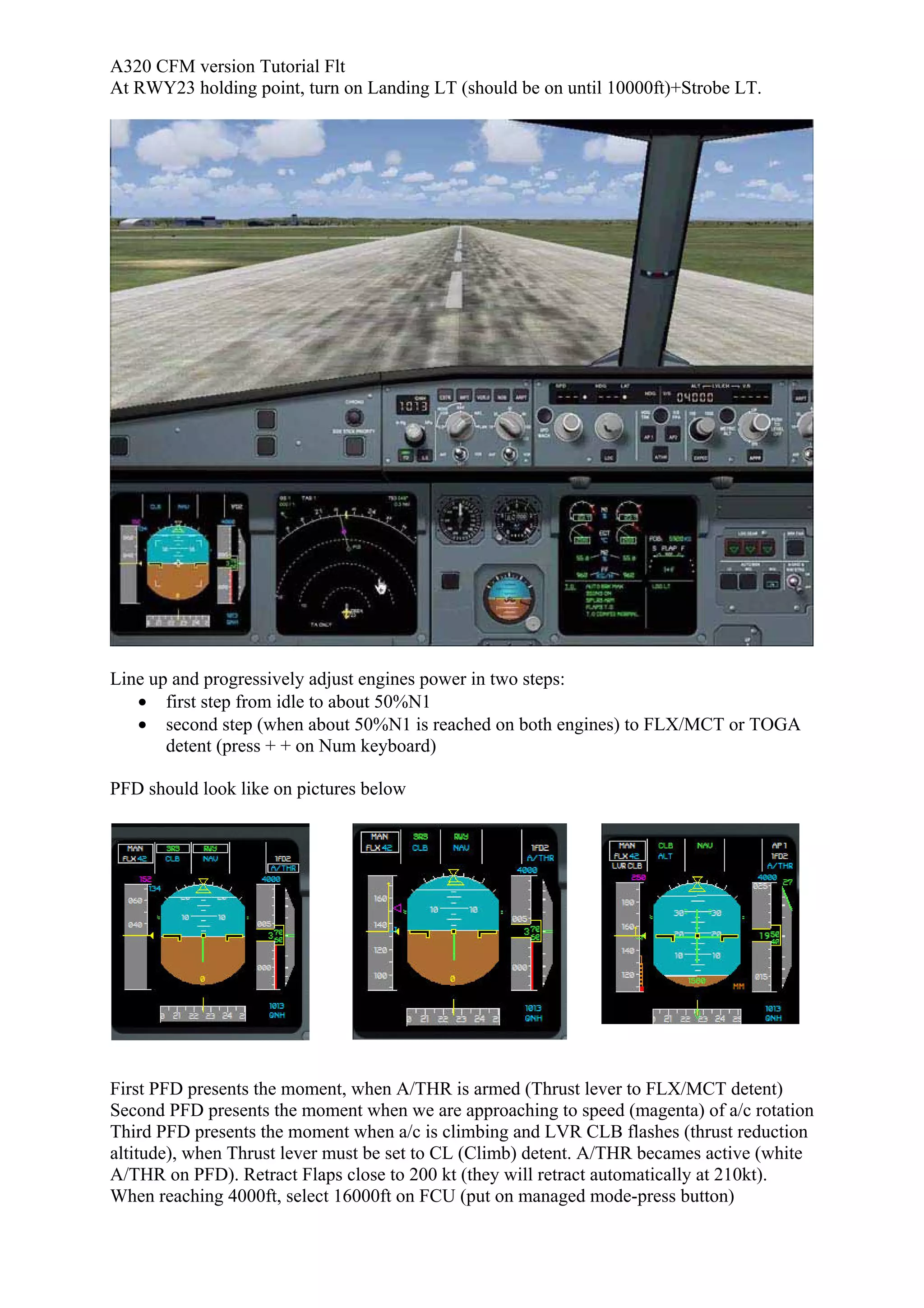
At RWY23 holding point, turn on Landing LT (should be on until 10000ft)+Strobe LT.


Line up and progressively adjust engines power in two steps:
   • first step from idle to about 50%N1
   • second step (when about 50%N1 is reached on both engines) to FLX/MCT or TOGA
       detent (press + + on Num keyboard)

PFD should look like on pictures below


First PFD presents the moment, when A/THR is armed (Thrust lever to FLX/MCT detent)
Second PFD presents the moment when we are approaching to speed (magenta) of a/c rotation
Third PFD presents the moment when a/c is climbing and LVR CLB flashes (thrust reduction
altitude), when Thrust lever must be set to CL (Climb) detent. A/THR becames active (white
A/THR on PFD). Retract Flaps close to 200 kt (they will retract automatically at 210kt).
When reaching 4000ft, select 16000ft on FCU (put on managed mode-press button)
A320 CFM version Tutorial Flt

                                      At transition altitude we must
                                      set altimeter to STD (flashes
                                      when altimeter is QNH and
                                      a/c is above transition level)
                                      Push baro control (STD app)


We are leaving LDZA finally ☺


Our ND looks like on picture below:

                                      •   Top of descent. A point
                                          where descent should
                                          start from cruise alt.
                                      •   Top of climb. A point
                                          where climb altitude will
                                          be reached
                                      •   Speed change
                                      •   Range of displayed nav
                                          plan can be changed
A320 CFM version Tutorial Flt

Close to TOD (Top of descent) ,set 5000ft on FCU (given by ATC) and when
DEACELERATE appears, press in altitude selector (managed mode acc FMS), or if you like
you can pull out altitude knob and go to OP DES mode (It controls a/c pitch to maintain target
speed and commands idle thrust). Third mode available will be V/S (Vertical speed ) mode.
The V/S mode can be engaged in two ways. Pulling the V/S knob will engage V/S mode and
will open V/S window to the existing vertical speed. Pushing this knob will engage V/S mode
and open the window with zero vertical speed. It is up to you to decide which mode will you
use. MORE DRAG means that you are to quick. Apply Speed brake until speed droped to
calculated speed. In managed descent, target speed triangle is replaced by mark and two
brackets indicate allowable airspeed range. Again when transition level is reached during
descent pull out QNH knob, turn on LAND LT and SEATBELTS ON
A320 CFM version Tutorial Flt


    PFD Managed descent                 PFD V/S mode descent

Arrange V/S to cross CRE NDB at 4000ft. In our case I set V/S to 1800ft/min and again to
4000ft in managed mode. Again you can use any mode (managed, OP DES, or V/S mode)


Now we are close to LDPL. See pictures below

                                                                       DECEL point is
                                                                       automatically inserted
                                                                       before approach
                                                                       segment. Overflying
                                                                       this point will engage
                                                                       Approach Flight stage
A320 CFM version Tutorial Flt

ILS frequency is tuned automatically or manually (enter ILS freq. and course in RAD NAV
page through MCDU) via FMGC (Flight Management and Guidance Computer). Manually
enter 111.50 and press LSK3. Enter course 267 and press LSK4. ILS is tuned manually. If we
didn't enter ILS freq and course, FMGC will automatically tune freq. and course.

                                                          Don't forget to set AUTOBRAKE to
                                                          MED or LOW (rain), and ARMED
                                                          GROUND SPOILERS.


Because we are close to calculated Deceleration point, we will engage manualy Approach
stage by pressing PERF key and then ACTIVATE APPR PHASE (LSK6) and CONFIRM :


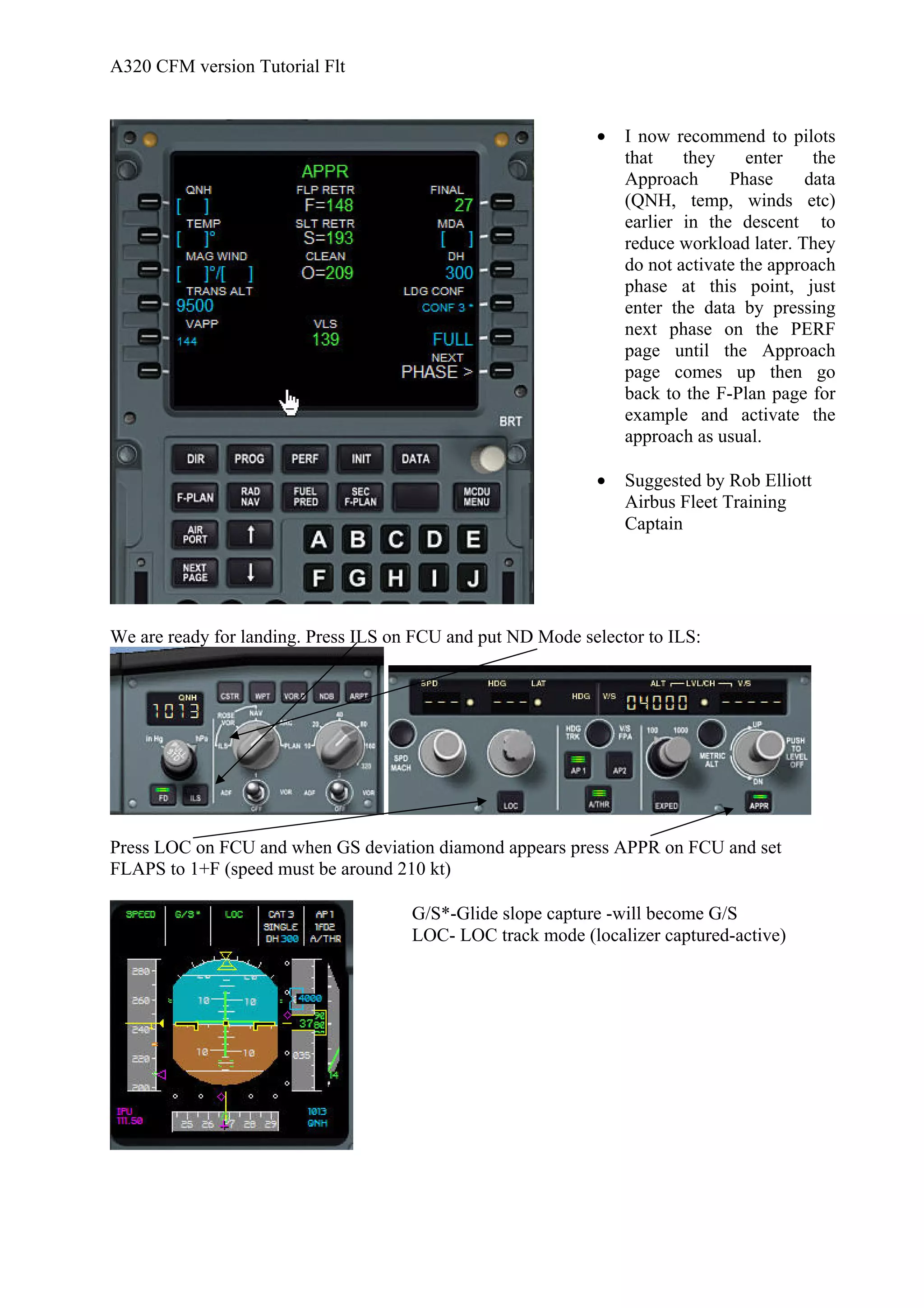
Pressing NEXT PHASE (RSK6), APPR page appears. On that page we are entering DH
(Decision Height), and LDG CONF (Flaps FULL in our case)
A320 CFM version Tutorial Flt


                                                             •   I now recommend to pilots
                                                                 that    they     enter   the
                                                                 Approach      Phase     data
                                                                 (QNH, temp, winds etc)
                                                                 earlier in the descent to
                                                                 reduce workload later. They
                                                                 do not activate the approach
                                                                 phase at this point, just
                                                                 enter the data by pressing
                                                                 next phase on the PERF
                                                                 page until the Approach
                                                                 page comes up then go
                                                                 back to the F-Plan page for
                                                                 example and activate the
                                                                 approach as usual.

                                                             •   Suggested by Rob Elliott
                                                                 Airbus Fleet Training
                                                                 Captain


We are ready for landing. Press ILS on FCU and put ND Mode selector to ILS:


Press LOC on FCU and when GS deviation diamond appears press APPR on FCU and set
FLAPS to 1+F (speed must be around 210 kt)

                                      G/S*-Glide slope capture -will become G/S
                                      LOC- LOC track mode (localizer captured-active)
A320 CFM version Tutorial Flt

As you approaching LDPL lower the speed by setting FLAPS 2.
When the plane begins to descend on glideslope, deploy the flaps FULL.
When you descend trough 2000ft lower the gear. Also LANDING MEMO appears on upper
ECAM (below 2000ft if L/G down or below 800ft if L/G not down)
Now you can disengage AP and A/THR (or left engaged) or land with AP1&2 engaged
(CAT3 DUAL).

Note: For Manual landing:
   • Use CONF 3 for approach and landing
   • The recommendation to use managed speed remains valid
   • Minimum VAPP is VLS (CONF3)+10kt

Note: For automatic landing:
   • Use CONF 3 for approach and landing
   • The recommendation to use managed speed remains valid
   • Minimum VAPP is VLS+5kt

VLS- Minimum selectable speed


At verbal «RETARD, RETARD», press – on keypad for THRUST IDLE. Start flare at about
20ft. Make a gentle progressive flare and allow the airplane to touch down. Lower the nose
wheel without delay and return sidestick to pitch neutral position.
Select REV immediately after touchdown of main landing gear.
Maximum reverse thrust is allowed down to 70kt.
Before reaching 20kt disengage AUTOBRK.
After leaving landing runway set STROBE LT to OFF

Welcome to PULA ☺
A320 CFM version Tutorial Flt


By Edin Hasanović
Email: ehasanov@gmail.com

Pss airbus a320 flight tutorial

  • 1.
    A320 CFM versionTutorial Flt PSS Airbus A319/320 Flight Tutorial (with graphical presentation) Only for MS Flight Simulator Copyright © 2005 Edin Hasanović
  • 2.
    A320 CFM versionTutorial Flt PSS Airbus A320 Flight Tutorial. This tutorial will show You how to prepare aircraft for flight. Our a/c is PSS a320c (CFM engines) We will make short flight from LDZA RWY23 to LDPL RWY27. This will be configuration of our A320: ZFW=60000kg, Fuel:6200kg (50% 0% 50%) First part must be done in Phoenix Paylod Editor. Save the setting. Second part will be done in FS2004 (Fuel setting) Our Flight plan: MABA2S.MABAN GISER CRE.CRE3A (enter in MCDU)
  • 3.
    A320 CFM versionTutorial Flt We will start with cold and dark cockpit (you can define this through AirbusPanelConfig.exe) 1. press BAT1&2 p/b (OFF goes off) 2. Press in all 6 p/b of Fuel Pumps (OFF goes off). APU can run without Engine driven pumps (EDP). APU is equiped with APU Fuel pump which will run automatically if fuel feed pressure is low. In real life left wing pumps are started, because fuel for APU is supplied from left side.
  • 4.
    A320 CFM versionTutorial Flt 3. Now we can start APU by pressing APU Master Sw P/B 4. After few seconds (on lower ECAM FLAP OPEN appears and green AVAIL on P/B) we can press Start (blue ON appears) 5. APU ECAM page appears. After 99% N, we can start APU Bleed which is neccessary for engine start 6. Open MCDU (shift+3) LSK1 RSK1 LSK RSK2 LSK3 RSK3 LSK4 RSK4 LSK5 RSK5 LSK6 RSK6
  • 5.
    A320 CFM versionTutorial Flt 7. Enter LDZA/LDPL and press RSK1 You will see that screen. Next step is entering of cruise FL, which will be in our case FL160. Enter FL160 and press LSK6 8. Now we are ready to enter our Flight plan ☺. Press F-PLAN on our MCDU Now press LSK1. LAT REV FROM LDZA page appears. Select DEPARTURE (LSK1). Now we are choosing SID (Standard Instrument Departure which will be MABA2S. You can scroll with arrows (up,down). Scroll until you see MABA2S, and then press key next to it (in our case LSK5), and then INSERT (RSK6). See picture below. After MABAN enter GISER and press LSK5L. Final step is choosing LDPL -> ARRIVE -> 27-> CRE3A -> INSERT (this is the STAR- Standard Arrival Procedure for Rwy 27). If you have F-PLN DISCONTINUITY press CLR and LSK3 (see picture below)
  • 6.
    A320 CFM versionTutorial Flt 9. Next step is to enter ZFW and Fuel quantity through MCDU INIT Page. Press INIT and then ALIGN IRS (RSK3) and NEXT PAGE. Second step is to enter ZFW 60 (that means 60000kg) and press RSK1 and BLOCK Fuel 6.2 (that means 6200kg) and press RSK2 (see pict below). Final step is to press PERF and with right mouse click on V1,V2,VR initialize speeds. (You can also enter manually if you have charts ☺)
  • 7.
    A320 CFM versionTutorial Flt 10. Turn on Beacon lights and prepare for engine start. Open central pedestal (shift+4) 7. Select Mode selector to IGN Start 8. Put Engine 2 Master SW to ON (on upper ECAM Engine page appears) 9. Put Engine 1 Master SW to ON 10. After Engines start return Mode selector to NORM 11. The ECAM should be as picture below. Enter initial altitude given by ATC (let say 4000ft)
  • 8.
    A320 CFM versionTutorial Flt Note that FCU is centrally located on the glareshield. It provides control of autopilots and flight directors, control of airspeed, horizontal modes, climb/descent modes and vertical speed. Each knob can be rotated, pushed and pulled. If knob is pulled, the pilots takes direct control of this function. This is called Selected mode. If knob is pushed, the control is given to FMS (FMGC) which guides the a/c acc to entered route. This is Managed mode (in managed mode window is dashed with white dot). It is up to you to decide which mode to use. I was present few times in real A319/320 in the cockit as observer and selected mode was used. Example: Prepare for taxing to Rwy23. To move the airplane normally idle thrust is sufficient. If needed, additional thrust (max 40% N1) should be used. The normal maximum taxi speed should be 30kt in a straight line and 10kt for a tight turn. Monitor ground speed on ND. 2min after second engine start TO Memo appears on upper ECAM. 12. Press AUTOBRAKE MAX p/b 13. Set Flaps lever to take-off flap setting (1+F) 14. Press T.O.Config after performing all actions. 15. T.O.CONFIG NORMAL should appear 16. Turn on TAXY/TO LT
  • 9.
    A320 CFM versionTutorial Flt At RWY23 holding point, turn on Landing LT (should be on until 10000ft)+Strobe LT. Line up and progressively adjust engines power in two steps: • first step from idle to about 50%N1 • second step (when about 50%N1 is reached on both engines) to FLX/MCT or TOGA detent (press + + on Num keyboard) PFD should look like on pictures below First PFD presents the moment, when A/THR is armed (Thrust lever to FLX/MCT detent) Second PFD presents the moment when we are approaching to speed (magenta) of a/c rotation Third PFD presents the moment when a/c is climbing and LVR CLB flashes (thrust reduction altitude), when Thrust lever must be set to CL (Climb) detent. A/THR becames active (white A/THR on PFD). Retract Flaps close to 200 kt (they will retract automatically at 210kt). When reaching 4000ft, select 16000ft on FCU (put on managed mode-press button)
  • 10.
    A320 CFM versionTutorial Flt At transition altitude we must set altimeter to STD (flashes when altimeter is QNH and a/c is above transition level) Push baro control (STD app) We are leaving LDZA finally ☺ Our ND looks like on picture below: • Top of descent. A point where descent should start from cruise alt. • Top of climb. A point where climb altitude will be reached • Speed change • Range of displayed nav plan can be changed
  • 11.
    A320 CFM versionTutorial Flt Close to TOD (Top of descent) ,set 5000ft on FCU (given by ATC) and when DEACELERATE appears, press in altitude selector (managed mode acc FMS), or if you like you can pull out altitude knob and go to OP DES mode (It controls a/c pitch to maintain target speed and commands idle thrust). Third mode available will be V/S (Vertical speed ) mode. The V/S mode can be engaged in two ways. Pulling the V/S knob will engage V/S mode and will open V/S window to the existing vertical speed. Pushing this knob will engage V/S mode and open the window with zero vertical speed. It is up to you to decide which mode will you use. MORE DRAG means that you are to quick. Apply Speed brake until speed droped to calculated speed. In managed descent, target speed triangle is replaced by mark and two brackets indicate allowable airspeed range. Again when transition level is reached during descent pull out QNH knob, turn on LAND LT and SEATBELTS ON
  • 12.
    A320 CFM versionTutorial Flt PFD Managed descent PFD V/S mode descent Arrange V/S to cross CRE NDB at 4000ft. In our case I set V/S to 1800ft/min and again to 4000ft in managed mode. Again you can use any mode (managed, OP DES, or V/S mode) Now we are close to LDPL. See pictures below DECEL point is automatically inserted before approach segment. Overflying this point will engage Approach Flight stage
  • 13.
    A320 CFM versionTutorial Flt ILS frequency is tuned automatically or manually (enter ILS freq. and course in RAD NAV page through MCDU) via FMGC (Flight Management and Guidance Computer). Manually enter 111.50 and press LSK3. Enter course 267 and press LSK4. ILS is tuned manually. If we didn't enter ILS freq and course, FMGC will automatically tune freq. and course. Don't forget to set AUTOBRAKE to MED or LOW (rain), and ARMED GROUND SPOILERS. Because we are close to calculated Deceleration point, we will engage manualy Approach stage by pressing PERF key and then ACTIVATE APPR PHASE (LSK6) and CONFIRM : Pressing NEXT PHASE (RSK6), APPR page appears. On that page we are entering DH (Decision Height), and LDG CONF (Flaps FULL in our case)
  • 14.
    A320 CFM versionTutorial Flt • I now recommend to pilots that they enter the Approach Phase data (QNH, temp, winds etc) earlier in the descent to reduce workload later. They do not activate the approach phase at this point, just enter the data by pressing next phase on the PERF page until the Approach page comes up then go back to the F-Plan page for example and activate the approach as usual. • Suggested by Rob Elliott Airbus Fleet Training Captain We are ready for landing. Press ILS on FCU and put ND Mode selector to ILS: Press LOC on FCU and when GS deviation diamond appears press APPR on FCU and set FLAPS to 1+F (speed must be around 210 kt) G/S*-Glide slope capture -will become G/S LOC- LOC track mode (localizer captured-active)
  • 15.
    A320 CFM versionTutorial Flt As you approaching LDPL lower the speed by setting FLAPS 2. When the plane begins to descend on glideslope, deploy the flaps FULL. When you descend trough 2000ft lower the gear. Also LANDING MEMO appears on upper ECAM (below 2000ft if L/G down or below 800ft if L/G not down) Now you can disengage AP and A/THR (or left engaged) or land with AP1&2 engaged (CAT3 DUAL). Note: For Manual landing: • Use CONF 3 for approach and landing • The recommendation to use managed speed remains valid • Minimum VAPP is VLS (CONF3)+10kt Note: For automatic landing: • Use CONF 3 for approach and landing • The recommendation to use managed speed remains valid • Minimum VAPP is VLS+5kt VLS- Minimum selectable speed At verbal «RETARD, RETARD», press – on keypad for THRUST IDLE. Start flare at about 20ft. Make a gentle progressive flare and allow the airplane to touch down. Lower the nose wheel without delay and return sidestick to pitch neutral position. Select REV immediately after touchdown of main landing gear. Maximum reverse thrust is allowed down to 70kt. Before reaching 20kt disengage AUTOBRK. After leaving landing runway set STROBE LT to OFF Welcome to PULA ☺
  • 16.
    A320 CFM versionTutorial Flt By Edin Hasanović Email: ehasanov@gmail.com