Tips on using my ppt.
1. You can freely download, edit, modify and put your
name etc.
2. Don’t be concerned about number of slides. Half the
slides are blanks except for the title.
3. First show the blank slides (eg. Aetiology ) > Ask
students what they already know about ethology of
today's topic. > Then show next slide which enumerates
aetiologies.
4. At the end rerun the show – show blank> ask questions >
show next slide.
5. This will be an ACTIVE LEARNING SESSION x
three revisions.
6. Good for self study also. Good for self study also.
Display blank slide> Think what you already know about
this > Read next slide.
Introduction
Introduction
• The psoas muscle is a retroperitoneal organ
that originates from the lateral borders of
the 12th thoracic to fifth lumbar vertebrae
and inserts on the lesser trochanter of the
femur.
Introduction
• The psoas muscle lies in close proximity to
many other organs, including the sigmoid
colon, jejunum, appendix, ureters, aorta,
renal pelvis, pancreas, iliac lymph nodes,
and spine.
• Infections in these organs can contiguously
spread to the psoas muscle.
• The psoas muscle has a rich vascular
supply that is believed to predispose it to
hematogenous spread from sites of occult
infection.
Pathophysiology
Pathophysiology
• Primary psoas abscess
– intravenous drug users,
– diabetes,
– Immunosupression
– renal failure.
– human immunodeficiency virus (HIV).
Pathophysiology
• Secondary psoas abscess
– Gastrointestinal
• Diverticulitis, appendicitis, Crohn's disease,
colorectal carcinoma, appendiceal tumor
– Genitourinary
• Urinary tract infection, extracorporeal shock wave
lithotripsy, cancer
– Musculoskeletal
• Vertebral osteomyelitis, lumbar spondylodiskitis,
infectious sacroiliitis, septic arthritis
–
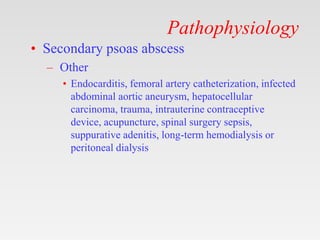
Pathophysiology
• Secondary psoas abscess
– Other
• Endocarditis, femoral artery catheterization, infected
abdominal aortic aneurysm, hepatocellular
carcinoma, trauma, intrauterine contraceptive
device, acupuncture, spinal surgery sepsis,
suppurative adenitis, long-term hemodialysis or
peritoneal dialysis
Bacteriology
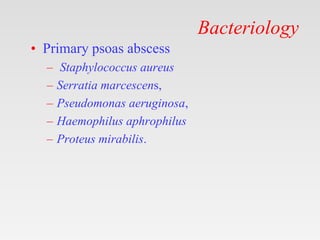
Bacteriology
• Primary psoas abscess
– Staphylococcus aureus
– Serratia marcescens,
– Pseudomonas aeruginosa,
– Haemophilus aphrophilus
– Proteus mirabilis.
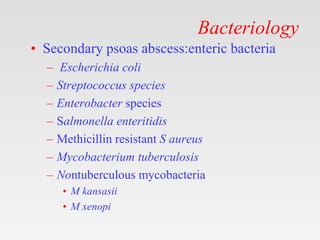
Bacteriology
• Secondary psoas abscess:enteric bacteria
– Escherichia coli
– Streptococcus species
– Enterobacter species
– Salmonella enteritidis
– Methicillin resistant S aureus
– Mycobacterium tuberculosis
– Nontuberculous mycobacteria
• M kansasii
• M xenopi
Clinical Features:Symptoms
Nonspecific.
• fever
• flank pain
• abdominal pain
• Limp
• pain sometimes radiates anteriorly to the
hip and thigh.
• Other symptoms are nausea, malaise, and
weight loss.
Clinical Features:Signs
 Posture- supine position, with the knee
moderately flexed and the hip mildly
externally rotated.
 Psoas sign passively extending the thigh of
a patient lying on his side with knees
extended, or asking the patient to actively
flex his thigh at the hip. If abdominal
pain results, it is a "positive psoas sign".
 Tender swelling below inguinal ligament.
Diagnostic Studies
Diagnostic Studies
• Laboratory Studies
• Imaging Studies
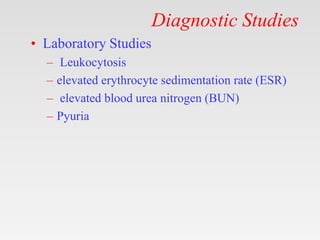
Diagnostic Studies
• Laboratory Studies
– Leukocytosis
– elevated erythrocyte sedimentation rate (ESR)
– elevated blood urea nitrogen (BUN)
– Pyuria
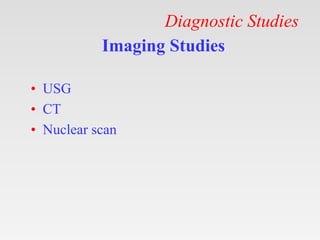
Diagnostic Studies
Imaging Studies
• USG
• CT
• Nuclear scan
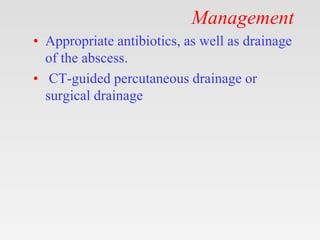
Management
Management
• Appropriate antibiotics, as well as drainage
of the abscess.
• CT-guided percutaneous drainage or
surgical drainage
Get this ppt in mobile
1. Download Microsoft
PowerPoint from play
store.
2. Open Google assistant
3. Open Google lens.
4. Scan qr code from
next slide.
Get my ppt collection
• https://www.slideshare.net/drpradeeppande/
edit_my_uploads
• https://www.dropbox.com/sh/x600md3cvj8
5woy/AACVMHuQtvHvl_K8ehc3ltkEa?dl
=0
• https://www.facebook.com/doctorpradeeppa
nde/?ref=pages_you_manage

Psoas abscess.pptx

  • 1.
    Tips on usingmy ppt. 1. You can freely download, edit, modify and put your name etc. 2. Don’t be concerned about number of slides. Half the slides are blanks except for the title. 3. First show the blank slides (eg. Aetiology ) > Ask students what they already know about ethology of today's topic. > Then show next slide which enumerates aetiologies. 4. At the end rerun the show – show blank> ask questions > show next slide. 5. This will be an ACTIVE LEARNING SESSION x three revisions. 6. Good for self study also. Good for self study also. Display blank slide> Think what you already know about this > Read next slide.
  • 2.
  • 3.
    Introduction • The psoasmuscle is a retroperitoneal organ that originates from the lateral borders of the 12th thoracic to fifth lumbar vertebrae and inserts on the lesser trochanter of the femur.
  • 4.
    Introduction • The psoasmuscle lies in close proximity to many other organs, including the sigmoid colon, jejunum, appendix, ureters, aorta, renal pelvis, pancreas, iliac lymph nodes, and spine. • Infections in these organs can contiguously spread to the psoas muscle. • The psoas muscle has a rich vascular supply that is believed to predispose it to hematogenous spread from sites of occult infection.
  • 5.
  • 6.
    Pathophysiology • Primary psoasabscess – intravenous drug users, – diabetes, – Immunosupression – renal failure. – human immunodeficiency virus (HIV).
  • 7.
    Pathophysiology • Secondary psoasabscess – Gastrointestinal • Diverticulitis, appendicitis, Crohn's disease, colorectal carcinoma, appendiceal tumor – Genitourinary • Urinary tract infection, extracorporeal shock wave lithotripsy, cancer – Musculoskeletal • Vertebral osteomyelitis, lumbar spondylodiskitis, infectious sacroiliitis, septic arthritis –
  • 8.
    Pathophysiology • Secondary psoasabscess – Other • Endocarditis, femoral artery catheterization, infected abdominal aortic aneurysm, hepatocellular carcinoma, trauma, intrauterine contraceptive device, acupuncture, spinal surgery sepsis, suppurative adenitis, long-term hemodialysis or peritoneal dialysis
  • 9.
  • 10.
    Bacteriology • Primary psoasabscess – Staphylococcus aureus – Serratia marcescens, – Pseudomonas aeruginosa, – Haemophilus aphrophilus – Proteus mirabilis.
  • 11.
    Bacteriology • Secondary psoasabscess:enteric bacteria – Escherichia coli – Streptococcus species – Enterobacter species – Salmonella enteritidis – Methicillin resistant S aureus – Mycobacterium tuberculosis – Nontuberculous mycobacteria • M kansasii • M xenopi
  • 12.
  • 13.
    Clinical Features:Symptoms Nonspecific. • fever •flank pain • abdominal pain • Limp • pain sometimes radiates anteriorly to the hip and thigh. • Other symptoms are nausea, malaise, and weight loss.
  • 14.
  • 15.
    Clinical Features:Signs  Posture-supine position, with the knee moderately flexed and the hip mildly externally rotated.  Psoas sign passively extending the thigh of a patient lying on his side with knees extended, or asking the patient to actively flex his thigh at the hip. If abdominal pain results, it is a "positive psoas sign".  Tender swelling below inguinal ligament.
  • 16.
  • 17.
    Diagnostic Studies • LaboratoryStudies • Imaging Studies
  • 18.
    Diagnostic Studies • LaboratoryStudies – Leukocytosis – elevated erythrocyte sedimentation rate (ESR) – elevated blood urea nitrogen (BUN) – Pyuria
  • 19.
    Diagnostic Studies Imaging Studies •USG • CT • Nuclear scan
  • 20.
  • 21.
    Management • Appropriate antibiotics,as well as drainage of the abscess. • CT-guided percutaneous drainage or surgical drainage
  • 22.
    Get this pptin mobile 1. Download Microsoft PowerPoint from play store. 2. Open Google assistant 3. Open Google lens. 4. Scan qr code from next slide.
  • 25.
    Get my pptcollection • https://www.slideshare.net/drpradeeppande/ edit_my_uploads • https://www.dropbox.com/sh/x600md3cvj8 5woy/AACVMHuQtvHvl_K8ehc3ltkEa?dl =0 • https://www.facebook.com/doctorpradeeppa nde/?ref=pages_you_manage

Editor's Notes

  • #2 drpradeeppande@gmail.com 7697305442
  • #25 drpradeeppande@gmail.com 7697305442