PSBE2-08
Research Methods
        Week 4


   Tassos Sarampalis   1
The week’s reading


Chapter 4 (pp. 87-122)
Chapter 5 (pp. 123-159)


                          2
RELIABILITY AND VALIDITY


                           3
Reliability
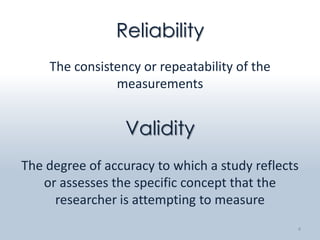
    The consistency or repeatability of the
               measurements


                 Validity
The degree of accuracy to which a study reflects
   or assesses the specific concept that the
     researcher is attempting to measure
                                               4
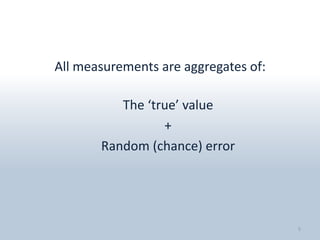
All measurements are aggregates of:

          The ‘true’ value
                 +
       Random (chance) error


                                      5
Stability and Equivalence
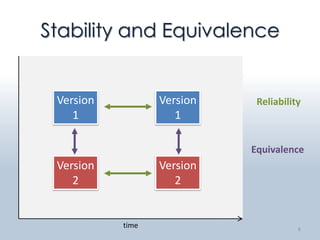
• Test-retest reliability
• Alternate-form reliability
       Version            Version     Reliability
• Internal-consistency reliability
          1                  1

                                     Equivalence
      Version             Version
         2                   2


                   time                         6
Internal Consistency
How related are individual items within the
measure?

• Spearman-Brown
• Kuder and Richardson Formula 20 (KR20)
• Cronbach’s alpha


                                              7
Replication in Research
• What do we mean by ‘replication’?

• Three factors to consider:
  – When
  – How         is the replication is conducted?
  – By whom


                                                   8
Replication in Research
• What do we mean by ‘replication’?

• Three factors to consider:
  – When
  – How         is the replication is conducted?
  – By whom


Early replications are more valuable than later
ones                                               9
Replication in Research
• What do we mean by ‘replication’?

• Three factors to consider:
  – When
  – How         is the replication is conducted?
  – By whom


The difference between precise and varied
replication                                        10
Replication in Research
• What do we mean by ‘replication’?

• Three factors to consider:
  – When
  – How         is the replication is conducted?
  – By whom


Independence of replicators
                                                   11
Validity
• Content-related
  – How well a measure represents all dimensions
• Criterion-related
  – Concurrent vs. predictive validity
• Construct-related
  – Convergent vs. discriminant validity


                                                   12
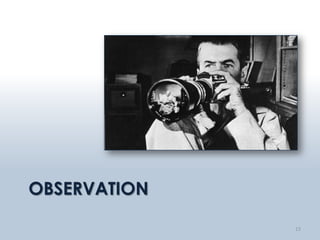
OBSERVATION

              13
Observational Methods
• Categories based on intervention by
  researcher
  – Observation without Intervention
  – Observation with Intervention
• Categories based on methods for recording
  behavior
  – comprehensive record
  – selected behaviors
Observation without Intervention
• Naturalistic Observation
  – observation in natural (real-world) setting without
    attempt to intervene or change situation
  – use when ethical considerations prevent
    experimental manipulation
• Goals
  – describe “normal” behavior, examine relationships
    among naturally occurring variables
  – establish external validity of lab findings
Observation with Intervention
• Most psychological research involves
  intervention
• Three methods in natural settings
  – participant observation
  – structured observation
  – field experiment
Observation with Intervention
• Participant observation
  – observer is active participant in the natural setting
    he or she observes
     • undisguised: people know they’re being observed
       (e.g., Kitchen Stories, 2003 Norwegian film)
     • disguised: people don’t know they’re being observed
Observation with Intervention
• Problems with participant observation
  – Reactivity
     • when people change their usual behavior because
       they’re being observed
     • disguised participant observation controls reactivity
  – Observers lose objectivity or become too involved
    in situation
  – Observers influence behavior of people they’re
    observing (e.g., Hawthorne Effect)
Observation with Intervention
• Structured observation
  – set up (structure) specific situation in order to
    observe behavior
  – used when behavior is difficult to observe as it
    naturally occurs
  – researchers use confederates to structure
    situations
  – problems: when observers don’t follow same
    procedures across observations
Observation with Intervention
• Example of structured observation
  – Simons and Levin (1998): “change blindness”
            http://www.youtube.com/watch?v=FWSxSQsspiQ
Observation with Intervention
• Field Experiment
  – manipulate independent variable in natural
    setting and observe behavior (dependent variable)
     • two or more conditions to compare (IV)
     • often use confederates to create conditions
     • strive for control in natural setting
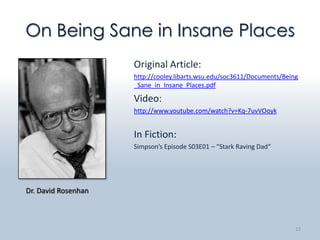
On Being Sane in Insane Places
                     Original Article:
                     http://cooley.libarts.wsu.edu/soc3611/Documents/Being
                     _Sane_in_Insane_Places.pdf

                     Video:
                     http://www.youtube.com/watch?v=Kq-7uvVOoyk


                     In Fiction:
                     Simpson’s Episode S03E01 – “Stark Raving Dad“


Dr. David Rosenhan


                                                                         22
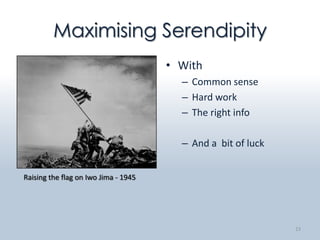
Maximising Serendipity
                                      • With
                                        – Common sense
                                        – Hard work
                                        – The right info

                                        – And a bit of luck


Raising the flag on Iwo Jima - 1945


                                                              23
Errors in Observational Research
• Non-interactional artifacts
  – Interpreter biases
  – Observer biases


• Interactional artifacts


                                24
Non-reactive Measures
• Archival research

• Physical Traces

• Unobtrusive Observation
  – Simple
  – Contrived


                             25
Selecting Judges
• Identify the type of judge that is most likely to
  produce accurate judgments

  – Search the literature
  – Test them


                                                  26
Rating Biases
• Errors of Leniency
  – e.g., Halo Effect
• Severity Errors
• Errors of Central Tendency
• Logical Errors


                               27
Thank you


            28

Psbe2 08 research methods 2011-2012 - week 4

  • 1.
    PSBE2-08 Research Methods Week 4 Tassos Sarampalis 1
  • 2.
    The week’s reading Chapter4 (pp. 87-122) Chapter 5 (pp. 123-159) 2
  • 3.
  • 4.
    Reliability The consistency or repeatability of the measurements Validity The degree of accuracy to which a study reflects or assesses the specific concept that the researcher is attempting to measure 4
  • 5.
    All measurements areaggregates of: The ‘true’ value + Random (chance) error 5
  • 6.
    Stability and Equivalence •Test-retest reliability • Alternate-form reliability Version Version Reliability • Internal-consistency reliability 1 1 Equivalence Version Version 2 2 time 6
  • 7.
    Internal Consistency How relatedare individual items within the measure? • Spearman-Brown • Kuder and Richardson Formula 20 (KR20) • Cronbach’s alpha 7
  • 8.
    Replication in Research •What do we mean by ‘replication’? • Three factors to consider: – When – How is the replication is conducted? – By whom 8
  • 9.
    Replication in Research •What do we mean by ‘replication’? • Three factors to consider: – When – How is the replication is conducted? – By whom Early replications are more valuable than later ones 9
  • 10.
    Replication in Research •What do we mean by ‘replication’? • Three factors to consider: – When – How is the replication is conducted? – By whom The difference between precise and varied replication 10
  • 11.
    Replication in Research •What do we mean by ‘replication’? • Three factors to consider: – When – How is the replication is conducted? – By whom Independence of replicators 11
  • 12.
    Validity • Content-related – How well a measure represents all dimensions • Criterion-related – Concurrent vs. predictive validity • Construct-related – Convergent vs. discriminant validity 12
  • 13.
  • 14.
    Observational Methods • Categoriesbased on intervention by researcher – Observation without Intervention – Observation with Intervention • Categories based on methods for recording behavior – comprehensive record – selected behaviors
  • 15.
    Observation without Intervention •Naturalistic Observation – observation in natural (real-world) setting without attempt to intervene or change situation – use when ethical considerations prevent experimental manipulation • Goals – describe “normal” behavior, examine relationships among naturally occurring variables – establish external validity of lab findings
  • 16.
    Observation with Intervention •Most psychological research involves intervention • Three methods in natural settings – participant observation – structured observation – field experiment
  • 17.
    Observation with Intervention •Participant observation – observer is active participant in the natural setting he or she observes • undisguised: people know they’re being observed (e.g., Kitchen Stories, 2003 Norwegian film) • disguised: people don’t know they’re being observed
  • 18.
    Observation with Intervention •Problems with participant observation – Reactivity • when people change their usual behavior because they’re being observed • disguised participant observation controls reactivity – Observers lose objectivity or become too involved in situation – Observers influence behavior of people they’re observing (e.g., Hawthorne Effect)
  • 19.
    Observation with Intervention •Structured observation – set up (structure) specific situation in order to observe behavior – used when behavior is difficult to observe as it naturally occurs – researchers use confederates to structure situations – problems: when observers don’t follow same procedures across observations
  • 20.
    Observation with Intervention •Example of structured observation – Simons and Levin (1998): “change blindness” http://www.youtube.com/watch?v=FWSxSQsspiQ
  • 21.
    Observation with Intervention •Field Experiment – manipulate independent variable in natural setting and observe behavior (dependent variable) • two or more conditions to compare (IV) • often use confederates to create conditions • strive for control in natural setting
  • 22.
    On Being Sanein Insane Places Original Article: http://cooley.libarts.wsu.edu/soc3611/Documents/Being _Sane_in_Insane_Places.pdf Video: http://www.youtube.com/watch?v=Kq-7uvVOoyk In Fiction: Simpson’s Episode S03E01 – “Stark Raving Dad“ Dr. David Rosenhan 22
  • 23.
    Maximising Serendipity • With – Common sense – Hard work – The right info – And a bit of luck Raising the flag on Iwo Jima - 1945 23
  • 24.
    Errors in ObservationalResearch • Non-interactional artifacts – Interpreter biases – Observer biases • Interactional artifacts 24
  • 25.
    Non-reactive Measures • Archivalresearch • Physical Traces • Unobtrusive Observation – Simple – Contrived 25
  • 26.
    Selecting Judges • Identifythe type of judge that is most likely to produce accurate judgments – Search the literature – Test them 26
  • 27.
    Rating Biases • Errorsof Leniency – e.g., Halo Effect • Severity Errors • Errors of Central Tendency • Logical Errors 27
  • 28.