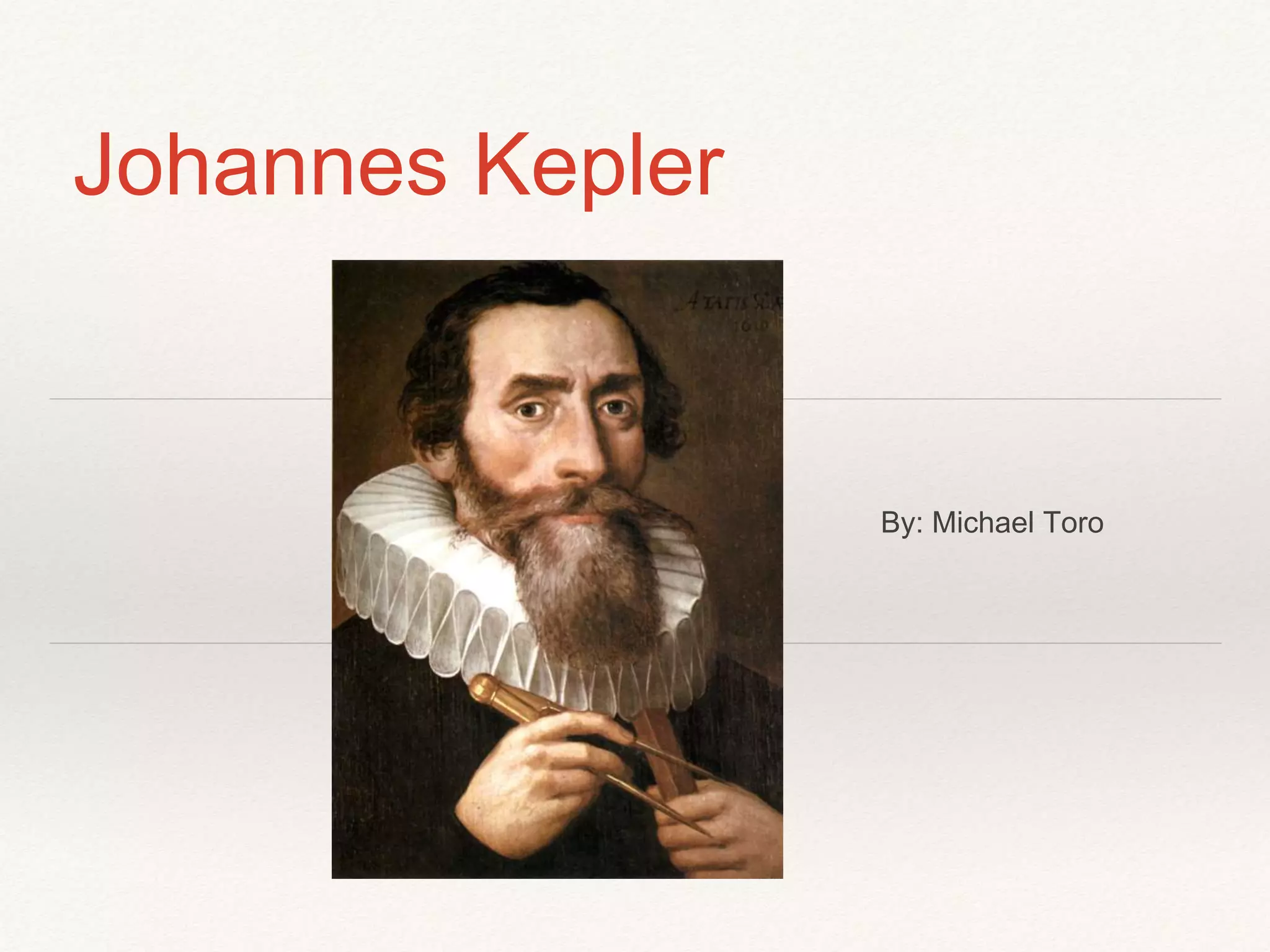
Johannes Kepler
By: Michael Toro
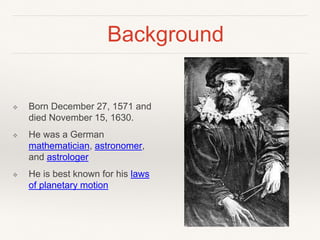
Background
❖ Born December 27, 1571 and
died November 15, 1630.
❖ He was a German
mathematician, astronomer,
and astrologer
❖ He is best known for his laws
of planetary motion
A bit more Background
❖ Kepler served as Tycho Brahe's assistant until the
latter's death in 1601 and was then appointed Tycho's
successor as Imperial Mathematician, the most
prestigious appointment in mathematics in Europe.
❖ Tycho was afraid that Kepler would surpass him, so in
an effort to keep his status, Tycho didn't show Kepler
all his data, and gave him the difficult task of studying
mars
Keplers Discovery
❖ Although Tycho made Kepler take on the difficult task
to study the orbit of mars, it was the key to Kepler
forming his laws
❖ Kepler formulated three laws of planetary motion.
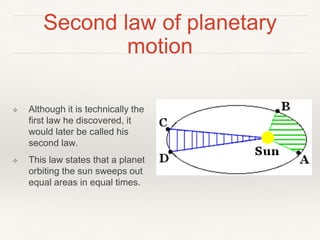
Second law of planetary
motion
❖ Although it is technically the
first law he discovered, it
would later be called his
second law.
❖ This law states that a planet
orbiting the sun sweeps out
equal areas in equal times.
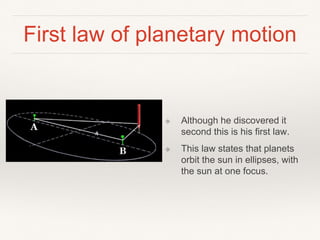
First law of planetary motion
❖ Although he discovered it
second this is his first law.
❖ This law states that planets
orbit the sun in ellipses, with
the sun at one focus.
Third law of planetary motion
❖ This law recognized that the relationship between the
period of two planets. The time they take to orbit the
sun is connected to their distance from the sun.
Use of the scientific method
❖ Kepler used the scientific method to determine his
laws.
❖ His hypothesis that the sun was at the center of the
universe with planets moving in an elliptical orbit
around the sun was proven true
❖ He used observation as his tests and used
mathematics to discover his laws which were later
confirmed by others.
Influences
❖ Kepler's discoveries changed the way that planets
were studied.
❖ Newton built upon the idea of the sun in the center of
the universe
❖ Newton also showed the unity of Kepler’s laws
Is it relevant today?
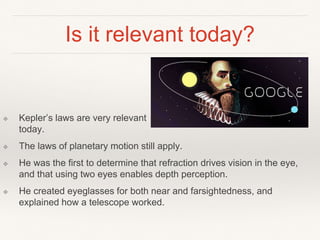
❖ Kepler’s laws are very relevant
today.
❖ The laws of planetary motion still apply.
❖ He was the first to determine that refraction drives vision in the eye,
and that using two eyes enables depth perception.
❖ He created eyeglasses for both near and farsightedness, and
explained how a telescope worked.

Ps 101 presentation

  • 1.
  • 2.
    Background ❖ Born December27, 1571 and died November 15, 1630. ❖ He was a German mathematician, astronomer, and astrologer ❖ He is best known for his laws of planetary motion
  • 3.
    A bit moreBackground ❖ Kepler served as Tycho Brahe's assistant until the latter's death in 1601 and was then appointed Tycho's successor as Imperial Mathematician, the most prestigious appointment in mathematics in Europe. ❖ Tycho was afraid that Kepler would surpass him, so in an effort to keep his status, Tycho didn't show Kepler all his data, and gave him the difficult task of studying mars
  • 4.
    Keplers Discovery ❖ AlthoughTycho made Kepler take on the difficult task to study the orbit of mars, it was the key to Kepler forming his laws ❖ Kepler formulated three laws of planetary motion.
  • 5.
    Second law ofplanetary motion ❖ Although it is technically the first law he discovered, it would later be called his second law. ❖ This law states that a planet orbiting the sun sweeps out equal areas in equal times.
  • 6.
    First law ofplanetary motion ❖ Although he discovered it second this is his first law. ❖ This law states that planets orbit the sun in ellipses, with the sun at one focus.
  • 7.
    Third law ofplanetary motion ❖ This law recognized that the relationship between the period of two planets. The time they take to orbit the sun is connected to their distance from the sun.
  • 8.
    Use of thescientific method ❖ Kepler used the scientific method to determine his laws. ❖ His hypothesis that the sun was at the center of the universe with planets moving in an elliptical orbit around the sun was proven true ❖ He used observation as his tests and used mathematics to discover his laws which were later confirmed by others.
  • 9.
    Influences ❖ Kepler's discoverieschanged the way that planets were studied. ❖ Newton built upon the idea of the sun in the center of the universe ❖ Newton also showed the unity of Kepler’s laws
  • 10.
    Is it relevanttoday? ❖ Kepler’s laws are very relevant today. ❖ The laws of planetary motion still apply. ❖ He was the first to determine that refraction drives vision in the eye, and that using two eyes enables depth perception. ❖ He created eyeglasses for both near and farsightedness, and explained how a telescope worked.