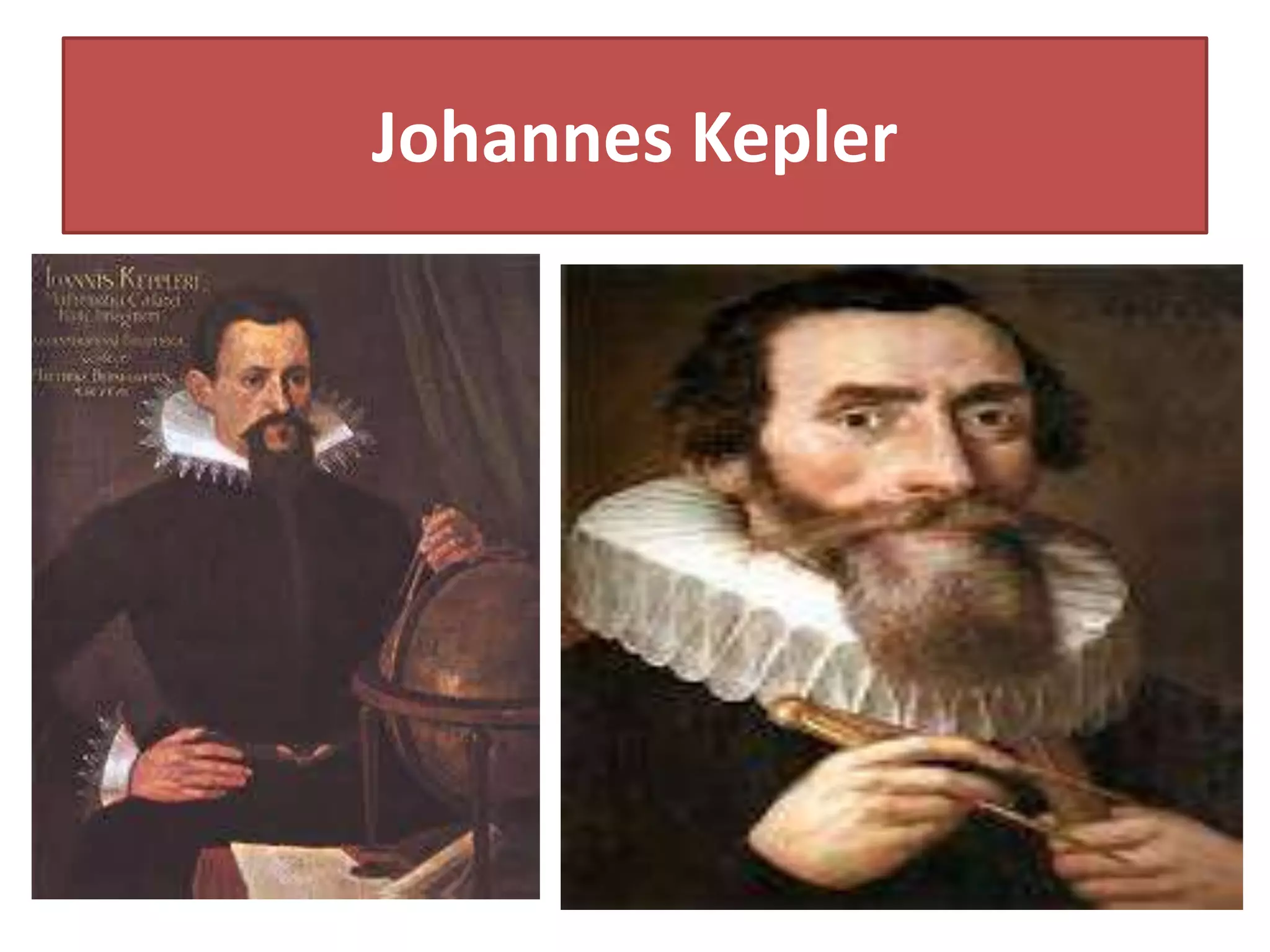
Johannes Kepler
• Born: (1571-12-27)December 27, 1571

• Died : November 15, 1630(1630-11-15) (aged 58)

• Residence: Germany

• Nationality: German

• Fields: Astronomy, astrology, mathematics and natural
  philosophy .

  Institutions: University of Linz

• Known for: Kepler's laws of planetary motion
  Kepler conjecture
•  Johannes Kepler was a German mathematician, astronomer and
  astrologer. A key figure in the 17th century scientific revolution, he is
  best known for his eponymous laws of planetary motion, codified by
  later astronomers, based on his works Astronomia
  nova, Harmonices Mundi, and Epitome of Copernican Astronomy.
  These works also provided one of the foundations for Isaac
  Newton's theory of universal gravitation.
• During his career, Kepler was a mathematics teacher at a seminary
  school in Graz, Austria, where he became an associate of Prince
  Hans Ulrich von Eggenberg. Later he became an assistant to
  astronomer Tycho Brahe, and eventually the imperial mathematician
  to Emperor Rudolf II and his two successors Matthias and Ferdinand
  II. He was also a mathematics teacher in Linz, Austria, and an
  adviser to General Wallenstein. Additionally, he did fundamental
  work in the field of optics, invented an improved version of the
  refracting telescope (the Keplerian Telescope), and mentioned the
  telescopic discoveries of his contemporary Galileo Galilei.
• Kepler lived in an era when there was no clear
  distinction between astronomy and astrology, but
  there was a strong division between astronomy (a
  branch of mathematics within the liberal arts) and
  physics (a branch of natural philosophy). Kepler also
  incorporated religious arguments and reasoning into
  his work, motivated by the religious conviction and
  belief that God had created the world according to an
  intelligible plan that is accessible through the natural
  light of reason. Kepler described his new astronomy as
  "celestial physics", as "an excursion into Aristotle's
  Metaphysics", and as "a supplement to Aristotle's On
  the Heavens", transforming the ancient tradition of
  physical cosmology by treating astronomy as part of a
  universal mathematical physics.
Kepler’s law of motion

In astronomy, Kepler's laws of
  planetary motion are three
  scientific laws describing orbital
  motion, each giving a description
  of the motion of planets around
  the Sun.
Kepler's laws are:
• The orbit of every planet is an ellipse
  with the Sun at one of the two foci.
• A line joining a planet and the Sun
  sweeps out equal areas during equal
  intervals of time.
• The square of the orbital period of a
  planet is directly proportional to the
  cube of the semi-major axis of its
  orbit.
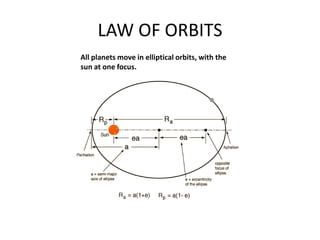
LAW OF ORBITS
All planets move in elliptical orbits, with the
sun at one focus.
This is one of Kepler's laws. The
  elliptical shape of the orbit is a
 result of the inverse square force
 of gravity. The eccentricity of the
ellipse is greatly exaggerated here.
Orbit Eccentricity

 The eccentricity of an ellipse can be
  defined as the ratio of the distance
 between the foci to the major axis of
the ellipse. The eccentricity is zero for
 a circle. Of the planetary orbits, only
     Pluto has a large eccentricity.
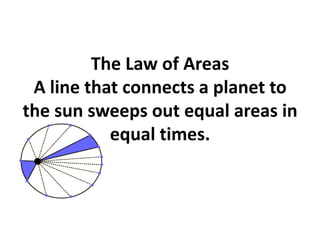
The Law of Areas
 A line that connects a planet to
the sun sweeps out equal areas in
           equal times.
This is one of Kepler's laws.This
empirical law discovered by Kepler
arises from conservation of angular
  momentum. When the planet is
     closer to the sun, it moves
 faster, sweeping through a longer
         path in a given time.
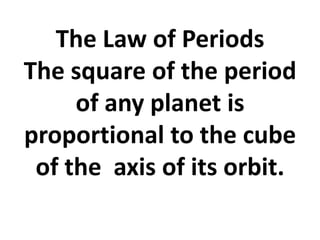
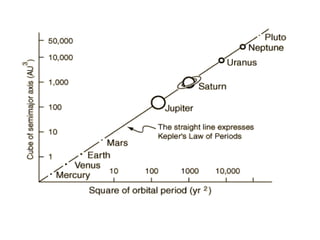
The Law of Periods
The square of the period
     of any planet is
proportional to the cube
 of the axis of its orbit.
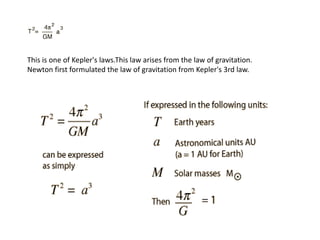
This is one of Kepler's laws.This law arises from the law of gravitation.
Newton first formulated the law of gravitation from Kepler's 3rd law.
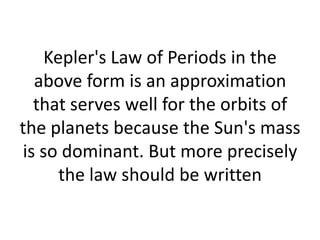
Kepler's Law of Periods in the
  above form is an approximation
  that serves well for the orbits of
the planets because the Sun's mass
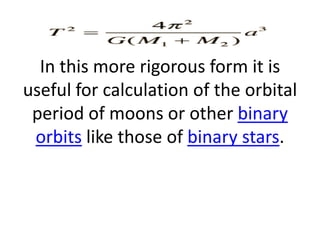
is so dominant. But more precisely
      the law should be written
In this more rigorous form it is
useful for calculation of the orbital
 period of moons or other binary
 orbits like those of binary stars.
DONE BY-
NIKHIL SAI-9TH B - 32
OMKAR-9TH B -33
KV.NO.1.UPPAL

Presentation1

  • 1.
  • 2.
    • Born: (1571-12-27)December27, 1571 • Died : November 15, 1630(1630-11-15) (aged 58) • Residence: Germany • Nationality: German • Fields: Astronomy, astrology, mathematics and natural philosophy . Institutions: University of Linz • Known for: Kepler's laws of planetary motion Kepler conjecture
  • 3.
    • JohannesKepler was a German mathematician, astronomer and astrologer. A key figure in the 17th century scientific revolution, he is best known for his eponymous laws of planetary motion, codified by later astronomers, based on his works Astronomia nova, Harmonices Mundi, and Epitome of Copernican Astronomy. These works also provided one of the foundations for Isaac Newton's theory of universal gravitation. • During his career, Kepler was a mathematics teacher at a seminary school in Graz, Austria, where he became an associate of Prince Hans Ulrich von Eggenberg. Later he became an assistant to astronomer Tycho Brahe, and eventually the imperial mathematician to Emperor Rudolf II and his two successors Matthias and Ferdinand II. He was also a mathematics teacher in Linz, Austria, and an adviser to General Wallenstein. Additionally, he did fundamental work in the field of optics, invented an improved version of the refracting telescope (the Keplerian Telescope), and mentioned the telescopic discoveries of his contemporary Galileo Galilei.
  • 4.
    • Kepler livedin an era when there was no clear distinction between astronomy and astrology, but there was a strong division between astronomy (a branch of mathematics within the liberal arts) and physics (a branch of natural philosophy). Kepler also incorporated religious arguments and reasoning into his work, motivated by the religious conviction and belief that God had created the world according to an intelligible plan that is accessible through the natural light of reason. Kepler described his new astronomy as "celestial physics", as "an excursion into Aristotle's Metaphysics", and as "a supplement to Aristotle's On the Heavens", transforming the ancient tradition of physical cosmology by treating astronomy as part of a universal mathematical physics.
  • 5.
    Kepler’s law ofmotion In astronomy, Kepler's laws of planetary motion are three scientific laws describing orbital motion, each giving a description of the motion of planets around the Sun.
  • 6.
    Kepler's laws are: •The orbit of every planet is an ellipse with the Sun at one of the two foci. • A line joining a planet and the Sun sweeps out equal areas during equal intervals of time. • The square of the orbital period of a planet is directly proportional to the cube of the semi-major axis of its orbit.
  • 7.
    LAW OF ORBITS Allplanets move in elliptical orbits, with the sun at one focus.
  • 8.
    This is oneof Kepler's laws. The elliptical shape of the orbit is a result of the inverse square force of gravity. The eccentricity of the ellipse is greatly exaggerated here.
  • 9.
    Orbit Eccentricity Theeccentricity of an ellipse can be defined as the ratio of the distance between the foci to the major axis of the ellipse. The eccentricity is zero for a circle. Of the planetary orbits, only Pluto has a large eccentricity.
  • 10.
    The Law ofAreas A line that connects a planet to the sun sweeps out equal areas in equal times.
  • 11.
    This is oneof Kepler's laws.This empirical law discovered by Kepler arises from conservation of angular momentum. When the planet is closer to the sun, it moves faster, sweeping through a longer path in a given time.
  • 12.
    The Law ofPeriods The square of the period of any planet is proportional to the cube of the axis of its orbit.
  • 14.
    This is oneof Kepler's laws.This law arises from the law of gravitation. Newton first formulated the law of gravitation from Kepler's 3rd law.
  • 15.
    Kepler's Law ofPeriods in the above form is an approximation that serves well for the orbits of the planets because the Sun's mass is so dominant. But more precisely the law should be written
  • 16.
    In this morerigorous form it is useful for calculation of the orbital period of moons or other binary orbits like those of binary stars.
  • 17.
    DONE BY- NIKHIL SAI-9THB - 32 OMKAR-9TH B -33 KV.NO.1.UPPAL