POVERTY REDUCTION STRATEGY PAPER 
ON 
NORTH WESTERN FRONTIER PROVINCE OF PAKISTAN 
PLANNING AND DEVELOPMENT DEPARTMENT 
GOVERNMENT OF N.W.F.P. 
April 2003
ACRONYMS AND ABBREVIATIONS 
ADB Asian Development Bank 
AIT Agriculture Income Tax 
AWB Area Water Boards 
CBO Community Based Organization 
CCO Citizen Community Organization 
CRPRID Centre for Research on Poverty Reduction and Income Distribution 
CWD Communications and Works Department 
DAC Departmental Account Committee 
DAO District Accounting Officer 
DCO District Coordination Officer 
DFID Department for International Development 
EIROP Essential Institutional Reform Operationalization Project 
EMIS Education Management Information System 
EOBI Employees Old-age Benefits Institution 
FBS Federal Bureau of Statistics 
FMC Fiscal Monitoring Committee 
GAVI Global Alliance for Vaccination Initiative 
GTZ German Development Corporation 
HMIS Health Management Information Survey 
HR Human Resource 
IM&R Instructional Materials and Minor Repair 
IPRSP Interim Poverty Reduction Strategy Paper 
LHW Lady Health Worker 
M&E Monitoring and Evaluation 
MICS Multiple Indicators Cluster Survey 
MTBF Medium Term Budget Framework 
NAB National Accountability Bureau 
NGO Non –governmental Organization 
NWFP North West Frontier Province 
O&M Operation & Maintenance 
P&D Planning and Development 
PAC Public Accounts Committee 
PFAA Provincial Financial Accountability Assessment 
PIHS Pakistan Integrated Household Survey 
PRP Poverty Reduction Plan 
PRSP Poverty Reduction Strategy Paper 
PSC Public Service Commission 
PTA Parent-teacher Associations 
SBP State Bank of Pakistan 
SDC Swiss Development Corporation 
SME Small and Medium Enterprise 
SPDC Social Policy Development Center 
SWOT Strengths, Weaknesses, Opportunities and Threats 
UNDP United Nations Development Program 
WAPDA Water and Power Development Authority
TABLE OF CONTENTS 
Executive Summary 
i 
Chapter 1 
Introduction 
1 
Chapter 2 
Poverty in NWFP 
3 
Chapter 3 
PRSP Dialogue – The Consultative Process 
11 
Chapter 4 
The Poverty Reduction Strategy 
14 
Chapter 5 
The Medium term Budgetary Framework 
40 
Chapter 6 
Monitoring and Evaluation 
44 
Annex 1 
Poverty in NWFP 
47 
Annex ll: 
Gender 
60 
Annex lll 
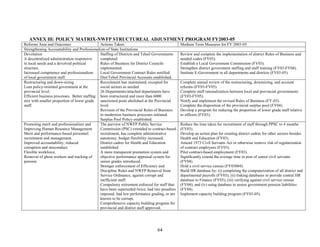
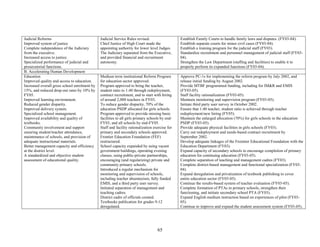
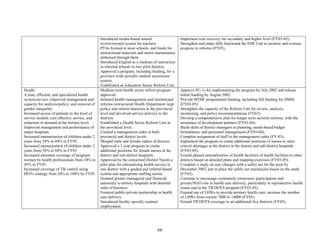
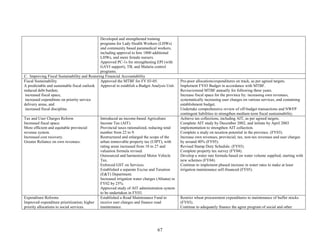
Policy Matrix NWFP Structural Adjustment 
64 
Annex lV: 
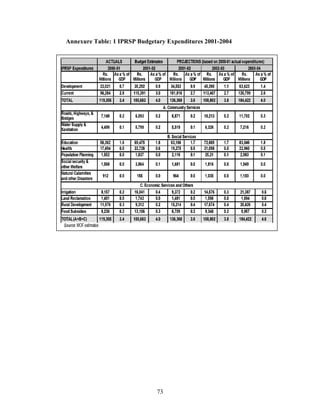
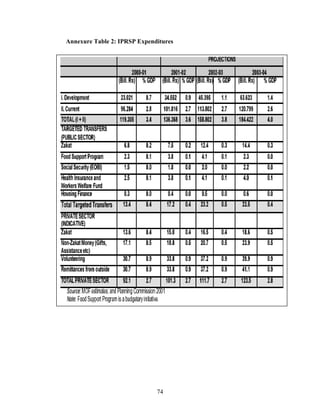
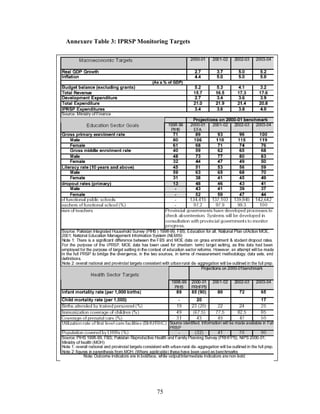
Pakistan’s IPRSP Summary 
72 
Annex V 
Decentralization in Pakistan 
80
ACKNOWLEDGEMENTS 
This document reflects an extensive process of consultations and builds on the ongoing Poverty Reduction Plan of the Government of the NWFP. 
Thanks are due to the Nazims and elected Governments as well as the District Coordination Officers and staff of all the districts of the NWFP for their input into this strategy. Thanks are also due to the Secretaries and staff of all the line departments of the Provincial government for their input. 
This strategy reflects the hard work of the Planning and Development Department of the Government of the NWFP who worked zealously to put it together in a very short time. 
The financial assistance and technical support of UNICEF and especially its local office in Peshawar is also gratefully acknowledged
i 
EXECUTIVE SUMMARY 
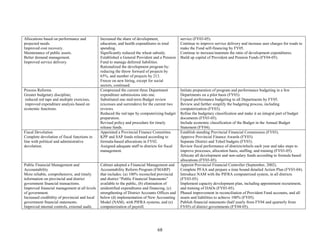
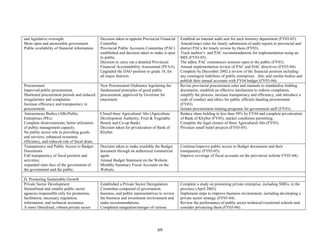
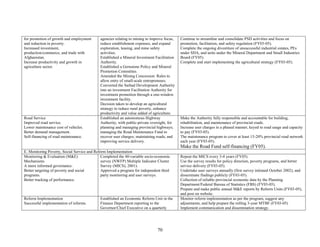
NWFP is by far the poorest province of Pakistan, with an overall incidence of poverty substantially higher than that for the country as a whole (poverty headcount in 1998-99 for NWFP is 43% as compared to 33% for Pakistan). Both urban and rural poverty in NWFP are higher than that for the entire country (poverty headcounts for urban and rural NWFP are 31% and 47% respectively, compared to 24% and 36% respectively for all of Pakistan). Moreover, the depth of both urban and rural poverty, measured by the poverty gap is relatively higher for NWFP than for the rest of the country. Consistent with the poverty estimates, the average per-capita consumption expenditures are also lower for NWFP vis-à-vis the rest of the country. 
Poverty in NWFP has changed significantly over the decade. The trends are very mixed depending on the choice of the base year for comparison. If 1990-91 is compared to 1998-99, then urban poverty in NWFP appears to have declined substantially (by close to 6 percentage points)—even more than the decline in national urban poverty. Meanwhile, the rural poverty in NWFP seems to have increased by more than 4 percentage points over the same period. However, it is also important to note that notwithstanding the decline in urban poverty in NWFP during this period the urban areas in this province still remain the poorest in the country by a large margin. And even more alarming is the fact that if there is a comparison between 1993 and 1999 then the available evidence indicates a dramatic and consistent worsening of poverty in NWFP in both the rural and urban sectors 
Several characteristics of poverty in NWFP based on the available research are listed below: 
• NWFP faces difficult challenges due to its geography, history and location 
• NWFP is the poorest Province of Pakistan 
• NWFP has poor social indicators and highest gender disparity 
• Gender gaps are significant for all socio-economic indicators in NWFP 
• Gender gaps tend to be wider in rural areas than in urban areas of NWFP. 
• Gender gaps in NWFP are found to be larger than for the country as a whole 
• Land ownership in rural NWFP is less concentrated than for the rest of the country, and there is prevalence of small landholdings, low agriculture productivity and high rural poverty 
A large proportion of the paid employees in the urban sector of NWFP are engaged as wage labor in the informal sector, which is a significant employer in urban areas. The poor have relatively low access to safe drinking water and sanitation facilities. Availability of safe drinking water and sanitation facilities is characterized by large rural- urban gaps in NWFP. In terms of access to safe water and drainage in NWFP both urban and rural sectors alike fare significantly worse than the country as a whole
i i 
•NWFP has a limited resource base 
•Province’s own revenues are low and its fiscal position has deteriorated during 1990 
•Province’s financial management has remained weak 
Much of province’s economic potential is still unexploited – while this is at present a major weakness it also offers a major opportunity in the future. 
In addition to using the individual characteristics of poverty geographic targeting also provides an effective method for improving the efficiency of resource use for poverty reduction. This paper uses levels of deprivation to rank districts. The deprivation indices presented here are based on the recently released Government of the NWFP Multi Indicator Cluster Survey 2001 data set. These data were especially collected with support from UNICEF to provide district-level indicators and benchmarks for poverty reduction. 
The overarching objective of the Poverty Reduction Strategy for the NWFP is poverty reduction through efforts to restore good governance and the respect for the rule of law, enhance the effectiveness of public expenditure especially in the key social sectors and re-establish the integrity of state institutions and their accountability to the public. Of course, no poverty reduction strategy can be complete without efforts to promote pro- poor growth. The PRSP for the NWFP, therefore, has the following five main pillars with strengthening governance to improve public service delivery as the central cross cutting theme: 
1. Governance reforms to achieve an efficient, accountable, and service oriented civil service; 
2. Reforms to improve service delivery in key sectors (especially basic social services); Fiscal and financial management reforms to improve governance in budget and financial management, 
3. A medium term budget framework (MTBF), enhance effectiveness and accountability of expenditures, and strengthen resource mobilization; 
4. Promote sustainable private sector development to accelerate economic growth. 
5. Addressing vulnerability to shocks 
Given the larger gender disparities in the NWFP mainstreaming gender is an essential element of all strategic interventions proposed here. It is not only important from a rights based perspective but is also the most optimal poverty reduction strategy given the ease with which more than fifty percent of the poor can be targeted. 
This strategy is based on an extensive consultative process that was initiated in December 2002. These consultations covered the entire Province and involved stakeholders meetings at the grass roots level for the identification of the perceived strengths, weaknesses, opportunities and threat in each district and sector, as well as the recommendations to ensure opportunity, security and empowerment so necessary for effective poverty reduction. Based on this consultative process, it has become quite clear
ii i 
that for the five pronged strategy to be successful the following basic measures must adopted: 
• Training and support to enable the local Governments to think along modern lines in order to enable them to function as sustainable entities with proactive planning for the development and promotion of all available resources at the district level 
• Specific training for the local Governments to enable them to prepare business plans and advertise the business and tourism possibilities in their districts along modern lines. 
• Strengthening of the office of the District Planning Officer with equipment and training to act as a Business Development and Support Units for all the citizens of the districts. This office would be charged with providing essential links to the on- going national level support initiatives such as SMEDA, Qaumi Zarat Bank, Khushali Bank and other initiatives that can be tapped to develop the small and medium industries and the agriculture sector. These offices should act as conduits for business promotion in the districts and for attracting investment and finding markets to assist the local inhabitants. Over time these offices will be in a position to charge a fee for such services. 
• Initiating district level studies to assess how best to develop and promote the comparative advantage of the Province, in particular horticulture and vegetable farming; processing and marketing of foods, development of timber and non-timber forest products; and the exploitation and development of minerals and gem stones on modern business lines; 
• Setting up Poverty Reduction Associations of concerned well to do citizens with logistical support from the District Governments to evolve and implement schemes to improve the opportunity, security and empowerment of the vulnerable at the grassroots level. These associations should also be charged with ensuring that all such schemes are environmentally sustainable and biodiversity conserving and provide adequate opportunities to the vulnerable especially women. In addition these associations can serve as the focal mechanism for the supervision and distribution of basic food items at cost price to the poor and vulnerable as well as the provision of basic cooked food (dal and roti at designated tanoors) to the destitute in each locality through informal collections from philanthropists in and around the area. 
The detailed Medium Term Budgetary framework presented here was agreed upon by the Government of the NWFP in line with the initiatives proposed under the four pillars of the original Poverty Reduction Plan in 2001. The Monitoring and Evaluation Framework with the clear designation of responsibilities and next steps was also agreed upon at that time. 
Risks to the success of the overall strategy for NWFP include backsliding on the key fiscal and financial steps committed to by the Government of NWFP in 2001 as part of the conditionality for the World Bank structural adjustment credit. Additional risks come from the lack of smooth functioning of the devolved local government; the lack of effective consensus building amongst the district level government and elected officials
iv 
to ensure ownership of the poverty reduction strategy; and lack of momentum in the overall national PRSP efforts.
1 
CHAPTER 1. INTRODUCTION 
This Poverty Reduction Strategy Paper (PRSP) for the North West Frontier Province reinforces the poverty reduction strategy for Pakistan. Within the overall parameters of the national PRSP the strategy for the NWFP integrates the existing Provincial Poverty Reduction Plan (PRP) and the Medium Term Budgetary Framework into a three-year strategy. The PRP for the NWFP was built on four pillars that more or less overlapped the national Interim Poverty Reduction Strategy Paper (I-PRSP). The NWFP PRP however, did not suggest any interventions for addressing aspects of vulnerability to shocks. In this important dimension the PRSP for the NWFP takes the strategic interventions that are part of the national IPRSP as given and incorporates a recommendation for strengthening the informal system of philanthropy. 
The unexploited strength of the NWFP economy lies, amongst other sources, in its tremendous potential in its minerals, value-added agriculture, timber and non-timber products, hydel resources and potential for tourism development. This PRSP recognizes that accelerating economic growth and generating employment for the poor is key to poverty reduction. In this the private sector has to be the engine of growth. Such growth should be based in the rural sector where the majority of the poor reside and where the highest employment multipliers are evidenced. 
The NWFP like the country as a whole is faced with the twin challenges of reviving growth and reducing poverty. There is realization that restoring economic growth and improving access to basic needs, such as primary education, preventive health care, and population welfare services, is essential for winning the fight against poverty. The complex and multidimensional nature of poverty thus warrants a poverty reduction strategy that ensures rapid pro-poor economic growth through sound macroeconomic reforms, improved access to social services, broad based governance reforms, and targeted interventions Pakistan’s interim poverty reduction strategy I-PRSP put in place in November 2001 takes into account the economic, social, and governance dimensions. Like the national strategy this provincial strategy also emphasizes policies for economic and social development but also seeks greater involvement of the poor in the formulation of these policies and management of their affairs. The strategy aims at forging broad- based alliances with civil society and the private sector in the quest for eliminating poverty and accelerating growth 
The strategy is based on an extensive consultative process initiated in December 2002 that covered the entire Province and involved stakeholders meetings at the grass roots level for the identification of the strengths, weaknesses, opportunities and threat in each district and sector as well as the interventions to ensure opportunity, security and empowerment so necessary for effective poverty reduction. 
This consultative process is essential for ensuring ownership and hence sustainability of any strategy. The strategic recommendations presented in this paper are backed by a well-
2 
defined Medium term budgetary framework. This framework enables expenditures to be directed to the key areas and then tracked over the period of implementation. Additionally The paper also presents a Monitoring and Evaluation strategy which is critical to the success of the poverty reduction strategy. 
Pakistan’s I-PRSP is backed with a strong program of monitoring as well as capacity development, including that for gathering and analyzing information for impact assessment. The I-PRSP outlines new institutional mechanisms that will be employed for the regular/periodic monitoring and evaluation of poverty reduction expenditures and corresponding outcome indicators at the federal, provincial, and district levels. These institutional arrangements are presently evolving and will be finalized in consultations with provincial governments. Key outcome indictors have also been suggested. The final benchmarks and targets will be set after consultations with national and provincial statistical agencies, federal line departments, and provincial governments. 
The PRSP for the NWFP draws on these aspects of Monitoring and Evaluation. Its eventual success will rest in the continuation of the reforms committed to under the structural adjustment program by the Government of NWFP and on the ownership that can be built through an ongoing process of consultations. It is imperative, therefore, that the political consensus to the reform package underlying this strategy be obtained as quickly as possible and the process of consultations at the grass roots level be concluded as quickly as possible. The NWFP is the first Province to put together a draft PRSP. 
The medium term prospects for economic growth for the economy of the NWFP as the frontline province have been uncertain since September 11, 2001. This uncertainty has serious implications for the stability of NWFP’s macroeconomic and planning framework and can significantly undermine the reform efforts outlined in this PRSP. The strategy presented here therefore is based on the assumption of ceterus paribus i.e. other things remaining the same. 
This strategy paper is divided into six chapters. The Poverty Profile for NWFP is summarily described in the second Chapter. Details are presented in the Annexure. The process of dialogue is presented in Chapter three. The strategic plan forms the fourth chapter. The medium term budgetary framework is described in the fifth chapter. Monitoring and Evaluation processes are described in the sixth chapter.
3 
CHAPTER 2. POVERTY IN NWFP 
Poverty in NWFP should be understood in the broader context of poverty in Pakistan.1 In addition, understanding issues specific to poverty in the province also requires examining the concentration of poverty across areas within NWFP. Such an understanding can help to inform policymakers by identifying priority needs and target groups for intervention. 
Detailed analysis of the poverty situation in NWFP is presented in Annex I. A summary is presented here to give context to the strategy presented in later chapters. The NWFP is the poorest Province of Pakistan. 
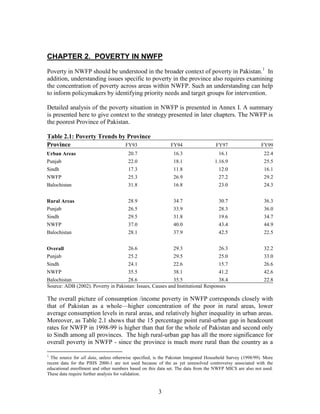
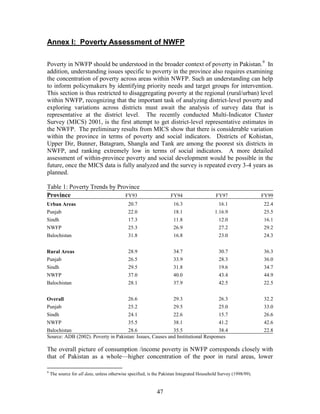
Table 2.1: Poverty Trends by Province 
Province 
FY93 
FY94 
FY97 
FY99 
Urban Areas 
20.7 
16.3 
16.1 
22.4 
Punjab 
22.0 
18.1 
1.16.9 
25.5 
Sindh 
17.3 
11.8 
12.0 
16.1 
NWFP 
25.3 
26.9 
27.2 
29.2 
Balochistan 
31.8 
16.8 
23.0 
24.3 
Rural Areas 
28.9 
34.7 
30.7 
36.3 
Punjab 
26.5 
33.9 
28.3 
36.0 
Sindh 
29.5 
31.8 
19.6 
34.7 
NWFP 
37.0 
40.0 
43.4 
44.9 
Balochistan 
28.1 
37.9 
42.5 
22.5 
Overall 
26.6 
29.3 
26.3 
32.2 
Punjab 
25.2 
29.5 
25.0 
33.0 
Sindh 
24.1 
22.6 
15.7 
26.6 
NWFP 
35.5 
38.1 
41.2 
42.6 
Balochistan 
28.6 
35.5 
38.4 
22.8 
Source: ADB (2002). Poverty in Pakistan: Issues, Causes and Institutional Responses 
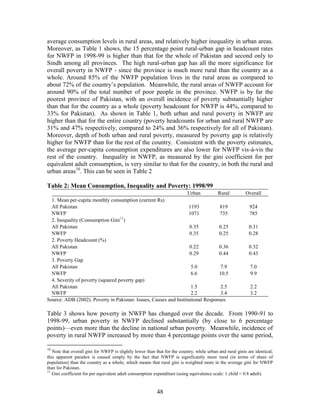
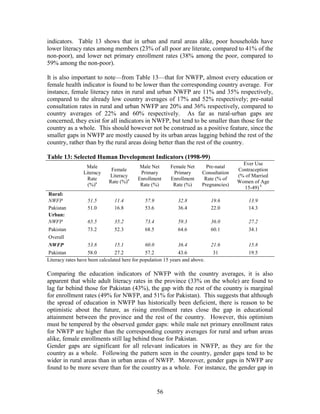
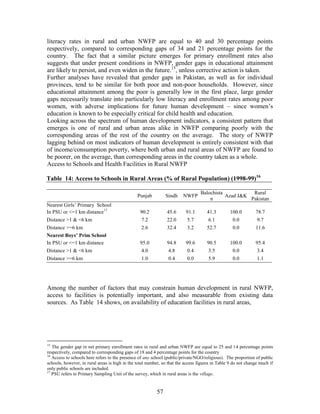
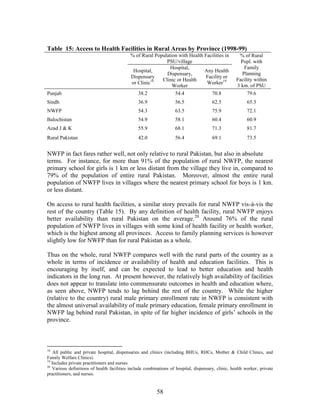
The overall picture of consumption /income poverty in NWFP corresponds closely with that of Pakistan as a whole—higher concentration of the poor in rural areas, lower average consumption levels in rural areas, and relatively higher inequality in urban areas. Moreover, as Table 2.1 shows that the 15 percentage point rural-urban gap in headcount rates for NWFP in 1998-99 is higher than that for the whole of Pakistan and second only to Sindh among all provinces. The high rural-urban gap has all the more significance for overall poverty in NWFP - since the province is much more rural than the country as a 
1 The source for all data, unless otherwise specified, is the Pakistan Integrated Household Survey (1998/99). More recent data for the PIHS 2000-1 are not used because of the as yet unresolved controversy associated with the educational enrollment and other numbers based on this data set. The data from the NWFP MICS are also not used. These data require further analysis for validation.
4 
whole. Around 85% of the NWFP population lives in the rural areas as compared to about 72% of the country’s population. Meanwhile, the rural areas of NWFP account for around 90% of the total number of poor people in the province. NWFP is by far the poorest province of Pakistan, with an overall incidence of poverty substantially higher than that for the country as a whole (poverty headcount for NWFP is 44%, compared to 33% for Pakistan). As shown in Table 1, both urban and rural poverty in NWFP are higher than that for the entire country (poverty headcounts for urban and rural NWFP are 31% and 47% respectively, compared to 24% and 36% respectively for all of Pakistan). Moreover, depth of both urban and rural poverty, measured by poverty gap is relatively higher for NWFP than for the rest of the country. Consistent with the poverty estimates, the average per-capita consumption expenditures are also lower for NWFP vis-à-vis the rest of the country. 
High Rural Poverty 
The overall picture of consumption /income poverty in NWFP corresponds closely with that of Pakistan as a whole—higher concentration of the poor in rural areas; lower average consumption levels in rural areas; and, relatively higher inequality in urban areas There is a 15 percentage point rural-urban gap in headcount rates estimated for NWFP in 1998-99. This is higher than that for the whole of Pakistan and second only to the Sindh province. The high rural-urban gap has all the more significance for overall poverty in NWFP - since the province is much more rural than the country as a whole. Around 85% of the NWFP population lives in the rural areas as compared to about 72% of the country’s population. Moreover, the rural areas of NWFP account for around 90% of the total number of poor people in the province. 
NWFP Poorest Province of Pakistan 
NWFP is by far the poorest province of Pakistan, with an overall incidence of poverty substantially higher than that for the country as a whole (poverty headcount in 1998-99 for NWFP is 43% as compared to 33% for Pakistan). Both urban and rural poverty in NWFP are higher than that for the entire country (poverty headcounts for urban and rural NWFP are 31% and 47% respectively, compared to 24% and 36% respectively for all of Pakistan). Moreover, the depth of both urban and rural poverty, measured by the poverty gap is relatively higher for NWFP than for the rest of the country. Consistent with the poverty estimates, the average per-capita consumption expenditures are also lower for NWFP vis-à-vis the rest of the country. 
Inequality in NWFP, as measured by the gini coefficient for per equivalent adult consumption, is very similar to that for the country, in both the rural and urban areas. Note that overall gini for NWFP is slightly lower than that for the country, while the urban and rural ginis are identical. This apparent paradox is caused simply by the fact that NWFP is significantly more rural (in terms of share of population) than the country as a whole, which means that the rural gini has a larger weighted in the average gini for NWFP than for Pakistan.
5 
Poverty Trends in NWFP 
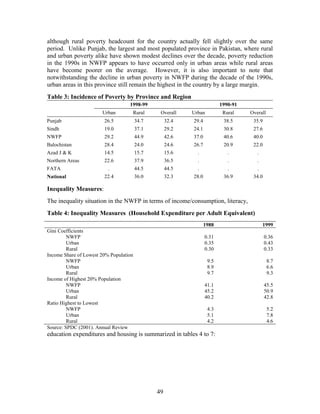
Poverty in NWFP has changed over the decade. The trends are very mixed. In comparing 
1990-91 to 1998-99, urban poverty in NWFP appears to have declined substantially (by 
close to 6 percentage points)—even more than the decline in national urban poverty. 
Meanwhile, the incidence of poverty in rural NWFP seems to have increased by more 
than 4 percentage points over the same period; although the rural poverty headcount for 
the country actually fell slightly over the same period. Poverty reduction in NWFP when 
comparing the estimates for 1990-1 with those for 1998-99 appears to have occurred only 
in urban areas while rural areas have become poorer on the average. However, it is also 
important to note that notwithstanding the decline in urban poverty in NWFP during this 
period the urban areas in this province still remain the poorest in the country by a large 
margin. And even more alarming is the fact that if there is a comparison between 1993 
and 1999 then the available evidence indicates a dramatic and consistent worsening of 
poverty in NWFP in both the rural and urban sectors. [Figure 2.1]. 
Figure 2.1: The Continuously Deteriorating NWFP Poverty Situation 1993 to 1999 
Characteristics of Poverty 
Several Characteristics of poverty in NWFP based on the available research are listed 
below: 
• NWFP faces difficult challenges due to its geography, history and location 
• NWFP is the poorest Province of Pakistan 
• NWFP has poor social indicators and highest gender disparity 
• Gender gaps are significant for all socio-economic indicators in NWFP 
• Gender gaps tend to be wider in rural areas than in urban areas of NWFP. 
• Gender gaps in NWFP are found to be larger than for the country as a whole 
26.6 
29.3 
26.3 
32.2 
35.5 
38.1 
41.2 
42.6 
0.0 
5.0 
10.0 
15.0 
20.0 
25.0 
30.0 
35.0 
40.0 
45.0 
FY93 FY94 FY97 FY99 
Pakistan NWFP
6 
• Land ownership in rural NWFP is less concentrated than for the rest of the country, and there is prevalence of small landholdings, low agriculture productivity and high rural poverty 
• A large proportion of the paid employees in the urban sector of NWFP are engaged as wage labor in the informal sector, which is a significant employer in urban areas. 
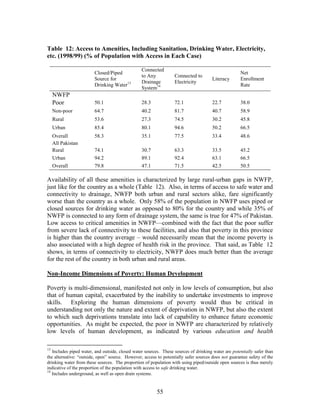
• The poor have relatively low access to safe drinking water and sanitation facilities 
• Availability of safe drinking water and sanitation facilities is characterized by large rural-urban gaps in NWFP. 
• In terms of access to safe water and drainage in NWFP both urban and rural sectors alike fare significantly worse than the country as a whole 
• NWFP has a limited resource base 
• Province’s own revenues are low and its fiscal position has deteriorated during 1990s 
• Province’s financial management has remained weak 
• Much of province’s economic potential is still unexploited – while this is at present a major weakness it also offers a major opportunity in the future. 
Correlates of Poverty 
Several correlates of household characteristics and income poverty can be established from the available research for the NWFP: 
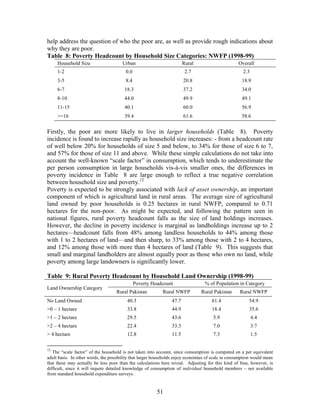
• The poor are more likely to live in larger households 
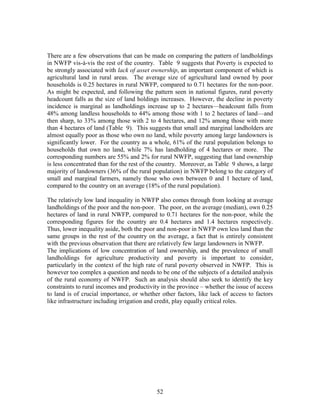
• Poverty is associated with lack of asset ownership. The average size of agricultural land owned by poor households is 0.25 hectares in rural NWFP, compared to 0.71 hectares for the non-poor 
• Rural poverty headcount falls as the size of land holdings increases 
• Small and marginal landholders are almost equally poor as those who own no land, 
• Poverty among large landowners is significantly lower 
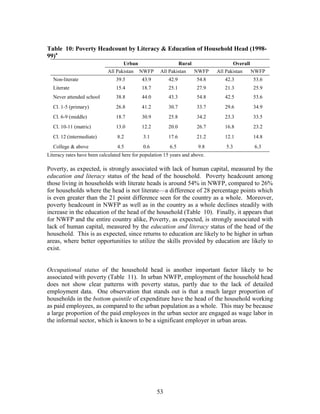
• Poverty, is strongly associated with lack of human capital, measured by the education and literacy status of the head of the household 
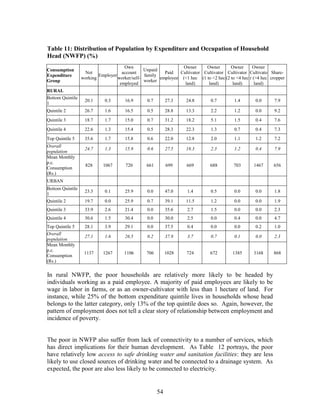
• In urban NWFP, employment of the household head does not show clear patterns with poverty status, partly due to the lack of detailed employment data. 
• However, a much larger proportion of households in the bottom quintile of expenditure have the head of the household working as paid employees, as compared to the urban population as a whole. 
• In rural NWFP, the poor households are relatively more likely to be headed by individuals working as a paid employee 
These correlations along with the characteristics of poverty listed above provide the indicative framework for the effective targeting of scarce resources within the poverty reduction strategy for NWFP.
7 
The Multiple Indicator Cluster Survey 
Geographic targeting provides a method for improving the efficiency of resource use for poverty reduction. Resources can be assigned on the basis of district ranking. In order to collect information on key social and economic indicators at district level, the government of NWFP, through the Planning and Development Department (P&DD) and support from UNICEF conducted a household survey (Multiple Indicators Cluster Survey MICS) from September to December 2001. A total of 13,076 households drawn from 873 primary sampling units of which 223 were urban and 650 rural were interviewed. This survey is the first attempt to get district-level representative estimates in the NWFP. This survey collected data on wide range of indicators concerning children and women. Indicators comprise income, infant and under-five child mortality, under nutrition, education, adult literacy, water and sanitation, ante-natal and birth care, birth registration, feeding patterns, young child recent illness and cost of treatment, and use of contraceptives and awareness of HIV/AIDS. The aims of this survey were: 
• To establishes a credible baseline for monitoring socioeconomic status of districts at the start of the new decade and devolution process 
• To develop ranking of districts to highlight the inter-district disparities in social and economic indicators so as to be able to address these through appropriate district level social sector planning efforts by the provincial government. 
• To provide information on the situation of children and women, as well as child- focused benchmarking for measuring progress in post devolution era and for reporting on the World Summit Goals for Children. 
• Rectify data gaps in information systems from national surveys and sectoral databases; and address gender disparities and lack of uniformity in resource distribution among districts. 
• Building capacity of relevant government institutions, especially the provincial Bureau of Statistics, through their active involvement in all the phases of the survey. 
Based on the data of this survey, Table 2.2 below presents ranking of districts based on six key indicators: infant mortality, primary school enrolment, adult literacy, water and sanitation and income per day per capita. The results from MICS show that there is considerable variation within the province in terms of poverty and social indicators. Districts of Kohistan, Upper Dir, Bunner, Batagram, Shanga and Tank are among the poorest six districts in NWFP, and ranking extremely low in terms of social indicators. 
The composite rank is the weighted sum of all ranks for these six indicators. The composite rank indicates that Haripur is the least deprived district while Kohistan is the most deprived district of NWFP. Looking at other indicators, this table shows that Kohistan ranked lowest for 5 out of the six indicators. Haripur remained on top for infant mortality while for safe water it ranked 14. Bannu was observed to be number 1 for the use of safe water. However, for all the othert indicators it is amongst the most deprived.
8 
For enrolment and literacy, Abbotabad was the top ranked district. Peshawar ranked number 1 and Shangla ranked lowest in terms of urban population. 
At the research level there are two major issues that require immediate attention for devising an effective poverty reduction strategy. The low agricultural productivity in NWFP combined with the smaller landholding size and the lower inequality of landholding needs to be examined in depth. Such an analysis should also seek to identify the key constraints to rural incomes and productivity in the province – whether the issue of access to land is of crucial importance, or whether other factors, like lack of access to factors like infrastructure including irrigation and credit, play equally critical roles. 
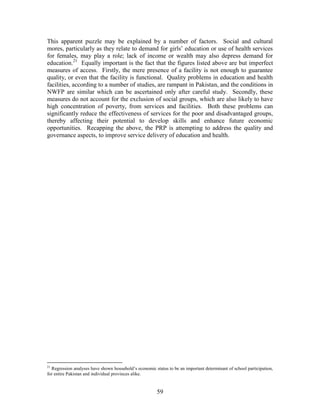
Also at present the relatively high availability of health and education facilities in the NWFP does not appear to translate into commensurate outcomes in health and education. NWFP tends to lag behind the rest of the country in these outcomes. While the higher (relative to the country) rural male primary enrollment rate in NWFP is consistent with the almost universal availability of male primary education, female primary enrollment in NWFP lag behind rural Pakistan, in spite of the far higher incidence of girls’ schools in the province. 
Table 2.2: NWFP- Summary results of districts by Rankings 
District 
Combined rank 
Infant mortality 
Enrolled in primary school 
Adult literacy 15+ 
Use of safe water 
Adequate toilet 
Average income per day per capita 
Urban pop 
Haripur 
1 
1 
2 
2 
14 
2 
3 
12 
Abbotabad 
2 
6 
1 
1 
12 
4 
4 
7 
Malakand 
3 
2 
3 
7 
4 
8 
8 
15 
Kohat 
4 
7 
6 
3 
10 
5 
1 
2 
Mansehra 
5 
5 
4 
5 
17 
14 
7 
19 
Peshawar 
6 
4 
13 
6 
3 
3 
12 
1 
Nowshehra 
7 
8 
7 
10 
7 
6 
11 
3 
Mardan 
8 
12 
5 
11 
6 
13 
9 
5 
Karak 
9 
3 
14 
4 
11 
19 
15 
17 
Chitral 
10 
11 
6 
8 
15 
1 
18 
13 
Hangu 
11 
10 
16 
14 
16 
9 
5 
4 
Swabi 
12 
18 
9 
13 
8 
12 
10 
8 
Bunner 
13 
9 
20 
22 
19 
18 
2 
22 
Lower Dir 
14 
15 
10 
17 
21 
22 
6 
18 
Swat 
15 
21 
11 
9 
9 
7 
17 
11 
D I Khan 
16 
17 
17 
19 
2 
10 
13 
10 
Charsadda 
17 
13 
15 
16 
18 
20 
14 
6 
Bannu 
18 
16 
19 
12 
1 
16 
20 
16 
Lakki Marwat 
19 
14 
21 
15 
5 
15 
22 
14 
Tank 
20 
20 
18 
18 
13 
17 
21 
9 
Batgram 
21 
23 
12 
21 
20 
21 
16 
21 
Upper Dir 
22 
19 
22 
23 
23 
23 
19 
20 
Shangla 
23 
22 
23 
20 
22 
11 
24 
24 
Kohistan 
24 
24 
24 
24 
24 
24 
23 
23 
Source: District-based Multiple Indicators Cluster Survey (2001)
9 
This apparent puzzle may be explained by a number of factors. Social and cultural mores, particularly as they relate to demand for girls’ education or use of health services for females, may play a role; lack of income or wealth may also depress demand for education.2 Equally important is the fact that the figures listed above are but imperfect measures of access. Firstly, the mere presence of a facility is not enough to guarantee quality, or even that the facility is functional. Quality problems in education and health facilities, according to a number of studies, are rampant in Pakistan, and the conditions in NWFP are similar which can be ascertained only after careful study. Secondly, these measures do not account for the exclusion of social groups, which are also likely to have high concentration of poverty, from services and facilities. Both these problems can significantly reduce the effectiveness of services for the poor and disadvantaged groups, thereby affecting their potential to develop skills and enhance future economic opportunities. Females are a largely disadvantaged group in the NWFP. There is a large gender gap in the NWFP in terms of both the level and access to opportunity, empowerment and security considered essential for reducing poverty. 
Focusing on the Large Gender Gap 
The gender gap can be monitored through the present level of indicators in NWFP for females versus males. A selected number of indicators has been presented in the following table. Ideally, the Female/Male ratio should be 100% and the Male-Female gap should be zero. In general, the lower the Female/Male ratio or the larger the Male-Female number, the wider is the gender gap. When the Female/Male and Male-Female indicators obtain values of greater than 100% and negative, respectively, then the incidence among female population is higher than male population. From the table below it can be observed that the number of underweight female children is higher than the number of underweight male children. This category applies to under-five children. Again, this is a gender gap in favour of the male under-five population. All the indicators noted below point to the fact that the female population has greater barriers to physical and mental development than the male population. Thus, focusing on strategies to address this issue becomes urgent in NWFP. 
Table 2.2: NWFP Gender Gap in Key Indicators 
Indicator 
Female/Male 
Male - Female 
Adult Literacy rate (15 years +) 
36.7% 
36.4% 
Net primary school enrolment 
72.7% 
12% 
Immunization (BCG scar)* 
94.0% 
4.2% 
Children reaching grade 5 
98.5% 
1% 
Underweight (-2SD) under 5 years of age 
108.0% 
-3% (negative 3%) 
Source: “NWFP, A District-based Multiple Indicators Cluser Survey, 2001”; GoNWFP, PDD, May 2002.*Data analyzed and presented from original data set by UNICEF; disaggregated data not present in the MICS report. 
Considering the district data from the MICS report, Kohistan district has the widest net primary school enrolment gap (Female/Male = 48%; Male – Female = 11%) and 
2 Regression analyses have shown household’s economic status to be an important determinant of school participation, for entire Pakistan and individual provinces alike.
10 
Abbotabad has the lowest gap (Female/Male = 96%; Male – Female = 3%). Considering adult literacy rates, Kohistan district has the widest gap (Female/Male = 10.2%; Male – Female = 21.4%) and Abbotabad has the lowest gap (Female/Male = 57.7%; Male – Female = 33.1%). 
When adult literacy rates are compared to net primary school enrolment, the improving situation of gender gap can be observed. Therefore, it can be forecasted that the adult literacy gap will be closed as time passes. When implementing the strategies addressed to education and adult literacy, this fact will be taken into consideration. 
At the same time, the large variation in the gender gap between Kohistan district and Abbotabad indicates that further district level analysis on strategies should be undertaken at the time of implementation. Obviously, in areas or districts where gender disparity represented by Female/Male ration is 50% lower (a 50% ratio indicates there are twice as many males than females in this category) accelerated strategies for closing the gap should be followed. The adult literacy gender ratio of 10.2% quoted above indicates that there are 10 times more literate men than women. 
The Poverty Reduction Strategy therefore attempts to address the quality and governance aspects, to improve service delivery of education and health with a special focus on reducing the gender disparities.
11 
CHAPTER 3. PRSP DIALOGUE 
In preparing the Poverty Reduction Plan during 2000-2001 the government of NWFP held extensive consultations with NGOs, donors and other stakeholders. However, the NWFP Government did not discuss and/or disseminate the PRP program to the new District Nazims, Councilors, and district officials. It was waiting for them to settle into their new roles. 
This process of consultation at the local level was finally initiated in December 2002 when SWOT (Strengths Weaknesses, Opportunities and Threats] analysis was initiated at two levels. Templates and instructions were issued to all DCOs to involve the devolved elected local Government and elected officials and other stake-holders in the consultative process. Discussions were also initiated with all the heads of sections within the Planning and Development Department of the Government of the NWFP and the Chief Planning Officers of the key departments in order for them to initiate discussions at the sectoral levels with all key stake-holders. The intention was to initiate dialogue with the new district governments and all levels of civil society to ensure that the detailed sectoral strategies and investment programs contained in the PRSP fully reflect the district government priorities. This was extremely essential to engender ownership of the reform objectives. 
As part of this initiation program presentations on the determinants and dynamics of poverty in NWFP and the key elements of the Poverty Reduction Plan were presented to the Section Chiefs of the P&D Department and the Chief Planning officers of the line ministries and to all the DCOs and elected Nazims and other officials of the local Governments who were invited to Peshawar for discussion in mid January 2003. 
The response was significant. All the participants welcomed the process and stressed the need to define their own strategies of poverty reduction based on their own perceptions of poverty. Based on this response there is even more reason for the consultative process to be made an ongoing process for monitoring and evaluation and be given the highest priority to ensure effective ownership and sustainability of the poverty reduction strategy. 
Detailed guidance notes as well as an instrument based on the SWOT (strengths, weaknesses, opportunities, threats) framework was also circulated to every DCO in the province requesting that consultative workshops for stakeholders be organized in each district. The objective was to bring stakeholders from all segments of civil society into the PRSP formulation discussions in order to determine the strengths, weaknesses, opportunities and threats facing the districts as well as to suggest key interventions to increase opportunity, security and empowerment of the people. These latter three aspects are based on international experience, considered to be essential for any effective poverty reduction strategy. 
The DCO led consultations with the elected officials and the representatives of civil society were held in every district. And following the meeting held in Peshawar to which
12 
all the DCOs in the Province as well as the District Nazims were invited it was decided to conduct a series of larger stakeholder consultations in the selected districts to be facilitated by the PRSP consultant and his team of experts. These consultative workshops were held in five districts namely, Peshawar, Mardan, Swabi, Dir and Mansehra during February 2003. 
Earlier in January 2003, a meeting was also held in Peshawar with the Federal Secretary, Economic Affairs Division coordinated by the Additional Chief Secretary Development. The Federal Coordinator of the PRSP Program also attended. All the Provincial Secretaries of the key line departments in the province attended. This meeting provided the general direction and agreement on the salient features of the PRSP 
The completed SWOT instruments from the consultations in all the Districts as well as the results from the five extended workshops in the selected districts were analyzed and integrated into the PRSP. 
The main results of the assessment of the Strengths weaknesses opportunities and threats from these consultations are summarized below: 
The main strengths listed by the stakeholders during the consultative workshops included: 
 Innovative and hardworking manpower 
 Rich Mineral resources 
 Abundant Hydel resources 
 Fertile land; and 
 Horticulture including fruits vegetables and rare medicinal herbs and livestock. 
The main opportunities were seen in the areas of: 
 horticulture and vegetable production and value-added processing 
 mineral and natural resource exploitation and processing within the province 
 the use of the hydel resources as a source of power for small and medium scale industry and for small scale power generation 
 dairy and livestock development 
 tourism and 
 the opportunities arising out of the Afghan reconstruction. 
The main weaknesses that came up in the discussions included: 
 extreme poverty 
 Inadequate resources given size of poverty problem 
 high population growth 
 pressure of Afghan refugees 
 high population pressure on good agricultural land 
 high population pressure development and social sector resources 
 Great geographic and development diversity across regions both with and across districts Poor exploitation of natural resources including wate
13 
 Low quality and coverage of infrastructure 
 Poor quality drinking water in a number of districts and urban areas 
The threats were seen to come mainly from: 
 poor governance 
 poor understanding of the rights and responsibilities under the Devolution Plan 
 Inadequate functioning of the local government system 
 lack of effective district to province and province to center coordination 
 high refugee population 
 drought 
These SWOTS formed the basis of the interventions suggested by the consultative process. These are discussed at the end of the next section. It is expected that this process of consultation will continue over time and that regular two-way flow of information from the provincial P&D Department to the districts and from the districts back to the P&D Departments will take place on a continuous basis. Such a two-way flow of information is absolutely essential for the monitoring and evaluation of the overall poverty reduction strategy.
14 
CHAPTER 4. THE POVERTY REDUCTION SRATEGY (PRS) 
Background 
The Government started to address the multiple social and economic problems during 2000, with varying degrees of success. Recognizing that many of the problems were interdependent and needed a more systematic approach, the Government of the NWFP decided to develop a comprehensive reform program for the province. For this purpose, it prepared a strategy document, the Provincial Reform Program (PRP) 2001-2004, which was discussed extensively with various agencies, including the World Bank. The proposed program was approved by the NWFP Cabinet in June 2001. Several of the PRP reform measures were incorporated in the FY02 Budget and reflected in the Budget White Paper and other documents. NWFP was the first province to embark on such a comprehensive reform program. That on going PRP forms the core of the Provincial PRSP. Moreover the Government of NWFP has committed to a structural adjustment program to bolster this medium term plan. Elements of the Structural Adjustment Program are presented in Annex II. This lists the actions taken so far as well as those planned over the medium term 2003-2005 for each one of the key poverty reducing interventions. 
With the coming into power of an elected Government in 2002 it was imperative that that the commitments made for the medium term i.e. 2003-2005 be ratified as quickly as possible. No strategy can be effective without political commitment. On April 5, 2003 the PRSP for the NWFP was presented before the Senior Minister and the Health Minister as well as the Secretaries of the key line Ministries. What is presented below has the approval of the Senior Minister and is based on the assumption that the political consensus exists to carry forward the commitments made in the past two years. In all strategic planning of an economic nature the crucial assumption is cetirus paribus i.e. all other things being equal. 
The overarching objective of the Poverty Reduction Strategy Paper for the NWFP is to restore good governance and the respect for the rule of law, enhance the effectiveness of public expenditures, re-establish the integrity of state institutions and their accountability to the public. These objectives are in line with the goals of the I-PRSP for Pakistan [see Annex III]. The PRSP for the NWFP has the following five main pillars with strengthening governance to improve public service delivery as the cross cutting theme: 
1. Governance reforms to achieve an efficient, accountable, and service oriented civil service; 
2. Reforms to improve service delivery in key sectors (especially basic health, education and social services); 
3. Fiscal and financial management reforms to improve governance in budget and financial management, adopt a medium term budget framework (MTBF), enhance
15 
effectiveness and accountability of expenditures, and strengthen resource mobilization; and 
4. Promoting Sustainable growth. 
5. Addressing Vulnerability to Shocks 
A prosperous and stable NWFP is geographically and economically critical to Pakistan’s well being. In addition, there is a consensus among the policy makers and civil society that a more literate and healthy population would enhance job opportunities within and outside the province, and mitigate the risks for extremism. Recently, the Government of Pakistan, together with the governments of NWFP and Balochistan, has initiated preparation of a federally funded development program to address the under development of the areas bordering Afghanistan. The majority of the populated border areas fall in NWFP. These areas are amongst the poorest in NWFP, and the program is intended to provide resources for physical infrastructure, social services, and income generating activities. Moreover, the Federal and the NWFP government have also formulated a long- term program to mainstream the tribal areas – politically, legally and constitutionally – with the rest of the country. 
A) Strengthening Accountability and Professionalism of State Institutions 
Decades of neglect and decay took their toll on governance in the province, as in the rest of the country. The result has been excessive staff, poor compensation (especially at higher levels), declining quality of civil servants, over-centralization of decision-making, complaints of widespread corruption and malfeasance, poor management systems, and cumbersome and costly procedures. These are complex issues that would take a long time to address. The Government of NWFP has therefore drawn up a phased and realistic program to achieve its objectives in this area. 
Devolution and Civil service Reforms 
Objectives and Strategy. The objectives of the devolution and civil service reforms are to increase the efficiency of government operations, make them more accountable to users, effective in delivering public services, and raise the level of competence and integrity of government officials. Government strategy to achieve these objectives is to fully implement the devolution of power, decentralize functions and operations, reduce staff at the provincial level, tighten the system of accountability, reorganize functions and departments at the provincial level, improve recruitment and make promotions more performance based, simplify procedures, and computerize business process. 
Recent Reforms. The restructuring and rightsizing of provincial government, including administrative and operational aspects of the Devolution, have been largely completed. In regards to devolution, the required staff (around 200,000 out of total 280,000 provincial employees) has been assigned to district governments3; and district budgeting 
3 Eventually most of these staff would become district government employees. For now they are provincial employees, but their postings and performance evaluation is now down by district governments.
16 
and most other non-policy functions have been transferred to the districts. The district Rules of Business have been prepared, training of elected representatives and staff has been instituted, local government contract rules have been notified, and district accounts have been established. In regards to rightsizing, the Government of NWFP has restructured 26 provincial departments, merging several departments, closing autonomous bodies and several specialized agencies, thus streamlining and downsizing the departmental structure and refocusing it according to new functions. Consequently on the basis of identified redundancies, over 6,000 employees have been placed in a surplus pool, many of whom have been assigned to districts. 
Recruitment, promotion, and transfer policies have been revised and the key institution managing them strengthened. The provincial Public Service Commission (PSC) has been strengthened and made more autonomous, through appropriate changes in its legislation and government’s administrative and Financial Rules. The PSC has been made fully responsible for all recruitment of officials of officer grade. Institutional mechanisms have been put in place to make recruitment and promotion merit- and performance-based. The existing contract employment policy is being revised with a view to making all task- and location-specific positions subject to contract employment. The Government is continuing its freeze on new hiring, except for social sector delivery staff such as teachers; and the compulsory retirement rules have been amended to facilitate retiring of redundant or incompetent officials. 
Far reaching Judicial Reforms have been initiated. The judicial and executive functions have been legally separated. The judiciary has been made autonomous in matters of recruitment of judicial officials and financial aspects, which is a significant step in enhancing the independence of the judiciary. 
Several institutional reforms and capacity building programs have been initiated. These include: (i) the Essential Institutional Reform Operationalization Project (EIROP) funded by UNDP, SDC and GTZ, was initiated in March 2001 to assist with human resource (HR) and institutional reform and support capacity building and training at the district level. The EIROP will be implemented over three years; (ii) with DFID support, a training program for the new elected representatives and officials has been launched at district and lower levels. In phase I, all union councilors were trained. A special program of training women councilors is planned shortly. The government has started training of district government functionaries in Financial Management, Budgeting, and Development Planning. It has also launched a program of IT training; and (iii) cognizant of the huge capacity building needs, especially to implement the PRP and the expanded social sector programs, the government has initiated a review of unmet capacity needs. It has already decided to establish the Education and Health Sector Reforms Units, the Budget Analysis Unit, and the overall Economic Reforms Unit. In addition, the government has approved a comprehensive three-year capacity building program to strengthen the managerial and technical capacity of provincial and district officials. 
Medium-Term Reforms. Over the medium term, the Government plans to continue to implement the reforms under way and further intensify them. Among the planned actions
17 
are: (i) implementing the expanded capacity building program; (ii) developing a HR database using computerized payroll data and by conducting a civil servants census; (iii) reviewing and adjusting the restructuring, downsizing, and personnel management measures; (iv) strengthening district government staffing and staff training; (v) completing district rules of business and codes; (vi) establishing courts for small causes and family disputes; (vii) establishing public safety and accountability commissions/offices at the provincial and district levels; (viii) appointing separate senior officials to handle public complaints against officials; and (ix) establishing a Local Government Commission to oversee performance of district governments. The ongoing and planned reforms are expected to have a significant impact in terms of increasing the efficiency, effectiveness, and integrity of the civil service, as well as making it more responsive to people’s needs through devolution and administrative decentralization. 
Anti-Corruption Initiatives 
The government has moved aggressively on anti-corruption by sending a clear signal that no one is above the law, and taking steps to reduce corruption in the future. Anti- corruption rules have been simplified to make disciplinary actions easier to implement. Better enforcement has resulted in the initiation of 2240 disciplinary cases since 1999 (compared to a similar number in the last decade), over half of which have been decided. In addition, it has dismissed or suspended about 300 education department employees (including teachers) for negligence and prolonged absence from duties. 
B) Accelerating Human Development 
Social Asset Creation: 
Impoverished communities usually do not have access to basic social services. They need the support of the government to be able to raise their children in a healthy and productive environment. Today’s children are parents to the next generation, thus, if they are not properly supported through social assets such as health facilities and primary schools, they become transmitters of poverty. In a vicious cycle, malnourished girls grow up to become malnourished mothers who give birth to underweight babies, parents lacking access to crucial information are unable to optimally feed and care for their children; and illiterate parents cannot support children in their learning process. Children are often hardest hit by poverty. It causes lifelong damage to their minds and bodies. They are therefore likely to pass poverty on to their children, perpetuation the poverty cycle. 
The provincial government strategy with respect to social asset creation for the poor includes support to establishment of primary schools, primary health facilities, safe water points, communal latrines and capacity building of established entities that work with the communities, such as the Lady Health Workers (LHW). Special attention will be given to the welfare and access of poor children within this strategy. Nutritional needs of the population will be addressed within this strategy. One of the major strategies of the
18 
government is to break this cycle of poverty through creating social assets that is accessible to the poorest of the poor, the vulnerable groups, women and children. 
Investments in children today will help lay a solid foundation for sustained and equitable economic growth in the future. Attainment of sustained rapid economic growth is not possible with high levels of illiteracy, malnutrition and morbidity. Therefore social asset creation for the poor, economic and social reform go hand in hand in to ensure a strategy that will alleviate poverty for the population successfully and in a sustainable manner. 
A major thrust of the Government’s reform effort is to improve the delivery of human development services to turn around the current situation and have a lasting impact on productivity, equity, poverty, and social support system. These efforts are in tandem and complementary to the financial and governance reforms that would have a positive impact on improved delivery of various government services, through increased resources, efficiency, and responsiveness of the system. The important reforms in the delivery of social services and delivery of community infrastructure services are discussed below. 
Education 
The education indicators in the province are still relatively low, the main reasons for which are: inadequate financial resources; physical inaccessibility of many areas; poorly trained and ill-paid teachers; general decay in educational standards in the country; inadequate supply of instructional materials in schools; poor physical facilities in schools; weak accountability, institutional capacity and management of the educational system; and lack of community involvement in school affairs. 
Objectives and Strategy. The Provincial Reform Program has made educational improvement the foundation for achieving longer-term economic development and poverty alleviation in the province. “Education is the first priority, second priority and third priority of the government” according to the Government of NWFP. The Government’s medium-term objectives in the sector are to: 
(i) improve primary education (both enrollment and quality of instruction); 
(ii) reduce gender and rural-urban disparities; and 
(iii) expand the capacity at the secondary school level. 
These objectives will be achieved by increasing resource allocation to the sector, allocating more resources to female education, upgrading the quality of instruction and teacher training, improving the management structure, implementing devolution, and increasing community and private sector involvement. In May 2002, the government approved a comprehensive medium-term reform program, which builds upon and strengthens the reform program developed in 2001 under the PRP and reflects higher budgetary allocations included in the MTBF for FY03-05.
19 
Recent Reforms. The highest priority is being given to improving quality and access by taking the following measures: 
Approving a comprehensive province-wide staff and facility rationalization plan which would serve as a basis for needs-based recruitment, rationalization of facilities to reduce inefficiencies, and redeployment to ensure every primary school meets the targeted teacher student ratio of 1:30. As part of this rationalization plan, recruitment for 2,100 additional teachers has been approved for immediate deployment to schools without adequate teachers; addressing teacher absenteeism by deploying teachers to their home districts and facility-specific contract recruitment; introducing a results-based teacher evaluation and reward system and initiating a province-wide periodic student assessment system as part of the National Education Assessment System (NEAS), which would be fully funded in the FY03 budget. 
Strengthening of teacher training programs; The institutional and management reforms comprising bifurcation of the provincial education department into lower and higher level education; Creating separate teaching and management cadres, the latter is meant to establish a professional school managerial cadre; Introducing computer literacy and English-medium instruction on a pilot basis; Introducing textbook deregulation for Classes 9-12, and developing a road map for expanding this initiative to the primary sector, to allow for more efficient and competitive printing and publishing of textbooks. 
Establishing clear criteria for the establishment/construction of primary schools and up gradation of schools, in order to strengthen transparency of decision making and ensure that decisions are in line with sector goals; and Establishing an Education Sector reform Unit and staffing it to monitor and oversee progress in implementation of reforms. 
Public-private partnerships and community involvement is being encouraged through: 
Initiating a program to encourage private sector to use unoccupied government buildings for establishing schools; restructuring the Frontier Education Foundation which supports NGOs providing education, to make it autonomous and expand its activities to promote public-private partnership with adequate linkages with the Departments of Education; 
strengthening parent-teacher associations (PTAs) in almost all 20,000 primary schools; and providing funds for instructional materials and minor repair (IM&R) to individual schools through the PTAs. 
The monitoring and supervisory mechanisms have been strengthened. Circle Teams have been designated to carry out field visits every two weeks to monitor absenteeism and availability of inputs at the facility level based on the new monitoring forms. The reports are reviewed monthly at the district level, and will now be reviewed quarterly by the Education Minister. The government views these steps as supplementing the citizen/community oversight and accountability arrangements built into the devolution plan. These are viewed as the only sustainable and effective way to monitor agency performance. In addition, the Education Management Information System (EMIS) would be fully funded in the regular budget, starting in FY03.
20 
Steps have been taken to reduce gender disparity. The FY02 budget allocated 70% of the sector’s development budget to girls’ schools, and innovative incentive schemes are being developed to increase girls; enrollment. A major primary school facility upgradation program is being initiated to ensure that essential missing physical facilities (such as toilets, boundary walls, electricity) are provided to 100% of girls schools by end- FY03. 
The allocation for education has been increased significantly. Expenditures on education have increased by 27% from Rs. 6.9 billion in FY 99 to Rs. 8.8 billion in FY01. Expenditures have been reallocated toward primary and secondary education and vocational training (including teacher training and away from tertiary and university education. User charges from higher education, which have historically been very low, were increased by around 20% in FY01. 
Medium-Term Reforms. Over the medium term, the Government plans to take the following actions: 
• Increase allocations by over 73% from Rs. 8.5 billion in FY02 to Rs. 14.7 billion in FY05, including increasing instructional materials and minor repair allocations several folds; 
• Complete the management reforms to implement the process of district-based management, separation of teaching ad management staff, and training of staff; 
• Complete the teacher redeployment, and facility rationalization based on the approved staff and facility rationalization plan; 
• Expand school capacity in partnership with the private sector and communities and continue the strengthening of PTAs; 
• Provide essential physical facilities in all primary schools, especially for girls, and continue the policy of larger allocation of development funds for girls’ schools; 
• Deployment of teachers in home districts and location-based new recruitment, and in-service teacher training; 
• Consolidate performance-based teacher evaluation and compensation, and the province-wide student assessment system; 
• Continue textbook de-regulation; 
• Expand secondary school capacity, PTAs for secondary schools, and school facilities for computer literacy; 
• Establish primary schools in seriously deficient districts; 
• Further increase in higher education user charges; and 
• Continue to strengthen the monitoring and supervision system including the commission of a regular third party user and facility survey in October 2002, and annually thereafter, for independent monitoring of, among others, service delivery indicators. 
The impact of these wide-ranging reforms is expected to be substantial. By the end of FY05, the overall primary school enrolment is expected to increase by 15%, with girls’
21 
enrolment increasing by 30%.4 By the end of FY03, 100% of girls’ schools would have basic physical facilities (such as toilets and boundary walls), and 100% of boys’ schools will achieve the target by end of FY05. Serious gaps in school capacity in remote areas would have been remedied. The quality of teachers, instruction, and student achievement are also expected to be significantly higher by FY05. 
Health 
Underlying the low level of health indicators are inadequate and uneven availability of primary health facilities, poorly staffed and stocked clinics, unplanned expansion of facilities, inadequate allocations which are heavily skewed towards the tertiary health care, and high incidence of preventable diseases. 
Objectives and Strategy. The objective in the health sector is to significantly improve health indicators in the province over the medium term. The Government’s strategy, prepared in consultation with stakeholders, is to improve the management structure, reorganized health facilities, with a multi-level referral system, focus on preventive and primary health care, remove obvious gaps in facilities, increase budgetary allocations as well as user charges, and increase reliance on the private sector with adequate regulation. 
Recent Reforms. The Health Care and Hospital System Management Reforms have been initiated. The Department of Health has been restructured in line with the Devolution initiative with a substantive shift of staff and resources to the districts. A management cadre has been created, and the separate male/female cadres of doctors have been merged. A Health Sector Reform unit has been established to strengthen capacity for planning and monitoring the reform process. Plans are being formulated, on a district basis, to rationalize health service delivery and facilities aimed at developing a graded and referral based system with appropriate staffing norms. A pilot is under implementation in one district to rationalize facility and serve as the basis for wider replication. Rationalization studies are underway in 13 other districts. All tertiary hospitals have been given financial and administrative autonomy with the aim of achieving financial self-sufficiency in three years, while plans are being developed to protect access of the poor through safety nets. A hospital management system is being developed to improve cost effectiveness and efficiency of public hospitals. A three-year program has been approved to engage more female nurses to meet acute shortages at the district and sub-district hospitals. And finally, facility-specific contracts have been introduced to reduce absenteeism. 
Communicable Disease Control and Maternal Health Programs have been strengthened. A program to expand the coverage of immunization under the Global Alliance for Vaccination Initiative (GAVI) has been approved. This expanded program includes support for activities such as monitoring, staff development, and cold chain improvement which are all expected to improve coverage of immunization. The Hepatitis B vaccination has been initiated in three districts and province-wide coverage will being in 
4 Traditionally, the government has tracked gross enrollment rates. With the introduction of MICS and strengthening of EMIS, NWFP will start tracking net enrollment rates from FY04.
22 
FY03. A provincial task force, chaired by the Governor, for polio elimination has been overseeing an aggressive campaign against polio. Polio cases have been reduced from 57 in FY00 to 28 in FY01. An intensive campaign for TT immunization of pregnant women in 15 high risk areas, with involvement of Lady Health Workers (LHWs), was initiated in August 2001. A plan to recruit1800 additional LHWs has been approved, and their role and that of paramedics is being expanded to include nutritional and reproductive health education. Finally, the TB DOTS program has been revitalized in 5 districts covering 20 percent of the population. 
Allocations for health sector have also been increased More emphasis has been given to expenditures on primary health care and mother and child care where the expenditures have increased by 8% compared to a 2% overall increase in health expenditures during the MTBF period. 
Medium-Term Reforms. As health sector reforms have been initiated in all the important areas, the emphasis in the medium term will be on consolidation and strengthening. In particular, the Government plans to focus on the following activities: 
• Strengthening the Reform Unit, capacity and training of the district staff, and the hospital management system; 
• Reviewing the experience of the pilot project for a graded referral system and replicate it in other districts; 
• Expanding the use of LHWs and paramedics as the frontline health workers and continue location-specific recruitment/deployment of health workers; 
• Augmenting public health services in partnership with the private sector and local communities; 
• Implementing phased increases in user charges and putting in place an effective safety net for the poor; 
• Expanding the coverage of communicable disease control programs of immunization, TB DOTS, and of reproductive health services; 
• Increasing total expenditure by 120% to Rs. 4.3 billion in FY 05, with higher allocation for primary care; and 
• Monitoring the impact of reforms through periodic MICS and third party surveys. 
Women Development 
Progress in this area has been going on for many years. Women are increasingly receiving education, participating in many professions and businesses, and playing an active role in politics. However, as shown in the Gender Gap Analysis (Annex ll), the Government realizes that it has to sharpen and strengthen its focus on this important development issue to fully utilize its human resources. 
Girls and women constitute a large portion of the population in NWFP. A comparison of social indicators shows that girls and women lag behind boys and men in terms of
23 
survival, development, protection and participation. Contrary to international trends, there are fewer females than males in Pakistan. Less girls than boys get enrolled in schools, as can be seen in the Gender Gap Analysis. Girls and women are also more at risk of violence and exploitation. Families often take the decision of restricting mobility of girls and women to protect them from external threats of violence and abuse, thus depriving them of equal opportunities for development. 
As a result of reduced opportunities, girls and women are unable to develop their full potential thus limiting their ability to contribute fully to the development of the family and the community. It also places a heavy responsibility on boys and men, who often have to support large families of 8-10 persons on a single income. Translated at the provincial level, the inadequate human development and protection of girls and women deprives the province of huge economic and development potential. Without addressing the issues of gender-based biases and discriminations against girls and women, poverty reduction strategies would not have the desired impact in the province. 
Government of Pakistan acceded to the Convention on Elimination of Discrimination Against Women (CEDAW) in 1996, thus indicating its commitment to provide equal opportunities for development and elimination of discriminations against girls and women at all levels, including various government and social levels. The Government of Pakistan has also prepared a National Plan of Action, which outlines plans for key areas of development for girls and women, which include health, education, economic empowerment, political participation and protection from violence and exploitation. The plans addresses the issues of development of girls and women in different spheres of life. It proposes selected strategic interventions aimed at providing equal and equitable human development opportunities and protection from violence and abuse for girls and women. 
Future Strategy: 
The provincial government will implement numerous strategies in this regard, which include: promoting the participation of women in decision making processes; policy change to facilitate female participation; capacity building and skill development; partnership with community, NGO and private sector; gender disparity reduction; ensuring access to gender disaggregated data; and provision of improved access to social services for the female population. 
In line with this strategic approach, key interventions proposed include a focus on the following: 
 Review and bring about required changes in legislative framework and policies to end discriminations and gender biases with a focus on education, health, finance, asset ownership, labour and protection from violence; 
 Promote participation of women in decision making processes at all levels including in the political processes; 
 Build the capacity of women in decision making positions to enable them to fulfill their responsibilities;
24 
 Raise awareness on equal rights of girls and women for survival, development, protection and participation from policy to household level, with a focus on boys and men; 
 Develop capacity of women for improved participation, financial and land management as well as entrepreneurial skills; 
 Ensure equal access to services for girls and women including in the areas of health, education, skills training and credit; 
 Ensuring that routine monitoring systems used for data generation, surveys and evaluations will provide gender disaggregated quantitative and qualitative information; 
 Ensure that the planning process does utilize gender disaggregated data to ameliorate the situation of the female population; 
 Develop capacity of service providers for ending gender-biases in planning and access to services and gender-based violence and exploitation; 
 Remove barriers of age, domicile, female discrimination as an affirmative action to help reduce the gender gap in employment; 
 Document, monitor and address gender-based biases and violence against women. 
Specifically, in each of the sectoral reform areas, especially in the crucial education sector, concerted efforts are being made to reduce gender disparity. Also access to maternal and family planning services is being increased. The Department of Women Development has under implementation several schemes, partly with support from the private sector and local communities, to promote skill development among women and provide temporary shelter, a crisis center, and free legal assistance for women in distress. The Government plans to expand these activities through public-private partnership, community help, and NGOs’ assistance. 
A Provincial Steering Committee, including civil society members, would oversee these activities, and provide a vehicle to raise people’s awareness of the needs and rights of women. 
Children constitute majority of Pakistan’s population. The proportion of the population aged less than 15 years is higher in NWFP than the national average. Government of Pakistan is committed to welfare and development of this large cohort. Child rights are recognized through the Convention on the Rights of the Child (CRC) to which Pakistan is a signatory. Recently, in the UN Special Session on Children, 2002, Pakistan alongwith the rest of the world, agreed to make policies and take actions for meeting goals and objectives set at the Special Session. These commitments are contained in the outcome document entitled “A World fit for Children”. As a follow up, Pakistan is preparing a National Plan of Action [NPA] for Children. Similar planning initiatives are going on in provinces and Provincial Plans of Action [PPA] for Children are under preparation. This document is set to lead action for child rights and child welfare in the next 10 to 15 years. It is recommended that the strategies under the Provincial Plan of Action (PPA) under preparation be given priority in the overall poverty reduction strategy of the NWFP.
25 
There are elaborate national and provincial plans to provide education and health to children. However in crucial areas such protection from violence and child labour plans are still being developed. Plan of Action for Children for NWFP would therefore serve to fill these crucial gaps in the social sector policies relating to children in a holistic manner. 
It is now accepted worldwide that there can be no sustainable development without giving access to rights. Rights of the children are of special significance in this regard. The government has shown commitment by announcing plans to of adequately funding the Plan of Action for Children. While detailed indicators are included in the PPA, three indicators on birth registration, juvenile justice and education of worst forms of child labour are being included in the PRSP for creating sharp focus and linkages between the policies of the government and its implementation methodology. The Plan of Action for Children will provide the matrix for implementing the commitments contained in the PRSP. 
Water Supply and Sanitation5: 
Only Sixty-three percent of NWFP population has access to safe drinking water, which excludes open dug wells. This figure stands at 89 and 59 per cent for urban and rural access, respectively. Thirty-nine per cent of the population in NWFP have access to adequate sanitation. The urban – rural access is 75 and 33 per cent respectively. Lack of access to safe water, inadequate sanitation and poor hygiene practices are some of the underlying causes of malnutrition, disease and death in children. The lack of access to safe sanitation is one of the major reasons for prevalence of sicknesses such as diarrhea in children and adults. Ensuring access to safe water and adequate sanitation can have a major impact on raising the long-term GDP levels of the province. The ranking of provinces in with respect to adequate sanitation has been presented in table 2.1. 
Under the devolution plan, rural water has been increasingly decentralized to the district and sub-district level including the allocation of funds to the different social sectors. Provincial governments are now releasing block allocations to districts. The funds earmarked for the sector are included in overall provincial budgets (e.g the Public Health and Engineering Departments, Local Government). 
Within the existing fiscal space there is a need to ensure that budgets for rural water and sanitation are earmarked within the block allocations to districts and included in the Khushal Pakistan Programme. Rural water and sanitation projects can also be funded from the special funds allocated to each MNAs and MPAs. 
It will be imperative to allocate funds for rural areas for water and sanitation as traditionally, the focus has been on large infrastructure urban projects with high Operation & Management costs and little community involvement, affecting the sustainability of these projects. Low cost solutions for rural water and sanitation have proved effective and have been insitutionalised within the local government. With the redefinition of the roles and redistribution of functions of the local government, resources 
5 All data quoted in this subsection are from NWFP MICS 2001
26 
and information on low cost technological options need to be provided at district and sub- district levels. 
Strategies for rural water and sanitation: The following strategies will be followed for rural areas: 
 Policy shift focussing on low cost technology and sustainable models; 
 Capacity building of district and sub-district functionaries vis-à-vis their new roles and responsibilities; 
 Replication of successful low cost interventions with community involvement. 
The devolution has provided an opportunity to address key institutional constraints, which have historically hindered the delivery of urban services, especially to the poor [see Annex IV]. Using this opportunity, Government of NWFP has: consolidated various service delivery agencies (Communications & Works and Public Health Engineering Department) with fragmented and overlapping service provision mandates; transferred functions and organizations to the local governments (including the Urban Development Authorities); and instituted special arrangements for the main urban center, the Peshawar City District. A regulatory body will be established for the urban water sector at the provincial level. The Government of NWFP has nurtured an enabling environment for participatory development and has spearheaded Community Driven Development initiatives throughout the province. The World Bank’s Community Infrastructure Project in NWFP has been a success story to the extent that a follow-on operation is being planned. The Province is also the first in the country to start the development of an integrated and participatory strategic plan at a city district level, which is likely to provide a model for a comprehensive development framework for the newly formed district governments. The Government intends to examine the need for any further streamlining of agencies in this sector, adopting a uniform policy for community participation and responsibility, and upgrading the management and technical capability of the local government urban services institutions. 
C) Improving Fiscal Sustainability and Restoring Financial Accountability. 
Fiscal and Expenditure Reforms 
Objectives and Strategy. To expand fiscal resources for meeting its growing development and service needs, the GOVERNMENT OF NWFP has adopted a comprehensive medium-term fiscal strategy. This includes: 
• Increasing provincial revenues through further tax reform and accelerating user charge increases and saving interest payments through better debt management; 
• Divesting inessential activities; 
• Implementing fiscal devolution; 
• Improving budgetary process, financial management, procurement process and transparency; 
• Strengthening the audit oversight arrangements; and
27 
• Formulating a medium term budget framework. 
The key medium term pillar of fiscal adjustment is expenditure management and increasing non-tax revenues and user charges, given the low immediate potential for enhancing taxes. 
Recent Reforms. The Government has started implementing the above strategy and has already taken actions in key areas as discussed below: 
Implementation of fiscal decentralization has begun at the provincial level. In anticipation of the devolution of powers, the province prepared the initial district budgets for FY02. Local governments are preparing their own budgets for FY03, and the needed staff has been re-assigned to the districts. Starting in FY02, the province began allocating certain development funds across districts based on clear criteria, including population and indicators of social development and backwardness. NWFP is the first province to have used a needs-based formula for budgetary transfers to the districts. 
Revenue measures are being implemented to strengthen revenue mobilization. The tax reforms include reducing and restructuring provincial taxes; imposing of income-based agricultural income tax to complement the province’s land-based tax (unlike the other provinces the land tax in NWFP is applied to all landholdings without exemptions); outsourcing of collection of motor vehicle tax and harmonization of rates with other provinces; and restructuring and expanding of the base of the Urban Property Tax from 18 to 27 rating areas. Moreover, enhancement and rationalization of user charges has been initiated, especially for economic and tertiary-level social services. Irrigation water rates (abiana) are being increased by 25% each year. Higher user charges for roads and tertiary health and education services are also planned, beginning in FY03. 
Expenditures have been reprioritized to improve composition and strengthen expenditure management. The development program was rationalized. Over the last two years, the number of ongoing projects has been reduced by two-thirds, from 1125 to 375 projects; as a result the “throw-forward” of fiscal liabilities to complete ongoing projects was also reduced by 62% from Rs. 24 billion to Rs. 9 billion. Throw-forward now is around 100% of the annual development program compared to more than 300% a few years ago. The share of development expenditure in total expenditures has increased from an average of 10-15% during FY98-01 to 25% in FY02. The Government Of NWFP has reduced the wheat subsidy from Rs. 2.7 billion in FY99 to Rs. 1 billion in FY02. A number of public enterprises and autonomous bodies have been closed, which would save around Rs. 70- 100 million annually. 
Budget formulation and monitoring has improved. Unlike past practices, the government is no longer permitting spending commitments to be made against net hydel profits above the capped amount of Rs. 6 billion. It has also programmed expenditures assuming a shortfall of around 5% in federal tax transfers to NWFP. The Government of NWFP has also instituted several reforms in the preparation, processing, and execution of the budget
28 
including: posting fiscal data on the web; economic classification of expenditures in budget documents; introducing amid-term review; computerizing budget preparation; establishing a new schedule for timely release of funds; and establishing a professionally staffed Budget Analysis Unit, to start functioning in early FY 03. 
Budget Outcome for FY02 is on track. During the first 9 months of FY02, provincial tax collection was well on track to meet the budget targets mainly due to higher collection of electricity duty; collections of other taxes are also consistent with the budget. Collection of user charges add up to 65 percent of the budgeted amount despite lower collection of ‘abiana’ on account of drought. Federal tax transfers have been slightly lower than anticipated due to lower collection at the federal level. However, transfer of hydel profits, up until May, were only Rs. 1.7 billion out of the ‘capped’ Rs. 6 billion for the year. Substantial federal grants for the Khushal Pakistan Program and subvention have offset some of the shortfalls in total revenue receipts. On the expenditure side, partly reflecting revenue shortfalls and transitional disruptions due to devolution, total expenditure is just above 60 percent of the budgeted amount for the whole year. Expenditures have picked up in the fourth quarter, now that procedural bottlenecks to transfer of funds to the districts have been resolved. 
As a result of fiscal restructuring, the share of current expenditures will fall from 74% of total spending in FY02 to 69% in FY05, with a corresponding increase in development expenditure. The expenditures on priority social sectors – mainly education and health – will increase from 27% of total expenditures in FY02 to 35% in FY05.6 It is expected that with the implementation of its fiscal strategy, the province would have a more sustainable fiscal position, and, together with institutional reforms, an improved public service delivery. 
To complement efforts to generate their own resources, the Government of NWFP is seeking financial assistance from the Bank, for support of its broad based development efforts and restructuring of the provincial fiscal accounts. As a result of the projected borrowings from the Bank, the Government of NWFP’s total outstanding debt will increase from Rs. 73 billion in FY02 to Rs.95 billion FY05, but total debt service (including principal) will decline from Rs. 8.6 billion to Rs. 7.8 billion over the same period due to lower interest payments. As a proportion of the government’s receipts, total debt service will decline from 23% in FY02 to 17% in FY05. 
Medium-Term Reforms. The medium-term reforms in this area focus on efforts to strengthen implementation of revenue and expenditure reforms consistent with the MTBF, and include further improvement of revenue mobilization to achieve a sustainable fiscal position, and enhanced funding for social services to meet medium term target outcomes. In addition, the Government of NWFP aims to further strengthen budget processing and monitoring, including computerization, increasing the coverage of fiscal data posted on the web, and program and performance budgeting. The permanent 
6 In education: from an annual average of Rs. 0.5 billion (FY98 – 02) of development expenditures to an annual average of Rs.2.9 billion during FY03-05; and in health: from Rs.200 million annual average, during FY98-02, to annual average of Rs. 0.9 billion during FY03-05.
29 
Provincial Finance Commission would be established to institutionalize fiscal decentralization and review on an ongoing basis fiscal performance of the districts. In addition the government will be undertaking a study on tax potential which will be completed during FY03, to provide the provincial government with the analysis and recommendations on further tax measures for the FY04 budget. A medium term plan will be developed, during FY03, for the modernization and strengthening of AIT collection and processing. Also an agreement would be reached with the Federal Bureau of Statistics, and funding provided, to collect reliable provincial economic data. 
Financial Management and Accountability 
Financial management and accountability issues are at the center of the NWFP Government’s reform program. Improvement in fiscal management, quality of public accounts, public accountability and procurement are among the key reform targets. The Government of NWFP has taken the following actions to strengthen and improve financial management. 
The Fiscal Monitoring Committee (FMC) and the Departmental Account Committees (DACs) are fully functioning. The Provincial FMC has been functioning adequately and has done a good job. According to the provincial AG, for FY01, 100% of NWFP’s provincial receipts and 100% of expenditures were reconciled, compared to only 50-60% a few years ago. This was a good achievement compared with past experience and the situation in other provinces. Reconciliation between the AG and the State Bank of Pakistan (SBP) have improved substantially and the amounts in suspense are now insignificant, with the re-introduction of next day reconciliation between the DAOs and the SBP/National Bank of Pakistan. Unlike the past when DACs were infrequently held, the DACs are now being held regularly as per the schedule provided by the AG’s office. In FY01 and FY02, 100% of the DACs were held. 
The accounting capacity is being strengthened as follows: (i) NWFP will appoint in early FY03 a Provincial Controller in its Department of Finance to lead financial management reforms. The Controller’s main task will be to implement financial management and public financial accountability reforms. In addition, the Controller will be responsible for: (a) accounting and financial reporting (jointly with the provincial AG); (b) developing provincial capacity to handle accounting and payroll; (c) preparing program to strengthen internal controls, internal audit, and financial policies and procedures; and (d) assisting agencies respond to audit observations and systemic issues; and (ii) the position of the District Accounting Officers – the linchpin in the accounting systems – are being upgraded to professionally manage the accounts under the newly devolved fiscal authority. The province has decided to upgrade, for all major districts, these DAO positions to officer grade to attract qualified staff. They will induct younger and better trained staff at this critical first tier accounting management position. 
A Public Accounts Committee (PAC) has been formed. The functioning of the ad hoc PAC in NWFP was delayed due to a High Court ruling against it. This judgment has recently been rescinded, and the Committee formed in end-May 2002. The Governor has
30 
requested the PAC to review past audit reports on last-in first-out basis and open all Committee meetings to the public. It is expected that PAC will be made a fully functioning agency with the province taking prompt action on its recommendations. 
Fund Release Procedures for Development and Non-salary Funding for Priority Sectors have been streamlined. For the development budget, 50% of releases are now made each in July and January. In case of non-development expenditures, releases are being made as follows: 10% in July, 40% in August, 40% in January, with remaining 10% kept as contingency. 
The Overall Legal and Regulatory Framework for Procurement is being improved starting with the approval of a new Procurement Ordinance to simplify processes, increase competition and transparency, and introduce a code of ethics.7 Thereafter, during FY03, detailed rules and regulations would be notified, the existing Purchase Manual revised, and standard bidding documents introduced. 
The General Provident and Pension Funds have been established. In order to better manage the government’s deferred liabilities, the Government of NWFP has established a separate General Provident Fund and a Pension Fund outside the Provincial Consolidated Fund. At present, the General Provident Fund has a total deposit of Rs. 3 billion, against the present total deferred liability of Rs. 6 billion. The Pension Fund presently has deposits of Rs. 1.6 billion against the current pension liability of Rs. 2.5 – 3 billion per annum. The government has been increasing the capital of the Pension and Provident Funds in the last two years and intends to continue this during FY03-05, depending upon resource availability. The amounts placed in these Funds are invested in approved fixed income securities and the interest income generated is ploughed back into the respective Funds. 
In addition to above measures, the Government of NWFP has recently approved a Financial Management Reform Program. This program provides a broad framework, a road map for its implementation and benchmarks. It was agreed with the Government of NWFP that a detailed Provincial Financial Accountability Assessment (PFAA) would be conducted jointly by the Bank and the Government of NWFP by December 2002. Based on the findings of the PFAA, a more comprehensive short, medium, and long term financial management reform action plan will be prepared and agreed between the Bank and the Government of NWFP. 
Supplementing the provincial efforts, the World Bank supported project for strengthening accounting and financial reporting is also being implemented at the provincial level. Under the project, the adoption of the New Accounting Model and computerization of government accounting system will have a positive impact on the reliability and timeliness of provincial accounts. By December 2003, all of the District Accounting Officers (DAOs) will be computerized and linked to the provincial Accountant General’s (AG’s) Office and the Finance Department. 
7 The NWFP Governor approved enactment of the Ordinance on May 30, 2002.
31 
D) Promoting Sustainable Growth 
The unexploited strength of the NWFP economy lies, amongst other sources, in its tremendous potential in its minerals, value-added agriculture, timber and non-timber products, hydel resources and potential for tourism development. This PRSP recognizes that accelerating growth is key to poverty reduction but also that the private sector has to be the engine of this growth and that such growth should be based in the rural sector where the majority of the poor reside and where the highest employment multipliers are evidenced. The PRSP also strongly endorses the mainstreaming of gender in all growth promotion activities in the Province as the most efficient means for poverty reduction. 
The Rural Development Strategy proposed here relies on the acceleration of growth in value-added agriculture and overall agriculture development accompanied by the development of the non-farm sector to bring about poverty reduction. In this respect the Government is envisaged to play only a supporting role to promote the private sector through the provision of farm to market roads, easy and timely availability of institutional credit and easy and timely availability of information and technology. 
Within agriculture development the Government should ensuring farmers’ easy access to necessary technical information and inputs so that they can exploiting the province’s comparative advantage in terms of location to supply not only the large domestic markets but also the middle east. An important step in this regard is the rationalizing of the Agriculture Extension Department and the initiating of programs to enhance its technical capacity to help farmers increase production and export. Other specific areas of focus include assisting the development of the seed industry with public-private partnership; expanding the vaccination coverage of livestock; reducing the role of the public sector and improving the overall functioning of agriculture markets. 
The largest poverty reduction comes from the development of the non-farm sector in rural areas. This sector is generally extremely employment intensive and requires the lowest amounts of capital per job created. It is therefore ideal in the resource constrained conditions of NWFP. The Government will actively promote off-farm employment opportunities by promoting agro-based industries and employment through processing and other activities and services that rely on the linkages with the farm sector The dairy and livestock sector offer enormous potential in this regard. 
The Province has enormous mineral resources including marble and precious gemstones. These need to be fully exploited for sustainable poverty reduction. It is important that the minerals be processed within the province so as to create jobs locally. In this regard it is important to allow easy entry of small-scale businesses by encouraging private investment and improving the law and order situation.
32 
The Province also has enormous tourism potential. This requires infrastructure development through a developing a road network and the development of facilities such as hotels, motels, rest houses, restaurants and gift shops. The Government can facilitate by providing access to and beautification of local sites, better access to credit for kiosks and food stalls and preparing and distribution of advertisements, brochures, and seminars to attract tourists The local Governments have a large role to play in this respect. Again the law and order situation is crucial for tourism development. 
Specific steps to improve the business environment, enhance productivity of agriculture, reduce the role of the public sector in commercial and industrial activities, and promote public-private partnerships are needed. Reforms to improve the efficiency of the province’s infrastructure, including irrigation facilities, road and urban infrastructure and services, and environmental protection would also support the growth process. These specific steps include: 
Improving the Business Environment for Industry and Trade 
The GOP has recently established a Cabinet Committee on Deregulation to review the federal level regulatory constraints to the development of the private sector. The Government of NWFP, in addition to assisting this GOP Committee, is implementing several reforms. These are: 
• A public-private sector Deregulation and Facilitation Review Committee has been established to review provincial regulatory constraints, and its recommendations would be implemented over the next two years; 
• The Industrial Department has been reorganized, and its focus is being shifted to promotion, facilitation, and enforcement of safety regulations; 
• Divestiture/privatization of commercial activities is being implemented. The government intends to start reducing its shareholding in the Bank of Khyber, the main provincially-owned commercial enterprise, to reach below 50% by FY04 and complete divesture by FY05. In addition, a program has been initiated to lease the dozen or so off-grid micro hydel projects to the private sector in the local area; 
• To exploit the province’s mineral, gemstone, and marble resources on economic lines, the Mineral Department has been restructure, a Policy Committee appointed, Concession Rules amended to allow entry of small-scale businesses, and a Mineral Investment Facilitation Authority has been established; and 
• A detailed province wide study to analyze the sources of and constraints to private sector development, with particular emphasis on the role of SMEs should be undertaken. This would be used to design a more focused economic growth and poverty alleviation strategy to unleash the province’s full potential. This study should identify the gains from the locational advantage of NWFP and the business possibilities related to the reconstruction in Afghanistan. 
Sectoral reforms to improve the effectiveness and quality of economic and infrastructure services that are critical to growth include:
33 
Agriculture. Although the arable land in the province is not extensive, agriculture remains the mainstay of the province. An agriculture and rural sectoral strategy is being developed, with some implementation already underway, emphasizing: (i) targeting overall agricultural growth through sound policies, including reducing the role of the public sector, withdrawing subsidies and allowing market pricing; (ii) alleviating poverty in rural areas; (iii) ensuring farmers’ access to necessary technical information and inputs to increase agricultural productivity and exploiting the province’s comparative advantage in production and export of high value added crops and horticultural products by rationalizing the extension department and initiating a program to enhance its technical capacity; (iv) further developing the seed industry with public-private partnership; (v) expanding vaccination coverage of livestock; and (vi) divesting all non-core activities. The province is in the process of legally winding up three recently closed autonomous bodies (the Frontier Cooperative Bank, the Agricultural Development Authority, and the Fruit and Vegetable Board), and downsizing or restructuring other agencies to shift focus to agricultural policy, research and development, and extension services. 
Irrigation. Although NWFP is not a widely irrigated as Punjab, efficient irrigation of the province’s fertile tract is crucial for its agricultural economy. Under the on-going National Drainage Project, the government has initiated institutional reforms to decentralize the management of the irrigation and drainage system, improve maintenance of the system, enhance water availability at the tail end, and increase cost recovery. These reforms involve: (i) transforming the Irrigation Department into an autonomous NWFP irrigation and Drainage Authority, leaving only regulatory functions in the government domain; (ii) establishing commercially oriented and autonomous Area Water Boards (AWB) at the command level, with farmer representation; (iii) devolving O&M and cost recovery responsibilities to formally organized Farmer Organizations at the distributary/minor levels; and most importantly, (iv) fostering beneficiary/community/private sector participation in all aspects of the operation and management of the irrigation and drainage systems. These institutional reforms have been initiated but implementation needs to be accelerated. In addition, to generate resources for the water sector, the water charges (abiana) have been increased annually by 25% and the government has taken right sizing and cost reducing measures, include a freeze on new recruitment, sale of assets (earth moving machinery, tubewell rigs etc) and privatization of government tubewells through community mobilization. Over the medium term, the government plans to follow through with the above reforms and ensure that the new institutions are made operational. 
Roads. The province has a relatively good road network, except in a few remote, hilly areas, but adequate maintenance is a major issue. The government has initiated several measures to deal with the issues of inefficiency of the system, poor cost recovery, inadequate funding, and the backlog of maintenance of province roads. The measures include establishing an autonomous Highway Authority, under public-private oversight, for managing all aspects of provincial highways. The Authority would be responsible for managing the newly established Road Maintenance Fund which would be funded through user charges, and would help improve service delivery. Maintenance and other road
34 
construction activities will continue to be outsourced. In addition, a specific program is being initiated to rehabilitate, during the next seven years, all the roads in very poor conditions. The government has prepared a program of increasing user charges to self finance the Maintenance Fund, as well as completing the backlog of maintenance work within five years. 
Putting it all together to Improve Income Opportunity. The district level consultations generated a number of suggestions for improving the income opportunity of the poor. These interventions focused on streamlining marketing through: 
o improved information flow as well as improved grading, certification and transportation of horticultural and vegetable products; 
o encouragement of cooperatives for marketing and processing of horticultural and vegetable crops, dairy and livestock production 
o sustainable exploitation of forests and non-timber forest products through the private sector 
o ensuring easy access to credit and better marketing facilities for small cottage and household industry including those for leather, Khaddar, cloth, caps, knives, woodcarving and carpets. 
o Tourism should be encouraged through better access to credit for kiosks, 
o Restaurants and hotels and through the dissemination and advertisement of information about the same. 
o Promotion of mineral and especially gem stone exploitation through inviting private investment. 
It is recommended that the elected district governments should act as efficient businesses through better marketing for investment and improved access to credit in their districts. District Governments should find ways to encourage businesses from outside to invest in these districts as well as to find markets outside of these districts for the products to be produced here. 
In order to operationalize the strategy for improving the income opportunity of the poor in NWFP detailed district-wide studies are needed to: 
o Analyze the full resource potential of the province and identify the constraints 
o Analyze and evaluate alternatives in each area recommended in the strategy to come up with specific policies 
o Provide incentives to address locational disadvantages – ensure a playing field 
It is critical that access to information be improved. In this regard the ongoing E Governance Reforms need to be strengthened. The recently launched DCIC program should be expanded for provision of easy access to information on marketing, health, education, etc. Efforts are already underway to strengthen the Bureau of Statistics. The dissemination of information should be coordinated and intensified with links to Government of NWFP E Portal. There is a great need to build capacity. The Capacity Building Advisory Board has been announced. The EIROP program is ongoing. In the new global scenario there is an urgent need to build technical capacity to provide
35 
certification to meet WTO standards. And above all there needs to be an all out effort to improve human skills to enhance Productivity 
Improving personal security. The major interventions suggested for improving security included community mobilization through CBO/CCOs. The provision of free legal services by volunteers especially free services for under-privileged women. The need to provide land consolidation as well as the need to end corruption and improve governance were also recommended as key measures to improve security, lawlessness and . It was recommended that lawlessness be eliminated and personal security be ensured. There was also a recommendation to ensure food security for all. The general recommendation to end corruption and improve governance was made in each and every consultative session. 
Empowering the Vulnerable. The key recommendations to increase the empowerment of the vulnerable included the continuance of the local governments system with greater representation by women and the under-privileged. The representation of the under- privileged in plan identification, monitoring and evaluation and training programs for women in income generation as well as basic health and nutrition. 
F) Addressing Vulnerability to Shocks 
The interventions listed in the PRSP for Pakistan to address vulnerability to shocks are also being implemented in the NWFP. These are: 
Zakat rehabilitation grants 
In the national IPRSP a key instrument for social rehabilitation and reducing vulnerability to exogenous shocks is the revamped system of Zakat and Ushr. The Zakat and Ushr Ordinance (1980) mandates that 2.5 per cent of the value of all declared, fixed financial assets (i.e. savings accounts/certificates and financial assets for fixed term) for those possessing nisaab (the specified limit) are to be automatically deducted at source at the beginning of the month of Ramadan. The system of collection and disbursement of Zakat, overseen by respective Zakat Committees, has been recently reorganized to improve their efficacy. While the institutional framework for implementation, monitoring, and evaluation of this social intervention is being strengthened, relief to beneficiaries in the form of subsistence grants were raised last year from a monthly transfer of Rs. 300 to Rs. 500. Zakat has thus emerged as the government’s central program or social safety instrument. However, its potential and scope in fighting poverty is yet to be fully realized. Contrary to previous dedicated emphasis on grants and stipends, the revitalized Zakat system will provide funds to Mustahiqeen (beneficiaries) not only to fulfill basic needs but also to permanently rehabilitate them, by assisting them in the establishment of small-scale commercial projects or other means of living suitable to their qualifications, skills profile, and local conditions, thereby allowing them to achieve self reliance 
Rehabilitation schemes have been prepared which are aimed at about 1.5 million new beneficiaries, who will be provided Rs. 10,000 to Rs. 50,000 each for starting up small
36 
businesses/trades. The funds will be allocated with Provincial, District, and Local Zakat and Ushr Committees determining the needs of Mustahiqeen in their respective areas as well as area-wise priorities for allocation of funds, Local Councils will administer the rehabilitation packages. The Mustahiq candidate must submit a written application, on the prescribed form, to the Local Zakat Committee, containing a proposal for grant utilization, as well as indicating need. Local Committees may sanction grants of upto Rs. 10,000; and must forward applications with their own recommendations to District Committees, for approval of Rehabilitation grants greater than Rs. 10,000 and up to Rs. 50,000. On approval of cases, the District Zakat and Ushr Committee may release the grant to the concerned Local Zakat Committee for disbursement. 
Mustahiq beneficiaries must provide written undertakings to the effect that funds received will be utilized exclusively for the purposes for which they have been granted. A consolidated monitoring and institutional framework is being developed for the rehabilitation scheme to coordinate interaction between the Committees, and ensure accountability of beneficiaries. The District Rehabilitation Monitoring Committees, and their Tehsil and Local counterparts, will be responsible for the effective monitoring of the Schemes at their respective levels. Committees at each level shall undertake field visits and report on the functioning of the Schemes, with responsibility for reporting irregularities to District Committees. 
Under the national IPRSP the Funds allocated by the Central Zakat Council for the Rehabilitation Schemes are to be in addition to the usual 4 percent allocated under this category in the previous system. Disbursement of the existing 4 percent will, therefore, continue in accordance with the Zakat Disbursement Procedures. Funds approved by the Central Zakat Council are to be disbursed by provincial quota, approved by the Council after which, Provincial Councils will remit funds to the district level. Accounts for all transactions and flow of funds under the Rehabilitation Scheme are to be maintained by the Local Zakat Committee and Provincial Zakat Council and audited by the Auditor General of Pakistan. 
The Food support program 
The Food Support Program for the poorest sections of the population has also been revitalized and funds for the program have been set aside. The program is designed to mitigate the impact of increase in wheat prices. Its coverage extends to the poorest households with monthly income of up to Rs. 2000. Cash support of Rs. 2000 is provided to them through biannual installments. The program was implemented at the district level through the help of district officials. A system of means testing at the local level has been adopted for identification of beneficiaries by linking the program with the Zakat system where records of Mustahiqeen are developed through extensive participation. 
In addition to the food support program, Pakistan Bait ul Maal provided support to destitute people for a number of purposes including medical support, fund for bonded labor, students’ stipends, community education and dialysis support.
37 
The Khushal Pakistan Program - (Poverty Alleviation Program) 
Due to the transitory nature of poverty the Khushal Pakistan Program is a social intervention aimed at generating economic activity through public works. A sum of Rs.11.5 billion has been released under the Khushal Pakistan Program (Poverty Alleviation Program) to the districts through provincial governments; while the schemes under the program have been identified and selected at the district level through active community participation. This program has created numerous employment opportunities and is providing essential infrastructure in rural and low-income urban areas. The program has focused on the construction of farm to market roads, water supply schemes, irrigation spurs and repair and operationalization of schools. Under the IT component of the program, rural based vocational training in computers is being promoted. The Khushal Pakistan Program depends on the functioning of district governments under the devolution program for further importance and local ownership. 
The cost of the schemes selected under Khushal Pakistan Program has been kept between Rs 0.05 million to Rs 5.00 million per scheme, in rural areas and Rs 0.05 million and Rs 8.00 million in urban areas. The following criteria have been followed while identifying and analyzing projects for the program: 
• The project should be capable of integration with earlier infrastructure, for instance trunk sewers, roads etc. 
• The management and implementation of the projects will be in partnership with the communities. In case of rural roads local councils will take over the projects on completion. 
• In each district the local D istrict Coordination Officer ( DCO) will select 25 per cent of the projects in marginalized areas. He will identify areas, in consultation with local NGOs and civil society, where there is a lack of sufficient basic infrastructure and majority of inhabitants belong to low-income groups. 
• In cases where existing schemes require major expenditures for rehabilitation, work may be undertaken under the program, provided that the total cost of such rehabilitation work will not be more than 25 per cent of the allocation for a district. 
• The projects will not be of a cost of less than Rs 1 million to prevent a thin spread of funds except in the case of rehabilitation of drinking water supply. 
• Khushal Pakistan program will be utilized for productive purposes and will not be provided for administrative expenditures. Communities will continue to identify projects and implement them under a participatory approach in the Khushal Pakistan Programme. 
Enhanced Role for NGOs and civil society 
NGOs can play an important role in social service delivery, advocacy, and empowerment.
38 
In recent years, the NGO sector has risen to meet the growing demand for social services. Interventions have included empowerment through participatory development at the grassroots level towards raising consciousness about rights and responsibilities, capacity building, and poverty reduction. At the provincial and national level, NGO’s are also contributors to policy formulation, planning, and research. NGOs feature strongly in the Government’s policy to provide social development and assistance to the vulnerable. The Government provides institutionalized support to NGOs through a range of government ministries including the Ministry of Women Development, Social Welfare and Special Education that is the focal point for NGOs. It also provides financial support through the National Council for Social Welfare and the National Zakat Foundation and similar bodies in Provincial Governments. 
The NGO sector is constrained by limited resources, especially financial resources commensurate with their commitments. To address issues relating to capacity and acceptance of NGOs, a successful strategy adopted for the involvement of NGOs in alleviating poverty would involve: 
 Developing a consortia or forum of NGOs working on a particular issue. 
 Pooling resources and using umbrella NGOs to help build capacity of the smaller NGOs 
 ensuring better coordination and exchange of ideas, information and expertise (e.g the UNICEF sponsored WESNET) 
Other social protection mechanisms 
Pakistan’s social security system bypasses a large section of the population, especially in terms of provision of pensions and/or old-age benefits. Although, government employees and their dependents are entitled to pension and medical support only a small fraction of private employers provide such support through Employees Old-age Benefits Institution (EOBI) and associated Provincial Social Security Institutions. The federal government regulates and administers EOBI, which along with provincial institutions provides invalidity support, pensions, and medical care. 
Informal NWFP Specific Safety Net 
This strategy proposes the setting up Poverty Reduction Associations of concerned well to do citizens with logistical support from the District Governments to evolve and implement schemes to improve the opportunity, security and empowerment of the vulnerable at the grassroots level. These associations should also be charged with ensuring that all such schemes are environmentally sustainable and biodiversity conserving and provide adequate opportunities to the vulnerable especially women. In addition these associations can serve as the focal mechanism for the supervision and distribution of basic food items at cost price to the poor and vulnerable as well as the provision of basic cooked food (dal and roti at designated tanoors) to the destitute in each locality through informal collections from philanthropists in and around the area.
39 
Overall Recommendations 
In addition to the interventions outlined in the other sections this strategy therefore also proposes the following additional measures: 
• Training and support to enable the local Governments to think along modern lines to enable them to functioning as sustainable entities with proactive planning for the development and promotion of all available resources at the district level 
• Providing training through the on-going EIROP project for the local Governments to enable them to prepare business plans and advertise the business and tourism possibilities their districts along modern lines. 
• Strengthening the office of the District Planning Officer with equipment and training from the on going EIROP project to act as a Business Development and Support Units for all the citizens of the districts. This office would be charged with providing essential links to the on-going national level support initiatives such as SMEDA, Zarai Taraqiati Bank, Khushali Bank and other initiatives that can be used to develop the small and medium industries and agriculture. 
• Initiating district level studies to assess how best to develop and promote horticulture and vegetable farming, food processing including fruit preservation, timber and non- timber forest products exploitation and mineral and gems development on modern business lines;
40 
CHAPTER 5. THE MEDIUM TERM BUDGET FRAMEWORK 
The most significant aspect of PRSP process in the NWFP is that a Medium-Term Budgetary Framework (MTBF) had already been formulated. The province has prepared an MTBF for FY03-05 to adopt a framework for improving the allocation of resources and planning for priority development expenditures over the medium term. The Provincial MTBF approved by the Cabinet of Government of NWFP has been predicated on the following assumptions. First, the existing National Finance Commission formula has been assumed for planning purposes. Second, the resources accruing from hydel profits transfers to NWFP from WAPDA have been projected at the capped amount of Rs. 6 billion per year. Lastly, provincial revenue buoyancy assumptions have been taken at very conservative levels to avoid unrealistic projections. 
The Government expects that, as a result of the revenue and expenditure reforms underway and proposed under MTBF, additional fiscal space generated will be approximately Rs. 2.6 billion/year, about 5-6 percent of total expenditures. Over the next three years, the provincial efforts are conservatively expected to generate Rs. 7.8 billion in additional spending capacity. 
Table 5.1 Fiscal Space Created through the MTBF (Rs. Million) 
FY03 
FY04 
FY05 
Increase in Revenues 
Provincial Taxes 
229 
316 
391 
Non-Tax receipts 
78 
78 
78 
User Charges 
436 
576 
706 
Decline in Expenditure 
Subsidies 
1,450 
1,450 
1,450 
Interest Payments 
0 
179 
336 
Total Fiscal Space Created 
2,193 
2,598 
2,960 
This fiscal space will be created through first increasing provincial “own revenue” mobilization, as follows: (a) increasing non-tax revenues, of which user charges are forecast to rise by over 75% by FY05; (b) increasing provincial tax revenues, which is projected to grow by 15% in FY03 and 10% each during FY04 and FY05.8 The collection of agriculture income tax (AIT) will be strengthened. This is conservatively estimated to raise Rs. 60 million in the first year, and gradually increase thereafter. Implementation difficulties are anticipated given the need for improved land surveys, limited collection capacity, and the need for improvement in local tax administration. However, the reform effort has a very important longer term role to play through closing a major loophole for 
8 Despite the generally non-buoyant nature of provincial “own revenue” sources, the projected increases are significant especially for FY03. However, the increase does not show up in the rounded off ratios (as % of provincial GDP), because of their relatively small size. In any case the base for estimating the ratio, provincial GDP, is not very reliable. The targets for FY04 and FY05 have been conservatively estimated (taking into account recent tends, administrative capacity and simultaneous measures to increase national taxes) and will be re-evaluated based on the results of the study of the provincial tax potential, which is planned to be completed prior to formulation of FY04 budget.
41 
tax evasion, reducing a major distortion that has been politically difficult to tackle, and creating a vehicle for local taxation that has a significant potential. It is expected that over a five to ten year period this could become a far more significant revenue source. Second, withdrawal of the poorly targeted and ineffective wheat subsidy is expected to generate about Rs. 1.5 billion (50% of own revenue) each year in savings. In future, only allocations for management costs of strategic stocks will be made. Third, expensive debt of around Rs. 6 billion will be retired over FY03-05. This will save the province about Rs. 1.0 billion over three years and reduce the share of interest payments in total expenditures from 17% at present to 10% in FY05. Details of the MTBF allocation to the key sectors identified by this PRSP are presented in the Tables 5.2 and 5.3 below:
42 
Table 5.2: NWFP: Summary of Medium-term Budget FY01 to FY05 (Rs. Million) 
Projected 
FY03 
FY04 
FY05 
Federal Transfers 
34,116 
37,022 
40,248 
Federal tax assignments 
21,700 
24,087 
26,937 
Subvention grants 
4,716 
5,235 
6,011 
Hydel profits from WAPDA 
6,000 
6,000 
6,000 
Other grants 
1,700 
1,700 
1,700 
Provincial Resources 
4,374 
4,742 
5,136 
Provincial taxes 
1,624 
1,784 
1,945 
User charges 
1,457 
1,665 
1,898 
Non-tax and capital receipts 
1,293 
1,293 
1,293 
Total receipts 
38,861 
42,143 
46,170 
Current expenditure 
32,980 
34,347 
35,908 
of which: Social services 
11,308 
12,385 
13,517 
Interest payments 
6,628 
5,944 
5,328 
Subsidies 
0 
0 
0 
Development expenditures 
11,754 
13,987 
16,299 
of which: Social services 
3,687 
4,819 
5,560 
Total expenditures 
44,734 
48,333 
52,207 
Overall deficit 
-5,873 
-6,191 
-6,037 
Financing 
5,873 
6,191 
6,037 
Foreign project assistance (net) 
3,748 
4,194 
4,502 
Other financing items 
-1,175 
-1,303 
-1,365 
Cash development loans (CDL) 
-2,100 
-2,100 
-2,100 
Proposed World Bank financing 
5,400 
5,400 
5,000 
Share in Total Expenditures 
Current expenditure 
73.7 
71.1 
68.8 
Interest payments 
14.8 
12.3 
10.2 
Development expenditures 
26.3 
28.9 
31.2 
Total social sector 
31.2 
33.5 
35.3 
of which: Social services 
24.3 
25.9 
28.1 
: Health 
6.7 
7.4 
7.1 
In Percent of Provincial GDP 
Federal tax assignments 
5.4 
5.4 
5.6 
Provincial taxes 
0.4 
0.4 
0.4 
Non-tax receipts 
2 
1.9 
1.8 
of which: Hydel profits 
1.5 
1.4 
1.2 
: User charges 
0.4 
0.4 
0.4 
Grants 
1.7 
1.6 
1.7 
Total receipts 
9.6 
9.5 
9.5 
Current expenditure 
8.2 
7.8 
7.4 
Development expenditures 
2.9 
3.2 
3.4 
Overall deficit 
-1.5 
-1.4 
-1.2 
Total social sector expenditure 
3.5 
3.7 
3.8
43 
Table 5.3 Detailed Breakdown of Expenditures under the MTBF for NWFP 
Rs in million 
Percent of Total Expenditure 
2003 
2004 
2005 
2006 
2003 
2004 
2005 
2006 
Community services 
919 
965 
1,013 
1,064 
2.1 
2.0 
1.9 
2.0 
Social Services 
11,308 
12,385 
13,517 
14,704 
25.3 
25.6 
25.9 
27.2 
Education 
8,839 
9,793 
10,798 
11,847 
19.8 
20.3 
20.7 
21.9 
Health 
2,387 
2,507 
2,632 
2,764 
5.3 
5.2 
5.0 
5.1 
Others 
81 
85 
90 
94 
0.2 
0.2 
0.2 
0.2 
Economic Services 
2,193 
2,303 
2,418 
2,539 
4.9 
4.8 
4.6 
4.7 
Agriculture 
834 
875 
919 
965 
1.9 
1.8 
1.8 
1.8 
Irrigation 
761 
799 
839 
881 
1.7 
1.7 
1.6 
1.6 
Rural Development 
547 
575 
603 
634 
1.2 
1.2 
1.2 
1.2 
Others 
51 
54 
57 
60 
0.1 
0.1 
0.1 
0.1 
Subsidies 
0.0 
0.0 
0.0 
0.0 
Wheat 
0.0 
0.0 
0.0 
0.0 
inventory mgmt costs 
500 
500 
500 
500 
1.1 
1.0 
1.0 
0.9 
Other Current Exp 
100 
100 
100 
100 
0.2 
0.2 
0.2 
0.2 
Current Exp 
32,980.4 
34,346.5 
35,907.9 
37,912.8 
73.7 
71.1 
68.8 
70.1 
Development Exp 
11,754.2 
13,987.2 
16,299.1 
16,201.5 
26.3 
28.9 
31.2 
29.9 
Social Services 
2,649 
3,789 
4,978 
4,227 
5.9 
7.8 
9.5 
7.8 
Education 
2,039 
2,740 
3,878 
3,071 
4.6 
5.7 
7.4 
5.7 
PRSP Education 
1,400 
2,000 
3,000 
2,000 
3.1 
4.1 
5.7 
3.7 
Health 
6,10 
1,048 
1,101 
1,156 
1.4 
2.2 
2.1 
2.1 
PRSP health 
400 
1,000 
1,500 
500 
0.9 
2.1 
2.9 
0.9 
Economic Services 
2,303 
2,798 
3,318 
3,864 
5.1 
5.8 
6.4 
7.1 
PRSP Agriculture 
654 
380 
380 
380 
1.5 
0.8 
0.7 
0.7 
Community Service 
1,798 
1,888 
1,982 
2,081 
4.0 
3.9 
3.8 
3.8 
PRSP community service 
500 
500 
500 
250 
1.1 
1.0 
1.0 
0.5 
Total Expenditure 
44,734.7 
48,333.8 
52,207 
54,114.3 
100.0 
100.0 
100.0 
100.0
44 
CHAPTER 6. 
MONITORING AND EVALUATION MECHANISMS IN THE NWFP PRSP 
In addition to the Monitoring and Evaluation mechanism built into the National PRSP process [see Annex III] the specific aspects of the key monitoring indicators and the institutional mechanisms for their implementation in the NWFP are presented in table 6.1 below: 
Table 6.1: Monitoring the NWFP PRSP 
Areas and Indicators 
End-Period Targets (FY05) 
Institutional Arrangements for Monitoring 
1. Overall 
Provincial GDP growth rate 
. 
Poverty (Caloric) 
4-5% 
38% (down from 44% in FY99) 
Planning and Development Department Source for Poverty Data; PIHS Survey every two years. 
2. Public Finance 
Provincial Tax Revenue Growth 
User Charges 
Pro-poor I-PRSP expenditures 
Development expenditure 
Maintain timely comprehensive and reconciled fiscal data using the New Accounting Model. 
15% annual growth in FY03; 10% p.a. in FY04 & 05. 
75% increase over FY03-05. 
From 29% of expenditures in FY02 to 35% in FY05. 
From 26% of total expenditures in FY02 to 31% in FY05 
100% computerization and reconciliation of civil accounts. 
Quarterly Fiscal Monitoring Reports, Annual Budget Statements of Department of Finance, and Annual Budgets. 
Department of Finance/Accountant General Office. 
3. Social Sectors 
Gross primary enrollment rate 
Gross primary enrollment rate female. 
Reduction in primary school dropout rates 
Girls school provided essential physical facilities 
Full immunization % of children less than 2 years. 
% of population with access to TB Control using DOTS. 
Antenatal coverage of pregnant women by health professionals. 
Contraceptive Prevalence Rate. 
85% (up from 70%) 
84% (up from 54%) 
35% (down from 45%) 
100% by FY05. 
80% (up from 54%) 
100% (up from 20%) 
45% (up from 34%) 
35% (up from 21%) 
PIHS, Annual EMIS, MICS, Annual Monitoring Reports prepared by the Education Sector Reforms Unit, and Third Party Survey. 
-do 
-do- 
PIHS, Annual HMIS, MICS, Annual Reports of the Health Sector Reforms Unit and Third Party Survey. 
-do- 
-do-- 
4. Infrastructure 
population with access to safe drinking water. 
Population of roads classified in poor condition. 
65% (up from 58%) 
50% (up from 80%) 
PIHS, MICS 
Annual reports of CWD, and Independent surveys.
45 
The baseline data is based on PIHS, EMIS and HIMS. In addition, for Education, the PRSP for NWFP will target and track the net enrollment targets based on the MICS. 
In the national IPRSP it is proposed that as part of the provincial consultations, nationally consistent measurement methodology will be developed in order to prepare poverty lines, which are consistent over time and space. For this purpose data collected by the Federal Bureau of Statistics (FBS) through Pakistan Integrated Household Surveys (PIHS) will be utilized. PIHS, is however, not designed for analysis at the district level, and this shortcoming is proposed to be addressed through increased technical capacity at the provincial level. The MICS with an extended expenditure and incomes module could provide a feasible alternative. This will be explored in greater detail in the future. Also as proposed in the national strategy, other sources of data will be identified and their capacity for meeting district level data requirements strengthened, so that intermediate/output indicators (success drivers) can be tracked. 
In terms of evaluating progress on the final indicators in the national PRSP, it is envisaged that the provinces will identify focal points within their respective Planning and Development Departments. These monitoring units will track progress, in close coordination with district governments, on intermediate and outcome indicators and report periodic progress to the national PRSP monitoring and evaluation unit, the Centre for Research on Poverty Reduction and Income Distribution (CRPRID), at the Planning Commission. The Poverty Reduction Coordinator within the Planning and Development Department of NWFP will perform this extremely important function. 
The information thus collected will be analyzed at the CRPRID which is to be responsible for the collection and evaluation of all information relating to inputs (expenditures), output/ intermediate and outcome indicators from the provincial monitoring units, FBS and other concerned departments. The CRPRID will be involved in developing and institutionalizing the system for poverty monitoring at the national, provincial, and district levels; and analyzing impact of poverty reduction policies on the poor. It will also be responsible for producing analytical progress reports on the final PRSP indicators on a periodic basis. To ensure the success of this system the process of data reporting (of PRSP indicators) to CRPRID will have to be strengthened and streamlined. 
Evidently, instituting a comprehensive mechanism for preparation and monitoring of PRSP will call for creation of significant capacities at various government levels and in different departments. Four key areas where this need is particularly pressing are PRSP preparation (dialogue with civil society, poverty assessment), monitoring (data collection, impact assessment), statistics (covering all PRSP indicators) and special studies and surveys (deeper and continuous analysis of poverty profile in selected areas). These needs cut across all governments, federal, provincial and district. 
The next steps required for the institutionalization of the Monitoring and Evaluation System for the NWFP are summarized in Table 6.2 below. The actions required call for repeating the MICS every three to four years with the next one in FY05. These steps also
46 
call for annual user surveys. It is most important that the process of using the information collected from the Monitoring and Evaluation system in the process of policy making be institutionalized. The success of the program lies in the effective analysis and dissemination of the Monitoring and Evaluation information and in the institutionalization of the system at the grass roots level where projects and programs are actually implemented. 
Table 6.2: Monitoring and Evaluation – The Progress so far and the Next Steps 
Objective 
Progress so far 
Actions Required 
Monitoring & Evaluation (M&E) System 
Mechanism for more informed governance. 
Better targeting of poverty and social programs. 
Better tracking of performance. 
Completed the 40-variable socio- economic survey (NWFP) Multiple Indicator Cluster Survey (MICS), 2001). 
Approved a program for independent third party monitoring and user surveys. 
Repeat the MICS every 3-4 years (repeat in FY05). 
Use the survey results for policy direction, poverty programs, and better service delivery (FY03-05). 
Undertake user surveys annually (first survey initiated October 2002), and disseminate findings publicly (FY03-05). 
Collection of reliable provincial economic data by the Planning Department/Federal Bureau of Statistics (FBS) (FY03-05). 
Prepare and make public annual M&E reports by Reform Units (FY03-05), and post on website. 
Reform Implementation: 
Successful implementation of reforms. 
Established an Economic Reform Unit in the Finance Department reporting to the Governor/Chief Executive on a quarterly basis. 
Approved a communication and dissemination strategy on reform implementation. 
Monitor reform implementation as per the program, suggest adjustments, and help prepare the rolling 3-year MTBF (FY03-05) 
Implement communication and dissemination strategy.
47 
Annex I: Poverty Assessment of NWFP 
Poverty in NWFP should be understood in the broader context of poverty in Pakistan.9 In addition, understanding issues specific to poverty in the province also requires examining the concentration of poverty across areas within NWFP. Such an understanding can help to inform policymakers by identifying priority needs and target groups for intervention. This section is thus restricted to disaggregating poverty at the regional (rural/urban) level within NWFP, recognizing that the important task of analyzing district-level poverty and exploring variations across districts must await the analysis of survey data that is representative at the district level. The recently conducted Multi-Indicator Cluster Survey (MICS) 2001, is the first attempt to get district-level representative estimates in the NWFP. The preliminary results from MICS show that there is considerable variation within the province in terms of poverty and social indicators. Districts of Kohistan, Upper Dir, Bunner, Batagram, Shangla and Tank are among the poorest six districts in NWFP, and ranking extremely low in terms of social indicators. A more detailed assessment of within-province poverty and social development would be possible in the future, once the MICS data is fully analyzed and the survey is repeated every 3-4 years as planned. 
Table 1: Poverty Trends by Province 
Province 
FY93 
FY94 
FY97 
FY99 
Urban Areas 
20.7 
16.3 
16.1 
22.4 
Punjab 
22.0 
18.1 
1.16.9 
25.5 
Sindh 
17.3 
11.8 
12.0 
16.1 
NWFP 
25.3 
26.9 
27.2 
29.2 
Balochistan 
31.8 
16.8 
23.0 
24.3 
Rural Areas 
28.9 
34.7 
30.7 
36.3 
Punjab 
26.5 
33.9 
28.3 
36.0 
Sindh 
29.5 
31.8 
19.6 
34.7 
NWFP 
37.0 
40.0 
43.4 
44.9 
Balochistan 
28.1 
37.9 
42.5 
22.5 
Overall 
26.6 
29.3 
26.3 
32.2 
Punjab 
25.2 
29.5 
25.0 
33.0 
Sindh 
24.1 
22.6 
15.7 
26.6 
NWFP 
35.5 
38.1 
41.2 
42.6 
Balochistan 
28.6 
35.5 
38.4 
22.8 
Source: ADB (2002). Poverty in Pakistan: Issues, Causes and Institutional Responses 
The overall picture of consumption /income poverty in NWFP corresponds closely with that of Pakistan as a whole—higher concentration of the poor in rural areas, lower 
9 The source for all data, unless otherwise specified, is the Pakistan Integrated Household Survey (1998/99).
48 
average consumption levels in rural areas, and relatively higher inequality in urban areas. Moreover, as Table 1 shows, the 15 percentage point rural-urban gap in headcount rates for NWFP in 1998-99 is higher than that for the whole of Pakistan and second only to Sindh among all provinces. The high rural-urban gap has all the more significance for overall poverty in NWFP - since the province is much more rural than the country as a whole. Around 85% of the NWFP population lives in the rural areas as compared to about 72% of the country’s population. Meanwhile, the rural areas of NWFP account for around 90% of the total number of poor people in the province. NWFP is by far the poorest province of Pakistan, with an overall incidence of poverty substantially higher than that for the country as a whole (poverty headcount for NWFP is 44%, compared to 33% for Pakistan). As shown in Table 1, both urban and rural poverty in NWFP are higher than that for the entire country (poverty headcounts for urban and rural NWFP are 31% and 47% respectively, compared to 24% and 36% respectively for all of Pakistan). Moreover, depth of both urban and rural poverty, measured by poverty gap is relatively higher for NWFP than for the rest of the country. Consistent with the poverty estimates, the average per-capita consumption expenditures are also lower for NWFP vis-à-vis the rest of the country. Inequality in NWFP, as measured by the gini coefficient for per equivalent adult consumption, is very similar to that for the country, in both the rural and urban areas10. This can be seen in Table 2 
Table 2: Mean Consumption, Inequality and Poverty: 1998/99 
Urban 
Rural 
Overall 
1. Mean per-capita monthly consumption (current Rs) 
All Pakistan 
1193 
819 
924 
NWFP 
1071 
735 
785 
2. Inequality (Consumption Gini11) 
All Pakistan 
0.35 
0.25 
0.31 
NWFP 
0.35 
0.25 
0.28 
2. Poverty Headcount (%) 
All Pakistan 
0.22 
0.36 
0.32 
NWFP 
0.29 
0.44 
0.43 
3. Poverty Gap 
All Pakistan 
5.0 
7.9 
7.0 
NWFP 
6.6 
10.5 
9.9 
4. Severity of poverty (squared poverty gap) 
All Pakistan 
1.5 
2.5 
2.2 
NWFP 
2.2 
3.4 
3.2 
Source: ADB (2002). Poverty in Pakistan: Issues, Causes and Institutional Responses 
Table 3 shows how poverty in NWFP has changed over the decade. From 1990-91 to 1998-99, urban poverty in NWFP declined substantially (by close to 6 percentage points)—even more than the decline in national urban poverty. Meanwhile, incidence of poverty in rural NWFP increased by more than 4 percentage points over the same period, 
10 Note that overall gini for NWFP is slightly lower than that for the country, while urban and rural ginis are identical; this apparent paradox is caused simply by the fact that NWFP is significantly more rural (in terms of share of population) than the country as a whole, which means that rural gini is weighted more in the average gini for NWFP than for Pakistan. 
11 Gini coefficient for per equivalent adult consumption expenditure (using equivalence scale: 1 child = 0.8 adult).
49 
although rural poverty headcount for the country actually fell slightly over the same period. Unlike Punjab, the largest and most populated province in Pakistan, where rural and urban poverty alike have shown modest declines over the decade, poverty reduction in the 1990s in NWFP appears to have occurred only in urban areas while rural areas have become poorer on the average. However, it is also important to note that notwithstanding the decline in urban poverty in NWFP during the decade of the 1990s, urban areas in this province still remain the highest in the country by a large margin. 
Table 3: Incidence of Poverty by Province and Region 
1998-99 
1990-91 
Urban 
Rural 
Overall 
Urban 
Rural 
Overall 
Punjab 
26.5 
34.7 
32.4 
29.4 
38.5 
35.9 
Sindh 
19.0 
37.1 
29.2 
24.1 
30.8 
27.6 
NWFP 
29.2 
44.9 
42.6 
37.0 
40.6 
40.0 
Balochistan 
28.4 
24.0 
24.6 
26.7 
20.9 
22.0 
Azad J & K 
14.5 
15.7 
15.6 
. 
. 
. 
Northern Areas 
22.6 
37.9 
36.5 
. 
. 
. 
FATA 
. 
44.5 
44.5 
. 
. 
. 
National 
22.4 
36.0 
32.3 
28.0 
36.9 
34.0 
Inequality Measures: 
The inequality situation in the NWFP in terms of income/consumption, literacy, 
Table 4: Inequality Measures (Household Expenditure per Adult Equivalent) 
1988 
1999 
Gini Coefficients 
NWFP 
0.31 
0.36 
Urban 
0.35 
0.43 
Rural 
0.30 
0.33 
Income Share of Lowest 20% Population 
NWFP 
9.5 
8.7 
Urban 
8.9 
6.6 
Rural 
9.7 
9.3 
Income of Highest 20% Population 
NWFP 
41.1 
45.5 
Urban 
45.2 
50.9 
Rural 
40.2 
42.8 
Ratio Highest to Lowest 
NWFP 
4.3 
5.2 
Urban 
5.1 
7.8 
Rural 
4.2 
4.6 
Source: SPDC (2001). Annual Review 
education expenditures and housing is summarized in tables 4 to 7:
50 
Table 5: Inequality In Literacy - [Highest to Lowest Ratio – Per Capita Income Quintiles] 
Male 
Female 
Total 
INEQUALITY IN LITERACY 
NWFP 
1.92 
3.37 
2.30 
Urban 
1.69 
2.76 
2.06 
Rural 
2.15 
3.99 
2.53 
INEQUALITY IN PRIMARY ENROLMENT RATIO 
NWFP 
1.58 
2.74 
1.94 
Urban 
1.33 
2.35 
1.64 
Rural 
1.83 
3.12 
2.24 
INEQUALITY INSECONDARY ENROLMENT RATIO 
NWFP 
1.98 
4.23 
2.42 
Urban 
1.95 
2.49 
2.14 
Rural 
2.02 
5.98 
2.70 
Source: SPDC (2001). Annual Review 
Table 6: Inequality In Per Pupil Expenditure On Primary And Secondary Education [Highest to Lowest Ratio – Per Capita Income Quintiles] 
Ratio 
Primary Education 
NWFP 
7.07 
Urban 
7.79 
Rural 
6.35 
Secondary Education 
NWFP 
6.11 
Urban 
7.01 
Rural 
5.22 
Source: SPDC (2001). Annual Review 
Table 7: Inequality In Housing Services [Highest to Lowest Ratio Per Capita Income Quintiles] 
Electricity 
Gas 
Telephone 
Piped Water 
House connected to underground sewerage 
NWFP 
1.59 
3.02 
10.14 
1.55 
5.52 
Urban 
1.38 
4.13 
7.10 
1.52 
5.52 
Rural 
1.80 
1.91 
13.19 
1.59 
-- 
Source: SPDC (2001). Annual Review 
Characteristics of the Poor 
Understanding the nature of poverty requires looking beyond the limits of poverty as defined by lack of consumption, and examining the characteristics of poor households to identify the non-income dimensions of poverty. In this context, it is useful to draw correlations between consumption/income poverty and various household characteristics. Although such correlations will not be enough to establish a causal relationship, they do
51 
help address the question of who the poor are, as well as provide rough indications about why they are poor. 
Table 8: Poverty Headcount by Household Size Categories: NWFP (1998-99) 
Household Size 
Urban 
Rural 
Overall 
1-2 
0.0 
2.7 
2.3 
3-5 
8.4 
20.8 
18.9 
6-7 
18.3 
37.2 
34.0 
8-10 
44.0 
49.9 
49.1 
11-15 
40.1 
60.0 
56.9 
>=16 
39.4 
61.6 
58.6 
Firstly, the poor are more likely to live in larger households (Table 8). Poverty incidence is found to increase rapidly as household size increases: - from a headcount rate of well below 20% for households of size 5 and below, to 34% for those of size 6 to 7, and 57% for those of size 11 and above. While these simple calculations do not take into account the well-known “scale factor” in consumption, which tends to underestimate the per person consumption in large households vis-à-vis smaller ones, the differences in poverty incidence in Table 8 are large enough to reflect a true negative correlation between household size and poverty.12 
Poverty is expected to be strongly associated with lack of asset ownership, an important component of which is agricultural land in rural areas. The average size of agricultural land owned by poor households is 0.25 hectares in rural NWFP, compared to 0.71 hectares for the non-poor. As might be expected, and following the pattern seen in national figures, rural poverty headcount falls as the size of land holdings increases. However, the decline in poverty incidence is marginal as landholdings increase up to 2 hectares—headcount falls from 48% among landless households to 44% among those with 1 to 2 hectares of land—and then sharp, to 33% among those with 2 to 4 hectares, and 12% among those with more than 4 hectares of land (Table 9). This suggests that small and marginal landholders are almost equally poor as those who own no land, while poverty among large landowners is significantly lower. 
Table 9: Rural Poverty Headcount by Household Land Ownership (1998-99) 
Land Ownership Category 
Poverty Headcount 
% of Population in Category 
Rural Pakistan 
Rural NWFP 
Rural Pakistan 
Rural NWFP 
No Land Owned 
40.3 
47.7 
61.4 
54.9 
>0 – 1 hectare 
33.8 
44.9 
18.4 
35.6 
>1 – 2 hectare 
29.5 
43.6 
5.9 
4.4 
>2 – 4 hectare 
22.4 
33.3 
7.0 
3.7 
> 4 hectare 
12.8 
11.5 
7.3 
1.5 
12 The “scale factor” of the household is not taken into account, since consumption is computed on a per equivalent adult basis. In other words, the possibility that larger households enjoy economies of scale in consumption would mean that these may actually be less poor than the calculations here reveal. Adjusting for this kind of bias, however, is difficult, since it will require detailed knowledge of consumption of individual household members – not available from standard household expenditure surveys.
52 
There are a few observations that can be made on comparing the pattern of landholdings in NWFP vis-à-vis the rest of the country. Table 9 suggests that Poverty is expected to be strongly associated with lack of asset ownership, an important component of which is agricultural land in rural areas. The average size of agricultural land owned by poor households is 0.25 hectares in rural NWFP, compared to 0.71 hectares for the non-poor. As might be expected, and following the pattern seen in national figures, rural poverty headcount falls as the size of land holdings increases. However, the decline in poverty incidence is marginal as landholdings increase up to 2 hectares—headcount falls from 48% among landless households to 44% among those with 1 to 2 hectares of land—and then sharp, to 33% among those with 2 to 4 hectares, and 12% among those with more than 4 hectares of land (Table 9). This suggests that small and marginal landholders are almost equally poor as those who own no land, while poverty among large landowners is significantly lower. For the country as a whole, 61% of the rural population belongs to households that own no land, while 7% has landholding of 4 hectares or more. The corresponding numbers are 55% and 2% for rural NWFP, suggesting that land ownership is less concentrated than for the rest of the country. Moreover, as Table 9 shows, a large majority of landowners (36% of the rural population) in NWFP belong to the category of small and marginal farmers, namely those who own between 0 and 1 hectare of land, compared to the country on an average (18% of the rural population). 
The relatively low land inequality in NWFP also comes through from looking at average landholdings of the poor and the non-poor. The poor, on the average (median), own 0.25 hectares of land in rural NWFP, compared to 0.71 hectares for the non-poor, while the corresponding figures for the country are 0.4 hectares and 1.4 hectares respectively. Thus, lower inequality aside, both the poor and non-poor in NWFP own less land than the same groups in the rest of the country on the average, a fact that is entirely consistent with the previous observation that there are relatively few large landowners in NWFP. 
The implications of low concentration of land ownership, and the prevalence of small landholdings for agriculture productivity and poverty is important to consider, particularly in the context of the high rate of rural poverty observed in NWFP. This is however too complex a question and needs to be one of the subjects of a detailed analysis of the rural economy of NWFP. Such an analysis should also seek to identify the key constraints to rural incomes and productivity in the province – whether the issue of access to land is of crucial importance, or whether other factors, like lack of access to factors like infrastructure including irrigation and credit, play equally critical roles.
53 
Table 10: Poverty Headcount by Literacy & Education of Household Head (1998- 99)a 
Urban 
Rural 
Overall 
All Pakistan 
NWFP 
All Pakistan 
NWFP 
All Pakistan 
NWFP 
Non-literate 
39.5 
43.9 
42.9 
54.8 
42.3 
53.6 
Literate 
15.4 
18.7 
25.1 
27.9 
21.3 
25.9 
Never attended school 
38.8 
44.0 
43.3 
54.8 
42.5 
53.6 
Cl. 1-5 (primary) 
26.8 
41.2 
30.7 
33.7 
29.6 
34.9 
Cl. 6-9 (middle) 
18.7 
30.9 
25.8 
34.2 
23.3 
33.5 
Cl. 10-11 (matric) 
13.0 
12.2 
20.0 
26.7 
16.8 
23.2 
Cl. 12 (intermediate) 
8.2 
3.1 
17.6 
21.2 
12.1 
14.8 
College & above 
4.5 
0.6 
6.5 
9.8 
5.3 
6.3 
Literacy rates have been calculated here for population 15 years and above. 
Poverty, as expected, is strongly associated with lack of human capital, measured by the education and literacy status of the head of the household. Poverty headcount among those living in households with literate heads is around 54% in NWFP, compared to 26% for households where the head is not literate—a difference of 28 percentage points which is even greater than the 21 point difference seen for the country as a whole. Moreover, poverty headcount in NWFP as well as in the country as a whole declines steadily with increase in the education of the head of the household (Table 10). Finally, it appears that for NWFP and the entire country alike, Poverty, as expected, is strongly associated with lack of human capital, measured by the education and literacy status of the head of the household. This is as expected, since returns to education are likely to be higher in urban areas, where better opportunities to utilize the skills provided by education are likely to exist. 
Occupational status of the household head is another important factor likely to be associated with poverty (Table 11). In urban NWFP, employment of the household head does not show clear patterns with poverty status, partly due to the lack of detailed employment data. One observation that stands out is that a much larger proportion of households in the bottom quintile of expenditure have the head of the household working as paid employees, as compared to the urban population as a whole. This may be because a large proportion of the paid employees in the urban sector are engaged as wage labor in the informal sector, which is known to be a significant employer in urban areas.
54 
Table 11: Distribution of Population by Expenditure and Occupation of Household Head (NWFP) (%) 
Consumption Expenditure Group 
Not working 
Employer 
Own 
account worker/self- employed 
Unpaid 
family worker 
Paid 
employee 
Owner 
Cultivator (<1 hec land) 
Owner 
Cultivator (1 to <2 hec land) 
Owner 
Cultivator (2 to <4 hec land) 
Owner 
Cultivator (>4 hec land) 
Share- cropper 
RURAL 
Bottom Quintile 1 
20.1 
0.3 
16.9 
0.7 
27.3 
24.8 
0.7 
1.4 
0.0 
7.9 
Quintile 2 
26.7 
1.6 
16.5 
0.5 
28.8 
13.3 
2.2 
1.2 
0.0 
9.2 
Quintile 3 
18.7 
1.7 
15.0 
0.7 
31.2 
18.2 
5.1 
1.5 
0.4 
7.6 
Quintile 4 
22.6 
1.3 
15.4 
0.5 
28.3 
22.3 
1.3 
0.7 
0.4 
7.3 
Top Quintile 5 
35.6 
1.7 
15.8 
0.6 
22.0 
12.8 
2.0 
1.1 
1.2 
7.2 
Overall population 
24.7 
1.3 
15.9 
0.6 
27.5 
18.3 
2.3 
1.2 
0.4 
7.9 
Mean Monthly p.c. 
Consumption (Rs.) 
828 
1067 
720 
661 
699 
669 
688 
703 
1467 
656 
URBAN 
Bottom Quintile 1 
23.3 
0.1 
25.9 
0.0 
47.0 
1.4 
0.5 
0.0 
0.0 
1.8 
Quintile 2 
19.7 
0.0 
25.9 
0.7 
39.1 
11.5 
1.2 
0.0 
0.0 
1.9 
Quintile 3 
33.9 
2.6 
21.4 
0.0 
35.6 
2.7 
1.5 
0.0 
0.0 
2.3 
Quintile 4 
30.6 
1.5 
30.4 
0.0 
30.0 
2.5 
0.0 
0.4 
0.0 
4.7 
Top Quintile 5 
28.1 
3.9 
29.1 
0.0 
37.5 
0.4 
0.0 
0.0 
0.2 
1.0 
Overall population 
27.1 
1.6 
26.5 
0.2 
37.9 
3.7 
0.7 
0.1 
0.0 
2.3 
Mean Monthly p.c. 
Consumption (Rs.) 
1137 
1267 
1106 
706 
1028 
724 
672 
1385 
3168 
868 
In rural NWFP, the poor households are relatively more likely to be headed by individuals working as a paid employee. A majority of paid employees are likely to be wage in labor in farms, or as an owner-cultivator with less than 1 hectare of land. For instance, while 25% of the bottom expenditure quintile lives in households whose head belongs to the latter category, only 13% of the top quintile does so. Again, however, the pattern of employment does not tell a clear story of relationship between employment and incidence of poverty. 
The poor in NWFP also suffer from lack of connectivity to a number of services, which has direct implications for their human development. As Table 12 portrays, the poor have relatively low access to safe drinking water and sanitation facilities: they are less likely to use closed sources of drinking water and be connected to a drainage system. As expected, the poor are also less likely to be connected to electricity.
55 
Table 12: Access to Amenities, Including Sanitation, Drinking Water, Electricity, etc. (1998/99) (% of Population with Access in Each Case) 
Closed/Piped Source for Drinking Water13 
Connected to Any Drainage System14 
Connected to Electricity 
Literacy 
Net Enrollment Rate 
NWFP 
Poor 
50.1 
28.3 
72.1 
22.7 
38.0 
Non-poor 
64.7 
40.2 
81.7 
40.7 
58.9 
Rural 
53.6 
27.3 
74.5 
30.2 
45.8 
Urban 
85.4 
80.1 
94.6 
50.2 
66.5 
Overall 
58.3 
35.1 
77.5 
33.4 
48.6 
All Pakistan 
Rural 
74.1 
30.7 
63.3 
33.5 
45.2 
Urban 
94.2 
89.1 
92.4 
63.1 
66.5 
Overall 
79.8 
47.1 
71.5 
42.5 
50.5 
Availability of all these amenities is characterized by large rural-urban gaps in NWFP, just like for the country as a whole (Table 12). Also, in terms of access to safe water and connectivity to drainage, NWFP both urban and rural sectors alike, fare significantly worse than the country as a whole. Only 58% of the population in NWFP uses piped or closed sources for drinking water as opposed to 80% for the country and while 35% of NWFP is connected to any form of drainage system, the same is true for 47% of Pakistan. Low access to critical amenities in NWFP—combined with the fact that the poor suffer from severe lack of connectivity to these facilities, and also that poverty in this province is higher than the country average – would necessarily mean that the income poverty is also associated with a high degree of health risk in the province. That said, as Table 12 shows, in terms of connectivity to electricity, NWFP does much better than the average for the rest of the country in both urban and rural areas. 
Non-Income Dimensions of Poverty: Human Development 
Poverty is multi-dimensional, manifested not only in low levels of consumption, but also that of human capital, exacerbated by the inability to undertake investments to improve skills. Exploring the human dimensions of poverty would thus be critical in understanding not only the nature and extent of deprivation in NWFP, but also the extent to which such deprivations translate into lack of capability to enhance future economic opportunities. As might be expected, the poor in NWFP are characterized by relatively low levels of human development, as indicated by various education and health 
13 Includes piped water, and outside, closed water sources. These sources of drinking water are potentially safer than the alternative: “outside, open” source. However, access to potentially safer sources does not guarantee safety of the drinking water from these sources. The proportion of population with using piped/outside open sources is thus merely indicative of the proportion of the population with access to safe drinking water. 
14 Includes underground, as well as open drain systems.
56 
indicators. Table 13 shows that in urban and rural areas alike, poor households have lower literacy rates among members (23% of all poor are literate, compared to 41% of the non-poor), and lower net primary enrollment rates (38% among the poor, compared to 59% among the non-poor). 
It is also important to note—from Table 13—that for NWFP, almost every education or female health indicator is found to be lower than the corresponding country average. For instance, female literacy rates in rural and urban NWFP are 11% and 35% respectively, compared to the already low country averages of 17% and 52% respectively; pre-natal consultation rates in rural and urban NWFP are 20% and 36% respectively, compared to country averages of 22% and 60% respectively. As far as rural-urban gaps are concerned, they exist for all indicators in NWFP, but tend to be smaller than those for the country as a whole. This should however not be construed as a positive feature, since the smaller gaps in NWFP are mostly caused by its urban areas lagging behind the rest of the country, rather than by the rural areas doing better than the rest of the country. 
Table 13: Selected Human Development Indicators (1998-99) 
Male Literacy Rate (%)a 
Female Literacy Rate (%)a 
Male Net Primary Enrollment Rate (%) 
Female Net Primary Enrollment Rate (%) 
Pre-natal Consultation Rate (% of Pregnancies) 
Ever Use Contraception (% of Married Women of Age 15-49) b 
Rural: 
NWFP 
51.5 
11.4 
57.9 
32.8 
19.6 
13.9 
Pakistan 
51.0 
16.8 
53.6 
36.4 
22.0 
14.3 
Urban: 
NWFP 
65.5 
35.2 
73.4 
59.3 
36.0 
27.2 
Pakistan 
73.2 
52.3 
68.5 
64.6 
60.1 
34.1 
Overall 
NWFP 
53.8 
15.1 
60.0 
36.4 
21.6 
15.8 
Pakistan 
58.0 
27.2 
57.2 
43.6 
31 
19.5 
Literacy rates have been calculated here for population 15 years and above. 
Comparing the education indicators of NWFP with the country averages, it is also apparent that while adult literacy rates in the province (33% on the whole) are found to lag far behind those for Pakistan (43%), the gap with the rest of the country is marginal for enrollment rates (49% for NWFP, and 51% for Pakistan). This suggests that although the spread of education in NWFP has historically been deficient, there is reason to be optimistic about the future, as rising enrollment rates close the gap in educational attainment between the province and the rest of the country. However, this optimism must be tempered by the observed gender gaps: while male net primary enrollment rates for NWFP are higher than the corresponding country averages for rural and urban areas alike, female enrollments still lag behind those for Pakistan. 
Gender gaps are significant for all relevant indicators in NWFP, as they are for the country as a whole. Following the pattern seen in the country, gender gaps tend to be wider in rural areas than in urban areas of NWFP. Moreover, gender gaps in NWFP are found to be more severe than for the country as a whole. For instance, the gender gap in
57 
literacy rates in rural and urban NWFP are equal to 40 and 30 percentage points respectively, compared to corresponding gaps of 34 and 21 percentage points for the country. The fact that a similar picture emerges for primary enrollment rates also suggests that under present conditions in NWFP, gender gaps in educational attainment are likely to persist, and even widen in the future.15, unless corrective action is taken. 
Further analyses have revealed that gender gaps in Pakistan, as well as for individual provinces, tend to be similar for both poor and non-poor households. However, since educational attainment among the poor is generally low in the first place, large gender gaps necessarily translate into particularly low literacy and enrollment rates among poor women, with adverse implications for future human development – since women’s education is known to be especially critical for child health and education. 
Looking across the spectrum of human development indicators, a consistent pattern that emerges is one of rural and urban areas alike in NWFP comparing poorly with the corresponding areas of the rest of the country on the average. The story of NWFP lagging behind on most indicators of human development is entirely consistent with that of income/consumption poverty, where both urban and rural areas of NWFP are found to be poorer, on the average, than corresponding areas in the country taken as a whole. 
Access to Schools and Health Facilities in Rural NWFP 
Table 14: Access to Schools in Rural Areas (% of Rural Population) (1998-99)16 
Punjab 
Sindh 
NWFP 
Balochistan 
Azad J&K 
Rural Pakistan 
Nearest Girls’ Primary School 
In PSU or <=1 km distance17 
90.2 
45.6 
91.1 
41.3 
100.0 
78.7 
Distance >1 & <6 km 
7.2 
22.0 
5.7 
6.1 
0.0 
9.7 
Distance >=6 km 
2.6 
32.4 
3.2 
52.7 
0.0 
11.6 
Nearest Boys’ Prim School 
In PSU or <=1 km distance 
95.0 
94.8 
99.6 
90.5 
100.0 
95.4 
Distance >1 & <6 km 
4.0 
4.8 
0.4 
3.5 
0.0 
3.4 
Distance >=6 km 
1.0 
0.4 
0.0 
5.9 
0.0 
1.1 
Among the number of factors that may constrain human development in rural NWFP, access to facilities is potentially important, and also measurable from existing data sources. As Table 14 shows, on availability of education facilities in rural areas, 
15 The gender gap in net primary enrollment rates in rural and urban NWFP are equal to 25 and 14 percentage points respectively, compared to corresponding gaps of 18 and 4 percentage points for the country 
16 Access to schools here refers to the presence of any school (public/private/NGO/religious). The proportion of public schools, however, in rural areas is high in the total number, so that the access figures in Table 9 do not change much if only public schools are included. 
17 PSU refers to Primary Sampling Unit of the survey, which in rural areas is the village.
58 
Table 15: Access to Health Facilities in Rural Areas by Province (1998-99) 
% of Rural Population with Health Facilities in PSU/village 
% of Rural Popl. with Family Planning Facility within 3 km. of PSU 
Hospital, Dispensary or Clinic18 
Hospital, Dispensary, Clinic or Health Worker 
Any Health Facility or Worker19 
Punjab 
38.2 
54.4 
70.8 
79.6 
Sindh 
36.9 
56.5 
62.5 
65.3 
NWFP 
54.3 
63.5 
75.9 
72.1 
Balochistan 
54.9 
58.1 
60.4 
60.9 
Azad J & K 
55.9 
68.1 
71.3 
81.7 
Rural Pakistan 
42.0 
56.4 
69.1 
73.5 
NWFP in fact fares rather well, not only relative to rural Pakistan, but also in absolute 
terms. For instance, for more than 91% of the population of rural NWFP, the nearest primary school for girls is 1 km or less distant from the village they live in, compared to 79% of the population of entire rural Pakistan. Moreover, almost the entire rural population of NWFP lives in villages where the nearest primary school for boys is 1 km. or less distant. 
On access to rural health facilities, a similar story prevails for rural NWFP vis-à-vis the rest of the country (Table 15). By any definition of health facility, rural NWFP enjoys better availability than rural Pakistan on the average.20 Around 76% of the rural population of NWFP lives in villages with some kind of health facility or health worker, which is the highest among all provinces. Access to family planning services is however slightly low for NWFP than for rural Pakistan as a whole. 
Thus on the whole, rural NWFP compares well with the rural parts of the country as a whole in terms of incidence or availability of health and education facilities. This is encouraging by itself, and can be expected to lead to better education and health indicators in the long run. At present however, the relatively high availability of facilities does not appear to translate into commensurate outcomes in health and education where, as seen above, NWFP tends to lag behind the rest of the country. While the higher (relative to the country) rural male primary enrollment rate in NWFP is consistent with the almost universal availability of male primary education, female primary enrollment in NWFP lag behind rural Pakistan, in spite of far higher incidence of girls’ schools in the province. 
18 All public and private hospital, dispensaries and clinics (including BHUs, RHCs, Mother & Child Clinics, and Family Welfare Clinics). 
19 Includes private practitioners and nurses 
20 Various definitions of health facilities include combinations of hospital, dispensary, clinic, health worker, private practitioners, and nurses.
59 
This apparent puzzle may be explained by a number of factors. Social and cultural mores, particularly as they relate to demand for girls’ education or use of health services for females, may play a role; lack of income or wealth may also depress demand for education.21 Equally important is the fact that the figures listed above are but imperfect measures of access. Firstly, the mere presence of a facility is not enough to guarantee quality, or even that the facility is functional. Quality problems in education and health facilities, according to a number of studies, are rampant in Pakistan, and the conditions in NWFP are similar which can be ascertained only after careful study. Secondly, these measures do not account for the exclusion of social groups, which are also likely to have high concentration of poverty, from services and facilities. Both these problems can significantly reduce the effectiveness of services for the poor and disadvantaged groups, thereby affecting their potential to develop skills and enhance future economic opportunities. Recapping the above, the PRP is attempting to address the quality and governance aspects, to improve service delivery of education and health. 
21 Regression analyses have shown household’s economic status to be an important determinant of school participation, for entire Pakistan and individual provinces alike.
60 
Annex II 
Gender Disparities in NWFP 
Education: 
Literacy rate and educational statistics indicate the presence of wide gender disparity in NWFP. 
Table 1: Population that has ever attended school 
1995-96 
1996-97 
1998-99 
2001-02 
Male 
Female 
Male 
Female 
Male 
Female 
Male 
Female 
Urban Pakistan 
80 
57 
78 
57 
79 
60 
78 
61 
NWFP 
80 
44 
74 
41 
74 
44 
79 
47 
Rural Pakistan 
63 
25 
61 
25 
59 
23 
60 
25 
NWFP 
62 
21 
62 
22 
61 
19 
65 
21 
Overall Pakistan 
69 
35 
66 
35 
66 
34 
66 
36 
NWFP 
66 
25 
64 
26 
64 
23 
67 
25 
Source: PIHS (Various issues) 
The above table reveals a huge gender disparity in the population that has ever attended school. This gap is much higher in rural NWFP with a difference of 44 % between male and female percentage as compared to urban areas where the difference is 32%. Over the years, both rural and urban figures show somewhat similar trends with no considerable difference in the gender gap. 
Table 2: Population ever attended school by expenditure group and gender 2001-02 
NWFP 
Urban areas 
Rural areas 
Male 
Female 
Male 
Female 
1st Quintile 
62 
24 
54 
12 
2nd Quintile 
71 
32 
59 
18 
3rd Quintile 
75 
41 
66 
20 
4th Quintile 
82 
50 
72 
24 
5th Quintile 
91 
67 
84 
41 
Over all 
79 
47 
65 
21 
Source: PIHS 2001-02 
The table reveals an increasing trend in both male and female figures for population that has ever attended school with an increase in income. However the difference between male and female figures does not change by a considerable amount across income groups. Whereas in urban areas this difference slightly decreases moving towards the higher expenditure quintile, the opposite is true for rural areas where this difference increases with an increase in the expenditure quintile.
61 
Table 3: Literacy-population ten years and older by gender 
1995-96 
1996-97 
1998-99 
2001-02 
Male 
Female 
Male 
Female 
Male 
Female 
Male 
Female 
Urban Pakistan 
66 
49 
65 
50 
73 
56 
72 
56 
NWFP 
58 
31 
58 
34 
66 
40 
70 
41 
Rural Pakistan 
45 
16 
44 
17 
52 
20 
51 
21 
NWFP 
40 
11 
43 
13 
54 
16 
55 
16 
Overall Pakistan 
52 
26 
51 
28 
59 
31 
58 
32 
NWFP 
43 
14 
46 
17 
56 
20 
57 
20 
Source: PIHS (Various issues) 
Literacy rate in both urban and rural regions of NWFP has increased however gender disparity has persistently remained stagnant despite over all improvement in both male and female literacy ratios. Except for male literacy in rural areas in 98-99 and 2001-02, NWFP indicators have never surpassed the national figures. 
Table 4: Literacy rate by expenditure group and gender 2001-02 
NWFP 
Urban areas 
Rural areas 
Overall 
Male 
Female 
Male 
Female 
Male 
Female 
1st Quintile 
47 
19 
43 
7 
44 
8 
2nd Quintile 
59 
24 
48 
13 
50 
14 
3rd Quintile 
66 
34 
55 
15 
56 
17 
4th Quintile 
71 
44 
62 
20 
64 
24 
5th Quintile 
87 
63 
78 
36 
81 
44 
Total 
70 
41 
55 
16 
57 
20 
Source: PIHS 2001-02 
Whereas both male and female literacy across regions increases with an increase in the expenditure quintile, one witnesses little change in gender differences. The rural and urban disparity is greater for female figures than the male ones. 
Table 5: Gross enrolment rate by region and gender 
1995-96 
1996-97 
1998-99 
2001-02 
Male 
Female 
Male 
Female 
Male 
Female 
Male 
Female 
URBAN AREAS 
95 
90 
95 
91 
95 
92 
94 
87 
NWFP 
88 
82 
99 
70 
97 
83 
100 
86 
RURAL AREAS 
81 
54 
74 
53 
75 
50 
80 
52 
NWFP 
79 
42 
70 
52 
82 
49 
96 
52 
OVERALL 
85 
64 
80 
64 
80 
61 
83 
61 
NWFP 
80 
49 
74 
55 
84 
54 
97 
56 
Source: PIHS
62 
Table 6: Gross enrolment rate by expenditure group and gender 2001-02 
Urban areas 
Rural areas 
Male 
Female 
Male 
Female 
1st Quintile 
89 
46 
87 
38 
2nd Quintile 
89 
77 
87 
48 
3rd Quintile 
90 
88 
98 
60 
4th Quintile 
119 
104 
119 
55 
5th Quintile 
117 
101 
105 
78 
Source: PIHS 2001-02 
The gross enrollment ratio shows much higher levels of gender disparity in rural regions than urban. The GER increases with an increase in the expenditure quintile for both male and female population. In urban areas gender disparity slowly decreases with an increase in the expenditure quintile, however rural areas do not show any particular pattern. Highest gender disparity persists in the 4th quintile in rural areas. 
Health: 
Table 7: Infant Mortality Rate 
Deaths/1000 births 
1996-97 
1998-99 
Male 
Female 
Male 
Female 
Urban Pakistan 
82 
85 
77 
68 
NWFP 
94 
60 
101 
57 
Rural Pakistan 
108 
117 
99 
91 
NWFP 
79 
68 
61 
57 
Overall Pakistan 
101 
108 
93 
85 
NWFP 
81 
67 
67 
57 
Source: PIHS (Various issues) 
There has been a decline in both male and female infant mortality rate in NWFP between 96-97 and 98-99. Male infant mortality has been lower than national figures in rural areas and higher in the urban areas. Female infant mortality in NWFP has been lower than male infant mortality across regions. Female infant mortality in NWFP has been lower in both urban and rural areas than the national figures.
63 
Labor force participation: 
Table 8: Percentage distribution of employed persons by employment status by gender 
Overall 
Urban 
Rural 
Male 
Female 
Male 
Female 
Male 
Female 
Employer 
1.15 
0.00 
1.76 
0.00 
1.04 
0.00 
Self employed 
14.46 
1.57 
23.09 
2.16 
12.97 
1.46 
Unpaid family helper 
14.38 
8.59 
11.21 
0.70 
14.93 
9.95 
Employee 
34.32 
4.59 
48.53 
8.56 
31.87 
3.90 
Owner Cultivator 
14.18 
1.44 
2.59 
0.00 
16.18 
1.68 
Share cropper 
3.89 
0.29 
1.02 
0.00 
4.39 
0.34 
Contract cultivator 
0.92 
0.07 
0.38 
0.00 
1.01 
0.08 
Source: HIES 1998-99 
Generally female employment status in NWFP across all categories is lower than male employment status. The table indicates that mostly male members in rural and urban areas are employees, unpaid family helpers or self-employed. In rural areas a considerable percentage of employed male population comprises of owner cultivators. These figures are extremely low for the female population. In urban areas the female population consists of either employees, self employed or unpaid family helpers whereas in rural areas majority of the women are unpaid family helpers. Whereas 16.18 percent of male employed persons in rural areas are owner cultivators, merely 1.68 percent of the women have similar employment status. 
Table 9: Percentage distribution of employed persons, average monthly income and income share 
NWFP 
Urban NWFP 
Rural NWFP 
% of employed persons 
Av income contributed 
% income share 
% of employed persons 
Av income contributed 
% income share 
% of employed persons 
Av income contributed 
% income share 
Head of household 
Total 
43.13 
2563 
61.52 
44.55 
4321 
63.17 
42.89 
2251 
61.23 
Male 
41.42 
2535 
59.68 
42.99 
4270 
61.25 
41.15 
2227 
59.39 
Female 
1.71 
28 
1.84 
1.56 
52 
1.91 
1.74 
24 
1.83 
Other than head of household 
Total 
56.87 
2115 
38.48 
55.45 
2993 
36.83 
57.11 
1959 
38.77 
Male 
41.28 
1837 
31.8 
45.14 
2465 
31.30 
40.62 
1726 
31.89 
Female 
15.59 
278 
6.68 
10.31 
529 
5.53 
16.49 
233 
6.89 
Source: HIES 1998-99 
Average income contribution by female heads of household is much less than their male counterparts. There is wide regional disparity for both male and female heads. Similar trends obtain for family earners other than the head of households. Female average income contributions are extremely low, so much so that they are almost negligible as compared to the total figures.
64 
ANNEX IlI: POLICY MATRIX-NWFP STRUCTUREAL ADJUSTMENT PROGRAM FY2003-05 
Reforms Area and Outcomes 
Actions Taken 
Medium Term Measures for FY 2003-05 
Strengthening Accountability and Professionalism of State Institutions 
Devolution 
A decentralized administration responsive to local needs and a devolved political structure. 
Increased competence and professionalism of local government staff. 
Staffing of Districts and Tehsil Governments completed. 
Rules of Business for District Councils implemented. 
Local Government Contract Rules notified. 
Dist/Tehsil Provincial Accounts established. 
Review and complete the implementation of district Rules of Business and needed codes (FY03). 
Establish a Local Government Commission (FY03). 
Strengthen district government staffing and staff training (FY03-FY04). 
Institute E-Government in all departments and districts (FY03-05). 
Restructuring and down-sizing 
Lean policy-oriented government at the provincial level. 
Efficient business processes. Better staffing mix with smaller proportion of lower grade staff. 
Recruitment ban maintained, excepted for social sectors as needed. 
26 Departments/attached departments have been restructured and more than 6000 sanctioned posts abolished at the Provincial level. 
Revision of the Provincial Rules of Business to modernize business processes initiated. 
Surplus Pool Policy established. 
Complete annual review of the restructuring, downsizing, and account reforms (FY03-FY05). 
Complete staff rationalization between local and provincial governments (FY03-FY05). 
Notify and implement the revised Rules of Business (FY-03). 
Complete the disposition of the provincial surplus pool (FY04). 
Develop a program for reducing the proportion of lower grade staff relative to officers (FY03). 
Promoting merit and professionalism and Improving Human Resource Management 
Merit and performance-based personnel recruitment and management. 
Improved accountability, reduced corruption and misconduct. 
Flexible workforce. 
Removal of ghost workers and tracking of pension 
The purview of NWFP Public Service Commission (PSC) extended to contract-based recruitment, has complete administrative autonomy; budget flexibility increased. 
District cadres for Health and Education established. 
A more transparent promotion system and objective performance appraisal system for senior grades introduced. 
Stronger enforcement of Efficiency and Discipline Rules and NWFP Removal from Service Ordinance, against corrupt and inefficient staff. 
Compulsory retirement enforced for staff that: have been superseded twice; had two penalties imposed; had low performance grading, or are known to be corrupt. 
Comprehensive capacity building program for provincial and district staff approved. 
Reduce the time taken for recruitment of staff through PPSC to 4 months (FY03). 
Develop an action plan for creating district cadres for other sectors besides Health and Education (FY03). 
Amend 1973 Civil Servants Act or otherwise remove risk of regularization of contract employees (FY03). 
Pilot contract-based employment (FY03). 
Significantly extend the average time in post of senior civil servants (FY04). 
Hold a civil service census (FY03004). 
Build HR database by: (i) completing the computerization of all district and departmental payrolls (FY03); (ii) linking databases to provide central HR database to Finance (FY03); (iii) verifying against civil service census (FY04); and (iv) using database to assess government pension liabilities (FY04). 
Implement capacity building program (FY03-05).
65 
Judicial Reforms 
Improved system of justice 
Complete independence of the Judiciary from the executive. 
Increased access to justice. 
Specialized performance of judicial and prosecutorial functions. 
Judicial Service Rules revised. 
Chief Justice of High Court made the appointing authority for lower level Judges. 
The Judiciary separated from the Executive, and provided financial and recruitment autonomy. 
Establish Family Courts to handle family laws and disputes. (FY03-04). 
Establish separate courts for minor civil cases (FY03-04). 
Establish a training program for the judicial staff (FY03). 
Standardize recruitment and personnel management of judicial staff (FY03- 04). 
Strengthen the Law Department (staffing and facilities) to enable it to properly perform its expanded functions (FY03-04). 
B. Accelerating Human Development 
Education 
Improved quality and access to education. 
Increased overall gross school enrolment by 15%, and reduced drop-out rates by 10% by FY05. 
Improved learning environment. 
Reduced gender disparity. 
Improved delivery system. 
Specialized school management. 
Improved availability and quality of textbooks. 
Community involvement and support ensuring student/teacher attendance, maintenance of schools, and provision of adequate instructional materials. 
Better management capacity and efficiency at the district level. 
A standardized and objective student assessment of educational quality. 
Medium term institutional Reform Program for education sector approved. 
Program approved to bring the teacher, student ratio to 1:40 through redeployment, contract recruitment, and to start with hiring of around 2,000 teachers in FY03. 
To reduce gender disparity, 70% of the education PSDP allocated for girls schools. 
Program approved to provide missing basic facilities to all girls primary schools by end- FY03, and all schools by end-FY05. 
Staff and facility rationalization exercise for primary and secondary schools approved. 
Frontier Education Foundation (FEF) restructured. 
School capacity expanded by using vacant government buildings, operating evening classes, using public-private partnerships, encouraging (and regularizing) private and community primary schools. 
Introduced a regular mechanism for monitoring and supervision of schools, including teacher absenteeism, fully funded EMIS, and a third party user survey. 
Initiated separation of management and teaching cadres. 
District cadre of officials created. 
Textbooks publication for grades 9-12 deregulated. 
Approve PC-1s for implementing the reform program by July 2002, and release initial funding by August 2002. 
Provide MTBF programmed funding, including for IM&R and EMIS (FY03-05). 
Staff facility rationalization (FY03-05). 
Maintain monitoring and supervision program (FY03-05). 
Initiate third party user survey in October 2002. 
Ensure that 1:40 teacher, student ratio is achieved through teacher redeployment/new hiring (FY05). 
Maintain the enlarged allocation (70%) for girls schools in the education PSDP (FY03-05). 
Provide adequate physical facilities in girls schools (FY03). 
Carry out redeployment and needs-based contract recruitment by September 2002. 
Develop adequate linkages of the Frointier Educational Foundation with the Education Department (FY03). 
Expand capacity of secondary schools to encourage completion of primary education for continuing education (FY03-05). 
Complete separation of teaching and management cadres (FY03). 
Complete district-based management and functional specialization (FY03- 04). 
Expand deregulation and privatization of textbook publishing to cover entire education sector (FY03-05). 
Continue the results-based system of teacher evaluation (FY03-05). 
Complete formation of PTAs in primary schools, strengthen their functioning, and initiate secondary school PTA (FY03). 
Expand English medium instruction based on experiences of pilot (FY03- 05). 
Continue to improve and expand the student assessment system (FY03-05).
66 
Introduced results-based annual review/reward system for teachers. 
PTAs formed in most schools, and funds for instructional materials and minor maintenance disbursed through them. 
Introduced English as a medium of instruction in selected schools in two pilot districts. 
Approved a program, including funding, for a province-wide periodic student assessment system. 
Established an Education Sector Reform Unit. 
Implement cost recovery for secondary and higher level (FY03-05). 
Strengthen and make fully functional the ESR Unit to monitor and oversee progress in reforms (FY03). 
Health 
A lean, efficient, and specialized health system/service; improved management and capacity for analysis/policy; and removal of gender inequality. 
Increased access of patients to the level of service needed; cost effective service; and reduction in demand at the tertiary level. 
Improved management and performance of major hospitals. 
Increased immunization of children under 2 years from 54% to 84% in FY05. 
Increased antenatal coverage of pregnant women by health professionals from 34% to 45% in FY05. 
Increased coverage of TB control using DOTs strategy from 20% to 100% by FY05. 
Medium term health sector reform program approved. 
Initiated health management and institutional reforms restructured Health Department; kept policy and reform functions at the provincial level and devolved service delivery to the districts. 
Established a Health Sector Reform Unit at the provincial level. 
Created a management cadre at both provincial and district levels. 
Merged male and female cadres of doctors. 
Approved a 3 year program to create additional positions for female nurses at the district and sub-district hospitals. 
Approved by the concerned District Nazim a pilot plan for rationalizing health service in one district with a graded and referral-based system and appropriate staffing norms. 
Granted greater managerial and financial autonomy to tertiary hospitals with detailed rules of business. 
Fostered public-private partnership in health care delivery. 
Introduced facility specific contract employment. 
Approve PC-1s for implementing the program by July 2002 and release initial funding by August 2002. 
Provide MTBF programmed funding, including full funding for HMIS (FY03-05). 
Strengthen the capacity of the Reform Unit for review, analysis, monitoring, and policy recommendations (FY03). 
Develop a comprehensive plan for longer term sectoral reforms, with the assistance of development partners (FY03-04). 
Build skills of district managers in planning, needs-based budget formulation, and personnel management (FY03-04). 
Complete assignment of staff to the management cadre (FY-03). 
Implement the program to create additional positions of nurses to meet critical shortages at the district at the district and sub-district hospitals (FY03-05). 
Extend phased rationalization of health facilities of health facilities to other districts based on detailed plans and mapping exercises (FY03-05). 
Complete a study on user changes with a safely net for the poor by December 2002, put in place the safely net mechanism based on the study (FY03). 
Continue to encourage community awareness/ participation and private/NGO role in health care delivery, particularly in reproductive health issues and in the TB DOTS program (FY03-05). 
Expand use of LHWs to provide primary health care; increase the number of LHWs from current 7800 to 14000 (FY05). 
Extend TB DOTS coverage to an additional five districts (FY05).
67 
Developed and strengthened training programs for Lady Health Workers (LHWs) and community based paramedical workers, including approval to hire 1800 additional LHWs, and more female nursers. 
Approved PC-1s for strengthening EPI (with GAVI support), TB, and Malaria control programs. 
C. Improving Fiscal Sustainability and Restoring Financial Accountability 
Fiscal Sustainability 
A predictable and sustainable fiscal outlook 
reduced debt burden; 
increased fiscal space, 
increased expenditure on priority service delivery areas, and 
increased fiscal discipline. 
Approved the MTBF for FY 03-05. 
Approval to establish a Budget Analysis Unit. 
Pro-poor allocations/expenditures on track, as per agreed targets. 
Implement FY03 Budget in accordance with MTBF. 
Revise/extend MTBF annually for following three years. 
Increase fiscal space for the province by: increasing own revenues, systematically increasing user charges on various services, and containing establishment budget. 
Undertake comprehensive review of off-budget transactions and NWFP contingent liabilities to strengthen medium term fiscal susteainability. 
Tax and User Charges Reform 
Increased fiscal space. 
More efficient and equitable provincial revenue system. 
Increased cost recovery. 
Greater Reliance on own revenues. 
Introduced an income-based Agriculture Income Tax (AIT). 
Provincial taxes rationalized, reducing total number from 22 to 9. 
Restructured and enlarged the scope of the urban immovable property tax (UIPT), with rating areas increased from 18 to 27 and valuation formula revised. 
Outsourced and harmonized Motor Vehicle Tax. 
Enforced GST on Services. 
Established a separate Excise and Taxation (E&T) Department. 
Increased irrigation water charges (Abiana) in FY02 by 25%. 
Approved study of AIT administration system to be undertaken in FY03. 
Achieve tax collections, including AIT, as per agreed targets. 
Complete AIT study by December 2002, and initiate by April 2003 implementation to strengthen AIT collection. 
Complete a study on taxation potential in the province. (FY03). 
Increase own revenues, provincial, tax, non-tax revenues and user charges by around 40% (FY05). 
Revised Stamp Duty Schedule. (FY03). 
Complete property tax survey (FY04). 
Develop a water rate formula based on water volume supplied, starting with new schemes (FY04). 
Continue to implement phased increase in water rates to make at least irrigation maintenance self-financed (FY05). 
Expenditure Reforms 
Improved expenditure prioritization; higher priority allocations to social services. 
Established a Road Maintenance Fund to receive user charges and finance road maintenance. 
Restrict wheat procurement expenditures to maintenance of buffer stocks (FY03). 
Continue to adequately finance the agree program of social and other
68 
Allocations based on performance and projected needs. 
Improved cost recovery. 
Maintenance of public assets. 
Better demand management. 
Improved service delivery. 
Increased the share of development, education, and health expenditures in total spending. 
Significantly reduced the wheat subsidy. 
Established a General Provident and a Pension Fund to manage deferred liabilities. 
Rationalized the development program by: reducing the throw forward of projects by 65%, and number of projects by 213. 
Freeze on new hiring, except for social sectors, continued. 
service (FY03-05). 
Continue to improve service delivery and increase user charges for roads to make the Fund self-financing by FY05. 
Continue to increase/maintain the ratio of development expenditures. 
Build up capital of Provident and Pension Funds (FY04-05). 
Process Reforms 
Greater budgetary discipline; 
reduced red tape and multiple exercises, 
improved expenditure analysis based on economic functions. 
Compressed the current three Department expenditure submissions into one. 
Substituted one mid-term Budget review (excesses and surrenders) for the current two reviews. 
Reduced the red tape by computerizing budget preparation. 
Revised policy and procedure for timely release funds. 
Initiate preparation of program and performance budgeting in a few Departments on a pilot basis (FY03). 
Expand performance budgeting to all Departments by FY05. 
Review and further simplify the budgeting process, including computerization (FY03). 
Refine the budgetary classification and make it an integral part of budget documents (FY03-05). 
Include economic classification of the Budget in the Annual Budget Statement (FY04). 
Fiscal Devolution 
Complete devolution of fiscal functions in line with political and administrative devolution. 
Appointed a Provincial Finance Committee. 
KPP and SAP funds released according to formula-based allocations in FY02. 
Assigned adequate staff to districts for fiscal management. 
Establish standing Provincial Financial Commission (FY03). 
Approve Provincial Finance Awards (FY03). 
Separate District and Tehsil budgets (FY03). 
Review fiscal performance of districts/tehsils each year and take steps to improve processes, allocation basis, staffing, and training (FY03-05). 
Allocate all development and non-salary funds according to formula based allocations (FY03-05). 
Public Financial Management and Accountability 
More reliable, comprehensive, and timely information on provincial and district government financial transactions. 
Improved financial management at all levels of government. 
Increased credibility of provincial and local government financial statements. 
Improved internal controls, external audit, 
Cabinet adopted a Financial Management and Accountability Reform Program (FMARP) that includes: (a) 100% reconciled provincial and district “Public Financial Statements” available to the public, (b) elimination of unidentified expenditures and financing, (c) strengthening of District Accounts Offices and below (d) implementation of New Accounting Model (NAM), with PIFRA systems, and (e) computerization of payroll. 
Appoint Provincial Financial Controller (September, 2002). 
Complete PFAA and prepare a time bound detailed Action Plan (FY03-04). 
Introduce NAM with the PIFRA computerized system, in all districts (FY03-05). 
Implement capacity development plan, including appointment recruitment, and training of DAOs (FY03-05). 
Phased improvement in reconciliation of Provident Fund accounts, and all assets and liabilities to achieve 100% (FY05). 
Publish financial statements (half yearly from FY04 and quarterly from FY05) of district governments (FY04-05).
69 
and legislative oversight. 
More open and answerable government. 
Public availability of financial information. 
Decision taken to appoint Provincial Financial Controller. 
Provincial Public Accounts Committee (PAC) established and decision taken to make it open to public. 
Decision to carry out a detailed Provincial Financial Accountability Assessment (PFAA). 
Upgraded the DAO position to grade 18, for all major districts. 
Establish an internal audit unit for each ministry department (FY03-05). 
Amend/enact rules for timely submission of audit reports to provincial and district PACs for timely review by them (FY03). 
Track auditor’s and PAC recommendations for implementation using an MIS (FY03-05). 
The adhoc PAC commences sessions open to the public (FY03). 
Annual implementation review of PAC and DAC directives (FY03-04). 
Complete by December 2002 a review of the financial position including any contingent liabilities of public enterprises. Abs, and similar bodies and publish their annual accounts with FY04 budget (FY03-04). 
Procurement 
Improved public procurement. 
Shortened procurement periods and reduced irregularities and complaints. 
Increase efficiency and transparency in procurement. 
New Procurement Ordinance legislating the fundamental principles of good public procurement, approved by Governor for enactment. 
Revise provincial procurement rules and manuals to standardize bidding documents, establish an effective mechanism to redress complaints, simplify the process, increase transparency and efficiency, and introduce a code of conduct and ethics for public officials handing procurement (FY03). 
Initiate procurement training programs for government staff (FY03). 
Autonomous Bodies (ABs/Public Enterprises (PEs) 
Complete disinvestments, better utilization of public management capacity. 
No public sector role in providing goods and services; enhanced economic efficiency, and reduced risk of fiscal drain. 
Closed three Agricultural Abs (Agriculture Development Authority, Fruit & Vegetable Board, and Co-op Bank) 
Decision taken for privatization of Bank of Khyber. 
Reduce share holding to less than 50% by FY04 and complete privatization of Bank of Khyber (FY05), market conditions permitting. 
Complete the legal closure of three Agricultural Abs (FY03). 
Privatize small hydel projects (FY03-05). 
Transparency and Public Access to Budget Documents 
Full transparency of fiscal position and activities; 
expanded inter-face of the government of the government and the public. 
Decision taken to make available the Budget document through an authorized commercial agent. 
Annual Budget Statement on the Website. 
Monthly Summary Fiscal Accounts on the Website. 
Continue/improve public access to Budget documents and their transparency (FY03-05). 
Improve coverage of fiscal accounts on the provincial website FY03-04). 
D. Promoting Sustainable Growth 
Private Sector Development 
Streamlined and smaller public sector agencies responsible only for promotion, facilitation, necessary regulation, information, and technical assistance. 
A more liberalized, vibrant private sector 
Established a Private Sector Deregulation Committee composed of government, business, and public representatives to review the business and investment environment and make recommendations. 
Completed integration/merger of various 
Complete a study on promoting private enterprise, including SMEs, in the province (April 2003). 
Implement steps to improve business environment, including developing a private sector strategy (FY03-04). 
Review the performance of public sector technical/vocational schools and consider privatizing them (FY03-04).
70 
for promotion of growth and employment and reduction in poverty. 
Increased investment, production/commerce, and trade with Afghanistan. 
Increase productivity and growth in agriculture sector. 
agencies relating to mining to improve focus, reduce establishment expenses, and expand exploration, leasing, and mine safety activities. 
Established a Mineral Investment Facilitation Authority. 
Established a Gernstone Policy and Mineral Promotion Committee. 
Amended the Mining Concession Rules to allow entry of small-scale entrepreneurs. 
Converted the Sarhad Development Authority into an investment Facilitation Authority for investment promotion through a one-window investment facility. 
Decision taken to develop an agricultural strategy to reduce rural poverty, enhance productivity and value added of agriculture. 
Continue to streamline and consolidate PSD activities and focus on promotion, facilitation, and safety regulation (FY03-05). 
Complete the ongoing divestiture of unsuccessful industrial estates, PEs under SDA, and units under the Mineral Department and Small Industries Board (FY05). 
Complete and start implementing the agricultural strategy (FY03-05). 
Road Service 
Improved road service. 
Lower maintenance cost of vehicles. 
Better demand management. 
Self-financing of road maintenance. 
Established an autonomous Highway Authority, with public-private oversight, for planning and managing provincial highways; managing the Road Maintenance Fund to recover user charges; maintaining roads; and improving service delivery. 
Make the Authority fully responsible and accountable for building, rehabilitation, and maintenance of provincial roads. 
Increase user charges in a phased manner, keyed to road usage and capacity to pay (FY03-05). 
The maintenance program to cover at least 15-20% provincial road network each year (FY03-05). 
Make the Road Fund self-financing (FY05). 
E. Monitoring Poverty, Social Service and Reform Implementation 
Monitoring & Evaluation (M&E) Mechanisms 
A more informed governance. 
Better targeting of poverty and social programs. 
Better tracking of performance. 
Completed the 40-variable socio-economic survey (NWFP) Multiple Indicator Cluster Survey (MICS), 2001). 
Approved a program for independent third party monitoring and user surveys. 
Repeat the MICS every 3-4 years (FY05). 
Use the survey results for policy direction, poverty programs, and better service delivery (FY03-05). 
Undertake user surveys annually (first survey initiated October 2002), and disseminate findings publicly (FY03-05). 
Collection of reliable provincial economic data by the Planning Department/Federal Bureau of Statistics (FBS) (FY03-05). 
Prepare and make public annual M&E reports by Reform Units (FY03-05), and post on website. 
Reform Implementation 
Successful implementation of reforms. 
Established an Economic Reform Unit in the Finance Department reporting to the Governor/Chief Executive on a quarterly 
Monitor reform implementation as per the program, suggest any adjustments, and help prepare the rolling 3-year MTBF (FY03-05) 
Implement communication and dissemination strategy.
71 
basis. 
Approved a communication and dissemination strategy on reform implementation.
72 
Annex Iv: Pakistan’s Interim Poverty Reduction Strategy 
Pakistan’s I-PRSP specifies five main goals of policy in the years ahead. These are: 
1. engendering growth, 
2. reforming governance, 
3. creating income generating opportunities (specifically for the poor), 
4. improving human development, and 
5. reducing vulnerability to shocks (at the microeconomic level). 
Faster growth is to be pursued through a combination of prudent macroeconomic management, coupled with appropriate sectoral policies. The macroeconomic agenda stresses the importance of increasing tax revenue in order to provide more fiscal space for poverty reduction initiatives, while also overcoming Pakistan’s adverse debt dynamics. Export growth is similarly recognized as vital to improving the external debt situation. Key sectors addressed include agriculture, small and medium enterprises (SMEs), the financial sector, infrastructure, energy, oil and gas, and telecom. 
The I-PRSP argues that implementation of the government’s devolution strategy holds the promises of a “gross-roots” transformation of Pakistan’s politics, and better citizen oversight of government programs. It envisages providing income-generating opportunities for the poor primarily through a housing program, the distribution of government-owned land to the poor, and improved access to micro-credit. The human development strategy presents an integrated framework to address the critical bottlenecks in service delivery especially in health and education, and describes the ongoing devolution plan as the major policy reform geared to this end. 
As gender disparities remain substantial in all social indicators, targeted programs are considered essential to reduce these gaps, e.g. through subsidies for girls education, and through programs like the Lady Health Workers Program and Women’s Health Project. Shocks are to be better dealt with by revamping the Zakat system, revitalizing the food support program, and expanding the Khushal Pakistan Program. 
The I-PRSP also envisages institutionalizing mechanisms to track poverty-related expenditures and monitor intermediate variables as well as outcomes. The I-PRSP does not discuss whether the program is consistent with achievement of the Millennium Development Goals for the year 2015, although a casual impression is that it would indeed put Pakistan on the road to achieving the goals. The government of Pakistan intends to address this issue in the final PRSP that is to be prepared over the coming months. 
The key Budgetary expenditures proposed under the IPRSP are presented below:
73 
Annexure Table: 1 IPRSP Budgetary Expenditures 2001-2004
74 
Annexure Table 2: IPRSP Expenditures
75 
Annexure Table 3: IPRSP Monitoring Targets
76 
Annexure Table 3 (continued) IPRSP Monitoring targets
77 
Annexure Table 3 (continued) IPRSP Targets
78 
Annexure Table 3 (continued) IPRSP Targets
79 
Annexure Table 3 (continued) IPRSP Targets
80 
ANNEX V: Decentralization and Devolution in Pakistan 
Pakistan’s devolution plan, finalized in August 2000, seeks to reform its over-centralized government in order to improve decision-making, accountability and service delivery. 
The devolution plan has four major objectives 1) “to empower the people at the grass roots level, 2) to subordinate district administrative functionaries to elected representatives, 3) to give financial autonomy to local government; 4) and to ensure “speedy justice at the doorsteps of the people.” Special reference is made to those poor harassed and intimidate by corrupt policy and local administrators. Accordingly, the plan will provide for monitoring of the police by union members charges in judicial structure police reforms, and separation of the judicial and administrative functions of local authorities. 
The plan envisages the creation of full-fledged district governments with legislative and financial powers, serving below the federal and provincial levels. This structure will have three-tiers, with direct population elections to the first level, the Union Councils (Ucs). The other two: the Tehsil Councils (TCs) and the Zila (district) Councils (ZCs) are to be indirectly elected by the UC members acting as an electoral college, Co-elected Nazims and Naib Nazims will read the councils at each level and serve as members in the superceding electoral colleges. A salient feature of the election to all local government will be that political parties will not be allowed to promote their candidates, who will instead have to run on individual ballots. A system of separate electorates for minorities will endure, and one third of seats will be reserved for women. There will be a new system of fiscal transfers to the Zila districts through provincial finance commissions. Each district will be allocated funds on the basis of its size and its social and development need. Local budget planning will be done by the Union Council and monitoring mechanisms will reportedly be built into the system to guard against corruption. 
The plan is being implemented in several phases, with much work remaining. The question of how to mobilize local resources remains unresolved. Federal and Provincial governments are reluctant to share existing resources, particularly given the strained fiscal situation. At present, local government receives 10 to 15 percent from the provinces, which themselves lack the funds for the delivery of the various services, especially in the social sector. Other key elements of the plan – the fiscal framework, administrative arrangements, civil service structure and management, and effective accountability and participation mechanisms – have also yet to be finalized. 
The devolution plan was finalized after considerable consultations with stakeholders, including external donors. The inclusion of several established NGO representatives active in both the central and provincial cabinets has added credibility to the undertaking. Notwithstanding the continued influence of local elites, there is reportedly some evidence that new voices have appeared at local level contesting elite capture of local government and anti-poverty programs. These gamer support mainly among those elected on the reserved seals for women and from peasants, workers NGO groups. It is not only
81 
Pakistan’s experience however, that the mere building of new institutions is rarely enough to make them work as intended. 
However, two important issues regarding service deliver are not solved by devolution. First, there are severe distributional inequities in the provisions of health and education, most of which extend across districts. In addition, there are inequities across the rural- urban divide. These problems therefore require attention at higher levels of government. It is also important that the government focus on the issue of equity and enact measures aimed at reducing problems of differential access for disadvantaged groups. 
Second, there are significant demand side problems – difficulties in encouraging families to take full advantage of the services that are made available in the health and education sectors. This appears to be especially true in the context of parental resistance to the education of their children, and in particular to girls education in rural area. Addressing such demand-size issues may require interventions that seek to overcome social barriers to girls education through incentives, monetary and otherwise, to parents. Such interventions are likely to be beyond the resource capacity of local governments, and are in any case likely to be politically more contentious in districts where this is a problem than at higher levels of government. They will therefore likely require significant resources and the continued, or even increased, involvement of higher-level governments. 
The government’s medium term health strategy rightly takes such concerns into account. It is concentrating on prevention and control programs, especially in the area of reproductive health, child health, nutrient deficiencies and communicable and infectious disease, where demand-side problems are most acute. Programs include adoption of strategies against TB and malaria, measures for preventing the spread of Hepatitis B, HIV, and AIDS through immunization and public health campaigns. Distributional concerns are also paramount, since the strategy promotes targeted interventions that focus on disadvantaged sections of society, especially in rural areas, through programs like Lady Health Workers Programs and Women Health Project. 
A community based focus for health policy is also in line with the observation that community-specific characteristics, such as wealth and possibly the presence of quality health facilities, strongly determine health outcomes in Pakistani children. This is particularly the case for the noted chronic deficiencies in child anthropometrics – e.g. height and weight – in rural communities – a symptom indicative of malnutrition and other health problems. There is accordingly a clear need to target health interventions at poorer communities. 
Specific ways to solve the demand-side problem in the delivery of social services are still under discussion. One intervention that has met with success is outright subsidies to households, such as the Bangladesh Food-for-Education and Female Education Scholarship programs, which link food transfers and scholarships to poor households to primary school enrollment of their children, particularly girls. 
Source: Interim PRSP (2001). Naseem (2001). “Government and NGO Programs in the Alleviation of Poverty in Pakistan. A Political Economy Survey.”

POVERTY REDUCTION STRATEGY PAPER ON NORTH WESTERN FRONTIER PROVINCE OF PAKISTAN

  • 1.
    POVERTY REDUCTION STRATEGYPAPER ON NORTH WESTERN FRONTIER PROVINCE OF PAKISTAN PLANNING AND DEVELOPMENT DEPARTMENT GOVERNMENT OF N.W.F.P. April 2003
  • 2.
    ACRONYMS AND ABBREVIATIONS ADB Asian Development Bank AIT Agriculture Income Tax AWB Area Water Boards CBO Community Based Organization CCO Citizen Community Organization CRPRID Centre for Research on Poverty Reduction and Income Distribution CWD Communications and Works Department DAC Departmental Account Committee DAO District Accounting Officer DCO District Coordination Officer DFID Department for International Development EIROP Essential Institutional Reform Operationalization Project EMIS Education Management Information System EOBI Employees Old-age Benefits Institution FBS Federal Bureau of Statistics FMC Fiscal Monitoring Committee GAVI Global Alliance for Vaccination Initiative GTZ German Development Corporation HMIS Health Management Information Survey HR Human Resource IM&R Instructional Materials and Minor Repair IPRSP Interim Poverty Reduction Strategy Paper LHW Lady Health Worker M&E Monitoring and Evaluation MICS Multiple Indicators Cluster Survey MTBF Medium Term Budget Framework NAB National Accountability Bureau NGO Non –governmental Organization NWFP North West Frontier Province O&M Operation & Maintenance P&D Planning and Development PAC Public Accounts Committee PFAA Provincial Financial Accountability Assessment PIHS Pakistan Integrated Household Survey PRP Poverty Reduction Plan PRSP Poverty Reduction Strategy Paper PSC Public Service Commission PTA Parent-teacher Associations SBP State Bank of Pakistan SDC Swiss Development Corporation SME Small and Medium Enterprise SPDC Social Policy Development Center SWOT Strengths, Weaknesses, Opportunities and Threats UNDP United Nations Development Program WAPDA Water and Power Development Authority
  • 3.
    TABLE OF CONTENTS Executive Summary i Chapter 1 Introduction 1 Chapter 2 Poverty in NWFP 3 Chapter 3 PRSP Dialogue – The Consultative Process 11 Chapter 4 The Poverty Reduction Strategy 14 Chapter 5 The Medium term Budgetary Framework 40 Chapter 6 Monitoring and Evaluation 44 Annex 1 Poverty in NWFP 47 Annex ll: Gender 60 Annex lll Policy Matrix NWFP Structural Adjustment 64 Annex lV: Pakistan’s IPRSP Summary 72 Annex V Decentralization in Pakistan 80
  • 4.
    ACKNOWLEDGEMENTS This documentreflects an extensive process of consultations and builds on the ongoing Poverty Reduction Plan of the Government of the NWFP. Thanks are due to the Nazims and elected Governments as well as the District Coordination Officers and staff of all the districts of the NWFP for their input into this strategy. Thanks are also due to the Secretaries and staff of all the line departments of the Provincial government for their input. This strategy reflects the hard work of the Planning and Development Department of the Government of the NWFP who worked zealously to put it together in a very short time. The financial assistance and technical support of UNICEF and especially its local office in Peshawar is also gratefully acknowledged
  • 5.
    i EXECUTIVE SUMMARY NWFP is by far the poorest province of Pakistan, with an overall incidence of poverty substantially higher than that for the country as a whole (poverty headcount in 1998-99 for NWFP is 43% as compared to 33% for Pakistan). Both urban and rural poverty in NWFP are higher than that for the entire country (poverty headcounts for urban and rural NWFP are 31% and 47% respectively, compared to 24% and 36% respectively for all of Pakistan). Moreover, the depth of both urban and rural poverty, measured by the poverty gap is relatively higher for NWFP than for the rest of the country. Consistent with the poverty estimates, the average per-capita consumption expenditures are also lower for NWFP vis-à-vis the rest of the country. Poverty in NWFP has changed significantly over the decade. The trends are very mixed depending on the choice of the base year for comparison. If 1990-91 is compared to 1998-99, then urban poverty in NWFP appears to have declined substantially (by close to 6 percentage points)—even more than the decline in national urban poverty. Meanwhile, the rural poverty in NWFP seems to have increased by more than 4 percentage points over the same period. However, it is also important to note that notwithstanding the decline in urban poverty in NWFP during this period the urban areas in this province still remain the poorest in the country by a large margin. And even more alarming is the fact that if there is a comparison between 1993 and 1999 then the available evidence indicates a dramatic and consistent worsening of poverty in NWFP in both the rural and urban sectors Several characteristics of poverty in NWFP based on the available research are listed below: • NWFP faces difficult challenges due to its geography, history and location • NWFP is the poorest Province of Pakistan • NWFP has poor social indicators and highest gender disparity • Gender gaps are significant for all socio-economic indicators in NWFP • Gender gaps tend to be wider in rural areas than in urban areas of NWFP. • Gender gaps in NWFP are found to be larger than for the country as a whole • Land ownership in rural NWFP is less concentrated than for the rest of the country, and there is prevalence of small landholdings, low agriculture productivity and high rural poverty A large proportion of the paid employees in the urban sector of NWFP are engaged as wage labor in the informal sector, which is a significant employer in urban areas. The poor have relatively low access to safe drinking water and sanitation facilities. Availability of safe drinking water and sanitation facilities is characterized by large rural- urban gaps in NWFP. In terms of access to safe water and drainage in NWFP both urban and rural sectors alike fare significantly worse than the country as a whole
  • 6.
    i i •NWFPhas a limited resource base •Province’s own revenues are low and its fiscal position has deteriorated during 1990 •Province’s financial management has remained weak Much of province’s economic potential is still unexploited – while this is at present a major weakness it also offers a major opportunity in the future. In addition to using the individual characteristics of poverty geographic targeting also provides an effective method for improving the efficiency of resource use for poverty reduction. This paper uses levels of deprivation to rank districts. The deprivation indices presented here are based on the recently released Government of the NWFP Multi Indicator Cluster Survey 2001 data set. These data were especially collected with support from UNICEF to provide district-level indicators and benchmarks for poverty reduction. The overarching objective of the Poverty Reduction Strategy for the NWFP is poverty reduction through efforts to restore good governance and the respect for the rule of law, enhance the effectiveness of public expenditure especially in the key social sectors and re-establish the integrity of state institutions and their accountability to the public. Of course, no poverty reduction strategy can be complete without efforts to promote pro- poor growth. The PRSP for the NWFP, therefore, has the following five main pillars with strengthening governance to improve public service delivery as the central cross cutting theme: 1. Governance reforms to achieve an efficient, accountable, and service oriented civil service; 2. Reforms to improve service delivery in key sectors (especially basic social services); Fiscal and financial management reforms to improve governance in budget and financial management, 3. A medium term budget framework (MTBF), enhance effectiveness and accountability of expenditures, and strengthen resource mobilization; 4. Promote sustainable private sector development to accelerate economic growth. 5. Addressing vulnerability to shocks Given the larger gender disparities in the NWFP mainstreaming gender is an essential element of all strategic interventions proposed here. It is not only important from a rights based perspective but is also the most optimal poverty reduction strategy given the ease with which more than fifty percent of the poor can be targeted. This strategy is based on an extensive consultative process that was initiated in December 2002. These consultations covered the entire Province and involved stakeholders meetings at the grass roots level for the identification of the perceived strengths, weaknesses, opportunities and threat in each district and sector, as well as the recommendations to ensure opportunity, security and empowerment so necessary for effective poverty reduction. Based on this consultative process, it has become quite clear
  • 7.
    ii i thatfor the five pronged strategy to be successful the following basic measures must adopted: • Training and support to enable the local Governments to think along modern lines in order to enable them to function as sustainable entities with proactive planning for the development and promotion of all available resources at the district level • Specific training for the local Governments to enable them to prepare business plans and advertise the business and tourism possibilities in their districts along modern lines. • Strengthening of the office of the District Planning Officer with equipment and training to act as a Business Development and Support Units for all the citizens of the districts. This office would be charged with providing essential links to the on- going national level support initiatives such as SMEDA, Qaumi Zarat Bank, Khushali Bank and other initiatives that can be tapped to develop the small and medium industries and the agriculture sector. These offices should act as conduits for business promotion in the districts and for attracting investment and finding markets to assist the local inhabitants. Over time these offices will be in a position to charge a fee for such services. • Initiating district level studies to assess how best to develop and promote the comparative advantage of the Province, in particular horticulture and vegetable farming; processing and marketing of foods, development of timber and non-timber forest products; and the exploitation and development of minerals and gem stones on modern business lines; • Setting up Poverty Reduction Associations of concerned well to do citizens with logistical support from the District Governments to evolve and implement schemes to improve the opportunity, security and empowerment of the vulnerable at the grassroots level. These associations should also be charged with ensuring that all such schemes are environmentally sustainable and biodiversity conserving and provide adequate opportunities to the vulnerable especially women. In addition these associations can serve as the focal mechanism for the supervision and distribution of basic food items at cost price to the poor and vulnerable as well as the provision of basic cooked food (dal and roti at designated tanoors) to the destitute in each locality through informal collections from philanthropists in and around the area. The detailed Medium Term Budgetary framework presented here was agreed upon by the Government of the NWFP in line with the initiatives proposed under the four pillars of the original Poverty Reduction Plan in 2001. The Monitoring and Evaluation Framework with the clear designation of responsibilities and next steps was also agreed upon at that time. Risks to the success of the overall strategy for NWFP include backsliding on the key fiscal and financial steps committed to by the Government of NWFP in 2001 as part of the conditionality for the World Bank structural adjustment credit. Additional risks come from the lack of smooth functioning of the devolved local government; the lack of effective consensus building amongst the district level government and elected officials
  • 8.
    iv to ensureownership of the poverty reduction strategy; and lack of momentum in the overall national PRSP efforts.
  • 9.
    1 CHAPTER 1.INTRODUCTION This Poverty Reduction Strategy Paper (PRSP) for the North West Frontier Province reinforces the poverty reduction strategy for Pakistan. Within the overall parameters of the national PRSP the strategy for the NWFP integrates the existing Provincial Poverty Reduction Plan (PRP) and the Medium Term Budgetary Framework into a three-year strategy. The PRP for the NWFP was built on four pillars that more or less overlapped the national Interim Poverty Reduction Strategy Paper (I-PRSP). The NWFP PRP however, did not suggest any interventions for addressing aspects of vulnerability to shocks. In this important dimension the PRSP for the NWFP takes the strategic interventions that are part of the national IPRSP as given and incorporates a recommendation for strengthening the informal system of philanthropy. The unexploited strength of the NWFP economy lies, amongst other sources, in its tremendous potential in its minerals, value-added agriculture, timber and non-timber products, hydel resources and potential for tourism development. This PRSP recognizes that accelerating economic growth and generating employment for the poor is key to poverty reduction. In this the private sector has to be the engine of growth. Such growth should be based in the rural sector where the majority of the poor reside and where the highest employment multipliers are evidenced. The NWFP like the country as a whole is faced with the twin challenges of reviving growth and reducing poverty. There is realization that restoring economic growth and improving access to basic needs, such as primary education, preventive health care, and population welfare services, is essential for winning the fight against poverty. The complex and multidimensional nature of poverty thus warrants a poverty reduction strategy that ensures rapid pro-poor economic growth through sound macroeconomic reforms, improved access to social services, broad based governance reforms, and targeted interventions Pakistan’s interim poverty reduction strategy I-PRSP put in place in November 2001 takes into account the economic, social, and governance dimensions. Like the national strategy this provincial strategy also emphasizes policies for economic and social development but also seeks greater involvement of the poor in the formulation of these policies and management of their affairs. The strategy aims at forging broad- based alliances with civil society and the private sector in the quest for eliminating poverty and accelerating growth The strategy is based on an extensive consultative process initiated in December 2002 that covered the entire Province and involved stakeholders meetings at the grass roots level for the identification of the strengths, weaknesses, opportunities and threat in each district and sector as well as the interventions to ensure opportunity, security and empowerment so necessary for effective poverty reduction. This consultative process is essential for ensuring ownership and hence sustainability of any strategy. The strategic recommendations presented in this paper are backed by a well-
  • 10.
    2 defined Mediumterm budgetary framework. This framework enables expenditures to be directed to the key areas and then tracked over the period of implementation. Additionally The paper also presents a Monitoring and Evaluation strategy which is critical to the success of the poverty reduction strategy. Pakistan’s I-PRSP is backed with a strong program of monitoring as well as capacity development, including that for gathering and analyzing information for impact assessment. The I-PRSP outlines new institutional mechanisms that will be employed for the regular/periodic monitoring and evaluation of poverty reduction expenditures and corresponding outcome indicators at the federal, provincial, and district levels. These institutional arrangements are presently evolving and will be finalized in consultations with provincial governments. Key outcome indictors have also been suggested. The final benchmarks and targets will be set after consultations with national and provincial statistical agencies, federal line departments, and provincial governments. The PRSP for the NWFP draws on these aspects of Monitoring and Evaluation. Its eventual success will rest in the continuation of the reforms committed to under the structural adjustment program by the Government of NWFP and on the ownership that can be built through an ongoing process of consultations. It is imperative, therefore, that the political consensus to the reform package underlying this strategy be obtained as quickly as possible and the process of consultations at the grass roots level be concluded as quickly as possible. The NWFP is the first Province to put together a draft PRSP. The medium term prospects for economic growth for the economy of the NWFP as the frontline province have been uncertain since September 11, 2001. This uncertainty has serious implications for the stability of NWFP’s macroeconomic and planning framework and can significantly undermine the reform efforts outlined in this PRSP. The strategy presented here therefore is based on the assumption of ceterus paribus i.e. other things remaining the same. This strategy paper is divided into six chapters. The Poverty Profile for NWFP is summarily described in the second Chapter. Details are presented in the Annexure. The process of dialogue is presented in Chapter three. The strategic plan forms the fourth chapter. The medium term budgetary framework is described in the fifth chapter. Monitoring and Evaluation processes are described in the sixth chapter.
  • 11.
    3 CHAPTER 2.POVERTY IN NWFP Poverty in NWFP should be understood in the broader context of poverty in Pakistan.1 In addition, understanding issues specific to poverty in the province also requires examining the concentration of poverty across areas within NWFP. Such an understanding can help to inform policymakers by identifying priority needs and target groups for intervention. Detailed analysis of the poverty situation in NWFP is presented in Annex I. A summary is presented here to give context to the strategy presented in later chapters. The NWFP is the poorest Province of Pakistan. Table 2.1: Poverty Trends by Province Province FY93 FY94 FY97 FY99 Urban Areas 20.7 16.3 16.1 22.4 Punjab 22.0 18.1 1.16.9 25.5 Sindh 17.3 11.8 12.0 16.1 NWFP 25.3 26.9 27.2 29.2 Balochistan 31.8 16.8 23.0 24.3 Rural Areas 28.9 34.7 30.7 36.3 Punjab 26.5 33.9 28.3 36.0 Sindh 29.5 31.8 19.6 34.7 NWFP 37.0 40.0 43.4 44.9 Balochistan 28.1 37.9 42.5 22.5 Overall 26.6 29.3 26.3 32.2 Punjab 25.2 29.5 25.0 33.0 Sindh 24.1 22.6 15.7 26.6 NWFP 35.5 38.1 41.2 42.6 Balochistan 28.6 35.5 38.4 22.8 Source: ADB (2002). Poverty in Pakistan: Issues, Causes and Institutional Responses The overall picture of consumption /income poverty in NWFP corresponds closely with that of Pakistan as a whole—higher concentration of the poor in rural areas, lower average consumption levels in rural areas, and relatively higher inequality in urban areas. Moreover, as Table 2.1 shows that the 15 percentage point rural-urban gap in headcount rates for NWFP in 1998-99 is higher than that for the whole of Pakistan and second only to Sindh among all provinces. The high rural-urban gap has all the more significance for overall poverty in NWFP - since the province is much more rural than the country as a 1 The source for all data, unless otherwise specified, is the Pakistan Integrated Household Survey (1998/99). More recent data for the PIHS 2000-1 are not used because of the as yet unresolved controversy associated with the educational enrollment and other numbers based on this data set. The data from the NWFP MICS are also not used. These data require further analysis for validation.
  • 12.
    4 whole. Around85% of the NWFP population lives in the rural areas as compared to about 72% of the country’s population. Meanwhile, the rural areas of NWFP account for around 90% of the total number of poor people in the province. NWFP is by far the poorest province of Pakistan, with an overall incidence of poverty substantially higher than that for the country as a whole (poverty headcount for NWFP is 44%, compared to 33% for Pakistan). As shown in Table 1, both urban and rural poverty in NWFP are higher than that for the entire country (poverty headcounts for urban and rural NWFP are 31% and 47% respectively, compared to 24% and 36% respectively for all of Pakistan). Moreover, depth of both urban and rural poverty, measured by poverty gap is relatively higher for NWFP than for the rest of the country. Consistent with the poverty estimates, the average per-capita consumption expenditures are also lower for NWFP vis-à-vis the rest of the country. High Rural Poverty The overall picture of consumption /income poverty in NWFP corresponds closely with that of Pakistan as a whole—higher concentration of the poor in rural areas; lower average consumption levels in rural areas; and, relatively higher inequality in urban areas There is a 15 percentage point rural-urban gap in headcount rates estimated for NWFP in 1998-99. This is higher than that for the whole of Pakistan and second only to the Sindh province. The high rural-urban gap has all the more significance for overall poverty in NWFP - since the province is much more rural than the country as a whole. Around 85% of the NWFP population lives in the rural areas as compared to about 72% of the country’s population. Moreover, the rural areas of NWFP account for around 90% of the total number of poor people in the province. NWFP Poorest Province of Pakistan NWFP is by far the poorest province of Pakistan, with an overall incidence of poverty substantially higher than that for the country as a whole (poverty headcount in 1998-99 for NWFP is 43% as compared to 33% for Pakistan). Both urban and rural poverty in NWFP are higher than that for the entire country (poverty headcounts for urban and rural NWFP are 31% and 47% respectively, compared to 24% and 36% respectively for all of Pakistan). Moreover, the depth of both urban and rural poverty, measured by the poverty gap is relatively higher for NWFP than for the rest of the country. Consistent with the poverty estimates, the average per-capita consumption expenditures are also lower for NWFP vis-à-vis the rest of the country. Inequality in NWFP, as measured by the gini coefficient for per equivalent adult consumption, is very similar to that for the country, in both the rural and urban areas. Note that overall gini for NWFP is slightly lower than that for the country, while the urban and rural ginis are identical. This apparent paradox is caused simply by the fact that NWFP is significantly more rural (in terms of share of population) than the country as a whole, which means that the rural gini has a larger weighted in the average gini for NWFP than for Pakistan.
  • 13.
    5 Poverty Trendsin NWFP Poverty in NWFP has changed over the decade. The trends are very mixed. In comparing 1990-91 to 1998-99, urban poverty in NWFP appears to have declined substantially (by close to 6 percentage points)—even more than the decline in national urban poverty. Meanwhile, the incidence of poverty in rural NWFP seems to have increased by more than 4 percentage points over the same period; although the rural poverty headcount for the country actually fell slightly over the same period. Poverty reduction in NWFP when comparing the estimates for 1990-1 with those for 1998-99 appears to have occurred only in urban areas while rural areas have become poorer on the average. However, it is also important to note that notwithstanding the decline in urban poverty in NWFP during this period the urban areas in this province still remain the poorest in the country by a large margin. And even more alarming is the fact that if there is a comparison between 1993 and 1999 then the available evidence indicates a dramatic and consistent worsening of poverty in NWFP in both the rural and urban sectors. [Figure 2.1]. Figure 2.1: The Continuously Deteriorating NWFP Poverty Situation 1993 to 1999 Characteristics of Poverty Several Characteristics of poverty in NWFP based on the available research are listed below: • NWFP faces difficult challenges due to its geography, history and location • NWFP is the poorest Province of Pakistan • NWFP has poor social indicators and highest gender disparity • Gender gaps are significant for all socio-economic indicators in NWFP • Gender gaps tend to be wider in rural areas than in urban areas of NWFP. • Gender gaps in NWFP are found to be larger than for the country as a whole 26.6 29.3 26.3 32.2 35.5 38.1 41.2 42.6 0.0 5.0 10.0 15.0 20.0 25.0 30.0 35.0 40.0 45.0 FY93 FY94 FY97 FY99 Pakistan NWFP
  • 14.
    6 • Landownership in rural NWFP is less concentrated than for the rest of the country, and there is prevalence of small landholdings, low agriculture productivity and high rural poverty • A large proportion of the paid employees in the urban sector of NWFP are engaged as wage labor in the informal sector, which is a significant employer in urban areas. • The poor have relatively low access to safe drinking water and sanitation facilities • Availability of safe drinking water and sanitation facilities is characterized by large rural-urban gaps in NWFP. • In terms of access to safe water and drainage in NWFP both urban and rural sectors alike fare significantly worse than the country as a whole • NWFP has a limited resource base • Province’s own revenues are low and its fiscal position has deteriorated during 1990s • Province’s financial management has remained weak • Much of province’s economic potential is still unexploited – while this is at present a major weakness it also offers a major opportunity in the future. Correlates of Poverty Several correlates of household characteristics and income poverty can be established from the available research for the NWFP: • The poor are more likely to live in larger households • Poverty is associated with lack of asset ownership. The average size of agricultural land owned by poor households is 0.25 hectares in rural NWFP, compared to 0.71 hectares for the non-poor • Rural poverty headcount falls as the size of land holdings increases • Small and marginal landholders are almost equally poor as those who own no land, • Poverty among large landowners is significantly lower • Poverty, is strongly associated with lack of human capital, measured by the education and literacy status of the head of the household • In urban NWFP, employment of the household head does not show clear patterns with poverty status, partly due to the lack of detailed employment data. • However, a much larger proportion of households in the bottom quintile of expenditure have the head of the household working as paid employees, as compared to the urban population as a whole. • In rural NWFP, the poor households are relatively more likely to be headed by individuals working as a paid employee These correlations along with the characteristics of poverty listed above provide the indicative framework for the effective targeting of scarce resources within the poverty reduction strategy for NWFP.
  • 15.
    7 The MultipleIndicator Cluster Survey Geographic targeting provides a method for improving the efficiency of resource use for poverty reduction. Resources can be assigned on the basis of district ranking. In order to collect information on key social and economic indicators at district level, the government of NWFP, through the Planning and Development Department (P&DD) and support from UNICEF conducted a household survey (Multiple Indicators Cluster Survey MICS) from September to December 2001. A total of 13,076 households drawn from 873 primary sampling units of which 223 were urban and 650 rural were interviewed. This survey is the first attempt to get district-level representative estimates in the NWFP. This survey collected data on wide range of indicators concerning children and women. Indicators comprise income, infant and under-five child mortality, under nutrition, education, adult literacy, water and sanitation, ante-natal and birth care, birth registration, feeding patterns, young child recent illness and cost of treatment, and use of contraceptives and awareness of HIV/AIDS. The aims of this survey were: • To establishes a credible baseline for monitoring socioeconomic status of districts at the start of the new decade and devolution process • To develop ranking of districts to highlight the inter-district disparities in social and economic indicators so as to be able to address these through appropriate district level social sector planning efforts by the provincial government. • To provide information on the situation of children and women, as well as child- focused benchmarking for measuring progress in post devolution era and for reporting on the World Summit Goals for Children. • Rectify data gaps in information systems from national surveys and sectoral databases; and address gender disparities and lack of uniformity in resource distribution among districts. • Building capacity of relevant government institutions, especially the provincial Bureau of Statistics, through their active involvement in all the phases of the survey. Based on the data of this survey, Table 2.2 below presents ranking of districts based on six key indicators: infant mortality, primary school enrolment, adult literacy, water and sanitation and income per day per capita. The results from MICS show that there is considerable variation within the province in terms of poverty and social indicators. Districts of Kohistan, Upper Dir, Bunner, Batagram, Shanga and Tank are among the poorest six districts in NWFP, and ranking extremely low in terms of social indicators. The composite rank is the weighted sum of all ranks for these six indicators. The composite rank indicates that Haripur is the least deprived district while Kohistan is the most deprived district of NWFP. Looking at other indicators, this table shows that Kohistan ranked lowest for 5 out of the six indicators. Haripur remained on top for infant mortality while for safe water it ranked 14. Bannu was observed to be number 1 for the use of safe water. However, for all the othert indicators it is amongst the most deprived.
  • 16.
    8 For enrolmentand literacy, Abbotabad was the top ranked district. Peshawar ranked number 1 and Shangla ranked lowest in terms of urban population. At the research level there are two major issues that require immediate attention for devising an effective poverty reduction strategy. The low agricultural productivity in NWFP combined with the smaller landholding size and the lower inequality of landholding needs to be examined in depth. Such an analysis should also seek to identify the key constraints to rural incomes and productivity in the province – whether the issue of access to land is of crucial importance, or whether other factors, like lack of access to factors like infrastructure including irrigation and credit, play equally critical roles. Also at present the relatively high availability of health and education facilities in the NWFP does not appear to translate into commensurate outcomes in health and education. NWFP tends to lag behind the rest of the country in these outcomes. While the higher (relative to the country) rural male primary enrollment rate in NWFP is consistent with the almost universal availability of male primary education, female primary enrollment in NWFP lag behind rural Pakistan, in spite of the far higher incidence of girls’ schools in the province. Table 2.2: NWFP- Summary results of districts by Rankings District Combined rank Infant mortality Enrolled in primary school Adult literacy 15+ Use of safe water Adequate toilet Average income per day per capita Urban pop Haripur 1 1 2 2 14 2 3 12 Abbotabad 2 6 1 1 12 4 4 7 Malakand 3 2 3 7 4 8 8 15 Kohat 4 7 6 3 10 5 1 2 Mansehra 5 5 4 5 17 14 7 19 Peshawar 6 4 13 6 3 3 12 1 Nowshehra 7 8 7 10 7 6 11 3 Mardan 8 12 5 11 6 13 9 5 Karak 9 3 14 4 11 19 15 17 Chitral 10 11 6 8 15 1 18 13 Hangu 11 10 16 14 16 9 5 4 Swabi 12 18 9 13 8 12 10 8 Bunner 13 9 20 22 19 18 2 22 Lower Dir 14 15 10 17 21 22 6 18 Swat 15 21 11 9 9 7 17 11 D I Khan 16 17 17 19 2 10 13 10 Charsadda 17 13 15 16 18 20 14 6 Bannu 18 16 19 12 1 16 20 16 Lakki Marwat 19 14 21 15 5 15 22 14 Tank 20 20 18 18 13 17 21 9 Batgram 21 23 12 21 20 21 16 21 Upper Dir 22 19 22 23 23 23 19 20 Shangla 23 22 23 20 22 11 24 24 Kohistan 24 24 24 24 24 24 23 23 Source: District-based Multiple Indicators Cluster Survey (2001)
  • 17.
    9 This apparentpuzzle may be explained by a number of factors. Social and cultural mores, particularly as they relate to demand for girls’ education or use of health services for females, may play a role; lack of income or wealth may also depress demand for education.2 Equally important is the fact that the figures listed above are but imperfect measures of access. Firstly, the mere presence of a facility is not enough to guarantee quality, or even that the facility is functional. Quality problems in education and health facilities, according to a number of studies, are rampant in Pakistan, and the conditions in NWFP are similar which can be ascertained only after careful study. Secondly, these measures do not account for the exclusion of social groups, which are also likely to have high concentration of poverty, from services and facilities. Both these problems can significantly reduce the effectiveness of services for the poor and disadvantaged groups, thereby affecting their potential to develop skills and enhance future economic opportunities. Females are a largely disadvantaged group in the NWFP. There is a large gender gap in the NWFP in terms of both the level and access to opportunity, empowerment and security considered essential for reducing poverty. Focusing on the Large Gender Gap The gender gap can be monitored through the present level of indicators in NWFP for females versus males. A selected number of indicators has been presented in the following table. Ideally, the Female/Male ratio should be 100% and the Male-Female gap should be zero. In general, the lower the Female/Male ratio or the larger the Male-Female number, the wider is the gender gap. When the Female/Male and Male-Female indicators obtain values of greater than 100% and negative, respectively, then the incidence among female population is higher than male population. From the table below it can be observed that the number of underweight female children is higher than the number of underweight male children. This category applies to under-five children. Again, this is a gender gap in favour of the male under-five population. All the indicators noted below point to the fact that the female population has greater barriers to physical and mental development than the male population. Thus, focusing on strategies to address this issue becomes urgent in NWFP. Table 2.2: NWFP Gender Gap in Key Indicators Indicator Female/Male Male - Female Adult Literacy rate (15 years +) 36.7% 36.4% Net primary school enrolment 72.7% 12% Immunization (BCG scar)* 94.0% 4.2% Children reaching grade 5 98.5% 1% Underweight (-2SD) under 5 years of age 108.0% -3% (negative 3%) Source: “NWFP, A District-based Multiple Indicators Cluser Survey, 2001”; GoNWFP, PDD, May 2002.*Data analyzed and presented from original data set by UNICEF; disaggregated data not present in the MICS report. Considering the district data from the MICS report, Kohistan district has the widest net primary school enrolment gap (Female/Male = 48%; Male – Female = 11%) and 2 Regression analyses have shown household’s economic status to be an important determinant of school participation, for entire Pakistan and individual provinces alike.
  • 18.
    10 Abbotabad hasthe lowest gap (Female/Male = 96%; Male – Female = 3%). Considering adult literacy rates, Kohistan district has the widest gap (Female/Male = 10.2%; Male – Female = 21.4%) and Abbotabad has the lowest gap (Female/Male = 57.7%; Male – Female = 33.1%). When adult literacy rates are compared to net primary school enrolment, the improving situation of gender gap can be observed. Therefore, it can be forecasted that the adult literacy gap will be closed as time passes. When implementing the strategies addressed to education and adult literacy, this fact will be taken into consideration. At the same time, the large variation in the gender gap between Kohistan district and Abbotabad indicates that further district level analysis on strategies should be undertaken at the time of implementation. Obviously, in areas or districts where gender disparity represented by Female/Male ration is 50% lower (a 50% ratio indicates there are twice as many males than females in this category) accelerated strategies for closing the gap should be followed. The adult literacy gender ratio of 10.2% quoted above indicates that there are 10 times more literate men than women. The Poverty Reduction Strategy therefore attempts to address the quality and governance aspects, to improve service delivery of education and health with a special focus on reducing the gender disparities.
  • 19.
    11 CHAPTER 3.PRSP DIALOGUE In preparing the Poverty Reduction Plan during 2000-2001 the government of NWFP held extensive consultations with NGOs, donors and other stakeholders. However, the NWFP Government did not discuss and/or disseminate the PRP program to the new District Nazims, Councilors, and district officials. It was waiting for them to settle into their new roles. This process of consultation at the local level was finally initiated in December 2002 when SWOT (Strengths Weaknesses, Opportunities and Threats] analysis was initiated at two levels. Templates and instructions were issued to all DCOs to involve the devolved elected local Government and elected officials and other stake-holders in the consultative process. Discussions were also initiated with all the heads of sections within the Planning and Development Department of the Government of the NWFP and the Chief Planning Officers of the key departments in order for them to initiate discussions at the sectoral levels with all key stake-holders. The intention was to initiate dialogue with the new district governments and all levels of civil society to ensure that the detailed sectoral strategies and investment programs contained in the PRSP fully reflect the district government priorities. This was extremely essential to engender ownership of the reform objectives. As part of this initiation program presentations on the determinants and dynamics of poverty in NWFP and the key elements of the Poverty Reduction Plan were presented to the Section Chiefs of the P&D Department and the Chief Planning officers of the line ministries and to all the DCOs and elected Nazims and other officials of the local Governments who were invited to Peshawar for discussion in mid January 2003. The response was significant. All the participants welcomed the process and stressed the need to define their own strategies of poverty reduction based on their own perceptions of poverty. Based on this response there is even more reason for the consultative process to be made an ongoing process for monitoring and evaluation and be given the highest priority to ensure effective ownership and sustainability of the poverty reduction strategy. Detailed guidance notes as well as an instrument based on the SWOT (strengths, weaknesses, opportunities, threats) framework was also circulated to every DCO in the province requesting that consultative workshops for stakeholders be organized in each district. The objective was to bring stakeholders from all segments of civil society into the PRSP formulation discussions in order to determine the strengths, weaknesses, opportunities and threats facing the districts as well as to suggest key interventions to increase opportunity, security and empowerment of the people. These latter three aspects are based on international experience, considered to be essential for any effective poverty reduction strategy. The DCO led consultations with the elected officials and the representatives of civil society were held in every district. And following the meeting held in Peshawar to which
  • 20.
    12 all theDCOs in the Province as well as the District Nazims were invited it was decided to conduct a series of larger stakeholder consultations in the selected districts to be facilitated by the PRSP consultant and his team of experts. These consultative workshops were held in five districts namely, Peshawar, Mardan, Swabi, Dir and Mansehra during February 2003. Earlier in January 2003, a meeting was also held in Peshawar with the Federal Secretary, Economic Affairs Division coordinated by the Additional Chief Secretary Development. The Federal Coordinator of the PRSP Program also attended. All the Provincial Secretaries of the key line departments in the province attended. This meeting provided the general direction and agreement on the salient features of the PRSP The completed SWOT instruments from the consultations in all the Districts as well as the results from the five extended workshops in the selected districts were analyzed and integrated into the PRSP. The main results of the assessment of the Strengths weaknesses opportunities and threats from these consultations are summarized below: The main strengths listed by the stakeholders during the consultative workshops included:  Innovative and hardworking manpower  Rich Mineral resources  Abundant Hydel resources  Fertile land; and  Horticulture including fruits vegetables and rare medicinal herbs and livestock. The main opportunities were seen in the areas of:  horticulture and vegetable production and value-added processing  mineral and natural resource exploitation and processing within the province  the use of the hydel resources as a source of power for small and medium scale industry and for small scale power generation  dairy and livestock development  tourism and  the opportunities arising out of the Afghan reconstruction. The main weaknesses that came up in the discussions included:  extreme poverty  Inadequate resources given size of poverty problem  high population growth  pressure of Afghan refugees  high population pressure on good agricultural land  high population pressure development and social sector resources  Great geographic and development diversity across regions both with and across districts Poor exploitation of natural resources including wate
  • 21.
    13  Lowquality and coverage of infrastructure  Poor quality drinking water in a number of districts and urban areas The threats were seen to come mainly from:  poor governance  poor understanding of the rights and responsibilities under the Devolution Plan  Inadequate functioning of the local government system  lack of effective district to province and province to center coordination  high refugee population  drought These SWOTS formed the basis of the interventions suggested by the consultative process. These are discussed at the end of the next section. It is expected that this process of consultation will continue over time and that regular two-way flow of information from the provincial P&D Department to the districts and from the districts back to the P&D Departments will take place on a continuous basis. Such a two-way flow of information is absolutely essential for the monitoring and evaluation of the overall poverty reduction strategy.
  • 22.
    14 CHAPTER 4.THE POVERTY REDUCTION SRATEGY (PRS) Background The Government started to address the multiple social and economic problems during 2000, with varying degrees of success. Recognizing that many of the problems were interdependent and needed a more systematic approach, the Government of the NWFP decided to develop a comprehensive reform program for the province. For this purpose, it prepared a strategy document, the Provincial Reform Program (PRP) 2001-2004, which was discussed extensively with various agencies, including the World Bank. The proposed program was approved by the NWFP Cabinet in June 2001. Several of the PRP reform measures were incorporated in the FY02 Budget and reflected in the Budget White Paper and other documents. NWFP was the first province to embark on such a comprehensive reform program. That on going PRP forms the core of the Provincial PRSP. Moreover the Government of NWFP has committed to a structural adjustment program to bolster this medium term plan. Elements of the Structural Adjustment Program are presented in Annex II. This lists the actions taken so far as well as those planned over the medium term 2003-2005 for each one of the key poverty reducing interventions. With the coming into power of an elected Government in 2002 it was imperative that that the commitments made for the medium term i.e. 2003-2005 be ratified as quickly as possible. No strategy can be effective without political commitment. On April 5, 2003 the PRSP for the NWFP was presented before the Senior Minister and the Health Minister as well as the Secretaries of the key line Ministries. What is presented below has the approval of the Senior Minister and is based on the assumption that the political consensus exists to carry forward the commitments made in the past two years. In all strategic planning of an economic nature the crucial assumption is cetirus paribus i.e. all other things being equal. The overarching objective of the Poverty Reduction Strategy Paper for the NWFP is to restore good governance and the respect for the rule of law, enhance the effectiveness of public expenditures, re-establish the integrity of state institutions and their accountability to the public. These objectives are in line with the goals of the I-PRSP for Pakistan [see Annex III]. The PRSP for the NWFP has the following five main pillars with strengthening governance to improve public service delivery as the cross cutting theme: 1. Governance reforms to achieve an efficient, accountable, and service oriented civil service; 2. Reforms to improve service delivery in key sectors (especially basic health, education and social services); 3. Fiscal and financial management reforms to improve governance in budget and financial management, adopt a medium term budget framework (MTBF), enhance
  • 23.
    15 effectiveness andaccountability of expenditures, and strengthen resource mobilization; and 4. Promoting Sustainable growth. 5. Addressing Vulnerability to Shocks A prosperous and stable NWFP is geographically and economically critical to Pakistan’s well being. In addition, there is a consensus among the policy makers and civil society that a more literate and healthy population would enhance job opportunities within and outside the province, and mitigate the risks for extremism. Recently, the Government of Pakistan, together with the governments of NWFP and Balochistan, has initiated preparation of a federally funded development program to address the under development of the areas bordering Afghanistan. The majority of the populated border areas fall in NWFP. These areas are amongst the poorest in NWFP, and the program is intended to provide resources for physical infrastructure, social services, and income generating activities. Moreover, the Federal and the NWFP government have also formulated a long- term program to mainstream the tribal areas – politically, legally and constitutionally – with the rest of the country. A) Strengthening Accountability and Professionalism of State Institutions Decades of neglect and decay took their toll on governance in the province, as in the rest of the country. The result has been excessive staff, poor compensation (especially at higher levels), declining quality of civil servants, over-centralization of decision-making, complaints of widespread corruption and malfeasance, poor management systems, and cumbersome and costly procedures. These are complex issues that would take a long time to address. The Government of NWFP has therefore drawn up a phased and realistic program to achieve its objectives in this area. Devolution and Civil service Reforms Objectives and Strategy. The objectives of the devolution and civil service reforms are to increase the efficiency of government operations, make them more accountable to users, effective in delivering public services, and raise the level of competence and integrity of government officials. Government strategy to achieve these objectives is to fully implement the devolution of power, decentralize functions and operations, reduce staff at the provincial level, tighten the system of accountability, reorganize functions and departments at the provincial level, improve recruitment and make promotions more performance based, simplify procedures, and computerize business process. Recent Reforms. The restructuring and rightsizing of provincial government, including administrative and operational aspects of the Devolution, have been largely completed. In regards to devolution, the required staff (around 200,000 out of total 280,000 provincial employees) has been assigned to district governments3; and district budgeting 3 Eventually most of these staff would become district government employees. For now they are provincial employees, but their postings and performance evaluation is now down by district governments.
  • 24.
    16 and mostother non-policy functions have been transferred to the districts. The district Rules of Business have been prepared, training of elected representatives and staff has been instituted, local government contract rules have been notified, and district accounts have been established. In regards to rightsizing, the Government of NWFP has restructured 26 provincial departments, merging several departments, closing autonomous bodies and several specialized agencies, thus streamlining and downsizing the departmental structure and refocusing it according to new functions. Consequently on the basis of identified redundancies, over 6,000 employees have been placed in a surplus pool, many of whom have been assigned to districts. Recruitment, promotion, and transfer policies have been revised and the key institution managing them strengthened. The provincial Public Service Commission (PSC) has been strengthened and made more autonomous, through appropriate changes in its legislation and government’s administrative and Financial Rules. The PSC has been made fully responsible for all recruitment of officials of officer grade. Institutional mechanisms have been put in place to make recruitment and promotion merit- and performance-based. The existing contract employment policy is being revised with a view to making all task- and location-specific positions subject to contract employment. The Government is continuing its freeze on new hiring, except for social sector delivery staff such as teachers; and the compulsory retirement rules have been amended to facilitate retiring of redundant or incompetent officials. Far reaching Judicial Reforms have been initiated. The judicial and executive functions have been legally separated. The judiciary has been made autonomous in matters of recruitment of judicial officials and financial aspects, which is a significant step in enhancing the independence of the judiciary. Several institutional reforms and capacity building programs have been initiated. These include: (i) the Essential Institutional Reform Operationalization Project (EIROP) funded by UNDP, SDC and GTZ, was initiated in March 2001 to assist with human resource (HR) and institutional reform and support capacity building and training at the district level. The EIROP will be implemented over three years; (ii) with DFID support, a training program for the new elected representatives and officials has been launched at district and lower levels. In phase I, all union councilors were trained. A special program of training women councilors is planned shortly. The government has started training of district government functionaries in Financial Management, Budgeting, and Development Planning. It has also launched a program of IT training; and (iii) cognizant of the huge capacity building needs, especially to implement the PRP and the expanded social sector programs, the government has initiated a review of unmet capacity needs. It has already decided to establish the Education and Health Sector Reforms Units, the Budget Analysis Unit, and the overall Economic Reforms Unit. In addition, the government has approved a comprehensive three-year capacity building program to strengthen the managerial and technical capacity of provincial and district officials. Medium-Term Reforms. Over the medium term, the Government plans to continue to implement the reforms under way and further intensify them. Among the planned actions
  • 25.
    17 are: (i)implementing the expanded capacity building program; (ii) developing a HR database using computerized payroll data and by conducting a civil servants census; (iii) reviewing and adjusting the restructuring, downsizing, and personnel management measures; (iv) strengthening district government staffing and staff training; (v) completing district rules of business and codes; (vi) establishing courts for small causes and family disputes; (vii) establishing public safety and accountability commissions/offices at the provincial and district levels; (viii) appointing separate senior officials to handle public complaints against officials; and (ix) establishing a Local Government Commission to oversee performance of district governments. The ongoing and planned reforms are expected to have a significant impact in terms of increasing the efficiency, effectiveness, and integrity of the civil service, as well as making it more responsive to people’s needs through devolution and administrative decentralization. Anti-Corruption Initiatives The government has moved aggressively on anti-corruption by sending a clear signal that no one is above the law, and taking steps to reduce corruption in the future. Anti- corruption rules have been simplified to make disciplinary actions easier to implement. Better enforcement has resulted in the initiation of 2240 disciplinary cases since 1999 (compared to a similar number in the last decade), over half of which have been decided. In addition, it has dismissed or suspended about 300 education department employees (including teachers) for negligence and prolonged absence from duties. B) Accelerating Human Development Social Asset Creation: Impoverished communities usually do not have access to basic social services. They need the support of the government to be able to raise their children in a healthy and productive environment. Today’s children are parents to the next generation, thus, if they are not properly supported through social assets such as health facilities and primary schools, they become transmitters of poverty. In a vicious cycle, malnourished girls grow up to become malnourished mothers who give birth to underweight babies, parents lacking access to crucial information are unable to optimally feed and care for their children; and illiterate parents cannot support children in their learning process. Children are often hardest hit by poverty. It causes lifelong damage to their minds and bodies. They are therefore likely to pass poverty on to their children, perpetuation the poverty cycle. The provincial government strategy with respect to social asset creation for the poor includes support to establishment of primary schools, primary health facilities, safe water points, communal latrines and capacity building of established entities that work with the communities, such as the Lady Health Workers (LHW). Special attention will be given to the welfare and access of poor children within this strategy. Nutritional needs of the population will be addressed within this strategy. One of the major strategies of the
  • 26.
    18 government isto break this cycle of poverty through creating social assets that is accessible to the poorest of the poor, the vulnerable groups, women and children. Investments in children today will help lay a solid foundation for sustained and equitable economic growth in the future. Attainment of sustained rapid economic growth is not possible with high levels of illiteracy, malnutrition and morbidity. Therefore social asset creation for the poor, economic and social reform go hand in hand in to ensure a strategy that will alleviate poverty for the population successfully and in a sustainable manner. A major thrust of the Government’s reform effort is to improve the delivery of human development services to turn around the current situation and have a lasting impact on productivity, equity, poverty, and social support system. These efforts are in tandem and complementary to the financial and governance reforms that would have a positive impact on improved delivery of various government services, through increased resources, efficiency, and responsiveness of the system. The important reforms in the delivery of social services and delivery of community infrastructure services are discussed below. Education The education indicators in the province are still relatively low, the main reasons for which are: inadequate financial resources; physical inaccessibility of many areas; poorly trained and ill-paid teachers; general decay in educational standards in the country; inadequate supply of instructional materials in schools; poor physical facilities in schools; weak accountability, institutional capacity and management of the educational system; and lack of community involvement in school affairs. Objectives and Strategy. The Provincial Reform Program has made educational improvement the foundation for achieving longer-term economic development and poverty alleviation in the province. “Education is the first priority, second priority and third priority of the government” according to the Government of NWFP. The Government’s medium-term objectives in the sector are to: (i) improve primary education (both enrollment and quality of instruction); (ii) reduce gender and rural-urban disparities; and (iii) expand the capacity at the secondary school level. These objectives will be achieved by increasing resource allocation to the sector, allocating more resources to female education, upgrading the quality of instruction and teacher training, improving the management structure, implementing devolution, and increasing community and private sector involvement. In May 2002, the government approved a comprehensive medium-term reform program, which builds upon and strengthens the reform program developed in 2001 under the PRP and reflects higher budgetary allocations included in the MTBF for FY03-05.
  • 27.
    19 Recent Reforms.The highest priority is being given to improving quality and access by taking the following measures: Approving a comprehensive province-wide staff and facility rationalization plan which would serve as a basis for needs-based recruitment, rationalization of facilities to reduce inefficiencies, and redeployment to ensure every primary school meets the targeted teacher student ratio of 1:30. As part of this rationalization plan, recruitment for 2,100 additional teachers has been approved for immediate deployment to schools without adequate teachers; addressing teacher absenteeism by deploying teachers to their home districts and facility-specific contract recruitment; introducing a results-based teacher evaluation and reward system and initiating a province-wide periodic student assessment system as part of the National Education Assessment System (NEAS), which would be fully funded in the FY03 budget. Strengthening of teacher training programs; The institutional and management reforms comprising bifurcation of the provincial education department into lower and higher level education; Creating separate teaching and management cadres, the latter is meant to establish a professional school managerial cadre; Introducing computer literacy and English-medium instruction on a pilot basis; Introducing textbook deregulation for Classes 9-12, and developing a road map for expanding this initiative to the primary sector, to allow for more efficient and competitive printing and publishing of textbooks. Establishing clear criteria for the establishment/construction of primary schools and up gradation of schools, in order to strengthen transparency of decision making and ensure that decisions are in line with sector goals; and Establishing an Education Sector reform Unit and staffing it to monitor and oversee progress in implementation of reforms. Public-private partnerships and community involvement is being encouraged through: Initiating a program to encourage private sector to use unoccupied government buildings for establishing schools; restructuring the Frontier Education Foundation which supports NGOs providing education, to make it autonomous and expand its activities to promote public-private partnership with adequate linkages with the Departments of Education; strengthening parent-teacher associations (PTAs) in almost all 20,000 primary schools; and providing funds for instructional materials and minor repair (IM&R) to individual schools through the PTAs. The monitoring and supervisory mechanisms have been strengthened. Circle Teams have been designated to carry out field visits every two weeks to monitor absenteeism and availability of inputs at the facility level based on the new monitoring forms. The reports are reviewed monthly at the district level, and will now be reviewed quarterly by the Education Minister. The government views these steps as supplementing the citizen/community oversight and accountability arrangements built into the devolution plan. These are viewed as the only sustainable and effective way to monitor agency performance. In addition, the Education Management Information System (EMIS) would be fully funded in the regular budget, starting in FY03.
  • 28.
    20 Steps havebeen taken to reduce gender disparity. The FY02 budget allocated 70% of the sector’s development budget to girls’ schools, and innovative incentive schemes are being developed to increase girls; enrollment. A major primary school facility upgradation program is being initiated to ensure that essential missing physical facilities (such as toilets, boundary walls, electricity) are provided to 100% of girls schools by end- FY03. The allocation for education has been increased significantly. Expenditures on education have increased by 27% from Rs. 6.9 billion in FY 99 to Rs. 8.8 billion in FY01. Expenditures have been reallocated toward primary and secondary education and vocational training (including teacher training and away from tertiary and university education. User charges from higher education, which have historically been very low, were increased by around 20% in FY01. Medium-Term Reforms. Over the medium term, the Government plans to take the following actions: • Increase allocations by over 73% from Rs. 8.5 billion in FY02 to Rs. 14.7 billion in FY05, including increasing instructional materials and minor repair allocations several folds; • Complete the management reforms to implement the process of district-based management, separation of teaching ad management staff, and training of staff; • Complete the teacher redeployment, and facility rationalization based on the approved staff and facility rationalization plan; • Expand school capacity in partnership with the private sector and communities and continue the strengthening of PTAs; • Provide essential physical facilities in all primary schools, especially for girls, and continue the policy of larger allocation of development funds for girls’ schools; • Deployment of teachers in home districts and location-based new recruitment, and in-service teacher training; • Consolidate performance-based teacher evaluation and compensation, and the province-wide student assessment system; • Continue textbook de-regulation; • Expand secondary school capacity, PTAs for secondary schools, and school facilities for computer literacy; • Establish primary schools in seriously deficient districts; • Further increase in higher education user charges; and • Continue to strengthen the monitoring and supervision system including the commission of a regular third party user and facility survey in October 2002, and annually thereafter, for independent monitoring of, among others, service delivery indicators. The impact of these wide-ranging reforms is expected to be substantial. By the end of FY05, the overall primary school enrolment is expected to increase by 15%, with girls’
  • 29.
    21 enrolment increasingby 30%.4 By the end of FY03, 100% of girls’ schools would have basic physical facilities (such as toilets and boundary walls), and 100% of boys’ schools will achieve the target by end of FY05. Serious gaps in school capacity in remote areas would have been remedied. The quality of teachers, instruction, and student achievement are also expected to be significantly higher by FY05. Health Underlying the low level of health indicators are inadequate and uneven availability of primary health facilities, poorly staffed and stocked clinics, unplanned expansion of facilities, inadequate allocations which are heavily skewed towards the tertiary health care, and high incidence of preventable diseases. Objectives and Strategy. The objective in the health sector is to significantly improve health indicators in the province over the medium term. The Government’s strategy, prepared in consultation with stakeholders, is to improve the management structure, reorganized health facilities, with a multi-level referral system, focus on preventive and primary health care, remove obvious gaps in facilities, increase budgetary allocations as well as user charges, and increase reliance on the private sector with adequate regulation. Recent Reforms. The Health Care and Hospital System Management Reforms have been initiated. The Department of Health has been restructured in line with the Devolution initiative with a substantive shift of staff and resources to the districts. A management cadre has been created, and the separate male/female cadres of doctors have been merged. A Health Sector Reform unit has been established to strengthen capacity for planning and monitoring the reform process. Plans are being formulated, on a district basis, to rationalize health service delivery and facilities aimed at developing a graded and referral based system with appropriate staffing norms. A pilot is under implementation in one district to rationalize facility and serve as the basis for wider replication. Rationalization studies are underway in 13 other districts. All tertiary hospitals have been given financial and administrative autonomy with the aim of achieving financial self-sufficiency in three years, while plans are being developed to protect access of the poor through safety nets. A hospital management system is being developed to improve cost effectiveness and efficiency of public hospitals. A three-year program has been approved to engage more female nurses to meet acute shortages at the district and sub-district hospitals. And finally, facility-specific contracts have been introduced to reduce absenteeism. Communicable Disease Control and Maternal Health Programs have been strengthened. A program to expand the coverage of immunization under the Global Alliance for Vaccination Initiative (GAVI) has been approved. This expanded program includes support for activities such as monitoring, staff development, and cold chain improvement which are all expected to improve coverage of immunization. The Hepatitis B vaccination has been initiated in three districts and province-wide coverage will being in 4 Traditionally, the government has tracked gross enrollment rates. With the introduction of MICS and strengthening of EMIS, NWFP will start tracking net enrollment rates from FY04.
  • 30.
    22 FY03. Aprovincial task force, chaired by the Governor, for polio elimination has been overseeing an aggressive campaign against polio. Polio cases have been reduced from 57 in FY00 to 28 in FY01. An intensive campaign for TT immunization of pregnant women in 15 high risk areas, with involvement of Lady Health Workers (LHWs), was initiated in August 2001. A plan to recruit1800 additional LHWs has been approved, and their role and that of paramedics is being expanded to include nutritional and reproductive health education. Finally, the TB DOTS program has been revitalized in 5 districts covering 20 percent of the population. Allocations for health sector have also been increased More emphasis has been given to expenditures on primary health care and mother and child care where the expenditures have increased by 8% compared to a 2% overall increase in health expenditures during the MTBF period. Medium-Term Reforms. As health sector reforms have been initiated in all the important areas, the emphasis in the medium term will be on consolidation and strengthening. In particular, the Government plans to focus on the following activities: • Strengthening the Reform Unit, capacity and training of the district staff, and the hospital management system; • Reviewing the experience of the pilot project for a graded referral system and replicate it in other districts; • Expanding the use of LHWs and paramedics as the frontline health workers and continue location-specific recruitment/deployment of health workers; • Augmenting public health services in partnership with the private sector and local communities; • Implementing phased increases in user charges and putting in place an effective safety net for the poor; • Expanding the coverage of communicable disease control programs of immunization, TB DOTS, and of reproductive health services; • Increasing total expenditure by 120% to Rs. 4.3 billion in FY 05, with higher allocation for primary care; and • Monitoring the impact of reforms through periodic MICS and third party surveys. Women Development Progress in this area has been going on for many years. Women are increasingly receiving education, participating in many professions and businesses, and playing an active role in politics. However, as shown in the Gender Gap Analysis (Annex ll), the Government realizes that it has to sharpen and strengthen its focus on this important development issue to fully utilize its human resources. Girls and women constitute a large portion of the population in NWFP. A comparison of social indicators shows that girls and women lag behind boys and men in terms of
  • 31.
    23 survival, development,protection and participation. Contrary to international trends, there are fewer females than males in Pakistan. Less girls than boys get enrolled in schools, as can be seen in the Gender Gap Analysis. Girls and women are also more at risk of violence and exploitation. Families often take the decision of restricting mobility of girls and women to protect them from external threats of violence and abuse, thus depriving them of equal opportunities for development. As a result of reduced opportunities, girls and women are unable to develop their full potential thus limiting their ability to contribute fully to the development of the family and the community. It also places a heavy responsibility on boys and men, who often have to support large families of 8-10 persons on a single income. Translated at the provincial level, the inadequate human development and protection of girls and women deprives the province of huge economic and development potential. Without addressing the issues of gender-based biases and discriminations against girls and women, poverty reduction strategies would not have the desired impact in the province. Government of Pakistan acceded to the Convention on Elimination of Discrimination Against Women (CEDAW) in 1996, thus indicating its commitment to provide equal opportunities for development and elimination of discriminations against girls and women at all levels, including various government and social levels. The Government of Pakistan has also prepared a National Plan of Action, which outlines plans for key areas of development for girls and women, which include health, education, economic empowerment, political participation and protection from violence and exploitation. The plans addresses the issues of development of girls and women in different spheres of life. It proposes selected strategic interventions aimed at providing equal and equitable human development opportunities and protection from violence and abuse for girls and women. Future Strategy: The provincial government will implement numerous strategies in this regard, which include: promoting the participation of women in decision making processes; policy change to facilitate female participation; capacity building and skill development; partnership with community, NGO and private sector; gender disparity reduction; ensuring access to gender disaggregated data; and provision of improved access to social services for the female population. In line with this strategic approach, key interventions proposed include a focus on the following:  Review and bring about required changes in legislative framework and policies to end discriminations and gender biases with a focus on education, health, finance, asset ownership, labour and protection from violence;  Promote participation of women in decision making processes at all levels including in the political processes;  Build the capacity of women in decision making positions to enable them to fulfill their responsibilities;
  • 32.
    24  Raiseawareness on equal rights of girls and women for survival, development, protection and participation from policy to household level, with a focus on boys and men;  Develop capacity of women for improved participation, financial and land management as well as entrepreneurial skills;  Ensure equal access to services for girls and women including in the areas of health, education, skills training and credit;  Ensuring that routine monitoring systems used for data generation, surveys and evaluations will provide gender disaggregated quantitative and qualitative information;  Ensure that the planning process does utilize gender disaggregated data to ameliorate the situation of the female population;  Develop capacity of service providers for ending gender-biases in planning and access to services and gender-based violence and exploitation;  Remove barriers of age, domicile, female discrimination as an affirmative action to help reduce the gender gap in employment;  Document, monitor and address gender-based biases and violence against women. Specifically, in each of the sectoral reform areas, especially in the crucial education sector, concerted efforts are being made to reduce gender disparity. Also access to maternal and family planning services is being increased. The Department of Women Development has under implementation several schemes, partly with support from the private sector and local communities, to promote skill development among women and provide temporary shelter, a crisis center, and free legal assistance for women in distress. The Government plans to expand these activities through public-private partnership, community help, and NGOs’ assistance. A Provincial Steering Committee, including civil society members, would oversee these activities, and provide a vehicle to raise people’s awareness of the needs and rights of women. Children constitute majority of Pakistan’s population. The proportion of the population aged less than 15 years is higher in NWFP than the national average. Government of Pakistan is committed to welfare and development of this large cohort. Child rights are recognized through the Convention on the Rights of the Child (CRC) to which Pakistan is a signatory. Recently, in the UN Special Session on Children, 2002, Pakistan alongwith the rest of the world, agreed to make policies and take actions for meeting goals and objectives set at the Special Session. These commitments are contained in the outcome document entitled “A World fit for Children”. As a follow up, Pakistan is preparing a National Plan of Action [NPA] for Children. Similar planning initiatives are going on in provinces and Provincial Plans of Action [PPA] for Children are under preparation. This document is set to lead action for child rights and child welfare in the next 10 to 15 years. It is recommended that the strategies under the Provincial Plan of Action (PPA) under preparation be given priority in the overall poverty reduction strategy of the NWFP.
  • 33.
    25 There areelaborate national and provincial plans to provide education and health to children. However in crucial areas such protection from violence and child labour plans are still being developed. Plan of Action for Children for NWFP would therefore serve to fill these crucial gaps in the social sector policies relating to children in a holistic manner. It is now accepted worldwide that there can be no sustainable development without giving access to rights. Rights of the children are of special significance in this regard. The government has shown commitment by announcing plans to of adequately funding the Plan of Action for Children. While detailed indicators are included in the PPA, three indicators on birth registration, juvenile justice and education of worst forms of child labour are being included in the PRSP for creating sharp focus and linkages between the policies of the government and its implementation methodology. The Plan of Action for Children will provide the matrix for implementing the commitments contained in the PRSP. Water Supply and Sanitation5: Only Sixty-three percent of NWFP population has access to safe drinking water, which excludes open dug wells. This figure stands at 89 and 59 per cent for urban and rural access, respectively. Thirty-nine per cent of the population in NWFP have access to adequate sanitation. The urban – rural access is 75 and 33 per cent respectively. Lack of access to safe water, inadequate sanitation and poor hygiene practices are some of the underlying causes of malnutrition, disease and death in children. The lack of access to safe sanitation is one of the major reasons for prevalence of sicknesses such as diarrhea in children and adults. Ensuring access to safe water and adequate sanitation can have a major impact on raising the long-term GDP levels of the province. The ranking of provinces in with respect to adequate sanitation has been presented in table 2.1. Under the devolution plan, rural water has been increasingly decentralized to the district and sub-district level including the allocation of funds to the different social sectors. Provincial governments are now releasing block allocations to districts. The funds earmarked for the sector are included in overall provincial budgets (e.g the Public Health and Engineering Departments, Local Government). Within the existing fiscal space there is a need to ensure that budgets for rural water and sanitation are earmarked within the block allocations to districts and included in the Khushal Pakistan Programme. Rural water and sanitation projects can also be funded from the special funds allocated to each MNAs and MPAs. It will be imperative to allocate funds for rural areas for water and sanitation as traditionally, the focus has been on large infrastructure urban projects with high Operation & Management costs and little community involvement, affecting the sustainability of these projects. Low cost solutions for rural water and sanitation have proved effective and have been insitutionalised within the local government. With the redefinition of the roles and redistribution of functions of the local government, resources 5 All data quoted in this subsection are from NWFP MICS 2001
  • 34.
    26 and informationon low cost technological options need to be provided at district and sub- district levels. Strategies for rural water and sanitation: The following strategies will be followed for rural areas:  Policy shift focussing on low cost technology and sustainable models;  Capacity building of district and sub-district functionaries vis-à-vis their new roles and responsibilities;  Replication of successful low cost interventions with community involvement. The devolution has provided an opportunity to address key institutional constraints, which have historically hindered the delivery of urban services, especially to the poor [see Annex IV]. Using this opportunity, Government of NWFP has: consolidated various service delivery agencies (Communications & Works and Public Health Engineering Department) with fragmented and overlapping service provision mandates; transferred functions and organizations to the local governments (including the Urban Development Authorities); and instituted special arrangements for the main urban center, the Peshawar City District. A regulatory body will be established for the urban water sector at the provincial level. The Government of NWFP has nurtured an enabling environment for participatory development and has spearheaded Community Driven Development initiatives throughout the province. The World Bank’s Community Infrastructure Project in NWFP has been a success story to the extent that a follow-on operation is being planned. The Province is also the first in the country to start the development of an integrated and participatory strategic plan at a city district level, which is likely to provide a model for a comprehensive development framework for the newly formed district governments. The Government intends to examine the need for any further streamlining of agencies in this sector, adopting a uniform policy for community participation and responsibility, and upgrading the management and technical capability of the local government urban services institutions. C) Improving Fiscal Sustainability and Restoring Financial Accountability. Fiscal and Expenditure Reforms Objectives and Strategy. To expand fiscal resources for meeting its growing development and service needs, the GOVERNMENT OF NWFP has adopted a comprehensive medium-term fiscal strategy. This includes: • Increasing provincial revenues through further tax reform and accelerating user charge increases and saving interest payments through better debt management; • Divesting inessential activities; • Implementing fiscal devolution; • Improving budgetary process, financial management, procurement process and transparency; • Strengthening the audit oversight arrangements; and
  • 35.
    27 • Formulatinga medium term budget framework. The key medium term pillar of fiscal adjustment is expenditure management and increasing non-tax revenues and user charges, given the low immediate potential for enhancing taxes. Recent Reforms. The Government has started implementing the above strategy and has already taken actions in key areas as discussed below: Implementation of fiscal decentralization has begun at the provincial level. In anticipation of the devolution of powers, the province prepared the initial district budgets for FY02. Local governments are preparing their own budgets for FY03, and the needed staff has been re-assigned to the districts. Starting in FY02, the province began allocating certain development funds across districts based on clear criteria, including population and indicators of social development and backwardness. NWFP is the first province to have used a needs-based formula for budgetary transfers to the districts. Revenue measures are being implemented to strengthen revenue mobilization. The tax reforms include reducing and restructuring provincial taxes; imposing of income-based agricultural income tax to complement the province’s land-based tax (unlike the other provinces the land tax in NWFP is applied to all landholdings without exemptions); outsourcing of collection of motor vehicle tax and harmonization of rates with other provinces; and restructuring and expanding of the base of the Urban Property Tax from 18 to 27 rating areas. Moreover, enhancement and rationalization of user charges has been initiated, especially for economic and tertiary-level social services. Irrigation water rates (abiana) are being increased by 25% each year. Higher user charges for roads and tertiary health and education services are also planned, beginning in FY03. Expenditures have been reprioritized to improve composition and strengthen expenditure management. The development program was rationalized. Over the last two years, the number of ongoing projects has been reduced by two-thirds, from 1125 to 375 projects; as a result the “throw-forward” of fiscal liabilities to complete ongoing projects was also reduced by 62% from Rs. 24 billion to Rs. 9 billion. Throw-forward now is around 100% of the annual development program compared to more than 300% a few years ago. The share of development expenditure in total expenditures has increased from an average of 10-15% during FY98-01 to 25% in FY02. The Government Of NWFP has reduced the wheat subsidy from Rs. 2.7 billion in FY99 to Rs. 1 billion in FY02. A number of public enterprises and autonomous bodies have been closed, which would save around Rs. 70- 100 million annually. Budget formulation and monitoring has improved. Unlike past practices, the government is no longer permitting spending commitments to be made against net hydel profits above the capped amount of Rs. 6 billion. It has also programmed expenditures assuming a shortfall of around 5% in federal tax transfers to NWFP. The Government of NWFP has also instituted several reforms in the preparation, processing, and execution of the budget
  • 36.
    28 including: postingfiscal data on the web; economic classification of expenditures in budget documents; introducing amid-term review; computerizing budget preparation; establishing a new schedule for timely release of funds; and establishing a professionally staffed Budget Analysis Unit, to start functioning in early FY 03. Budget Outcome for FY02 is on track. During the first 9 months of FY02, provincial tax collection was well on track to meet the budget targets mainly due to higher collection of electricity duty; collections of other taxes are also consistent with the budget. Collection of user charges add up to 65 percent of the budgeted amount despite lower collection of ‘abiana’ on account of drought. Federal tax transfers have been slightly lower than anticipated due to lower collection at the federal level. However, transfer of hydel profits, up until May, were only Rs. 1.7 billion out of the ‘capped’ Rs. 6 billion for the year. Substantial federal grants for the Khushal Pakistan Program and subvention have offset some of the shortfalls in total revenue receipts. On the expenditure side, partly reflecting revenue shortfalls and transitional disruptions due to devolution, total expenditure is just above 60 percent of the budgeted amount for the whole year. Expenditures have picked up in the fourth quarter, now that procedural bottlenecks to transfer of funds to the districts have been resolved. As a result of fiscal restructuring, the share of current expenditures will fall from 74% of total spending in FY02 to 69% in FY05, with a corresponding increase in development expenditure. The expenditures on priority social sectors – mainly education and health – will increase from 27% of total expenditures in FY02 to 35% in FY05.6 It is expected that with the implementation of its fiscal strategy, the province would have a more sustainable fiscal position, and, together with institutional reforms, an improved public service delivery. To complement efforts to generate their own resources, the Government of NWFP is seeking financial assistance from the Bank, for support of its broad based development efforts and restructuring of the provincial fiscal accounts. As a result of the projected borrowings from the Bank, the Government of NWFP’s total outstanding debt will increase from Rs. 73 billion in FY02 to Rs.95 billion FY05, but total debt service (including principal) will decline from Rs. 8.6 billion to Rs. 7.8 billion over the same period due to lower interest payments. As a proportion of the government’s receipts, total debt service will decline from 23% in FY02 to 17% in FY05. Medium-Term Reforms. The medium-term reforms in this area focus on efforts to strengthen implementation of revenue and expenditure reforms consistent with the MTBF, and include further improvement of revenue mobilization to achieve a sustainable fiscal position, and enhanced funding for social services to meet medium term target outcomes. In addition, the Government of NWFP aims to further strengthen budget processing and monitoring, including computerization, increasing the coverage of fiscal data posted on the web, and program and performance budgeting. The permanent 6 In education: from an annual average of Rs. 0.5 billion (FY98 – 02) of development expenditures to an annual average of Rs.2.9 billion during FY03-05; and in health: from Rs.200 million annual average, during FY98-02, to annual average of Rs. 0.9 billion during FY03-05.
  • 37.
    29 Provincial FinanceCommission would be established to institutionalize fiscal decentralization and review on an ongoing basis fiscal performance of the districts. In addition the government will be undertaking a study on tax potential which will be completed during FY03, to provide the provincial government with the analysis and recommendations on further tax measures for the FY04 budget. A medium term plan will be developed, during FY03, for the modernization and strengthening of AIT collection and processing. Also an agreement would be reached with the Federal Bureau of Statistics, and funding provided, to collect reliable provincial economic data. Financial Management and Accountability Financial management and accountability issues are at the center of the NWFP Government’s reform program. Improvement in fiscal management, quality of public accounts, public accountability and procurement are among the key reform targets. The Government of NWFP has taken the following actions to strengthen and improve financial management. The Fiscal Monitoring Committee (FMC) and the Departmental Account Committees (DACs) are fully functioning. The Provincial FMC has been functioning adequately and has done a good job. According to the provincial AG, for FY01, 100% of NWFP’s provincial receipts and 100% of expenditures were reconciled, compared to only 50-60% a few years ago. This was a good achievement compared with past experience and the situation in other provinces. Reconciliation between the AG and the State Bank of Pakistan (SBP) have improved substantially and the amounts in suspense are now insignificant, with the re-introduction of next day reconciliation between the DAOs and the SBP/National Bank of Pakistan. Unlike the past when DACs were infrequently held, the DACs are now being held regularly as per the schedule provided by the AG’s office. In FY01 and FY02, 100% of the DACs were held. The accounting capacity is being strengthened as follows: (i) NWFP will appoint in early FY03 a Provincial Controller in its Department of Finance to lead financial management reforms. The Controller’s main task will be to implement financial management and public financial accountability reforms. In addition, the Controller will be responsible for: (a) accounting and financial reporting (jointly with the provincial AG); (b) developing provincial capacity to handle accounting and payroll; (c) preparing program to strengthen internal controls, internal audit, and financial policies and procedures; and (d) assisting agencies respond to audit observations and systemic issues; and (ii) the position of the District Accounting Officers – the linchpin in the accounting systems – are being upgraded to professionally manage the accounts under the newly devolved fiscal authority. The province has decided to upgrade, for all major districts, these DAO positions to officer grade to attract qualified staff. They will induct younger and better trained staff at this critical first tier accounting management position. A Public Accounts Committee (PAC) has been formed. The functioning of the ad hoc PAC in NWFP was delayed due to a High Court ruling against it. This judgment has recently been rescinded, and the Committee formed in end-May 2002. The Governor has
  • 38.
    30 requested thePAC to review past audit reports on last-in first-out basis and open all Committee meetings to the public. It is expected that PAC will be made a fully functioning agency with the province taking prompt action on its recommendations. Fund Release Procedures for Development and Non-salary Funding for Priority Sectors have been streamlined. For the development budget, 50% of releases are now made each in July and January. In case of non-development expenditures, releases are being made as follows: 10% in July, 40% in August, 40% in January, with remaining 10% kept as contingency. The Overall Legal and Regulatory Framework for Procurement is being improved starting with the approval of a new Procurement Ordinance to simplify processes, increase competition and transparency, and introduce a code of ethics.7 Thereafter, during FY03, detailed rules and regulations would be notified, the existing Purchase Manual revised, and standard bidding documents introduced. The General Provident and Pension Funds have been established. In order to better manage the government’s deferred liabilities, the Government of NWFP has established a separate General Provident Fund and a Pension Fund outside the Provincial Consolidated Fund. At present, the General Provident Fund has a total deposit of Rs. 3 billion, against the present total deferred liability of Rs. 6 billion. The Pension Fund presently has deposits of Rs. 1.6 billion against the current pension liability of Rs. 2.5 – 3 billion per annum. The government has been increasing the capital of the Pension and Provident Funds in the last two years and intends to continue this during FY03-05, depending upon resource availability. The amounts placed in these Funds are invested in approved fixed income securities and the interest income generated is ploughed back into the respective Funds. In addition to above measures, the Government of NWFP has recently approved a Financial Management Reform Program. This program provides a broad framework, a road map for its implementation and benchmarks. It was agreed with the Government of NWFP that a detailed Provincial Financial Accountability Assessment (PFAA) would be conducted jointly by the Bank and the Government of NWFP by December 2002. Based on the findings of the PFAA, a more comprehensive short, medium, and long term financial management reform action plan will be prepared and agreed between the Bank and the Government of NWFP. Supplementing the provincial efforts, the World Bank supported project for strengthening accounting and financial reporting is also being implemented at the provincial level. Under the project, the adoption of the New Accounting Model and computerization of government accounting system will have a positive impact on the reliability and timeliness of provincial accounts. By December 2003, all of the District Accounting Officers (DAOs) will be computerized and linked to the provincial Accountant General’s (AG’s) Office and the Finance Department. 7 The NWFP Governor approved enactment of the Ordinance on May 30, 2002.
  • 39.
    31 D) PromotingSustainable Growth The unexploited strength of the NWFP economy lies, amongst other sources, in its tremendous potential in its minerals, value-added agriculture, timber and non-timber products, hydel resources and potential for tourism development. This PRSP recognizes that accelerating growth is key to poverty reduction but also that the private sector has to be the engine of this growth and that such growth should be based in the rural sector where the majority of the poor reside and where the highest employment multipliers are evidenced. The PRSP also strongly endorses the mainstreaming of gender in all growth promotion activities in the Province as the most efficient means for poverty reduction. The Rural Development Strategy proposed here relies on the acceleration of growth in value-added agriculture and overall agriculture development accompanied by the development of the non-farm sector to bring about poverty reduction. In this respect the Government is envisaged to play only a supporting role to promote the private sector through the provision of farm to market roads, easy and timely availability of institutional credit and easy and timely availability of information and technology. Within agriculture development the Government should ensuring farmers’ easy access to necessary technical information and inputs so that they can exploiting the province’s comparative advantage in terms of location to supply not only the large domestic markets but also the middle east. An important step in this regard is the rationalizing of the Agriculture Extension Department and the initiating of programs to enhance its technical capacity to help farmers increase production and export. Other specific areas of focus include assisting the development of the seed industry with public-private partnership; expanding the vaccination coverage of livestock; reducing the role of the public sector and improving the overall functioning of agriculture markets. The largest poverty reduction comes from the development of the non-farm sector in rural areas. This sector is generally extremely employment intensive and requires the lowest amounts of capital per job created. It is therefore ideal in the resource constrained conditions of NWFP. The Government will actively promote off-farm employment opportunities by promoting agro-based industries and employment through processing and other activities and services that rely on the linkages with the farm sector The dairy and livestock sector offer enormous potential in this regard. The Province has enormous mineral resources including marble and precious gemstones. These need to be fully exploited for sustainable poverty reduction. It is important that the minerals be processed within the province so as to create jobs locally. In this regard it is important to allow easy entry of small-scale businesses by encouraging private investment and improving the law and order situation.
  • 40.
    32 The Provincealso has enormous tourism potential. This requires infrastructure development through a developing a road network and the development of facilities such as hotels, motels, rest houses, restaurants and gift shops. The Government can facilitate by providing access to and beautification of local sites, better access to credit for kiosks and food stalls and preparing and distribution of advertisements, brochures, and seminars to attract tourists The local Governments have a large role to play in this respect. Again the law and order situation is crucial for tourism development. Specific steps to improve the business environment, enhance productivity of agriculture, reduce the role of the public sector in commercial and industrial activities, and promote public-private partnerships are needed. Reforms to improve the efficiency of the province’s infrastructure, including irrigation facilities, road and urban infrastructure and services, and environmental protection would also support the growth process. These specific steps include: Improving the Business Environment for Industry and Trade The GOP has recently established a Cabinet Committee on Deregulation to review the federal level regulatory constraints to the development of the private sector. The Government of NWFP, in addition to assisting this GOP Committee, is implementing several reforms. These are: • A public-private sector Deregulation and Facilitation Review Committee has been established to review provincial regulatory constraints, and its recommendations would be implemented over the next two years; • The Industrial Department has been reorganized, and its focus is being shifted to promotion, facilitation, and enforcement of safety regulations; • Divestiture/privatization of commercial activities is being implemented. The government intends to start reducing its shareholding in the Bank of Khyber, the main provincially-owned commercial enterprise, to reach below 50% by FY04 and complete divesture by FY05. In addition, a program has been initiated to lease the dozen or so off-grid micro hydel projects to the private sector in the local area; • To exploit the province’s mineral, gemstone, and marble resources on economic lines, the Mineral Department has been restructure, a Policy Committee appointed, Concession Rules amended to allow entry of small-scale businesses, and a Mineral Investment Facilitation Authority has been established; and • A detailed province wide study to analyze the sources of and constraints to private sector development, with particular emphasis on the role of SMEs should be undertaken. This would be used to design a more focused economic growth and poverty alleviation strategy to unleash the province’s full potential. This study should identify the gains from the locational advantage of NWFP and the business possibilities related to the reconstruction in Afghanistan. Sectoral reforms to improve the effectiveness and quality of economic and infrastructure services that are critical to growth include:
  • 41.
    33 Agriculture. Althoughthe arable land in the province is not extensive, agriculture remains the mainstay of the province. An agriculture and rural sectoral strategy is being developed, with some implementation already underway, emphasizing: (i) targeting overall agricultural growth through sound policies, including reducing the role of the public sector, withdrawing subsidies and allowing market pricing; (ii) alleviating poverty in rural areas; (iii) ensuring farmers’ access to necessary technical information and inputs to increase agricultural productivity and exploiting the province’s comparative advantage in production and export of high value added crops and horticultural products by rationalizing the extension department and initiating a program to enhance its technical capacity; (iv) further developing the seed industry with public-private partnership; (v) expanding vaccination coverage of livestock; and (vi) divesting all non-core activities. The province is in the process of legally winding up three recently closed autonomous bodies (the Frontier Cooperative Bank, the Agricultural Development Authority, and the Fruit and Vegetable Board), and downsizing or restructuring other agencies to shift focus to agricultural policy, research and development, and extension services. Irrigation. Although NWFP is not a widely irrigated as Punjab, efficient irrigation of the province’s fertile tract is crucial for its agricultural economy. Under the on-going National Drainage Project, the government has initiated institutional reforms to decentralize the management of the irrigation and drainage system, improve maintenance of the system, enhance water availability at the tail end, and increase cost recovery. These reforms involve: (i) transforming the Irrigation Department into an autonomous NWFP irrigation and Drainage Authority, leaving only regulatory functions in the government domain; (ii) establishing commercially oriented and autonomous Area Water Boards (AWB) at the command level, with farmer representation; (iii) devolving O&M and cost recovery responsibilities to formally organized Farmer Organizations at the distributary/minor levels; and most importantly, (iv) fostering beneficiary/community/private sector participation in all aspects of the operation and management of the irrigation and drainage systems. These institutional reforms have been initiated but implementation needs to be accelerated. In addition, to generate resources for the water sector, the water charges (abiana) have been increased annually by 25% and the government has taken right sizing and cost reducing measures, include a freeze on new recruitment, sale of assets (earth moving machinery, tubewell rigs etc) and privatization of government tubewells through community mobilization. Over the medium term, the government plans to follow through with the above reforms and ensure that the new institutions are made operational. Roads. The province has a relatively good road network, except in a few remote, hilly areas, but adequate maintenance is a major issue. The government has initiated several measures to deal with the issues of inefficiency of the system, poor cost recovery, inadequate funding, and the backlog of maintenance of province roads. The measures include establishing an autonomous Highway Authority, under public-private oversight, for managing all aspects of provincial highways. The Authority would be responsible for managing the newly established Road Maintenance Fund which would be funded through user charges, and would help improve service delivery. Maintenance and other road
  • 42.
    34 construction activitieswill continue to be outsourced. In addition, a specific program is being initiated to rehabilitate, during the next seven years, all the roads in very poor conditions. The government has prepared a program of increasing user charges to self finance the Maintenance Fund, as well as completing the backlog of maintenance work within five years. Putting it all together to Improve Income Opportunity. The district level consultations generated a number of suggestions for improving the income opportunity of the poor. These interventions focused on streamlining marketing through: o improved information flow as well as improved grading, certification and transportation of horticultural and vegetable products; o encouragement of cooperatives for marketing and processing of horticultural and vegetable crops, dairy and livestock production o sustainable exploitation of forests and non-timber forest products through the private sector o ensuring easy access to credit and better marketing facilities for small cottage and household industry including those for leather, Khaddar, cloth, caps, knives, woodcarving and carpets. o Tourism should be encouraged through better access to credit for kiosks, o Restaurants and hotels and through the dissemination and advertisement of information about the same. o Promotion of mineral and especially gem stone exploitation through inviting private investment. It is recommended that the elected district governments should act as efficient businesses through better marketing for investment and improved access to credit in their districts. District Governments should find ways to encourage businesses from outside to invest in these districts as well as to find markets outside of these districts for the products to be produced here. In order to operationalize the strategy for improving the income opportunity of the poor in NWFP detailed district-wide studies are needed to: o Analyze the full resource potential of the province and identify the constraints o Analyze and evaluate alternatives in each area recommended in the strategy to come up with specific policies o Provide incentives to address locational disadvantages – ensure a playing field It is critical that access to information be improved. In this regard the ongoing E Governance Reforms need to be strengthened. The recently launched DCIC program should be expanded for provision of easy access to information on marketing, health, education, etc. Efforts are already underway to strengthen the Bureau of Statistics. The dissemination of information should be coordinated and intensified with links to Government of NWFP E Portal. There is a great need to build capacity. The Capacity Building Advisory Board has been announced. The EIROP program is ongoing. In the new global scenario there is an urgent need to build technical capacity to provide
  • 43.
    35 certification tomeet WTO standards. And above all there needs to be an all out effort to improve human skills to enhance Productivity Improving personal security. The major interventions suggested for improving security included community mobilization through CBO/CCOs. The provision of free legal services by volunteers especially free services for under-privileged women. The need to provide land consolidation as well as the need to end corruption and improve governance were also recommended as key measures to improve security, lawlessness and . It was recommended that lawlessness be eliminated and personal security be ensured. There was also a recommendation to ensure food security for all. The general recommendation to end corruption and improve governance was made in each and every consultative session. Empowering the Vulnerable. The key recommendations to increase the empowerment of the vulnerable included the continuance of the local governments system with greater representation by women and the under-privileged. The representation of the under- privileged in plan identification, monitoring and evaluation and training programs for women in income generation as well as basic health and nutrition. F) Addressing Vulnerability to Shocks The interventions listed in the PRSP for Pakistan to address vulnerability to shocks are also being implemented in the NWFP. These are: Zakat rehabilitation grants In the national IPRSP a key instrument for social rehabilitation and reducing vulnerability to exogenous shocks is the revamped system of Zakat and Ushr. The Zakat and Ushr Ordinance (1980) mandates that 2.5 per cent of the value of all declared, fixed financial assets (i.e. savings accounts/certificates and financial assets for fixed term) for those possessing nisaab (the specified limit) are to be automatically deducted at source at the beginning of the month of Ramadan. The system of collection and disbursement of Zakat, overseen by respective Zakat Committees, has been recently reorganized to improve their efficacy. While the institutional framework for implementation, monitoring, and evaluation of this social intervention is being strengthened, relief to beneficiaries in the form of subsistence grants were raised last year from a monthly transfer of Rs. 300 to Rs. 500. Zakat has thus emerged as the government’s central program or social safety instrument. However, its potential and scope in fighting poverty is yet to be fully realized. Contrary to previous dedicated emphasis on grants and stipends, the revitalized Zakat system will provide funds to Mustahiqeen (beneficiaries) not only to fulfill basic needs but also to permanently rehabilitate them, by assisting them in the establishment of small-scale commercial projects or other means of living suitable to their qualifications, skills profile, and local conditions, thereby allowing them to achieve self reliance Rehabilitation schemes have been prepared which are aimed at about 1.5 million new beneficiaries, who will be provided Rs. 10,000 to Rs. 50,000 each for starting up small
  • 44.
    36 businesses/trades. Thefunds will be allocated with Provincial, District, and Local Zakat and Ushr Committees determining the needs of Mustahiqeen in their respective areas as well as area-wise priorities for allocation of funds, Local Councils will administer the rehabilitation packages. The Mustahiq candidate must submit a written application, on the prescribed form, to the Local Zakat Committee, containing a proposal for grant utilization, as well as indicating need. Local Committees may sanction grants of upto Rs. 10,000; and must forward applications with their own recommendations to District Committees, for approval of Rehabilitation grants greater than Rs. 10,000 and up to Rs. 50,000. On approval of cases, the District Zakat and Ushr Committee may release the grant to the concerned Local Zakat Committee for disbursement. Mustahiq beneficiaries must provide written undertakings to the effect that funds received will be utilized exclusively for the purposes for which they have been granted. A consolidated monitoring and institutional framework is being developed for the rehabilitation scheme to coordinate interaction between the Committees, and ensure accountability of beneficiaries. The District Rehabilitation Monitoring Committees, and their Tehsil and Local counterparts, will be responsible for the effective monitoring of the Schemes at their respective levels. Committees at each level shall undertake field visits and report on the functioning of the Schemes, with responsibility for reporting irregularities to District Committees. Under the national IPRSP the Funds allocated by the Central Zakat Council for the Rehabilitation Schemes are to be in addition to the usual 4 percent allocated under this category in the previous system. Disbursement of the existing 4 percent will, therefore, continue in accordance with the Zakat Disbursement Procedures. Funds approved by the Central Zakat Council are to be disbursed by provincial quota, approved by the Council after which, Provincial Councils will remit funds to the district level. Accounts for all transactions and flow of funds under the Rehabilitation Scheme are to be maintained by the Local Zakat Committee and Provincial Zakat Council and audited by the Auditor General of Pakistan. The Food support program The Food Support Program for the poorest sections of the population has also been revitalized and funds for the program have been set aside. The program is designed to mitigate the impact of increase in wheat prices. Its coverage extends to the poorest households with monthly income of up to Rs. 2000. Cash support of Rs. 2000 is provided to them through biannual installments. The program was implemented at the district level through the help of district officials. A system of means testing at the local level has been adopted for identification of beneficiaries by linking the program with the Zakat system where records of Mustahiqeen are developed through extensive participation. In addition to the food support program, Pakistan Bait ul Maal provided support to destitute people for a number of purposes including medical support, fund for bonded labor, students’ stipends, community education and dialysis support.
  • 45.
    37 The KhushalPakistan Program - (Poverty Alleviation Program) Due to the transitory nature of poverty the Khushal Pakistan Program is a social intervention aimed at generating economic activity through public works. A sum of Rs.11.5 billion has been released under the Khushal Pakistan Program (Poverty Alleviation Program) to the districts through provincial governments; while the schemes under the program have been identified and selected at the district level through active community participation. This program has created numerous employment opportunities and is providing essential infrastructure in rural and low-income urban areas. The program has focused on the construction of farm to market roads, water supply schemes, irrigation spurs and repair and operationalization of schools. Under the IT component of the program, rural based vocational training in computers is being promoted. The Khushal Pakistan Program depends on the functioning of district governments under the devolution program for further importance and local ownership. The cost of the schemes selected under Khushal Pakistan Program has been kept between Rs 0.05 million to Rs 5.00 million per scheme, in rural areas and Rs 0.05 million and Rs 8.00 million in urban areas. The following criteria have been followed while identifying and analyzing projects for the program: • The project should be capable of integration with earlier infrastructure, for instance trunk sewers, roads etc. • The management and implementation of the projects will be in partnership with the communities. In case of rural roads local councils will take over the projects on completion. • In each district the local D istrict Coordination Officer ( DCO) will select 25 per cent of the projects in marginalized areas. He will identify areas, in consultation with local NGOs and civil society, where there is a lack of sufficient basic infrastructure and majority of inhabitants belong to low-income groups. • In cases where existing schemes require major expenditures for rehabilitation, work may be undertaken under the program, provided that the total cost of such rehabilitation work will not be more than 25 per cent of the allocation for a district. • The projects will not be of a cost of less than Rs 1 million to prevent a thin spread of funds except in the case of rehabilitation of drinking water supply. • Khushal Pakistan program will be utilized for productive purposes and will not be provided for administrative expenditures. Communities will continue to identify projects and implement them under a participatory approach in the Khushal Pakistan Programme. Enhanced Role for NGOs and civil society NGOs can play an important role in social service delivery, advocacy, and empowerment.
  • 46.
    38 In recentyears, the NGO sector has risen to meet the growing demand for social services. Interventions have included empowerment through participatory development at the grassroots level towards raising consciousness about rights and responsibilities, capacity building, and poverty reduction. At the provincial and national level, NGO’s are also contributors to policy formulation, planning, and research. NGOs feature strongly in the Government’s policy to provide social development and assistance to the vulnerable. The Government provides institutionalized support to NGOs through a range of government ministries including the Ministry of Women Development, Social Welfare and Special Education that is the focal point for NGOs. It also provides financial support through the National Council for Social Welfare and the National Zakat Foundation and similar bodies in Provincial Governments. The NGO sector is constrained by limited resources, especially financial resources commensurate with their commitments. To address issues relating to capacity and acceptance of NGOs, a successful strategy adopted for the involvement of NGOs in alleviating poverty would involve:  Developing a consortia or forum of NGOs working on a particular issue.  Pooling resources and using umbrella NGOs to help build capacity of the smaller NGOs  ensuring better coordination and exchange of ideas, information and expertise (e.g the UNICEF sponsored WESNET) Other social protection mechanisms Pakistan’s social security system bypasses a large section of the population, especially in terms of provision of pensions and/or old-age benefits. Although, government employees and their dependents are entitled to pension and medical support only a small fraction of private employers provide such support through Employees Old-age Benefits Institution (EOBI) and associated Provincial Social Security Institutions. The federal government regulates and administers EOBI, which along with provincial institutions provides invalidity support, pensions, and medical care. Informal NWFP Specific Safety Net This strategy proposes the setting up Poverty Reduction Associations of concerned well to do citizens with logistical support from the District Governments to evolve and implement schemes to improve the opportunity, security and empowerment of the vulnerable at the grassroots level. These associations should also be charged with ensuring that all such schemes are environmentally sustainable and biodiversity conserving and provide adequate opportunities to the vulnerable especially women. In addition these associations can serve as the focal mechanism for the supervision and distribution of basic food items at cost price to the poor and vulnerable as well as the provision of basic cooked food (dal and roti at designated tanoors) to the destitute in each locality through informal collections from philanthropists in and around the area.
  • 47.
    39 Overall Recommendations In addition to the interventions outlined in the other sections this strategy therefore also proposes the following additional measures: • Training and support to enable the local Governments to think along modern lines to enable them to functioning as sustainable entities with proactive planning for the development and promotion of all available resources at the district level • Providing training through the on-going EIROP project for the local Governments to enable them to prepare business plans and advertise the business and tourism possibilities their districts along modern lines. • Strengthening the office of the District Planning Officer with equipment and training from the on going EIROP project to act as a Business Development and Support Units for all the citizens of the districts. This office would be charged with providing essential links to the on-going national level support initiatives such as SMEDA, Zarai Taraqiati Bank, Khushali Bank and other initiatives that can be used to develop the small and medium industries and agriculture. • Initiating district level studies to assess how best to develop and promote horticulture and vegetable farming, food processing including fruit preservation, timber and non- timber forest products exploitation and mineral and gems development on modern business lines;
  • 48.
    40 CHAPTER 5.THE MEDIUM TERM BUDGET FRAMEWORK The most significant aspect of PRSP process in the NWFP is that a Medium-Term Budgetary Framework (MTBF) had already been formulated. The province has prepared an MTBF for FY03-05 to adopt a framework for improving the allocation of resources and planning for priority development expenditures over the medium term. The Provincial MTBF approved by the Cabinet of Government of NWFP has been predicated on the following assumptions. First, the existing National Finance Commission formula has been assumed for planning purposes. Second, the resources accruing from hydel profits transfers to NWFP from WAPDA have been projected at the capped amount of Rs. 6 billion per year. Lastly, provincial revenue buoyancy assumptions have been taken at very conservative levels to avoid unrealistic projections. The Government expects that, as a result of the revenue and expenditure reforms underway and proposed under MTBF, additional fiscal space generated will be approximately Rs. 2.6 billion/year, about 5-6 percent of total expenditures. Over the next three years, the provincial efforts are conservatively expected to generate Rs. 7.8 billion in additional spending capacity. Table 5.1 Fiscal Space Created through the MTBF (Rs. Million) FY03 FY04 FY05 Increase in Revenues Provincial Taxes 229 316 391 Non-Tax receipts 78 78 78 User Charges 436 576 706 Decline in Expenditure Subsidies 1,450 1,450 1,450 Interest Payments 0 179 336 Total Fiscal Space Created 2,193 2,598 2,960 This fiscal space will be created through first increasing provincial “own revenue” mobilization, as follows: (a) increasing non-tax revenues, of which user charges are forecast to rise by over 75% by FY05; (b) increasing provincial tax revenues, which is projected to grow by 15% in FY03 and 10% each during FY04 and FY05.8 The collection of agriculture income tax (AIT) will be strengthened. This is conservatively estimated to raise Rs. 60 million in the first year, and gradually increase thereafter. Implementation difficulties are anticipated given the need for improved land surveys, limited collection capacity, and the need for improvement in local tax administration. However, the reform effort has a very important longer term role to play through closing a major loophole for 8 Despite the generally non-buoyant nature of provincial “own revenue” sources, the projected increases are significant especially for FY03. However, the increase does not show up in the rounded off ratios (as % of provincial GDP), because of their relatively small size. In any case the base for estimating the ratio, provincial GDP, is not very reliable. The targets for FY04 and FY05 have been conservatively estimated (taking into account recent tends, administrative capacity and simultaneous measures to increase national taxes) and will be re-evaluated based on the results of the study of the provincial tax potential, which is planned to be completed prior to formulation of FY04 budget.
  • 49.
    41 tax evasion,reducing a major distortion that has been politically difficult to tackle, and creating a vehicle for local taxation that has a significant potential. It is expected that over a five to ten year period this could become a far more significant revenue source. Second, withdrawal of the poorly targeted and ineffective wheat subsidy is expected to generate about Rs. 1.5 billion (50% of own revenue) each year in savings. In future, only allocations for management costs of strategic stocks will be made. Third, expensive debt of around Rs. 6 billion will be retired over FY03-05. This will save the province about Rs. 1.0 billion over three years and reduce the share of interest payments in total expenditures from 17% at present to 10% in FY05. Details of the MTBF allocation to the key sectors identified by this PRSP are presented in the Tables 5.2 and 5.3 below:
  • 50.
    42 Table 5.2:NWFP: Summary of Medium-term Budget FY01 to FY05 (Rs. Million) Projected FY03 FY04 FY05 Federal Transfers 34,116 37,022 40,248 Federal tax assignments 21,700 24,087 26,937 Subvention grants 4,716 5,235 6,011 Hydel profits from WAPDA 6,000 6,000 6,000 Other grants 1,700 1,700 1,700 Provincial Resources 4,374 4,742 5,136 Provincial taxes 1,624 1,784 1,945 User charges 1,457 1,665 1,898 Non-tax and capital receipts 1,293 1,293 1,293 Total receipts 38,861 42,143 46,170 Current expenditure 32,980 34,347 35,908 of which: Social services 11,308 12,385 13,517 Interest payments 6,628 5,944 5,328 Subsidies 0 0 0 Development expenditures 11,754 13,987 16,299 of which: Social services 3,687 4,819 5,560 Total expenditures 44,734 48,333 52,207 Overall deficit -5,873 -6,191 -6,037 Financing 5,873 6,191 6,037 Foreign project assistance (net) 3,748 4,194 4,502 Other financing items -1,175 -1,303 -1,365 Cash development loans (CDL) -2,100 -2,100 -2,100 Proposed World Bank financing 5,400 5,400 5,000 Share in Total Expenditures Current expenditure 73.7 71.1 68.8 Interest payments 14.8 12.3 10.2 Development expenditures 26.3 28.9 31.2 Total social sector 31.2 33.5 35.3 of which: Social services 24.3 25.9 28.1 : Health 6.7 7.4 7.1 In Percent of Provincial GDP Federal tax assignments 5.4 5.4 5.6 Provincial taxes 0.4 0.4 0.4 Non-tax receipts 2 1.9 1.8 of which: Hydel profits 1.5 1.4 1.2 : User charges 0.4 0.4 0.4 Grants 1.7 1.6 1.7 Total receipts 9.6 9.5 9.5 Current expenditure 8.2 7.8 7.4 Development expenditures 2.9 3.2 3.4 Overall deficit -1.5 -1.4 -1.2 Total social sector expenditure 3.5 3.7 3.8
  • 51.
    43 Table 5.3Detailed Breakdown of Expenditures under the MTBF for NWFP Rs in million Percent of Total Expenditure 2003 2004 2005 2006 2003 2004 2005 2006 Community services 919 965 1,013 1,064 2.1 2.0 1.9 2.0 Social Services 11,308 12,385 13,517 14,704 25.3 25.6 25.9 27.2 Education 8,839 9,793 10,798 11,847 19.8 20.3 20.7 21.9 Health 2,387 2,507 2,632 2,764 5.3 5.2 5.0 5.1 Others 81 85 90 94 0.2 0.2 0.2 0.2 Economic Services 2,193 2,303 2,418 2,539 4.9 4.8 4.6 4.7 Agriculture 834 875 919 965 1.9 1.8 1.8 1.8 Irrigation 761 799 839 881 1.7 1.7 1.6 1.6 Rural Development 547 575 603 634 1.2 1.2 1.2 1.2 Others 51 54 57 60 0.1 0.1 0.1 0.1 Subsidies 0.0 0.0 0.0 0.0 Wheat 0.0 0.0 0.0 0.0 inventory mgmt costs 500 500 500 500 1.1 1.0 1.0 0.9 Other Current Exp 100 100 100 100 0.2 0.2 0.2 0.2 Current Exp 32,980.4 34,346.5 35,907.9 37,912.8 73.7 71.1 68.8 70.1 Development Exp 11,754.2 13,987.2 16,299.1 16,201.5 26.3 28.9 31.2 29.9 Social Services 2,649 3,789 4,978 4,227 5.9 7.8 9.5 7.8 Education 2,039 2,740 3,878 3,071 4.6 5.7 7.4 5.7 PRSP Education 1,400 2,000 3,000 2,000 3.1 4.1 5.7 3.7 Health 6,10 1,048 1,101 1,156 1.4 2.2 2.1 2.1 PRSP health 400 1,000 1,500 500 0.9 2.1 2.9 0.9 Economic Services 2,303 2,798 3,318 3,864 5.1 5.8 6.4 7.1 PRSP Agriculture 654 380 380 380 1.5 0.8 0.7 0.7 Community Service 1,798 1,888 1,982 2,081 4.0 3.9 3.8 3.8 PRSP community service 500 500 500 250 1.1 1.0 1.0 0.5 Total Expenditure 44,734.7 48,333.8 52,207 54,114.3 100.0 100.0 100.0 100.0
  • 52.
    44 CHAPTER 6. MONITORING AND EVALUATION MECHANISMS IN THE NWFP PRSP In addition to the Monitoring and Evaluation mechanism built into the National PRSP process [see Annex III] the specific aspects of the key monitoring indicators and the institutional mechanisms for their implementation in the NWFP are presented in table 6.1 below: Table 6.1: Monitoring the NWFP PRSP Areas and Indicators End-Period Targets (FY05) Institutional Arrangements for Monitoring 1. Overall Provincial GDP growth rate . Poverty (Caloric) 4-5% 38% (down from 44% in FY99) Planning and Development Department Source for Poverty Data; PIHS Survey every two years. 2. Public Finance Provincial Tax Revenue Growth User Charges Pro-poor I-PRSP expenditures Development expenditure Maintain timely comprehensive and reconciled fiscal data using the New Accounting Model. 15% annual growth in FY03; 10% p.a. in FY04 & 05. 75% increase over FY03-05. From 29% of expenditures in FY02 to 35% in FY05. From 26% of total expenditures in FY02 to 31% in FY05 100% computerization and reconciliation of civil accounts. Quarterly Fiscal Monitoring Reports, Annual Budget Statements of Department of Finance, and Annual Budgets. Department of Finance/Accountant General Office. 3. Social Sectors Gross primary enrollment rate Gross primary enrollment rate female. Reduction in primary school dropout rates Girls school provided essential physical facilities Full immunization % of children less than 2 years. % of population with access to TB Control using DOTS. Antenatal coverage of pregnant women by health professionals. Contraceptive Prevalence Rate. 85% (up from 70%) 84% (up from 54%) 35% (down from 45%) 100% by FY05. 80% (up from 54%) 100% (up from 20%) 45% (up from 34%) 35% (up from 21%) PIHS, Annual EMIS, MICS, Annual Monitoring Reports prepared by the Education Sector Reforms Unit, and Third Party Survey. -do -do- PIHS, Annual HMIS, MICS, Annual Reports of the Health Sector Reforms Unit and Third Party Survey. -do- -do-- 4. Infrastructure population with access to safe drinking water. Population of roads classified in poor condition. 65% (up from 58%) 50% (up from 80%) PIHS, MICS Annual reports of CWD, and Independent surveys.
  • 53.
    45 The baselinedata is based on PIHS, EMIS and HIMS. In addition, for Education, the PRSP for NWFP will target and track the net enrollment targets based on the MICS. In the national IPRSP it is proposed that as part of the provincial consultations, nationally consistent measurement methodology will be developed in order to prepare poverty lines, which are consistent over time and space. For this purpose data collected by the Federal Bureau of Statistics (FBS) through Pakistan Integrated Household Surveys (PIHS) will be utilized. PIHS, is however, not designed for analysis at the district level, and this shortcoming is proposed to be addressed through increased technical capacity at the provincial level. The MICS with an extended expenditure and incomes module could provide a feasible alternative. This will be explored in greater detail in the future. Also as proposed in the national strategy, other sources of data will be identified and their capacity for meeting district level data requirements strengthened, so that intermediate/output indicators (success drivers) can be tracked. In terms of evaluating progress on the final indicators in the national PRSP, it is envisaged that the provinces will identify focal points within their respective Planning and Development Departments. These monitoring units will track progress, in close coordination with district governments, on intermediate and outcome indicators and report periodic progress to the national PRSP monitoring and evaluation unit, the Centre for Research on Poverty Reduction and Income Distribution (CRPRID), at the Planning Commission. The Poverty Reduction Coordinator within the Planning and Development Department of NWFP will perform this extremely important function. The information thus collected will be analyzed at the CRPRID which is to be responsible for the collection and evaluation of all information relating to inputs (expenditures), output/ intermediate and outcome indicators from the provincial monitoring units, FBS and other concerned departments. The CRPRID will be involved in developing and institutionalizing the system for poverty monitoring at the national, provincial, and district levels; and analyzing impact of poverty reduction policies on the poor. It will also be responsible for producing analytical progress reports on the final PRSP indicators on a periodic basis. To ensure the success of this system the process of data reporting (of PRSP indicators) to CRPRID will have to be strengthened and streamlined. Evidently, instituting a comprehensive mechanism for preparation and monitoring of PRSP will call for creation of significant capacities at various government levels and in different departments. Four key areas where this need is particularly pressing are PRSP preparation (dialogue with civil society, poverty assessment), monitoring (data collection, impact assessment), statistics (covering all PRSP indicators) and special studies and surveys (deeper and continuous analysis of poverty profile in selected areas). These needs cut across all governments, federal, provincial and district. The next steps required for the institutionalization of the Monitoring and Evaluation System for the NWFP are summarized in Table 6.2 below. The actions required call for repeating the MICS every three to four years with the next one in FY05. These steps also
  • 54.
    46 call forannual user surveys. It is most important that the process of using the information collected from the Monitoring and Evaluation system in the process of policy making be institutionalized. The success of the program lies in the effective analysis and dissemination of the Monitoring and Evaluation information and in the institutionalization of the system at the grass roots level where projects and programs are actually implemented. Table 6.2: Monitoring and Evaluation – The Progress so far and the Next Steps Objective Progress so far Actions Required Monitoring & Evaluation (M&E) System Mechanism for more informed governance. Better targeting of poverty and social programs. Better tracking of performance. Completed the 40-variable socio- economic survey (NWFP) Multiple Indicator Cluster Survey (MICS), 2001). Approved a program for independent third party monitoring and user surveys. Repeat the MICS every 3-4 years (repeat in FY05). Use the survey results for policy direction, poverty programs, and better service delivery (FY03-05). Undertake user surveys annually (first survey initiated October 2002), and disseminate findings publicly (FY03-05). Collection of reliable provincial economic data by the Planning Department/Federal Bureau of Statistics (FBS) (FY03-05). Prepare and make public annual M&E reports by Reform Units (FY03-05), and post on website. Reform Implementation: Successful implementation of reforms. Established an Economic Reform Unit in the Finance Department reporting to the Governor/Chief Executive on a quarterly basis. Approved a communication and dissemination strategy on reform implementation. Monitor reform implementation as per the program, suggest adjustments, and help prepare the rolling 3-year MTBF (FY03-05) Implement communication and dissemination strategy.
  • 55.
    47 Annex I:Poverty Assessment of NWFP Poverty in NWFP should be understood in the broader context of poverty in Pakistan.9 In addition, understanding issues specific to poverty in the province also requires examining the concentration of poverty across areas within NWFP. Such an understanding can help to inform policymakers by identifying priority needs and target groups for intervention. This section is thus restricted to disaggregating poverty at the regional (rural/urban) level within NWFP, recognizing that the important task of analyzing district-level poverty and exploring variations across districts must await the analysis of survey data that is representative at the district level. The recently conducted Multi-Indicator Cluster Survey (MICS) 2001, is the first attempt to get district-level representative estimates in the NWFP. The preliminary results from MICS show that there is considerable variation within the province in terms of poverty and social indicators. Districts of Kohistan, Upper Dir, Bunner, Batagram, Shangla and Tank are among the poorest six districts in NWFP, and ranking extremely low in terms of social indicators. A more detailed assessment of within-province poverty and social development would be possible in the future, once the MICS data is fully analyzed and the survey is repeated every 3-4 years as planned. Table 1: Poverty Trends by Province Province FY93 FY94 FY97 FY99 Urban Areas 20.7 16.3 16.1 22.4 Punjab 22.0 18.1 1.16.9 25.5 Sindh 17.3 11.8 12.0 16.1 NWFP 25.3 26.9 27.2 29.2 Balochistan 31.8 16.8 23.0 24.3 Rural Areas 28.9 34.7 30.7 36.3 Punjab 26.5 33.9 28.3 36.0 Sindh 29.5 31.8 19.6 34.7 NWFP 37.0 40.0 43.4 44.9 Balochistan 28.1 37.9 42.5 22.5 Overall 26.6 29.3 26.3 32.2 Punjab 25.2 29.5 25.0 33.0 Sindh 24.1 22.6 15.7 26.6 NWFP 35.5 38.1 41.2 42.6 Balochistan 28.6 35.5 38.4 22.8 Source: ADB (2002). Poverty in Pakistan: Issues, Causes and Institutional Responses The overall picture of consumption /income poverty in NWFP corresponds closely with that of Pakistan as a whole—higher concentration of the poor in rural areas, lower 9 The source for all data, unless otherwise specified, is the Pakistan Integrated Household Survey (1998/99).
  • 56.
    48 average consumptionlevels in rural areas, and relatively higher inequality in urban areas. Moreover, as Table 1 shows, the 15 percentage point rural-urban gap in headcount rates for NWFP in 1998-99 is higher than that for the whole of Pakistan and second only to Sindh among all provinces. The high rural-urban gap has all the more significance for overall poverty in NWFP - since the province is much more rural than the country as a whole. Around 85% of the NWFP population lives in the rural areas as compared to about 72% of the country’s population. Meanwhile, the rural areas of NWFP account for around 90% of the total number of poor people in the province. NWFP is by far the poorest province of Pakistan, with an overall incidence of poverty substantially higher than that for the country as a whole (poverty headcount for NWFP is 44%, compared to 33% for Pakistan). As shown in Table 1, both urban and rural poverty in NWFP are higher than that for the entire country (poverty headcounts for urban and rural NWFP are 31% and 47% respectively, compared to 24% and 36% respectively for all of Pakistan). Moreover, depth of both urban and rural poverty, measured by poverty gap is relatively higher for NWFP than for the rest of the country. Consistent with the poverty estimates, the average per-capita consumption expenditures are also lower for NWFP vis-à-vis the rest of the country. Inequality in NWFP, as measured by the gini coefficient for per equivalent adult consumption, is very similar to that for the country, in both the rural and urban areas10. This can be seen in Table 2 Table 2: Mean Consumption, Inequality and Poverty: 1998/99 Urban Rural Overall 1. Mean per-capita monthly consumption (current Rs) All Pakistan 1193 819 924 NWFP 1071 735 785 2. Inequality (Consumption Gini11) All Pakistan 0.35 0.25 0.31 NWFP 0.35 0.25 0.28 2. Poverty Headcount (%) All Pakistan 0.22 0.36 0.32 NWFP 0.29 0.44 0.43 3. Poverty Gap All Pakistan 5.0 7.9 7.0 NWFP 6.6 10.5 9.9 4. Severity of poverty (squared poverty gap) All Pakistan 1.5 2.5 2.2 NWFP 2.2 3.4 3.2 Source: ADB (2002). Poverty in Pakistan: Issues, Causes and Institutional Responses Table 3 shows how poverty in NWFP has changed over the decade. From 1990-91 to 1998-99, urban poverty in NWFP declined substantially (by close to 6 percentage points)—even more than the decline in national urban poverty. Meanwhile, incidence of poverty in rural NWFP increased by more than 4 percentage points over the same period, 10 Note that overall gini for NWFP is slightly lower than that for the country, while urban and rural ginis are identical; this apparent paradox is caused simply by the fact that NWFP is significantly more rural (in terms of share of population) than the country as a whole, which means that rural gini is weighted more in the average gini for NWFP than for Pakistan. 11 Gini coefficient for per equivalent adult consumption expenditure (using equivalence scale: 1 child = 0.8 adult).
  • 57.
    49 although ruralpoverty headcount for the country actually fell slightly over the same period. Unlike Punjab, the largest and most populated province in Pakistan, where rural and urban poverty alike have shown modest declines over the decade, poverty reduction in the 1990s in NWFP appears to have occurred only in urban areas while rural areas have become poorer on the average. However, it is also important to note that notwithstanding the decline in urban poverty in NWFP during the decade of the 1990s, urban areas in this province still remain the highest in the country by a large margin. Table 3: Incidence of Poverty by Province and Region 1998-99 1990-91 Urban Rural Overall Urban Rural Overall Punjab 26.5 34.7 32.4 29.4 38.5 35.9 Sindh 19.0 37.1 29.2 24.1 30.8 27.6 NWFP 29.2 44.9 42.6 37.0 40.6 40.0 Balochistan 28.4 24.0 24.6 26.7 20.9 22.0 Azad J & K 14.5 15.7 15.6 . . . Northern Areas 22.6 37.9 36.5 . . . FATA . 44.5 44.5 . . . National 22.4 36.0 32.3 28.0 36.9 34.0 Inequality Measures: The inequality situation in the NWFP in terms of income/consumption, literacy, Table 4: Inequality Measures (Household Expenditure per Adult Equivalent) 1988 1999 Gini Coefficients NWFP 0.31 0.36 Urban 0.35 0.43 Rural 0.30 0.33 Income Share of Lowest 20% Population NWFP 9.5 8.7 Urban 8.9 6.6 Rural 9.7 9.3 Income of Highest 20% Population NWFP 41.1 45.5 Urban 45.2 50.9 Rural 40.2 42.8 Ratio Highest to Lowest NWFP 4.3 5.2 Urban 5.1 7.8 Rural 4.2 4.6 Source: SPDC (2001). Annual Review education expenditures and housing is summarized in tables 4 to 7:
  • 58.
    50 Table 5:Inequality In Literacy - [Highest to Lowest Ratio – Per Capita Income Quintiles] Male Female Total INEQUALITY IN LITERACY NWFP 1.92 3.37 2.30 Urban 1.69 2.76 2.06 Rural 2.15 3.99 2.53 INEQUALITY IN PRIMARY ENROLMENT RATIO NWFP 1.58 2.74 1.94 Urban 1.33 2.35 1.64 Rural 1.83 3.12 2.24 INEQUALITY INSECONDARY ENROLMENT RATIO NWFP 1.98 4.23 2.42 Urban 1.95 2.49 2.14 Rural 2.02 5.98 2.70 Source: SPDC (2001). Annual Review Table 6: Inequality In Per Pupil Expenditure On Primary And Secondary Education [Highest to Lowest Ratio – Per Capita Income Quintiles] Ratio Primary Education NWFP 7.07 Urban 7.79 Rural 6.35 Secondary Education NWFP 6.11 Urban 7.01 Rural 5.22 Source: SPDC (2001). Annual Review Table 7: Inequality In Housing Services [Highest to Lowest Ratio Per Capita Income Quintiles] Electricity Gas Telephone Piped Water House connected to underground sewerage NWFP 1.59 3.02 10.14 1.55 5.52 Urban 1.38 4.13 7.10 1.52 5.52 Rural 1.80 1.91 13.19 1.59 -- Source: SPDC (2001). Annual Review Characteristics of the Poor Understanding the nature of poverty requires looking beyond the limits of poverty as defined by lack of consumption, and examining the characteristics of poor households to identify the non-income dimensions of poverty. In this context, it is useful to draw correlations between consumption/income poverty and various household characteristics. Although such correlations will not be enough to establish a causal relationship, they do
  • 59.
    51 help addressthe question of who the poor are, as well as provide rough indications about why they are poor. Table 8: Poverty Headcount by Household Size Categories: NWFP (1998-99) Household Size Urban Rural Overall 1-2 0.0 2.7 2.3 3-5 8.4 20.8 18.9 6-7 18.3 37.2 34.0 8-10 44.0 49.9 49.1 11-15 40.1 60.0 56.9 >=16 39.4 61.6 58.6 Firstly, the poor are more likely to live in larger households (Table 8). Poverty incidence is found to increase rapidly as household size increases: - from a headcount rate of well below 20% for households of size 5 and below, to 34% for those of size 6 to 7, and 57% for those of size 11 and above. While these simple calculations do not take into account the well-known “scale factor” in consumption, which tends to underestimate the per person consumption in large households vis-à-vis smaller ones, the differences in poverty incidence in Table 8 are large enough to reflect a true negative correlation between household size and poverty.12 Poverty is expected to be strongly associated with lack of asset ownership, an important component of which is agricultural land in rural areas. The average size of agricultural land owned by poor households is 0.25 hectares in rural NWFP, compared to 0.71 hectares for the non-poor. As might be expected, and following the pattern seen in national figures, rural poverty headcount falls as the size of land holdings increases. However, the decline in poverty incidence is marginal as landholdings increase up to 2 hectares—headcount falls from 48% among landless households to 44% among those with 1 to 2 hectares of land—and then sharp, to 33% among those with 2 to 4 hectares, and 12% among those with more than 4 hectares of land (Table 9). This suggests that small and marginal landholders are almost equally poor as those who own no land, while poverty among large landowners is significantly lower. Table 9: Rural Poverty Headcount by Household Land Ownership (1998-99) Land Ownership Category Poverty Headcount % of Population in Category Rural Pakistan Rural NWFP Rural Pakistan Rural NWFP No Land Owned 40.3 47.7 61.4 54.9 >0 – 1 hectare 33.8 44.9 18.4 35.6 >1 – 2 hectare 29.5 43.6 5.9 4.4 >2 – 4 hectare 22.4 33.3 7.0 3.7 > 4 hectare 12.8 11.5 7.3 1.5 12 The “scale factor” of the household is not taken into account, since consumption is computed on a per equivalent adult basis. In other words, the possibility that larger households enjoy economies of scale in consumption would mean that these may actually be less poor than the calculations here reveal. Adjusting for this kind of bias, however, is difficult, since it will require detailed knowledge of consumption of individual household members – not available from standard household expenditure surveys.
  • 60.
    52 There area few observations that can be made on comparing the pattern of landholdings in NWFP vis-à-vis the rest of the country. Table 9 suggests that Poverty is expected to be strongly associated with lack of asset ownership, an important component of which is agricultural land in rural areas. The average size of agricultural land owned by poor households is 0.25 hectares in rural NWFP, compared to 0.71 hectares for the non-poor. As might be expected, and following the pattern seen in national figures, rural poverty headcount falls as the size of land holdings increases. However, the decline in poverty incidence is marginal as landholdings increase up to 2 hectares—headcount falls from 48% among landless households to 44% among those with 1 to 2 hectares of land—and then sharp, to 33% among those with 2 to 4 hectares, and 12% among those with more than 4 hectares of land (Table 9). This suggests that small and marginal landholders are almost equally poor as those who own no land, while poverty among large landowners is significantly lower. For the country as a whole, 61% of the rural population belongs to households that own no land, while 7% has landholding of 4 hectares or more. The corresponding numbers are 55% and 2% for rural NWFP, suggesting that land ownership is less concentrated than for the rest of the country. Moreover, as Table 9 shows, a large majority of landowners (36% of the rural population) in NWFP belong to the category of small and marginal farmers, namely those who own between 0 and 1 hectare of land, compared to the country on an average (18% of the rural population). The relatively low land inequality in NWFP also comes through from looking at average landholdings of the poor and the non-poor. The poor, on the average (median), own 0.25 hectares of land in rural NWFP, compared to 0.71 hectares for the non-poor, while the corresponding figures for the country are 0.4 hectares and 1.4 hectares respectively. Thus, lower inequality aside, both the poor and non-poor in NWFP own less land than the same groups in the rest of the country on the average, a fact that is entirely consistent with the previous observation that there are relatively few large landowners in NWFP. The implications of low concentration of land ownership, and the prevalence of small landholdings for agriculture productivity and poverty is important to consider, particularly in the context of the high rate of rural poverty observed in NWFP. This is however too complex a question and needs to be one of the subjects of a detailed analysis of the rural economy of NWFP. Such an analysis should also seek to identify the key constraints to rural incomes and productivity in the province – whether the issue of access to land is of crucial importance, or whether other factors, like lack of access to factors like infrastructure including irrigation and credit, play equally critical roles.
  • 61.
    53 Table 10:Poverty Headcount by Literacy & Education of Household Head (1998- 99)a Urban Rural Overall All Pakistan NWFP All Pakistan NWFP All Pakistan NWFP Non-literate 39.5 43.9 42.9 54.8 42.3 53.6 Literate 15.4 18.7 25.1 27.9 21.3 25.9 Never attended school 38.8 44.0 43.3 54.8 42.5 53.6 Cl. 1-5 (primary) 26.8 41.2 30.7 33.7 29.6 34.9 Cl. 6-9 (middle) 18.7 30.9 25.8 34.2 23.3 33.5 Cl. 10-11 (matric) 13.0 12.2 20.0 26.7 16.8 23.2 Cl. 12 (intermediate) 8.2 3.1 17.6 21.2 12.1 14.8 College & above 4.5 0.6 6.5 9.8 5.3 6.3 Literacy rates have been calculated here for population 15 years and above. Poverty, as expected, is strongly associated with lack of human capital, measured by the education and literacy status of the head of the household. Poverty headcount among those living in households with literate heads is around 54% in NWFP, compared to 26% for households where the head is not literate—a difference of 28 percentage points which is even greater than the 21 point difference seen for the country as a whole. Moreover, poverty headcount in NWFP as well as in the country as a whole declines steadily with increase in the education of the head of the household (Table 10). Finally, it appears that for NWFP and the entire country alike, Poverty, as expected, is strongly associated with lack of human capital, measured by the education and literacy status of the head of the household. This is as expected, since returns to education are likely to be higher in urban areas, where better opportunities to utilize the skills provided by education are likely to exist. Occupational status of the household head is another important factor likely to be associated with poverty (Table 11). In urban NWFP, employment of the household head does not show clear patterns with poverty status, partly due to the lack of detailed employment data. One observation that stands out is that a much larger proportion of households in the bottom quintile of expenditure have the head of the household working as paid employees, as compared to the urban population as a whole. This may be because a large proportion of the paid employees in the urban sector are engaged as wage labor in the informal sector, which is known to be a significant employer in urban areas.
  • 62.
    54 Table 11:Distribution of Population by Expenditure and Occupation of Household Head (NWFP) (%) Consumption Expenditure Group Not working Employer Own account worker/self- employed Unpaid family worker Paid employee Owner Cultivator (<1 hec land) Owner Cultivator (1 to <2 hec land) Owner Cultivator (2 to <4 hec land) Owner Cultivator (>4 hec land) Share- cropper RURAL Bottom Quintile 1 20.1 0.3 16.9 0.7 27.3 24.8 0.7 1.4 0.0 7.9 Quintile 2 26.7 1.6 16.5 0.5 28.8 13.3 2.2 1.2 0.0 9.2 Quintile 3 18.7 1.7 15.0 0.7 31.2 18.2 5.1 1.5 0.4 7.6 Quintile 4 22.6 1.3 15.4 0.5 28.3 22.3 1.3 0.7 0.4 7.3 Top Quintile 5 35.6 1.7 15.8 0.6 22.0 12.8 2.0 1.1 1.2 7.2 Overall population 24.7 1.3 15.9 0.6 27.5 18.3 2.3 1.2 0.4 7.9 Mean Monthly p.c. Consumption (Rs.) 828 1067 720 661 699 669 688 703 1467 656 URBAN Bottom Quintile 1 23.3 0.1 25.9 0.0 47.0 1.4 0.5 0.0 0.0 1.8 Quintile 2 19.7 0.0 25.9 0.7 39.1 11.5 1.2 0.0 0.0 1.9 Quintile 3 33.9 2.6 21.4 0.0 35.6 2.7 1.5 0.0 0.0 2.3 Quintile 4 30.6 1.5 30.4 0.0 30.0 2.5 0.0 0.4 0.0 4.7 Top Quintile 5 28.1 3.9 29.1 0.0 37.5 0.4 0.0 0.0 0.2 1.0 Overall population 27.1 1.6 26.5 0.2 37.9 3.7 0.7 0.1 0.0 2.3 Mean Monthly p.c. Consumption (Rs.) 1137 1267 1106 706 1028 724 672 1385 3168 868 In rural NWFP, the poor households are relatively more likely to be headed by individuals working as a paid employee. A majority of paid employees are likely to be wage in labor in farms, or as an owner-cultivator with less than 1 hectare of land. For instance, while 25% of the bottom expenditure quintile lives in households whose head belongs to the latter category, only 13% of the top quintile does so. Again, however, the pattern of employment does not tell a clear story of relationship between employment and incidence of poverty. The poor in NWFP also suffer from lack of connectivity to a number of services, which has direct implications for their human development. As Table 12 portrays, the poor have relatively low access to safe drinking water and sanitation facilities: they are less likely to use closed sources of drinking water and be connected to a drainage system. As expected, the poor are also less likely to be connected to electricity.
  • 63.
    55 Table 12:Access to Amenities, Including Sanitation, Drinking Water, Electricity, etc. (1998/99) (% of Population with Access in Each Case) Closed/Piped Source for Drinking Water13 Connected to Any Drainage System14 Connected to Electricity Literacy Net Enrollment Rate NWFP Poor 50.1 28.3 72.1 22.7 38.0 Non-poor 64.7 40.2 81.7 40.7 58.9 Rural 53.6 27.3 74.5 30.2 45.8 Urban 85.4 80.1 94.6 50.2 66.5 Overall 58.3 35.1 77.5 33.4 48.6 All Pakistan Rural 74.1 30.7 63.3 33.5 45.2 Urban 94.2 89.1 92.4 63.1 66.5 Overall 79.8 47.1 71.5 42.5 50.5 Availability of all these amenities is characterized by large rural-urban gaps in NWFP, just like for the country as a whole (Table 12). Also, in terms of access to safe water and connectivity to drainage, NWFP both urban and rural sectors alike, fare significantly worse than the country as a whole. Only 58% of the population in NWFP uses piped or closed sources for drinking water as opposed to 80% for the country and while 35% of NWFP is connected to any form of drainage system, the same is true for 47% of Pakistan. Low access to critical amenities in NWFP—combined with the fact that the poor suffer from severe lack of connectivity to these facilities, and also that poverty in this province is higher than the country average – would necessarily mean that the income poverty is also associated with a high degree of health risk in the province. That said, as Table 12 shows, in terms of connectivity to electricity, NWFP does much better than the average for the rest of the country in both urban and rural areas. Non-Income Dimensions of Poverty: Human Development Poverty is multi-dimensional, manifested not only in low levels of consumption, but also that of human capital, exacerbated by the inability to undertake investments to improve skills. Exploring the human dimensions of poverty would thus be critical in understanding not only the nature and extent of deprivation in NWFP, but also the extent to which such deprivations translate into lack of capability to enhance future economic opportunities. As might be expected, the poor in NWFP are characterized by relatively low levels of human development, as indicated by various education and health 13 Includes piped water, and outside, closed water sources. These sources of drinking water are potentially safer than the alternative: “outside, open” source. However, access to potentially safer sources does not guarantee safety of the drinking water from these sources. The proportion of population with using piped/outside open sources is thus merely indicative of the proportion of the population with access to safe drinking water. 14 Includes underground, as well as open drain systems.
  • 64.
    56 indicators. Table13 shows that in urban and rural areas alike, poor households have lower literacy rates among members (23% of all poor are literate, compared to 41% of the non-poor), and lower net primary enrollment rates (38% among the poor, compared to 59% among the non-poor). It is also important to note—from Table 13—that for NWFP, almost every education or female health indicator is found to be lower than the corresponding country average. For instance, female literacy rates in rural and urban NWFP are 11% and 35% respectively, compared to the already low country averages of 17% and 52% respectively; pre-natal consultation rates in rural and urban NWFP are 20% and 36% respectively, compared to country averages of 22% and 60% respectively. As far as rural-urban gaps are concerned, they exist for all indicators in NWFP, but tend to be smaller than those for the country as a whole. This should however not be construed as a positive feature, since the smaller gaps in NWFP are mostly caused by its urban areas lagging behind the rest of the country, rather than by the rural areas doing better than the rest of the country. Table 13: Selected Human Development Indicators (1998-99) Male Literacy Rate (%)a Female Literacy Rate (%)a Male Net Primary Enrollment Rate (%) Female Net Primary Enrollment Rate (%) Pre-natal Consultation Rate (% of Pregnancies) Ever Use Contraception (% of Married Women of Age 15-49) b Rural: NWFP 51.5 11.4 57.9 32.8 19.6 13.9 Pakistan 51.0 16.8 53.6 36.4 22.0 14.3 Urban: NWFP 65.5 35.2 73.4 59.3 36.0 27.2 Pakistan 73.2 52.3 68.5 64.6 60.1 34.1 Overall NWFP 53.8 15.1 60.0 36.4 21.6 15.8 Pakistan 58.0 27.2 57.2 43.6 31 19.5 Literacy rates have been calculated here for population 15 years and above. Comparing the education indicators of NWFP with the country averages, it is also apparent that while adult literacy rates in the province (33% on the whole) are found to lag far behind those for Pakistan (43%), the gap with the rest of the country is marginal for enrollment rates (49% for NWFP, and 51% for Pakistan). This suggests that although the spread of education in NWFP has historically been deficient, there is reason to be optimistic about the future, as rising enrollment rates close the gap in educational attainment between the province and the rest of the country. However, this optimism must be tempered by the observed gender gaps: while male net primary enrollment rates for NWFP are higher than the corresponding country averages for rural and urban areas alike, female enrollments still lag behind those for Pakistan. Gender gaps are significant for all relevant indicators in NWFP, as they are for the country as a whole. Following the pattern seen in the country, gender gaps tend to be wider in rural areas than in urban areas of NWFP. Moreover, gender gaps in NWFP are found to be more severe than for the country as a whole. For instance, the gender gap in
  • 65.
    57 literacy ratesin rural and urban NWFP are equal to 40 and 30 percentage points respectively, compared to corresponding gaps of 34 and 21 percentage points for the country. The fact that a similar picture emerges for primary enrollment rates also suggests that under present conditions in NWFP, gender gaps in educational attainment are likely to persist, and even widen in the future.15, unless corrective action is taken. Further analyses have revealed that gender gaps in Pakistan, as well as for individual provinces, tend to be similar for both poor and non-poor households. However, since educational attainment among the poor is generally low in the first place, large gender gaps necessarily translate into particularly low literacy and enrollment rates among poor women, with adverse implications for future human development – since women’s education is known to be especially critical for child health and education. Looking across the spectrum of human development indicators, a consistent pattern that emerges is one of rural and urban areas alike in NWFP comparing poorly with the corresponding areas of the rest of the country on the average. The story of NWFP lagging behind on most indicators of human development is entirely consistent with that of income/consumption poverty, where both urban and rural areas of NWFP are found to be poorer, on the average, than corresponding areas in the country taken as a whole. Access to Schools and Health Facilities in Rural NWFP Table 14: Access to Schools in Rural Areas (% of Rural Population) (1998-99)16 Punjab Sindh NWFP Balochistan Azad J&K Rural Pakistan Nearest Girls’ Primary School In PSU or <=1 km distance17 90.2 45.6 91.1 41.3 100.0 78.7 Distance >1 & <6 km 7.2 22.0 5.7 6.1 0.0 9.7 Distance >=6 km 2.6 32.4 3.2 52.7 0.0 11.6 Nearest Boys’ Prim School In PSU or <=1 km distance 95.0 94.8 99.6 90.5 100.0 95.4 Distance >1 & <6 km 4.0 4.8 0.4 3.5 0.0 3.4 Distance >=6 km 1.0 0.4 0.0 5.9 0.0 1.1 Among the number of factors that may constrain human development in rural NWFP, access to facilities is potentially important, and also measurable from existing data sources. As Table 14 shows, on availability of education facilities in rural areas, 15 The gender gap in net primary enrollment rates in rural and urban NWFP are equal to 25 and 14 percentage points respectively, compared to corresponding gaps of 18 and 4 percentage points for the country 16 Access to schools here refers to the presence of any school (public/private/NGO/religious). The proportion of public schools, however, in rural areas is high in the total number, so that the access figures in Table 9 do not change much if only public schools are included. 17 PSU refers to Primary Sampling Unit of the survey, which in rural areas is the village.
  • 66.
    58 Table 15:Access to Health Facilities in Rural Areas by Province (1998-99) % of Rural Population with Health Facilities in PSU/village % of Rural Popl. with Family Planning Facility within 3 km. of PSU Hospital, Dispensary or Clinic18 Hospital, Dispensary, Clinic or Health Worker Any Health Facility or Worker19 Punjab 38.2 54.4 70.8 79.6 Sindh 36.9 56.5 62.5 65.3 NWFP 54.3 63.5 75.9 72.1 Balochistan 54.9 58.1 60.4 60.9 Azad J & K 55.9 68.1 71.3 81.7 Rural Pakistan 42.0 56.4 69.1 73.5 NWFP in fact fares rather well, not only relative to rural Pakistan, but also in absolute terms. For instance, for more than 91% of the population of rural NWFP, the nearest primary school for girls is 1 km or less distant from the village they live in, compared to 79% of the population of entire rural Pakistan. Moreover, almost the entire rural population of NWFP lives in villages where the nearest primary school for boys is 1 km. or less distant. On access to rural health facilities, a similar story prevails for rural NWFP vis-à-vis the rest of the country (Table 15). By any definition of health facility, rural NWFP enjoys better availability than rural Pakistan on the average.20 Around 76% of the rural population of NWFP lives in villages with some kind of health facility or health worker, which is the highest among all provinces. Access to family planning services is however slightly low for NWFP than for rural Pakistan as a whole. Thus on the whole, rural NWFP compares well with the rural parts of the country as a whole in terms of incidence or availability of health and education facilities. This is encouraging by itself, and can be expected to lead to better education and health indicators in the long run. At present however, the relatively high availability of facilities does not appear to translate into commensurate outcomes in health and education where, as seen above, NWFP tends to lag behind the rest of the country. While the higher (relative to the country) rural male primary enrollment rate in NWFP is consistent with the almost universal availability of male primary education, female primary enrollment in NWFP lag behind rural Pakistan, in spite of far higher incidence of girls’ schools in the province. 18 All public and private hospital, dispensaries and clinics (including BHUs, RHCs, Mother & Child Clinics, and Family Welfare Clinics). 19 Includes private practitioners and nurses 20 Various definitions of health facilities include combinations of hospital, dispensary, clinic, health worker, private practitioners, and nurses.
  • 67.
    59 This apparentpuzzle may be explained by a number of factors. Social and cultural mores, particularly as they relate to demand for girls’ education or use of health services for females, may play a role; lack of income or wealth may also depress demand for education.21 Equally important is the fact that the figures listed above are but imperfect measures of access. Firstly, the mere presence of a facility is not enough to guarantee quality, or even that the facility is functional. Quality problems in education and health facilities, according to a number of studies, are rampant in Pakistan, and the conditions in NWFP are similar which can be ascertained only after careful study. Secondly, these measures do not account for the exclusion of social groups, which are also likely to have high concentration of poverty, from services and facilities. Both these problems can significantly reduce the effectiveness of services for the poor and disadvantaged groups, thereby affecting their potential to develop skills and enhance future economic opportunities. Recapping the above, the PRP is attempting to address the quality and governance aspects, to improve service delivery of education and health. 21 Regression analyses have shown household’s economic status to be an important determinant of school participation, for entire Pakistan and individual provinces alike.
  • 68.
    60 Annex II Gender Disparities in NWFP Education: Literacy rate and educational statistics indicate the presence of wide gender disparity in NWFP. Table 1: Population that has ever attended school 1995-96 1996-97 1998-99 2001-02 Male Female Male Female Male Female Male Female Urban Pakistan 80 57 78 57 79 60 78 61 NWFP 80 44 74 41 74 44 79 47 Rural Pakistan 63 25 61 25 59 23 60 25 NWFP 62 21 62 22 61 19 65 21 Overall Pakistan 69 35 66 35 66 34 66 36 NWFP 66 25 64 26 64 23 67 25 Source: PIHS (Various issues) The above table reveals a huge gender disparity in the population that has ever attended school. This gap is much higher in rural NWFP with a difference of 44 % between male and female percentage as compared to urban areas where the difference is 32%. Over the years, both rural and urban figures show somewhat similar trends with no considerable difference in the gender gap. Table 2: Population ever attended school by expenditure group and gender 2001-02 NWFP Urban areas Rural areas Male Female Male Female 1st Quintile 62 24 54 12 2nd Quintile 71 32 59 18 3rd Quintile 75 41 66 20 4th Quintile 82 50 72 24 5th Quintile 91 67 84 41 Over all 79 47 65 21 Source: PIHS 2001-02 The table reveals an increasing trend in both male and female figures for population that has ever attended school with an increase in income. However the difference between male and female figures does not change by a considerable amount across income groups. Whereas in urban areas this difference slightly decreases moving towards the higher expenditure quintile, the opposite is true for rural areas where this difference increases with an increase in the expenditure quintile.
  • 69.
    61 Table 3:Literacy-population ten years and older by gender 1995-96 1996-97 1998-99 2001-02 Male Female Male Female Male Female Male Female Urban Pakistan 66 49 65 50 73 56 72 56 NWFP 58 31 58 34 66 40 70 41 Rural Pakistan 45 16 44 17 52 20 51 21 NWFP 40 11 43 13 54 16 55 16 Overall Pakistan 52 26 51 28 59 31 58 32 NWFP 43 14 46 17 56 20 57 20 Source: PIHS (Various issues) Literacy rate in both urban and rural regions of NWFP has increased however gender disparity has persistently remained stagnant despite over all improvement in both male and female literacy ratios. Except for male literacy in rural areas in 98-99 and 2001-02, NWFP indicators have never surpassed the national figures. Table 4: Literacy rate by expenditure group and gender 2001-02 NWFP Urban areas Rural areas Overall Male Female Male Female Male Female 1st Quintile 47 19 43 7 44 8 2nd Quintile 59 24 48 13 50 14 3rd Quintile 66 34 55 15 56 17 4th Quintile 71 44 62 20 64 24 5th Quintile 87 63 78 36 81 44 Total 70 41 55 16 57 20 Source: PIHS 2001-02 Whereas both male and female literacy across regions increases with an increase in the expenditure quintile, one witnesses little change in gender differences. The rural and urban disparity is greater for female figures than the male ones. Table 5: Gross enrolment rate by region and gender 1995-96 1996-97 1998-99 2001-02 Male Female Male Female Male Female Male Female URBAN AREAS 95 90 95 91 95 92 94 87 NWFP 88 82 99 70 97 83 100 86 RURAL AREAS 81 54 74 53 75 50 80 52 NWFP 79 42 70 52 82 49 96 52 OVERALL 85 64 80 64 80 61 83 61 NWFP 80 49 74 55 84 54 97 56 Source: PIHS
  • 70.
    62 Table 6:Gross enrolment rate by expenditure group and gender 2001-02 Urban areas Rural areas Male Female Male Female 1st Quintile 89 46 87 38 2nd Quintile 89 77 87 48 3rd Quintile 90 88 98 60 4th Quintile 119 104 119 55 5th Quintile 117 101 105 78 Source: PIHS 2001-02 The gross enrollment ratio shows much higher levels of gender disparity in rural regions than urban. The GER increases with an increase in the expenditure quintile for both male and female population. In urban areas gender disparity slowly decreases with an increase in the expenditure quintile, however rural areas do not show any particular pattern. Highest gender disparity persists in the 4th quintile in rural areas. Health: Table 7: Infant Mortality Rate Deaths/1000 births 1996-97 1998-99 Male Female Male Female Urban Pakistan 82 85 77 68 NWFP 94 60 101 57 Rural Pakistan 108 117 99 91 NWFP 79 68 61 57 Overall Pakistan 101 108 93 85 NWFP 81 67 67 57 Source: PIHS (Various issues) There has been a decline in both male and female infant mortality rate in NWFP between 96-97 and 98-99. Male infant mortality has been lower than national figures in rural areas and higher in the urban areas. Female infant mortality in NWFP has been lower than male infant mortality across regions. Female infant mortality in NWFP has been lower in both urban and rural areas than the national figures.
  • 71.
    63 Labor forceparticipation: Table 8: Percentage distribution of employed persons by employment status by gender Overall Urban Rural Male Female Male Female Male Female Employer 1.15 0.00 1.76 0.00 1.04 0.00 Self employed 14.46 1.57 23.09 2.16 12.97 1.46 Unpaid family helper 14.38 8.59 11.21 0.70 14.93 9.95 Employee 34.32 4.59 48.53 8.56 31.87 3.90 Owner Cultivator 14.18 1.44 2.59 0.00 16.18 1.68 Share cropper 3.89 0.29 1.02 0.00 4.39 0.34 Contract cultivator 0.92 0.07 0.38 0.00 1.01 0.08 Source: HIES 1998-99 Generally female employment status in NWFP across all categories is lower than male employment status. The table indicates that mostly male members in rural and urban areas are employees, unpaid family helpers or self-employed. In rural areas a considerable percentage of employed male population comprises of owner cultivators. These figures are extremely low for the female population. In urban areas the female population consists of either employees, self employed or unpaid family helpers whereas in rural areas majority of the women are unpaid family helpers. Whereas 16.18 percent of male employed persons in rural areas are owner cultivators, merely 1.68 percent of the women have similar employment status. Table 9: Percentage distribution of employed persons, average monthly income and income share NWFP Urban NWFP Rural NWFP % of employed persons Av income contributed % income share % of employed persons Av income contributed % income share % of employed persons Av income contributed % income share Head of household Total 43.13 2563 61.52 44.55 4321 63.17 42.89 2251 61.23 Male 41.42 2535 59.68 42.99 4270 61.25 41.15 2227 59.39 Female 1.71 28 1.84 1.56 52 1.91 1.74 24 1.83 Other than head of household Total 56.87 2115 38.48 55.45 2993 36.83 57.11 1959 38.77 Male 41.28 1837 31.8 45.14 2465 31.30 40.62 1726 31.89 Female 15.59 278 6.68 10.31 529 5.53 16.49 233 6.89 Source: HIES 1998-99 Average income contribution by female heads of household is much less than their male counterparts. There is wide regional disparity for both male and female heads. Similar trends obtain for family earners other than the head of households. Female average income contributions are extremely low, so much so that they are almost negligible as compared to the total figures.
  • 72.
    64 ANNEX IlI:POLICY MATRIX-NWFP STRUCTUREAL ADJUSTMENT PROGRAM FY2003-05 Reforms Area and Outcomes Actions Taken Medium Term Measures for FY 2003-05 Strengthening Accountability and Professionalism of State Institutions Devolution A decentralized administration responsive to local needs and a devolved political structure. Increased competence and professionalism of local government staff. Staffing of Districts and Tehsil Governments completed. Rules of Business for District Councils implemented. Local Government Contract Rules notified. Dist/Tehsil Provincial Accounts established. Review and complete the implementation of district Rules of Business and needed codes (FY03). Establish a Local Government Commission (FY03). Strengthen district government staffing and staff training (FY03-FY04). Institute E-Government in all departments and districts (FY03-05). Restructuring and down-sizing Lean policy-oriented government at the provincial level. Efficient business processes. Better staffing mix with smaller proportion of lower grade staff. Recruitment ban maintained, excepted for social sectors as needed. 26 Departments/attached departments have been restructured and more than 6000 sanctioned posts abolished at the Provincial level. Revision of the Provincial Rules of Business to modernize business processes initiated. Surplus Pool Policy established. Complete annual review of the restructuring, downsizing, and account reforms (FY03-FY05). Complete staff rationalization between local and provincial governments (FY03-FY05). Notify and implement the revised Rules of Business (FY-03). Complete the disposition of the provincial surplus pool (FY04). Develop a program for reducing the proportion of lower grade staff relative to officers (FY03). Promoting merit and professionalism and Improving Human Resource Management Merit and performance-based personnel recruitment and management. Improved accountability, reduced corruption and misconduct. Flexible workforce. Removal of ghost workers and tracking of pension The purview of NWFP Public Service Commission (PSC) extended to contract-based recruitment, has complete administrative autonomy; budget flexibility increased. District cadres for Health and Education established. A more transparent promotion system and objective performance appraisal system for senior grades introduced. Stronger enforcement of Efficiency and Discipline Rules and NWFP Removal from Service Ordinance, against corrupt and inefficient staff. Compulsory retirement enforced for staff that: have been superseded twice; had two penalties imposed; had low performance grading, or are known to be corrupt. Comprehensive capacity building program for provincial and district staff approved. Reduce the time taken for recruitment of staff through PPSC to 4 months (FY03). Develop an action plan for creating district cadres for other sectors besides Health and Education (FY03). Amend 1973 Civil Servants Act or otherwise remove risk of regularization of contract employees (FY03). Pilot contract-based employment (FY03). Significantly extend the average time in post of senior civil servants (FY04). Hold a civil service census (FY03004). Build HR database by: (i) completing the computerization of all district and departmental payrolls (FY03); (ii) linking databases to provide central HR database to Finance (FY03); (iii) verifying against civil service census (FY04); and (iv) using database to assess government pension liabilities (FY04). Implement capacity building program (FY03-05).
  • 73.
    65 Judicial Reforms Improved system of justice Complete independence of the Judiciary from the executive. Increased access to justice. Specialized performance of judicial and prosecutorial functions. Judicial Service Rules revised. Chief Justice of High Court made the appointing authority for lower level Judges. The Judiciary separated from the Executive, and provided financial and recruitment autonomy. Establish Family Courts to handle family laws and disputes. (FY03-04). Establish separate courts for minor civil cases (FY03-04). Establish a training program for the judicial staff (FY03). Standardize recruitment and personnel management of judicial staff (FY03- 04). Strengthen the Law Department (staffing and facilities) to enable it to properly perform its expanded functions (FY03-04). B. Accelerating Human Development Education Improved quality and access to education. Increased overall gross school enrolment by 15%, and reduced drop-out rates by 10% by FY05. Improved learning environment. Reduced gender disparity. Improved delivery system. Specialized school management. Improved availability and quality of textbooks. Community involvement and support ensuring student/teacher attendance, maintenance of schools, and provision of adequate instructional materials. Better management capacity and efficiency at the district level. A standardized and objective student assessment of educational quality. Medium term institutional Reform Program for education sector approved. Program approved to bring the teacher, student ratio to 1:40 through redeployment, contract recruitment, and to start with hiring of around 2,000 teachers in FY03. To reduce gender disparity, 70% of the education PSDP allocated for girls schools. Program approved to provide missing basic facilities to all girls primary schools by end- FY03, and all schools by end-FY05. Staff and facility rationalization exercise for primary and secondary schools approved. Frontier Education Foundation (FEF) restructured. School capacity expanded by using vacant government buildings, operating evening classes, using public-private partnerships, encouraging (and regularizing) private and community primary schools. Introduced a regular mechanism for monitoring and supervision of schools, including teacher absenteeism, fully funded EMIS, and a third party user survey. Initiated separation of management and teaching cadres. District cadre of officials created. Textbooks publication for grades 9-12 deregulated. Approve PC-1s for implementing the reform program by July 2002, and release initial funding by August 2002. Provide MTBF programmed funding, including for IM&R and EMIS (FY03-05). Staff facility rationalization (FY03-05). Maintain monitoring and supervision program (FY03-05). Initiate third party user survey in October 2002. Ensure that 1:40 teacher, student ratio is achieved through teacher redeployment/new hiring (FY05). Maintain the enlarged allocation (70%) for girls schools in the education PSDP (FY03-05). Provide adequate physical facilities in girls schools (FY03). Carry out redeployment and needs-based contract recruitment by September 2002. Develop adequate linkages of the Frointier Educational Foundation with the Education Department (FY03). Expand capacity of secondary schools to encourage completion of primary education for continuing education (FY03-05). Complete separation of teaching and management cadres (FY03). Complete district-based management and functional specialization (FY03- 04). Expand deregulation and privatization of textbook publishing to cover entire education sector (FY03-05). Continue the results-based system of teacher evaluation (FY03-05). Complete formation of PTAs in primary schools, strengthen their functioning, and initiate secondary school PTA (FY03). Expand English medium instruction based on experiences of pilot (FY03- 05). Continue to improve and expand the student assessment system (FY03-05).
  • 74.
    66 Introduced results-basedannual review/reward system for teachers. PTAs formed in most schools, and funds for instructional materials and minor maintenance disbursed through them. Introduced English as a medium of instruction in selected schools in two pilot districts. Approved a program, including funding, for a province-wide periodic student assessment system. Established an Education Sector Reform Unit. Implement cost recovery for secondary and higher level (FY03-05). Strengthen and make fully functional the ESR Unit to monitor and oversee progress in reforms (FY03). Health A lean, efficient, and specialized health system/service; improved management and capacity for analysis/policy; and removal of gender inequality. Increased access of patients to the level of service needed; cost effective service; and reduction in demand at the tertiary level. Improved management and performance of major hospitals. Increased immunization of children under 2 years from 54% to 84% in FY05. Increased immunization of children under 2 years from 54% to 84% in FY05. Increased antenatal coverage of pregnant women by health professionals from 34% to 45% in FY05. Increased coverage of TB control using DOTs strategy from 20% to 100% by FY05. Medium term health sector reform program approved. Initiated health management and institutional reforms restructured Health Department; kept policy and reform functions at the provincial level and devolved service delivery to the districts. Established a Health Sector Reform Unit at the provincial level. Created a management cadre at both provincial and district levels. Merged male and female cadres of doctors. Approved a 3 year program to create additional positions for female nurses at the district and sub-district hospitals. Approved by the concerned District Nazim a pilot plan for rationalizing health service in one district with a graded and referral-based system and appropriate staffing norms. Granted greater managerial and financial autonomy to tertiary hospitals with detailed rules of business. Fostered public-private partnership in health care delivery. Introduced facility specific contract employment. Approve PC-1s for implementing the program by July 2002 and release initial funding by August 2002. Provide MTBF programmed funding, including full funding for HMIS (FY03-05). Strengthen the capacity of the Reform Unit for review, analysis, monitoring, and policy recommendations (FY03). Develop a comprehensive plan for longer term sectoral reforms, with the assistance of development partners (FY03-04). Build skills of district managers in planning, needs-based budget formulation, and personnel management (FY03-04). Complete assignment of staff to the management cadre (FY-03). Implement the program to create additional positions of nurses to meet critical shortages at the district at the district and sub-district hospitals (FY03-05). Extend phased rationalization of health facilities of health facilities to other districts based on detailed plans and mapping exercises (FY03-05). Complete a study on user changes with a safely net for the poor by December 2002, put in place the safely net mechanism based on the study (FY03). Continue to encourage community awareness/ participation and private/NGO role in health care delivery, particularly in reproductive health issues and in the TB DOTS program (FY03-05). Expand use of LHWs to provide primary health care; increase the number of LHWs from current 7800 to 14000 (FY05). Extend TB DOTS coverage to an additional five districts (FY05).
  • 75.
    67 Developed andstrengthened training programs for Lady Health Workers (LHWs) and community based paramedical workers, including approval to hire 1800 additional LHWs, and more female nursers. Approved PC-1s for strengthening EPI (with GAVI support), TB, and Malaria control programs. C. Improving Fiscal Sustainability and Restoring Financial Accountability Fiscal Sustainability A predictable and sustainable fiscal outlook reduced debt burden; increased fiscal space, increased expenditure on priority service delivery areas, and increased fiscal discipline. Approved the MTBF for FY 03-05. Approval to establish a Budget Analysis Unit. Pro-poor allocations/expenditures on track, as per agreed targets. Implement FY03 Budget in accordance with MTBF. Revise/extend MTBF annually for following three years. Increase fiscal space for the province by: increasing own revenues, systematically increasing user charges on various services, and containing establishment budget. Undertake comprehensive review of off-budget transactions and NWFP contingent liabilities to strengthen medium term fiscal susteainability. Tax and User Charges Reform Increased fiscal space. More efficient and equitable provincial revenue system. Increased cost recovery. Greater Reliance on own revenues. Introduced an income-based Agriculture Income Tax (AIT). Provincial taxes rationalized, reducing total number from 22 to 9. Restructured and enlarged the scope of the urban immovable property tax (UIPT), with rating areas increased from 18 to 27 and valuation formula revised. Outsourced and harmonized Motor Vehicle Tax. Enforced GST on Services. Established a separate Excise and Taxation (E&T) Department. Increased irrigation water charges (Abiana) in FY02 by 25%. Approved study of AIT administration system to be undertaken in FY03. Achieve tax collections, including AIT, as per agreed targets. Complete AIT study by December 2002, and initiate by April 2003 implementation to strengthen AIT collection. Complete a study on taxation potential in the province. (FY03). Increase own revenues, provincial, tax, non-tax revenues and user charges by around 40% (FY05). Revised Stamp Duty Schedule. (FY03). Complete property tax survey (FY04). Develop a water rate formula based on water volume supplied, starting with new schemes (FY04). Continue to implement phased increase in water rates to make at least irrigation maintenance self-financed (FY05). Expenditure Reforms Improved expenditure prioritization; higher priority allocations to social services. Established a Road Maintenance Fund to receive user charges and finance road maintenance. Restrict wheat procurement expenditures to maintenance of buffer stocks (FY03). Continue to adequately finance the agree program of social and other
  • 76.
    68 Allocations basedon performance and projected needs. Improved cost recovery. Maintenance of public assets. Better demand management. Improved service delivery. Increased the share of development, education, and health expenditures in total spending. Significantly reduced the wheat subsidy. Established a General Provident and a Pension Fund to manage deferred liabilities. Rationalized the development program by: reducing the throw forward of projects by 65%, and number of projects by 213. Freeze on new hiring, except for social sectors, continued. service (FY03-05). Continue to improve service delivery and increase user charges for roads to make the Fund self-financing by FY05. Continue to increase/maintain the ratio of development expenditures. Build up capital of Provident and Pension Funds (FY04-05). Process Reforms Greater budgetary discipline; reduced red tape and multiple exercises, improved expenditure analysis based on economic functions. Compressed the current three Department expenditure submissions into one. Substituted one mid-term Budget review (excesses and surrenders) for the current two reviews. Reduced the red tape by computerizing budget preparation. Revised policy and procedure for timely release funds. Initiate preparation of program and performance budgeting in a few Departments on a pilot basis (FY03). Expand performance budgeting to all Departments by FY05. Review and further simplify the budgeting process, including computerization (FY03). Refine the budgetary classification and make it an integral part of budget documents (FY03-05). Include economic classification of the Budget in the Annual Budget Statement (FY04). Fiscal Devolution Complete devolution of fiscal functions in line with political and administrative devolution. Appointed a Provincial Finance Committee. KPP and SAP funds released according to formula-based allocations in FY02. Assigned adequate staff to districts for fiscal management. Establish standing Provincial Financial Commission (FY03). Approve Provincial Finance Awards (FY03). Separate District and Tehsil budgets (FY03). Review fiscal performance of districts/tehsils each year and take steps to improve processes, allocation basis, staffing, and training (FY03-05). Allocate all development and non-salary funds according to formula based allocations (FY03-05). Public Financial Management and Accountability More reliable, comprehensive, and timely information on provincial and district government financial transactions. Improved financial management at all levels of government. Increased credibility of provincial and local government financial statements. Improved internal controls, external audit, Cabinet adopted a Financial Management and Accountability Reform Program (FMARP) that includes: (a) 100% reconciled provincial and district “Public Financial Statements” available to the public, (b) elimination of unidentified expenditures and financing, (c) strengthening of District Accounts Offices and below (d) implementation of New Accounting Model (NAM), with PIFRA systems, and (e) computerization of payroll. Appoint Provincial Financial Controller (September, 2002). Complete PFAA and prepare a time bound detailed Action Plan (FY03-04). Introduce NAM with the PIFRA computerized system, in all districts (FY03-05). Implement capacity development plan, including appointment recruitment, and training of DAOs (FY03-05). Phased improvement in reconciliation of Provident Fund accounts, and all assets and liabilities to achieve 100% (FY05). Publish financial statements (half yearly from FY04 and quarterly from FY05) of district governments (FY04-05).
  • 77.
    69 and legislativeoversight. More open and answerable government. Public availability of financial information. Decision taken to appoint Provincial Financial Controller. Provincial Public Accounts Committee (PAC) established and decision taken to make it open to public. Decision to carry out a detailed Provincial Financial Accountability Assessment (PFAA). Upgraded the DAO position to grade 18, for all major districts. Establish an internal audit unit for each ministry department (FY03-05). Amend/enact rules for timely submission of audit reports to provincial and district PACs for timely review by them (FY03). Track auditor’s and PAC recommendations for implementation using an MIS (FY03-05). The adhoc PAC commences sessions open to the public (FY03). Annual implementation review of PAC and DAC directives (FY03-04). Complete by December 2002 a review of the financial position including any contingent liabilities of public enterprises. Abs, and similar bodies and publish their annual accounts with FY04 budget (FY03-04). Procurement Improved public procurement. Shortened procurement periods and reduced irregularities and complaints. Increase efficiency and transparency in procurement. New Procurement Ordinance legislating the fundamental principles of good public procurement, approved by Governor for enactment. Revise provincial procurement rules and manuals to standardize bidding documents, establish an effective mechanism to redress complaints, simplify the process, increase transparency and efficiency, and introduce a code of conduct and ethics for public officials handing procurement (FY03). Initiate procurement training programs for government staff (FY03). Autonomous Bodies (ABs/Public Enterprises (PEs) Complete disinvestments, better utilization of public management capacity. No public sector role in providing goods and services; enhanced economic efficiency, and reduced risk of fiscal drain. Closed three Agricultural Abs (Agriculture Development Authority, Fruit & Vegetable Board, and Co-op Bank) Decision taken for privatization of Bank of Khyber. Reduce share holding to less than 50% by FY04 and complete privatization of Bank of Khyber (FY05), market conditions permitting. Complete the legal closure of three Agricultural Abs (FY03). Privatize small hydel projects (FY03-05). Transparency and Public Access to Budget Documents Full transparency of fiscal position and activities; expanded inter-face of the government of the government and the public. Decision taken to make available the Budget document through an authorized commercial agent. Annual Budget Statement on the Website. Monthly Summary Fiscal Accounts on the Website. Continue/improve public access to Budget documents and their transparency (FY03-05). Improve coverage of fiscal accounts on the provincial website FY03-04). D. Promoting Sustainable Growth Private Sector Development Streamlined and smaller public sector agencies responsible only for promotion, facilitation, necessary regulation, information, and technical assistance. A more liberalized, vibrant private sector Established a Private Sector Deregulation Committee composed of government, business, and public representatives to review the business and investment environment and make recommendations. Completed integration/merger of various Complete a study on promoting private enterprise, including SMEs, in the province (April 2003). Implement steps to improve business environment, including developing a private sector strategy (FY03-04). Review the performance of public sector technical/vocational schools and consider privatizing them (FY03-04).
  • 78.
    70 for promotionof growth and employment and reduction in poverty. Increased investment, production/commerce, and trade with Afghanistan. Increase productivity and growth in agriculture sector. agencies relating to mining to improve focus, reduce establishment expenses, and expand exploration, leasing, and mine safety activities. Established a Mineral Investment Facilitation Authority. Established a Gernstone Policy and Mineral Promotion Committee. Amended the Mining Concession Rules to allow entry of small-scale entrepreneurs. Converted the Sarhad Development Authority into an investment Facilitation Authority for investment promotion through a one-window investment facility. Decision taken to develop an agricultural strategy to reduce rural poverty, enhance productivity and value added of agriculture. Continue to streamline and consolidate PSD activities and focus on promotion, facilitation, and safety regulation (FY03-05). Complete the ongoing divestiture of unsuccessful industrial estates, PEs under SDA, and units under the Mineral Department and Small Industries Board (FY05). Complete and start implementing the agricultural strategy (FY03-05). Road Service Improved road service. Lower maintenance cost of vehicles. Better demand management. Self-financing of road maintenance. Established an autonomous Highway Authority, with public-private oversight, for planning and managing provincial highways; managing the Road Maintenance Fund to recover user charges; maintaining roads; and improving service delivery. Make the Authority fully responsible and accountable for building, rehabilitation, and maintenance of provincial roads. Increase user charges in a phased manner, keyed to road usage and capacity to pay (FY03-05). The maintenance program to cover at least 15-20% provincial road network each year (FY03-05). Make the Road Fund self-financing (FY05). E. Monitoring Poverty, Social Service and Reform Implementation Monitoring & Evaluation (M&E) Mechanisms A more informed governance. Better targeting of poverty and social programs. Better tracking of performance. Completed the 40-variable socio-economic survey (NWFP) Multiple Indicator Cluster Survey (MICS), 2001). Approved a program for independent third party monitoring and user surveys. Repeat the MICS every 3-4 years (FY05). Use the survey results for policy direction, poverty programs, and better service delivery (FY03-05). Undertake user surveys annually (first survey initiated October 2002), and disseminate findings publicly (FY03-05). Collection of reliable provincial economic data by the Planning Department/Federal Bureau of Statistics (FBS) (FY03-05). Prepare and make public annual M&E reports by Reform Units (FY03-05), and post on website. Reform Implementation Successful implementation of reforms. Established an Economic Reform Unit in the Finance Department reporting to the Governor/Chief Executive on a quarterly Monitor reform implementation as per the program, suggest any adjustments, and help prepare the rolling 3-year MTBF (FY03-05) Implement communication and dissemination strategy.
  • 79.
    71 basis. Approveda communication and dissemination strategy on reform implementation.
  • 80.
    72 Annex Iv:Pakistan’s Interim Poverty Reduction Strategy Pakistan’s I-PRSP specifies five main goals of policy in the years ahead. These are: 1. engendering growth, 2. reforming governance, 3. creating income generating opportunities (specifically for the poor), 4. improving human development, and 5. reducing vulnerability to shocks (at the microeconomic level). Faster growth is to be pursued through a combination of prudent macroeconomic management, coupled with appropriate sectoral policies. The macroeconomic agenda stresses the importance of increasing tax revenue in order to provide more fiscal space for poverty reduction initiatives, while also overcoming Pakistan’s adverse debt dynamics. Export growth is similarly recognized as vital to improving the external debt situation. Key sectors addressed include agriculture, small and medium enterprises (SMEs), the financial sector, infrastructure, energy, oil and gas, and telecom. The I-PRSP argues that implementation of the government’s devolution strategy holds the promises of a “gross-roots” transformation of Pakistan’s politics, and better citizen oversight of government programs. It envisages providing income-generating opportunities for the poor primarily through a housing program, the distribution of government-owned land to the poor, and improved access to micro-credit. The human development strategy presents an integrated framework to address the critical bottlenecks in service delivery especially in health and education, and describes the ongoing devolution plan as the major policy reform geared to this end. As gender disparities remain substantial in all social indicators, targeted programs are considered essential to reduce these gaps, e.g. through subsidies for girls education, and through programs like the Lady Health Workers Program and Women’s Health Project. Shocks are to be better dealt with by revamping the Zakat system, revitalizing the food support program, and expanding the Khushal Pakistan Program. The I-PRSP also envisages institutionalizing mechanisms to track poverty-related expenditures and monitor intermediate variables as well as outcomes. The I-PRSP does not discuss whether the program is consistent with achievement of the Millennium Development Goals for the year 2015, although a casual impression is that it would indeed put Pakistan on the road to achieving the goals. The government of Pakistan intends to address this issue in the final PRSP that is to be prepared over the coming months. The key Budgetary expenditures proposed under the IPRSP are presented below:
  • 81.
    73 Annexure Table:1 IPRSP Budgetary Expenditures 2001-2004
  • 82.
    74 Annexure Table2: IPRSP Expenditures
  • 83.
    75 Annexure Table3: IPRSP Monitoring Targets
  • 84.
    76 Annexure Table3 (continued) IPRSP Monitoring targets
  • 85.
    77 Annexure Table3 (continued) IPRSP Targets
  • 86.
    78 Annexure Table3 (continued) IPRSP Targets
  • 87.
    79 Annexure Table3 (continued) IPRSP Targets
  • 88.
    80 ANNEX V:Decentralization and Devolution in Pakistan Pakistan’s devolution plan, finalized in August 2000, seeks to reform its over-centralized government in order to improve decision-making, accountability and service delivery. The devolution plan has four major objectives 1) “to empower the people at the grass roots level, 2) to subordinate district administrative functionaries to elected representatives, 3) to give financial autonomy to local government; 4) and to ensure “speedy justice at the doorsteps of the people.” Special reference is made to those poor harassed and intimidate by corrupt policy and local administrators. Accordingly, the plan will provide for monitoring of the police by union members charges in judicial structure police reforms, and separation of the judicial and administrative functions of local authorities. The plan envisages the creation of full-fledged district governments with legislative and financial powers, serving below the federal and provincial levels. This structure will have three-tiers, with direct population elections to the first level, the Union Councils (Ucs). The other two: the Tehsil Councils (TCs) and the Zila (district) Councils (ZCs) are to be indirectly elected by the UC members acting as an electoral college, Co-elected Nazims and Naib Nazims will read the councils at each level and serve as members in the superceding electoral colleges. A salient feature of the election to all local government will be that political parties will not be allowed to promote their candidates, who will instead have to run on individual ballots. A system of separate electorates for minorities will endure, and one third of seats will be reserved for women. There will be a new system of fiscal transfers to the Zila districts through provincial finance commissions. Each district will be allocated funds on the basis of its size and its social and development need. Local budget planning will be done by the Union Council and monitoring mechanisms will reportedly be built into the system to guard against corruption. The plan is being implemented in several phases, with much work remaining. The question of how to mobilize local resources remains unresolved. Federal and Provincial governments are reluctant to share existing resources, particularly given the strained fiscal situation. At present, local government receives 10 to 15 percent from the provinces, which themselves lack the funds for the delivery of the various services, especially in the social sector. Other key elements of the plan – the fiscal framework, administrative arrangements, civil service structure and management, and effective accountability and participation mechanisms – have also yet to be finalized. The devolution plan was finalized after considerable consultations with stakeholders, including external donors. The inclusion of several established NGO representatives active in both the central and provincial cabinets has added credibility to the undertaking. Notwithstanding the continued influence of local elites, there is reportedly some evidence that new voices have appeared at local level contesting elite capture of local government and anti-poverty programs. These gamer support mainly among those elected on the reserved seals for women and from peasants, workers NGO groups. It is not only
  • 89.
    81 Pakistan’s experiencehowever, that the mere building of new institutions is rarely enough to make them work as intended. However, two important issues regarding service deliver are not solved by devolution. First, there are severe distributional inequities in the provisions of health and education, most of which extend across districts. In addition, there are inequities across the rural- urban divide. These problems therefore require attention at higher levels of government. It is also important that the government focus on the issue of equity and enact measures aimed at reducing problems of differential access for disadvantaged groups. Second, there are significant demand side problems – difficulties in encouraging families to take full advantage of the services that are made available in the health and education sectors. This appears to be especially true in the context of parental resistance to the education of their children, and in particular to girls education in rural area. Addressing such demand-size issues may require interventions that seek to overcome social barriers to girls education through incentives, monetary and otherwise, to parents. Such interventions are likely to be beyond the resource capacity of local governments, and are in any case likely to be politically more contentious in districts where this is a problem than at higher levels of government. They will therefore likely require significant resources and the continued, or even increased, involvement of higher-level governments. The government’s medium term health strategy rightly takes such concerns into account. It is concentrating on prevention and control programs, especially in the area of reproductive health, child health, nutrient deficiencies and communicable and infectious disease, where demand-side problems are most acute. Programs include adoption of strategies against TB and malaria, measures for preventing the spread of Hepatitis B, HIV, and AIDS through immunization and public health campaigns. Distributional concerns are also paramount, since the strategy promotes targeted interventions that focus on disadvantaged sections of society, especially in rural areas, through programs like Lady Health Workers Programs and Women Health Project. A community based focus for health policy is also in line with the observation that community-specific characteristics, such as wealth and possibly the presence of quality health facilities, strongly determine health outcomes in Pakistani children. This is particularly the case for the noted chronic deficiencies in child anthropometrics – e.g. height and weight – in rural communities – a symptom indicative of malnutrition and other health problems. There is accordingly a clear need to target health interventions at poorer communities. Specific ways to solve the demand-side problem in the delivery of social services are still under discussion. One intervention that has met with success is outright subsidies to households, such as the Bangladesh Food-for-Education and Female Education Scholarship programs, which link food transfers and scholarships to poor households to primary school enrollment of their children, particularly girls. Source: Interim PRSP (2001). Naseem (2001). “Government and NGO Programs in the Alleviation of Poverty in Pakistan. A Political Economy Survey.”