







Using Proverbs
in the English Classroom
Presented by Vera Tabureanu
DEFINITION
A proverb is a short well-known
supposedly wise, saying, usually
in simple language.
Proverbs contain truth,
common sense, experience and
wisdom, and they are
indisputable.
Difference between a proverb
and saying
Proverb: a short sentence, etc., usually
known by many people, stating something
commonly experienced or giving advice or a
short popular saying, usually of ancient
origin, that expresses effectively some
commonplace truth or useful thought; .
E.g. Slow and steady wins the race"
A bad cause requires many words.
A broken hand works, but not a broken
heart.
Saying: a well-known and wise statement
made by famous people, which often has a
meaning that is different from the simple
meanings of the words it contains:
What is a friend? A single soul dwelling in
two bodies.
Aristotle .
Try not to become a man of success, but
rather try to become a man of value. - Albert
Einstein
Hinduism is not a religion, its a way of life.
-Swami Vivekananda
The average length of
proverbs constitutes
7 words
COMMON PATTERNS OF PROVERBS
Better X than Y
Like X, like Y
No X without Y
One X doesn’t make a Y
If X , then Y
PAREMIOLOGY
IS THE SCIENCE STUDYING
PROVERBS
PAREMIOLOGISTS differentiate among
the proverbial subgenres
Proverbs as such
Proverbial expressions e.g. to bite the dust
Proverbial comparisons e.g. as busy as a
be
Proverbial interrogatives e.g. Does a
chicken have lips?
Twin formulas e.g. give and take
Wellerisms e.g. ‘Each to his own,’ as the
farmer said when he kissed his cow.
PROVERBS are used to
strengthen arguments,
express generalization,
influence people,
rationalize our own shortcomings,
question behavioral patterns,
satirize social evils
and make fun of ridiculous situations.
Mieder
PROVERBS
advise,
console,
inspire,
comment on events,
interpret behaviour
foster attitudes, such as optimism,
pessimism and humility.
Nippold
USING PROVERBS IN THE CLASS HELPS TO
diversify the teaching process and
make it brighter,
solve some educational problems
improve students’
-learning experience,
-their language skills
-their understanding of themselves
and the world.
WHEN AND WHY TO USE
PROVERBS IN CLASS
can be used at any stage of the lesson
as warm-up activities, for presenting
and/or practising lexical items and
grammar structures and practising
pronunciation.
Using proverbs in class the teacher
can stimulate a discussion or a debate,
provide a topic for a project work or
essay writing.
Both the Bible and medieval
Latin have played a huge
role in distributing proverbs
across Europe
Proverbs change with time and
culture
Some old proverbs reflect a
culture that no longer exists
Let the cobbler stick to his last.
New proverbs appear instead
Garbage in, garbage out,
a proverb created due to our
computerised time..
Old proverbs are also used as so
called anti-proverbs today
Nobody is perfect,
is changed to
No body is perfect
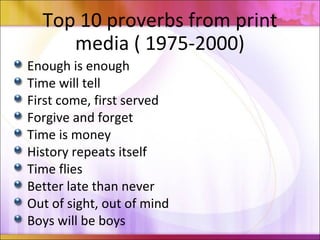
Top 10 proverbs from print
media ( 1975-2000)
Enough is enough
Time will tell
First come, first served
Forgive and forget
Time is money
History repeats itself
Time flies
Better late than never
Out of sight, out of mind
Boys will be boys
Many proverbs also contain
metaphors.
e.g. A watched pot never boils
Proverbs often have
multiple meanings and are
therefore dependent on
context.
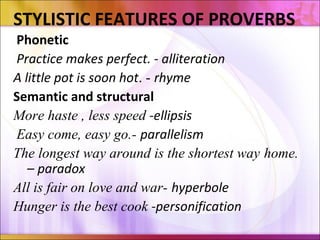
STYLISTIC FEATURES OF PROVERBS
Phonetic
Practice makes perfect. - alliteration
A little pot is soon hot. - rhyme
Semantic and structural
More haste , less speed -ellipsis
Easy come, easy go.- parallelism
The longest way around is the shortest way home.
– paradox
All is fair on love and war- hyperbole
Hunger is the best cook -personification
NON-METAPHORICAL PROVERBS
Honesty is the best policy
Phonetics
Nothing seek, nothing find.
Не that will thrive, must rise at
five.
What is worth doing is worth
doing well
Modals
All men can't be first.
Beggar can never be bankrupt.
Fair face may hide a foul heart.
Cracked bell can never sound
well.
Activities with proverbs to
be used in class:
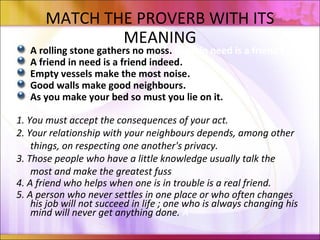
MATCH THE PROVERB WITH ITS
MEANING
A rolling stone gathers no moss. fiend in need is a friend i
A friend in need is a friend indeed.
Empty vessels make the most noise.
Good walls make good neighbours.
As you make your bed so must you lie on it.
1. You must accept the consequences of your act.
2. Your relationship with your neighbours depends, among other
things, on respecting one another's privacy.
3. Those people who have a little knowledge usually talk the
most and make the greatest fuss
4. A friend who helps when one is in trouble is a real friend.
5. A person who never settles in one place or who often changes
his job will not succeed in life ; one who is always changing his
mind will never get anything done. A
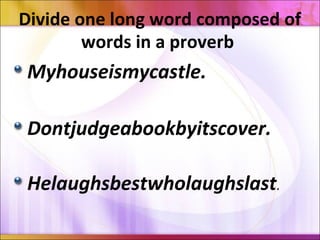
Divide one long word composed of
words in a proverb
Myhouseismycastle.
Dontjudgeabookbyitscover.
Helaughsbestwholaughslast.
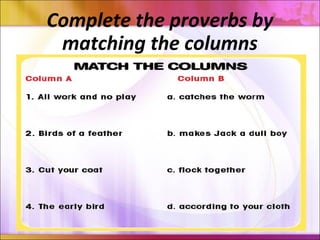
Complete the proverbs by
matching the columns
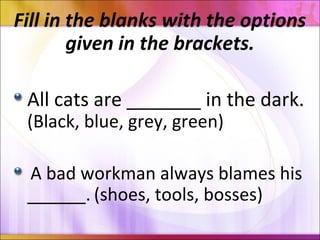
Fill in the blanks with the options
given in the brackets.
All cats are _______ in the dark.
(Black, blue, grey, green)
A bad workman always blames his
______. (shoes, tools, bosses)
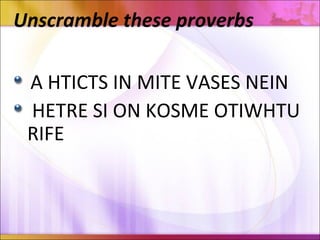
Unscramble these proverbs
A HTICTS IN MITE VASES NEIN
HETRE SI ON KOSME OTIWHTU
RIFE
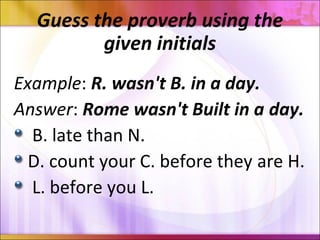
Guess the proverb using the
given initials
Example: R. wasn't B. in a day.
Answer: Rome wasn't Built in a day.
B. late than N.
D. count your C. before they are H.
L. before you L.
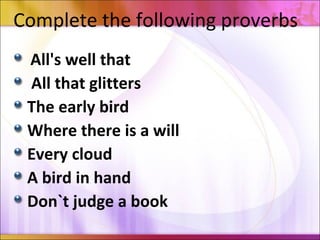
Complete the following proverbs
All's well that
All that glitters
The early bird
Where there is a will
Every cloud
A bird in hand
Don`t judge a book
List proverbs that you live
your life by
e.g. Handsome is what
hansdome does
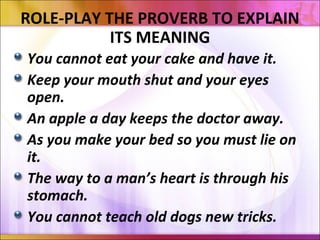
ROLE-PLAY THE PROVERB TO EXPLAIN
ITS MEANING
You cannot eat your cake and have it.
Keep your mouth shut and your eyes
open.
An apple a day keeps the doctor away.
As you make your bed so you must lie on
it.
The way to a man’s heart is through his
stomach.
You cannot teach old dogs new tricks.
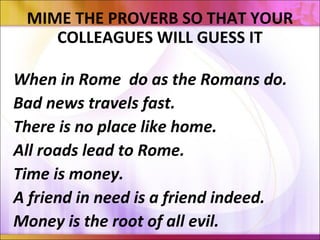
MIME THE PROVERB SO THAT YOUR
COLLEAGUES WILL GUESS IT
When in Rome do as the Romans do.
Bad news travels fast.
There is no place like home.
All roads lead to Rome.
Time is money.
A friend in need is a friend indeed.
Money is the root of all evil.
DRAW THE PROVERB SO THAT
YOUR COLLEAGUES WILL
GUESS IT
Thank you for your attention!!!!

Proverbs vera

  • 1.
    Using Proverbs in theEnglish Classroom Presented by Vera Tabureanu
  • 2.
    DEFINITION A proverb isa short well-known supposedly wise, saying, usually in simple language. Proverbs contain truth, common sense, experience and wisdom, and they are indisputable.
  • 3.
    Difference between aproverb and saying Proverb: a short sentence, etc., usually known by many people, stating something commonly experienced or giving advice or a short popular saying, usually of ancient origin, that expresses effectively some commonplace truth or useful thought; . E.g. Slow and steady wins the race" A bad cause requires many words. A broken hand works, but not a broken heart.
  • 4.
    Saying: a well-knownand wise statement made by famous people, which often has a meaning that is different from the simple meanings of the words it contains: What is a friend? A single soul dwelling in two bodies. Aristotle . Try not to become a man of success, but rather try to become a man of value. - Albert Einstein Hinduism is not a religion, its a way of life. -Swami Vivekananda
  • 5.
    The average lengthof proverbs constitutes 7 words
  • 6.
    COMMON PATTERNS OFPROVERBS Better X than Y Like X, like Y No X without Y One X doesn’t make a Y If X , then Y
  • 7.
    PAREMIOLOGY IS THE SCIENCESTUDYING PROVERBS
  • 8.
    PAREMIOLOGISTS differentiate among theproverbial subgenres Proverbs as such Proverbial expressions e.g. to bite the dust Proverbial comparisons e.g. as busy as a be Proverbial interrogatives e.g. Does a chicken have lips? Twin formulas e.g. give and take Wellerisms e.g. ‘Each to his own,’ as the farmer said when he kissed his cow.
  • 9.
    PROVERBS are usedto strengthen arguments, express generalization, influence people, rationalize our own shortcomings, question behavioral patterns, satirize social evils and make fun of ridiculous situations. Mieder
  • 10.
    PROVERBS advise, console, inspire, comment on events, interpretbehaviour foster attitudes, such as optimism, pessimism and humility. Nippold
  • 11.
    USING PROVERBS INTHE CLASS HELPS TO diversify the teaching process and make it brighter, solve some educational problems improve students’ -learning experience, -their language skills -their understanding of themselves and the world.
  • 12.
    WHEN AND WHYTO USE PROVERBS IN CLASS can be used at any stage of the lesson as warm-up activities, for presenting and/or practising lexical items and grammar structures and practising pronunciation. Using proverbs in class the teacher can stimulate a discussion or a debate, provide a topic for a project work or essay writing.
  • 13.
    Both the Bibleand medieval Latin have played a huge role in distributing proverbs across Europe
  • 14.
    Proverbs change withtime and culture Some old proverbs reflect a culture that no longer exists Let the cobbler stick to his last. New proverbs appear instead Garbage in, garbage out, a proverb created due to our computerised time..
  • 15.
    Old proverbs arealso used as so called anti-proverbs today Nobody is perfect, is changed to No body is perfect
  • 16.
    Top 10 proverbsfrom print media ( 1975-2000) Enough is enough Time will tell First come, first served Forgive and forget Time is money History repeats itself Time flies Better late than never Out of sight, out of mind Boys will be boys
  • 17.
    Many proverbs alsocontain metaphors. e.g. A watched pot never boils Proverbs often have multiple meanings and are therefore dependent on context.
  • 18.
    STYLISTIC FEATURES OFPROVERBS Phonetic Practice makes perfect. - alliteration A little pot is soon hot. - rhyme Semantic and structural More haste , less speed -ellipsis Easy come, easy go.- parallelism The longest way around is the shortest way home. – paradox All is fair on love and war- hyperbole Hunger is the best cook -personification
  • 19.
  • 20.
    Phonetics Nothing seek, nothingfind. Не that will thrive, must rise at five. What is worth doing is worth doing well
  • 21.
    Modals All men can'tbe first. Beggar can never be bankrupt. Fair face may hide a foul heart. Cracked bell can never sound well.
  • 22.
    Activities with proverbsto be used in class:
  • 23.
    MATCH THE PROVERBWITH ITS MEANING A rolling stone gathers no moss. fiend in need is a friend i A friend in need is a friend indeed. Empty vessels make the most noise. Good walls make good neighbours. As you make your bed so must you lie on it. 1. You must accept the consequences of your act. 2. Your relationship with your neighbours depends, among other things, on respecting one another's privacy. 3. Those people who have a little knowledge usually talk the most and make the greatest fuss 4. A friend who helps when one is in trouble is a real friend. 5. A person who never settles in one place or who often changes his job will not succeed in life ; one who is always changing his mind will never get anything done. A
  • 24.
    Divide one longword composed of words in a proverb Myhouseismycastle. Dontjudgeabookbyitscover. Helaughsbestwholaughslast.
  • 25.
    Complete the proverbsby matching the columns
  • 26.
    Fill in theblanks with the options given in the brackets. All cats are _______ in the dark. (Black, blue, grey, green) A bad workman always blames his ______. (shoes, tools, bosses)
  • 27.
    Unscramble these proverbs AHTICTS IN MITE VASES NEIN HETRE SI ON KOSME OTIWHTU RIFE
  • 28.
    Guess the proverbusing the given initials Example: R. wasn't B. in a day. Answer: Rome wasn't Built in a day. B. late than N. D. count your C. before they are H. L. before you L.
  • 29.
    Complete the followingproverbs All's well that All that glitters The early bird Where there is a will Every cloud A bird in hand Don`t judge a book
  • 30.
    List proverbs thatyou live your life by e.g. Handsome is what hansdome does
  • 31.
    ROLE-PLAY THE PROVERBTO EXPLAIN ITS MEANING You cannot eat your cake and have it. Keep your mouth shut and your eyes open. An apple a day keeps the doctor away. As you make your bed so you must lie on it. The way to a man’s heart is through his stomach. You cannot teach old dogs new tricks.
  • 32.
    MIME THE PROVERBSO THAT YOUR COLLEAGUES WILL GUESS IT When in Rome do as the Romans do. Bad news travels fast. There is no place like home. All roads lead to Rome. Time is money. A friend in need is a friend indeed. Money is the root of all evil.
  • 33.
    DRAW THE PROVERBSO THAT YOUR COLLEAGUES WILL GUESS IT
  • 34.
    Thank you foryour attention!!!!