PROVERBS
A short information about proverbs
A proverb (from Latin : prov
erbium ) is a simple,
concrete,
traditional saying that
expresses a perceived truth
based on common sense or
experience. Proverbs are
often metaphorical and
use formulaic
language . Collectively, they
form a genre of folkore.
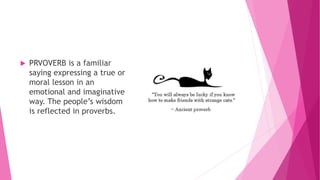
 PRVOVERB is a familiar
saying expressing a true or
moral lesson in an
emotional and imaginative
way. The people’s wisdom
is reflected in proverbs.
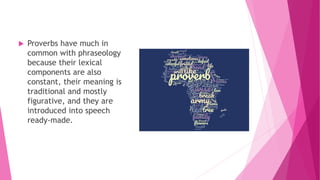
 Proverbs have much in
common with phraseology
because their lexical
components are also
constant, their meaning is
traditional and mostly
figurative, and they are
introduced into speech
ready-made.
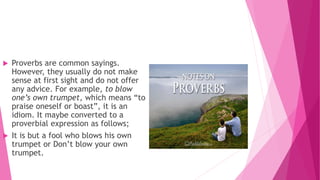
 Proverbs are common sayings.
However, they usually do not make
sense at first sight and do not offer
any advice. For example, to blow
one’s own trumpet, which means “to
praise oneself or boast”, it is an
idiom. It maybe converted to a
proverbial expression as follows;
 It is but a fool who blows his own
trumpet or Don’t blow your own
trumpet.
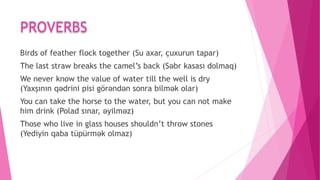
PROVERBS
Birds of feather flock together (Su axar, çuxurun tapar)
The last straw breaks the camel’s back (Səbr kasası dolmaq)
We never know the value of water till the well is dry
(Yaxşının qədrini pisi görəndən sonra bilmək olar)
You can take the horse to the water, but you can not make
him drink (Polad sınar, əyilməz)
Those who live in glass houses shouldn’t throw stones
(Yediyin qaba tüpürmək olmaz)
 Proverbs are the words of the wise and the
cheapest, created by the people, and have
been the formula of life for centuries. In
addition to the variety of themes, the finished
ideas, generalizations, and result are
pecluiarities of the proverbs.
 Proverbs are a testament
to the wisdom, wisdom
and counsel of the people
and are of great moral
and eductional
importance. Its main
feature is its small size,
but it is essentially wise
and advisable.
Examples;
PROVERBS

PROVERBS

  • 1.
  • 2.
    A short informationabout proverbs A proverb (from Latin : prov erbium ) is a simple, concrete, traditional saying that expresses a perceived truth based on common sense or experience. Proverbs are often metaphorical and use formulaic language . Collectively, they form a genre of folkore.
  • 3.
     PRVOVERB isa familiar saying expressing a true or moral lesson in an emotional and imaginative way. The people’s wisdom is reflected in proverbs.
  • 4.
     Proverbs havemuch in common with phraseology because their lexical components are also constant, their meaning is traditional and mostly figurative, and they are introduced into speech ready-made.
  • 5.
     Proverbs arecommon sayings. However, they usually do not make sense at first sight and do not offer any advice. For example, to blow one’s own trumpet, which means “to praise oneself or boast”, it is an idiom. It maybe converted to a proverbial expression as follows;  It is but a fool who blows his own trumpet or Don’t blow your own trumpet.
  • 6.
    PROVERBS Birds of featherflock together (Su axar, çuxurun tapar) The last straw breaks the camel’s back (Səbr kasası dolmaq) We never know the value of water till the well is dry (Yaxşının qədrini pisi görəndən sonra bilmək olar) You can take the horse to the water, but you can not make him drink (Polad sınar, əyilməz) Those who live in glass houses shouldn’t throw stones (Yediyin qaba tüpürmək olmaz)
  • 7.
     Proverbs arethe words of the wise and the cheapest, created by the people, and have been the formula of life for centuries. In addition to the variety of themes, the finished ideas, generalizations, and result are pecluiarities of the proverbs.
  • 8.
     Proverbs area testament to the wisdom, wisdom and counsel of the people and are of great moral and eductional importance. Its main feature is its small size, but it is essentially wise and advisable.
  • 9.