ENERGY-EFFICIENT QUERY PROCESSING IN WEB SEARCH
ENGINES
ABSTRACT:
Web search engines are composed by thousands of query processing nodes, i.e., servers
dedicated to process user queries. Such many servers consume a significant amount of energy,
mostly accountable to their CPUs, but they are necessary to ensure low latencies, since users
expect sub-second response times (e.g., 500 ms). However, users can hardly notice response
times that are faster than their expectations. Hence, we propose the Predictive Energy Saving
Online Scheduling Algorithm (PESOS ) to select the most appropriate CPU frequency to process
a query on a per-core basis. PESOS aims at process queries by their deadlines, and leverage
high-level scheduling information to reduce the CPU energy consumption of a query processing
node. PESOS bases its decision on query efficiency predictors, estimating the processing volume
and processing time of a query. We experimentally evaluate PESOS upon the TREC
ClueWeb09B collection and the MSN2006 query log. Results show that PESOS can reduce the
CPU energy consumption of a query processing node up to ∼ 48 percent compared to a system
running at maximum CPU core frequency. PESOS outperforms also the best state-of-the-art
competitor with a ∼ 20 percent energy saving, while the competitor requires a fine parameter
tuning and it may incurs in uncontrollable latency violations.
EXISTING SYSTEM
In the past, a large part of a datacenter energy consumption was accounted to inefficiencies in its
cooling and power supply systems. However, Barroso et al. [1] report that modern datacenters
have largely reduced the energy wastage of those infrastructures, leaving little room for further
improvement. On the contrary, opportunities exist to reduce the energy consumption of the
servers hosted in a datacenter. In particular, our work focuses on the CPU power management of
query processing nodes, since the CPUs dominate the energy consumption of physical servers
dedicated to search tasks. In fact, CPUs can use up to 66% of the whole energy consumed by a
query processing node at peak utilization [1]. Modern CPUs usually expose two energy saving
mechanism, namely C-states and P-states. C-states represent CPU cores idle states and they are
typically managed by the operating system. C0 is the operative state in which a CPU core can
perform computing tasks.
DISADVANTAGES
YDS is an offline algorithm to schedule generic computing jobs and cannot be used to schedule
online queries.
YDS requires to know in advance the processing volumes of jobs. Conversely, we do not know
how much work a query will require before its completion.
YDS schedules job using processing speeds (defined as units of work per time unit). The speed
value is continuous and unbounded (i.e., the speed can be indefinitely large). However, the
frequencies available to CPU cores are generally discrete and bounded.
PROPOSED SYSTEM
In this paper we propose the Predictive Energy Saving Online Scheduling algorithm (PESOS),
which considers the tail latency requirement of queries as an explicit parameter. Via the DVFS
technology, PESOS selects the most appropriate CPU frequency to process a query on a per-core
basis, so that the CPU energy consumption is reduced while respecting required tail latency. The
algorithm bases its decision on query efficiency predictors rather than core utilization. Query
efficiency predictors are techniques to estimate the processing time of a query before its
processing. They have been proposed to improve the performance of a search engine, for
instance to take decision about query scheduling or query processing parallelization However, to
the best of our knowledge, query efficiency predictor have not been considered for reducing the
energy consumption of query processing nodes. We build upon the approach described in and
propose
ADVANTAGES
YDS have several issues that make unfeasible to use it in a search engine. In the following, we
discuss:
1) A heuristic based on YDS which works in online scenarios without job preemption,
2) A methodology to estimate the processing volume of a query,
3) An algorithm to translate processing speeds into CPU core frequencies. Eventually, we
introduce and discuss our approach to select the most appropriate CPU core frequency to process
a query in a search engine.
OBJECTIVES
A novel Predictive Energy Saving Online Scheduling (PESOS) algorithm. In the context of Web
search engines, PESOS aims to reduce the CPU energy consumption of a query processing node
while imposing a required tail latency on the query response times. For each query, PESOS
selects the lowest possible CPU core frequency such that the energy consumption is reduced and
the deadlines are respected. PESOS selects the right CPU core frequency exploiting two different
kinds of query efficiency predictors (QEPs). The first QEP estimates the processing volume of
queries. The second QEP estimates the query processing times under different core frequencies,
given the number of postings to score. Since QEPs can be inaccurate,during their training we
recorded the root mean square error (RMSE) of the predictions. In this work, we proposing to
sum the RMSE to the actual predictions to compensate prediction errors.We then defined two
possible configuration for PESOS: time conservative, where prediction correction is enforced,
and energy conservative, where QEPs are left unmodified.
SYSTEM CONFIGURATION:
HARDWARE REQUIREMENTS:
Hardware - Pentium
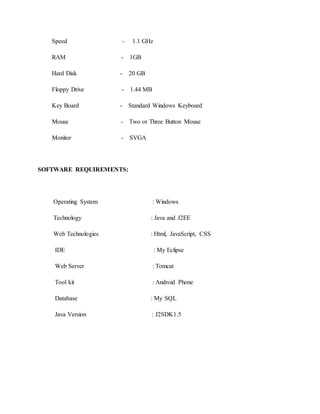
Speed - 1.1 GHz
RAM - 1GB
Hard Disk - 20 GB
Floppy Drive - 1.44 MB
Key Board - Standard Windows Keyboard
Mouse - Two or Three Button Mouse
Monitor - SVGA
SOFTWARE REQUIREMENTS:
Operating System : Windows
Technology : Java and J2EE
Web Technologies : Html, JavaScript, CSS
IDE : My Eclipse
Web Server : Tomcat
Tool kit : Android Phone
Database : My SQL
Java Version : J2SDK1.5

Energy-efficient Query Processing in Web Search Engines

  • 1.
    ENERGY-EFFICIENT QUERY PROCESSINGIN WEB SEARCH ENGINES ABSTRACT: Web search engines are composed by thousands of query processing nodes, i.e., servers dedicated to process user queries. Such many servers consume a significant amount of energy, mostly accountable to their CPUs, but they are necessary to ensure low latencies, since users expect sub-second response times (e.g., 500 ms). However, users can hardly notice response times that are faster than their expectations. Hence, we propose the Predictive Energy Saving Online Scheduling Algorithm (PESOS ) to select the most appropriate CPU frequency to process a query on a per-core basis. PESOS aims at process queries by their deadlines, and leverage high-level scheduling information to reduce the CPU energy consumption of a query processing node. PESOS bases its decision on query efficiency predictors, estimating the processing volume and processing time of a query. We experimentally evaluate PESOS upon the TREC ClueWeb09B collection and the MSN2006 query log. Results show that PESOS can reduce the CPU energy consumption of a query processing node up to ∼ 48 percent compared to a system running at maximum CPU core frequency. PESOS outperforms also the best state-of-the-art competitor with a ∼ 20 percent energy saving, while the competitor requires a fine parameter tuning and it may incurs in uncontrollable latency violations. EXISTING SYSTEM In the past, a large part of a datacenter energy consumption was accounted to inefficiencies in its cooling and power supply systems. However, Barroso et al. [1] report that modern datacenters have largely reduced the energy wastage of those infrastructures, leaving little room for further improvement. On the contrary, opportunities exist to reduce the energy consumption of the servers hosted in a datacenter. In particular, our work focuses on the CPU power management of query processing nodes, since the CPUs dominate the energy consumption of physical servers dedicated to search tasks. In fact, CPUs can use up to 66% of the whole energy consumed by a query processing node at peak utilization [1]. Modern CPUs usually expose two energy saving mechanism, namely C-states and P-states. C-states represent CPU cores idle states and they are
  • 2.
    typically managed bythe operating system. C0 is the operative state in which a CPU core can perform computing tasks. DISADVANTAGES YDS is an offline algorithm to schedule generic computing jobs and cannot be used to schedule online queries. YDS requires to know in advance the processing volumes of jobs. Conversely, we do not know how much work a query will require before its completion. YDS schedules job using processing speeds (defined as units of work per time unit). The speed value is continuous and unbounded (i.e., the speed can be indefinitely large). However, the frequencies available to CPU cores are generally discrete and bounded. PROPOSED SYSTEM In this paper we propose the Predictive Energy Saving Online Scheduling algorithm (PESOS), which considers the tail latency requirement of queries as an explicit parameter. Via the DVFS technology, PESOS selects the most appropriate CPU frequency to process a query on a per-core basis, so that the CPU energy consumption is reduced while respecting required tail latency. The algorithm bases its decision on query efficiency predictors rather than core utilization. Query efficiency predictors are techniques to estimate the processing time of a query before its processing. They have been proposed to improve the performance of a search engine, for instance to take decision about query scheduling or query processing parallelization However, to the best of our knowledge, query efficiency predictor have not been considered for reducing the energy consumption of query processing nodes. We build upon the approach described in and propose ADVANTAGES
  • 3.
    YDS have severalissues that make unfeasible to use it in a search engine. In the following, we discuss: 1) A heuristic based on YDS which works in online scenarios without job preemption, 2) A methodology to estimate the processing volume of a query, 3) An algorithm to translate processing speeds into CPU core frequencies. Eventually, we introduce and discuss our approach to select the most appropriate CPU core frequency to process a query in a search engine. OBJECTIVES A novel Predictive Energy Saving Online Scheduling (PESOS) algorithm. In the context of Web search engines, PESOS aims to reduce the CPU energy consumption of a query processing node while imposing a required tail latency on the query response times. For each query, PESOS selects the lowest possible CPU core frequency such that the energy consumption is reduced and the deadlines are respected. PESOS selects the right CPU core frequency exploiting two different kinds of query efficiency predictors (QEPs). The first QEP estimates the processing volume of queries. The second QEP estimates the query processing times under different core frequencies, given the number of postings to score. Since QEPs can be inaccurate,during their training we recorded the root mean square error (RMSE) of the predictions. In this work, we proposing to sum the RMSE to the actual predictions to compensate prediction errors.We then defined two possible configuration for PESOS: time conservative, where prediction correction is enforced, and energy conservative, where QEPs are left unmodified. SYSTEM CONFIGURATION: HARDWARE REQUIREMENTS: Hardware - Pentium
  • 4.
    Speed - 1.1GHz RAM - 1GB Hard Disk - 20 GB Floppy Drive - 1.44 MB Key Board - Standard Windows Keyboard Mouse - Two or Three Button Mouse Monitor - SVGA SOFTWARE REQUIREMENTS: Operating System : Windows Technology : Java and J2EE Web Technologies : Html, JavaScript, CSS IDE : My Eclipse Web Server : Tomcat Tool kit : Android Phone Database : My SQL Java Version : J2SDK1.5