 The amino acids undergo certain common reactions like
transamination and deamination for the liberation of ammonia.
The amino group of the amino acids is utilized for the formation
of urea which is an excretory end product of protein metabolism.
The carbon skeleton of the amino acids is first converted to keto
acids (by transamination) which meet one or more of the
following fates.
1. Utilized to generate energy.
2. Used for the synthesis of glucose.
3. Diverted for the formation of fat or ketone bodies.
4. Involved in the production of non-essential amino acids.
 TRANSAMINATION: The transfer of an amino ( NH2) group
from an amino acid to a keto acid is known as transamination.
This process involves the interconversion of a pair of amino
acids and a pair of keto acids, catalysed by a group of enzymes
called transaminases (recently, aminotransferases)
Salient features of transamination
 All transaminases require pyridoxal phosphate (PLP), a coenzyme
derived from vitamin B6.
 Specific transaminases exist for each pair of amino and keto acids.
However, only two namely aspartate transaminase and alanine
transaminase make a significant contribution for transamination.
 There is no free NH3 liberated, only the transfer of amino group occurs.
 Transamination is reversible .
 Transamination is very important for the redistribution of amino groups
and production of non-essential amino acids, as per the requirement of
the cell. It involves both catabolism (degradation) and anabolism
(synthesis) of amino acids.
 Transamination diverts the excess amino acids towards energy
generation.
 The amino acids undergo transamination to finally concentrate nitrogen
in glutamate. Glutamate is the only amino acid that undergoes oxidative
deamination to a significant extent to liberate free NH3 for urea
synthesis.
 All amino acids except lysine, threonine,
proline and hydroxyproline participate in
transamination.
 Serum transaminases are important for
diagnostic and prognostic purpose
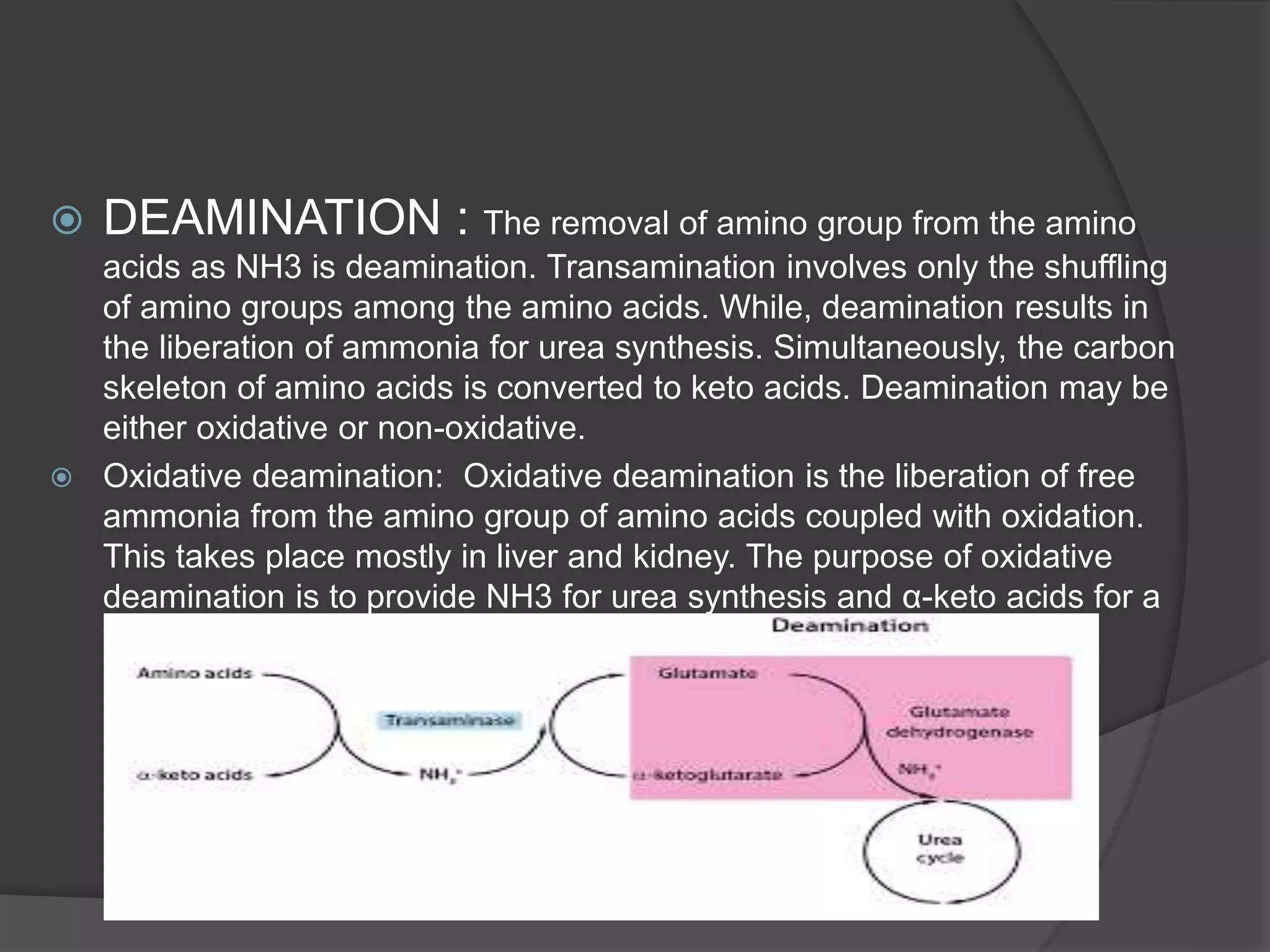
 DEAMINATION : The removal of amino group from the amino
acids as NH3 is deamination. Transamination involves only the shuffling
of amino groups among the amino acids. While, deamination results in
the liberation of ammonia for urea synthesis. Simultaneously, the carbon
skeleton of amino acids is converted to keto acids. Deamination may be
either oxidative or non-oxidative.
 Oxidative deamination: Oxidative deamination is the liberation of free
ammonia from the amino group of amino acids coupled with oxidation.
This takes place mostly in liver and kidney. The purpose of oxidative
deamination is to provide NH3 for urea synthesis and α-keto acids for a
variety of reactions, including energy generation.
 Oxidative deamination by amino acid oxidases, possess FMN
and FAD, respectively. They act on the corresponding amino
acids (L or D) to produce α-keto acids and NH3. In this reaction,
oxygen is reduced to H2O2, which is later decomposed by
catalase.
 Non-oxidative deamination : Some of the amino acids can be
deaminated to liberate NH3 without undergoing oxidation
 (a) Amino acid dehydrases : Serine, threonine and homoserine
are the hydroxy amino acids. They undergo non-oxidative
deamination catalysed by PLP-dependent dehydrases
(dehydratases).
 (b) Amino acid desulfhydrases : The sulfur amino acids, namely
cysteine and homocysteine, undergo deamination coupled with
desulfhydration to give keto acids.
 (c) Deamination of histidine: The enzyme histidase acts on
histidine to liberate NH3 by nonoxidative deamination process.
Ammonia
 The formation of Ammonia occurs from the amino
acids( transamination and deamination), biogenic
amines, amino group of purines, pyrimidines and by
the intestinal bacteria(Urease).
 Ammonia NH3 is constantly liberated in the
metabolism of amino acids, other nitrogenous
compounds.
 At the physiological pH, ammonia exists as
ammonium ion.
 Functions: Ammonia is not just waste product of
nitrogen metabolism. It is involved for synthesis of
many compounds in the body, Including non-
essential amino acids, purines, pyrimidines, amino
sugars. Ammonium ions are imortant to maintain
acid-base balance of the body.
 Excretion- The organisms had developed
different mechanisms for the disposal of
ammonia from the body.
 The animals in this regard are of three types-
 Ammoniotelic- The aquatic animals dispose off
NH3 into surrounding water.
 Uricotelic- Ammonia is converted to uric acid
eg. Reptiles and birds.
 Ureotelic- The ammonia is converted into urea
which is a non- toxic and soluble compound.
Eg. mammals
 Toxicity of Ammonia- Slight elevation in
the concentration of ammonia is harmful
to the brain.
 The elevation in blood ammonia level
may be genetic or acquired.
 When it accumulates in the body ,
slurring of speech and blurring of vision
and even tremors can happen.
 The hyperammonemia may cause
hepatic coma, and mental retardation.
UREA CYCLE
 Urea is the end product of protein metabolism.
 The nitrogen of amino acids converted to
ammonia, is toxic to the body. It is converted
to urea and detoxified.
 Urea is synthesized in liver and transported to
kidneys for excretion in urine.
 Urea cycle was proposed by Hans Krebs
andKurt Hensleit, hence it is known as Krebs-
Henseleit cycle.
 The first two enzymes are present in
mitochondria and rest are present in
Cytoplasm.
1. Carbamoyl phosphate synthase of mitochondria catalyses
the condensation of ammonium ion with CO2 to form
carbomoyl phosphate. This consumes 2 ATP and is
irreversible.
2. Citrulline is synthesized from carbamoyl phosphate and
ornithine by ornithine transcarbomoylase. The citrulline is
then transported to cytoplasm by transporter system.
3. The enzyme arginosuccinate synthase condenses
citrulline with aspartate to produce arginosuccinate.
4. The Arginosuccinase cleaves arginosuccinate to give
arginine and fumarate. The fumerate liberated provide
connecing link with TCA and gluconeogenesis.
5. Arginase is the final enzyme that cleaves arginine to yield
urea and ornithine. The ornithine is then enters in
mitochondria for reuse in urea cycle.
UREA CYCLE
 The urea produced in the liver freely
diffuss and is transported in blood to
kidneys. And then excreted.
 In healthy person normal blood urea
conc. is 10-4 mg/dl.
PROTEIN METABOLISM.pptx

PROTEIN METABOLISM.pptx

  • 2.
     The aminoacids undergo certain common reactions like transamination and deamination for the liberation of ammonia. The amino group of the amino acids is utilized for the formation of urea which is an excretory end product of protein metabolism. The carbon skeleton of the amino acids is first converted to keto acids (by transamination) which meet one or more of the following fates. 1. Utilized to generate energy. 2. Used for the synthesis of glucose. 3. Diverted for the formation of fat or ketone bodies. 4. Involved in the production of non-essential amino acids.  TRANSAMINATION: The transfer of an amino ( NH2) group from an amino acid to a keto acid is known as transamination. This process involves the interconversion of a pair of amino acids and a pair of keto acids, catalysed by a group of enzymes called transaminases (recently, aminotransferases)
  • 3.
    Salient features oftransamination  All transaminases require pyridoxal phosphate (PLP), a coenzyme derived from vitamin B6.  Specific transaminases exist for each pair of amino and keto acids. However, only two namely aspartate transaminase and alanine transaminase make a significant contribution for transamination.  There is no free NH3 liberated, only the transfer of amino group occurs.  Transamination is reversible .  Transamination is very important for the redistribution of amino groups and production of non-essential amino acids, as per the requirement of the cell. It involves both catabolism (degradation) and anabolism (synthesis) of amino acids.  Transamination diverts the excess amino acids towards energy generation.  The amino acids undergo transamination to finally concentrate nitrogen in glutamate. Glutamate is the only amino acid that undergoes oxidative deamination to a significant extent to liberate free NH3 for urea synthesis.
  • 4.
     All aminoacids except lysine, threonine, proline and hydroxyproline participate in transamination.  Serum transaminases are important for diagnostic and prognostic purpose
  • 5.
     DEAMINATION :The removal of amino group from the amino acids as NH3 is deamination. Transamination involves only the shuffling of amino groups among the amino acids. While, deamination results in the liberation of ammonia for urea synthesis. Simultaneously, the carbon skeleton of amino acids is converted to keto acids. Deamination may be either oxidative or non-oxidative.  Oxidative deamination: Oxidative deamination is the liberation of free ammonia from the amino group of amino acids coupled with oxidation. This takes place mostly in liver and kidney. The purpose of oxidative deamination is to provide NH3 for urea synthesis and α-keto acids for a variety of reactions, including energy generation.
  • 6.
     Oxidative deaminationby amino acid oxidases, possess FMN and FAD, respectively. They act on the corresponding amino acids (L or D) to produce α-keto acids and NH3. In this reaction, oxygen is reduced to H2O2, which is later decomposed by catalase.  Non-oxidative deamination : Some of the amino acids can be deaminated to liberate NH3 without undergoing oxidation  (a) Amino acid dehydrases : Serine, threonine and homoserine are the hydroxy amino acids. They undergo non-oxidative deamination catalysed by PLP-dependent dehydrases (dehydratases).  (b) Amino acid desulfhydrases : The sulfur amino acids, namely cysteine and homocysteine, undergo deamination coupled with desulfhydration to give keto acids.  (c) Deamination of histidine: The enzyme histidase acts on histidine to liberate NH3 by nonoxidative deamination process.
  • 8.
    Ammonia  The formationof Ammonia occurs from the amino acids( transamination and deamination), biogenic amines, amino group of purines, pyrimidines and by the intestinal bacteria(Urease).  Ammonia NH3 is constantly liberated in the metabolism of amino acids, other nitrogenous compounds.  At the physiological pH, ammonia exists as ammonium ion.  Functions: Ammonia is not just waste product of nitrogen metabolism. It is involved for synthesis of many compounds in the body, Including non- essential amino acids, purines, pyrimidines, amino sugars. Ammonium ions are imortant to maintain acid-base balance of the body.
  • 9.
     Excretion- Theorganisms had developed different mechanisms for the disposal of ammonia from the body.  The animals in this regard are of three types-  Ammoniotelic- The aquatic animals dispose off NH3 into surrounding water.  Uricotelic- Ammonia is converted to uric acid eg. Reptiles and birds.  Ureotelic- The ammonia is converted into urea which is a non- toxic and soluble compound. Eg. mammals
  • 10.
     Toxicity ofAmmonia- Slight elevation in the concentration of ammonia is harmful to the brain.  The elevation in blood ammonia level may be genetic or acquired.  When it accumulates in the body , slurring of speech and blurring of vision and even tremors can happen.  The hyperammonemia may cause hepatic coma, and mental retardation.
  • 11.
    UREA CYCLE  Ureais the end product of protein metabolism.  The nitrogen of amino acids converted to ammonia, is toxic to the body. It is converted to urea and detoxified.  Urea is synthesized in liver and transported to kidneys for excretion in urine.  Urea cycle was proposed by Hans Krebs andKurt Hensleit, hence it is known as Krebs- Henseleit cycle.  The first two enzymes are present in mitochondria and rest are present in Cytoplasm.
  • 12.
    1. Carbamoyl phosphatesynthase of mitochondria catalyses the condensation of ammonium ion with CO2 to form carbomoyl phosphate. This consumes 2 ATP and is irreversible. 2. Citrulline is synthesized from carbamoyl phosphate and ornithine by ornithine transcarbomoylase. The citrulline is then transported to cytoplasm by transporter system. 3. The enzyme arginosuccinate synthase condenses citrulline with aspartate to produce arginosuccinate. 4. The Arginosuccinase cleaves arginosuccinate to give arginine and fumarate. The fumerate liberated provide connecing link with TCA and gluconeogenesis. 5. Arginase is the final enzyme that cleaves arginine to yield urea and ornithine. The ornithine is then enters in mitochondria for reuse in urea cycle.
  • 13.
  • 14.
     The ureaproduced in the liver freely diffuss and is transported in blood to kidneys. And then excreted.  In healthy person normal blood urea conc. is 10-4 mg/dl.