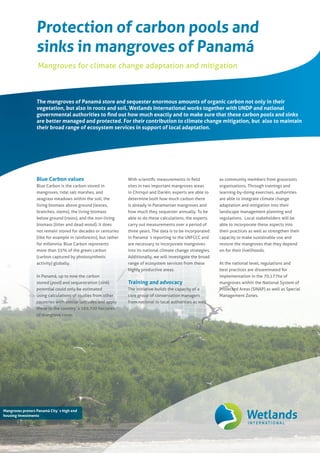
Mangroves protect Panamá City´s high end
housing investments
The mangroves of Panamá store and sequester enormous amounts of organic carbon not only in their
vegetation, but also in roots and soil. Wetlands International works together with UNDP and national
governmental authorities to find out how much exactly and to make sure that these carbon pools and sinks
are better managed and protected. For their contribution to climate change mitigation, but also to maintain
their broad range of ecosystem services in support of local adaptation.
Blue Carbon values
Blue Carbon is the carbon stored in
mangroves, tidal salt marshes, and
seagrass meadows within the soil, the
living biomass above ground (leaves,
branches, stems), the living biomass
below ground (roots), and the non-living
biomass (litter and dead wood). It does
not remain stored for decades or centuries
(like for example in rainforests), but rather
for millennia. Blue Carbon represents
more than 55% of the green carbon
(carbon captured by photosynthetic
activity) globally.
In Panamá, up to now the carbon
stored (pool) and sequestration (sink)
potential could only be estimated
using calculations of studies from other
countries with similar latitudes and apply
these to the country´s 169,700 hectares
of mangrove cover.
With scientific measurements in field
sites in two important mangroves areas
in Chiriquí and Darién, experts are able to
determine both how much carbon there
is already in Panamanian mangroves and
how much they sequester annually. To be
able to do these calculations, the experts
carry out measurements over a period of
three years. The data is to be incorporated
in Panamá´s reporting to the UNFCCC and
are necessary to incorporate mangroves
into its national climate change strategies.
Additionally, we will investigate the broad
range of ecosystem services from these
highly productive areas.
Training and advocacy
The initiative builds the capacity of a
core group of conservation managers
from national to local authorities as well
as community members from grassroots
organisations. Through trainings and
learning-by-doing exercises, authorities
are able to integrate climate change
adaptation and mitigation into their
landscape management planning and
regulations. Local stakeholders will be
able to incorporate these aspects into
their practices as well as strengthen their
capacity to make sustainable use and
restore the mangroves that they depend
on for their livelihoods.
At the national level, regulations and
best practices are disseminated for
implementation in the 70,177ha of
mangroves within the National System of
Protected Areas (SINAP) as well as Special
Management Zones.
Protection of carbon pools and
sinks in mangroves of Panamá
Mangroves for climate change adaptation and mitigation
Research, exchanges and
outreach
Drawing from the existent wealth
of knowledge (incl. traditional) and
sustainable management experiences
in the country as well as from new
initiatives, learning exchanges between
wetland-dependent communities in
Panama are promoted. Existing measures
and practices are thus “put into value”
both inside and outside the community
and can be replicated or up-scaled for
a broader impact on national mangrove
Community projects
The initiative develops a portfolio of
micro-projects in the communities of
Chiriquí Province, which holds some of
Panamá´s most extensive mangroves.
The multi-disciplinary teams help build
mangrove management capacities in the
communities, identify climate-related
risks and mangrove ecosystem services,
and apply climate change adaptation
measures.
These include reforestation as well as
sustainable productive activities designed
to diversify and increase community
members´ income and reduce pressure on
mangroves.
The goal is to make these mangroves an
essential building block of local resilience
to climate-related risks, as well as
maintain their important contribution to
global climate change mitigation, through
their function as a carbon sink.
More information
Julio Montes de Oca L.
Wetlands International
Latin America & the Caribbean
julio.montesdeocalugo@wetlands.org
Tel. +507 317 16 74
www.wetlands.org/lac
This project is part of the International
Climate Initiative. The Federal Ministry
for the Environment, Nature Conservation
and Nuclear Safety supports this initiative
on the basis of a decision adopted by the
German Bundestag.
Mangroves in Chorcha Abajo, Chiriquí
Wetlands International
@WetlandsInt
Wetlands International
Carbon measurement in Chiriquí Province of Panamá
Dario Tovar
Furthermore, a comprehensive
communications strategy will raise
awareness on mangroves´ importance for
the climate and promote the involvement
of different audiences, including women´s
groups, in mangrove conservation.
Quick facts:
169,700 ha of mangroves in Panamá
in 2007 from 361,500 ha in 1969
Mayority on Pacific coast,
only 16,382 ha Caribbean coast
5.2% of total forest cover
2.3% of total land cover
Supported by:

Protection of carbon pools and sinks in mangroves of Panamá

  • 1.
    Mangroves protect PanamáCity´s high end housing investments The mangroves of Panamá store and sequester enormous amounts of organic carbon not only in their vegetation, but also in roots and soil. Wetlands International works together with UNDP and national governmental authorities to find out how much exactly and to make sure that these carbon pools and sinks are better managed and protected. For their contribution to climate change mitigation, but also to maintain their broad range of ecosystem services in support of local adaptation. Blue Carbon values Blue Carbon is the carbon stored in mangroves, tidal salt marshes, and seagrass meadows within the soil, the living biomass above ground (leaves, branches, stems), the living biomass below ground (roots), and the non-living biomass (litter and dead wood). It does not remain stored for decades or centuries (like for example in rainforests), but rather for millennia. Blue Carbon represents more than 55% of the green carbon (carbon captured by photosynthetic activity) globally. In Panamá, up to now the carbon stored (pool) and sequestration (sink) potential could only be estimated using calculations of studies from other countries with similar latitudes and apply these to the country´s 169,700 hectares of mangrove cover. With scientific measurements in field sites in two important mangroves areas in Chiriquí and Darién, experts are able to determine both how much carbon there is already in Panamanian mangroves and how much they sequester annually. To be able to do these calculations, the experts carry out measurements over a period of three years. The data is to be incorporated in Panamá´s reporting to the UNFCCC and are necessary to incorporate mangroves into its national climate change strategies. Additionally, we will investigate the broad range of ecosystem services from these highly productive areas. Training and advocacy The initiative builds the capacity of a core group of conservation managers from national to local authorities as well as community members from grassroots organisations. Through trainings and learning-by-doing exercises, authorities are able to integrate climate change adaptation and mitigation into their landscape management planning and regulations. Local stakeholders will be able to incorporate these aspects into their practices as well as strengthen their capacity to make sustainable use and restore the mangroves that they depend on for their livelihoods. At the national level, regulations and best practices are disseminated for implementation in the 70,177ha of mangroves within the National System of Protected Areas (SINAP) as well as Special Management Zones. Protection of carbon pools and sinks in mangroves of Panamá Mangroves for climate change adaptation and mitigation
  • 2.
    Research, exchanges and outreach Drawingfrom the existent wealth of knowledge (incl. traditional) and sustainable management experiences in the country as well as from new initiatives, learning exchanges between wetland-dependent communities in Panama are promoted. Existing measures and practices are thus “put into value” both inside and outside the community and can be replicated or up-scaled for a broader impact on national mangrove Community projects The initiative develops a portfolio of micro-projects in the communities of Chiriquí Province, which holds some of Panamá´s most extensive mangroves. The multi-disciplinary teams help build mangrove management capacities in the communities, identify climate-related risks and mangrove ecosystem services, and apply climate change adaptation measures. These include reforestation as well as sustainable productive activities designed to diversify and increase community members´ income and reduce pressure on mangroves. The goal is to make these mangroves an essential building block of local resilience to climate-related risks, as well as maintain their important contribution to global climate change mitigation, through their function as a carbon sink. More information Julio Montes de Oca L. Wetlands International Latin America & the Caribbean julio.montesdeocalugo@wetlands.org Tel. +507 317 16 74 www.wetlands.org/lac This project is part of the International Climate Initiative. The Federal Ministry for the Environment, Nature Conservation and Nuclear Safety supports this initiative on the basis of a decision adopted by the German Bundestag. Mangroves in Chorcha Abajo, Chiriquí Wetlands International @WetlandsInt Wetlands International Carbon measurement in Chiriquí Province of Panamá Dario Tovar Furthermore, a comprehensive communications strategy will raise awareness on mangroves´ importance for the climate and promote the involvement of different audiences, including women´s groups, in mangrove conservation. Quick facts: 169,700 ha of mangroves in Panamá in 2007 from 361,500 ha in 1969 Mayority on Pacific coast, only 16,382 ha Caribbean coast 5.2% of total forest cover 2.3% of total land cover Supported by: