Radiation Therapy for Prostate
Cancer
NASPCC 10-13-18
Ronald Chen, MD MPH
Associate Professor, Radiation Oncology
University of North Carolina – Chapel Hill
Associate Director, UNC Lineberger Comprehensive Cancer
Center
Disclosures
• Accuray Inc: consulting and research funding
• Bayer: consulting
Outline
1) Shortening radiation treatment for prostate
cancer
2) “Oligometastatic” prostate cancer
REDUCING RADIATION TREATMENT
TIME
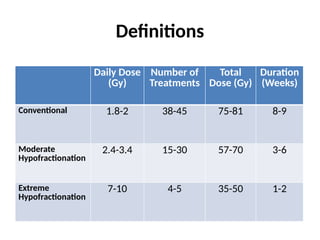
Definitions
Daily Dose
(Gy)
Number of
Treatments
Total
Dose (Gy)
Duration
(Weeks)
Conventional 1.8-2 38-45 75-81 8-9
Moderate
Hypofractionation
2.4-3.4 15-30 57-70 3-6
Extreme
Hypofractionation
7-10 4-5 35-50 1-2
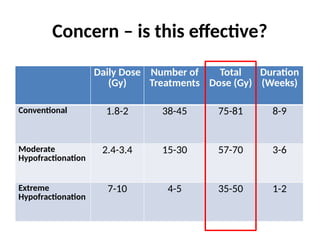
Concern – is this effective?
Daily Dose
(Gy)
Number of
Treatments
Total
Dose (Gy)
Duration
(Weeks)
Conventional 1.8-2 38-45 75-81 8-9
Moderate
Hypofractionation
2.4-3.4 15-30 57-70 3-6
Extreme
Hypofractionation
7-10 4-5 35-50 1-2
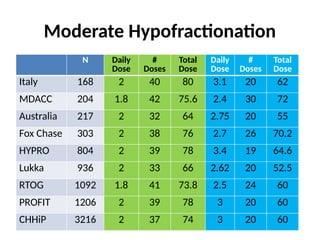
Concern – is this safe?
Daily Dose
(Gy)
Number of
Treatments
Total
Dose (Gy)
Duration
(Weeks)
Conventional 1.8-2 38-45 75-81 8-9
Moderate
Hypofractionation
2.4-3.4 15-30 57-70 3-6
Extreme
Hypofractionation
7-10 4-5 35-50 1-2
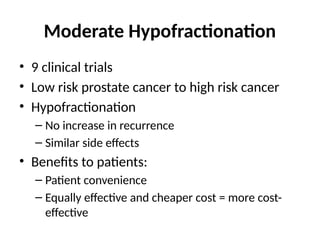
Moderate Hypofractionation
N Daily
Dose
#
Doses
Total
Dose
Daily
Dose
#
Doses
Total
Dose
Italy 168 2 40 80 3.1 20 62
MDACC 204 1.8 42 75.6 2.4 30 72
Australia 217 2 32 64 2.75 20 55
Fox Chase 303 2 38 76 2.7 26 70.2
HYPRO 804 2 39 78 3.4 19 64.6
Lukka 936 2 33 66 2.62 20 52.5
RTOG 1092 1.8 41 73.8 2.5 24 60
PROFIT 1206 2 39 78 3 20 60
CHHiP 3216 2 37 74 3 20 60
Moderate Hypofractionation
• 9 clinical trials
• Low risk prostate cancer to high risk cancer
• Hypofractionation
– No increase in recurrence
– Similar side effects
• Benefits to patients:
– Patient convenience
– Equally effective and cheaper cost = more cost-
effective
Extreme Hypofractionation
• Reducing radiation treatment to only 1-2
weeks
• “Cyberknife” is a branded machine that is
often used
Extreme Hypofractionation
• Largest reported study to date:
– Pooled analysis of patients from 8 institutions
(UCLA, Harvard/Beth-Israel, Italy, Georgetown,
Swedish Medical Center/Seattle, etc)
– N=1100, enrolled 2003-2011
– 35-40 Gy/4-5 fractions
King CR et al. Radiat Oncol 109:217-221, 2013.
Efficacy
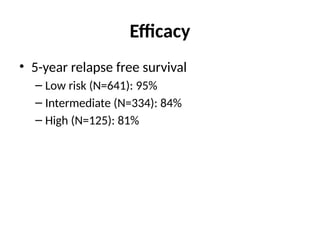
• 5-year relapse free survival
– Low risk (N=641): 95%
– Intermediate (N=334): 84%
– High (N=125): 81%
Efficacy
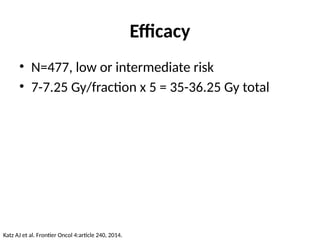
• N=477, low or intermediate risk
• 7-7.25 Gy/fraction x 5 = 35-36.25 Gy total
Katz AJ et al. Frontier Oncol 4:article 240, 2014.
Efficacy
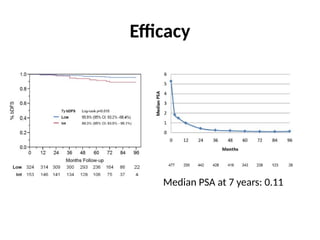
Median PSA at 7 years: 0.11
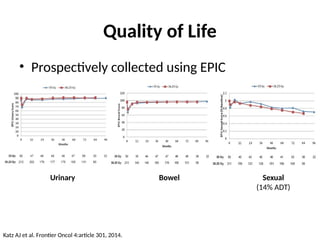
Quality of Life
• Prospectively collected using EPIC
Urinary Bowel Sexual
(14% ADT)
Katz AJ et al. Frontier Oncol 4:article 301, 2014.
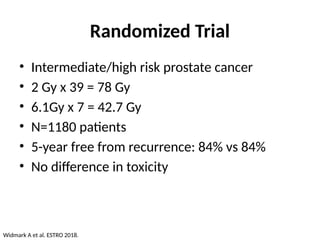
Randomized Trial
• Intermediate/high risk prostate cancer
• 2 Gy x 39 = 78 Gy
• 6.1Gy x 7 = 42.7 Gy
• N=1180 patients
• 5-year free from recurrence: 84% vs 84%
• No difference in toxicity
Widmark A et al. ESTRO 2018.
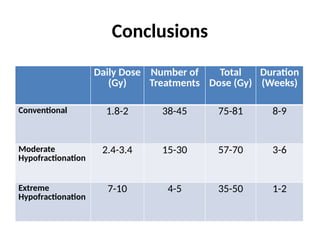
Conclusions
Daily Dose
(Gy)
Number of
Treatments
Total
Dose (Gy)
Duration
(Weeks)
Conventional 1.8-2 38-45 75-81 8-9
Moderate
Hypofractionation
2.4-3.4 15-30 57-70 3-6
Extreme
Hypofractionation
7-10 4-5 35-50 1-2
TREATMENT FOR OLIGOMETASTATIC
PROSTATE CANCER
Oligometastatic Cancer
• Cancer that has metastasized to only a few
places
• Currently, standard treatment is ADT
• Can aggressive treatment help some patients?
Is this potentially curable?
STOMP Trial
• 62 patients with prostate cancer recurrence
• ≤ 3 metastases
• Randomize:
– Observation
– Surgery or stereotactic body RT to all metastases
Ost P et al. JCO 36(5):446-53, 2018.
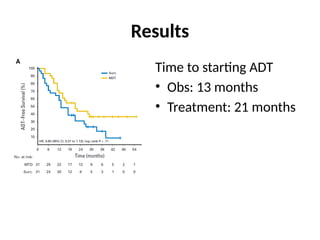
Results
Time to starting ADT
• Obs: 13 months
• Treatment: 21 months
Conclusion
• Targeted (surgery or SBRT) to all metastases
for patients with oligometastatic prostate
cancer is
– Well tolerated
– Delays the need for ADT – which may be beneficial
to patients
Other Ongoing Trials
• Patient with newly diagnosed metastatic
prostate cancer
– Few areas of metastasis
• Treat all the areas of disease (prostate and
metastases) – does that help improve patient
outcomes?
10-RadiationTherapyProstateCancer-Chen.pptx

  • 1.
    Radiation Therapy forProstate Cancer NASPCC 10-13-18 Ronald Chen, MD MPH Associate Professor, Radiation Oncology University of North Carolina – Chapel Hill Associate Director, UNC Lineberger Comprehensive Cancer Center
  • 2.
    Disclosures • Accuray Inc:consulting and research funding • Bayer: consulting
  • 3.
    Outline 1) Shortening radiationtreatment for prostate cancer 2) “Oligometastatic” prostate cancer
  • 4.
  • 5.
    Definitions Daily Dose (Gy) Number of Treatments Total Dose(Gy) Duration (Weeks) Conventional 1.8-2 38-45 75-81 8-9 Moderate Hypofractionation 2.4-3.4 15-30 57-70 3-6 Extreme Hypofractionation 7-10 4-5 35-50 1-2
  • 6.
    Concern – isthis effective? Daily Dose (Gy) Number of Treatments Total Dose (Gy) Duration (Weeks) Conventional 1.8-2 38-45 75-81 8-9 Moderate Hypofractionation 2.4-3.4 15-30 57-70 3-6 Extreme Hypofractionation 7-10 4-5 35-50 1-2
  • 7.
    Concern – isthis safe? Daily Dose (Gy) Number of Treatments Total Dose (Gy) Duration (Weeks) Conventional 1.8-2 38-45 75-81 8-9 Moderate Hypofractionation 2.4-3.4 15-30 57-70 3-6 Extreme Hypofractionation 7-10 4-5 35-50 1-2
  • 8.
    Moderate Hypofractionation N Daily Dose # Doses Total Dose Daily Dose # Doses Total Dose Italy168 2 40 80 3.1 20 62 MDACC 204 1.8 42 75.6 2.4 30 72 Australia 217 2 32 64 2.75 20 55 Fox Chase 303 2 38 76 2.7 26 70.2 HYPRO 804 2 39 78 3.4 19 64.6 Lukka 936 2 33 66 2.62 20 52.5 RTOG 1092 1.8 41 73.8 2.5 24 60 PROFIT 1206 2 39 78 3 20 60 CHHiP 3216 2 37 74 3 20 60
  • 9.
    Moderate Hypofractionation • 9clinical trials • Low risk prostate cancer to high risk cancer • Hypofractionation – No increase in recurrence – Similar side effects • Benefits to patients: – Patient convenience – Equally effective and cheaper cost = more cost- effective
  • 10.
    Extreme Hypofractionation • Reducingradiation treatment to only 1-2 weeks • “Cyberknife” is a branded machine that is often used
  • 11.
    Extreme Hypofractionation • Largestreported study to date: – Pooled analysis of patients from 8 institutions (UCLA, Harvard/Beth-Israel, Italy, Georgetown, Swedish Medical Center/Seattle, etc) – N=1100, enrolled 2003-2011 – 35-40 Gy/4-5 fractions King CR et al. Radiat Oncol 109:217-221, 2013.
  • 12.
    Efficacy • 5-year relapsefree survival – Low risk (N=641): 95% – Intermediate (N=334): 84% – High (N=125): 81%
  • 13.
    Efficacy • N=477, lowor intermediate risk • 7-7.25 Gy/fraction x 5 = 35-36.25 Gy total Katz AJ et al. Frontier Oncol 4:article 240, 2014.
  • 14.
  • 15.
    Quality of Life •Prospectively collected using EPIC Urinary Bowel Sexual (14% ADT) Katz AJ et al. Frontier Oncol 4:article 301, 2014.
  • 16.
    Randomized Trial • Intermediate/highrisk prostate cancer • 2 Gy x 39 = 78 Gy • 6.1Gy x 7 = 42.7 Gy • N=1180 patients • 5-year free from recurrence: 84% vs 84% • No difference in toxicity Widmark A et al. ESTRO 2018.
  • 17.
    Conclusions Daily Dose (Gy) Number of Treatments Total Dose(Gy) Duration (Weeks) Conventional 1.8-2 38-45 75-81 8-9 Moderate Hypofractionation 2.4-3.4 15-30 57-70 3-6 Extreme Hypofractionation 7-10 4-5 35-50 1-2
  • 18.
  • 19.
    Oligometastatic Cancer • Cancerthat has metastasized to only a few places • Currently, standard treatment is ADT • Can aggressive treatment help some patients? Is this potentially curable?
  • 20.
    STOMP Trial • 62patients with prostate cancer recurrence • ≤ 3 metastases • Randomize: – Observation – Surgery or stereotactic body RT to all metastases Ost P et al. JCO 36(5):446-53, 2018.
  • 21.
    Results Time to startingADT • Obs: 13 months • Treatment: 21 months
  • 22.
    Conclusion • Targeted (surgeryor SBRT) to all metastases for patients with oligometastatic prostate cancer is – Well tolerated – Delays the need for ADT – which may be beneficial to patients
  • 23.
    Other Ongoing Trials •Patient with newly diagnosed metastatic prostate cancer – Few areas of metastasis • Treat all the areas of disease (prostate and metastases) – does that help improve patient outcomes?
Editor's Notes