












WELCOME TO THE
‘
PROTOCOL
PRESENTATION
Presented by
Group six
10/30/13
Title
LIFE SATISFACTION AMONG
EMPLOYED MOTHERS IN THE
SELECTED ORGANISATIONS OF
DHARAN MUNICIPALITY.
Introduction
• Life satisfaction is widely considered to be
central aspect of human welfare and is not
merely a judgment about one’s life.
• For it is widely thought to involve
affirming, endorsing, appreciating or being
pleased with one’s life.1
Introduction cont….
• Life satisfaction is defined as “a global
assessment of a person’s quality of life
according to his or her chosen criteria.”
• Satisfaction of life depends not only on
what people have, but on criteria that people
choose themselves and how they judge their
own achievements.2
Introduction cont….
• The criteria and reference standards are a
personal choice and there largely influenced
by social, cultural and religious traditions of
a group.2
Rationale for the study
• Women comprise more than half of the
national population of our country.
• Hence the development of any country is
inseparably linked with the status of
development of women.2
• More over when a women become a mother
her responsibility is added up.
Rational Cont…
• Mothers who are working are not happy
leaving their child at such young age. They
feel guilty and anxious and their anxiety is
transmitted to the child. The mother will
phone ten times a day to find out what is
happening and try to give instructions
over the phone. This can make the whole
family develop neurotic tendencies.4
Rationale Cont…
•

It, therefore, becomes the role and
responsibility of scholars, educationists,
socialists, media and voluntary agencies also to
act as catalyst, an agent of change to cause
stir in the minds of men and storm in the
minds of women.
Cont……..

• The investigators from experience had
seen more working mothers aged
between 20 and 60 years were finding
difficulty in coping up with work family
conflict due to stress. They are
following defective coping strategies in
dealing with work family conflict. So
there is a need to assess life
satisfaction.
Objectives
• To assess the life satisfaction among the
employed mothers.
• To assess the association between life
satisfaction and selected socio-demographic
variables.
• To compare the life satisfaction among the
employed mothers in the selected
organisations.
Hypothesis
• There is no significant association between
the life satisfaction and the selected sociodemographic variables.
• There is no significant difference between
the life satisfaction among the working
mothers of the selected organisations.
Variables
• Independent variable
–
–
–
–
–
–
–
–

Age of mother
Religion
Educational status
Type of family
Family size
No. of children
Family income
Occupation of the
respondent
– Hours of work
– Occupation of
respondent’s husband

• Dependent
variable
– Life satisfaction
Measurement of
variables
• Age of mother:
– completed years in the last birthday.

• Educational status:
– Upto SLC
– Intermediate
– Bachelor and above
Cont….
• Type of family:
– Nuclear
– Joint

• Family income
• Working hours:
- Per week
OPERATIONAL DEFINITONS
•

Life satisfaction:In this study life satisfaction
refers to the overall satisfaction enjoyed in life by
women in the context of their multiple role
performances which is assessed by modified life
satisfaction scale.

• Selected organisations: It refers to BPKIHS and
all the secondary level schools of Dharan
municipality.

• .
Operatinol def. Cont…
• Employed mothers: Employed mother
refers to those who are currently working
as a nursing staffs in BPKIHS and those
mothers working as a teacher in the
schools.
Literature review
• A study conducted by Jan M in Kashmir
India depicts that women have average
level of life satisfaction at all age levels.
It is found that with an increase in age,
the overall life satisfaction decreases;
whereas, with an increase in personal
income, the over all life satisfaction
increases. Moreover, with an increase in
family income, the over all life satisfaction
of women also increases.1
• A study conducted by mameen S
showed that nearly two thirds of the
rural mothers were satisfied in their
life.
Conceptual framework
Research Methodology
• Research design
– Descriptive cross-sectional

• Study area
– BPKIHS and selected secondary level
schools of Dharan

• Population
– All the employed mothers working in the
schools and as a nursing staff in BPKIHS .
Cont…
• Sample size: 100
• Sampling technique
– Population proportionate simple random
sampling.
Cont…
• Inclusion criteria
– Who are available during the period of
data collection.
– Those with full time employment in the
organisation for a minimum period of 12
months.
Cont…
• Exclusion criteria
– Who are single mother.
– Those who are having any illness
(physical and mental)
Research instrument
Self developed life satisfaction
questionnaire based on literature review.

• Technique of data collection:
self administered semi-structured
questionnaire
Instrument Cont….
– Each domain containing 6 items including
2 negative items in each domains.
 
• The scale regarding life satisfaction
comprises 24 items under 5 responses i.e.,
strongly agree, Agree, neither, disagree,
strongly disagree coded as 5, 4, 3, 2, 1
respectively for positive items and 1, 2, 3,
4, 5 respectively for negative items.
Interpretation
• High level of life satisfaction- 91
and above
• Average level of life satisfaction- 61
to 90
• Low level of life satisfaction- 31 to
60
Cont…
• Validity
The tool will be translated to nepali
version by the experts and again
translated to english version.
– Content validity will be maintained by
taking feedbacks from various experts
of different fields.
– Pilot study will be done prior to the main
study.
Data analysis
Descriptive statistics will be used to explain
about the variables.
Inferential statistics (Chi Square test) will
be used to show the association between
the variables.
Ethical issues
• Permission from the concerned authorities will
be obtained. An informed consent will be
obtained from the research subject. The
information obtained will be kept confidential
and will be used for research purpose only.
Delimitation
• Since the study will be done from the
selected organisation it cannot be
generalised to the employed mothers of
the other organisations.
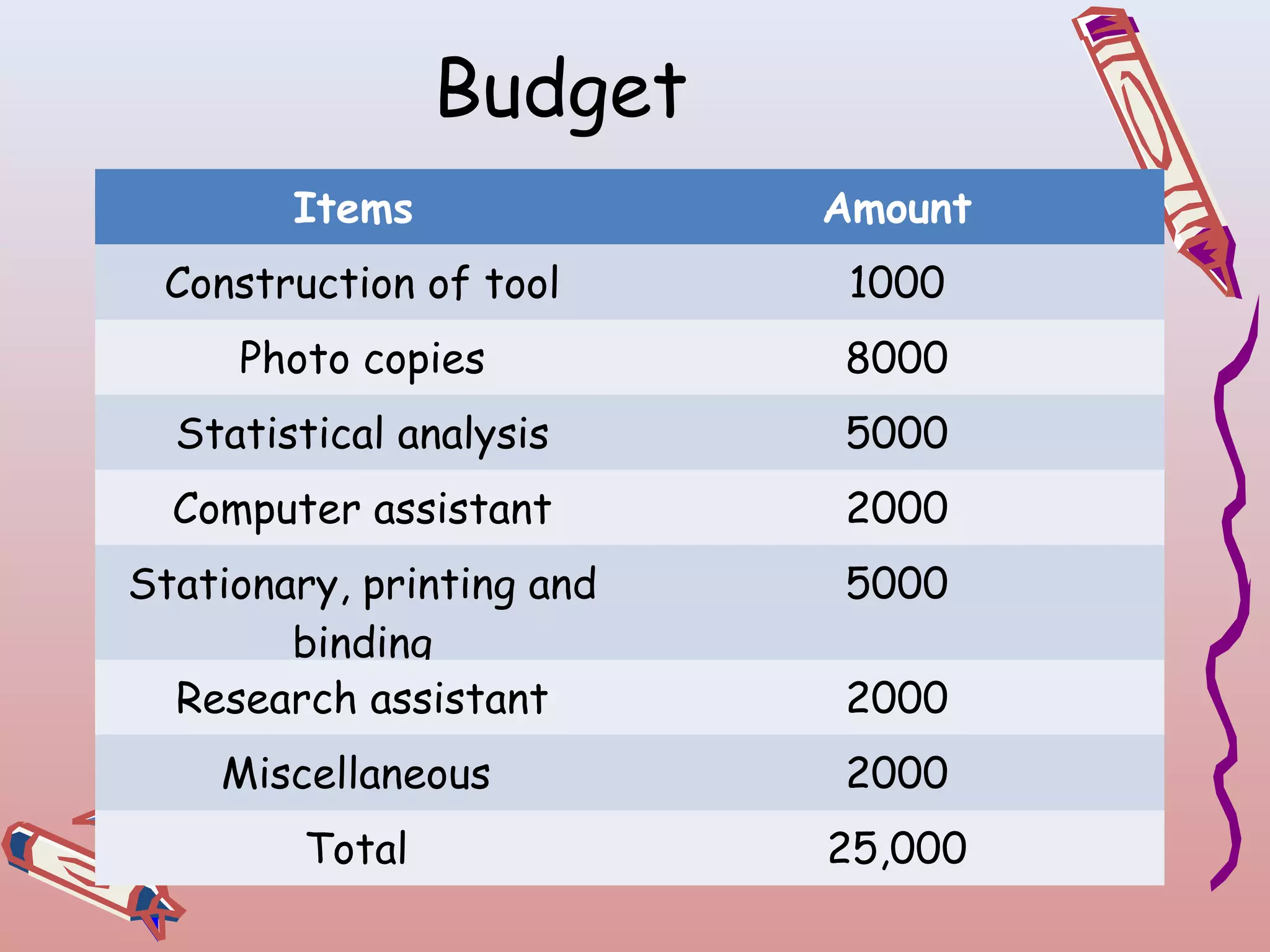
Budget
Items

Amount

Construction of tool

1000

Photo copies

8000

Statistical analysis

5000

Computer assistant

2000

Stationary, printing and
binding
Research assistant

5000

Miscellaneous

2000

Total

25,000

2000
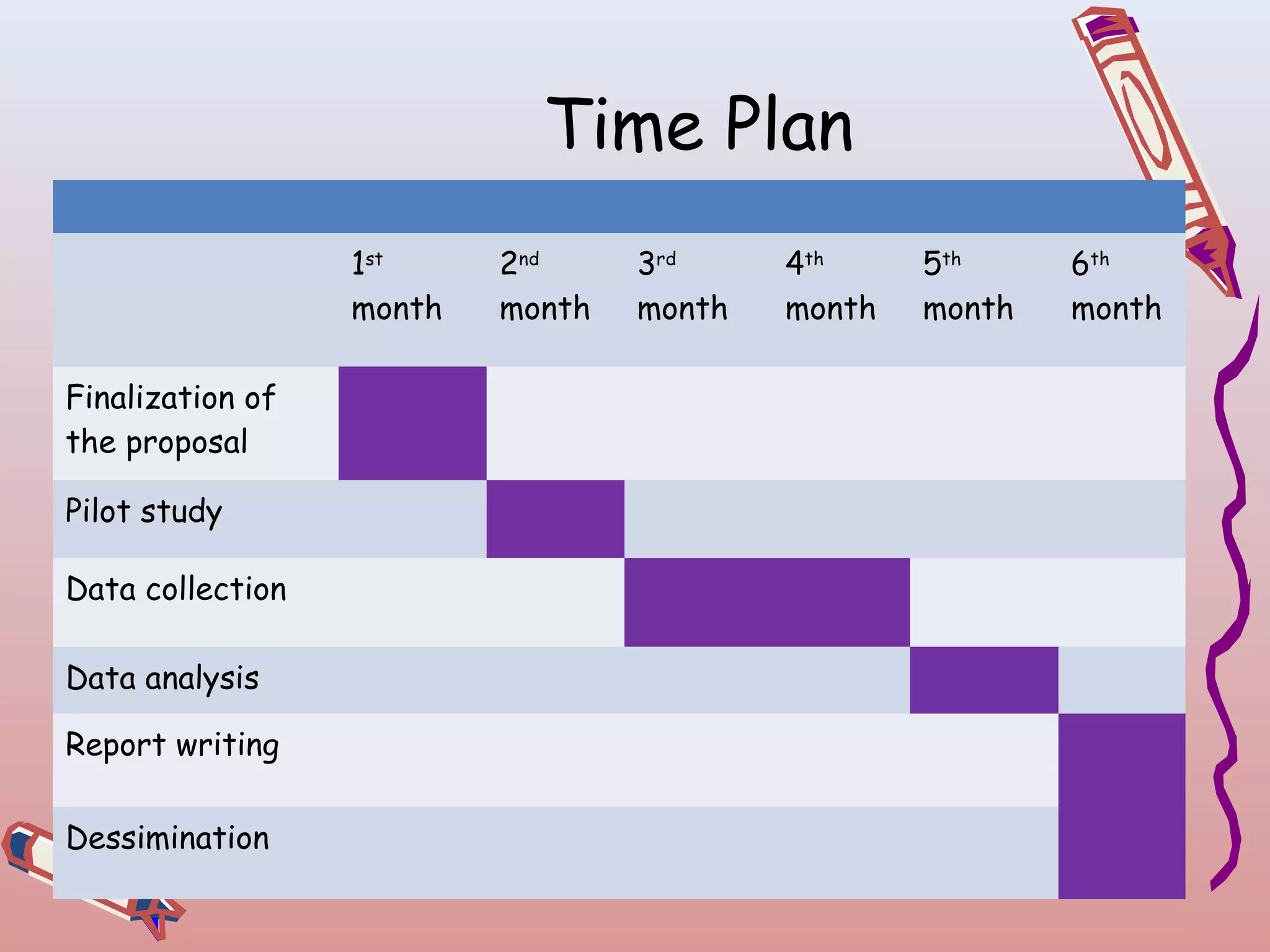
Time Plan
1st
month
Finalization of
the proposal
Pilot study
Data collection
Data analysis
Report writing
Dessimination

2nd
month

3rd
month

4th
month

5th
month

6th
month
Consent form
• Consent form.docx
References
1. Jan, M., Masood, T.(2008, vol 2, issue 1).An Assessment
of Life Satisfaction among Women. International Journal
for Studies on Home and Community Science.
2. Melies, A.L.,Douglas, M.K., Eribes, C., Shih, F.,
Messias, D.K.,(1996). Employed Mexican women as
mothers and partners: valued, empowered and
overloaded. Journal of Advanced nursing ;23:82-90.
3. Singh,Y.G.(Feb 2012;volIII).ISSUE-29.Life Satisfaction
of School Teacher in relation to General
Demography.International Referred Research Journal,
ISSN- 0975-3486, RNI-RAJBIL 2009/30097.
4. Basavaraj,A.U.(2010).Unpublished dessertation protocol.
ASSESSMENT OF LIFE SATISFACTION AMONG
WORKING MOTHERS”.
• questionaire.docx
Any
queries??????????
Thank you
for your
patience listening

Proposal life satisfaction

  • 1.
  • 2.
    Title LIFE SATISFACTION AMONG EMPLOYEDMOTHERS IN THE SELECTED ORGANISATIONS OF DHARAN MUNICIPALITY.
  • 3.
    Introduction • Life satisfactionis widely considered to be central aspect of human welfare and is not merely a judgment about one’s life. • For it is widely thought to involve affirming, endorsing, appreciating or being pleased with one’s life.1
  • 4.
    Introduction cont…. • Lifesatisfaction is defined as “a global assessment of a person’s quality of life according to his or her chosen criteria.” • Satisfaction of life depends not only on what people have, but on criteria that people choose themselves and how they judge their own achievements.2
  • 5.
    Introduction cont…. • Thecriteria and reference standards are a personal choice and there largely influenced by social, cultural and religious traditions of a group.2
  • 6.
    Rationale for thestudy • Women comprise more than half of the national population of our country. • Hence the development of any country is inseparably linked with the status of development of women.2 • More over when a women become a mother her responsibility is added up.
  • 7.
    Rational Cont… • Motherswho are working are not happy leaving their child at such young age. They feel guilty and anxious and their anxiety is transmitted to the child. The mother will phone ten times a day to find out what is happening and try to give instructions over the phone. This can make the whole family develop neurotic tendencies.4
  • 8.
    Rationale Cont… • It, therefore,becomes the role and responsibility of scholars, educationists, socialists, media and voluntary agencies also to act as catalyst, an agent of change to cause stir in the minds of men and storm in the minds of women.
  • 9.
    Cont…….. • The investigatorsfrom experience had seen more working mothers aged between 20 and 60 years were finding difficulty in coping up with work family conflict due to stress. They are following defective coping strategies in dealing with work family conflict. So there is a need to assess life satisfaction.
  • 10.
    Objectives • To assessthe life satisfaction among the employed mothers. • To assess the association between life satisfaction and selected socio-demographic variables. • To compare the life satisfaction among the employed mothers in the selected organisations.
  • 11.
    Hypothesis • There isno significant association between the life satisfaction and the selected sociodemographic variables. • There is no significant difference between the life satisfaction among the working mothers of the selected organisations.
  • 12.
    Variables • Independent variable – – – – – – – – Ageof mother Religion Educational status Type of family Family size No. of children Family income Occupation of the respondent – Hours of work – Occupation of respondent’s husband • Dependent variable – Life satisfaction
  • 13.
    Measurement of variables • Ageof mother: – completed years in the last birthday. • Educational status: – Upto SLC – Intermediate – Bachelor and above
  • 14.
    Cont…. • Type offamily: – Nuclear – Joint • Family income • Working hours: - Per week
  • 15.
    OPERATIONAL DEFINITONS • Life satisfaction:Inthis study life satisfaction refers to the overall satisfaction enjoyed in life by women in the context of their multiple role performances which is assessed by modified life satisfaction scale. • Selected organisations: It refers to BPKIHS and all the secondary level schools of Dharan municipality. • .
  • 16.
    Operatinol def. Cont… •Employed mothers: Employed mother refers to those who are currently working as a nursing staffs in BPKIHS and those mothers working as a teacher in the schools.
  • 17.
    Literature review • Astudy conducted by Jan M in Kashmir India depicts that women have average level of life satisfaction at all age levels. It is found that with an increase in age, the overall life satisfaction decreases; whereas, with an increase in personal income, the over all life satisfaction increases. Moreover, with an increase in family income, the over all life satisfaction of women also increases.1
  • 18.
    • A studyconducted by mameen S showed that nearly two thirds of the rural mothers were satisfied in their life.
  • 19.
  • 20.
    Research Methodology • Researchdesign – Descriptive cross-sectional • Study area – BPKIHS and selected secondary level schools of Dharan • Population – All the employed mothers working in the schools and as a nursing staff in BPKIHS .
  • 21.
    Cont… • Sample size:100 • Sampling technique – Population proportionate simple random sampling.
  • 22.
    Cont… • Inclusion criteria –Who are available during the period of data collection. – Those with full time employment in the organisation for a minimum period of 12 months.
  • 23.
    Cont… • Exclusion criteria –Who are single mother. – Those who are having any illness (physical and mental)
  • 24.
    Research instrument Self developedlife satisfaction questionnaire based on literature review. • Technique of data collection: self administered semi-structured questionnaire
  • 25.
    Instrument Cont…. – Eachdomain containing 6 items including 2 negative items in each domains.   • The scale regarding life satisfaction comprises 24 items under 5 responses i.e., strongly agree, Agree, neither, disagree, strongly disagree coded as 5, 4, 3, 2, 1 respectively for positive items and 1, 2, 3, 4, 5 respectively for negative items.
  • 26.
    Interpretation • High levelof life satisfaction- 91 and above • Average level of life satisfaction- 61 to 90 • Low level of life satisfaction- 31 to 60
  • 27.
    Cont… • Validity The toolwill be translated to nepali version by the experts and again translated to english version. – Content validity will be maintained by taking feedbacks from various experts of different fields. – Pilot study will be done prior to the main study.
  • 28.
    Data analysis Descriptive statisticswill be used to explain about the variables. Inferential statistics (Chi Square test) will be used to show the association between the variables.
  • 29.
    Ethical issues • Permissionfrom the concerned authorities will be obtained. An informed consent will be obtained from the research subject. The information obtained will be kept confidential and will be used for research purpose only.
  • 30.
    Delimitation • Since thestudy will be done from the selected organisation it cannot be generalised to the employed mothers of the other organisations.
  • 31.
    Budget Items Amount Construction of tool 1000 Photocopies 8000 Statistical analysis 5000 Computer assistant 2000 Stationary, printing and binding Research assistant 5000 Miscellaneous 2000 Total 25,000 2000
  • 32.
    Time Plan 1st month Finalization of theproposal Pilot study Data collection Data analysis Report writing Dessimination 2nd month 3rd month 4th month 5th month 6th month
  • 33.
  • 34.
    References 1. Jan, M.,Masood, T.(2008, vol 2, issue 1).An Assessment of Life Satisfaction among Women. International Journal for Studies on Home and Community Science. 2. Melies, A.L.,Douglas, M.K., Eribes, C., Shih, F., Messias, D.K.,(1996). Employed Mexican women as mothers and partners: valued, empowered and overloaded. Journal of Advanced nursing ;23:82-90.
  • 35.
    3. Singh,Y.G.(Feb 2012;volIII).ISSUE-29.LifeSatisfaction of School Teacher in relation to General Demography.International Referred Research Journal, ISSN- 0975-3486, RNI-RAJBIL 2009/30097. 4. Basavaraj,A.U.(2010).Unpublished dessertation protocol. ASSESSMENT OF LIFE SATISFACTION AMONG WORKING MOTHERS”.
  • 36.
  • 37.
  • 38.