SUCCESS
CRITERIA
I can…
•Illustrate theproperties of limits
•Apply limit properties
•Evaluate limit by direct substitution or by
simplification.
PROPERTIES OF LIMITS
4.
PROPERTIES OF LIMITS
SUCCESSCRITERIA
I CAN. . .
•Illustrate the properties of limits
•Apply limit properties
•Evaluate limit by direct substitution or by simplification.
OBJECTIVES
•Illustrate the properties of limits
•Apply limit properties
•Evaluate limit by direct substitution or by simplification.
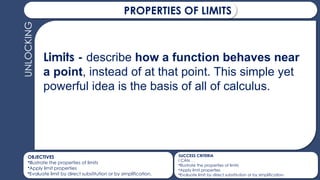
Limits - describe how a function behaves near
a point, instead of at that point. This simple yet
powerful idea is the basis of all of calculus.
UNLOCKING
5.
PROPERTIES OF LIMITS
SUCCESSCRITERIA
I CAN. . .
•Illustrate the properties of limits
•Apply limit properties
•Evaluate limit by direct substitution or by simplification.
OBJECTIVES
•Illustrate the properties of limits
•Apply limit properties
•Evaluate limit by direct substitution or by simplification.
LESSON
PROPER
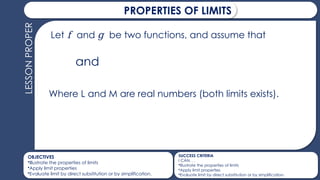
Let f and g be two functions, and assume that
and
Where L and M are real numbers (both limits exists).
6.
PROPERTIES OF LIMITS
SUCCESSCRITERIA
I CAN. . .
•Illustrate the properties of limits
•Apply limit properties
•Evaluate limit by direct substitution or by simplification.
OBJECTIVES
•Illustrate the properties of limits
•Apply limit properties
•Evaluate limit by direct substitution or by simplification.
LESSON
PROPER
Property 1: The limit of a constant is itself.
lim
𝑥 → 𝑐
𝑘=𝑘
for any constant
Example:
1.) ¿ 5 2.) ¿−2 3.) ¿
3
5
7.
PROPERTIES OF LIMITS
SUCCESSCRITERIA
I CAN. . .
•Illustrate the properties of limits
•Apply limit properties
•Evaluate limit by direct substitution or by simplification.
OBJECTIVES
•Illustrate the properties of limits
•Apply limit properties
•Evaluate limit by direct substitution or by simplification.
LESSON
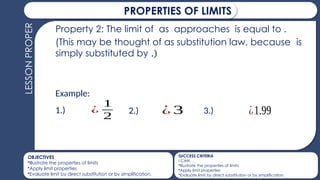
PROPER Property 2: The limit of as approaches is equal to .
(This may be thought of as substitution law, because is
simply substituted by .)
Example:
1.) ¿
1
2
2.) ¿ 3 3.) ¿1.99
8.
PROPERTIES OF LIMITS
SUCCESSCRITERIA
I CAN. . .
•Illustrate the properties of limits
•Apply limit properties
•Evaluate limit by direct substitution or by simplification.
OBJECTIVES
•Illustrate the properties of limits
•Apply limit properties
•Evaluate limit by direct substitution or by simplification.
LESSON
PROPER Let f and g be two functions, and assume that
and
Where L and M are real numbers (both limits exists).
Property 3: Limit of a Sum
Example:
1.) ¿ lim
𝑥→ 2
𝑥+ lim
𝑥 →2
4
¿ 2+ 4
¿ 6
9.
PROPERTIES OF LIMITS
SUCCESSCRITERIA
I CAN. . .
•Illustrate the properties of limits
•Apply limit properties
•Evaluate limit by direct substitution or by simplification.
OBJECTIVES
•Illustrate the properties of limits
•Apply limit properties
•Evaluate limit by direct substitution or by simplification.
LESSON
PROPER Let f and g be two functions, and assume that
and
Where L and M are real numbers (both limits exists). Then
lim
𝑥 → 𝑐
[ 𝑓 (𝑥 ) −𝑔(𝑥)]=¿ lim
𝑥 → 𝑐
𝑓 ( 𝑥 )− lim
𝑥 →𝑐
𝑔(𝑥 )=𝐿− 𝑀 ¿
Example: 1.) ¿ lim
𝑥→ 9
𝑥 − lim
𝑥 → 9
2
¿ 9 − 2
¿ 7
Property 4: Limit of a Difference
2.) ¿ lim
𝑥→ −3
𝑥2
− lim
𝑥 → −3
1
¿ 9 − 1
¿ 8
10.
PROPERTIES OF LIMITS
SUCCESSCRITERIA
I CAN. . .
•Illustrate the properties of limits
•Apply limit properties
•Evaluate limit by direct substitution or by simplification.
OBJECTIVES
•Illustrate the properties of limits
•Apply limit properties
•Evaluate limit by direct substitution or by simplification.
LESSON
PROPER Property 5: The constant multiple property
lim
𝑥 → 𝑐
𝑘∙ 𝑓 (𝑥)=¿𝑘 ∙lim
𝑥→ 𝑐
𝑓 (𝑥)=𝑘∙ 𝑀 ¿ for any constant
Example:
1.) ¿ 5 ∙ lim
𝑥 → 3
𝑥
¿ 5 ∙ 3
¿ 1 5
¿−10∙ lim
𝑥→ 𝑐
𝑓 (𝑥) ¿ −10 ∙ 2
2.) If the then
¿ −10 ∙ lim
𝑥→ 𝑐
2 ¿ − 20
11.
PROPERTIES OF LIMITS
SUCCESSCRITERIA
I CAN. . .
•Illustrate the properties of limits
•Apply limit properties
•Evaluate limit by direct substitution or by simplification.
OBJECTIVES
•Illustrate the properties of limits
•Apply limit properties
•Evaluate limit by direct substitution or by simplification.
LESSON
PROPER Let f and g be two functions, and assume that
and
Where L and M are real numbers (both limits exists). Then
lim
𝑥 → 𝑐
[ 𝑓 (𝑥)∙ 𝑔(𝑥 )]=lim
𝑥 →𝑐
𝑓 (𝑥 )∙ lim
𝑥 → 𝑐
𝑔(𝑥 )
Property 6: Limit of a Product
Example: 1.) Let and
lim
𝑥 → 𝑐
[ 𝑓 (𝑥)∙ 𝑔(𝑥 )]=lim
𝑥 →𝑐
𝑓 (𝑥 )∙ lim
𝑥 → 𝑐
𝑔(𝑥 )
¿ 6 ∙ 2
¿ 1 2
12.
PROPERTIES OF LIMITS
SUCCESSCRITERIA
I CAN. . .
•Illustrate the properties of limits
•Apply limit properties
•Evaluate limit by direct substitution or by simplification.
OBJECTIVES
•Illustrate the properties of limits
•Apply limit properties
•Evaluate limit by direct substitution or by simplification.
LESSON
PROPER
lim
𝑥 → 𝑐
[ 𝑓 (𝑥)∙ 𝑔(𝑥 )]=lim
𝑥 →𝑐
𝑓 (𝑥 )∙ lim
𝑥 → 𝑐
𝑔(𝑥 )
Property 6: Limit of a Product
Example: 2.)
13.
PROPERTIES OF LIMITS
SUCCESSCRITERIA
I CAN. . .
•Illustrate the properties of limits
•Apply limit properties
•Evaluate limit by direct substitution or by simplification.
OBJECTIVES
•Illustrate the properties of limits
•Apply limit properties
•Evaluate limit by direct substitution or by simplification.
LESSON
PROPER Property 7: Limit of a Quotient
lim
𝑥 → 𝑐
𝑓 (𝑥)
𝑔(𝑥 )
=
lim
𝑥 →𝑐
𝑓 (𝑥 )
lim
𝑥 → 𝑐
𝑔(𝑥 )
=
𝐿
𝑀 If
14.
PROPERTIES OF LIMITS
SUCCESSCRITERIA
I CAN. . .
•Illustrate the properties of limits
•Apply limit properties
•Evaluate limit by direct substitution or by simplification.
OBJECTIVES
•Illustrate the properties of limits
•Apply limit properties
•Evaluate limit by direct substitution or by simplification.
LESSON
PROPER Property 8: Limit of a Power
lim
𝑥 → 𝑐
[ 𝑓 (𝑥 )]
𝑝
=lim
𝑥→ 𝑐
[ 𝑓 ( 𝑥) ]
𝑝
= 𝐿
𝑝
is real number
Example:
15.
PROPERTIES OF LIMITS
SUCCESSCRITERIA
I CAN. . .
•Illustrate the properties of limits
•Apply limit properties
•Evaluate limit by direct substitution or by simplification.
OBJECTIVES
•Illustrate the properties of limits
•Apply limit properties
•Evaluate limit by direct substitution or by simplification.
LESSON
PROPER Property 9: Radical/Root Property
lim
𝑥 → 𝑐
𝑛
√ 𝑓 (𝑥)=𝑛
√lim
𝑥 → 𝑐
𝑓 (𝑥)=
𝑛
√𝐿
Example:
16.
SUCCESS CRITERIA
I CAN.. .
•Illustrate the properties of limits
•Apply limit properties
•Evaluate limit by direct substitution or by simplification.
OBJECTIVES
•Illustrate the properties of limits
•Apply limit properties
•Evaluate limit by direct substitution or by simplification.
ACTIVITY
1. ¿ lim
𝑥 → 2
( 𝑥
2
+ 4 𝑥 )3
2 . ¿ lim
𝑥 →7
𝑥2
− 49
𝑥 −7
3 . ¿ lim
𝑥 → 5
𝑥2
+2 𝑥 −35
𝑥
2
− 25
Determine the limit algebraically, if it exists.




![PROPERTIES OF LIMITS
SUCCESS CRITERIA
I CAN. . .
•Illustrate the properties of limits
•Apply limit properties
•Evaluate limit by direct substitution or by simplification.
OBJECTIVES
•Illustrate the properties of limits
•Apply limit properties
•Evaluate limit by direct substitution or by simplification.
LESSON
PROPER Let f and g be two functions, and assume that
and
Where L and M are real numbers (both limits exists). Then
lim
𝑥 → 𝑐
[ 𝑓 (𝑥 ) −𝑔(𝑥)]=¿ lim
𝑥 → 𝑐
𝑓 ( 𝑥 )− lim
𝑥 →𝑐
𝑔(𝑥 )=𝐿− 𝑀 ¿
Example: 1.) ¿ lim
𝑥→ 9
𝑥 − lim
𝑥 → 9
2
¿ 9 − 2
¿ 7
Property 4: Limit of a Difference
2.) ¿ lim
𝑥→ −3
𝑥2
− lim
𝑥 → −3
1
¿ 9 − 1
¿ 8](https://image.slidesharecdn.com/propertiesoflimitsbasiccalculus-250515050010-6264d4c6/85/PROPERTIES-OF-LIMITS-BASIC-CALCULUS-pptx-9-320.jpg)

![PROPERTIES OF LIMITS
SUCCESS CRITERIA
I CAN. . .
•Illustrate the properties of limits
•Apply limit properties
•Evaluate limit by direct substitution or by simplification.
OBJECTIVES
•Illustrate the properties of limits
•Apply limit properties
•Evaluate limit by direct substitution or by simplification.
LESSON
PROPER Let f and g be two functions, and assume that
and
Where L and M are real numbers (both limits exists). Then
lim
𝑥 → 𝑐
[ 𝑓 (𝑥)∙ 𝑔(𝑥 )]=lim
𝑥 →𝑐
𝑓 (𝑥 )∙ lim
𝑥 → 𝑐
𝑔(𝑥 )
Property 6: Limit of a Product
Example: 1.) Let and
lim
𝑥 → 𝑐
[ 𝑓 (𝑥)∙ 𝑔(𝑥 )]=lim
𝑥 →𝑐
𝑓 (𝑥 )∙ lim
𝑥 → 𝑐
𝑔(𝑥 )
¿ 6 ∙ 2
¿ 1 2](https://image.slidesharecdn.com/propertiesoflimitsbasiccalculus-250515050010-6264d4c6/85/PROPERTIES-OF-LIMITS-BASIC-CALCULUS-pptx-11-320.jpg)
![PROPERTIES OF LIMITS
SUCCESS CRITERIA
I CAN. . .
•Illustrate the properties of limits
•Apply limit properties
•Evaluate limit by direct substitution or by simplification.
OBJECTIVES
•Illustrate the properties of limits
•Apply limit properties
•Evaluate limit by direct substitution or by simplification.
LESSON
PROPER
lim
𝑥 → 𝑐
[ 𝑓 (𝑥)∙ 𝑔(𝑥 )]=lim
𝑥 →𝑐
𝑓 (𝑥 )∙ lim
𝑥 → 𝑐
𝑔(𝑥 )
Property 6: Limit of a Product
Example: 2.)](https://image.slidesharecdn.com/propertiesoflimitsbasiccalculus-250515050010-6264d4c6/85/PROPERTIES-OF-LIMITS-BASIC-CALCULUS-pptx-12-320.jpg)

![PROPERTIES OF LIMITS
SUCCESS CRITERIA
I CAN. . .
•Illustrate the properties of limits
•Apply limit properties
•Evaluate limit by direct substitution or by simplification.
OBJECTIVES
•Illustrate the properties of limits
•Apply limit properties
•Evaluate limit by direct substitution or by simplification.
LESSON
PROPER Property 8: Limit of a Power
lim
𝑥 → 𝑐
[ 𝑓 (𝑥 )]
𝑝
=lim
𝑥→ 𝑐
[ 𝑓 ( 𝑥) ]
𝑝
= 𝐿
𝑝
is real number
Example:](https://image.slidesharecdn.com/propertiesoflimitsbasiccalculus-250515050010-6264d4c6/85/PROPERTIES-OF-LIMITS-BASIC-CALCULUS-pptx-14-320.jpg)


![Earth Science activity -First Day -[1].pptx](https://cdn.slidesharecdn.com/ss_thumbnails/earthscience-firstday-1-250903072910-94467441-thumbnail.jpg?width=640&height=640&fit=bounds)


