c Amy Austin, September 16, 2015 1
Section 2.3: Limit Laws
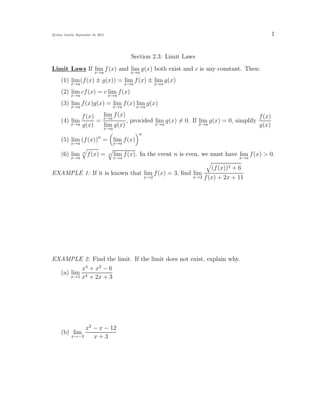
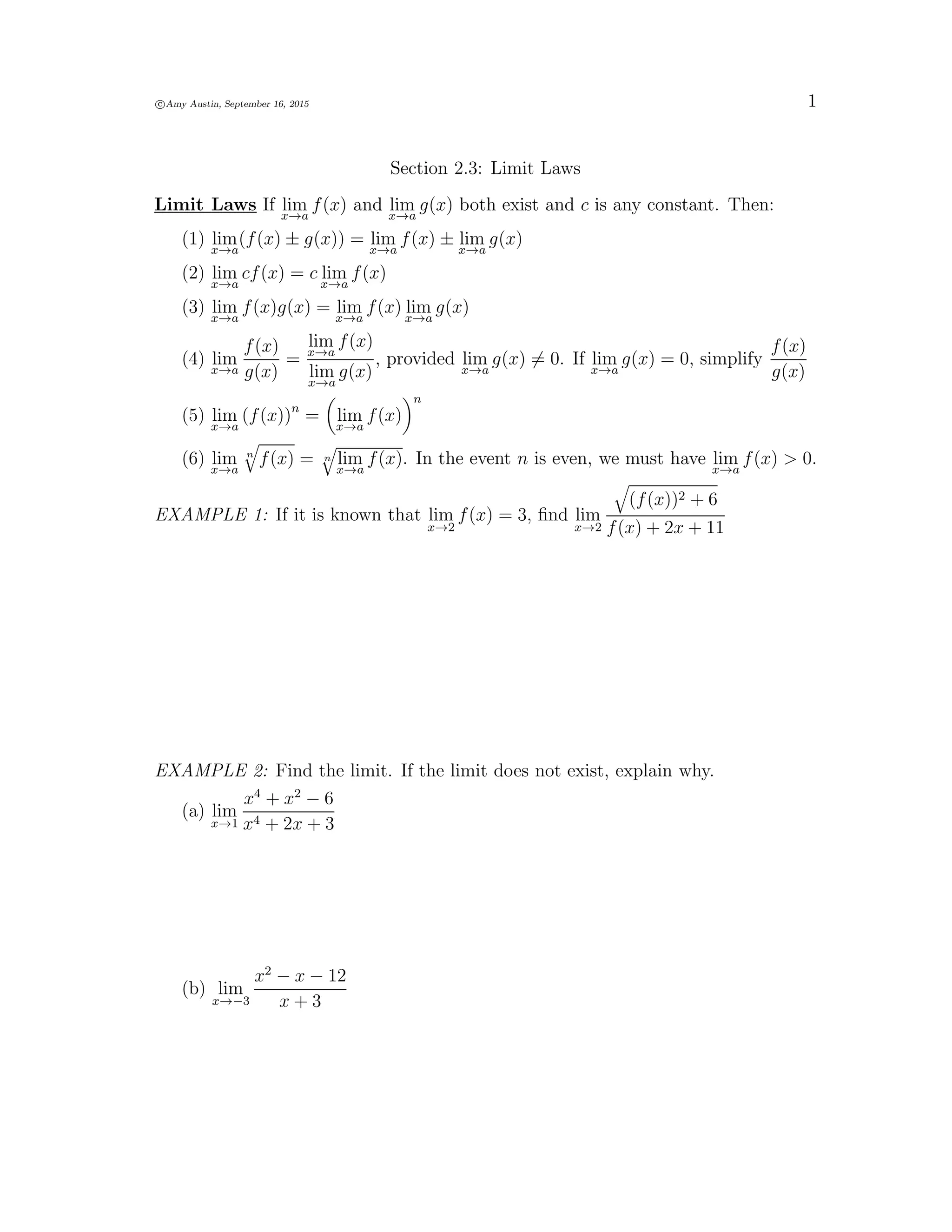
Limit Laws If lim
x→a
f(x) and lim
x→a
g(x) both exist and c is any constant. Then:
(1) lim
x→a
(f(x) ± g(x)) = lim
x→a
f(x) ± lim
x→a
g(x)
(2) lim
x→a
cf(x) = c lim
x→a
f(x)
(3) lim
x→a
f(x)g(x) = lim
x→a
f(x) lim
x→a
g(x)
(4) lim
x→a
f(x)
g(x)
=
lim
x→a
f(x)
lim
x→a
g(x)
, provided lim
x→a
g(x) 6= 0. If lim
x→a
g(x) = 0, simplify
f(x)
g(x)
(5) lim
x→a
(f(x))n
=

lim
x→a
f(x)
n
(6) lim
x→a
n
q
f(x) = n
q
lim
x→a
f(x). In the event n is even, we must have lim
x→a
f(x)  0.
EXAMPLE 1: If it is known that lim
x→2
f(x) = 3, find lim
x→2
q
(f(x))2 + 6
f(x) + 2x + 11
EXAMPLE 2: Find the limit. If the limit does not exist, explain why.
(a) lim
x→1
x4
+ x2
− 6
x4 + 2x + 3
(b) lim
x→−3
x2
− x − 12
x + 3
c Amy Austin, September 16, 2015 2
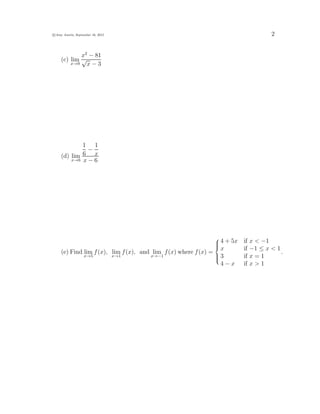
(c) lim
x→9
x2
− 81
√
x − 3
(d) lim
x→6
1
6
−
1
x
x − 6
(e) Find lim
x→5
f(x), lim
x→1
f(x), and lim
x→−1
f(x) where f(x) =







4 + 5x if x  −1
x if −1 ≤ x  1
3 if x = 1
4 − x if x  1
.
c Amy Austin, September 16, 2015 3
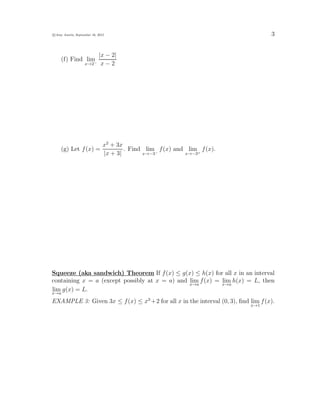
(f) Find lim
x→2−
|x − 2|
x − 2
(g) Let f(x) =
x2
+ 3x
|x + 3|
. Find lim
x→−3−
f(x) and lim
x→−3+
f(x).
Squeeze (aka sandwich) Theorem If f(x) ≤ g(x) ≤ h(x) for all x in an interval
containing x = a (except possibly at x = a) and lim
x→a
f(x) = lim
x→a
h(x) = L, then
lim
x→a
g(x) = L.
EXAMPLE 3: Given 3x ≤ f(x) ≤ x3
+2 for all x in the interval (0, 3), find lim
x→1
f(x).

Properties and theorems of limits and examples

  • 1.
    c Amy Austin,September 16, 2015 1 Section 2.3: Limit Laws Limit Laws If lim x→a f(x) and lim x→a g(x) both exist and c is any constant. Then: (1) lim x→a (f(x) ± g(x)) = lim x→a f(x) ± lim x→a g(x) (2) lim x→a cf(x) = c lim x→a f(x) (3) lim x→a f(x)g(x) = lim x→a f(x) lim x→a g(x) (4) lim x→a f(x) g(x) = lim x→a f(x) lim x→a g(x) , provided lim x→a g(x) 6= 0. If lim x→a g(x) = 0, simplify f(x) g(x) (5) lim x→a (f(x))n = lim x→a f(x) n (6) lim x→a n q f(x) = n q lim x→a f(x). In the event n is even, we must have lim x→a f(x) 0. EXAMPLE 1: If it is known that lim x→2 f(x) = 3, find lim x→2 q (f(x))2 + 6 f(x) + 2x + 11 EXAMPLE 2: Find the limit. If the limit does not exist, explain why. (a) lim x→1 x4 + x2 − 6 x4 + 2x + 3 (b) lim x→−3 x2 − x − 12 x + 3
  • 2.
    c Amy Austin,September 16, 2015 2 (c) lim x→9 x2 − 81 √ x − 3 (d) lim x→6 1 6 − 1 x x − 6 (e) Find lim x→5 f(x), lim x→1 f(x), and lim x→−1 f(x) where f(x) =        4 + 5x if x −1 x if −1 ≤ x 1 3 if x = 1 4 − x if x 1 .
  • 3.
    c Amy Austin,September 16, 2015 3 (f) Find lim x→2− |x − 2| x − 2 (g) Let f(x) = x2 + 3x |x + 3| . Find lim x→−3− f(x) and lim x→−3+ f(x). Squeeze (aka sandwich) Theorem If f(x) ≤ g(x) ≤ h(x) for all x in an interval containing x = a (except possibly at x = a) and lim x→a f(x) = lim x→a h(x) = L, then lim x→a g(x) = L. EXAMPLE 3: Given 3x ≤ f(x) ≤ x3 +2 for all x in the interval (0, 3), find lim x→1 f(x).