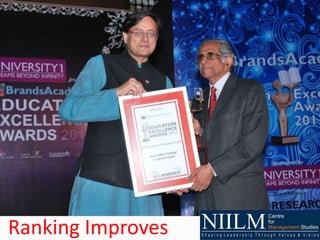
Ranking Improves
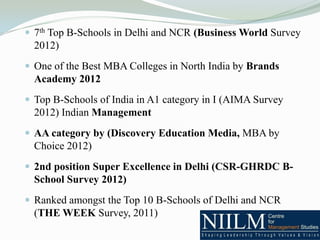
 7th Top B-Schools in Delhi and NCR (Business World Survey
  2012)
 One of the Best MBA Colleges in North India by Brands
  Academy 2012
 Top B-Schools of India in A1 category in I (AIMA Survey
  2012) Indian Management
 AA category by (Discovery Education Media, MBA by
  Choice 2012)
 2nd position Super Excellence in Delhi (CSR-GHRDC B-
  School Survey 2012)
 Ranked amongst the Top 10 B-Schools of Delhi and NCR
  (THE WEEK Survey, 2011)
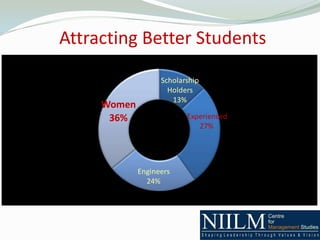
Attracting Better Students
                   Scholarship
                     Holders
                      13%
     Women
      36%                 Experienced
                             27%


             Engineers
               24%
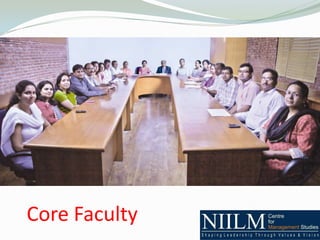
Core Faculty
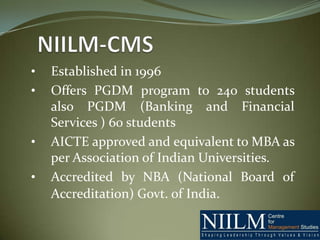
•   Established in 1996
•   Offers PGDM program to 240 students
    also PGDM (Banking and Financial
    Services ) 60 students
•   AICTE approved and equivalent to MBA as
    per Association of Indian Universities.
•   Accredited by NBA (National Board of
    Accreditation) Govt. of India.
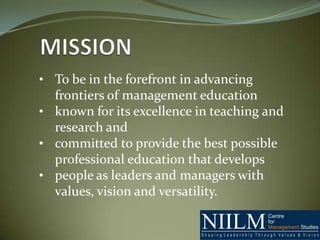
• To be in the forefront in advancing
  frontiers of management education
• known for its excellence in teaching and
  research and
• committed to provide the best possible
  professional education that develops
• people as leaders and managers with
  values, vision and versatility.
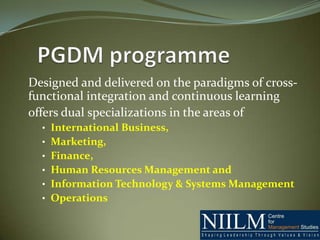
Designed and delivered on the paradigms of cross-
functional integration and continuous learning
offers dual specializations in the areas of
  • International Business,
  • Marketing,
  • Finance,
  • Human Resources Management and
  • Information Technology & Systems Management
  • Operations
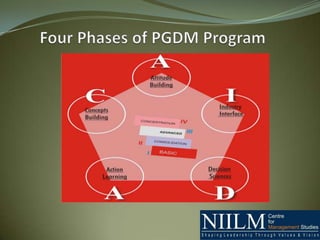
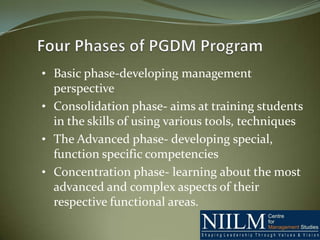
• Basic phase-developing management
  perspective
• Consolidation phase- aims at training students
  in the skills of using various tools, techniques
• The Advanced phase- developing special,
  function specific competencies
• Concentration phase- learning about the most
  advanced and complex aspects of their
  respective functional areas.
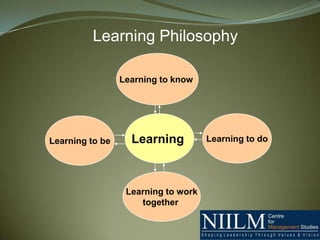
Learning Philosophy

                 Learning to know


Learning to be     Learning          Learning to do


                  Learning to work
                     together
LEARNING CYCLE
Students
Learning to know
  Subject Knowledge


  Practical Applications


  Exposure to Industry
Learning to do
   Develop and enhance planning, co-ordination,
    organizing and decision making skills

   Summer Internships/Live Projects/Role
    Plays/Cases/Management Simulation Games
Learning to work together
 Management games, role plays, group projects/
  assignments & team building exercises
 Various clubs : Finalytics; Opera; HR Dwellepment;
  Marwiz; Launch pad and SPACE (Society for
  Performing art and culture)
 To solve the problems of society at large & work
  together in community development projects
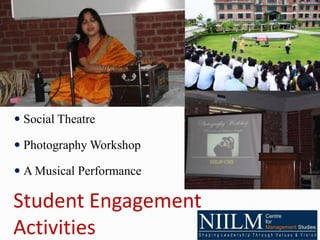
 Social Theatre

 Photography Workshop

 A Musical Performance

Student Engagement
Activities
Social Projects
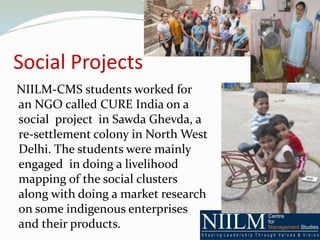
NIILM-CMS students worked for
an NGO called CURE India on a
social project in Sawda Ghevda, a
re-settlement colony in North West
Delhi. The students were mainly
engaged in doing a livelihood
mapping of the social clusters
along with doing a market research
on some indigenous enterprises
and their products.
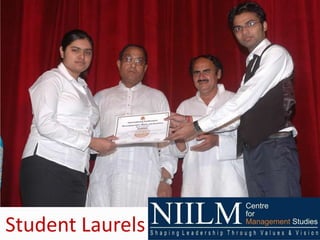
Student Laurels
 Participated in Chanakya – the 15th National
  Management Games 2011 (AIMA).
 Presentation of research papers at JIMS, New Delhi.
 Sumit Mukherjee got the Best Speaker Award.
 Second prize in the Marketing World Cup at IMT
  Ghaziabad.
 Best student presentation at an international
  conference at Teerthankar Mahaveer University
  (Moradabad).
 Participation in an international business quiz
  organized by Amity University.
Learning to be
 A good manager and a Leader
 Good Decision maker
 And above a good human being with values, vision and
 versatility


     This will enable them to realise their
                  full potential
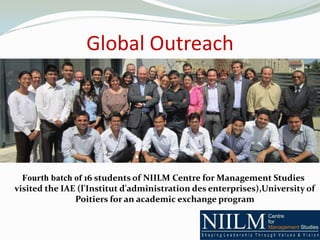
Global Outreach


  Fourth batch of 16 students of NIILM Centre for Management Studies
visited the IAE (l'Institut d'administration des enterprises),University of
               Poitiers for an academic exchange program
Unique Features
  A strong focus on Social Responsibility
     Community Development Projects
     Workshop on CSR
  Mentoring for students
  Strong focus on business communication
  ICT : ERP and online tests
  Students exchange program with Poitiers
  University, France
• Credits and Teaching Hours
 Pedagogy
 Lectures and Discussions
 Case Studies
 Presentations by students
 Situational Role-plays
 Computer-based Models
 Documentaries/Educational movies
 Games
Projects undertaken by students
 Summer Internship
 Dissertation
 Live Projects
 Community Development projects to enhance
  their sensitivity towards the society.
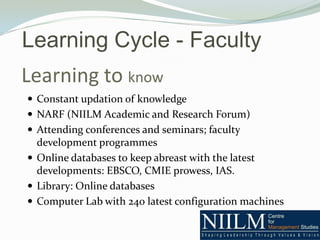
Learning Cycle - Faculty
Learning to know
 Constant updation of knowledge
 NARF (NIILM Academic and Research Forum)
 Attending conferences and seminars; faculty
  development programmes
 Online databases to keep abreast with the latest
  developments: EBSCO, CMIE prowess, IAS.
 Library: Online databases
 Computer Lab with 240 latest configuration machines
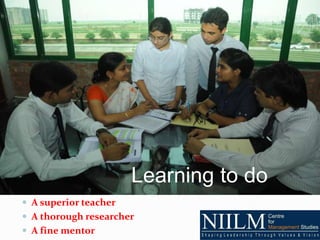
Learning to do
 A superior teacher
 A thorough researcher
 A fine mentor
Learning to do
 Research/Publications/Live Projects


 Organizing International Conferences/seminars/in
 house programmes

 Industry Academia Meet/HR Meet/ Brand
 Summit/Microfinance Conference/Alumni Meet
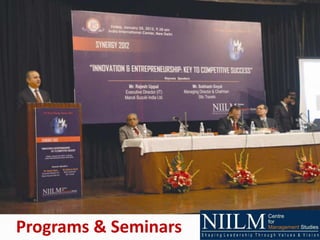
Programs & Seminars
Learning to work together
 Committees: Governing council, academic council,
  course review, academic affairs, examination, library,
  purchasing, alumni, cafeteria.
 Students committees: disciplinary, welfare.
 Coordinators of various clubs
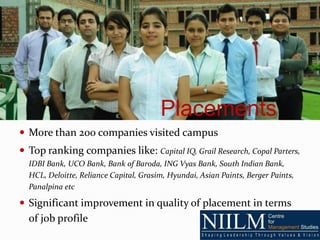
Placements
 More than 200 companies visited campus
 Top ranking companies like: Capital IQ, Grail Research, Copal Parters,
  IDBI Bank, UCO Bank, Bank of Baroda, ING Vyas Bank, South Indian Bank,
  HCL, Deloitte, Reliance Capital, Grasim, Hyundai, Asian Paints, Berger Paints,
  Panalpina etc

 Significant improvement in quality of placement in terms
  of job profile
Promotion ppt1

Promotion ppt1

  • 2.
  • 3.
     7th TopB-Schools in Delhi and NCR (Business World Survey 2012)  One of the Best MBA Colleges in North India by Brands Academy 2012  Top B-Schools of India in A1 category in I (AIMA Survey 2012) Indian Management  AA category by (Discovery Education Media, MBA by Choice 2012)  2nd position Super Excellence in Delhi (CSR-GHRDC B- School Survey 2012)  Ranked amongst the Top 10 B-Schools of Delhi and NCR (THE WEEK Survey, 2011)
  • 4.
    Attracting Better Students Scholarship Holders 13% Women 36% Experienced 27% Engineers 24%
  • 5.
  • 7.
    Established in 1996 • Offers PGDM program to 240 students also PGDM (Banking and Financial Services ) 60 students • AICTE approved and equivalent to MBA as per Association of Indian Universities. • Accredited by NBA (National Board of Accreditation) Govt. of India.
  • 8.
    • To bein the forefront in advancing frontiers of management education • known for its excellence in teaching and research and • committed to provide the best possible professional education that develops • people as leaders and managers with values, vision and versatility.
  • 9.
    Designed and deliveredon the paradigms of cross- functional integration and continuous learning offers dual specializations in the areas of • International Business, • Marketing, • Finance, • Human Resources Management and • Information Technology & Systems Management • Operations
  • 11.
    • Basic phase-developingmanagement perspective • Consolidation phase- aims at training students in the skills of using various tools, techniques • The Advanced phase- developing special, function specific competencies • Concentration phase- learning about the most advanced and complex aspects of their respective functional areas.
  • 12.
    Learning Philosophy Learning to know Learning to be Learning Learning to do Learning to work together
  • 13.
    LEARNING CYCLE Students Learning toknow  Subject Knowledge  Practical Applications  Exposure to Industry
  • 14.
    Learning to do  Develop and enhance planning, co-ordination, organizing and decision making skills  Summer Internships/Live Projects/Role Plays/Cases/Management Simulation Games
  • 15.
    Learning to worktogether  Management games, role plays, group projects/ assignments & team building exercises  Various clubs : Finalytics; Opera; HR Dwellepment; Marwiz; Launch pad and SPACE (Society for Performing art and culture)  To solve the problems of society at large & work together in community development projects
  • 16.
     Social Theatre Photography Workshop  A Musical Performance Student Engagement Activities
  • 17.
    Social Projects NIILM-CMS studentsworked for an NGO called CURE India on a social project in Sawda Ghevda, a re-settlement colony in North West Delhi. The students were mainly engaged in doing a livelihood mapping of the social clusters along with doing a market research on some indigenous enterprises and their products.
  • 18.
  • 19.
     Participated inChanakya – the 15th National Management Games 2011 (AIMA).  Presentation of research papers at JIMS, New Delhi. Sumit Mukherjee got the Best Speaker Award.  Second prize in the Marketing World Cup at IMT Ghaziabad.  Best student presentation at an international conference at Teerthankar Mahaveer University (Moradabad).  Participation in an international business quiz organized by Amity University.
  • 20.
    Learning to be A good manager and a Leader  Good Decision maker  And above a good human being with values, vision and versatility This will enable them to realise their full potential
  • 21.
    Global Outreach Fourth batch of 16 students of NIILM Centre for Management Studies visited the IAE (l'Institut d'administration des enterprises),University of Poitiers for an academic exchange program
  • 22.
    Unique Features A strong focus on Social Responsibility  Community Development Projects  Workshop on CSR  Mentoring for students  Strong focus on business communication  ICT : ERP and online tests  Students exchange program with Poitiers University, France
  • 23.
    • Credits andTeaching Hours Pedagogy  Lectures and Discussions  Case Studies  Presentations by students  Situational Role-plays  Computer-based Models  Documentaries/Educational movies  Games
  • 24.
    Projects undertaken bystudents  Summer Internship  Dissertation  Live Projects  Community Development projects to enhance their sensitivity towards the society.
  • 25.
    Learning Cycle -Faculty Learning to know  Constant updation of knowledge  NARF (NIILM Academic and Research Forum)  Attending conferences and seminars; faculty development programmes  Online databases to keep abreast with the latest developments: EBSCO, CMIE prowess, IAS.  Library: Online databases  Computer Lab with 240 latest configuration machines
  • 26.
    Learning to do A superior teacher  A thorough researcher  A fine mentor
  • 27.
    Learning to do Research/Publications/Live Projects  Organizing International Conferences/seminars/in house programmes  Industry Academia Meet/HR Meet/ Brand Summit/Microfinance Conference/Alumni Meet
  • 28.
  • 29.
    Learning to worktogether  Committees: Governing council, academic council, course review, academic affairs, examination, library, purchasing, alumni, cafeteria.  Students committees: disciplinary, welfare.  Coordinators of various clubs
  • 30.
    Placements  More than200 companies visited campus  Top ranking companies like: Capital IQ, Grail Research, Copal Parters, IDBI Bank, UCO Bank, Bank of Baroda, ING Vyas Bank, South Indian Bank, HCL, Deloitte, Reliance Capital, Grasim, Hyundai, Asian Paints, Berger Paints, Panalpina etc  Significant improvement in quality of placement in terms of job profile