Promoting Sustainability through
Energy-aware Linked Data Devices
Dr. Diego López-de-Ipiña
16:00-16:30, 18 October 2013, Essent.be, Veldkant 7, Kontich, Belgium
dipina@deusto.es
http://www.morelab.deusto.es
http://paginaspersonales.deusto.es/dipina

1
Agenda
•
•
•
•

IoT need for Linked Data
Eco-aware devices: why and what for?
Eco-aware Linked Data Devices
A practical case: Sustainable Linked Data
Coffee Maker

2
IoT Promise
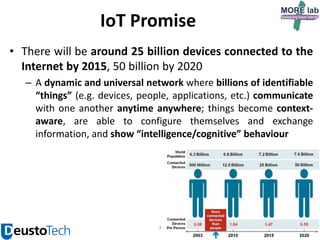
• There will be around 25 billion devices connected to the
Internet by 2015, 50 billion by 2020
– A dynamic and universal network where billions of identifiable
“things” (e.g. devices, people, applications, etc.) communicate
with one another anytime anywhere; things become contextaware, are able to configure themselves and exchange
information, and show “intelligence/cognitive” behaviour

3
IoT Enabling Technologies
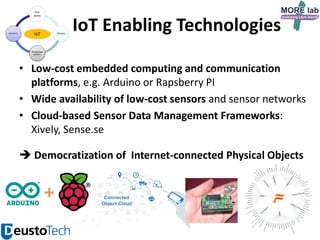
• Low-cost embedded computing and communication
platforms, e.g. Arduino or Rapsberry PI
• Wide availability of low-cost sensors and sensor networks
• Cloud-based Sensor Data Management Frameworks:
Xively, Sense.se

 Democratization of Internet-connected Physical Objects

4
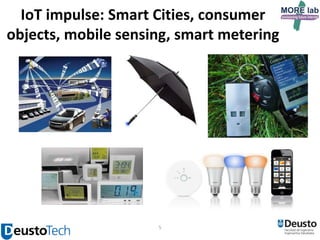
IoT impulse: Smart Cities, consumer
objects, mobile sensing, smart metering

5
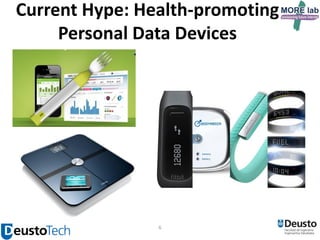
Current Hype: Health-promoting
Personal Data Devices

6
Nature of Data in IoT
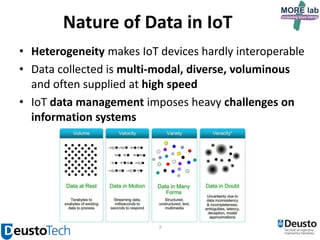
• Heterogeneity makes IoT devices hardly interoperable
• Data collected is multi-modal, diverse, voluminous
and often supplied at high speed
• IoT data management imposes heavy challenges on
information systems

7
Avoiding Data Silos through
Semantics
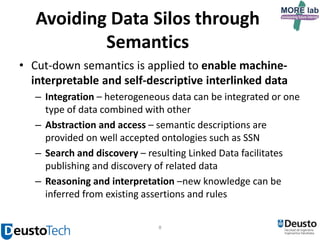
• Cut-down semantics is applied to enable machineinterpretable and self-descriptive interlinked data
– Integration – heterogeneous data can be integrated or one
type of data combined with other
– Abstraction and access – semantic descriptions are
provided on well accepted ontologies such as SSN
– Search and discovery – resulting Linked Data facilitates
publishing and discovery of related data
– Reasoning and interpretation –new knowledge can be
inferred from existing assertions and rules
8
Actionable Knowledge from
Sensorial Data
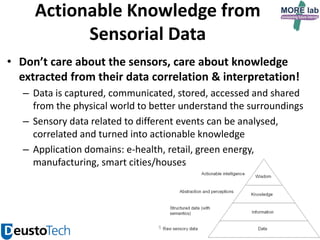
• Don’t care about the sensors, care about knowledge
extracted from their data correlation & interpretation!
– Data is captured, communicated, stored, accessed and shared
from the physical world to better understand the surroundings
– Sensory data related to different events can be analysed,
correlated and turned into actionable knowledge
– Application domains: e-health, retail, green energy,
manufacturing, smart cities/houses

9
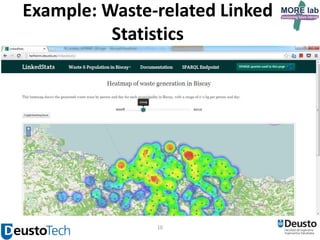
Example: Waste-related Linked
Statistics

10
Linked Data Devices
• Devices that apply the Linked Data principles to publish information:
– Use URIs as names for things
– Use HTTP URIs so that people can look up those names
– When someone looks up a URI, provide useful information, using the standard
(RDF, SPARQL)
– Include links to other URIs, so that they can discover more things

• Devices are becoming BIG PROSUMERS of Linked Data:
– Progressively more dynamic Linked Data coming from increasing amounts of
Internet-connected devices
• About the environment but also about the people themselves, due to trend
towards continuous people-centric enriched data
– Personal Linked Data Cloud vs. Space’s Linked Data Clouds vs. LOD Cloud

• Humongous potential on correlating all these data (BIG LINKED DATA):
energy saving, improve health monitoring, better human energy balance
11
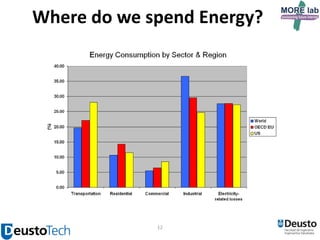
Where do we spend Energy?

12
Eco-Aware Devices
• Society wastes much more energy than it should  tons of
unnecessary CO2 emissions
– Due to inadequate use of electrical devices given the
intangible and invisible nature of energy
• Particularly in shared spaces, e.g. workplaces, where occupants
do not pay the bills directly
– Some studies reveal the enterprises could easily save 20% of
energy waste if measures were taken

• Solution: Eco-aware Devices
– Technological approach: Embedding intelligence in shared
appliances so that they react and adapt upon energy wasting
– Human behavioral change: Team-up with users to reduce
energy wasted through feedback and persuasion
13
Eco-Aware Devices in Action
• They help and motivate people to reduce energy waste by:
– Informing persuasively to concerned users about the misuse of
electronic appliances
– Customizing the operating mode of everyday electrical
appliances as a function of their real usage pattern
– Enabling behaviour export by enabling cooperation among
devices

• How do we ally devices and humans?
– Giving a voice to smart everyday objects to participate in the
energy conservation promotion
• Publishing info in Social Networks and LOD Cloud and through
seductive interfaces
14
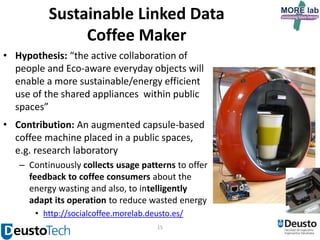
Sustainable Linked Data
Coffee Maker
• Hypothesis: “the active collaboration of
people and Eco-aware everyday objects will
enable a more sustainable/energy efficient
use of the shared appliances within public
spaces”
• Contribution: An augmented capsule-based
coffee machine placed in a public spaces,
e.g. research laboratory
– Continuously collects usage patterns to offer
feedback to coffee consumers about the
energy wasting and also, to intelligently
adapt its operation to reduce wasted energy
• http://socialcoffee.morelab.deusto.es/
15
Social + Sustainable + Persuasive +
Cooperative + Linked Data Device
1. Social since it reports its energy consumptions via social
networks, i.e. Twitter
2. Sustainable since it intelligently foresees when it should be
switched on or off
3. Persuasive since it does not stay still, it reports misuse and
motivates seductively usage corrections
4. Cooperative since it cooperates with other devices in order
to accelerate the learning process
5. Linked Data Device, since it generates reusable energy
consumption-related linked data interlinked with data from
other domains that facilitates their exploitation
16
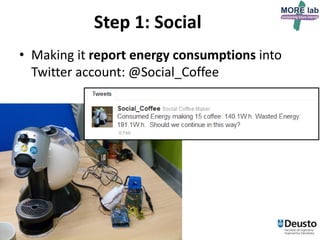
Step 1: Social
• Making it report energy consumptions into
Twitter account: @Social_Coffee

17
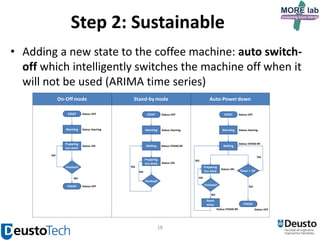
Step 2: Sustainable
• Adding a new state to the coffee machine: auto switchoff which intelligently switches the machine off when it
will not be used (ARIMA time series)

18
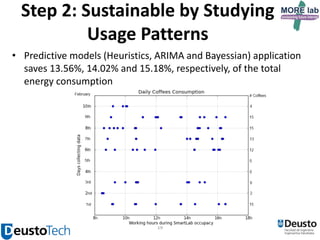
Step 2: Sustainable by Studying
Usage Patterns
• Predictive models (Heuristics, ARIMA and Bayessian) application
saves 13.56%, 14.02% and 15.18%, respectively, of the total
energy consumption

19
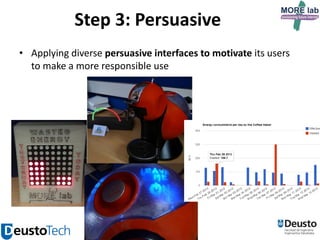
Step 3: Persuasive
• Applying diverse persuasive interfaces to motivate its users
to make a more responsible use

20
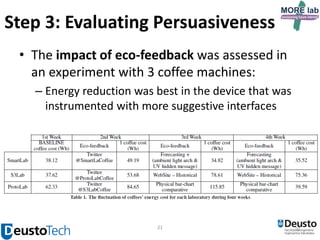
Step 3: Evaluating Persuasiveness
• The impact of eco-feedback was assessed in
an experiment with 3 coffee machines:
– Energy reduction was best in the device that was
instrumented with more suggestive interfaces

21

21
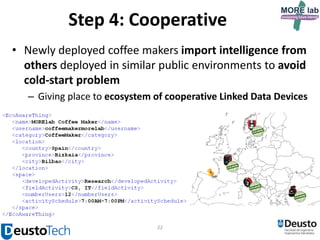
Step 4: Cooperative
• Newly deployed coffee makers import intelligence from
others deployed in similar public environments to avoid
cold-start problem
– Giving place to ecosystem of cooperative Linked Data Devices

22
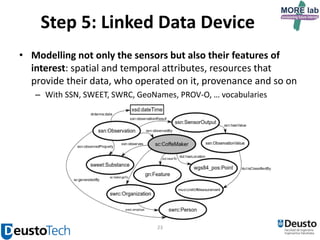
Step 5: Linked Data Device
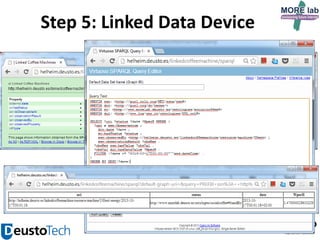
• Modelling not only the sensors but also their features of
interest: spatial and temporal attributes, resources that
provide their data, who operated on it, provenance and so on
– With SSN, SWEET, SWRC, GeoNames, PROV-O, … vocabularies

23
Step 5: Linked Data Device

24
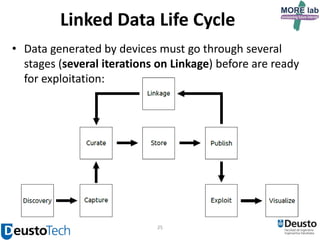
Linked Data Life Cycle
• Data generated by devices must go through several
stages (several iterations on Linkage) before are ready
for exploitation:

25
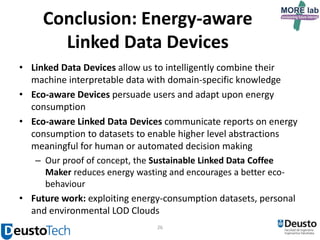
Conclusion: Energy-aware
Linked Data Devices
• Linked Data Devices allow us to intelligently combine their
machine interpretable data with domain-specific knowledge
• Eco-aware Devices persuade users and adapt upon energy
consumption
• Eco-aware Linked Data Devices communicate reports on energy
consumption to datasets to enable higher level abstractions
meaningful for human or automated decision making
– Our proof of concept, the Sustainable Linked Data Coffee
Maker reduces energy wasting and encourages a better ecobehaviour
• Future work: exploiting energy-consumption datasets, personal
and environmental LOD Clouds
26
Promoting Sustainability through
Energy-aware Linked Data Devices
Dr. Diego López-de-Ipiña
16:00-16:30, 18 October 2013, Essent.be, Veldkant 7, Kontich, Belgium
dipina@deusto.es
http://www.morelab.deusto.es
http://paginaspersonales.deusto.es/dipina

27
Acknowledgments
• Thanks to Diego Casado (@dieguich) and Juan López-de-Armentia
(@juanarmentia) for giving birth to the Social Sustainable
Persuasive Cooperative Linked Data-generating Coffee Maker !!!
– http://socialcoffee.morelab.deusto.es/
• Thanks to Mikel Emaldi (@memaldi) & Jon Lázaro (@jon_lazaro) for
the Linked Data support

28

28
References
•

Energy efficiency in the workplace: the solutions and the users that advocate them
– http://bit.ly/17OHeMy

•
•

•

•

Linked Open Data as the fuel for Smarter Cities. Mikel Emaldi, Oscar Peña, Jon
Lázaro, Diego López-de-Ipiña, book chapter under revision
Fighting against Vampire Appliances through Eco-aware Things. Juan López-deArmentia, Diego Casado-Mansilla and Diego López-de-Ipiña. Proceedings of The
Sixth International Conference on Innovative Mobile and Internet Services in
Ubiquitous Computing (Extending Seamlessly to the Internet of Things - esIoT2012
- workshop), pp. 868-873. Palermo, Italy, July 2012.
http://dx.doi.org/10.1109/IMIS.2012.112
Reducing energy waste through eco-aware everyday things. Juan López-deArmentia, Diego Casado-Mansilla, Sergio López-Pérez, Diego López-de-Ipiña,
Mobile Information Systems, vol., no., pp.; http://dx.doi.org/10.3233/MIS-130172,
ISSN 1574-017x, July 2013.
Semantics for the Internet of Things: Early Progress and Back to the Future.
Barnaghi, P., Wang, W., Henson, C., & Taylor, K. (2012). International Journal on
Semantic Web and Information Systems (IJSWIS), 8(1), 1-21.
http://dx.doi.org/10.4018/jswis.2012010101
29

Promoting Sustainability through Energy-aware Linked Data Devices

  • 1.
    Promoting Sustainability through Energy-awareLinked Data Devices Dr. Diego López-de-Ipiña 16:00-16:30, 18 October 2013, Essent.be, Veldkant 7, Kontich, Belgium dipina@deusto.es http://www.morelab.deusto.es http://paginaspersonales.deusto.es/dipina 1
  • 2.
    Agenda • • • • IoT need forLinked Data Eco-aware devices: why and what for? Eco-aware Linked Data Devices A practical case: Sustainable Linked Data Coffee Maker 2
  • 3.
    IoT Promise • Therewill be around 25 billion devices connected to the Internet by 2015, 50 billion by 2020 – A dynamic and universal network where billions of identifiable “things” (e.g. devices, people, applications, etc.) communicate with one another anytime anywhere; things become contextaware, are able to configure themselves and exchange information, and show “intelligence/cognitive” behaviour 3
  • 4.
    IoT Enabling Technologies •Low-cost embedded computing and communication platforms, e.g. Arduino or Rapsberry PI • Wide availability of low-cost sensors and sensor networks • Cloud-based Sensor Data Management Frameworks: Xively, Sense.se  Democratization of Internet-connected Physical Objects 4
  • 5.
    IoT impulse: SmartCities, consumer objects, mobile sensing, smart metering 5
  • 6.
  • 7.
    Nature of Datain IoT • Heterogeneity makes IoT devices hardly interoperable • Data collected is multi-modal, diverse, voluminous and often supplied at high speed • IoT data management imposes heavy challenges on information systems 7
  • 8.
    Avoiding Data Silosthrough Semantics • Cut-down semantics is applied to enable machineinterpretable and self-descriptive interlinked data – Integration – heterogeneous data can be integrated or one type of data combined with other – Abstraction and access – semantic descriptions are provided on well accepted ontologies such as SSN – Search and discovery – resulting Linked Data facilitates publishing and discovery of related data – Reasoning and interpretation –new knowledge can be inferred from existing assertions and rules 8
  • 9.
    Actionable Knowledge from SensorialData • Don’t care about the sensors, care about knowledge extracted from their data correlation & interpretation! – Data is captured, communicated, stored, accessed and shared from the physical world to better understand the surroundings – Sensory data related to different events can be analysed, correlated and turned into actionable knowledge – Application domains: e-health, retail, green energy, manufacturing, smart cities/houses 9
  • 10.
  • 11.
    Linked Data Devices •Devices that apply the Linked Data principles to publish information: – Use URIs as names for things – Use HTTP URIs so that people can look up those names – When someone looks up a URI, provide useful information, using the standard (RDF, SPARQL) – Include links to other URIs, so that they can discover more things • Devices are becoming BIG PROSUMERS of Linked Data: – Progressively more dynamic Linked Data coming from increasing amounts of Internet-connected devices • About the environment but also about the people themselves, due to trend towards continuous people-centric enriched data – Personal Linked Data Cloud vs. Space’s Linked Data Clouds vs. LOD Cloud • Humongous potential on correlating all these data (BIG LINKED DATA): energy saving, improve health monitoring, better human energy balance 11
  • 12.
    Where do wespend Energy? 12
  • 13.
    Eco-Aware Devices • Societywastes much more energy than it should  tons of unnecessary CO2 emissions – Due to inadequate use of electrical devices given the intangible and invisible nature of energy • Particularly in shared spaces, e.g. workplaces, where occupants do not pay the bills directly – Some studies reveal the enterprises could easily save 20% of energy waste if measures were taken • Solution: Eco-aware Devices – Technological approach: Embedding intelligence in shared appliances so that they react and adapt upon energy wasting – Human behavioral change: Team-up with users to reduce energy wasted through feedback and persuasion 13
  • 14.
    Eco-Aware Devices inAction • They help and motivate people to reduce energy waste by: – Informing persuasively to concerned users about the misuse of electronic appliances – Customizing the operating mode of everyday electrical appliances as a function of their real usage pattern – Enabling behaviour export by enabling cooperation among devices • How do we ally devices and humans? – Giving a voice to smart everyday objects to participate in the energy conservation promotion • Publishing info in Social Networks and LOD Cloud and through seductive interfaces 14
  • 15.
    Sustainable Linked Data CoffeeMaker • Hypothesis: “the active collaboration of people and Eco-aware everyday objects will enable a more sustainable/energy efficient use of the shared appliances within public spaces” • Contribution: An augmented capsule-based coffee machine placed in a public spaces, e.g. research laboratory – Continuously collects usage patterns to offer feedback to coffee consumers about the energy wasting and also, to intelligently adapt its operation to reduce wasted energy • http://socialcoffee.morelab.deusto.es/ 15
  • 16.
    Social + Sustainable+ Persuasive + Cooperative + Linked Data Device 1. Social since it reports its energy consumptions via social networks, i.e. Twitter 2. Sustainable since it intelligently foresees when it should be switched on or off 3. Persuasive since it does not stay still, it reports misuse and motivates seductively usage corrections 4. Cooperative since it cooperates with other devices in order to accelerate the learning process 5. Linked Data Device, since it generates reusable energy consumption-related linked data interlinked with data from other domains that facilitates their exploitation 16
  • 17.
    Step 1: Social •Making it report energy consumptions into Twitter account: @Social_Coffee 17
  • 18.
    Step 2: Sustainable •Adding a new state to the coffee machine: auto switchoff which intelligently switches the machine off when it will not be used (ARIMA time series) 18
  • 19.
    Step 2: Sustainableby Studying Usage Patterns • Predictive models (Heuristics, ARIMA and Bayessian) application saves 13.56%, 14.02% and 15.18%, respectively, of the total energy consumption 19
  • 20.
    Step 3: Persuasive •Applying diverse persuasive interfaces to motivate its users to make a more responsible use 20
  • 21.
    Step 3: EvaluatingPersuasiveness • The impact of eco-feedback was assessed in an experiment with 3 coffee machines: – Energy reduction was best in the device that was instrumented with more suggestive interfaces 21 21
  • 22.
    Step 4: Cooperative •Newly deployed coffee makers import intelligence from others deployed in similar public environments to avoid cold-start problem – Giving place to ecosystem of cooperative Linked Data Devices 22
  • 23.
    Step 5: LinkedData Device • Modelling not only the sensors but also their features of interest: spatial and temporal attributes, resources that provide their data, who operated on it, provenance and so on – With SSN, SWEET, SWRC, GeoNames, PROV-O, … vocabularies 23
  • 24.
    Step 5: LinkedData Device 24
  • 25.
    Linked Data LifeCycle • Data generated by devices must go through several stages (several iterations on Linkage) before are ready for exploitation: 25
  • 26.
    Conclusion: Energy-aware Linked DataDevices • Linked Data Devices allow us to intelligently combine their machine interpretable data with domain-specific knowledge • Eco-aware Devices persuade users and adapt upon energy consumption • Eco-aware Linked Data Devices communicate reports on energy consumption to datasets to enable higher level abstractions meaningful for human or automated decision making – Our proof of concept, the Sustainable Linked Data Coffee Maker reduces energy wasting and encourages a better ecobehaviour • Future work: exploiting energy-consumption datasets, personal and environmental LOD Clouds 26
  • 27.
    Promoting Sustainability through Energy-awareLinked Data Devices Dr. Diego López-de-Ipiña 16:00-16:30, 18 October 2013, Essent.be, Veldkant 7, Kontich, Belgium dipina@deusto.es http://www.morelab.deusto.es http://paginaspersonales.deusto.es/dipina 27
  • 28.
    Acknowledgments • Thanks toDiego Casado (@dieguich) and Juan López-de-Armentia (@juanarmentia) for giving birth to the Social Sustainable Persuasive Cooperative Linked Data-generating Coffee Maker !!! – http://socialcoffee.morelab.deusto.es/ • Thanks to Mikel Emaldi (@memaldi) & Jon Lázaro (@jon_lazaro) for the Linked Data support 28 28
  • 29.
    References • Energy efficiency inthe workplace: the solutions and the users that advocate them – http://bit.ly/17OHeMy • • • • Linked Open Data as the fuel for Smarter Cities. Mikel Emaldi, Oscar Peña, Jon Lázaro, Diego López-de-Ipiña, book chapter under revision Fighting against Vampire Appliances through Eco-aware Things. Juan López-deArmentia, Diego Casado-Mansilla and Diego López-de-Ipiña. Proceedings of The Sixth International Conference on Innovative Mobile and Internet Services in Ubiquitous Computing (Extending Seamlessly to the Internet of Things - esIoT2012 - workshop), pp. 868-873. Palermo, Italy, July 2012. http://dx.doi.org/10.1109/IMIS.2012.112 Reducing energy waste through eco-aware everyday things. Juan López-deArmentia, Diego Casado-Mansilla, Sergio López-Pérez, Diego López-de-Ipiña, Mobile Information Systems, vol., no., pp.; http://dx.doi.org/10.3233/MIS-130172, ISSN 1574-017x, July 2013. Semantics for the Internet of Things: Early Progress and Back to the Future. Barnaghi, P., Wang, W., Henson, C., & Taylor, K. (2012). International Journal on Semantic Web and Information Systems (IJSWIS), 8(1), 1-21. http://dx.doi.org/10.4018/jswis.2012010101 29