1
Citizen science andengaged research for high impact
sustainability outcomes
UNIC International Sustainability Leadership Autumn School
7 October 2025,
https://www.ucc.ie/en/unic/news/unic-international-sustainability-leadership-autumn-school.html
Prof. Diego López-de-Ipiña González-de-Artaza
dipina@deusto.es
http://paginaspersonales.deusto.es/dipina
http://www.morelab.deusto.es
@dipina
3
Citizen Observatories &Engaged Research
• Citizen Science as catalyzer of societal/environmental transformation
– Citizen Observatories (COs): platforms/initiatives that combine citizen-collected
data, scientific methods, and stakeholder engagement for environmental and
sustainability monitoring and action.
– Engaged research is research done with people who are affected by the topic—
rather than merely on them—meaningful, ongoing collaboration across the
whole project (framing questions, methods, data collection, interpretation, and
sharing results).
Well-designed COs not only generate environmental data, but also empower
communities, influence policy, and catalyze social change!
4.
4
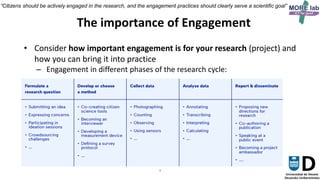
The importance ofEngagement
• Consider how important engagement is for your research (project) and
how you can bring it into practice
– Engagement in different phases of the research cycle:
“Citizens should be actively engaged in the research, and the engagement practices should clearly serve a scientific goal”
5.
5
Case Study 1:Barcelona Citizen Mobility Observatory
• Citizens tracked walkability and micro-mobility via GPS (2023).
• Revealed ‘blind spots’ in official mobility data.
• Integrated into Barcelona’s local planning decisions.
• Example of participatory sensing influencing public policy.
• References:
– “Home-to-school pedestrian mobility GPS data from a citizen science experiment
in the Barcelona area”
– “Pedestrian mobility citizen science complements expert mapping for enhancing
inclusive neighborhood placemaking”
6.
6
Case Study 2:OPUSH – Open Participatory Urban
Transformation
• Multi-city European project integrating citizen science in urban
planning
• Citizens co-created local interventions for sustainability.
• Results informed urban innovation and governance
frameworks.
• References: https://opush.net/
7.
7
Case Study 3:Urban Biodiversity Observatories
• The City Nature Challenge engages citizens in biodiversity mapping –
iNaturalist app.
• Data integrated into city green space and biodiversity management.
• Promotes awareness and local stewardship of urban ecosystems.
• Better understand – and therefore, take care of – nature that lives in
and around urban areas
• Reference: City Nature Challenge (2025)
8.
8
Citizen Observatories empowersociety
• Citizen Observatories empower communities by enabling the
public to collect, analyse and use data for better decision-
making on urban sustainability.
– Integration of citizen-generated data with traditional systems
advances sustainable cities.
– Collaborative approaches bridge the gap between local action and
global goals.
10
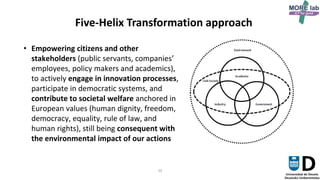
Five-Helix Transformation approach
•Empowering citizens and other
stakeholders (public servants, companies’
employees, policy makers and academics),
to actively engage in innovation processes,
participate in democratic systems, and
contribute to societal welfare anchored in
European values (human dignity, freedom,
democracy, equality, rule of law, and
human rights), still being consequent with
the environmental impact of our actions
11.
11
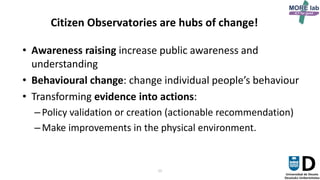
Citizen Observatories arehubs of change!
• Awareness raising increase public awareness and
understanding
• Behavioural change: change individual people’s behaviour
• Transforming evidence into actions:
–Policy validation or creation (actionable recommendation)
–Make improvements in the physical environment.
12.
12
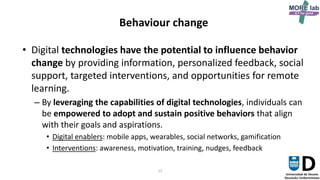
Behaviour change
• Digitaltechnologies have the potential to influence behavior
change by providing information, personalized feedback, social
support, targeted interventions, and opportunities for remote
learning.
– By leveraging the capabilities of digital technologies, individuals can
be empowered to adopt and sustain positive behaviors that align
with their goals and aspirations.
• Digital enablers: mobile apps, wearables, social networks, gamification
• Interventions: awareness, motivation, training, nudges, feedback
15
GREENGAGE: fostering anddemocratizing Citizen
Observatories (COs)
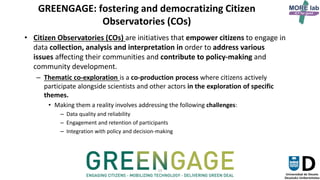
• Citizen Observatories (COs) are initiatives that empower citizens to engage in
data collection, analysis and interpretation in order to address various
issues affecting their communities and contribute to policy-making and
community development.
– Thematic co-exploration is a co-production process where citizens actively
participate alongside scientists and other actors in the exploration of specific
themes.
• Making them a reality involves addressing the following challenges:
– Data quality and reliability
– Engagement and retention of participants
– Integration with policy and decision-making
GREENGAGE
16.
16
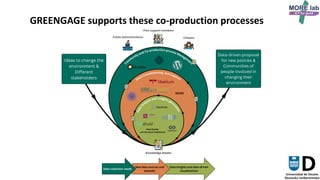
GREENGAGE – engagingcitizens, mobilizing technology,
delivering Green Deal
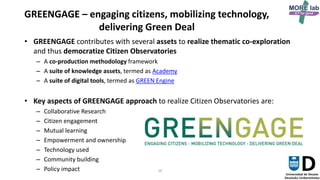
• GREENGAGE contributes with several assets to realize thematic co-exploration
and thus democratize Citizen Observatories
– A co-production methodology framework
– A suite of knowledge assets, termed as Academy
– A suite of digital tools, termed as GREEN Engine
• Key aspects of GREENGAGE approach to realize Citizen Observatories are:
– Collaborative Research
– Citizen engagement
– Mutual learning
– Empowerment and ownership
– Technology used
– Community building
– Policy impact
GREENGAGE
17.
17
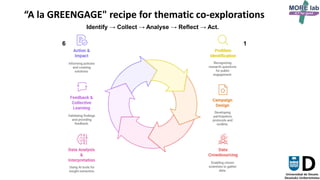
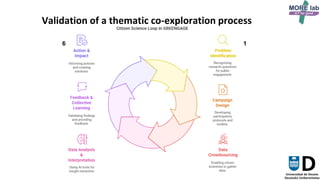
“A la GREENGAGE"recipe for thematic co-explorations
Identify → Collect → Analyse → Reflect → Act.
1
6
18.
18
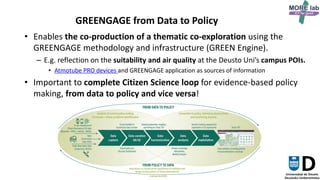
GREENGAGE from Datato Policy
• Enables the co-production of a thematic co-exploration using the
GREENGAGE methodology and infrastructure (GREEN Engine).
– E.g. reflection on the suitability and air quality at the Deusto Uni’s campus POIs.
• Atmotube PRO devices and GREENGAGE application as sources of information
• Important to complete Citizen Science loop for evidence-based policy
making, from data to policy and vice versa!
19.
19
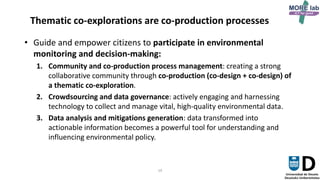
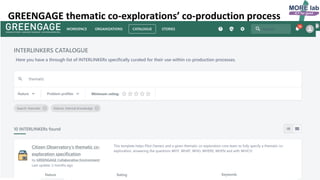
Thematic co-explorations areco-production processes
• Guide and empower citizens to participate in environmental
monitoring and decision-making:
1. Community and co-production process management: creating a strong
collaborative community through co-production (co-design + co-design) of
a thematic co-exploration.
2. Crowdsourcing and data governance: actively engaging and harnessing
technology to collect and manage vital, high-quality environmental data.
3. Data analysis and mitigations generation: data transformed into
actionable information becomes a powerful tool for understanding and
influencing environmental policy.
23
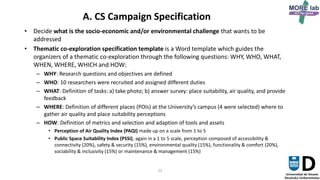
A. CS CampaignSpecification
• Decide what is the socio-economic and/or environmental challenge that wants to be
addressed
• Thematic co-exploration specification template is a Word template which guides the
organizers of a thematic co-exploration through the following questions: WHY, WHO, WHAT,
WHEN, WHERE, WHICH and HOW:
– WHY: Research questions and objectives are defined
– WHO: 10 researchers were recruited and assigned different duties
– WHAT: Definition of tasks: a) take photo; b) answer survey: place suitability, air quality, and provide
feedback
– WHERE: Definition of different places (POIs) at the University’s campus (4 were selected) where to
gather air quality and place suitability perceptions
– HOW: Definition of metrics and selection and adaption of tools and assets
• Perception of Air Quality Index (PAQI) made up on a scale from 1 to 5
• Public Space Suitability Index (PSSI), again in a 1 to 5 scale, perception composed of accessibility &
connectivity (20%), safety & security (15%), environmental quality (15%), functionality & comfort (20%),
sociability & inclusivity (15%) or maintenance & management (15%)
25
B. Design ofcrowdsourcing campaign
• Co-design the CS crowdsourcing campaign – based on the research questions,
objectives and data gaps previously identified
– Through thematic co-exploration bootstrap collaborative session: initial training, specification
of the thematic co-exploration, team and co-creation process setup, were carried out
Entity Field1 Field2
observatory1title University of Deusto's campus
area [lat1, lon1, lat2, lon2]
POI1 type air quality
description entrance to Faculty of Engineering
latitude&longitude 43,2708236, -2,9402889
tasks [task1, task2]
task1 POI POI1
topic suitability
type SURVEY
survey survey1
task2 POI POI1
topic air quality
type PHOTO
survey1 title
questions [question1, question2, question3]
question1 title What is the perceived air quality?
type SINGLE_CHOICE
option1 very clean
option2 clean
option3 normal
option4 polluted
option5 highly polluted
question2
… type SINGLE_CHOICE
question 3
… type TEXT
26.
26
C. Collect, extract,transform and load campaign data
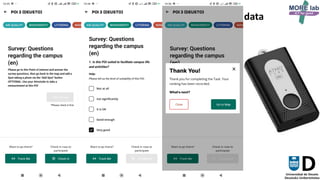
• Friday 14th March 2025, from 11:30am to 12:30pm CET, a crowdsourcing campaign was
executed, where 10 people took part
• Users installed GREENGAGE app from either Android's Google play store or Apple's app
store in their smartphones and used it to collect data
• The crowdsourcing campaign data was collected through an ETL (Extract-Transform-
Load) process
– Python scripts were used to gather sociodemographic data gathered at user registration in the app
– Python scripts were also used to access to Google Form’s data on designed PRE and POST impact
evaluation questionnaires
– Python scripts were used to get the data from GREENGAGE app’s backend
– All data was loaded into Apache Druid
28
D. Analyse datathrough visualisations
• After crowdsourcing campaign, a session for co-designing possible useful
visualizations
• Using data loaded into Druid, helped by Apache Superset tool a range of
visualizations was created
– Visualization of correlation of Atmotube device’s measurements and user perceptions at
each POI
– Visualization of aggregated cross-POI perceptions on air quality and place suitability
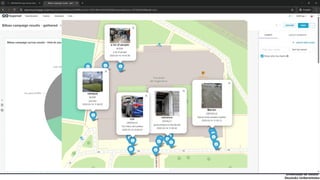
• Some ad-hoc visualizations through again Python scripts:
– HTML page to display spots where feedback and photos were submitted by observers
was also submitted
– Spreadsheet with analysis of sociodemographic profiles of participants
30
E. Evaluation ofthe thematic co-exploration experience and
results
• Collaborative reflection session on the gathered data and analysis results
was held
– There has been alignment between the perceptions regarding air quality and the actual
measurements obtained through more reliable devices as Atmotube
– Overall, the campus is considered suitable, but issues created by sharing walking space
between cars and people were identified
31.
31
F. Feedback andaction: Social media dissemination,
policymaking, replication
• To close the CS loop and contribute towards the positive transformation of
Deusto’s campus in Bilbao, the following actions were taken
– Discourse theme was created through which participants could continue communicating
with each other
– X and LinkedIn social media channels were used to summarize the thematic co-
exploration lessons learnt to the public
– A policy brief was created and sent to the vice-chancellor in the university of Deusto
responsible for the campus refurbishment.
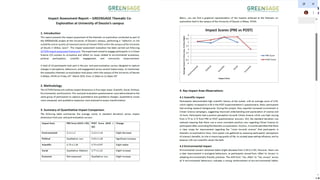
– Impact analysis about the executed campaign in terms of social, political and citizen
science aspects will be performed
32.
32
F. Feedback andaction: Social media dissemination,
policymaking, replication
33.
33
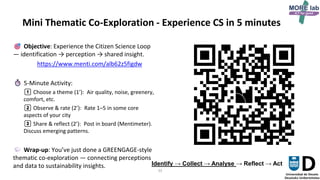
Mini Thematic Co-Exploration- Experience CS in 5 minutes
Objective: Experience the Citizen Science Loop
— identification → perception → shared insight.
https://www.menti.com/alb62z5figdw
5-Minute Activity:
1️⃣ Choose a theme (1’): Air quality, noise, greenery,
comfort, etc.
2️⃣ Observe & rate (2’): Rate 1–5 in some core
aspects of your city
3️⃣ Share & reflect (2’): Post in board (Mentimeter).
Discuss emerging patterns.
Wrap-up: You’ve just done a GREENGAGE-style
thematic co-exploration — connecting perceptions
and data to sustainability insights. Identify → Collect → Analyse → Reflect → Act
34.
34
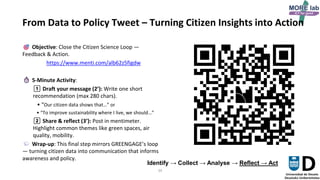
From Data toPolicy Tweet – Turning Citizen Insights into Action
Objective: Close the Citizen Science Loop —
Feedback & Action.
https://www.menti.com/alb62z5figdw
5-Minute Activity:
1️⃣ Draft your message (2’): Write one short
recommendation (max 280 chars).
• “Our citizen data shows that…” or
• “To improve sustainability where I live, we should…”
2️⃣ Share & reflect (3’): Post in mentimeter.
Highlight common themes like green spaces, air
quality, mobility.
Wrap-up: This final step mirrors GREENGAGE’s loop
— turning citizen data into communication that informs
awareness and policy.
Identify → Collect → Analyse → Reflect → Act
35.
35
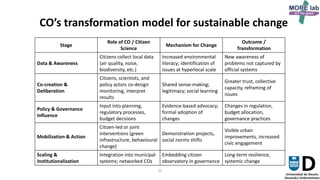
CO’s transformation modelfor sustainable change
Stage
Role of CO / Citizen
Science
Mechanism for Change
Outcome /
Transformation
Data & Awareness
Citizens collect local data
(air quality, noise,
biodiversity, etc.)
Increased environmental
literacy; identification of
issues at hyperlocal scale
New awareness of
problems not captured by
official systems
Co-creation &
Deliberation
Citizens, scientists, and
policy actors co-design
monitoring, interpret
results
Shared sense-making;
legitimacy; social learning
Greater trust, collective
capacity, reframing of
issues
Policy & Governance
Influence
Input into planning,
regulatory processes,
budget decisions
Evidence-based advocacy;
formal adoption of
changes
Changes in regulation,
budget allocation,
governance practices
Mobilization & Action
Citizen-led or joint
interventions (green
infrastructure, behavioural
change)
Demonstration projects,
social norms shifts
Visible urban
improvements, increased
civic engagement
Scaling &
Institutionalization
Integration into municipal
systems; networked COs
Embedding citizen
observatory in governance
Long-term resilience,
systemic change
36.
36
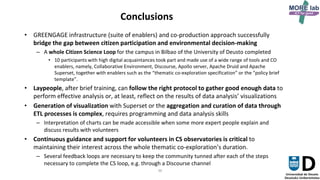
Conclusions
• GREENGAGE infrastructure(suite of enablers) and co-production approach successfully
bridge the gap between citizen participation and environmental decision-making
– A whole Citizen Science Loop for the campus in Bilbao of the University of Deusto completed
• 10 participants with high digital acquaintances took part and made use of a wide range of tools and CO
enablers, namely, Collaborative Environment, Discourse, Apollo server, Apache Druid and Apache
Superset, together with enablers such as the “thematic co-exploration specification” or the “policy brief
template”.
• Laypeople, after brief training, can follow the right protocol to gather good enough data to
perform effective analysis or, at least, reflect on the results of data analysis’ visualizations
• Generation of visualization with Superset or the aggregation and curation of data through
ETL processes is complex, requires programming and data analysis skills
– Interpretation of charts can be made accessible when some more expert people explain and
discuss results with volunteers
• Continuous guidance and support for volunteers in CS observatories is critical to
maintaining their interest across the whole thematic co-exploration’s duration.
– Several feedback loops are necessary to keep the community tunned after each of the steps
necessary to complete the CS loop, e.g. through a Discourse channel
37.
37
Citizen science andengaged research for high impact
sustainability outcomes
UNIC International Sustainability Leadership Autumn School
7 October 2025,
https://www.ucc.ie/en/unic/news/unic-international-sustainability-leadership-autumn-school.html
Prof. Diego López-de-Ipiña González-de-Artaza
dipina@deusto.es
http://paginaspersonales.deusto.es/dipina
http://www.morelab.deusto.es
@dipina

![25
B. Design of crowdsourcing campaign
• Co-design the CS crowdsourcing campaign – based on the research questions,
objectives and data gaps previously identified
– Through thematic co-exploration bootstrap collaborative session: initial training, specification
of the thematic co-exploration, team and co-creation process setup, were carried out
Entity Field1 Field2
observatory1title University of Deusto's campus
area [lat1, lon1, lat2, lon2]
POI1 type air quality
description entrance to Faculty of Engineering
latitude&longitude 43,2708236, -2,9402889
tasks [task1, task2]
task1 POI POI1
topic suitability
type SURVEY
survey survey1
task2 POI POI1
topic air quality
type PHOTO
survey1 title
questions [question1, question2, question3]
question1 title What is the perceived air quality?
type SINGLE_CHOICE
option1 very clean
option2 clean
option3 normal
option4 polluted
option5 highly polluted
question2
… type SINGLE_CHOICE
question 3
… type TEXT](https://image.slidesharecdn.com/citizenscienceandengagedresearch-251007100926-e240e9c8/85/Citizen-science-and-engaged-research-pdf-25-320.jpg)


![Participatory [Citizen] Science](https://cdn.slidesharecdn.com/ss_thumbnails/haklay-ecsa2016-160519212623-thumbnail.jpg?width=640&height=640&fit=bounds)


