Towards Ambient Assisted Cities and
            Citizens
             Dr. Diego López-de-Ipiña González-de-Artaza
   DeustoTech-INTERNET, DeustoTech – Deusto Institute of Technology
                     Madrid, 21 de Junio de 2012
                           dipina@deusto.es
              http://paginaspersonales.deusto.es/dipina
                    http://www.morelab.deusto.es


                                  1
Society Urbanisation
• Urban populations will grow by an estimated 2.3 billion over
  the next 40 years, and as much as 70% of the world’s
  population will live in cities by 2050
                            [World Urbanization Prospects, United Nations, 2011]


                                2
The Society is Aging
• Dramatic shift in demographics
  – By 2050 the number of people over the age of 60 is
    expected to triple, and will outnumber children under 15
    for the first time in human history [Business Insider, 2011]


                               3
What is a Smart City?
• A means of making available all the services
  and applications enabled by ICT to citizens,
  companies and authorities that are part of a
  city’s system
  – It aims to increase ALL citizens’ quality of life and
    improve the efficiency and quality of the services
    provided by governing entities and businesses


                           4
What is an Ambient
                Assisted City?
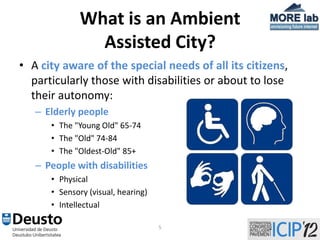
• A city aware of the special needs of all its citizens,
  particularly those with disabilities or about to lose
  their autonomy:
   – Elderly people
      • The "Young Old" 65-74
      • The "Old" 74-84
      • The "Oldest-Old" 85+
   – People with disabilities
      • Physical
      • Sensory (visual, hearing)
      • Intellectual

                                    5
Accessible & Inclusive Cities
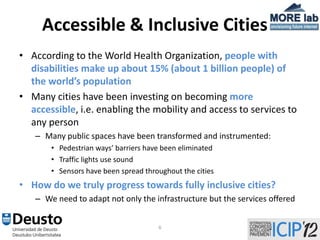
• According to the World Health Organization, people with
  disabilities make up about 15% (about 1 billion people) of
  the world’s population
• Many cities have been investing on becoming more
  accessible, i.e. enabling the mobility and access to services to
  any person
   – Many public spaces have been transformed and instrumented:
       • Pedestrian ways’ barriers have been eliminated
       • Traffic lights use sound
       • Sensors have been spread throughout the cities
• How do we truly progress towards fully inclusive cities?
   – We need to adapt not only the infrastructure but the services offered


                                      6
AccessMyNYC
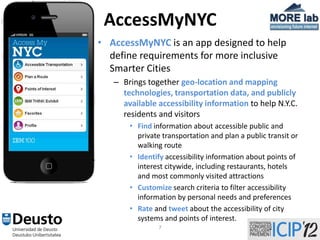
• AccessMyNYC is an app designed to help
  define requirements for more inclusive
  Smarter Cities
   – Brings together geo-location and mapping
     technologies, transportation data, and publicly
     available accessibility information to help N.Y.C.
     residents and visitors
       • Find information about accessible public and
         private transportation and plan a public transit or
         walking route
       • Identify accessibility information about points of
         interest citywide, including restaurants, hotels
         and most commonly visited attractions
       • Customize search criteria to filter accessibility
         information by personal needs and preferences
       • Rate and tweet about the accessibility of city
         systems and points of interest.
                7
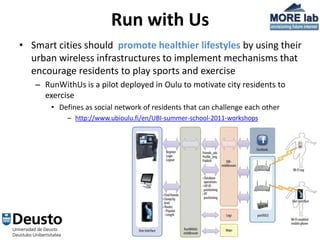
Run with Us
• Smart cities should promote healthier lifestyles by using their
  urban wireless infrastructures to implement mechanisms that
  encourage residents to play sports and exercise
   – RunWithUs is a pilot deployed in Oulu to motivate city residents to
     exercise
       • Defines as social network of residents that can challenge each other
           – http://www.ubioulu.fi/en/UBI-summer-school-2011-workshops


                                       8
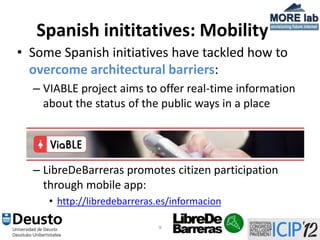
Spanish inititatives: Mobility
• Some Spanish initiatives have tackled how to
  overcome architectural barriers:
  – VIABLE project aims to offer real-time information
    about the status of the public ways in a place


  – LibreDeBarreras promotes citizen participation
    through mobile app:
     • http://libredebarreras.es/informacion

                             9
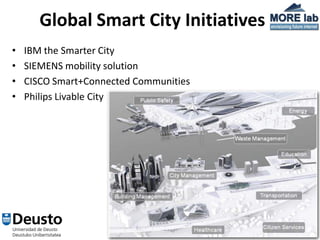
Global Smart City Initiatives
•   IBM the Smarter City
•   SIEMENS mobility solution
•   CISCO Smart+Connected Communities
•   Philips Livable City


                              10
Our work enhancing
    Accessibility in Public Spaces
• BlindShopping: Enabling Accessible Shopping
  for Visually Impaired People through Mobile
  Technologies
  – How to translate this to the Smart Cities domain?


• Imhotep: User-conscious adaptable mobile
  interfaces
  – How to apply it to Urban Apps?

                          11
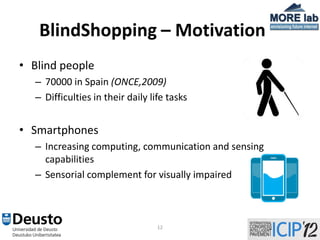
BlindShopping – Motivation
• Blind people
  – 70000 in Spain (ONCE,2009)
  – Difficulties in their daily life tasks


• Smartphones
  – Increasing computing, communication and sensing
    capabilities
  – Sensorial complement for visually impaired


                                  12
BlindShopping Platform
• Goal: A platform that enables blind people to
  shop autonomously in a supermarket
• What does it contribute with?
   – A navigation system
   – A product browsing mechanism
• Directly applicable to the Smart City domain:
  • Enabling blind people to navigate and browse through the
    real-world’s objects and services


                             13
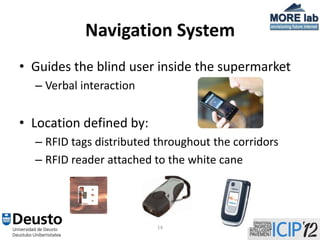
Navigation System
• Guides the blind user inside the supermarket
  – Verbal interaction


• Location defined by:
  – RFID tags distributed throughout the corridors
  – RFID reader attached to the white cane


                          14
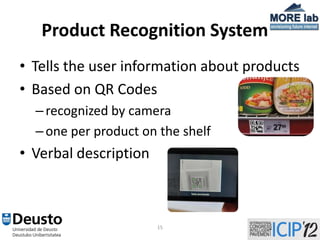
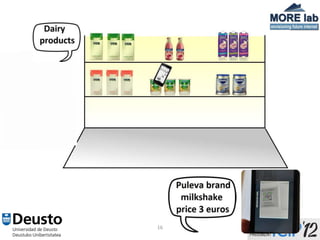
Product Recognition System
• Tells the user information about products
• Based on QR Codes
  – recognized by camera
  – one per product on the shelf
• Verbal description


                       15
16
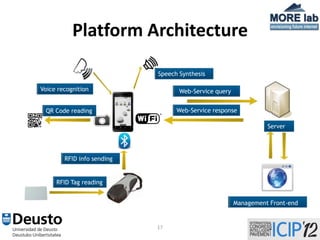
Platform Architecture

                            Speech Synthesis

Voice recognition                  Web-Service query


 QR Code reading                  Web-Service response

                                                                 Server


        RFID info sending


     RFID Tag reading


                                                       Management Front-end


                            17
BlindShopping + iPavement =
       Accessible Tourism
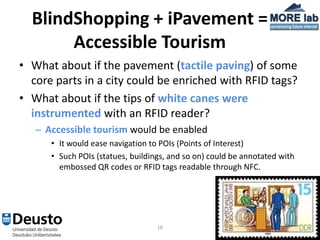
• What about if the pavement (tactile paving) of some
  core parts in a city could be enriched with RFID tags?
• What about if the tips of white canes were
  instrumented with an RFID reader?
   – Accessible tourism would be enabled
      • It would ease navigation to POIs (Points of Interest)
      • Such POIs (statues, buildings, and so on) could be annotated with
        embossed QR codes or RFID tags readable through NFC.


                                   18
Imhotep: User-conscious
        adaptable mobile interfaces
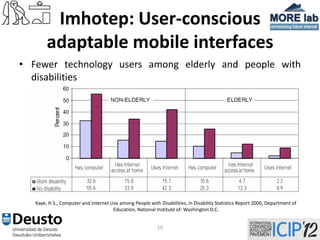
• Fewer technology users among elderly and people with
  disabilities


   Kaye, H.S., Computer and Internet Use among People with Disabilities, in Disability Statistics Report 2000, Department of
                                      Education, National Institute of: Washington D.C.


                                                           19
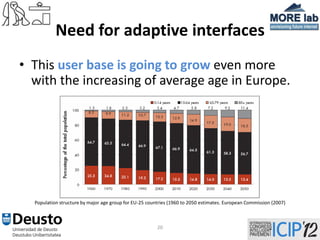
Need for adaptive interfaces
• This user base is going to grow even more
  with the increasing of average age in Europe.


  Population structure by major age group for EU-25 countries (1960 to 2050 estimates. European Commission (2007)


                                                        20
Need for adaptive interfaces
• Developers traditionally tend to ignore or
  neglect this user base
  – The individual user groups (each disability have
    different requirements) may not be big enough to
    justify the additional development costs
  – Developing accessible applications can be difficult
    and error-prone


                          21
Imhotep
• Aim  Provide tools that ease the
  development of adaptive, user-centric
  accessible applications
• Design objectives:
  – Make the framework platform independent
  – Reduce the adoption costs
  – Help AAL programmers without expertise in
    accessible applications
  – Practical down-to-earth approach

                     22
Framework architecture
• Composed by three main elements:
  – The pre-processor directives
  – The adaptation server
     • Aware of user and device capabilities
  – The     fuzzy     knowledge-eliciting      reasoner
    (integrated in the adaptation server)


                             23
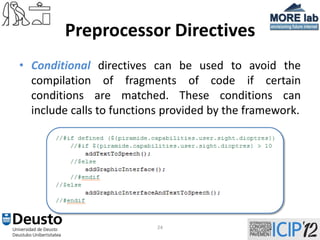
Preprocessor Directives
• Conditional directives can be used to avoid the
  compilation of fragments of code if certain
  conditions are matched. These conditions can
  include calls to functions provided by the framework.


                          24
Fuzzy Knowledge-Eliciting
                Reasoner
• Objectives
  – To infer new user and device capabilities from
    those specified in the profiles.
  – To enable the AAL developers to abstract from the
    crisp values (the user has less than 3 dioptres) in
    favour of more natural concepts (the user can see
    without a significant problem).


                          25
Assisted City
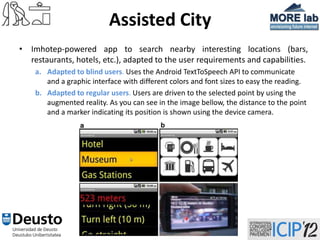
• Imhotep-powered app to search nearby interesting locations (bars,
  restaurants, hotels, etc.), adapted to the user requirements and capabilities.
    a. Adapted to blind users. Uses the Android TextToSpeech API to communicate
       and a graphic interface with different colors and font sizes to easy the reading.
    b. Adapted to regular users. Users are driven to the selected point by using the
       augmented reality. As you can see in the image bellow, the distance to the point
       and a marker indicating its position is shown using the device camera.


                                         26
Linked Cities and Citizens
• “City appeal” will be key to attract and retain
  citizens, companies and tourists
• User-driven and centric innovation:
  • The citizen should be heard, EMPOWERED!
     – Urban apps to enhance the experience and interactions of the
       citizen, by taking advantage of the city infrastructure
  • The information generated by cities and citizens must be
    linked and processed
     – How do we correlate, link and exploit such humongous data for all
       stakeholders’ benefit?
         » We should start talking about Big   (Linked) Data
                                 27
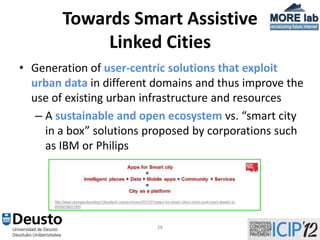
Towards Smart Assistive
             Linked Cities
• Generation of user-centric solutions that exploit
  urban data in different domains and thus improve the
  use of existing urban infrastructure and resources
   – A sustainable and open ecosystem vs. “smart city
     in a box” solutions proposed by corporations such
     as IBM or Philips


                          28
The LinkedCity project
• “To create a multi-device dataset and
  application marketplace based on
  standard web technologies, that exploits
  the data shared by councils and their
  citizens, and provides to citizens, tourists
  and workers an enhanced experience in
  a municipality”

                      29
LinkedCity Objectives
1.   Transform and release municipalities’ open data into Open Linked
     Data
2.   Generate structured council data from non-structured data coming
     from social networks and users
3.   Integrate, normalize, link and publish data for its massive analysis and
     exploitation by councils, enterprises and citizens
4.   Generate a scalable Cloud-based and NoSQL-based infrastructure
     that supports the urban apps marketplace
5.   Create a set of urban apps over the normalized data of a council, its
     citizens and companies
6.   Disseminate and transfer the service and data marketplace platform
     to companies and administrations


                                     30
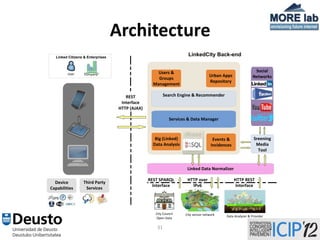
Architecture
  Linked Citizens & Enterprises
                                                                      LinkedCity Back-end


                                                     Users &                                                 Social
         User     Company                                                          Urban Apps               Networks
                                                     Groups
                                                                                   Repository
                                                   Management

                                      REST                Search Engine & Recommender
                                    Interface
                                   HTTP (AJAX)

                                                             Services & Data Manager


                                                    Big (Linked)                     Events &               Sreening
                                                   Data Analysis                    Incidences               Media
                                                                                                              Tool


                                                                     Linked Data Normalizer

                                                 REST SPARQL         HTTP over                   HTTP REST
  Device         Third Party
                                                   Interface           IPv6                       Interface
Capabilities      Services


                                                    City Council    City sensor network
                                                    Open Data                              Data Analyzer & Provider


                                                     31
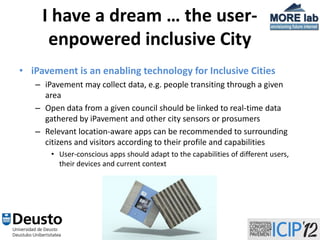
I have a dream … the user-
      enpowered inclusive City
• iPavement is an enabling technology for Inclusive Cities
   – iPavement may collect data, e.g. people transiting through a given
     area
   – Open data from a given council should be linked to real-time data
     gathered by iPavement and other city sensors or prosumers
   – Relevant location-aware apps can be recommended to surrounding
     citizens and visitors according to their profile and capabilities
       • User-conscious apps should adapt to the capabilities of different users,
         their devices and current context


                                        32
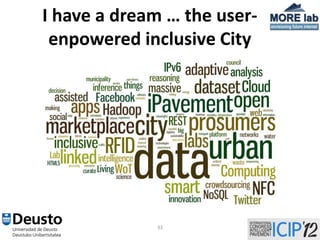
I have a dream … the user-
 enpowered inclusive City


             33
Towards Ambient Assisted Cities and
            Citizens
                  http://www.slideshare.net/dipina/

             Dr. Diego López-de-Ipiña González-de-Artaza
   DeustoTech-INTERNET, DeustoTech – Deusto Institute of Technology
                     Madrid, 21 de Junio de 2012
                           dipina@deusto.es
              http://paginaspersonales.deusto.es/dipina
                    http://www.morelab.deusto.es


                                  34

Towards Ambient Assisted Cities and Citizens

  • 1.
    Towards Ambient AssistedCities and Citizens Dr. Diego López-de-Ipiña González-de-Artaza DeustoTech-INTERNET, DeustoTech – Deusto Institute of Technology Madrid, 21 de Junio de 2012 dipina@deusto.es http://paginaspersonales.deusto.es/dipina http://www.morelab.deusto.es 1
  • 2.
    Society Urbanisation • Urbanpopulations will grow by an estimated 2.3 billion over the next 40 years, and as much as 70% of the world’s population will live in cities by 2050 [World Urbanization Prospects, United Nations, 2011] 2
  • 3.
    The Society isAging • Dramatic shift in demographics – By 2050 the number of people over the age of 60 is expected to triple, and will outnumber children under 15 for the first time in human history [Business Insider, 2011] 3
  • 4.
    What is aSmart City? • A means of making available all the services and applications enabled by ICT to citizens, companies and authorities that are part of a city’s system – It aims to increase ALL citizens’ quality of life and improve the efficiency and quality of the services provided by governing entities and businesses 4
  • 5.
    What is anAmbient Assisted City? • A city aware of the special needs of all its citizens, particularly those with disabilities or about to lose their autonomy: – Elderly people • The "Young Old" 65-74 • The "Old" 74-84 • The "Oldest-Old" 85+ – People with disabilities • Physical • Sensory (visual, hearing) • Intellectual 5
  • 6.
    Accessible & InclusiveCities • According to the World Health Organization, people with disabilities make up about 15% (about 1 billion people) of the world’s population • Many cities have been investing on becoming more accessible, i.e. enabling the mobility and access to services to any person – Many public spaces have been transformed and instrumented: • Pedestrian ways’ barriers have been eliminated • Traffic lights use sound • Sensors have been spread throughout the cities • How do we truly progress towards fully inclusive cities? – We need to adapt not only the infrastructure but the services offered 6
  • 7.
    AccessMyNYC • AccessMyNYC isan app designed to help define requirements for more inclusive Smarter Cities – Brings together geo-location and mapping technologies, transportation data, and publicly available accessibility information to help N.Y.C. residents and visitors • Find information about accessible public and private transportation and plan a public transit or walking route • Identify accessibility information about points of interest citywide, including restaurants, hotels and most commonly visited attractions • Customize search criteria to filter accessibility information by personal needs and preferences • Rate and tweet about the accessibility of city systems and points of interest. 7
  • 8.
    Run with Us •Smart cities should promote healthier lifestyles by using their urban wireless infrastructures to implement mechanisms that encourage residents to play sports and exercise – RunWithUs is a pilot deployed in Oulu to motivate city residents to exercise • Defines as social network of residents that can challenge each other – http://www.ubioulu.fi/en/UBI-summer-school-2011-workshops 8
  • 9.
    Spanish inititatives: Mobility •Some Spanish initiatives have tackled how to overcome architectural barriers: – VIABLE project aims to offer real-time information about the status of the public ways in a place – LibreDeBarreras promotes citizen participation through mobile app: • http://libredebarreras.es/informacion 9
  • 10.
    Global Smart CityInitiatives • IBM the Smarter City • SIEMENS mobility solution • CISCO Smart+Connected Communities • Philips Livable City 10
  • 11.
    Our work enhancing Accessibility in Public Spaces • BlindShopping: Enabling Accessible Shopping for Visually Impaired People through Mobile Technologies – How to translate this to the Smart Cities domain? • Imhotep: User-conscious adaptable mobile interfaces – How to apply it to Urban Apps? 11
  • 12.
    BlindShopping – Motivation •Blind people – 70000 in Spain (ONCE,2009) – Difficulties in their daily life tasks • Smartphones – Increasing computing, communication and sensing capabilities – Sensorial complement for visually impaired 12
  • 13.
    BlindShopping Platform • Goal:A platform that enables blind people to shop autonomously in a supermarket • What does it contribute with? – A navigation system – A product browsing mechanism • Directly applicable to the Smart City domain: • Enabling blind people to navigate and browse through the real-world’s objects and services 13
  • 14.
    Navigation System • Guidesthe blind user inside the supermarket – Verbal interaction • Location defined by: – RFID tags distributed throughout the corridors – RFID reader attached to the white cane 14
  • 15.
    Product Recognition System •Tells the user information about products • Based on QR Codes – recognized by camera – one per product on the shelf • Verbal description 15
  • 16.
  • 17.
    Platform Architecture Speech Synthesis Voice recognition Web-Service query QR Code reading Web-Service response Server RFID info sending RFID Tag reading Management Front-end 17
  • 18.
    BlindShopping + iPavement= Accessible Tourism • What about if the pavement (tactile paving) of some core parts in a city could be enriched with RFID tags? • What about if the tips of white canes were instrumented with an RFID reader? – Accessible tourism would be enabled • It would ease navigation to POIs (Points of Interest) • Such POIs (statues, buildings, and so on) could be annotated with embossed QR codes or RFID tags readable through NFC. 18
  • 19.
    Imhotep: User-conscious adaptable mobile interfaces • Fewer technology users among elderly and people with disabilities Kaye, H.S., Computer and Internet Use among People with Disabilities, in Disability Statistics Report 2000, Department of Education, National Institute of: Washington D.C. 19
  • 20.
    Need for adaptiveinterfaces • This user base is going to grow even more with the increasing of average age in Europe. Population structure by major age group for EU-25 countries (1960 to 2050 estimates. European Commission (2007) 20
  • 21.
    Need for adaptiveinterfaces • Developers traditionally tend to ignore or neglect this user base – The individual user groups (each disability have different requirements) may not be big enough to justify the additional development costs – Developing accessible applications can be difficult and error-prone 21
  • 22.
    Imhotep • Aim Provide tools that ease the development of adaptive, user-centric accessible applications • Design objectives: – Make the framework platform independent – Reduce the adoption costs – Help AAL programmers without expertise in accessible applications – Practical down-to-earth approach 22
  • 23.
    Framework architecture • Composedby three main elements: – The pre-processor directives – The adaptation server • Aware of user and device capabilities – The fuzzy knowledge-eliciting reasoner (integrated in the adaptation server) 23
  • 24.
    Preprocessor Directives • Conditionaldirectives can be used to avoid the compilation of fragments of code if certain conditions are matched. These conditions can include calls to functions provided by the framework. 24
  • 25.
    Fuzzy Knowledge-Eliciting Reasoner • Objectives – To infer new user and device capabilities from those specified in the profiles. – To enable the AAL developers to abstract from the crisp values (the user has less than 3 dioptres) in favour of more natural concepts (the user can see without a significant problem). 25
  • 26.
    Assisted City • Imhotep-poweredapp to search nearby interesting locations (bars, restaurants, hotels, etc.), adapted to the user requirements and capabilities. a. Adapted to blind users. Uses the Android TextToSpeech API to communicate and a graphic interface with different colors and font sizes to easy the reading. b. Adapted to regular users. Users are driven to the selected point by using the augmented reality. As you can see in the image bellow, the distance to the point and a marker indicating its position is shown using the device camera. 26
  • 27.
    Linked Cities andCitizens • “City appeal” will be key to attract and retain citizens, companies and tourists • User-driven and centric innovation: • The citizen should be heard, EMPOWERED! – Urban apps to enhance the experience and interactions of the citizen, by taking advantage of the city infrastructure • The information generated by cities and citizens must be linked and processed – How do we correlate, link and exploit such humongous data for all stakeholders’ benefit? » We should start talking about Big (Linked) Data 27
  • 28.
    Towards Smart Assistive Linked Cities • Generation of user-centric solutions that exploit urban data in different domains and thus improve the use of existing urban infrastructure and resources – A sustainable and open ecosystem vs. “smart city in a box” solutions proposed by corporations such as IBM or Philips 28
  • 29.
    The LinkedCity project •“To create a multi-device dataset and application marketplace based on standard web technologies, that exploits the data shared by councils and their citizens, and provides to citizens, tourists and workers an enhanced experience in a municipality” 29
  • 30.
    LinkedCity Objectives 1. Transform and release municipalities’ open data into Open Linked Data 2. Generate structured council data from non-structured data coming from social networks and users 3. Integrate, normalize, link and publish data for its massive analysis and exploitation by councils, enterprises and citizens 4. Generate a scalable Cloud-based and NoSQL-based infrastructure that supports the urban apps marketplace 5. Create a set of urban apps over the normalized data of a council, its citizens and companies 6. Disseminate and transfer the service and data marketplace platform to companies and administrations 30
  • 31.
    Architecture LinkedCitizens & Enterprises LinkedCity Back-end Users & Social User Company Urban Apps Networks Groups Repository Management REST Search Engine & Recommender Interface HTTP (AJAX) Services & Data Manager Big (Linked) Events & Sreening Data Analysis Incidences Media Tool Linked Data Normalizer REST SPARQL HTTP over HTTP REST Device Third Party Interface IPv6 Interface Capabilities Services City Council City sensor network Open Data Data Analyzer & Provider 31
  • 32.
    I have adream … the user- enpowered inclusive City • iPavement is an enabling technology for Inclusive Cities – iPavement may collect data, e.g. people transiting through a given area – Open data from a given council should be linked to real-time data gathered by iPavement and other city sensors or prosumers – Relevant location-aware apps can be recommended to surrounding citizens and visitors according to their profile and capabilities • User-conscious apps should adapt to the capabilities of different users, their devices and current context 32
  • 33.
    I have adream … the user- enpowered inclusive City 33
  • 34.
    Towards Ambient AssistedCities and Citizens http://www.slideshare.net/dipina/ Dr. Diego López-de-Ipiña González-de-Artaza DeustoTech-INTERNET, DeustoTech – Deusto Institute of Technology Madrid, 21 de Junio de 2012 dipina@deusto.es http://paginaspersonales.deusto.es/dipina http://www.morelab.deusto.es 34