Cell Biology:
Prokarotic vs
ekaryotic cells
Cells have evolved into 2
different architectures
Prokaryote ā€œstyleā€: all unicelular
organisms
Eukaryotic ā€œstyleā€: uni and
multicelular organisms
Cells have evolved into two different
architectures:
Prokaryotes
Eukaryotes
Who was here
first?
Prokaryotic cells were here first and for billions of years they were the only form of
life on Earth. They are all unicellular, and their inner structure is less organized.
Eukaryotic cells appeared on earth long after prokaryotes,evolving from complex
associations of primitive cells, but they are much more advanced. Eukaryotic
organisms can be unicellular or multicellular.
Prokaryotes
0
1
Characteristics of Prokaryotes
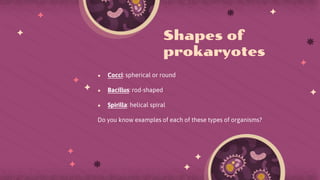
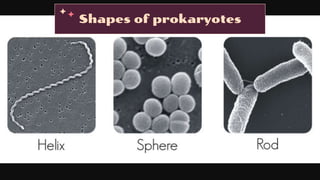
ā— Cocci: spherical or round
ā— Bacillus: rod-shaped
ā— Spirilla: helical spiral
Do you know examples of each of these types of organisms?
Shapes of
prokaryotes
Shapes of prokaryotes
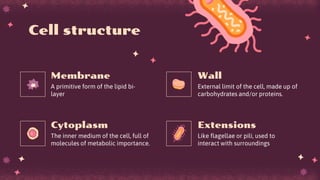
Cell structure
A primitive form of the lipid bi-
layer
External limit of the cell, made up of
carbohydrates and/or proteins.
The inner medium of the cell, full of
molecules of metabolic importance.
Like flagellae or pili, used to
interact with surroundings
Membrane
Cytoplasm
Wall
Extensions
Cell structure
0
2
Eukaryotes
Characteristics of Eukaryotes
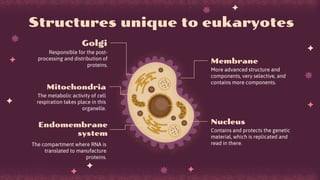
Structures unique to eukaryotes
Membrane
More advanced structure and
components, very selective, and
contains more components.
Nucleus
Contains and protects the genetic
material, which is replicated and
read in there.
Golgi
Responsible for the post-
processing and distribution of
proteins.
Mitochondria
The metabolic activity of cell
respiration takes place in this
organelle.
Endomembrane
system
The compartment where RNA is
translated to manufacture
proteins.
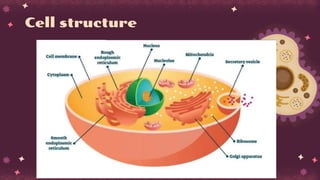
Cell structure
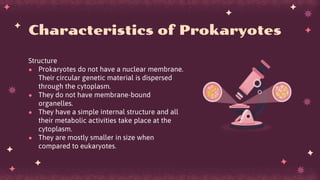
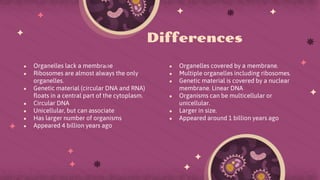
ā— Organelles lack a membrane
ā— Ribosomes are almost always the only
organelles.
ā— Genetic material (circular DNA and RNA)
floats in a central part of the cytoplasm.
ā— Circular DNA
ā— Unicellular, but can associate
ā— Has larger number of organisms
ā— Appeared 4 billion years ago
Differences
ā— Organelles covered by a membrane.
ā— Multiple organelles including ribosomes.
ā— Genetic material is covered by a nuclear
membrane. Linear DNA
ā— Organisms can be multicellular or
unicellular.
ā— Larger in size.
ā— Appeared around 1 billion years ago
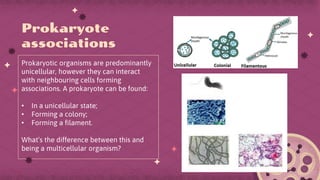
Prokaryotic organisms are predominantly
unicellular, however they can interact
with neighbouring cells forming
associations. A prokaryote can be found:
• In a unicellular state;
• Forming a colony;
• Forming a filament.
What’s the difference between this and
being a multicellular organism?
0
3
Processes
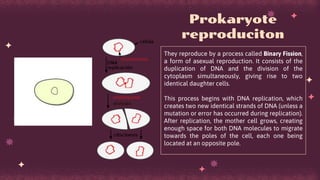
They reproduce by a process called Binary Fission,
a form of asexual reproduction. It consists of the
duplication of DNA and the division of the
cytoplasm simultaneously, giving rise to two
identical daughter cells.
This process begins with DNA replication, which
creates two new identical strands of DNA (unless a
mutation or error has occurred during replication).
After replication, the mother cell grows, creating
enough space for both DNA molecules to migrate
towards the poles of the cell, each one being
located at an opposite pole.
Prokaryote
reproduciton
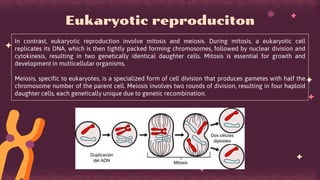
In contrast, eukaryotic reproduction involve mitosis and meiosis. During mitosis, a eukaryotic cell
replicates its DNA, which is then tightly packed forming chromosomes, followed by nuclear division and
cytokinesis, resulting in two genetically identical daughter cells. Mitosis is essential for growth and
development in multicellular organisms.
Meiosis, specific to eukaryotes, is a specialized form of cell division that produces gametes with half the
chromosome number of the parent cell. Meiosis involves two rounds of division, resulting in four haploid
daughter cells, each genetically unique due to genetic recombination.
Eukaryotic reproduciton
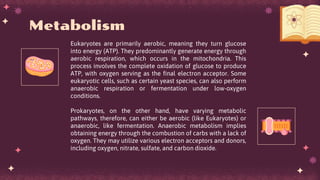
Eukaryotes are primarily aerobic, meaning they turn glucose
into energy (ATP). They predominantly generate energy through
aerobic respiration, which occurs in the mitochondria. This
process involves the complete oxidation of glucose to produce
ATP, with oxygen serving as the final electron acceptor. Some
eukaryotic cells, such as certain yeast species, can also perform
anaerobic respiration or fermentation under low-oxygen
conditions.
Prokaryotes, on the other hand, have varying metabolic
pathways, therefore, can either be aerobic (like Eukaryotes) or
anaerobic, like fermentation. Anaerobic metabolism implies
obtaining energy through the combustion of carbs with a lack of
oxygen. They may utilize various electron acceptors and donors,
including oxygen, nitrate, sulfate, and carbon dioxide.
Metabolism
How did Eukaryotes
come to be?
0
4
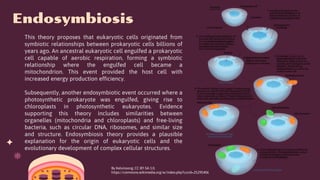
Endosymbiosis
By Kelvinsong, CC BY-SA 3.0,
https://commons.wikimedia.org/w/index.php?curid=25295406
This theory proposes that eukaryotic cells originated from
symbiotic relationships between prokaryotic cells billions of
years ago. An ancestral eukaryotic cell engulfed a prokaryotic
cell capable of aerobic respiration, forming a symbiotic
relationship where the engulfed cell became a
mitochondrion. This event provided the host cell with
increased energy production efficiency.
Subsequently, another endosymbiotic event occurred where a
photosynthetic prokaryote was engulfed, giving rise to
chloroplasts in photosynthetic eukaryotes. Evidence
supporting this theory includes similarities between
organelles (mitochondria and chloroplasts) and free-living
bacteria, such as circular DNA, ribosomes, and similar size
and structure. Endosymbiosis theory provides a plausible
explanation for the origin of eukaryotic cells and the
evolutionary development of complex cellular structures.
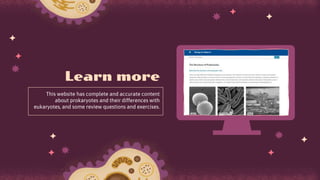
This website has complete and accurate content
about prokaryotes and their differences with
eukaryotes, and some review questions and exercises.
Learn more
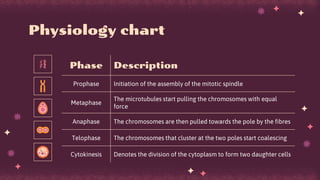
Physiology chart
Phase Description
Prophase Initiation of the assembly of the mitotic spindle
Metaphase
The microtubules start pulling the chromosomes with equal
force
Anaphase The chromosomes are then pulled towards the pole by the fibres
Telophase The chromosomes that cluster at the two poles start coalescing
Cytokinesis Denotes the division of the cytoplasm to form two daughter cells

Prokaryotic vs Eukaryotic organisms: characterization and comparison.pptx

  • 1.
  • 2.
    Cells have evolvedinto 2 different architectures
  • 3.
    Prokaryote ā€œstyleā€: allunicelular organisms Eukaryotic ā€œstyleā€: uni and multicelular organisms Cells have evolved into two different architectures: Prokaryotes Eukaryotes
  • 4.
    Who was here first? Prokaryoticcells were here first and for billions of years they were the only form of life on Earth. They are all unicellular, and their inner structure is less organized. Eukaryotic cells appeared on earth long after prokaryotes,evolving from complex associations of primitive cells, but they are much more advanced. Eukaryotic organisms can be unicellular or multicellular.
  • 5.
  • 6.
  • 7.
  • 8.
    ā— Cocci: sphericalor round ā— Bacillus: rod-shaped ā— Spirilla: helical spiral Do you know examples of each of these types of organisms? Shapes of prokaryotes
  • 9.
  • 10.
    Cell structure A primitiveform of the lipid bi- layer External limit of the cell, made up of carbohydrates and/or proteins. The inner medium of the cell, full of molecules of metabolic importance. Like flagellae or pili, used to interact with surroundings Membrane Cytoplasm Wall Extensions
  • 11.
  • 12.
  • 13.
  • 14.
    Structures unique toeukaryotes Membrane More advanced structure and components, very selective, and contains more components. Nucleus Contains and protects the genetic material, which is replicated and read in there. Golgi Responsible for the post- processing and distribution of proteins. Mitochondria The metabolic activity of cell respiration takes place in this organelle. Endomembrane system The compartment where RNA is translated to manufacture proteins.
  • 15.
  • 16.
    ā— Organelles lacka membrane ā— Ribosomes are almost always the only organelles. ā— Genetic material (circular DNA and RNA) floats in a central part of the cytoplasm. ā— Circular DNA ā— Unicellular, but can associate ā— Has larger number of organisms ā— Appeared 4 billion years ago Differences ā— Organelles covered by a membrane. ā— Multiple organelles including ribosomes. ā— Genetic material is covered by a nuclear membrane. Linear DNA ā— Organisms can be multicellular or unicellular. ā— Larger in size. ā— Appeared around 1 billion years ago
  • 17.
    Prokaryotic organisms arepredominantly unicellular, however they can interact with neighbouring cells forming associations. A prokaryote can be found: • In a unicellular state; • Forming a colony; • Forming a filament. What’s the difference between this and being a multicellular organism?
  • 18.
  • 19.
    They reproduce bya process called Binary Fission, a form of asexual reproduction. It consists of the duplication of DNA and the division of the cytoplasm simultaneously, giving rise to two identical daughter cells. This process begins with DNA replication, which creates two new identical strands of DNA (unless a mutation or error has occurred during replication). After replication, the mother cell grows, creating enough space for both DNA molecules to migrate towards the poles of the cell, each one being located at an opposite pole. Prokaryote reproduciton
  • 20.
    In contrast, eukaryoticreproduction involve mitosis and meiosis. During mitosis, a eukaryotic cell replicates its DNA, which is then tightly packed forming chromosomes, followed by nuclear division and cytokinesis, resulting in two genetically identical daughter cells. Mitosis is essential for growth and development in multicellular organisms. Meiosis, specific to eukaryotes, is a specialized form of cell division that produces gametes with half the chromosome number of the parent cell. Meiosis involves two rounds of division, resulting in four haploid daughter cells, each genetically unique due to genetic recombination. Eukaryotic reproduciton
  • 21.
    Eukaryotes are primarilyaerobic, meaning they turn glucose into energy (ATP). They predominantly generate energy through aerobic respiration, which occurs in the mitochondria. This process involves the complete oxidation of glucose to produce ATP, with oxygen serving as the final electron acceptor. Some eukaryotic cells, such as certain yeast species, can also perform anaerobic respiration or fermentation under low-oxygen conditions. Prokaryotes, on the other hand, have varying metabolic pathways, therefore, can either be aerobic (like Eukaryotes) or anaerobic, like fermentation. Anaerobic metabolism implies obtaining energy through the combustion of carbs with a lack of oxygen. They may utilize various electron acceptors and donors, including oxygen, nitrate, sulfate, and carbon dioxide. Metabolism
  • 22.
  • 23.
    Endosymbiosis By Kelvinsong, CCBY-SA 3.0, https://commons.wikimedia.org/w/index.php?curid=25295406 This theory proposes that eukaryotic cells originated from symbiotic relationships between prokaryotic cells billions of years ago. An ancestral eukaryotic cell engulfed a prokaryotic cell capable of aerobic respiration, forming a symbiotic relationship where the engulfed cell became a mitochondrion. This event provided the host cell with increased energy production efficiency. Subsequently, another endosymbiotic event occurred where a photosynthetic prokaryote was engulfed, giving rise to chloroplasts in photosynthetic eukaryotes. Evidence supporting this theory includes similarities between organelles (mitochondria and chloroplasts) and free-living bacteria, such as circular DNA, ribosomes, and similar size and structure. Endosymbiosis theory provides a plausible explanation for the origin of eukaryotic cells and the evolutionary development of complex cellular structures.
  • 24.
    This website hascomplete and accurate content about prokaryotes and their differences with eukaryotes, and some review questions and exercises. Learn more
  • 25.
    Physiology chart Phase Description ProphaseInitiation of the assembly of the mitotic spindle Metaphase The microtubules start pulling the chromosomes with equal force Anaphase The chromosomes are then pulled towards the pole by the fibres Telophase The chromosomes that cluster at the two poles start coalescing Cytokinesis Denotes the division of the cytoplasm to form two daughter cells