K.B.P.I.M.S.R., VARYE, SATARA MBA PROJECT
SHIVAJI UNIVERSITY, KOLHAPUR 1
CHAPTER - I
INTRODUCTION TO STUDY
1.1 Introduction
Supply chains encompass the companies and the business activities needed to design,
make, deliver, and use a product or service. Businesses depend on their supply chains
to provide them with what they need to survive and thrive. Supply chain management
is a set of approaches utilized to efficiently integrate suppliers, manufacturers,
warehouses, and stores, so that merchandise is produced and distributed at the right
quantities, to the right locations, and at the right time, in order to minimize system wide
costs while satisfying service level requirements. A supply chain consists of all stages
involved, directly or indirectly, in fulfilling a customer request. The supply chain not
only includes the manufacturer and suppliers, but also transporters, warehouses,
retailers, and customers themselves. Supply chain arises in both manufacturing and
service organization.
A supply chain is a collection of interdependent steps that, when followed, accomplish
a certain objective such as, meeting customer requirements. The supply chain is gaining
prominence as manufacturer’s control less of the speed at which products are
manufactured and distributed.
Every management face various problems in different area of operation, in this project
analysis of supply chain management survey have been done with reference to Shree
Feed stuffs Industries Pvt. Ltd. The organization producing cattle feed. Suppliers of the
organization situated within the country. Organization mainly distributes their products
in Satara, Koregaon, Jawali, Wai, Khandala, Maan, Khatav, Sangali, Sangola and
Solapur regions. This study focuses on supply chain management of organization.
1.2 Management problem
Management is unable to implement integrated and efficient supply chain management.
So management want to find out the problems in current supply chain management.
1.3 Statements of ResearchProblem
Study focuses on all elements of present supply chain management. Hence title of the
study is “Supply Chain Management with respect to Shree Feed stuffs Industries Pvt.
Ltd., Satara.”
K.B.P.I.M.S.R., VARYE, SATARA MBA PROJECT
SHIVAJI UNIVERSITY, KOLHAPUR 2
1.4 Objectives
1. To know current status of Supply Chain Management of organization.
2. To know problems in current supply chain management of organization.
3. To give suggestions for effective supply chain management.
1.5 Importance
1. Research study will help organization to know current status of supply chain
management of organization.
2. Research study will help management to know problems in Supply chain
management, by knowing the problems they can integrate supply chain
management by improving it.
3. Research study will help organization to provide better medium for information
sharing between supply chain partners.
4. Research study will help organization to Right Product Assortment and Quantity.
1.6 Scope of the study
The scope of research is divided into following factors:
A. Geographical scope
The geographical scope of this study is confined to all elements of supply chain
management of “Shree Feed stuffs Industries Pvt. Ltd., Satara.”
B. Conceptual scope
Conceptual scope of the study is focused on the concept of the Supply chain
management and its elements.
C. Analytical scope
Analytical scope of the study is limited to use of comparative study of standard and
actual Supply chain management of the organization.
1.7 ResearchMethodology
1.7.1 ResearchDesign
The nature of this research study is descriptive.
1.7.2 Data Required For the Study:
The data required for study is to obtain from primary and secondary data.
K.B.P.I.M.S.R., VARYE, SATARA MBA PROJECT
SHIVAJI UNIVERSITY, KOLHAPUR 3
A. Primary data
For study researcher will require Expectations, opinions of all the heads of the elements
of Supply chain management towards effective functioning of supply chain
management.
B. Secondary data
For study researcher will require the, vendor rating report, material requirement
planning, production planning and controlling charts, Distribution network chart, Order
processing, demand supply reports etc. also it includes concept of the Supply chain
management and its elements.
1.7.3 Data Sources
The source for the below data needed to be collected for the purpose of study through
primary data as well as secondary data are as follows:
A. Primary data
Primary data is generated from Opinions, observation and discussion with all heads of
the elements of supply chain management.
B. Secondary data
Secondary data is generated from various manuals from all elements of Supply chain
management and source like Books, Internet, websites etc.
1.8 Data Analysis
Researcher has analyzed the data using various simple tools like such as charts and
tables etc.
K.B.P.I.M.S.R., VARYE, SATARA MBA PROJECT
SHIVAJI UNIVERSITY, KOLHAPUR 4
1.9 Chapterization:
The collected data has been presented with following chapters.
Chapter 1 - Introduction of study
This chapter contains Introduction to study, Management problem, Research problem,
Objectives, Scope, Research methodology and Importance of study etc.
Chapter 2 - A Company profile
This chapter related to Introduction of organizational, History of organization, Product
profile, Organization chart, Achievement, Future plan etc.
Chapter 3 - Conceptual Framework
This chapter summarized the abstracter study it includes introduction, meaning,
Definition, Factor of supply chain management etc.
Chapter 4 - Data Analysis and Interpretation
In this chapter the data which is collected by researcher is analyzed and interpreted with
the help of Tabulation, Interpretation.
Chapter 5 - Findings, Conclusion, Suggestion
In this chapter the researcher has mentioned Findings, Conclusion, Suggestions and
Bibliography appended with annexure.
K.B.P.I.M.S.R., VARYE, SATARA MBA PROJECT
SHIVAJI UNIVERSITY, KOLHAPUR 5
CHAPTER – II
COMPANY PROFILE
2.1 Introduction
Shree Feed stuffs Pvt. Ltd is situated in Satara MIDC. It cattle feed manufacturing
company. The company is presently catering demand from local market. The company
is also producing milk products. They have been in feed manufacturing from 1982.
They are well known for their quality product and service in Satara District. It is
equipped with a Q C Lab, Weigh Bridge, and 2000 Square feet warehouse and batch
type semi-automatic plant with most modern machine. The unit is ISO 9001:2000
certified. The capacity of plant is 2000 MT/year. And they are producing 20000
MT/year. (Capacity is 2000MT/month & production is 1600MT/month). The company
manufactures and markets animal feed in Satara District and some areas in Solapur
District.
2.2 History and Background
Shree Feed stuff Pvt. Ltd was established in 1982 in Satara MIDC. The organization is
established by Mrs. Mrinalini Vasant Babar. Her qualification is B.A (English). She is
successfully handling to a company since last 28 years. Purpose behind the starting of
company is for income source for proprietor and farmers. The proprietor has deep
knowledge of this field. Therefore for utilization of knowledge she established
company.
2.3 Address
Old MIDC Satara, Plot No. B-55
Pin Code :- 415004
Contact No. :- + (91)-2162-244492
Email ID :- shree.feed@gmail.com
Fax :- +91-2162-246095
K.B.P.I.M.S.R., VARYE, SATARA MBA PROJECT
SHIVAJI UNIVERSITY, KOLHAPUR 6
2.4 Achievements
The company is awarded for “Successful Entrepreneur” from Gunvant Kamgar
Prathishtan, Satara.
2.5 Vision
1) Enhancing customer faith and satisfaction.
2) Improving effectiveness of our quality and food safety.
2.6 Mission
1) Providing maximum benefits to milk producer to uplift their standard of living
by providing inputs like animal husbandry, trainees.
2) To provide innovative products of first class quality at reasonable prices.
2.7 Objective
1) Industries trying to cut down the inventory and improve the working capital
cycle for a continuous production.
2) Shree feedstuff's pvt Ltd is concentrating on the development of technological
improvement. In their Industrial Coating so that to make the product stronger
position in the market.
3) Online marketing has become an integrated part of the industries and
industries trying installing a strong integrated for online marketing.
4) To enhance their marketing in rural sector a huge amount investment is made
in ad campaign and demonstration cum sales technique is going on.
2.8 Competitors of Company
1) Hindustan Feeds
2) Godrej
3) Pushkar
4) Baramati Agro
K.B.P.I.M.S.R., VARYE, SATARA MBA PROJECT
SHIVAJI UNIVERSITY, KOLHAPUR 7
2.9 Products of Company
Company has a range of products for cattle feed according to breed characteristics.
1) H.P. Pallets
2) HY Gain Pallets
3) Gold Premium (Bypass Protein Pallets)
4) HY Gain Plus Pallets
5) Corona Gold Pallets
Company produces cattle feed for milk cows and milk buffalo. The need for animal
feed is to provide nutrition in form of Energy, Fats, Minerals and Vitamins to
supplement Roughage, The animal population in Western Maharashtra is mostly Cross
Breed Holstein Friesian Cows and Buffalo’s Most farmers prefer to raise cows as they
have consistent milk production however milk rates are not very lucrative, while
buffalo’s milk fetches a very high premium while the production of milk is very erratic.
The animal feed is formulated according to the milk productively of the animal which
depends on milk cycle stage of the animal.
1. P. Pallets:
This is highest selling feed in the industry as the most of the bred in India is average
producers. These cows product about 10-15 liter/day; require bare minimum
maintenance and commercial quality animal feed.
2. High Gain Pallets:
This food is suitable for animal producing milk and after decreasing in milk of cow and
buffalo’s the demand for this feed is growing as now many farmers are purchasing
better breed of cattle for high productivity.
3. Gold Premium (Bypass Protein Pallets)
This is the highest quality feed which brings out the maximum milk yield performance
of the cows. This feed is generally fed immediately after calving cow is at the peak milk
production while the diet intake is quite low due to 9 month of dry deeding. The feed
is also suitable for cats le producing above 20 litters of milk/day.
K.B.P.I.M.S.R., VARYE, SATARA MBA PROJECT
SHIVAJI UNIVERSITY, KOLHAPUR 8
2.10 Ingredients required for feed:
Following table shows the required Ingredients used in each type of products. Each type
of product contains same type of ingredients but ratio is different for different products.
2.10.1 Raw Materials
1) De Oiled Rice Bran(D.O.R.B)
2) Maize
3) Molasses
4) Tur Chuni
5) Mug Chuni
6) Cotton Seed DOC
7) Rapseed DOC
8) Salseed DOC
9) Poha Konda
10) Rice Konda
11) Feed Supplements
12) Calcite Powder
13) Bentonite Powder
K.B.P.I.M.S.R., VARYE, SATARA MBA PROJECT
SHIVAJI UNIVERSITY, KOLHAPUR 9
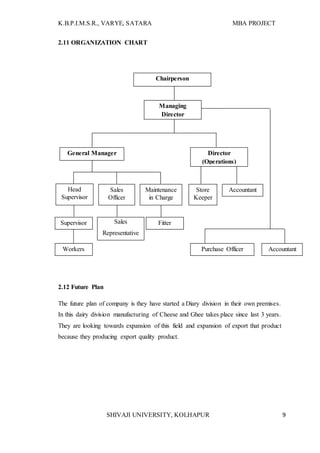
2.11 ORGANIZATION CHART
2.12 Future Plan
The future plan of company is they have started a Diary division in their own premises.
In this dairy division manufacturing of Cheese and Ghee takes place since last 3 years.
They are looking towards expansion of this field and expansion of export that product
because they producing export quality product.
Chairperson
Managing
Director
General Manager
Head
Supervisor
Sales
Officer
Maintenance
in Charge
Supervisor
Workers
Sales
Representative
Director
(Operations)
Store
Keeper
Accountant
Purchase Officer Accountant
Fitter
K.B.P.I.M.S.R., VARYE, SATARA MBA PROJECT
SHIVAJI UNIVERSITY, KOLHAPUR 10
CHAPTER – III
CONCEPTUAL FRAMEWORK
3.1 Introduction
The process from purchasing to receipt, inventorying, manufacturing and storage of in-
process and finished goods, to the distribution of the finished goods is one of the
material flows from the external supply market to the customer of manufacturing
company. However, integration is a frame of mind in today’s fast changing business
world, it should not stop the level of integration stated above. For as long as manager
can remember, companies have tried to design effective business model. The goal is to
meet customer need better than competitors. Success depends on building processes
that can design, make and deliver the innovative, high quality, low cost product and
services that customers demand. The wealth of nation is product of its labor and the
greatest improvement in the product of labor result from the division of labor. Through
specialization and trade, wealth is increased.
3.2 Supply Chain Management:
A Supply chain is network of supplier, manufacturing, assembly, distribution, and
logistics facilities that perform the function of procurement of materials into
intermediate and finish product, and the distribution of this product to customers.
Supply chain arises in both manufacturing and service organization.
A supply chain is a collection of interdependent steps that, when followed, accomplish
a certain objective such as, meeting customer requirements. The supply chain is gaining
prominence as manufacturer’s control less of the speed at which products are
manufactured and distributed.
Supply chain management is the systematic, strategic co-ordination of the traditional
business function and the tactic across these business functions within a particular
company and across business within the supply chain, for the purpose of improving the
long term performance of the individual companies and the supply chain as a whole.
K.B.P.I.M.S.R., VARYE, SATARA MBA PROJECT
SHIVAJI UNIVERSITY, KOLHAPUR 11
According to Professor Douglas M. Lambert, “Supply chain management (SCM) as
the integration of business process from the end user through original suppliers who
provide product, service, and information that adds value for the customer”.1
According to Christopher, SCM is defined as, “The management of upstream and
downstream relationship with suppliers and customer to deliver superior customer
value at less cost to the supply chain as a whole”2
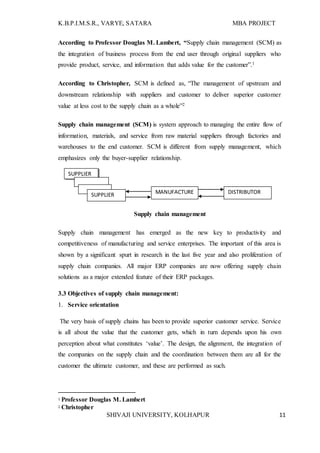
Supply chain management (SCM) is system approach to managing the entire flow of
information, materials, and service from raw material suppliers through factories and
warehouses to the end customer. SCM is different from supply management, which
emphasizes only the buyer-supplier relationship.
Supply chain management
Supply chain management has emerged as the new key to productivity and
competitiveness of manufacturing and service enterprises. The important of this area is
shown by a significant spurt in research in the last five year and also proliferation of
supply chain companies. All major ERP companies are now offering supply chain
solutions as a major extended feature of their ERP packages.
3.3 Objectives of supply chain management:
1. Service orientation
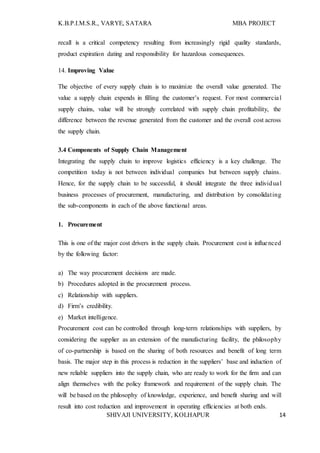
The very basis of supply chains has been to provide superior customer service. Service
is all about the value that the customer gets, which in turn depends upon his own
perception about what constitutes ‘value’. The design, the alignment, the integration of
the companies on the supply chain and the coordination between them are all for the
customer the ultimate customer, and these are performed as such.
1 Professor Douglas M. Lambert
2 Christopher
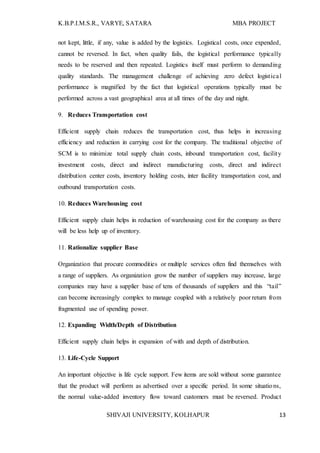
SUPPLIER
MANUFACTURE
R
DISTRIBUTORSUPPLIER
K.B.P.I.M.S.R., VARYE, SATARA MBA PROJECT
SHIVAJI UNIVERSITY, KOLHAPUR 12
2. System Orientation
System Orientation is at the core of the existence of any supply chain. Synergy due to
coordination is the main gain of supply chain. This entails that while getting optimal
result for the chain as a whole, the results for the partners on the chain may not
necessarily be optimal; system thinking involve thinking about all the elements in the
supply chain. Therefore, no one is neglected; no one’s interests are undercut.
3. Competitiveness and Efficiency
The supply chain is a business organization. It provides value to the customer while
being competitive. Competitiveness’ is essential for it to healthily sustain itself in order
to be able to provide increasing value to its customer. Efficiency is an important of
competitiveness.
4. Minimizing the Time
Efficient supply chain in an organization reduces the time required for converting
orders into cash. So there is minimal time leg and increase in productivity of the
organization.
5. Minimizing work-in-progress
Supply chain minimizes total work in process in supply chain.
6. Improving Pipeline Visibility
Efficient supply chain improves the visibility of each one of the activities of the supply
chain by each one of the partners.
7. Improving Visibility of Demand
Efficient supply chain improves visibility of demand by each one of the partners.
8. Improving Quality
Efficient supply chain helps in improving the quality of operations of the organizations.
Total Quality Management (TQM) has become a major commitment throughout all
facets of industry. Overall commitment to TQM is one of the major forces contributing
to the logistical renaissance. If a product becomes defective or if service promises are
K.B.P.I.M.S.R., VARYE, SATARA MBA PROJECT
SHIVAJI UNIVERSITY, KOLHAPUR 13
not kept, little, if any, value is added by the logistics. Logistical costs, once expended,
cannot be reversed. In fact, when quality fails, the logistical performance typically
needs to be reserved and then repeated. Logistics itself must perform to demanding
quality standards. The management challenge of achieving zero defect logistical
performance is magnified by the fact that logistical operations typically must be
performed across a vast geographical area at all times of the day and night.
9. Reduces Transportation cost
Efficient supply chain reduces the transportation cost, thus helps in increasing
efficiency and reduction in carrying cost for the company. The traditional objective of
SCM is to minimize total supply chain costs, inbound transportation cost, facility
investment costs, direct and indirect manufacturing costs, direct and indirect
distribution center costs, inventory holding costs, inter facility transportation cost, and
outbound transportation costs.
10. Reduces Warehousing cost
Efficient supply chain helps in reduction of warehousing cost for the company as there
will be less help up of inventory.
11. Rationalize supplier Base
Organization that procure commodities or multiple services often find themselves with
a range of suppliers. As organization grow the number of suppliers may increase, large
companies may have a supplier base of tens of thousands of suppliers and this “tail”
can become increasingly complex to manage coupled with a relatively poor return from
fragmented use of spending power.
12. Expanding Width/Depth of Distribution
Efficient supply chain helps in expansion of with and depth of distribution.
13. Life-Cycle Support
An important objective is life cycle support. Few items are sold without some guarantee
that the product will perform as advertised over a specific period. In some situations,
the normal value-added inventory flow toward customers must be reversed. Product
K.B.P.I.M.S.R., VARYE, SATARA MBA PROJECT
SHIVAJI UNIVERSITY, KOLHAPUR 14
recall is a critical competency resulting from increasingly rigid quality standards,
product expiration dating and responsibility for hazardous consequences.
14. Improving Value
The objective of every supply chain is to maximize the overall value generated. The
value a supply chain expends in filling the customer’s request. For most commercial
supply chains, value will be strongly correlated with supply chain profitability, the
difference between the revenue generated from the customer and the overall cost across
the supply chain.
3.4 Components of Supply Chain Management
Integrating the supply chain to improve logistics efficiency is a key challenge. The
competition today is not between individual companies but between supply chains.
Hence, for the supply chain to be successful, it should integrate the three individual
business processes of procurement, manufacturing, and distribution by consolidating
the sub-components in each of the above functional areas.
1. Procurement
This is one of the major cost drivers in the supply chain. Procurement cost is influenced
by the following factor:
a) The way procurement decisions are made.
b) Procedures adopted in the procurement process.
c) Relationship with suppliers.
d) Firm’s credibility.
e) Market intelligence.
Procurement cost can be controlled through long-term relationships with suppliers, by
considering the supplier as an extension of the manufacturing facility, the philosophy
of co-partnership is based on the sharing of both resources and benefit of long term
basis. The major step in this process is reduction in the suppliers’ base and induction of
new reliable suppliers into the supply chain, who are ready to work for the firm and can
align themselves with the policy framework and requirement of the supply chain. The
will be based on the philosophy of knowledge, experience, and benefit sharing and will
result into cost reduction and improvement in operating efficiencies at both ends.
K.B.P.I.M.S.R., VARYE, SATARA MBA PROJECT
SHIVAJI UNIVERSITY, KOLHAPUR 15
Material requirement planning is a critical element in the procurement in the Process.
In an integrated supply chain, material planning will have a cascading effect in the
entire supply chain. Hence, in co-partnership arrangements the material planning
process will cover inventory requirement in the entire supply chain, including both
firms and its suppliers.
Material flow across the supply chain is done in close co-ordination with the suppliers.
The actual shipment is scheduled as per the firm production programmers. The logistic
operation is planned to take care of any eventualities so as to deliver the material on
time, and with both reliability and consistency in performance.
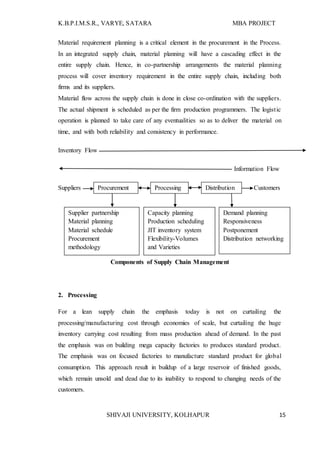
Inventory Flow
Information Flow
Suppliers Customers
Components of Supply Chain Management
2. Processing
For a lean supply chain the emphasis today is not on curtailing the
processing/manufacturing cost through economies of scale, but curtailing the huge
inventory carrying cost resulting from mass production ahead of demand. In the past
the emphasis was on building mega capacity factories to produces standard product.
The emphasis was on focused factories to manufacture standard product for global
consumption. This approach result in buildup of a large reservoir of finished goods,
which remain unsold and dead due to its inability to respond to changing needs of the
customers.
Procurement Processing Distribution
Demand planning
Responsiveness
Postponement
Distribution networking
Capacity planning
Production scheduling
JIT inventory system
Flexibility-Volumes
and Varieties
Supplier partnership
Material planning
Material schedule
Procurement
methodology
K.B.P.I.M.S.R., VARYE, SATARA MBA PROJECT
SHIVAJI UNIVERSITY, KOLHAPUR 16
3. Distribution
Traditionally the role of distribution in the business process is warehousing
transportation. However, in the supply chain modal the major task of distribution is the
management of demand, I.e., to make available the right product, at the right place, at
the right time, and at the least cost. Demand management covers all the activities
involving anticipating the customer requirement of product and fulfills that requirement
against defined service norms. Requirement fulfillment is done through proper
distribution network.
3.5 Functions of Supply Chain Management
Supply Chain Management is a cross-function to manage the movement of raw
materials into an organization, certain aspects of the internal processing materials into
finished goods, and then the movement of finished goods out of the organization toward
the end-consumer. As organization strive to focus on core competencies and becoming
more flexible, they have reduced their ownership of raw materials sources and proper
distribution channels.
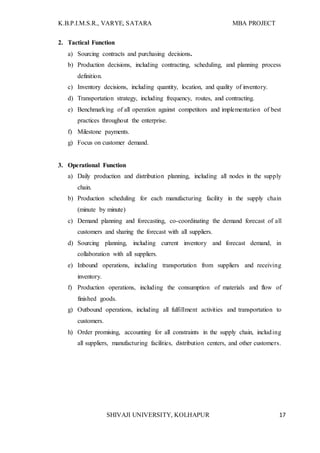
Supply chain activities can be grouped into strategic, tactical; and operational level of
activities:
1. Strategic function
Strategic network optimization, including the number, location, and size of warehouses,
distribution centers and facilities
a) Strategic partnership with suppliers, distributors, and customers, creating
communication channels for critical information and operational improvements
such as cross docking, direct shipping, and third-party logistics.
b) Product designs co-ordination, so that new and existing products can be
optimally integrated into the supply chain, load management.
c) Information Technology infrastructure, to support supply chain operations.
d) Where-to-make and what-to make-or-buy decisions.
e) Aligning overall organizational strategy with supply strategy.
K.B.P.I.M.S.R., VARYE, SATARA MBA PROJECT
SHIVAJI UNIVERSITY, KOLHAPUR 17
2. Tactical Function
a) Sourcing contracts and purchasing decisions.
b) Production decisions, including contracting, scheduling, and planning process
definition.
c) Inventory decisions, including quantity, location, and quality of inventory.
d) Transportation strategy, including frequency, routes, and contracting.
e) Benchmarking of all operation against competitors and implementation of best
practices throughout the enterprise.
f) Milestone payments.
g) Focus on customer demand.
3. Operational Function
a) Daily production and distribution planning, including all nodes in the supply
chain.
b) Production scheduling for each manufacturing facility in the supply chain
(minute by minute)
c) Demand planning and forecasting, co-coordinating the demand forecast of all
customers and sharing the forecast with all suppliers.
d) Sourcing planning, including current inventory and forecast demand, in
collaboration with all suppliers.
e) Inbound operations, including transportation from suppliers and receiving
inventory.
f) Production operations, including the consumption of materials and flow of
finished goods.
g) Outbound operations, including all fulfillment activities and transportation to
customers.
h) Order promising, accounting for all constraints in the supply chain, including
all suppliers, manufacturing facilities, distribution centers, and other customers.
K.B.P.I.M.S.R., VARYE, SATARA MBA PROJECT
SHIVAJI UNIVERSITY, KOLHAPUR 18
CHAPTER IV
DATA ANALYSIS AND INTERPRETATION
4.1 Introduction
Data analysis refers to the computation of certain measure along with searching for
patterns of relationship that exist among data.
Interpretation is the result of analysis, which enables the conversion of data in to
Statement, propositions, or conclusions, which ultimately complete the research
Objectives.
This chapter includes the analysis of Supply chain management in Shree Feed stuffs
Industries Pvt. Ltd. Satara. The data collection through secondary source.
For the purpose of data analysis used simple tools i.e. are table.
4.2 Data Analysis
In this chapter data analysis made as per “Supply Chain Management”.
K.B.P.I.M.S.R., VARYE, SATARA MBA PROJECT
SHIVAJI UNIVERSITY, KOLHAPUR 19
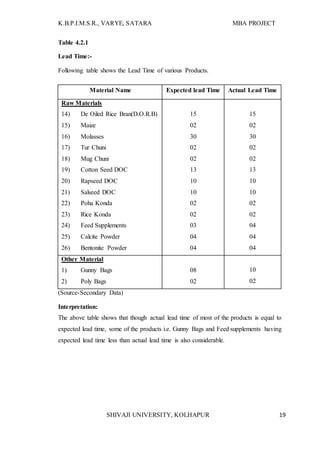
Table 4.2.1
Lead Time:-
Following table shows the Lead Time of various Products.
(Source-Secondary Data)
Interpretation:
The above table shows that though actual lead time of most of the products is equal to
expected lead time, some of the products i.e. Gunny Bags and Feed supplements having
expected lead time less than actual lead time is also considerable.
Material Name Expected lead Time Actual Lead Time
Raw Materials
14) De Oiled Rice Bran(D.O.R.B)
15) Maize
16) Molasses
17) Tur Chuni
18) Mug Chuni
19) Cotton Seed DOC
20) Rapseed DOC
21) Salseed DOC
22) Poha Konda
23) Rice Konda
24) Feed Supplements
25) Calcite Powder
26) Bentonite Powder
15
02
30
02
02
13
10
10
02
02
03
04
04
15
02
30
02
02
13
10
10
02
02
04
04
04
Other Material
1) Gunny Bags
2) Poly Bags
08
02
10
02
K.B.P.I.M.S.R., VARYE, SATARA MBA PROJECT
SHIVAJI UNIVERSITY, KOLHAPUR 20
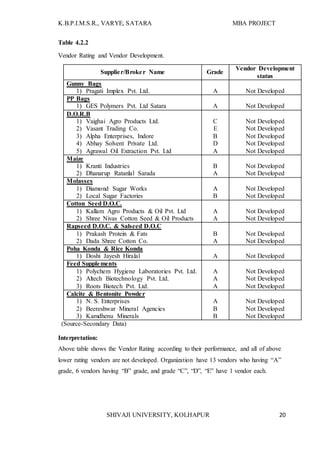
Table 4.2.2
Vendor Rating and Vendor Development.
Supplier/Broker Name Grade
Vendor Development
status
Gunny Bags
1) Pragati Implex Pvt. Ltd. A Not Developed
PP Bags
1) GES Polymers Pvt. Ltd Satara A Not Developed
D.O.R.B
1) Vaighai Agro Products Ltd.
2) Vasant Trading Co.
3) Alpha Enterprises, Indore
4) Abhay Solvent Private Ltd.
5) Agrawal Oil Extraction Pvt. Ltd
C
E
B
D
A
Not Developed
Not Developed
Not Developed
Not Developed
Not Developed
Maize
1) Kranti Industries
2) Dhanarup Ratanlal Sarada
B
A
Not Developed
Not Developed
Molasses
1) Diamond Sugar Works
2) Local Sugar Factories
A
B
Not Developed
Not Developed
Cotton Seed D.O.C.
1) Kallam Agro Products & Oil Pvt. Ltd
2) Shree Nivas Cotton Seed & Oil Products
A
A
Not Developed
Not Developed
Rapseed D.O.C. & Salseed D.O.C
1) Prakash Protein & Fats
2) Dada Shree Cotton Co.
B
A
Not Developed
Not Developed
Poha Konda & Rice Konda
1) Doshi Jayesh Hiralal A Not Developed
Feed Supplements
1) Polychem Hygiene Laboratories Pvt. Ltd.
2) Altech Biotechnology Pvt. Ltd.
3) Roots Biotech Pvt. Ltd.
A
A
A
Not Developed
Not Developed
Not Developed
Calcite & Bentonite Powder
1) N. S. Enterprises
2) Beereshwar Mineral Agencies
3) Kamdhenu Minerals
A
B
B
Not Developed
Not Developed
Not Developed
(Source-Secondary Data)
Interpretation:
Above table shows the Vendor Rating according to their performance, and all of above
lower rating vendors are not developed. Organization have 13 vendors who having “A”
grade, 6 vendors having “B” grade, and grade “C”, “D”, “E” have 1 vendor each.
K.B.P.I.M.S.R., VARYE, SATARA MBA PROJECT
SHIVAJI UNIVERSITY, KOLHAPUR 21
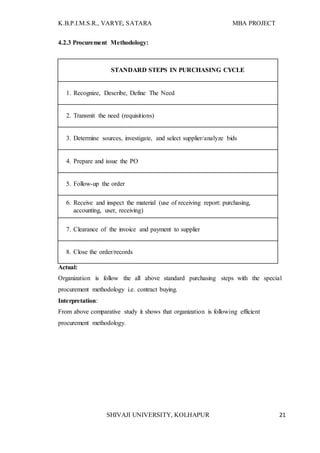
4.2.3 Procurement Methodology:
Actual:
Organization is follow the all above standard purchasing steps with the special
procurement methodology i.e. contract buying.
Interpretation:
From above comparative study it shows that organization is following efficient
procurement methodology.
STANDARD STEPS IN PURCHASING CYCLE
1. Recognize, Describe, Define The Need
2. Transmit the need (requisitions)
3. Determine sources, investigate, and select supplier/analyze bids
4. Prepare and issue the PO
5. Follow-up the order
6. Receive and inspect the material (use of receiving report: purchasing,
accounting, user, receiving)
7. Clearance of the invoice and payment to supplier
8. Close the order/records
K.B.P.I.M.S.R., VARYE, SATARA MBA PROJECT
SHIVAJI UNIVERSITY, KOLHAPUR 22
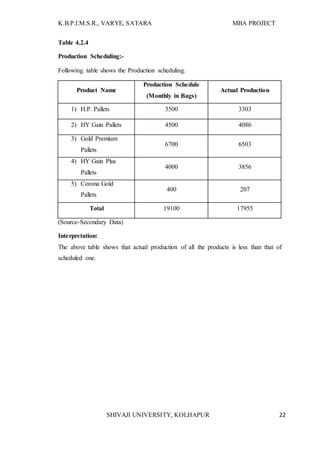
Table 4.2.4
Production Scheduling:-
Following table shows the Production scheduling.
Product Name
Production Schedule
(Monthly in Bags)
Actual Production
1) H.P. Pallets 3500 3303
2) HY Gain Pallets 4500 4086
3) Gold Premium
Pallets
6700 6503
4) HY Gain Plus
Pallets
4000 3856
5) Corona Gold
Pallets
400 207
Total 19100 17955
(Source-Secondary Data)
Interpretation:
The above table shows that actual production of all the products is less than that of
scheduled one.
K.B.P.I.M.S.R., VARYE, SATARA MBA PROJECT
SHIVAJI UNIVERSITY, KOLHAPUR 23
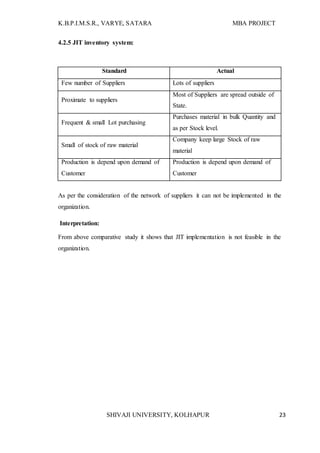
4.2.5 JIT inventory system:
Standard Actual
Few number of Suppliers Lots of suppliers
Proximate to suppliers
Most of Suppliers are spread outside of
State.
Frequent & small Lot purchasing
Purchases material in bulk Quantity and
as per Stock level.
Small of stock of raw material
Company keep large Stock of raw
material
Production is depend upon demand of
Customer
Production is depend upon demand of
Customer
As per the consideration of the network of suppliers it can not be implemented in the
organization.
Interpretation:
From above comparative study it shows that JIT implementation is not feasible in the
organization.
K.B.P.I.M.S.R., VARYE, SATARA MBA PROJECT
SHIVAJI UNIVERSITY, KOLHAPUR 24
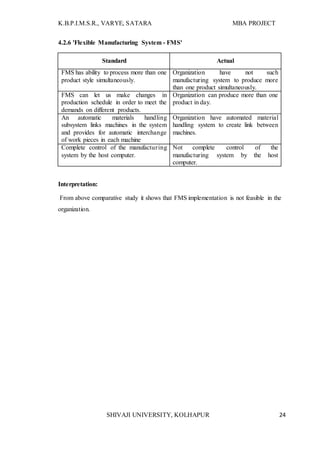
4.2.6 'Flexible Manufacturing System - FMS'
Standard Actual
FMS has ability to process more than one
product style simultaneously.
Organization have not such
manufacturing system to produce more
than one product simultaneously.
FMS can let us make changes in
production schedule in order to meet the
demands on different products.
Organization can produce more than one
product in day.
An automatic materials handling
subsystem links machines in the system
and provides for automatic interchange
of work pieces in each machine
Organization have automated material
handling system to create link between
machines.
Complete control of the manufacturing
system by the host computer.
Not complete control of the
manufacturing system by the host
computer.
Interpretation:
From above comparative study it shows that FMS implementation is not feasible in the
organization.
K.B.P.I.M.S.R., VARYE, SATARA MBA PROJECT
SHIVAJI UNIVERSITY, KOLHAPUR 25
4.2.7 Demand Planning
Demand Planning is a process used to create reliable forecasts. Effective demand
planning can guide organization to improve the accuracy of forecasts, align inventory
levels with peaks and troughs in demand, and enhance profitability for a given channel
or product.
Actual:
The approach begins with a statistical forecast. Data sources for the forecast include
planned sales orders, customer contracts and intercompany standing orders.
Interpretation:
From above comparative study it shows that Demand Planning is not used in an
organization to forecast sales orders.
K.B.P.I.M.S.R., VARYE, SATARA MBA PROJECT
SHIVAJI UNIVERSITY, KOLHAPUR 26
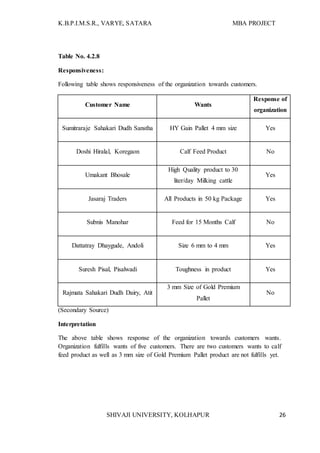
Table No. 4.2.8
Responsiveness:
Following table shows responsiveness of the organization towards customers.
Customer Name Wants
Response of
organization
Sumitraraje Sahakari Dudh Sanstha HY Gain Pallet 4 mm size Yes
Doshi Hiralal, Koregaon Calf Feed Product No
Umakant Bhosale
High Quality product to 30
liter/day Milking cattle
Yes
Jasaraj Traders All Products in 50 kg Package Yes
Subnis Manohar Feed for 15 Months Calf No
Dattatray Dhaygude, Andoli Size 6 mm to 4 mm Yes
Suresh Pisal, Pisalwadi Toughness in product Yes
Rajmata Sahakari Dudh Dairy, Atit
3 mm Size of Gold Premium
Pallet
No
(Secondary Source)
Interpretation
The above table shows response of the organization towards customers wants.
Organization fulfills wants of five customers. There are two customers wants to calf
feed product as well as 3 mm size of Gold Premium Pallet product are not fulfills yet.

Project Report

  • 1.
    K.B.P.I.M.S.R., VARYE, SATARAMBA PROJECT SHIVAJI UNIVERSITY, KOLHAPUR 1 CHAPTER - I INTRODUCTION TO STUDY 1.1 Introduction Supply chains encompass the companies and the business activities needed to design, make, deliver, and use a product or service. Businesses depend on their supply chains to provide them with what they need to survive and thrive. Supply chain management is a set of approaches utilized to efficiently integrate suppliers, manufacturers, warehouses, and stores, so that merchandise is produced and distributed at the right quantities, to the right locations, and at the right time, in order to minimize system wide costs while satisfying service level requirements. A supply chain consists of all stages involved, directly or indirectly, in fulfilling a customer request. The supply chain not only includes the manufacturer and suppliers, but also transporters, warehouses, retailers, and customers themselves. Supply chain arises in both manufacturing and service organization. A supply chain is a collection of interdependent steps that, when followed, accomplish a certain objective such as, meeting customer requirements. The supply chain is gaining prominence as manufacturer’s control less of the speed at which products are manufactured and distributed. Every management face various problems in different area of operation, in this project analysis of supply chain management survey have been done with reference to Shree Feed stuffs Industries Pvt. Ltd. The organization producing cattle feed. Suppliers of the organization situated within the country. Organization mainly distributes their products in Satara, Koregaon, Jawali, Wai, Khandala, Maan, Khatav, Sangali, Sangola and Solapur regions. This study focuses on supply chain management of organization. 1.2 Management problem Management is unable to implement integrated and efficient supply chain management. So management want to find out the problems in current supply chain management. 1.3 Statements of ResearchProblem Study focuses on all elements of present supply chain management. Hence title of the study is “Supply Chain Management with respect to Shree Feed stuffs Industries Pvt. Ltd., Satara.”
  • 2.
    K.B.P.I.M.S.R., VARYE, SATARAMBA PROJECT SHIVAJI UNIVERSITY, KOLHAPUR 2 1.4 Objectives 1. To know current status of Supply Chain Management of organization. 2. To know problems in current supply chain management of organization. 3. To give suggestions for effective supply chain management. 1.5 Importance 1. Research study will help organization to know current status of supply chain management of organization. 2. Research study will help management to know problems in Supply chain management, by knowing the problems they can integrate supply chain management by improving it. 3. Research study will help organization to provide better medium for information sharing between supply chain partners. 4. Research study will help organization to Right Product Assortment and Quantity. 1.6 Scope of the study The scope of research is divided into following factors: A. Geographical scope The geographical scope of this study is confined to all elements of supply chain management of “Shree Feed stuffs Industries Pvt. Ltd., Satara.” B. Conceptual scope Conceptual scope of the study is focused on the concept of the Supply chain management and its elements. C. Analytical scope Analytical scope of the study is limited to use of comparative study of standard and actual Supply chain management of the organization. 1.7 ResearchMethodology 1.7.1 ResearchDesign The nature of this research study is descriptive. 1.7.2 Data Required For the Study: The data required for study is to obtain from primary and secondary data.
  • 3.
    K.B.P.I.M.S.R., VARYE, SATARAMBA PROJECT SHIVAJI UNIVERSITY, KOLHAPUR 3 A. Primary data For study researcher will require Expectations, opinions of all the heads of the elements of Supply chain management towards effective functioning of supply chain management. B. Secondary data For study researcher will require the, vendor rating report, material requirement planning, production planning and controlling charts, Distribution network chart, Order processing, demand supply reports etc. also it includes concept of the Supply chain management and its elements. 1.7.3 Data Sources The source for the below data needed to be collected for the purpose of study through primary data as well as secondary data are as follows: A. Primary data Primary data is generated from Opinions, observation and discussion with all heads of the elements of supply chain management. B. Secondary data Secondary data is generated from various manuals from all elements of Supply chain management and source like Books, Internet, websites etc. 1.8 Data Analysis Researcher has analyzed the data using various simple tools like such as charts and tables etc.
  • 4.
    K.B.P.I.M.S.R., VARYE, SATARAMBA PROJECT SHIVAJI UNIVERSITY, KOLHAPUR 4 1.9 Chapterization: The collected data has been presented with following chapters. Chapter 1 - Introduction of study This chapter contains Introduction to study, Management problem, Research problem, Objectives, Scope, Research methodology and Importance of study etc. Chapter 2 - A Company profile This chapter related to Introduction of organizational, History of organization, Product profile, Organization chart, Achievement, Future plan etc. Chapter 3 - Conceptual Framework This chapter summarized the abstracter study it includes introduction, meaning, Definition, Factor of supply chain management etc. Chapter 4 - Data Analysis and Interpretation In this chapter the data which is collected by researcher is analyzed and interpreted with the help of Tabulation, Interpretation. Chapter 5 - Findings, Conclusion, Suggestion In this chapter the researcher has mentioned Findings, Conclusion, Suggestions and Bibliography appended with annexure.
  • 5.
    K.B.P.I.M.S.R., VARYE, SATARAMBA PROJECT SHIVAJI UNIVERSITY, KOLHAPUR 5 CHAPTER – II COMPANY PROFILE 2.1 Introduction Shree Feed stuffs Pvt. Ltd is situated in Satara MIDC. It cattle feed manufacturing company. The company is presently catering demand from local market. The company is also producing milk products. They have been in feed manufacturing from 1982. They are well known for their quality product and service in Satara District. It is equipped with a Q C Lab, Weigh Bridge, and 2000 Square feet warehouse and batch type semi-automatic plant with most modern machine. The unit is ISO 9001:2000 certified. The capacity of plant is 2000 MT/year. And they are producing 20000 MT/year. (Capacity is 2000MT/month & production is 1600MT/month). The company manufactures and markets animal feed in Satara District and some areas in Solapur District. 2.2 History and Background Shree Feed stuff Pvt. Ltd was established in 1982 in Satara MIDC. The organization is established by Mrs. Mrinalini Vasant Babar. Her qualification is B.A (English). She is successfully handling to a company since last 28 years. Purpose behind the starting of company is for income source for proprietor and farmers. The proprietor has deep knowledge of this field. Therefore for utilization of knowledge she established company. 2.3 Address Old MIDC Satara, Plot No. B-55 Pin Code :- 415004 Contact No. :- + (91)-2162-244492 Email ID :- shree.feed@gmail.com Fax :- +91-2162-246095
  • 6.
    K.B.P.I.M.S.R., VARYE, SATARAMBA PROJECT SHIVAJI UNIVERSITY, KOLHAPUR 6 2.4 Achievements The company is awarded for “Successful Entrepreneur” from Gunvant Kamgar Prathishtan, Satara. 2.5 Vision 1) Enhancing customer faith and satisfaction. 2) Improving effectiveness of our quality and food safety. 2.6 Mission 1) Providing maximum benefits to milk producer to uplift their standard of living by providing inputs like animal husbandry, trainees. 2) To provide innovative products of first class quality at reasonable prices. 2.7 Objective 1) Industries trying to cut down the inventory and improve the working capital cycle for a continuous production. 2) Shree feedstuff's pvt Ltd is concentrating on the development of technological improvement. In their Industrial Coating so that to make the product stronger position in the market. 3) Online marketing has become an integrated part of the industries and industries trying installing a strong integrated for online marketing. 4) To enhance their marketing in rural sector a huge amount investment is made in ad campaign and demonstration cum sales technique is going on. 2.8 Competitors of Company 1) Hindustan Feeds 2) Godrej 3) Pushkar 4) Baramati Agro
  • 7.
    K.B.P.I.M.S.R., VARYE, SATARAMBA PROJECT SHIVAJI UNIVERSITY, KOLHAPUR 7 2.9 Products of Company Company has a range of products for cattle feed according to breed characteristics. 1) H.P. Pallets 2) HY Gain Pallets 3) Gold Premium (Bypass Protein Pallets) 4) HY Gain Plus Pallets 5) Corona Gold Pallets Company produces cattle feed for milk cows and milk buffalo. The need for animal feed is to provide nutrition in form of Energy, Fats, Minerals and Vitamins to supplement Roughage, The animal population in Western Maharashtra is mostly Cross Breed Holstein Friesian Cows and Buffalo’s Most farmers prefer to raise cows as they have consistent milk production however milk rates are not very lucrative, while buffalo’s milk fetches a very high premium while the production of milk is very erratic. The animal feed is formulated according to the milk productively of the animal which depends on milk cycle stage of the animal. 1. P. Pallets: This is highest selling feed in the industry as the most of the bred in India is average producers. These cows product about 10-15 liter/day; require bare minimum maintenance and commercial quality animal feed. 2. High Gain Pallets: This food is suitable for animal producing milk and after decreasing in milk of cow and buffalo’s the demand for this feed is growing as now many farmers are purchasing better breed of cattle for high productivity. 3. Gold Premium (Bypass Protein Pallets) This is the highest quality feed which brings out the maximum milk yield performance of the cows. This feed is generally fed immediately after calving cow is at the peak milk production while the diet intake is quite low due to 9 month of dry deeding. The feed is also suitable for cats le producing above 20 litters of milk/day.
  • 8.
    K.B.P.I.M.S.R., VARYE, SATARAMBA PROJECT SHIVAJI UNIVERSITY, KOLHAPUR 8 2.10 Ingredients required for feed: Following table shows the required Ingredients used in each type of products. Each type of product contains same type of ingredients but ratio is different for different products. 2.10.1 Raw Materials 1) De Oiled Rice Bran(D.O.R.B) 2) Maize 3) Molasses 4) Tur Chuni 5) Mug Chuni 6) Cotton Seed DOC 7) Rapseed DOC 8) Salseed DOC 9) Poha Konda 10) Rice Konda 11) Feed Supplements 12) Calcite Powder 13) Bentonite Powder
  • 9.
    K.B.P.I.M.S.R., VARYE, SATARAMBA PROJECT SHIVAJI UNIVERSITY, KOLHAPUR 9 2.11 ORGANIZATION CHART 2.12 Future Plan The future plan of company is they have started a Diary division in their own premises. In this dairy division manufacturing of Cheese and Ghee takes place since last 3 years. They are looking towards expansion of this field and expansion of export that product because they producing export quality product. Chairperson Managing Director General Manager Head Supervisor Sales Officer Maintenance in Charge Supervisor Workers Sales Representative Director (Operations) Store Keeper Accountant Purchase Officer Accountant Fitter
  • 10.
    K.B.P.I.M.S.R., VARYE, SATARAMBA PROJECT SHIVAJI UNIVERSITY, KOLHAPUR 10 CHAPTER – III CONCEPTUAL FRAMEWORK 3.1 Introduction The process from purchasing to receipt, inventorying, manufacturing and storage of in- process and finished goods, to the distribution of the finished goods is one of the material flows from the external supply market to the customer of manufacturing company. However, integration is a frame of mind in today’s fast changing business world, it should not stop the level of integration stated above. For as long as manager can remember, companies have tried to design effective business model. The goal is to meet customer need better than competitors. Success depends on building processes that can design, make and deliver the innovative, high quality, low cost product and services that customers demand. The wealth of nation is product of its labor and the greatest improvement in the product of labor result from the division of labor. Through specialization and trade, wealth is increased. 3.2 Supply Chain Management: A Supply chain is network of supplier, manufacturing, assembly, distribution, and logistics facilities that perform the function of procurement of materials into intermediate and finish product, and the distribution of this product to customers. Supply chain arises in both manufacturing and service organization. A supply chain is a collection of interdependent steps that, when followed, accomplish a certain objective such as, meeting customer requirements. The supply chain is gaining prominence as manufacturer’s control less of the speed at which products are manufactured and distributed. Supply chain management is the systematic, strategic co-ordination of the traditional business function and the tactic across these business functions within a particular company and across business within the supply chain, for the purpose of improving the long term performance of the individual companies and the supply chain as a whole.
  • 11.
    K.B.P.I.M.S.R., VARYE, SATARAMBA PROJECT SHIVAJI UNIVERSITY, KOLHAPUR 11 According to Professor Douglas M. Lambert, “Supply chain management (SCM) as the integration of business process from the end user through original suppliers who provide product, service, and information that adds value for the customer”.1 According to Christopher, SCM is defined as, “The management of upstream and downstream relationship with suppliers and customer to deliver superior customer value at less cost to the supply chain as a whole”2 Supply chain management (SCM) is system approach to managing the entire flow of information, materials, and service from raw material suppliers through factories and warehouses to the end customer. SCM is different from supply management, which emphasizes only the buyer-supplier relationship. Supply chain management Supply chain management has emerged as the new key to productivity and competitiveness of manufacturing and service enterprises. The important of this area is shown by a significant spurt in research in the last five year and also proliferation of supply chain companies. All major ERP companies are now offering supply chain solutions as a major extended feature of their ERP packages. 3.3 Objectives of supply chain management: 1. Service orientation The very basis of supply chains has been to provide superior customer service. Service is all about the value that the customer gets, which in turn depends upon his own perception about what constitutes ‘value’. The design, the alignment, the integration of the companies on the supply chain and the coordination between them are all for the customer the ultimate customer, and these are performed as such. 1 Professor Douglas M. Lambert 2 Christopher SUPPLIER MANUFACTURE R DISTRIBUTORSUPPLIER
  • 12.
    K.B.P.I.M.S.R., VARYE, SATARAMBA PROJECT SHIVAJI UNIVERSITY, KOLHAPUR 12 2. System Orientation System Orientation is at the core of the existence of any supply chain. Synergy due to coordination is the main gain of supply chain. This entails that while getting optimal result for the chain as a whole, the results for the partners on the chain may not necessarily be optimal; system thinking involve thinking about all the elements in the supply chain. Therefore, no one is neglected; no one’s interests are undercut. 3. Competitiveness and Efficiency The supply chain is a business organization. It provides value to the customer while being competitive. Competitiveness’ is essential for it to healthily sustain itself in order to be able to provide increasing value to its customer. Efficiency is an important of competitiveness. 4. Minimizing the Time Efficient supply chain in an organization reduces the time required for converting orders into cash. So there is minimal time leg and increase in productivity of the organization. 5. Minimizing work-in-progress Supply chain minimizes total work in process in supply chain. 6. Improving Pipeline Visibility Efficient supply chain improves the visibility of each one of the activities of the supply chain by each one of the partners. 7. Improving Visibility of Demand Efficient supply chain improves visibility of demand by each one of the partners. 8. Improving Quality Efficient supply chain helps in improving the quality of operations of the organizations. Total Quality Management (TQM) has become a major commitment throughout all facets of industry. Overall commitment to TQM is one of the major forces contributing to the logistical renaissance. If a product becomes defective or if service promises are
  • 13.
    K.B.P.I.M.S.R., VARYE, SATARAMBA PROJECT SHIVAJI UNIVERSITY, KOLHAPUR 13 not kept, little, if any, value is added by the logistics. Logistical costs, once expended, cannot be reversed. In fact, when quality fails, the logistical performance typically needs to be reserved and then repeated. Logistics itself must perform to demanding quality standards. The management challenge of achieving zero defect logistical performance is magnified by the fact that logistical operations typically must be performed across a vast geographical area at all times of the day and night. 9. Reduces Transportation cost Efficient supply chain reduces the transportation cost, thus helps in increasing efficiency and reduction in carrying cost for the company. The traditional objective of SCM is to minimize total supply chain costs, inbound transportation cost, facility investment costs, direct and indirect manufacturing costs, direct and indirect distribution center costs, inventory holding costs, inter facility transportation cost, and outbound transportation costs. 10. Reduces Warehousing cost Efficient supply chain helps in reduction of warehousing cost for the company as there will be less help up of inventory. 11. Rationalize supplier Base Organization that procure commodities or multiple services often find themselves with a range of suppliers. As organization grow the number of suppliers may increase, large companies may have a supplier base of tens of thousands of suppliers and this “tail” can become increasingly complex to manage coupled with a relatively poor return from fragmented use of spending power. 12. Expanding Width/Depth of Distribution Efficient supply chain helps in expansion of with and depth of distribution. 13. Life-Cycle Support An important objective is life cycle support. Few items are sold without some guarantee that the product will perform as advertised over a specific period. In some situations, the normal value-added inventory flow toward customers must be reversed. Product
  • 14.
    K.B.P.I.M.S.R., VARYE, SATARAMBA PROJECT SHIVAJI UNIVERSITY, KOLHAPUR 14 recall is a critical competency resulting from increasingly rigid quality standards, product expiration dating and responsibility for hazardous consequences. 14. Improving Value The objective of every supply chain is to maximize the overall value generated. The value a supply chain expends in filling the customer’s request. For most commercial supply chains, value will be strongly correlated with supply chain profitability, the difference between the revenue generated from the customer and the overall cost across the supply chain. 3.4 Components of Supply Chain Management Integrating the supply chain to improve logistics efficiency is a key challenge. The competition today is not between individual companies but between supply chains. Hence, for the supply chain to be successful, it should integrate the three individual business processes of procurement, manufacturing, and distribution by consolidating the sub-components in each of the above functional areas. 1. Procurement This is one of the major cost drivers in the supply chain. Procurement cost is influenced by the following factor: a) The way procurement decisions are made. b) Procedures adopted in the procurement process. c) Relationship with suppliers. d) Firm’s credibility. e) Market intelligence. Procurement cost can be controlled through long-term relationships with suppliers, by considering the supplier as an extension of the manufacturing facility, the philosophy of co-partnership is based on the sharing of both resources and benefit of long term basis. The major step in this process is reduction in the suppliers’ base and induction of new reliable suppliers into the supply chain, who are ready to work for the firm and can align themselves with the policy framework and requirement of the supply chain. The will be based on the philosophy of knowledge, experience, and benefit sharing and will result into cost reduction and improvement in operating efficiencies at both ends.
  • 15.
    K.B.P.I.M.S.R., VARYE, SATARAMBA PROJECT SHIVAJI UNIVERSITY, KOLHAPUR 15 Material requirement planning is a critical element in the procurement in the Process. In an integrated supply chain, material planning will have a cascading effect in the entire supply chain. Hence, in co-partnership arrangements the material planning process will cover inventory requirement in the entire supply chain, including both firms and its suppliers. Material flow across the supply chain is done in close co-ordination with the suppliers. The actual shipment is scheduled as per the firm production programmers. The logistic operation is planned to take care of any eventualities so as to deliver the material on time, and with both reliability and consistency in performance. Inventory Flow Information Flow Suppliers Customers Components of Supply Chain Management 2. Processing For a lean supply chain the emphasis today is not on curtailing the processing/manufacturing cost through economies of scale, but curtailing the huge inventory carrying cost resulting from mass production ahead of demand. In the past the emphasis was on building mega capacity factories to produces standard product. The emphasis was on focused factories to manufacture standard product for global consumption. This approach result in buildup of a large reservoir of finished goods, which remain unsold and dead due to its inability to respond to changing needs of the customers. Procurement Processing Distribution Demand planning Responsiveness Postponement Distribution networking Capacity planning Production scheduling JIT inventory system Flexibility-Volumes and Varieties Supplier partnership Material planning Material schedule Procurement methodology
  • 16.
    K.B.P.I.M.S.R., VARYE, SATARAMBA PROJECT SHIVAJI UNIVERSITY, KOLHAPUR 16 3. Distribution Traditionally the role of distribution in the business process is warehousing transportation. However, in the supply chain modal the major task of distribution is the management of demand, I.e., to make available the right product, at the right place, at the right time, and at the least cost. Demand management covers all the activities involving anticipating the customer requirement of product and fulfills that requirement against defined service norms. Requirement fulfillment is done through proper distribution network. 3.5 Functions of Supply Chain Management Supply Chain Management is a cross-function to manage the movement of raw materials into an organization, certain aspects of the internal processing materials into finished goods, and then the movement of finished goods out of the organization toward the end-consumer. As organization strive to focus on core competencies and becoming more flexible, they have reduced their ownership of raw materials sources and proper distribution channels. Supply chain activities can be grouped into strategic, tactical; and operational level of activities: 1. Strategic function Strategic network optimization, including the number, location, and size of warehouses, distribution centers and facilities a) Strategic partnership with suppliers, distributors, and customers, creating communication channels for critical information and operational improvements such as cross docking, direct shipping, and third-party logistics. b) Product designs co-ordination, so that new and existing products can be optimally integrated into the supply chain, load management. c) Information Technology infrastructure, to support supply chain operations. d) Where-to-make and what-to make-or-buy decisions. e) Aligning overall organizational strategy with supply strategy.
  • 17.
    K.B.P.I.M.S.R., VARYE, SATARAMBA PROJECT SHIVAJI UNIVERSITY, KOLHAPUR 17 2. Tactical Function a) Sourcing contracts and purchasing decisions. b) Production decisions, including contracting, scheduling, and planning process definition. c) Inventory decisions, including quantity, location, and quality of inventory. d) Transportation strategy, including frequency, routes, and contracting. e) Benchmarking of all operation against competitors and implementation of best practices throughout the enterprise. f) Milestone payments. g) Focus on customer demand. 3. Operational Function a) Daily production and distribution planning, including all nodes in the supply chain. b) Production scheduling for each manufacturing facility in the supply chain (minute by minute) c) Demand planning and forecasting, co-coordinating the demand forecast of all customers and sharing the forecast with all suppliers. d) Sourcing planning, including current inventory and forecast demand, in collaboration with all suppliers. e) Inbound operations, including transportation from suppliers and receiving inventory. f) Production operations, including the consumption of materials and flow of finished goods. g) Outbound operations, including all fulfillment activities and transportation to customers. h) Order promising, accounting for all constraints in the supply chain, including all suppliers, manufacturing facilities, distribution centers, and other customers.
  • 18.
    K.B.P.I.M.S.R., VARYE, SATARAMBA PROJECT SHIVAJI UNIVERSITY, KOLHAPUR 18 CHAPTER IV DATA ANALYSIS AND INTERPRETATION 4.1 Introduction Data analysis refers to the computation of certain measure along with searching for patterns of relationship that exist among data. Interpretation is the result of analysis, which enables the conversion of data in to Statement, propositions, or conclusions, which ultimately complete the research Objectives. This chapter includes the analysis of Supply chain management in Shree Feed stuffs Industries Pvt. Ltd. Satara. The data collection through secondary source. For the purpose of data analysis used simple tools i.e. are table. 4.2 Data Analysis In this chapter data analysis made as per “Supply Chain Management”.
  • 19.
    K.B.P.I.M.S.R., VARYE, SATARAMBA PROJECT SHIVAJI UNIVERSITY, KOLHAPUR 19 Table 4.2.1 Lead Time:- Following table shows the Lead Time of various Products. (Source-Secondary Data) Interpretation: The above table shows that though actual lead time of most of the products is equal to expected lead time, some of the products i.e. Gunny Bags and Feed supplements having expected lead time less than actual lead time is also considerable. Material Name Expected lead Time Actual Lead Time Raw Materials 14) De Oiled Rice Bran(D.O.R.B) 15) Maize 16) Molasses 17) Tur Chuni 18) Mug Chuni 19) Cotton Seed DOC 20) Rapseed DOC 21) Salseed DOC 22) Poha Konda 23) Rice Konda 24) Feed Supplements 25) Calcite Powder 26) Bentonite Powder 15 02 30 02 02 13 10 10 02 02 03 04 04 15 02 30 02 02 13 10 10 02 02 04 04 04 Other Material 1) Gunny Bags 2) Poly Bags 08 02 10 02
  • 20.
    K.B.P.I.M.S.R., VARYE, SATARAMBA PROJECT SHIVAJI UNIVERSITY, KOLHAPUR 20 Table 4.2.2 Vendor Rating and Vendor Development. Supplier/Broker Name Grade Vendor Development status Gunny Bags 1) Pragati Implex Pvt. Ltd. A Not Developed PP Bags 1) GES Polymers Pvt. Ltd Satara A Not Developed D.O.R.B 1) Vaighai Agro Products Ltd. 2) Vasant Trading Co. 3) Alpha Enterprises, Indore 4) Abhay Solvent Private Ltd. 5) Agrawal Oil Extraction Pvt. Ltd C E B D A Not Developed Not Developed Not Developed Not Developed Not Developed Maize 1) Kranti Industries 2) Dhanarup Ratanlal Sarada B A Not Developed Not Developed Molasses 1) Diamond Sugar Works 2) Local Sugar Factories A B Not Developed Not Developed Cotton Seed D.O.C. 1) Kallam Agro Products & Oil Pvt. Ltd 2) Shree Nivas Cotton Seed & Oil Products A A Not Developed Not Developed Rapseed D.O.C. & Salseed D.O.C 1) Prakash Protein & Fats 2) Dada Shree Cotton Co. B A Not Developed Not Developed Poha Konda & Rice Konda 1) Doshi Jayesh Hiralal A Not Developed Feed Supplements 1) Polychem Hygiene Laboratories Pvt. Ltd. 2) Altech Biotechnology Pvt. Ltd. 3) Roots Biotech Pvt. Ltd. A A A Not Developed Not Developed Not Developed Calcite & Bentonite Powder 1) N. S. Enterprises 2) Beereshwar Mineral Agencies 3) Kamdhenu Minerals A B B Not Developed Not Developed Not Developed (Source-Secondary Data) Interpretation: Above table shows the Vendor Rating according to their performance, and all of above lower rating vendors are not developed. Organization have 13 vendors who having “A” grade, 6 vendors having “B” grade, and grade “C”, “D”, “E” have 1 vendor each.
  • 21.
    K.B.P.I.M.S.R., VARYE, SATARAMBA PROJECT SHIVAJI UNIVERSITY, KOLHAPUR 21 4.2.3 Procurement Methodology: Actual: Organization is follow the all above standard purchasing steps with the special procurement methodology i.e. contract buying. Interpretation: From above comparative study it shows that organization is following efficient procurement methodology. STANDARD STEPS IN PURCHASING CYCLE 1. Recognize, Describe, Define The Need 2. Transmit the need (requisitions) 3. Determine sources, investigate, and select supplier/analyze bids 4. Prepare and issue the PO 5. Follow-up the order 6. Receive and inspect the material (use of receiving report: purchasing, accounting, user, receiving) 7. Clearance of the invoice and payment to supplier 8. Close the order/records
  • 22.
    K.B.P.I.M.S.R., VARYE, SATARAMBA PROJECT SHIVAJI UNIVERSITY, KOLHAPUR 22 Table 4.2.4 Production Scheduling:- Following table shows the Production scheduling. Product Name Production Schedule (Monthly in Bags) Actual Production 1) H.P. Pallets 3500 3303 2) HY Gain Pallets 4500 4086 3) Gold Premium Pallets 6700 6503 4) HY Gain Plus Pallets 4000 3856 5) Corona Gold Pallets 400 207 Total 19100 17955 (Source-Secondary Data) Interpretation: The above table shows that actual production of all the products is less than that of scheduled one.
  • 23.
    K.B.P.I.M.S.R., VARYE, SATARAMBA PROJECT SHIVAJI UNIVERSITY, KOLHAPUR 23 4.2.5 JIT inventory system: Standard Actual Few number of Suppliers Lots of suppliers Proximate to suppliers Most of Suppliers are spread outside of State. Frequent & small Lot purchasing Purchases material in bulk Quantity and as per Stock level. Small of stock of raw material Company keep large Stock of raw material Production is depend upon demand of Customer Production is depend upon demand of Customer As per the consideration of the network of suppliers it can not be implemented in the organization. Interpretation: From above comparative study it shows that JIT implementation is not feasible in the organization.
  • 24.
    K.B.P.I.M.S.R., VARYE, SATARAMBA PROJECT SHIVAJI UNIVERSITY, KOLHAPUR 24 4.2.6 'Flexible Manufacturing System - FMS' Standard Actual FMS has ability to process more than one product style simultaneously. Organization have not such manufacturing system to produce more than one product simultaneously. FMS can let us make changes in production schedule in order to meet the demands on different products. Organization can produce more than one product in day. An automatic materials handling subsystem links machines in the system and provides for automatic interchange of work pieces in each machine Organization have automated material handling system to create link between machines. Complete control of the manufacturing system by the host computer. Not complete control of the manufacturing system by the host computer. Interpretation: From above comparative study it shows that FMS implementation is not feasible in the organization.
  • 25.
    K.B.P.I.M.S.R., VARYE, SATARAMBA PROJECT SHIVAJI UNIVERSITY, KOLHAPUR 25 4.2.7 Demand Planning Demand Planning is a process used to create reliable forecasts. Effective demand planning can guide organization to improve the accuracy of forecasts, align inventory levels with peaks and troughs in demand, and enhance profitability for a given channel or product. Actual: The approach begins with a statistical forecast. Data sources for the forecast include planned sales orders, customer contracts and intercompany standing orders. Interpretation: From above comparative study it shows that Demand Planning is not used in an organization to forecast sales orders.
  • 26.
    K.B.P.I.M.S.R., VARYE, SATARAMBA PROJECT SHIVAJI UNIVERSITY, KOLHAPUR 26 Table No. 4.2.8 Responsiveness: Following table shows responsiveness of the organization towards customers. Customer Name Wants Response of organization Sumitraraje Sahakari Dudh Sanstha HY Gain Pallet 4 mm size Yes Doshi Hiralal, Koregaon Calf Feed Product No Umakant Bhosale High Quality product to 30 liter/day Milking cattle Yes Jasaraj Traders All Products in 50 kg Package Yes Subnis Manohar Feed for 15 Months Calf No Dattatray Dhaygude, Andoli Size 6 mm to 4 mm Yes Suresh Pisal, Pisalwadi Toughness in product Yes Rajmata Sahakari Dudh Dairy, Atit 3 mm Size of Gold Premium Pallet No (Secondary Source) Interpretation The above table shows response of the organization towards customers wants. Organization fulfills wants of five customers. There are two customers wants to calf feed product as well as 3 mm size of Gold Premium Pallet product are not fulfills yet.