

Organisation Study
AJITH. C
Reg no:60713
Introduction
ď‚› The organisation study is aimed at have detail
knowledge about the various functions of departments
in a organisation. The organisation study includes the
structure and functioning of the organisation.
Primary objective;
 To Understand the Organizational Frame work and it’s
functioning.
Secondary objectives;
ď‚› To study how the activities of the various departments
are coordinated.
ď‚› .To identify the sale and production of the company
ď‚› .It help to analyze the various production process
ď‚› .To ensure the market share of the company
ď‚› To analyze how an organization is managed.
LIMITATIONS OF THE STUDY
I felt some limitations and drawbacks in my
study, some are given down;
ď‚› Due to busy schedules of the officers and
the employees proper detailed discussions
with them was not possible.
ď‚› The company was reluctant to reveal some
of its official documents and reports which
are kept confidential.
ď‚› The detailed data of the other companies
related to the same business was not
available to do a comparative study.
Industrial profile
ď‚› Earlier days the commercial production cattle feed was
not an important one. Most of the farmers depended
upon the traditional feeds like grass, hay, coconut cakes,
rice bran, etc. But the researchers in this area have shown
that the cattle get insufficient nutrition from this. Thus the
first effort for commercializing the cattle feed by adding
more nutritious ingredients.
ď‚› The Indian feed industry is about 35 years old. It is mainly
restricted to dairy and poultry feed manufacturing. Feed
manufacturing on a commercial and scientific basis
started around in 1965 with the setting up of medium sized
feeds plant in northern and western India. The quality
standards of Indian feeds are high and up to international
level.
Company Profile
ď‚› Kerala Feeds Limited, commissioned a feed mill aimed at
improving the lives of small farmers. Developing the
countryside and helping to combat the growing
depopulation. As a consequence of this, Kerala Feeds Ltd., a
Kerala Government Company, was set up in 1995,
incorporated under the Companies Act.
ď‚› The cattle feed plant with 500 TPD capacity was
commissioned in late 1998 and commercial production
started in January 1999, with one shift only. The second and
third shift operations were commenced in June 1999 and July
2000 respectively. The unit is located in Kallettumkara Village
Irinjalakkuda . The plant is situated in 27 acres of land and
has sufficient scope for further expansion. The Company is
headed by Chairmanship of the Secretary to Government
(Animal Husbandry & Dairy Development), Government of
Kerala.
Features of KFL
ď‚› The only balanced cattle feed which is produced by
M.M.C.P technology
ď‚› Cooking of the feed up to 80 C removes the moisture
hence increases the shelf-life of feed and helps easy
digestion of the feed.
ď‚› The raw materials are tested for quality at the fully
equipped laboratory which also ensure that least loss
occurs while handling the feed, which in turn ensures
cleanliness
ď‚› Raw materials like coconut cake, cotton seed cake, rice
included in their compounded feed. Hence it is not
necessary to feed the cattle separately with the said items.
ď‚› are included in the correct proportion. For increasing the
milk yield protein, fat, vitamin and minerals
Product Profile
1. Kerala Feeds Rich
2. Kerala Feeds Elite
3. Kerala Mineral Mixture (Keramin)
4. Kerala Malabaree Goat feed
5. Rabbit Feed
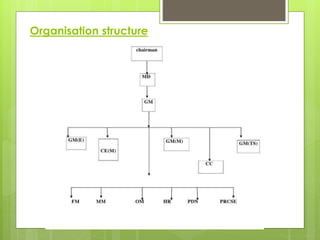
Organisation structure
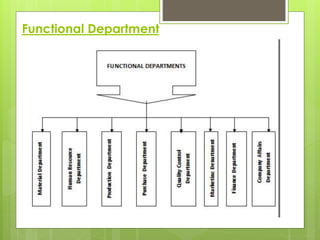
Functional Department
Departments
MATERIALS
Functions:
1. Receipt of Raw material
2. Issue of Raw material
3. Receipt of spares
4. Issue of spares
5. Receipt of finished feed
6. Despatch of finished feed
7. Inventory control
PURCHASE
Functions:
ď‚› Planning and procurement of Raw Materials and
Packing Materials required for Manufacture of Cattle
Feed & Mineral Mixture Plant, Spares and Capital items
required for Engineering Stores, Lab Equipments , Glass
wares and Chemicals, Furniture and Fixtures, other
miscellaneous items.
FINANCE & ACCOUNTS
Finance Functions:
1. Optimum utilization of funds .
2. To ensure control over expenses by constantly
monitoring actual with that of budgeted figures.
3. Cost control and Cost reduction by constantly
monitoring various operational activities.
PERSONNEL & ADMINISTRATION
Functions:
1. Recruitment, Induction and placement.
2. Framing Personnel Policies and Rules.
3. Creation and Abolition of Posts
4. Promotions, Transfers and Postings
5. Disciplinary Actions
6. Resignations, Retirements and Superannuation
7. Annual Performance appraisals
8. Maintenance of Service Records and Personnel
Files.
9. Issue of Salary/ Service/Experience certificate to
employees
PRODUCTION
Functions:
ď‚› The functions of Production & Maintenance Department
includes Planning & Execution of Production Schedule,
Maintenance of Equipments and Machineries.
Department also initiate development works related to
R&D for supporting plant activities and undertake new
projects.
MARKETING
ď‚› Advertisement, Marketing & Sales Promotion activities:
QUALITY CONTROL
Functions:
1. Incoming Raw material Quality Control
2. Inprocess Quality Control
3. Finished Feed Quality Control
4. Extension Activities related to feeds & Feeding
5. Analysis of external feed and raw material samples
6. Research & Development Activities
SECRETARIAL DEPARTMENT
ď‚› Functions:
ď‚› To conduct Board Meetings, Audit Committee Meetings and
share holders Meetings as per the provisions of Companies Act,
1956.
ď‚› To file periodical returns to the authorities concerned as per
Companies Act, 1956.
ď‚› To prepare the agenda notes for the above meetings and
Minutes of meetings and co-ordinate with Departments for
implementation of Board’s decisions.
IT DIVISION
Functions:
1. Electronic Data Processing (EDP) of the company in
vital areas such as Purchase Management, Marketing
Management, Management Information Systems etc.
2. Development and maintenance of ERP (Enterprise
Resource Planning) Solutions in the Company.
3. Maintenance of software as well as hardware.
4. Timely up-gradation of software and hardware.
5. Establishing high-end Communication as well as
computer technologies to the Company.
6. Arrange adequate exposure of new cutting edge
technologies to the employees.
SWOT Analysis
ď‚› Strength:
ď‚› KFL has a well organised MMCP technology which other
competitors have not. It is functioning fully automatic under
the control of computer system.
ď‚› The company is an ISO 9001-2000 certified. This indicates the
company is producing only quality products under the
regulation of Government.
ď‚› For raw material procurement company focus on all the
states of the country. Hence company can purchase
material at low price and win good quality.
ď‚› KFL has well organised QC department for ensuring the
quality of raw materials and finished feeds.
ď‚› Company maintains a wider distribution channel as it
distributes through private dealers, co-operative societies
and government institutions.
ď‚› Providing number of securities and welfare activities to the
employees.
ď‚› KFL is the only to provide pellet form cattle feeds.
Weakness:
ď‚› High price may charge to the product if the price
of raw material is increased.
ď‚› Most of the raw materials are from outside Kerala
hence transportation cost will be high.
ď‚› All the equipment are designed to operate only
on uninterrupted steady power supply
ď‚› The crucial parts of the plant are imported they
are very expensive and some of the spares are
not readily available in the domestic market.
 The company’s products demand is low at the
rainy season.
Opportunities:
ď‚› The company is facing cut-throat competition in
the Indian Market. Demand of the cattle feed is
increasingly day by day. This is with the strength of
quality of its product and consistent supply.
ď‚› Company now have 27 acres therefore can
expand its plant size for increasing production
capacity.
ď‚› Company focus only in Kerala market, it can
expand its market to outside Kerala.
ď‚› Demand is ahead of supply therefore company
can increase its production for equally distributing
to the amount of demand.
Threats:
ď‚› The competitors are flooding the market with their
products which is gradual.
ď‚› Increasing trend of raw material cost.
ď‚› Availability of raw material.
ď‚› Changes in government policies.
Findings:
ď‚› The company focuses on the quality of their product very
much.
ď‚› The cost of raw materials are high comparing to competitors
raw materials.
ď‚› IR relation is good.
ď‚› The only company which supplies cattle feed in pelletized form.
ď‚› Demand ahead of supply.
ď‚› Logistics facilities are very good, they have their own vehicles .
ď‚› Raw materials collected from all over India.
ď‚› Canteen facilities are poor.
ď‚› Employee turnover is low.
ď‚› MMCP technology made it possible to produce quality
products
ď‚› The company believes that measuring and monitoring the
customer satisfaction is the vital tool for evaluating
performance of KFL. One of the best advertisements is a
satisfied customer.
ď‚› All the process and technology in Kerala Feeds meet
international standard.
ď‚› The design of the plant is based on European standards.
Suggestions:
ď‚› Find best, but cheaper raw materials.
ď‚› The work of new units should be finished as early
as possible, because, demand is ahead of supply.
ď‚› Increase the capacity of the companies,
because demand is ahead of production.
ď‚› Canteen facility is there, but it should be
renovated.
ď‚› Company must expand to other states also, the
scope of the company in other states are good,
because demand of the product in other states
are also good.
Thank u…………………
Ajith organiations study at kerala feeds ltd

Ajith organiations study at kerala feeds ltd

  • 1.
  • 2.
    Introduction  The organisationstudy is aimed at have detail knowledge about the various functions of departments in a organisation. The organisation study includes the structure and functioning of the organisation. Primary objective;  To Understand the Organizational Frame work and it’s functioning. Secondary objectives;  To study how the activities of the various departments are coordinated.  .To identify the sale and production of the company  .It help to analyze the various production process  .To ensure the market share of the company  To analyze how an organization is managed.
  • 3.
    LIMITATIONS OF THESTUDY I felt some limitations and drawbacks in my study, some are given down; ď‚› Due to busy schedules of the officers and the employees proper detailed discussions with them was not possible. ď‚› The company was reluctant to reveal some of its official documents and reports which are kept confidential. ď‚› The detailed data of the other companies related to the same business was not available to do a comparative study.
  • 4.
    Industrial profile ď‚› Earlierdays the commercial production cattle feed was not an important one. Most of the farmers depended upon the traditional feeds like grass, hay, coconut cakes, rice bran, etc. But the researchers in this area have shown that the cattle get insufficient nutrition from this. Thus the first effort for commercializing the cattle feed by adding more nutritious ingredients. ď‚› The Indian feed industry is about 35 years old. It is mainly restricted to dairy and poultry feed manufacturing. Feed manufacturing on a commercial and scientific basis started around in 1965 with the setting up of medium sized feeds plant in northern and western India. The quality standards of Indian feeds are high and up to international level.
  • 5.
    Company Profile ď‚› KeralaFeeds Limited, commissioned a feed mill aimed at improving the lives of small farmers. Developing the countryside and helping to combat the growing depopulation. As a consequence of this, Kerala Feeds Ltd., a Kerala Government Company, was set up in 1995, incorporated under the Companies Act. ď‚› The cattle feed plant with 500 TPD capacity was commissioned in late 1998 and commercial production started in January 1999, with one shift only. The second and third shift operations were commenced in June 1999 and July 2000 respectively. The unit is located in Kallettumkara Village Irinjalakkuda . The plant is situated in 27 acres of land and has sufficient scope for further expansion. The Company is headed by Chairmanship of the Secretary to Government (Animal Husbandry & Dairy Development), Government of Kerala.
  • 6.
    Features of KFL ď‚›The only balanced cattle feed which is produced by M.M.C.P technology ď‚› Cooking of the feed up to 80 C removes the moisture hence increases the shelf-life of feed and helps easy digestion of the feed. ď‚› The raw materials are tested for quality at the fully equipped laboratory which also ensure that least loss occurs while handling the feed, which in turn ensures cleanliness ď‚› Raw materials like coconut cake, cotton seed cake, rice included in their compounded feed. Hence it is not necessary to feed the cattle separately with the said items. ď‚› are included in the correct proportion. For increasing the milk yield protein, fat, vitamin and minerals
  • 7.
    Product Profile 1. KeralaFeeds Rich 2. Kerala Feeds Elite 3. Kerala Mineral Mixture (Keramin) 4. Kerala Malabaree Goat feed 5. Rabbit Feed
  • 8.
  • 9.
  • 10.
    Departments MATERIALS Functions: 1. Receipt ofRaw material 2. Issue of Raw material 3. Receipt of spares 4. Issue of spares 5. Receipt of finished feed 6. Despatch of finished feed 7. Inventory control
  • 11.
    PURCHASE Functions: ď‚› Planning andprocurement of Raw Materials and Packing Materials required for Manufacture of Cattle Feed & Mineral Mixture Plant, Spares and Capital items required for Engineering Stores, Lab Equipments , Glass wares and Chemicals, Furniture and Fixtures, other miscellaneous items. FINANCE & ACCOUNTS Finance Functions: 1. Optimum utilization of funds . 2. To ensure control over expenses by constantly monitoring actual with that of budgeted figures. 3. Cost control and Cost reduction by constantly monitoring various operational activities.
  • 12.
    PERSONNEL & ADMINISTRATION Functions: 1.Recruitment, Induction and placement. 2. Framing Personnel Policies and Rules. 3. Creation and Abolition of Posts 4. Promotions, Transfers and Postings 5. Disciplinary Actions 6. Resignations, Retirements and Superannuation 7. Annual Performance appraisals 8. Maintenance of Service Records and Personnel Files. 9. Issue of Salary/ Service/Experience certificate to employees
  • 13.
    PRODUCTION Functions: ď‚› The functionsof Production & Maintenance Department includes Planning & Execution of Production Schedule, Maintenance of Equipments and Machineries. Department also initiate development works related to R&D for supporting plant activities and undertake new projects. MARKETING ď‚› Advertisement, Marketing & Sales Promotion activities:
  • 14.
    QUALITY CONTROL Functions: 1. IncomingRaw material Quality Control 2. Inprocess Quality Control 3. Finished Feed Quality Control 4. Extension Activities related to feeds & Feeding 5. Analysis of external feed and raw material samples 6. Research & Development Activities SECRETARIAL DEPARTMENT  Functions:  To conduct Board Meetings, Audit Committee Meetings and share holders Meetings as per the provisions of Companies Act, 1956.  To file periodical returns to the authorities concerned as per Companies Act, 1956.  To prepare the agenda notes for the above meetings and Minutes of meetings and co-ordinate with Departments for implementation of Board’s decisions.
  • 15.
    IT DIVISION Functions: 1. ElectronicData Processing (EDP) of the company in vital areas such as Purchase Management, Marketing Management, Management Information Systems etc. 2. Development and maintenance of ERP (Enterprise Resource Planning) Solutions in the Company. 3. Maintenance of software as well as hardware. 4. Timely up-gradation of software and hardware. 5. Establishing high-end Communication as well as computer technologies to the Company. 6. Arrange adequate exposure of new cutting edge technologies to the employees.
  • 16.
    SWOT Analysis ď‚› Strength: ď‚›KFL has a well organised MMCP technology which other competitors have not. It is functioning fully automatic under the control of computer system. ď‚› The company is an ISO 9001-2000 certified. This indicates the company is producing only quality products under the regulation of Government. ď‚› For raw material procurement company focus on all the states of the country. Hence company can purchase material at low price and win good quality. ď‚› KFL has well organised QC department for ensuring the quality of raw materials and finished feeds. ď‚› Company maintains a wider distribution channel as it distributes through private dealers, co-operative societies and government institutions. ď‚› Providing number of securities and welfare activities to the employees. ď‚› KFL is the only to provide pellet form cattle feeds.
  • 17.
    Weakness:  High pricemay charge to the product if the price of raw material is increased.  Most of the raw materials are from outside Kerala hence transportation cost will be high.  All the equipment are designed to operate only on uninterrupted steady power supply  The crucial parts of the plant are imported they are very expensive and some of the spares are not readily available in the domestic market.  The company’s products demand is low at the rainy season.
  • 18.
    Opportunities: ď‚› The companyis facing cut-throat competition in the Indian Market. Demand of the cattle feed is increasingly day by day. This is with the strength of quality of its product and consistent supply. ď‚› Company now have 27 acres therefore can expand its plant size for increasing production capacity. ď‚› Company focus only in Kerala market, it can expand its market to outside Kerala. ď‚› Demand is ahead of supply therefore company can increase its production for equally distributing to the amount of demand.
  • 19.
    Threats: ď‚› The competitorsare flooding the market with their products which is gradual. ď‚› Increasing trend of raw material cost. ď‚› Availability of raw material. ď‚› Changes in government policies.
  • 20.
    Findings: ď‚› The companyfocuses on the quality of their product very much. ď‚› The cost of raw materials are high comparing to competitors raw materials. ď‚› IR relation is good. ď‚› The only company which supplies cattle feed in pelletized form. ď‚› Demand ahead of supply. ď‚› Logistics facilities are very good, they have their own vehicles . ď‚› Raw materials collected from all over India. ď‚› Canteen facilities are poor. ď‚› Employee turnover is low. ď‚› MMCP technology made it possible to produce quality products ď‚› The company believes that measuring and monitoring the customer satisfaction is the vital tool for evaluating performance of KFL. One of the best advertisements is a satisfied customer. ď‚› All the process and technology in Kerala Feeds meet international standard. ď‚› The design of the plant is based on European standards.
  • 21.
    Suggestions: ď‚› Find best,but cheaper raw materials. ď‚› The work of new units should be finished as early as possible, because, demand is ahead of supply. ď‚› Increase the capacity of the companies, because demand is ahead of production. ď‚› Canteen facility is there, but it should be renovated. ď‚› Company must expand to other states also, the scope of the company in other states are good, because demand of the product in other states are also good.
  • 22.